Project Team Building
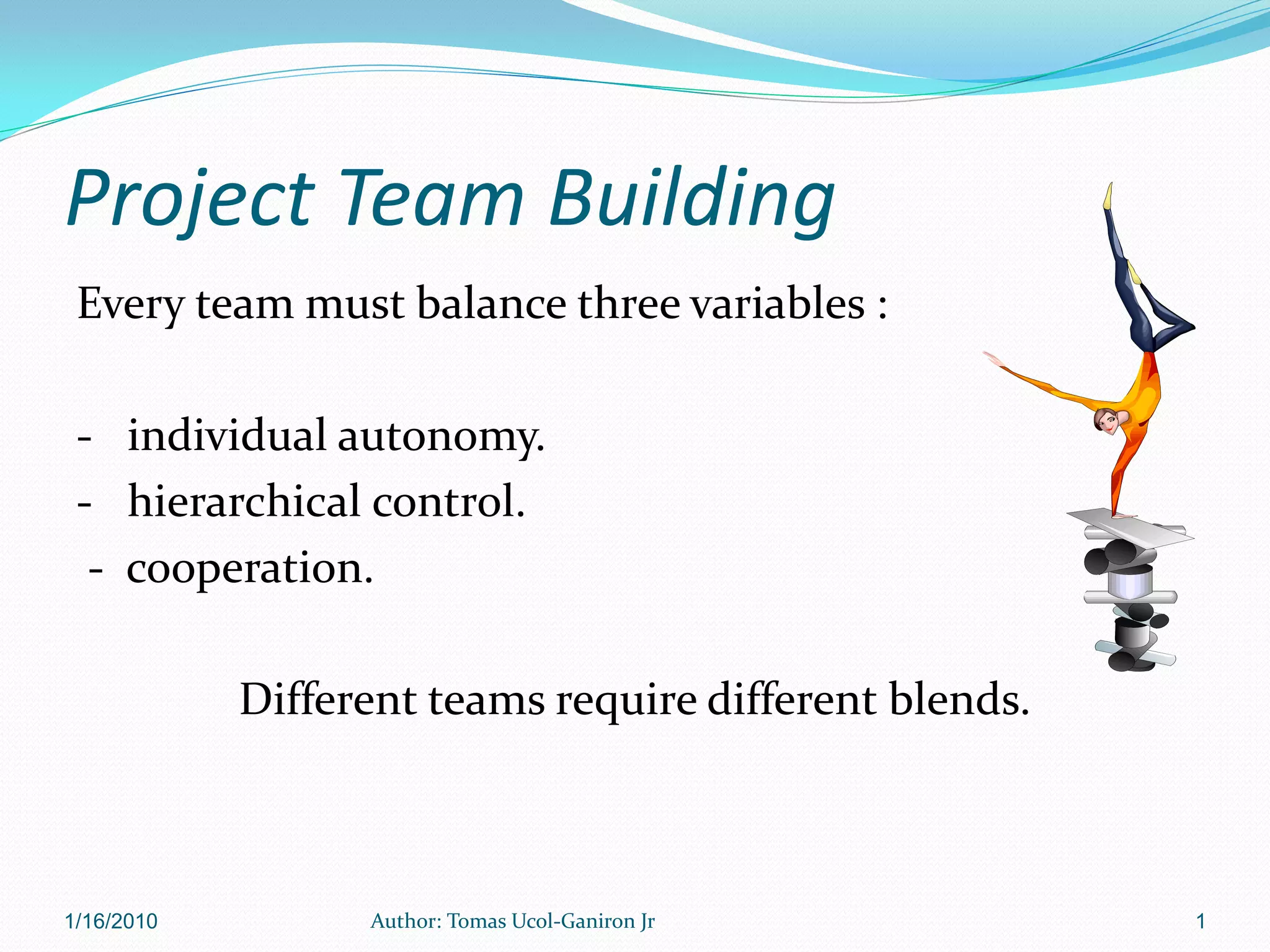
 Every team must balance three variables :

 - individual autonomy.
 - hierarchical control.
  - cooperation.

            Different teams require different blends.


1/16/2010         Author: Tomas Ucol-Ganiron Jr         1
Module Overview
  Definition of the team.


  Team stages.


  Learning how to work as a team.


  Building trust of the team.


1/16/2010      Author: Tomas Ucol-Ganiron Jr   2
Definition
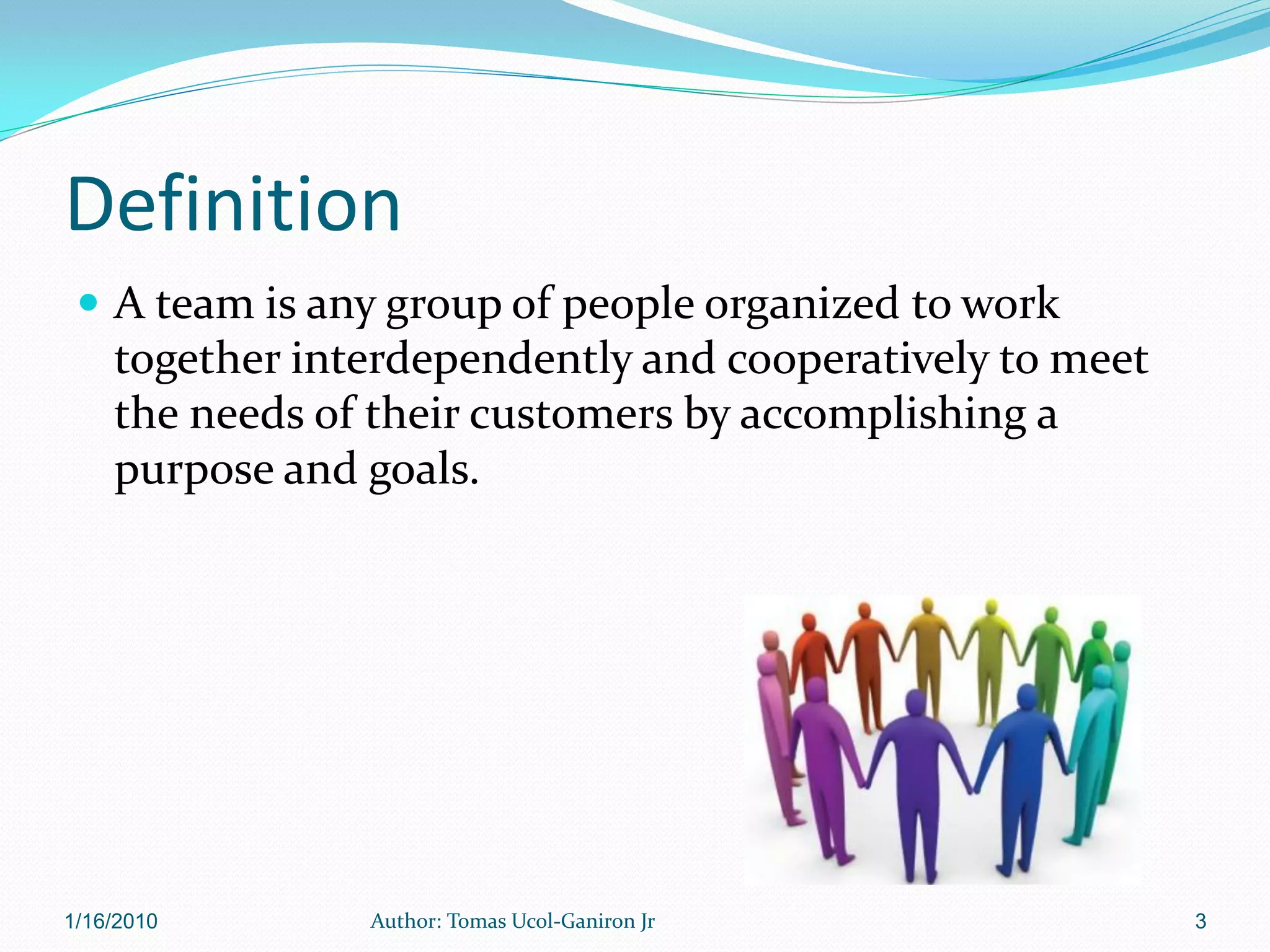
  A team is any group of people organized to work
    together interdependently and cooperatively to meet
    the needs of their customers by accomplishing a
    purpose and goals.


1/16/2010       Author: Tomas Ucol-Ganiron Jr             3
Team Stages
  Forming — feeling each other out (excitement,
      anxiety, ambivalence)
  Storming — statement of individual objectives
      (resistance, anger)
  Norming — agreements made (relief)
  Performing — high productivity (comfortable,
      satisfied, attached)
  Adjourning — saying farewell (conflicted, sad, proud)


1/16/2010         Author: Tomas Ucol-Ganiron Jr            4
Trust
  In life — the extent to which I am willing to put
   myself into a situation where you could harm me.
  In business — the extent to which I am willing to
   share information that you could use to harm me.


1/16/2010       Author: Tomas Ucol-Ganiron Jr          5
An Expanded
Definition of Trust
  A willingness to be vulnerable to the actions of
   another
  A degree of confidence that positive expectations will
   be met
  Taking action based on another’s word
  A belief in the goodwill of another toward you


1/16/2010       Author: Tomas Ucol-Ganiron Jr               6
Trust
                                                     Evidence of Trust
            Trust Is Not …                             Lack of monitoring
  Blind trust.
                                                       Unselfishness
  Total confidence.
                                                       Openness
  Predictability.
                                                       Risk-taking
  Mechanical cooperation.


1/16/2010            Author: Tomas Ucol-Ganiron Jr                           7
Factors Affecting the Decision to
Trust
  Individual tendency to trust
  Assessment of the other’s ability to carry out
   commitments
  Personal similarities and differences
  Relative power or authority
  Organizational environment


1/16/2010       Author: Tomas Ucol-Ganiron Jr       8
Ways to Build Trust …
  Act with integrity
  Protect those who are not present
  Listen
  Be sensitive and respectful
  Take the leap
  Make realistic commitments and keep them


1/16/2010      Author: Tomas Ucol-Ganiron Jr   9
… continued
  Judge substance, not image
  Offer status reports and forecasts
  Confront tough issues
  Display your talents
  Set high expectations
  Rigorously evaluate people


1/16/2010       Author: Tomas Ucol-Ganiron Jr   10
Summary
       Strong team work can improve performance

       “Storming” is a necessary stage on the way to
        “performing”

       Trust is the foundation of good teamwork


1/16/2010          Author: Tomas Ucol-Ganiron Jr        11
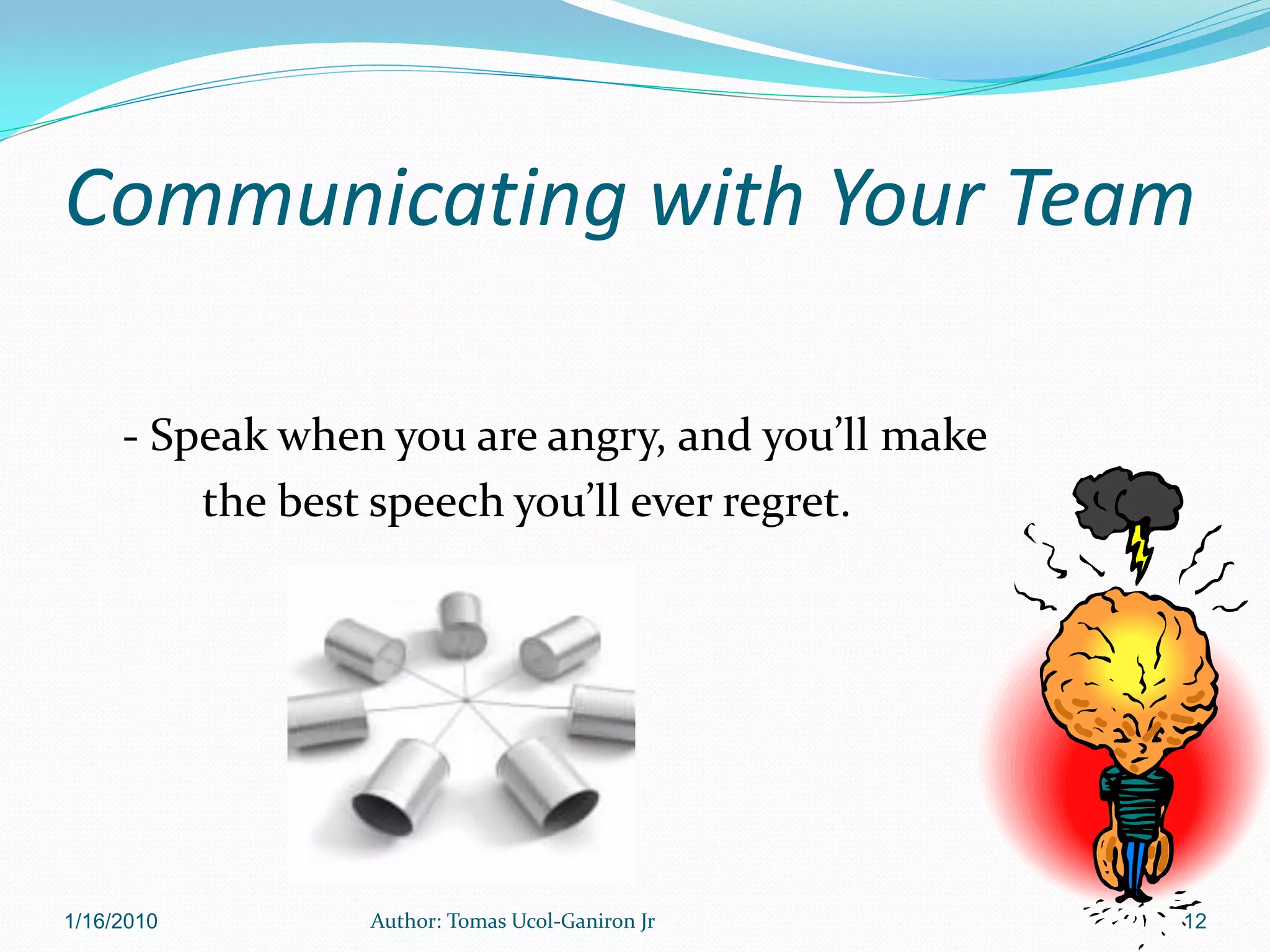
Communicating with Your Team

     - Speak when you are angry, and you’ll make
         the best speech you’ll ever regret.


1/16/2010        Author: Tomas Ucol-Ganiron Jr     12
Module Overview
                   Why communicate


             Barriers to communication


1/16/2010    Author: Tomas Ucol-Ganiron Jr   13
Fundamental Assumptions
       We communicate with other team members in order
        to influence their behavior.
       What can interfere?
            1. Tone
            2. Assumptions
            3. Style differences


1/16/2010           Author: Tomas Ucol-Ganiron Jr     14
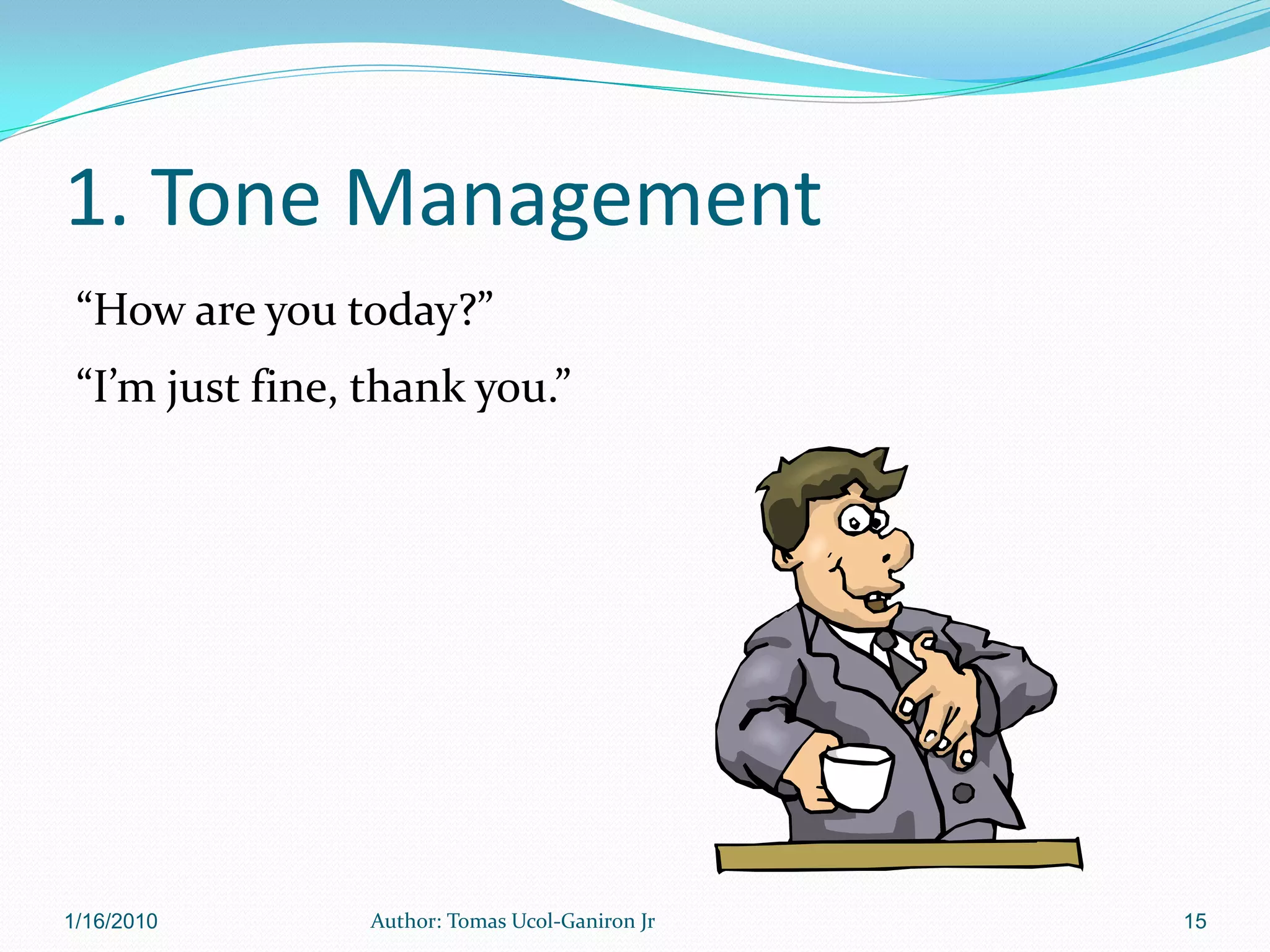
1. Tone Management
 “How are you today?”
 “I’m just fine, thank you.”


1/16/2010        Author: Tomas Ucol-Ganiron Jr   15
2. Assumptions
  What would you think if you arrived for a job
      interview and saw:
             A clean ash tray?
             A copy of Golf Digest magazine?
             Pictures of sailboats?
             A thick dictionary?


1/16/2010             Author: Tomas Ucol-Ganiron Jr   16
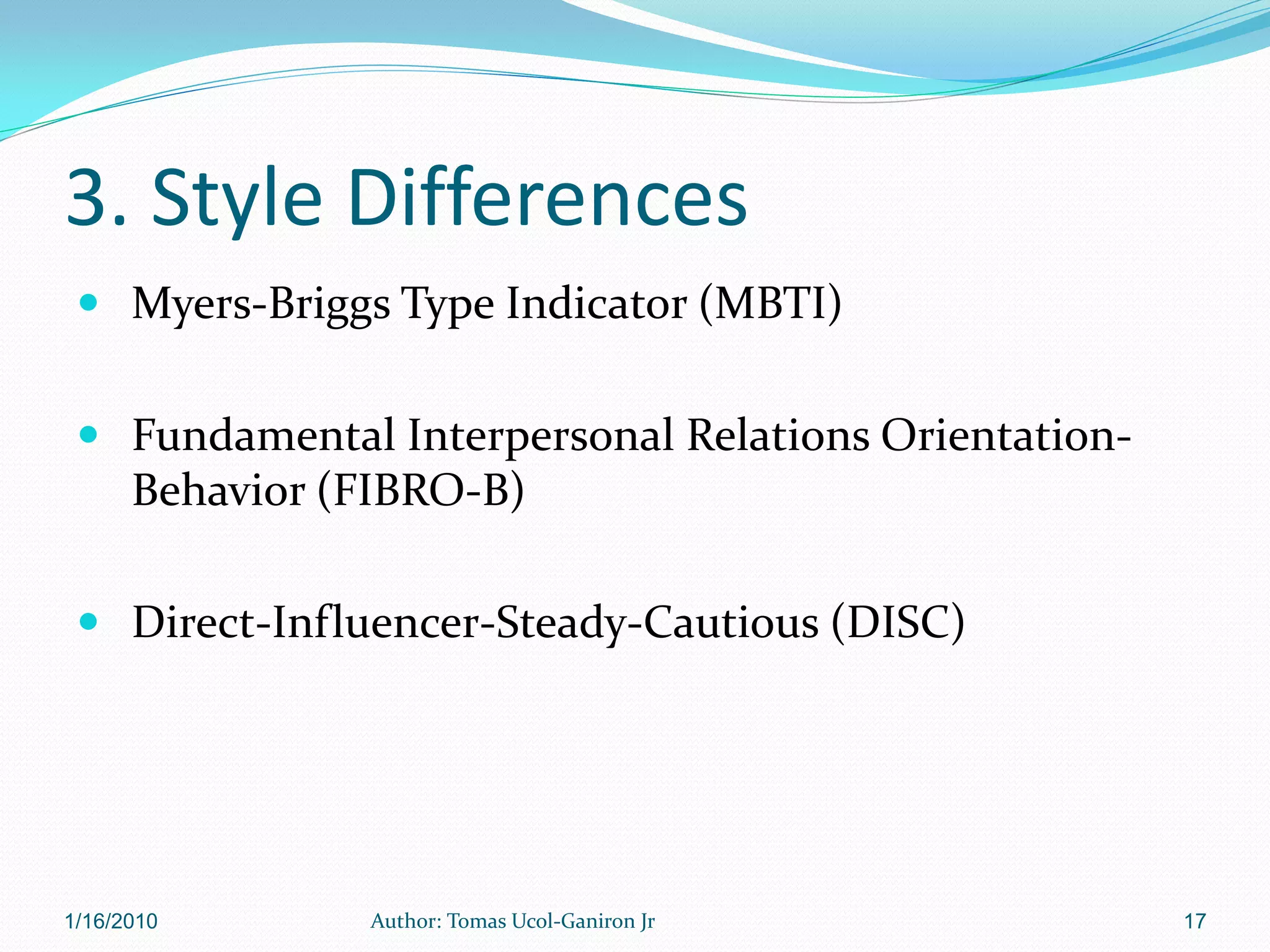
3. Style Differences
  Myers-Briggs Type Indicator (MBTI)


  Fundamental Interpersonal Relations Orientation-
      Behavior (FIBRO-B)

  Direct-Influencer-Steady-Cautious (DISC)


1/16/2010       Author: Tomas Ucol-Ganiron Jr         17
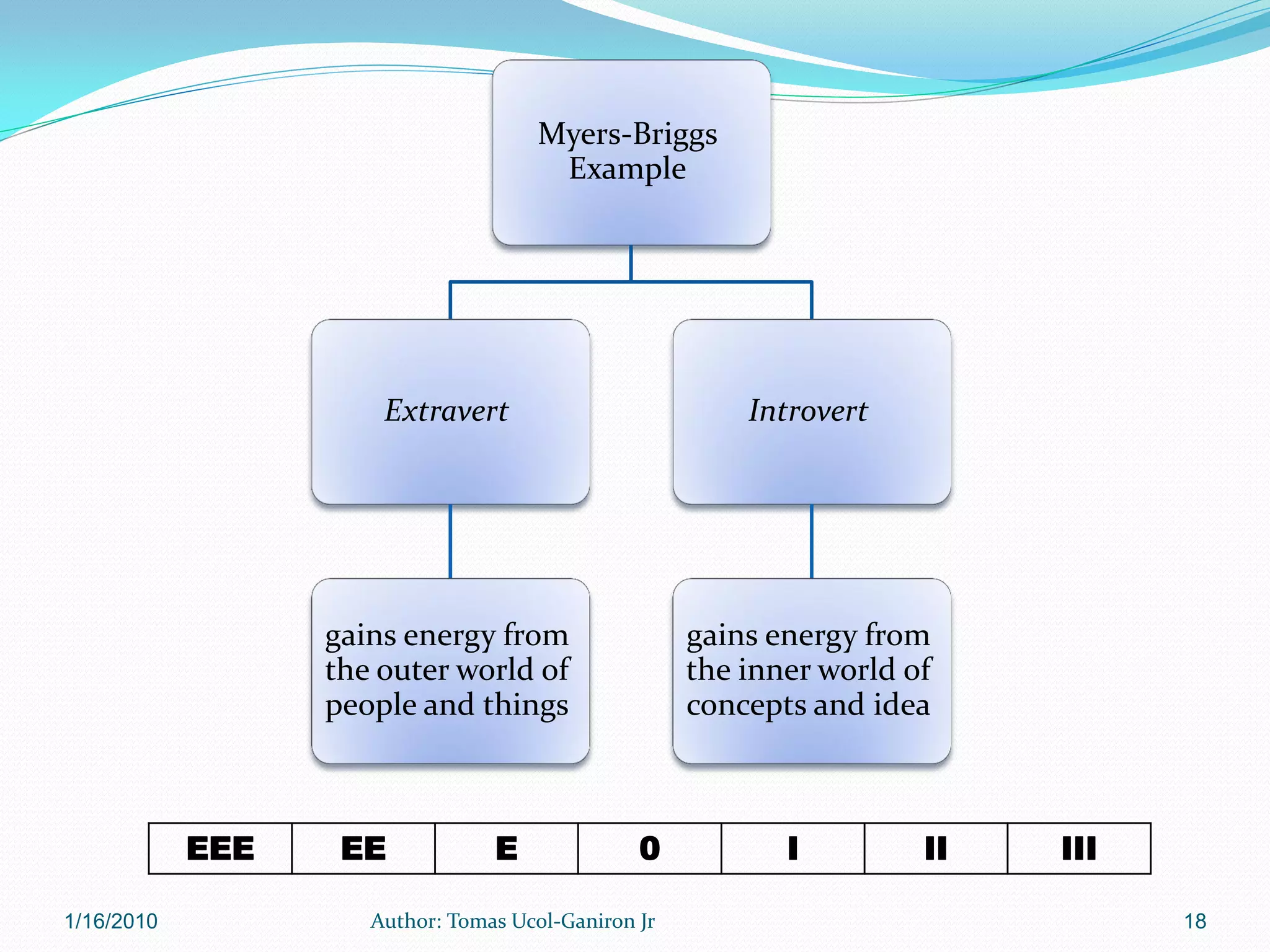
Myers-Briggs
                                       Example


                      Extravert                          Introvert


                  gains energy from                  gains energy from
                  the outer world of                 the inner world of
                  people and things                  concepts and idea


            EEE    EE            E              0           I         II   III

1/16/2010            Author: Tomas Ucol-Ganiron Jr                               18
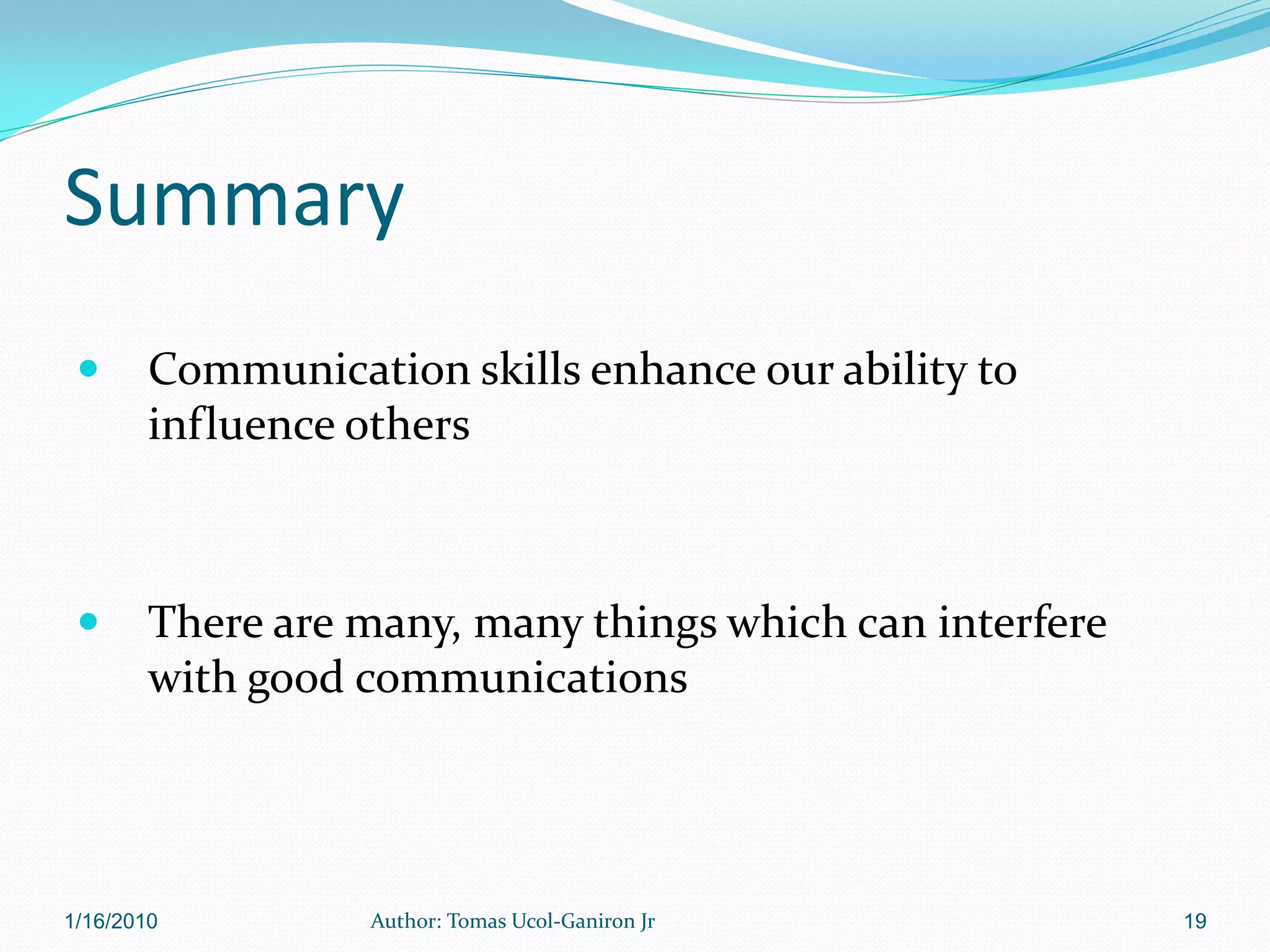
Summary
       Communication skills enhance our ability to
        influence others


       There are many, many things which can interfere
        with good communications


1/16/2010          Author: Tomas Ucol-Ganiron Jr          19
THANK YOU


1/16/2010   Author: Tomas Ucol-Ganiron Jr   20

Project Team Building

  • 1.
    Project Team Building Every team must balance three variables : - individual autonomy. - hierarchical control. - cooperation. Different teams require different blends. 1/16/2010 Author: Tomas Ucol-Ganiron Jr 1
  • 2.
    Module Overview Definition of the team.  Team stages.  Learning how to work as a team.  Building trust of the team. 1/16/2010 Author: Tomas Ucol-Ganiron Jr 2
  • 3.
    Definition  Ateam is any group of people organized to work together interdependently and cooperatively to meet the needs of their customers by accomplishing a purpose and goals. 1/16/2010 Author: Tomas Ucol-Ganiron Jr 3
  • 4.
    Team Stages Forming — feeling each other out (excitement, anxiety, ambivalence)  Storming — statement of individual objectives (resistance, anger)  Norming — agreements made (relief)  Performing — high productivity (comfortable, satisfied, attached)  Adjourning — saying farewell (conflicted, sad, proud) 1/16/2010 Author: Tomas Ucol-Ganiron Jr 4
  • 5.
    Trust  Inlife — the extent to which I am willing to put myself into a situation where you could harm me.  In business — the extent to which I am willing to share information that you could use to harm me. 1/16/2010 Author: Tomas Ucol-Ganiron Jr 5
  • 6.
    An Expanded Definition ofTrust  A willingness to be vulnerable to the actions of another  A degree of confidence that positive expectations will be met  Taking action based on another’s word  A belief in the goodwill of another toward you 1/16/2010 Author: Tomas Ucol-Ganiron Jr 6
  • 7.
    Trust Evidence of Trust Trust Is Not …  Lack of monitoring  Blind trust.  Unselfishness  Total confidence.  Openness  Predictability.  Risk-taking  Mechanical cooperation. 1/16/2010 Author: Tomas Ucol-Ganiron Jr 7
  • 8.
    Factors Affecting theDecision to Trust  Individual tendency to trust  Assessment of the other’s ability to carry out commitments  Personal similarities and differences  Relative power or authority  Organizational environment 1/16/2010 Author: Tomas Ucol-Ganiron Jr 8
  • 9.
    Ways to BuildTrust …  Act with integrity  Protect those who are not present  Listen  Be sensitive and respectful  Take the leap  Make realistic commitments and keep them 1/16/2010 Author: Tomas Ucol-Ganiron Jr 9
  • 10.
    … continued Judge substance, not image  Offer status reports and forecasts  Confront tough issues  Display your talents  Set high expectations  Rigorously evaluate people 1/16/2010 Author: Tomas Ucol-Ganiron Jr 10
  • 11.
    Summary  Strong team work can improve performance  “Storming” is a necessary stage on the way to “performing”  Trust is the foundation of good teamwork 1/16/2010 Author: Tomas Ucol-Ganiron Jr 11
  • 12.
    Communicating with YourTeam - Speak when you are angry, and you’ll make the best speech you’ll ever regret. 1/16/2010 Author: Tomas Ucol-Ganiron Jr 12
  • 13.
    Module Overview  Why communicate  Barriers to communication 1/16/2010 Author: Tomas Ucol-Ganiron Jr 13
  • 14.
    Fundamental Assumptions  We communicate with other team members in order to influence their behavior.  What can interfere? 1. Tone 2. Assumptions 3. Style differences 1/16/2010 Author: Tomas Ucol-Ganiron Jr 14
  • 15.
    1. Tone Management “How are you today?” “I’m just fine, thank you.” 1/16/2010 Author: Tomas Ucol-Ganiron Jr 15
  • 16.
    2. Assumptions What would you think if you arrived for a job interview and saw:  A clean ash tray?  A copy of Golf Digest magazine?  Pictures of sailboats?  A thick dictionary? 1/16/2010 Author: Tomas Ucol-Ganiron Jr 16
  • 17.
    3. Style Differences  Myers-Briggs Type Indicator (MBTI)  Fundamental Interpersonal Relations Orientation- Behavior (FIBRO-B)  Direct-Influencer-Steady-Cautious (DISC) 1/16/2010 Author: Tomas Ucol-Ganiron Jr 17
  • 18.
    Myers-Briggs Example Extravert Introvert gains energy from gains energy from the outer world of the inner world of people and things concepts and idea EEE EE E 0 I II III 1/16/2010 Author: Tomas Ucol-Ganiron Jr 18
  • 19.
    Summary  Communication skills enhance our ability to influence others  There are many, many things which can interfere with good communications 1/16/2010 Author: Tomas Ucol-Ganiron Jr 19
  • 20.
    THANK YOU 1/16/2010 Author: Tomas Ucol-Ganiron Jr 20