Stack
Stack?
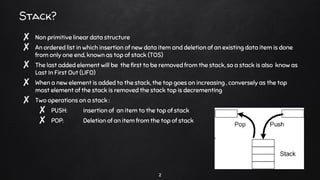
✘ Non primitive linear data structure
✘ An ordered list in which insertion of new data item and deletion of an existing data item is done
from only one end, known as top of stack (TOS)
✘ The last added element will be the first to be removed from the stack, so a stack is also know as
Last In First Out (LIFO)
✘ When a new element is added to the stack, the top goes on increasing , conversely as the top
most element of the stack is removed the stack top is decrementing
✘ Two operations on a stack :
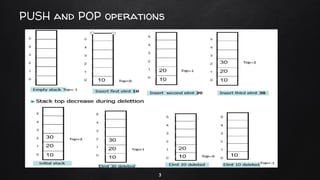
✘ PUSH: insertion of an item to the top of stack
✘ POP: Deletion of an item from the top of stack
2
PUSH and POP operations
3
Operations
✘ CREATE(S): Creates S as an empty stack
✘ PUSH (i,S): Inserts an element I on to the stack S and returns the new stack
✘ POP(S): Removes the top element of the stack and returns the new stack
✘ TOP(S): Returns the top element of the stack
✘ ISEMTS(S): Returns true if stack is empty else false.
4
Stack implementation
✘ Static implementation
uses arrays to create stack
✘ Dynamic implementation
Uses linked list for stack creation
5
Operations
✘ PUSH:
• process of adding a new element to the top of stack.
• Top is incremented by one for each PUSH operation.
• If array is full it is known as stack overflow
✘ POP:
• Process of deleting an element from the top of stack.
• After every POP operation top is decremented by one.
• If array is empty it results stack underflow condition
6
Function for PUSH and POP operations [using array]
void push(int stack[ ],int item)
{
/*add an item to the top of stack */
if(top>=MAXSIZE-1)
printf("OVERFLOWn");
else
{
top++;
stack[top]=item;
}
}
int pop( )
{
/*delete and return the top element from the stack*/
if(top==-1)
printf("UNDERFLOWn");
else
{
item=stack[top];
top=top-1;
}
return(item);
}
7
Function for PUSH and POP operations [using Linked list]
Void push( )
{
stack *newnode;
newnode=(stack*) malloc (sizeof(stack));
printf(“enter the data”);
scanf(“%d”,&newnode->data);
if (top==NULL)
newnode->next=NULL;
else
newnode->next=top;
top=newnode;
}
int pop( )
{
stack *p; int val;
p=top;
if (top==NULL)
{
printf(“stack is empty”);
return;
}
top=top->next;
val=p->data;
free(p);
Return(val);
}
8
Applications of stack
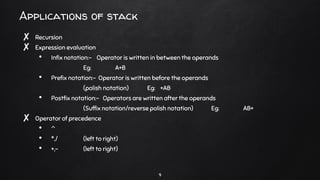
✘ Recursion
✘ Expression evaluation
• Infix notation:- Operator is written in between the operands
Eg: A+B
• Prefix notation:- Operator is written before the operands
(polish notation) Eg: +AB
• Postfix notation:- Operators are written after the operands
(Suffix notation/reverse polish notation) Eg: AB+
✘ Operator of precedence
• ^
• *,/ (left to right)
• +,- (left to right)
9
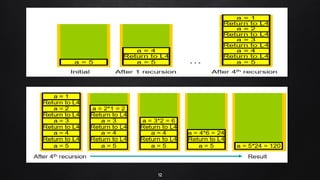
How Recursion Works
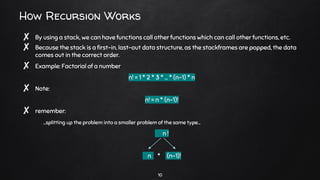
✘ By using a stack, we can have functions call other functions which can call other functions, etc.
✘ Because the stack is a first-in, last-out data structure, as the stackframes are popped, the data
comes out in the correct order.
✘ Example: Factorial of a number
n! = 1 * 2 * 3 * ... * (n-1) * n
✘ Note:
n! = n * (n-1)!
✘ remember:
...splitting up the problem into a smaller problem of the same type...
n !
n * (n-1)!
10
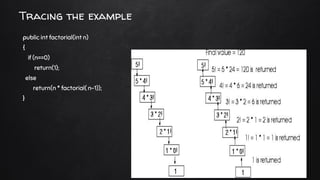
Tracing the example
public int factorial(int n)
{
if (n==0)
return(1);
else
return(n * factorial( n-1));
}
11
12
thanks!
13

Stack

  • 1.
  • 2.
    Stack? ✘ Non primitivelinear data structure ✘ An ordered list in which insertion of new data item and deletion of an existing data item is done from only one end, known as top of stack (TOS) ✘ The last added element will be the first to be removed from the stack, so a stack is also know as Last In First Out (LIFO) ✘ When a new element is added to the stack, the top goes on increasing , conversely as the top most element of the stack is removed the stack top is decrementing ✘ Two operations on a stack : ✘ PUSH: insertion of an item to the top of stack ✘ POP: Deletion of an item from the top of stack 2
  • 3.
    PUSH and POPoperations 3
  • 4.
    Operations ✘ CREATE(S): CreatesS as an empty stack ✘ PUSH (i,S): Inserts an element I on to the stack S and returns the new stack ✘ POP(S): Removes the top element of the stack and returns the new stack ✘ TOP(S): Returns the top element of the stack ✘ ISEMTS(S): Returns true if stack is empty else false. 4
  • 5.
    Stack implementation ✘ Staticimplementation uses arrays to create stack ✘ Dynamic implementation Uses linked list for stack creation 5
  • 6.
    Operations ✘ PUSH: • processof adding a new element to the top of stack. • Top is incremented by one for each PUSH operation. • If array is full it is known as stack overflow ✘ POP: • Process of deleting an element from the top of stack. • After every POP operation top is decremented by one. • If array is empty it results stack underflow condition 6
  • 7.
    Function for PUSHand POP operations [using array] void push(int stack[ ],int item) { /*add an item to the top of stack */ if(top>=MAXSIZE-1) printf("OVERFLOWn"); else { top++; stack[top]=item; } } int pop( ) { /*delete and return the top element from the stack*/ if(top==-1) printf("UNDERFLOWn"); else { item=stack[top]; top=top-1; } return(item); } 7
  • 8.
    Function for PUSHand POP operations [using Linked list] Void push( ) { stack *newnode; newnode=(stack*) malloc (sizeof(stack)); printf(“enter the data”); scanf(“%d”,&newnode->data); if (top==NULL) newnode->next=NULL; else newnode->next=top; top=newnode; } int pop( ) { stack *p; int val; p=top; if (top==NULL) { printf(“stack is empty”); return; } top=top->next; val=p->data; free(p); Return(val); } 8
  • 9.
    Applications of stack ✘Recursion ✘ Expression evaluation • Infix notation:- Operator is written in between the operands Eg: A+B • Prefix notation:- Operator is written before the operands (polish notation) Eg: +AB • Postfix notation:- Operators are written after the operands (Suffix notation/reverse polish notation) Eg: AB+ ✘ Operator of precedence • ^ • *,/ (left to right) • +,- (left to right) 9
  • 10.
    How Recursion Works ✘By using a stack, we can have functions call other functions which can call other functions, etc. ✘ Because the stack is a first-in, last-out data structure, as the stackframes are popped, the data comes out in the correct order. ✘ Example: Factorial of a number n! = 1 * 2 * 3 * ... * (n-1) * n ✘ Note: n! = n * (n-1)! ✘ remember: ...splitting up the problem into a smaller problem of the same type... n ! n * (n-1)! 10
  • 11.
    Tracing the example publicint factorial(int n) { if (n==0) return(1); else return(n * factorial( n-1)); } 11
  • 12.
  • 13.