Manage Projects ProfessionallyProject Management Toolkit
Important StuffSetting StandardsWhat setting you want today?Formal or Informal?What learning environment would you prefer?Lecture-based or interactive?Would you like others to talk on the phone during the program?Would you like to receive rewards for good performance?
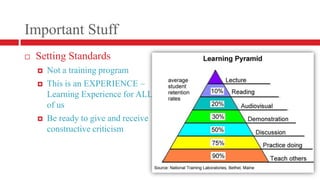
Important StuffSetting StandardsNot a training programThis is an EXPERIENCE – Learning Experience for ALL of usBe ready to give and receive constructive criticism
Learning ContractA contract between YOU and YOURSELFWrite ONLY what you want to remember laterNot more than 10 points“The Only Barrier to Learning the Truth is to Assume You Already Know It”Confucius
Why perform Project ManagementPreparation
Understanding the Expectation GameProject Intro
What is a ProjectProject Definition : "A temporary endeavor undertaken to create a unique product, service or result"FeaturesTemporary:  Has a finite duration, project ceases when its objective is achieved. Does not mean short duration. Normally, the product/service will outlive the projectUnique : Doing something that has not been done earlierProgressive Elaboration: "Developing in steps, and continuing in increments". Development of details progressivelyEnvironmentConstantly changingBuilding and DismantlingPrecedes Operations

What is a ProjectProjects and OperationsSimilarities:Performed by peopleConstrained by limited resourcesPlanned, executed and controlledDifferences:Operations: Ongoing, repetitive, necessary for sustaining the businessProjects: Temporary, unique.Projects and Strategic PlanningProjects are used to achieve strategic plansIn response to market demands, customer requests, organizational needs, technological advances, legal requirements.
What is Project ManagementApplication ofKnowledge (e.g. Domain areas - Pharmaceutical, construction, etc.)Skills (Managing)Tools & Techniques (Software)Project activities (e.g Time Management, Cost Management, etc.)The GOALProject objectivesPM is accomplished through processes Prepare – Plan – Execute - CloseProject work typically involvesIdentifying requirementsDefining objectivesBalancing the competing demands for Scope, Time, Cost, and QualityManaging stakeholders
Why Project Management?To enhance the probability of project successTo focus on objectives - Scope, Time, Cost, Quality & RiskFor effective response to rapid changesTo manage effective utilization of resourcesTo address stakeholders interestsTo manage risks effectivelyAchieve Financial EfficiencyProject CostProject TimeProject QualityLessons LearntCreate re-usable data and information for future use
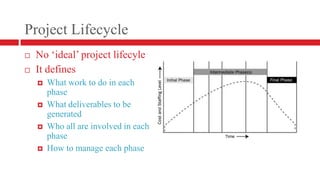
Project LifecycleNo ‘ideal’ project lifecyleIt definesWhat work to do in each phaseWhat deliverables to be generatedWho all are involved in each phaseHow to manage each phase
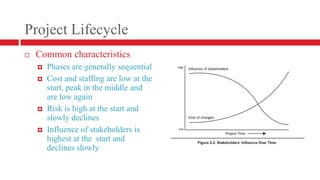
Project LifecycleCommon characteristicsPhases are generally sequentialCost and staffing are low at the start, peak in the middle and are low againRisk is high at the start and slowly declinesInfluence of stakeholders is highest at the  start and declines slowly
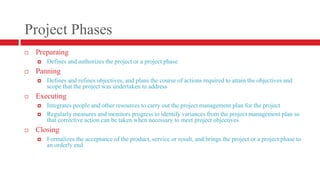
Project PhasesPreparaingDefines and authorizes the project or a project phasePanningDefines and refines objectives, and plans the course of actions required to attain the objectives and scope that the project was undertaken to addressExecutingIntegrates people and other resources to carry out the project management plan for the projectRegularly measures and monitors progress to identify variances from the project management plan so that corrective action can be taken when necessary to meet project objectivesClosingFormalizes the acceptance of the product, service or result, and brings the project or a project phase to an orderly end
Project CharterThe document that formally authorizes the projectAuthorizes Project Manager to apply organizational resourcesPM should be assigned at the earliest feasible, but should always be assigned before start of the planning phase, or during charter developmentThe Initiator or Sponsor is external to the project organization at a level appropriate to funding the project
Project CharterProject Charter should address the followingRequirements of the customers, sponsors and other stakeholdersBusiness needs, project justification, strategic planAssigned PM and authority (some other resources may also be pre-assigned)Product description/deliverablesSummary milestone scheduleStakeholder influencesFunctional organization and its participationConstraints and assumptions relating to organization, environment and external factorsSummary budgetAny change in the Project Charter should question the continuance of the project
Well planned is almost donePlanning
Project Activity Planning
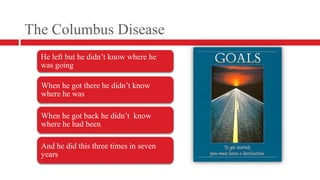
The Columbus Disease
Project PlanningPlanning is a process – not an outcomePlanning should address Setting the boundaries | Scope statementActivity planningActivity schedule developmentCost planningRisk planning
Scope StatementProject scope statement should address the following areas:Project and product objectivesProduct/service requirements and characteristicsProduct acceptance criteriaProject boundaries – What is included and what is notProject requirements and deliverablesProject constraintsProject assumptionsInitial project organizationInitial defined risksSchedule milestonesInitial Work Breakdown Structure
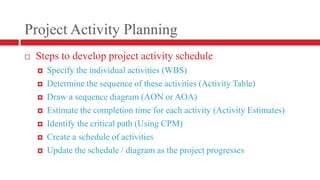
Project Activity PlanningSteps to develop project activity scheduleSpecify the individual activities (WBS)Determine the sequence of these activities (Activity Table)Draw a sequence diagram (AON or AOA)Estimate the completion time for each activity (Activity Estimates)Identify the critical path (Using CPM)Create a schedule of activitiesUpdate the schedule / diagram as the project progresses
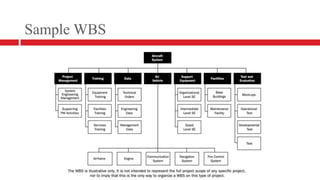
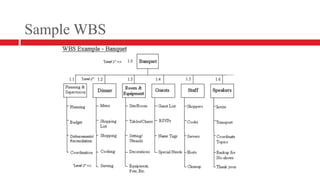
Activity Identification Tool - WBSDeliverable-oriented hierarchical decompositions of project work Creates the required deliverablesWBS organizes and defines the total scope of the projectSubdivides the project work into smaller, more manageable pieces of workHas descending levels with increasingly detailed definition of the project workLowest level WBS components are called work packages; they can be scheduled, cost-estimated, monitored and controlled
WBSCharacteristicsManageable (specific authority/responsibility assigned)Independent (with respect to other elements o( projects)Integrateable {so that the total package can be seen)Measurable (each deliverable)PurposeTo simplify a complex project - it is a summation of elementsPlanning can be better performedDuration, cost and budget can be establishedTime, expenditure, and performance can be trackedNetwork and Control Planning can be initiatedResponsibilities and Resources can be assignedOmission/duplication of tasks can be avoidedProvide a common structure and coding system
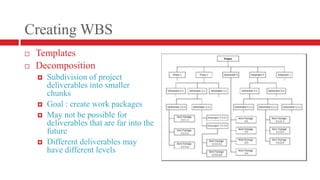
Creating WBSTemplatesDecompositionSubdivision of project deliverables into smaller chunksGoal : create work packagesMay not be possible for deliverables that are far into the futureDifferent deliverables may have different levels
Sample WBS
Sample WBS
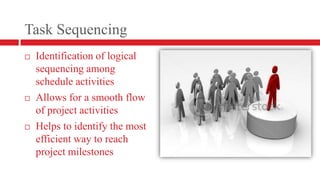
Task SequencingIdentification of logical sequencing among schedule activitiesAllows for a smooth flow of project activitiesHelps to identify the most efficient way to reach project milestones
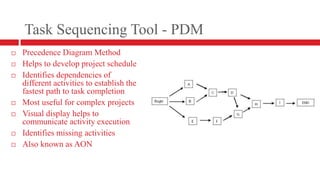
Task Sequencing Tool - PDMPrecedence Diagram MethodHelps to develop project scheduleIdentifies dependencies of different activities to establish the fastest path to task completionMost useful for complex projectsVisual display helps to communicate activity executionIdentifies missing activitiesAlso known as AON
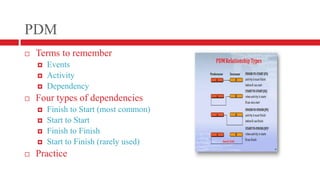
PDMTerms to rememberEventsActivityDependencyFour types of dependenciesFinish to Start (most common)Start to StartFinish to FinishStart to Finish (rarely used)Practice
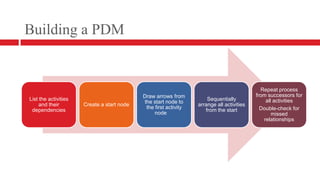
Building a PDM
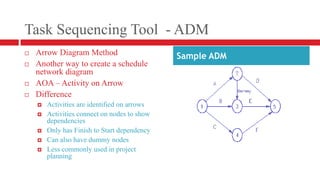
Task Sequencing Tool  - ADMArrow Diagram MethodAnother way to create a schedule network diagramAOA – Activity on ArrowDifferenceActivities are identified on arrowsActivities connect on nodes to show dependenciesOnly has Finish to Start dependencyCan also have dummy nodesLess commonly used in project planningSample ADM
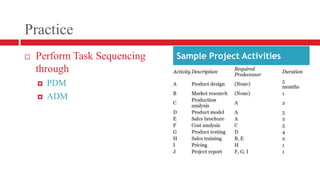
PracticePerform Task Sequencing throughPDMADMSample Project Activities
Duration Estimate ToolsParametric EstimateDetermined by multiplying the quantity of work by the productivity rateConstruction work – per square footDesign work – labor hour per designDrilling – time taken per cubic inchThree-point EstimateHelps to consider the amount of risk in the initial estimateConsiders 3 types of estimatesMost likelyOptimisticPessimistic
Schedule DevelopmentOutlines the proposed timelines for the project activitiesIs an iterative processIs typically completed AFTER activity duration estimateServes as the baseline against which project progress can be tracked
Schedule Development Tool - CPMDupont developed the concept in 1957 – to address the shutting of plants for maintenanceHelps to identify the path of activities where any delay WILL cause a delay in the project timelineFor activities outside the Critical Path, there is tolerance forLate startLate finishEarly startUsed to be carried out by hand – now there are software availableMS ProjectPrimaveraSchedule activities on the Critical Path are called Critical Activities
More on CPMCalculated by estimating the following 4 parameters for each activityES - Earliest start timeEarliest time at which the activity can start given that its precedent activities must be completed firstEF - Earliest finish timeEqual to the earliest start time for the activity plus the time required to complete the activityLS - Latest start timeEqual to the latest finish time minus the time required to complete the activityLF - Latest finish timeLatest time at which the activity can be completed without delaying the projectSlack TimeTime between its earliest and latest start timeAmount of time that you can delay an activity without delaying the project scheduleCritical Path	A path in which all activities have ES = LS and EF = LF
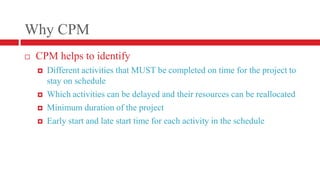
Why CPMCPM helps to identifyDifferent activities that MUST be completed on time for the project to stay on scheduleWhich activities can be delayed and their resources can be reallocatedMinimum duration of the project Early start and late start time for each activity in the schedule
Schedule Compression ToolsSchedule CompressionHelps to shorten project schedule WITHOUT changing the project scopeCompression techniquesCrashingCost and Time tradeoffs are analyzed to determine the greatest amount of project compressionOften results in increased costFast TrackingSequenced activities are performed in parallelE.g. – foundation work is started before detailed architecture drawings are completeIncreases project risks
Project Cost Planning
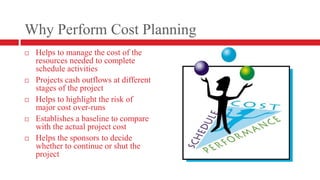
Why Perform Cost PlanningHelps to manage the cost of the resources needed to complete schedule activitiesProjects cash outflows at different stages of the projectHelps to highlight the risk of major cost over-runsEstablishes a baseline to compare with the actual project costHelps the sponsors to decide whether to continue or shut the project
Cost Planning ToolsBottom-up EstimatingStarts from Work Packages – from bottom level activitiesAdd up their costs and work upwardsAggregate the costs to reach a final figurePros and ConsUpside – is more accurate, cost changes can be recorded easilyDownside – takes more time, requires detailed knowledgeParametric Estimating (discussed earlier)
Cost Planning ToolsTop-down Estimating (Analogous Estimating)Takes cost inspiration from similar projects, tasksStarts from the top and work downwardsDivide the cost figures among different sub-projects or tasksPros and ConsUpside – quick and easy to use, good for early-stage planningDownside – often is very inaccurate, can mislead if used at a later stageReserve AnalysisContingency factor – what-if scenarioDownside – can over-state the cost estimate of schedule activityRemedy – aggregate reserves for a group of activity and assign it to a dummy task
Inputs for Cost PlanningEnterprise Environment FactorsOrganizational Process AssetsProject Scope StatementWork Breakdown StructureWBS DictionaryProject Management PlanSchedule Management PlanStaffing Management PlanRisk Register
Project Risk Planning
What is Project RiskProbability of an uncertain event or condition with a positive or negative effect on any one of the following project objectivesScopeCostTimeQualityExamplesProbability of delay in acquiring a permit from the government for an aspect of the projectProbability of unavailability of adequate resources assigned for a particular taskProbability of increase in resource cost
Understand RiskTypes of risksKnown risks – something we can plan forUnknown risks – we are caught off guardRisks – threats or opportunities?Taking risk against profitable gainUsing Fast Tracking to shorten project timelineRisks that offer opportunitiesLowering of taxes on project resources, brining cost downAttitude toward risk?Fear and avoidAccept and face
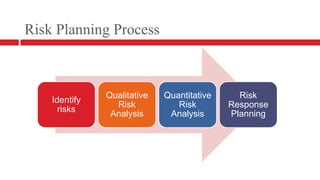
Risk Planning Process
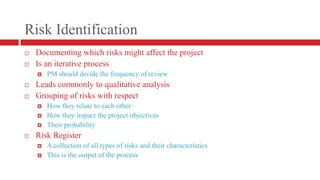
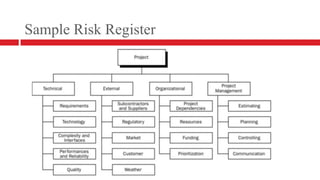
Risk IdentificationDocumenting which risks might affect the projectIs an iterative processPM should decide the frequency of reviewLeads commonly to qualitative analysis Grouping of risks with respectHow they relate to each otherHow they impact the project objectivesTheir probability Risk RegisterA collection of all types of risks and their characteristicsThis is the output of the process
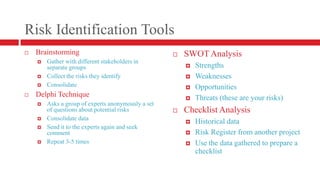
Risk Identification ToolsBrainstormingGather with different stakeholders in separate groupsCollect the risks they identifyConsolidateDelphi TechniqueAsks a group of experts anonymously a set of questions about potential risksConsolidate dataSend it to the experts again and seek commentRepeat 3-5 timesSWOT AnalysisStrengthsWeaknessesOpportunitiesThreats (these are your risks)Checklist AnalysisHistorical dataRisk Register from another projectUse the data gathered to prepare a checklist
Sample Risk Register
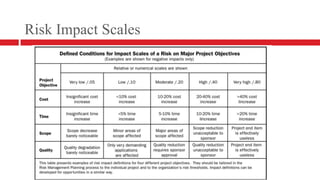
Risk Impact Scales
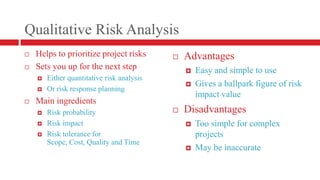
Qualitative Risk AnalysisHelps to prioritize project risksSets you up for the next stepEither quantitative risk analysisOr risk response planningMain ingredientsRisk probabilityRisk impactRisk tolerance for Scope, Cost, Quality and TimeAdvantagesEasy and simple to useGives a ballpark figure of risk impact valueDisadvantagesToo simple for complex projectsMay be inaccurate
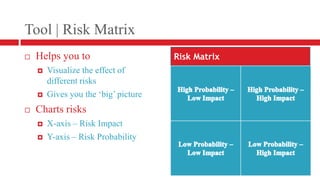
Tool | Risk MatrixHelps you to Visualize the effect of different risksGives you the ‘big’ pictureCharts risks X-axis – Risk ImpactY-axis – Risk ProbabilityRisk Matrix
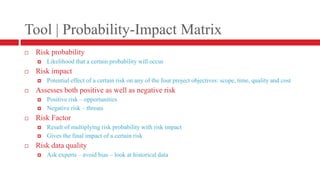
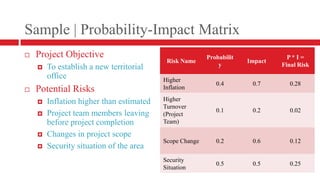
Tool | Probability-Impact MatrixRisk probabilityLikelihood that a certain probability will occurRisk impactPotential effect of a certain risk on any of the four project objectives: scope, time, quality and costAssesses both positive as well as negative riskPositive risk – opportunitiesNegative risk – threatsRisk FactorResult of multiplying risk probability with risk impactGives the final impact of a certain riskRisk data qualityAsk experts – avoid bias – look at historical data
Sample | Probability-Impact MatrixProject ObjectiveTo establish a new territorial officePotential RisksInflation higher than estimatedProject team members leaving before project completionChanges in project scopeSecurity situation of the area
Qualitative Risk Analysis | OutputQualitative analysis results inRanking of different risksGrouping of risksList of risks requiring response in the near-term / long-termList of risks for additional analysis
Risk Response PlanningProcess of developing responses toEnhance opportunitiesReduce threatsShould address risks based on their Risk Factor or priorityHelps to create some cushion by Allocating extra budgetAllocating extra time
Tools | Risk Response StrategiesResponding to ThreatsAvoidChange the PM plan to avoid a riskTransferShifting the impact and ownership of risk to third party (insurance policy)MitigateWork to reduce the probability or impact of a risk (test marketing, prototyping)Proactive Vs ReactiveResponding to OpportunitiesExploitSeek to face the risk head on (assigning better talent to a task)ShareSharing the ownership with a third party (JVs)EnhanceSeek to increase the probability or impact of the positive risk
Executing to PerfectionExecuting
Communicating What Needs ExecutionProject Communication Management
Communications ManagementObjectiveTo ensure timely and appropriate generation, collection, distribution, storage, retrieval and ultimate disposition of project informationProcesses for communication managementInformation distributionPerformance reportingStakeholder communication management
Information DistributionBroad StrategyNeed-to-know basisRestricts access – Keeps security intact – Maintains strong lines of separation – Keeps the focus of the members intactWant-to-know basisOpens access – Risks information proliferation – Allows for involvement – May increase distraction
Information Distribution | ToolsDistribution TriggersTime-based reports / meetingsFrequencyEvent-based reports / meetingsEvent significance identificationStyleFormalStandard templatesInformal No specific formatsMethodsIsolated meetingsProject team meetingsE-sharing thru project management systemsE-mails and file sharing systemsContentHigh-level Less detailsFocuses on output / deliverableLow-levelMore detailsFocuses on processes
Performance ReportingPurposeTo continuously assess current project performance against project estimated baselines related toScopeQualityTimeCost
Performance Reporting | ToolKPI – Key Performance IndicatorWhy“Numbers don’t lie”Helps to measure performance objectivelyRemember that KPIs shouldConnect with either one of the four project objectives (SCTQ)Measure live project performanceShould be designed so they result in numbers or %Will measure the performance result against baseline estimates
Stakeholder Communication ManagementPurposeTo satisfy the needs of and resolve issues with project stakeholdersSuggested Strategy“Need to know basis” – well-defined lines of communication separationActive engagement – answer before they question
Communicating What Needs ExecutionRisk Management
Risk ManagementObjectiveExecuting the risk plans and reassessing them to meet project objectives Risk Monitoring and ControlAssess the assumption of earlier identified risksMonitor the progress of risk response executionIdentify and analyze new risks
Risk Management | ToolRisk AuditExamines and documents the risk responses and compares it against the established baselinesSubjective activity – helps to see the trend and reassess the risk responsesVariance AnalysisIdentifies how much the actual progress has deviated from the baseline estimatesStatistical methodProvides an objective analysisReserve AnalysisRisks will occur – your reserves will get consumed, but how much?Analyze the use of reserves consumption
Quality Management
Quality ManagementQualityDegree to which a set of inherent characteristics meet requirementsPurposeTo ensure the baseline quality targets are met through Achieved throughQuality AssuranceTo ensure that processes are being followed as planned and proposedQuality ControlTo ensure specific project deliverables meet the quality standard that was planned and proposed
Quality AssuranceApplication of planned and systematic activities to ensure that processes are in line to meet the project objectivesNegates “Don’t fix it if it isn’t broken” philosophySetupA separate designated teamQuality CirclesMembers from within the team are assigned and rotated to perform QABenefitsChecks deviations before they result in bad quality deliverablePaves way for Continuous Improvement (Kaizen?)Helps to develop stronger standards for processes
QA | ToolsQuality AuditsStructured review activity to check whether project processes comply with organizational  / project policies and proceduresShouldn’t be announced – best when done without prior noticeConducted by trained in-house personnelProcess AnalysisA scheduled activity to systematically review processes in view of the deliverables and project objectivesFeedback from project members
Quality ControlMonitoring of specific project deliverables to check whether they comply with planned / proposed quality standardsSetupAn independent team performs quality checksDone through samplingStatistical analysis – to identify patterns and then identify root causeBenefitsKeeps poor quality deliverables from reaching in the hands of the customer or sponsorHelps to identify poor inputs into activitiesArrests trends that could lead to further deterioration in quality of the deliverables
Change Management
Change ManagementPurposeTo assess, record and incorporate any changes to the project objectives mainly T-Q-S-CIs performed from inception to completionIs important as projects seldom get executed exactly as plannedIs often a result of a risk being materializedPositive risk – positive changeNegative risk – negative change
Change ManagementSteps to perform control and manage changesIdentify the need for a change in the project objectivesReview request for changesAssessing the effects of proposed changes to SCTQ Inform and review the proposed changes with stakeholdersIf approved, document and update all SCTQ baselines
The DestinationClosing
Closing Project
Closing ProjectStructured processEnsure that deliverables are handed over to project sponsors or customersDocument and archive project records for future projectsEnsure project deliverables are accepted by sponsors / customersPerform comparative analysis of initial baseline estimates and final output
DocumentationPurposeTo ensure that all important activities, policies, processes and deliverables are documented for reviewBenefitFacilitates project performance analysisAllows for comparative analysis between projected and actualMakes templates available for future projectsSome policies and processes can be utilized by other departments in organizationsProvides important data for operations
Thanks

Project Management Toolkit - Presentation

  • 1.
  • 2.
    Important StuffSetting StandardsWhatsetting you want today?Formal or Informal?What learning environment would you prefer?Lecture-based or interactive?Would you like others to talk on the phone during the program?Would you like to receive rewards for good performance?
  • 3.
    Important StuffSetting StandardsNota training programThis is an EXPERIENCE – Learning Experience for ALL of usBe ready to give and receive constructive criticism
  • 4.
    Learning ContractA contractbetween YOU and YOURSELFWrite ONLY what you want to remember laterNot more than 10 points“The Only Barrier to Learning the Truth is to Assume You Already Know It”Confucius
  • 5.
    Why perform ProjectManagementPreparation
  • 6.
  • 7.
    What is aProjectProject Definition : "A temporary endeavor undertaken to create a unique product, service or result"FeaturesTemporary: Has a finite duration, project ceases when its objective is achieved. Does not mean short duration. Normally, the product/service will outlive the projectUnique : Doing something that has not been done earlierProgressive Elaboration: "Developing in steps, and continuing in increments". Development of details progressivelyEnvironmentConstantly changingBuilding and DismantlingPrecedes Operations
  • 8.
    What is aProjectProjects and OperationsSimilarities:Performed by peopleConstrained by limited resourcesPlanned, executed and controlledDifferences:Operations: Ongoing, repetitive, necessary for sustaining the businessProjects: Temporary, unique.Projects and Strategic PlanningProjects are used to achieve strategic plansIn response to market demands, customer requests, organizational needs, technological advances, legal requirements.
  • 9.
    What is ProjectManagementApplication ofKnowledge (e.g. Domain areas - Pharmaceutical, construction, etc.)Skills (Managing)Tools & Techniques (Software)Project activities (e.g Time Management, Cost Management, etc.)The GOALProject objectivesPM is accomplished through processes Prepare – Plan – Execute - CloseProject work typically involvesIdentifying requirementsDefining objectivesBalancing the competing demands for Scope, Time, Cost, and QualityManaging stakeholders
  • 10.
    Why Project Management?Toenhance the probability of project successTo focus on objectives - Scope, Time, Cost, Quality & RiskFor effective response to rapid changesTo manage effective utilization of resourcesTo address stakeholders interestsTo manage risks effectivelyAchieve Financial EfficiencyProject CostProject TimeProject QualityLessons LearntCreate re-usable data and information for future use
  • 11.
    Project LifecycleNo ‘ideal’project lifecyleIt definesWhat work to do in each phaseWhat deliverables to be generatedWho all are involved in each phaseHow to manage each phase
  • 12.
    Project LifecycleCommon characteristicsPhasesare generally sequentialCost and staffing are low at the start, peak in the middle and are low againRisk is high at the start and slowly declinesInfluence of stakeholders is highest at the start and declines slowly
  • 13.
    Project PhasesPreparaingDefines andauthorizes the project or a project phasePanningDefines and refines objectives, and plans the course of actions required to attain the objectives and scope that the project was undertaken to addressExecutingIntegrates people and other resources to carry out the project management plan for the projectRegularly measures and monitors progress to identify variances from the project management plan so that corrective action can be taken when necessary to meet project objectivesClosingFormalizes the acceptance of the product, service or result, and brings the project or a project phase to an orderly end
  • 14.
    Project CharterThe documentthat formally authorizes the projectAuthorizes Project Manager to apply organizational resourcesPM should be assigned at the earliest feasible, but should always be assigned before start of the planning phase, or during charter developmentThe Initiator or Sponsor is external to the project organization at a level appropriate to funding the project
  • 15.
    Project CharterProject Chartershould address the followingRequirements of the customers, sponsors and other stakeholdersBusiness needs, project justification, strategic planAssigned PM and authority (some other resources may also be pre-assigned)Product description/deliverablesSummary milestone scheduleStakeholder influencesFunctional organization and its participationConstraints and assumptions relating to organization, environment and external factorsSummary budgetAny change in the Project Charter should question the continuance of the project
  • 16.
    Well planned isalmost donePlanning
  • 17.
  • 18.
  • 19.
    Project PlanningPlanning isa process – not an outcomePlanning should address Setting the boundaries | Scope statementActivity planningActivity schedule developmentCost planningRisk planning
  • 20.
    Scope StatementProject scopestatement should address the following areas:Project and product objectivesProduct/service requirements and characteristicsProduct acceptance criteriaProject boundaries – What is included and what is notProject requirements and deliverablesProject constraintsProject assumptionsInitial project organizationInitial defined risksSchedule milestonesInitial Work Breakdown Structure
  • 21.
    Project Activity PlanningStepsto develop project activity scheduleSpecify the individual activities (WBS)Determine the sequence of these activities (Activity Table)Draw a sequence diagram (AON or AOA)Estimate the completion time for each activity (Activity Estimates)Identify the critical path (Using CPM)Create a schedule of activitiesUpdate the schedule / diagram as the project progresses
  • 22.
    Activity Identification Tool- WBSDeliverable-oriented hierarchical decompositions of project work Creates the required deliverablesWBS organizes and defines the total scope of the projectSubdivides the project work into smaller, more manageable pieces of workHas descending levels with increasingly detailed definition of the project workLowest level WBS components are called work packages; they can be scheduled, cost-estimated, monitored and controlled
  • 23.
    WBSCharacteristicsManageable (specific authority/responsibilityassigned)Independent (with respect to other elements o( projects)Integrateable {so that the total package can be seen)Measurable (each deliverable)PurposeTo simplify a complex project - it is a summation of elementsPlanning can be better performedDuration, cost and budget can be establishedTime, expenditure, and performance can be trackedNetwork and Control Planning can be initiatedResponsibilities and Resources can be assignedOmission/duplication of tasks can be avoidedProvide a common structure and coding system
  • 24.
    Creating WBSTemplatesDecompositionSubdivision ofproject deliverables into smaller chunksGoal : create work packagesMay not be possible for deliverables that are far into the futureDifferent deliverables may have different levels
  • 25.
  • 26.
  • 27.
    Task SequencingIdentification oflogical sequencing among schedule activitiesAllows for a smooth flow of project activitiesHelps to identify the most efficient way to reach project milestones
  • 28.
    Task Sequencing Tool- PDMPrecedence Diagram MethodHelps to develop project scheduleIdentifies dependencies of different activities to establish the fastest path to task completionMost useful for complex projectsVisual display helps to communicate activity executionIdentifies missing activitiesAlso known as AON
  • 29.
    PDMTerms to rememberEventsActivityDependencyFourtypes of dependenciesFinish to Start (most common)Start to StartFinish to FinishStart to Finish (rarely used)Practice
  • 30.
  • 31.
    Task Sequencing Tool - ADMArrow Diagram MethodAnother way to create a schedule network diagramAOA – Activity on ArrowDifferenceActivities are identified on arrowsActivities connect on nodes to show dependenciesOnly has Finish to Start dependencyCan also have dummy nodesLess commonly used in project planningSample ADM
  • 32.
    PracticePerform Task SequencingthroughPDMADMSample Project Activities
  • 33.
    Duration Estimate ToolsParametricEstimateDetermined by multiplying the quantity of work by the productivity rateConstruction work – per square footDesign work – labor hour per designDrilling – time taken per cubic inchThree-point EstimateHelps to consider the amount of risk in the initial estimateConsiders 3 types of estimatesMost likelyOptimisticPessimistic
  • 34.
    Schedule DevelopmentOutlines theproposed timelines for the project activitiesIs an iterative processIs typically completed AFTER activity duration estimateServes as the baseline against which project progress can be tracked
  • 35.
    Schedule Development Tool- CPMDupont developed the concept in 1957 – to address the shutting of plants for maintenanceHelps to identify the path of activities where any delay WILL cause a delay in the project timelineFor activities outside the Critical Path, there is tolerance forLate startLate finishEarly startUsed to be carried out by hand – now there are software availableMS ProjectPrimaveraSchedule activities on the Critical Path are called Critical Activities
  • 36.
    More on CPMCalculatedby estimating the following 4 parameters for each activityES - Earliest start timeEarliest time at which the activity can start given that its precedent activities must be completed firstEF - Earliest finish timeEqual to the earliest start time for the activity plus the time required to complete the activityLS - Latest start timeEqual to the latest finish time minus the time required to complete the activityLF - Latest finish timeLatest time at which the activity can be completed without delaying the projectSlack TimeTime between its earliest and latest start timeAmount of time that you can delay an activity without delaying the project scheduleCritical Path A path in which all activities have ES = LS and EF = LF
  • 37.
    Why CPMCPM helpsto identifyDifferent activities that MUST be completed on time for the project to stay on scheduleWhich activities can be delayed and their resources can be reallocatedMinimum duration of the project Early start and late start time for each activity in the schedule
  • 38.
    Schedule Compression ToolsScheduleCompressionHelps to shorten project schedule WITHOUT changing the project scopeCompression techniquesCrashingCost and Time tradeoffs are analyzed to determine the greatest amount of project compressionOften results in increased costFast TrackingSequenced activities are performed in parallelE.g. – foundation work is started before detailed architecture drawings are completeIncreases project risks
  • 39.
  • 40.
    Why Perform CostPlanningHelps to manage the cost of the resources needed to complete schedule activitiesProjects cash outflows at different stages of the projectHelps to highlight the risk of major cost over-runsEstablishes a baseline to compare with the actual project costHelps the sponsors to decide whether to continue or shut the project
  • 41.
    Cost Planning ToolsBottom-upEstimatingStarts from Work Packages – from bottom level activitiesAdd up their costs and work upwardsAggregate the costs to reach a final figurePros and ConsUpside – is more accurate, cost changes can be recorded easilyDownside – takes more time, requires detailed knowledgeParametric Estimating (discussed earlier)
  • 42.
    Cost Planning ToolsTop-downEstimating (Analogous Estimating)Takes cost inspiration from similar projects, tasksStarts from the top and work downwardsDivide the cost figures among different sub-projects or tasksPros and ConsUpside – quick and easy to use, good for early-stage planningDownside – often is very inaccurate, can mislead if used at a later stageReserve AnalysisContingency factor – what-if scenarioDownside – can over-state the cost estimate of schedule activityRemedy – aggregate reserves for a group of activity and assign it to a dummy task
  • 43.
    Inputs for CostPlanningEnterprise Environment FactorsOrganizational Process AssetsProject Scope StatementWork Breakdown StructureWBS DictionaryProject Management PlanSchedule Management PlanStaffing Management PlanRisk Register
  • 44.
  • 45.
    What is ProjectRiskProbability of an uncertain event or condition with a positive or negative effect on any one of the following project objectivesScopeCostTimeQualityExamplesProbability of delay in acquiring a permit from the government for an aspect of the projectProbability of unavailability of adequate resources assigned for a particular taskProbability of increase in resource cost
  • 46.
    Understand RiskTypes ofrisksKnown risks – something we can plan forUnknown risks – we are caught off guardRisks – threats or opportunities?Taking risk against profitable gainUsing Fast Tracking to shorten project timelineRisks that offer opportunitiesLowering of taxes on project resources, brining cost downAttitude toward risk?Fear and avoidAccept and face
  • 47.
  • 48.
    Risk IdentificationDocumenting whichrisks might affect the projectIs an iterative processPM should decide the frequency of reviewLeads commonly to qualitative analysis Grouping of risks with respectHow they relate to each otherHow they impact the project objectivesTheir probability Risk RegisterA collection of all types of risks and their characteristicsThis is the output of the process
  • 49.
    Risk Identification ToolsBrainstormingGatherwith different stakeholders in separate groupsCollect the risks they identifyConsolidateDelphi TechniqueAsks a group of experts anonymously a set of questions about potential risksConsolidate dataSend it to the experts again and seek commentRepeat 3-5 timesSWOT AnalysisStrengthsWeaknessesOpportunitiesThreats (these are your risks)Checklist AnalysisHistorical dataRisk Register from another projectUse the data gathered to prepare a checklist
  • 50.
  • 51.
  • 52.
    Qualitative Risk AnalysisHelpsto prioritize project risksSets you up for the next stepEither quantitative risk analysisOr risk response planningMain ingredientsRisk probabilityRisk impactRisk tolerance for Scope, Cost, Quality and TimeAdvantagesEasy and simple to useGives a ballpark figure of risk impact valueDisadvantagesToo simple for complex projectsMay be inaccurate
  • 53.
    Tool | RiskMatrixHelps you to Visualize the effect of different risksGives you the ‘big’ pictureCharts risks X-axis – Risk ImpactY-axis – Risk ProbabilityRisk Matrix
  • 54.
    Tool | Probability-ImpactMatrixRisk probabilityLikelihood that a certain probability will occurRisk impactPotential effect of a certain risk on any of the four project objectives: scope, time, quality and costAssesses both positive as well as negative riskPositive risk – opportunitiesNegative risk – threatsRisk FactorResult of multiplying risk probability with risk impactGives the final impact of a certain riskRisk data qualityAsk experts – avoid bias – look at historical data
  • 55.
    Sample | Probability-ImpactMatrixProject ObjectiveTo establish a new territorial officePotential RisksInflation higher than estimatedProject team members leaving before project completionChanges in project scopeSecurity situation of the area
  • 56.
    Qualitative Risk Analysis| OutputQualitative analysis results inRanking of different risksGrouping of risksList of risks requiring response in the near-term / long-termList of risks for additional analysis
  • 57.
    Risk Response PlanningProcessof developing responses toEnhance opportunitiesReduce threatsShould address risks based on their Risk Factor or priorityHelps to create some cushion by Allocating extra budgetAllocating extra time
  • 58.
    Tools | RiskResponse StrategiesResponding to ThreatsAvoidChange the PM plan to avoid a riskTransferShifting the impact and ownership of risk to third party (insurance policy)MitigateWork to reduce the probability or impact of a risk (test marketing, prototyping)Proactive Vs ReactiveResponding to OpportunitiesExploitSeek to face the risk head on (assigning better talent to a task)ShareSharing the ownership with a third party (JVs)EnhanceSeek to increase the probability or impact of the positive risk
  • 59.
  • 60.
    Communicating What NeedsExecutionProject Communication Management
  • 61.
    Communications ManagementObjectiveTo ensuretimely and appropriate generation, collection, distribution, storage, retrieval and ultimate disposition of project informationProcesses for communication managementInformation distributionPerformance reportingStakeholder communication management
  • 62.
    Information DistributionBroad StrategyNeed-to-knowbasisRestricts access – Keeps security intact – Maintains strong lines of separation – Keeps the focus of the members intactWant-to-know basisOpens access – Risks information proliferation – Allows for involvement – May increase distraction
  • 63.
    Information Distribution |ToolsDistribution TriggersTime-based reports / meetingsFrequencyEvent-based reports / meetingsEvent significance identificationStyleFormalStandard templatesInformal No specific formatsMethodsIsolated meetingsProject team meetingsE-sharing thru project management systemsE-mails and file sharing systemsContentHigh-level Less detailsFocuses on output / deliverableLow-levelMore detailsFocuses on processes
  • 64.
    Performance ReportingPurposeTo continuouslyassess current project performance against project estimated baselines related toScopeQualityTimeCost
  • 65.
    Performance Reporting |ToolKPI – Key Performance IndicatorWhy“Numbers don’t lie”Helps to measure performance objectivelyRemember that KPIs shouldConnect with either one of the four project objectives (SCTQ)Measure live project performanceShould be designed so they result in numbers or %Will measure the performance result against baseline estimates
  • 66.
    Stakeholder Communication ManagementPurposeTosatisfy the needs of and resolve issues with project stakeholdersSuggested Strategy“Need to know basis” – well-defined lines of communication separationActive engagement – answer before they question
  • 67.
    Communicating What NeedsExecutionRisk Management
  • 68.
    Risk ManagementObjectiveExecuting therisk plans and reassessing them to meet project objectives Risk Monitoring and ControlAssess the assumption of earlier identified risksMonitor the progress of risk response executionIdentify and analyze new risks
  • 69.
    Risk Management |ToolRisk AuditExamines and documents the risk responses and compares it against the established baselinesSubjective activity – helps to see the trend and reassess the risk responsesVariance AnalysisIdentifies how much the actual progress has deviated from the baseline estimatesStatistical methodProvides an objective analysisReserve AnalysisRisks will occur – your reserves will get consumed, but how much?Analyze the use of reserves consumption
  • 70.
  • 71.
    Quality ManagementQualityDegree towhich a set of inherent characteristics meet requirementsPurposeTo ensure the baseline quality targets are met through Achieved throughQuality AssuranceTo ensure that processes are being followed as planned and proposedQuality ControlTo ensure specific project deliverables meet the quality standard that was planned and proposed
  • 72.
    Quality AssuranceApplication ofplanned and systematic activities to ensure that processes are in line to meet the project objectivesNegates “Don’t fix it if it isn’t broken” philosophySetupA separate designated teamQuality CirclesMembers from within the team are assigned and rotated to perform QABenefitsChecks deviations before they result in bad quality deliverablePaves way for Continuous Improvement (Kaizen?)Helps to develop stronger standards for processes
  • 73.
    QA | ToolsQualityAuditsStructured review activity to check whether project processes comply with organizational / project policies and proceduresShouldn’t be announced – best when done without prior noticeConducted by trained in-house personnelProcess AnalysisA scheduled activity to systematically review processes in view of the deliverables and project objectivesFeedback from project members
  • 74.
    Quality ControlMonitoring ofspecific project deliverables to check whether they comply with planned / proposed quality standardsSetupAn independent team performs quality checksDone through samplingStatistical analysis – to identify patterns and then identify root causeBenefitsKeeps poor quality deliverables from reaching in the hands of the customer or sponsorHelps to identify poor inputs into activitiesArrests trends that could lead to further deterioration in quality of the deliverables
  • 75.
  • 76.
    Change ManagementPurposeTo assess,record and incorporate any changes to the project objectives mainly T-Q-S-CIs performed from inception to completionIs important as projects seldom get executed exactly as plannedIs often a result of a risk being materializedPositive risk – positive changeNegative risk – negative change
  • 77.
    Change ManagementSteps toperform control and manage changesIdentify the need for a change in the project objectivesReview request for changesAssessing the effects of proposed changes to SCTQ Inform and review the proposed changes with stakeholdersIf approved, document and update all SCTQ baselines
  • 78.
  • 79.
  • 80.
    Closing ProjectStructured processEnsurethat deliverables are handed over to project sponsors or customersDocument and archive project records for future projectsEnsure project deliverables are accepted by sponsors / customersPerform comparative analysis of initial baseline estimates and final output
  • 81.
    DocumentationPurposeTo ensure thatall important activities, policies, processes and deliverables are documented for reviewBenefitFacilitates project performance analysisAllows for comparative analysis between projected and actualMakes templates available for future projectsSome policies and processes can be utilized by other departments in organizationsProvides important data for operations
  • 82.

Editor's Notes

  • #6 Just like the project itself, project team is also temporary. Most often project teams are established for the sole purpose of the project. Unique outcome means that the project is designed to produce a new product or a new capability - for example, establishing of TQM to improve service standards. Similarly, a project could also be designed to produce research work.Progressive elaboration means that the project is constantly changing work in progress. The initially identified scope hardly ever remains the same as the project reaches its maturity. It also means that any project starts off with a simpler plan or idea which continues to become more and more elaborated as the work continues.
  • #7 Examples of projects include but are not limited to: Developing a new product or service Resulting a change in culture, staffing or style of an organzation Acquiring a new system or set of processes Establishing or constructing a new facility Organizing an event Running a campaign Implementing a new business process Preparing to design a sales proposal / business development effort
  • #8 PMs often talk abt the ‘Triple Constraint” - Project scope, cost and time. Project quality is affected by balancing these three factors. High quality projects deliver the project as per the planned scope, time and cost.
  • #9 Pros of being a project managerSteppingstone to recognition and promotion Lots of variety - no two days are alike Gives a strong sense of accomplishment - IF the project is successfully completed These is significant freedom of choice - as you are in charge of making decisions and setting policies that other will follow It is a great leadership opportunityCons of being a PMRequires significant people skills - might have to deal with lots of politics Requires tolerance of ambiguity and uncertainty - since the project is constantly experiencing changes There is a lot of responsibility - but not enough authorit with respect to changing scope, time or cost of the project If you are a techie, you may feel disconnected from your main line of expertise You may be perceived by some as not having a “read job” :)
  • #10 Exercise: Let’s suppose you are in charge of establishing a new territorial sales office / branch for your organization. Who all can be stakeholders in this project?Who all can be stakeholders?
  • #14 Show a different presentation on how to use CPM