PROJECT MANAGEMENT
FORMS, LIFE-CYCLE & HUMAN ASPECTS
A presentation on
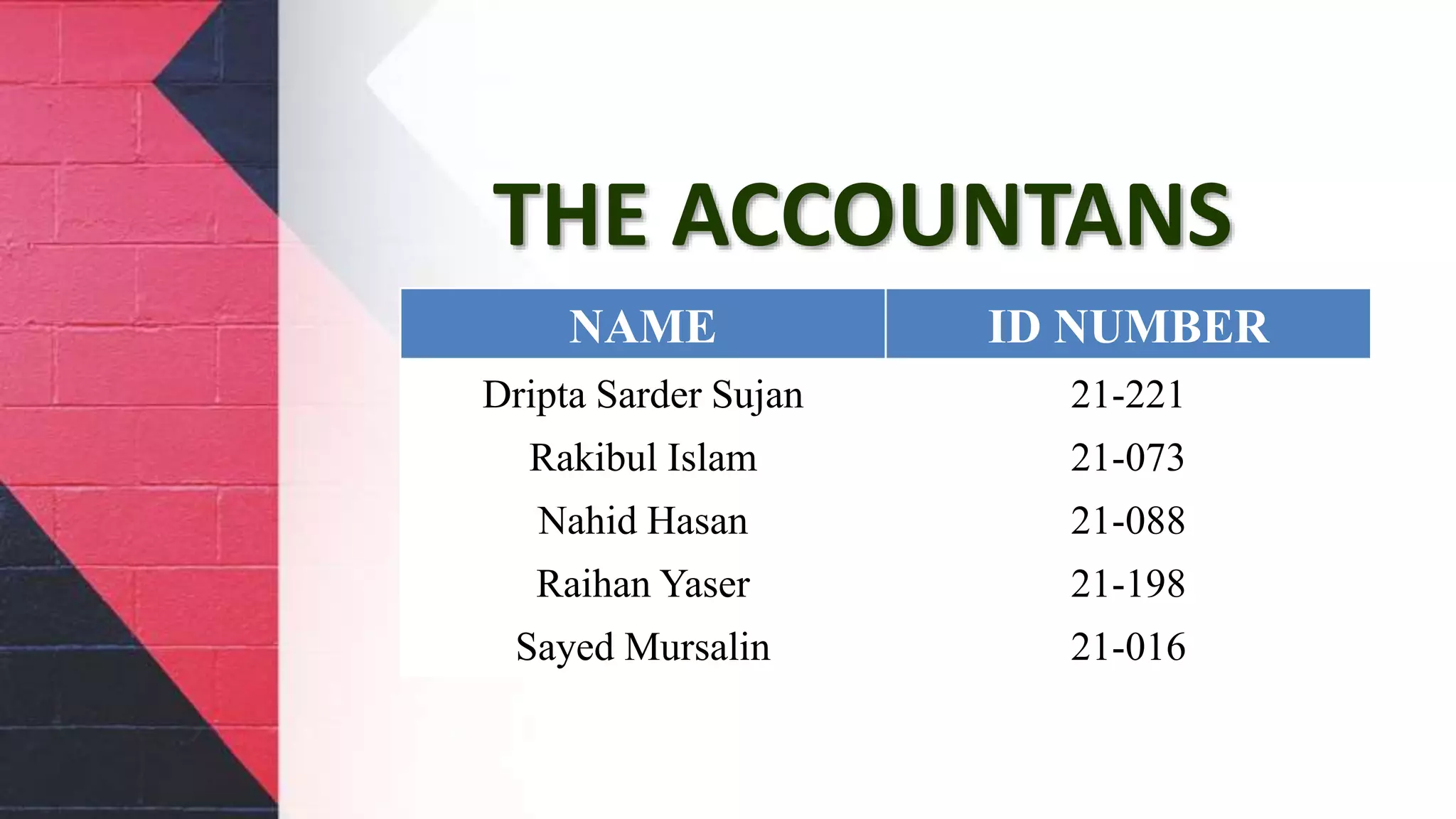
THE ACCOUNTANS
NAME ID NUMBER
Dripta Sarder Sujan 21-221
Rakibul Islam 21-073
Nahid Hasan 21-088
Raihan Yaser 21-198
Sayed Mursalin 21-016
LEARNING OBJECTIVES
• Describing different forms of project organization
• Describing the organizational culture for projects
• Describing the project life cycle
• Briefly explaining two performance analysis tools
• Discussing the human aspects of project management
• Specifying the pre-requisites for successful project implementation
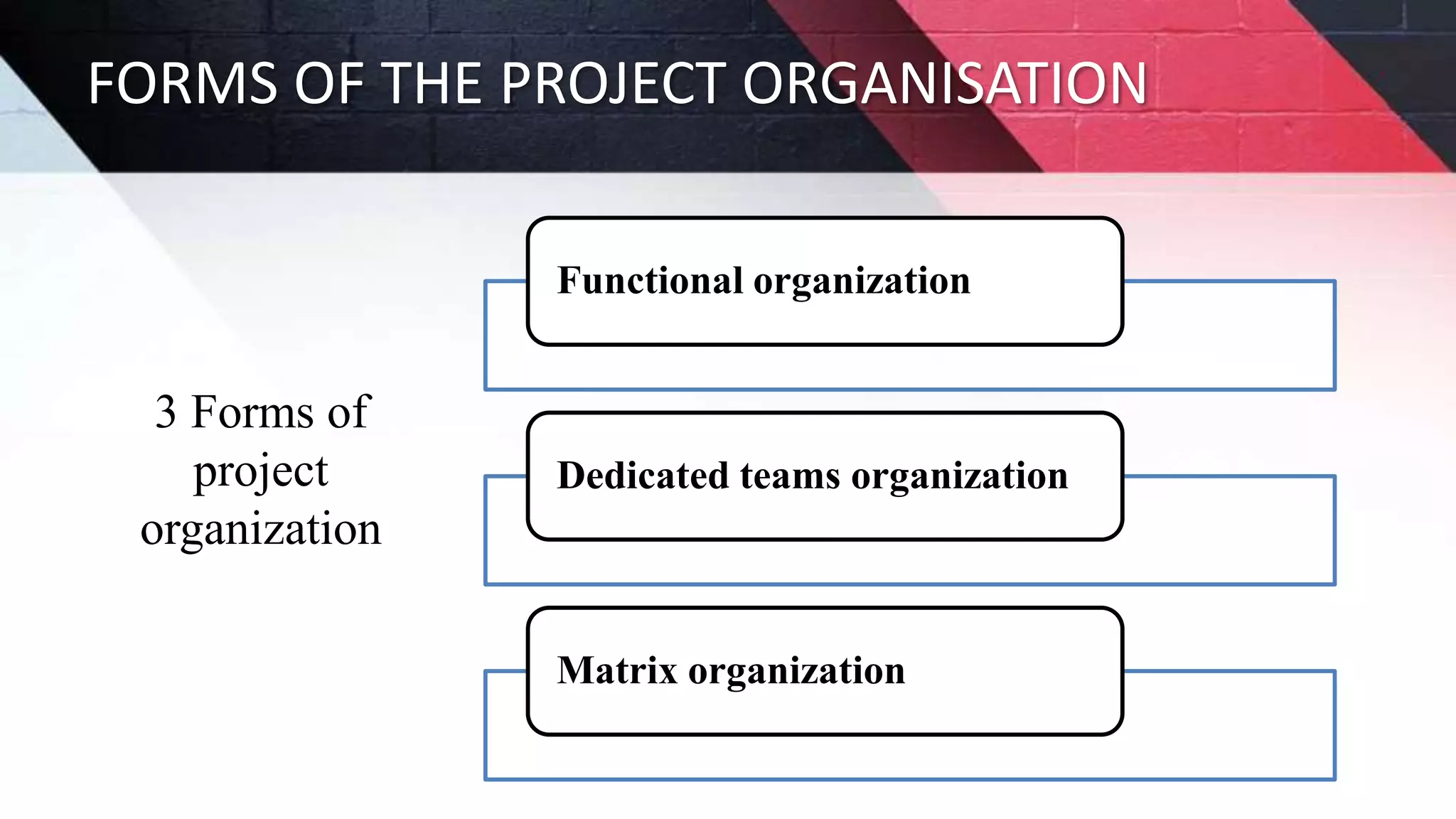
FORMS OF THE PROJECT ORGANISATION
Functional organization
Dedicated teams organization
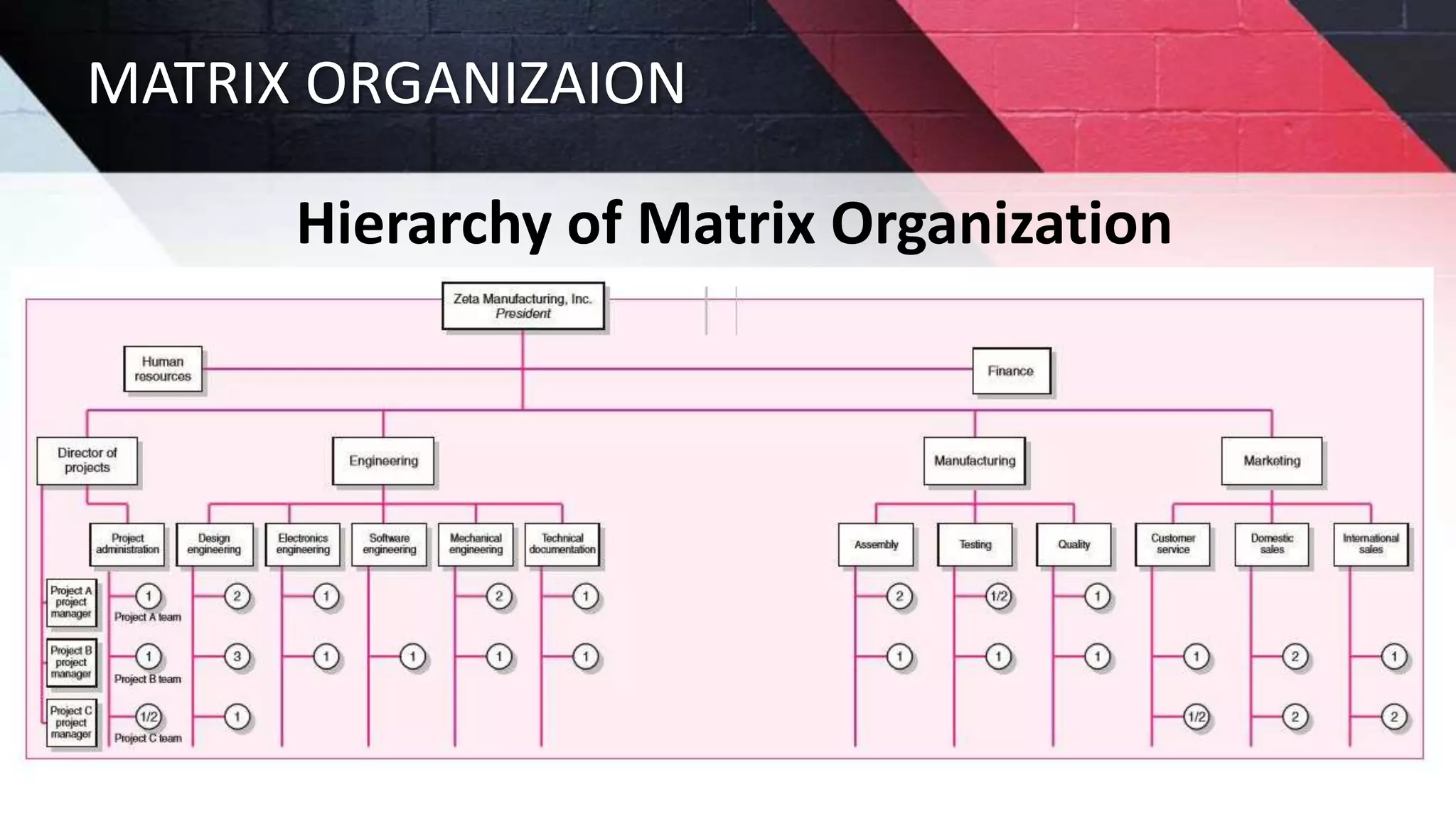
Matrix organization
3 Forms of
project
organization
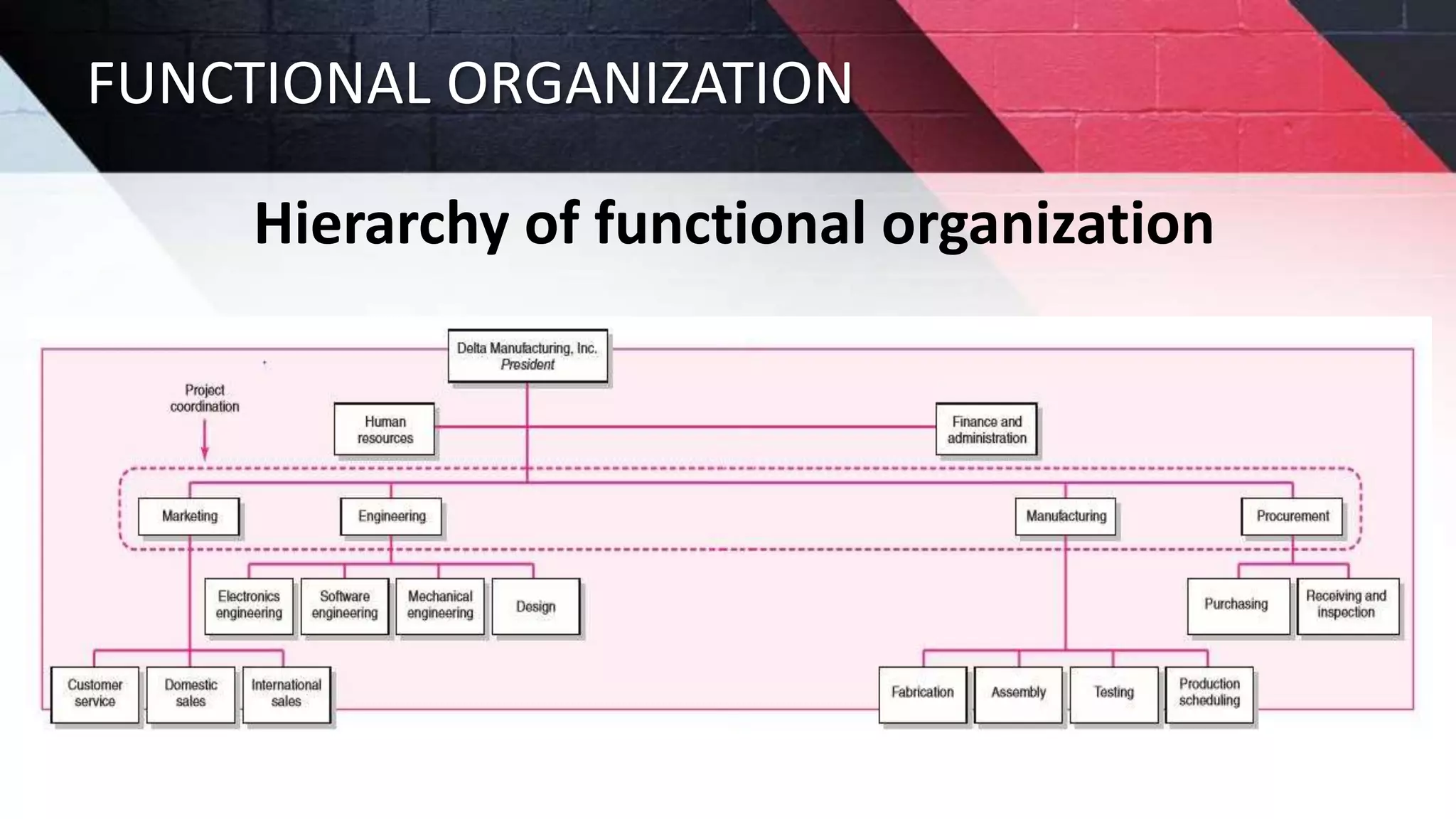
FUNCTIONAL ORGANIZATION
Hierarchy of functional organization
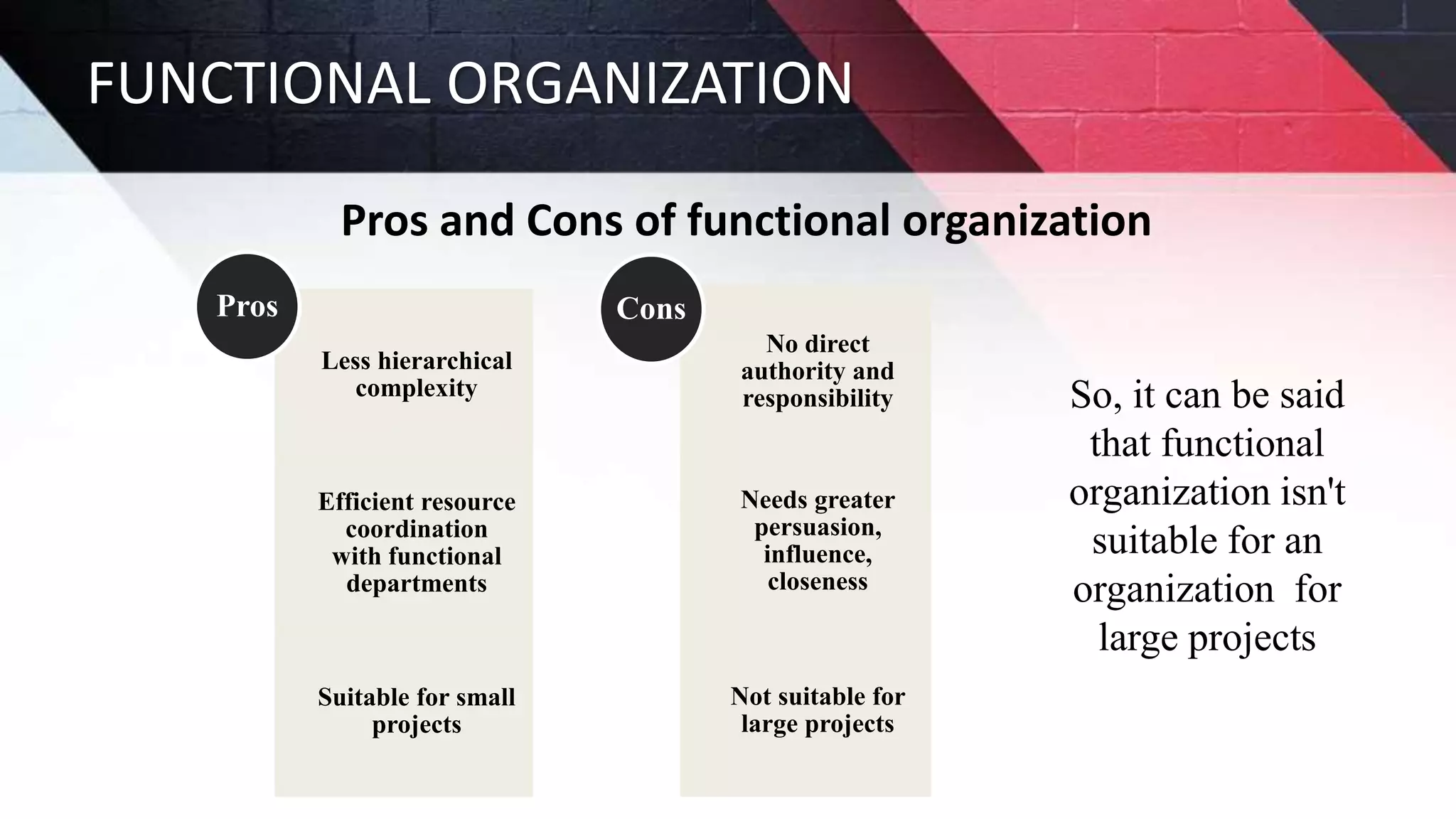
FUNCTIONAL ORGANIZATION
Pros and Cons of functional organization
Less hierarchical
complexity
Efficient resource
coordination
with functional
departments
Suitable for small
projects
Pros
No direct
authority and
responsibility
Needs greater
persuasion,
influence,
closeness
Not suitable for
large projects
Cons
So, it can be said
that functional
organization isn't
suitable for an
organization for
large projects
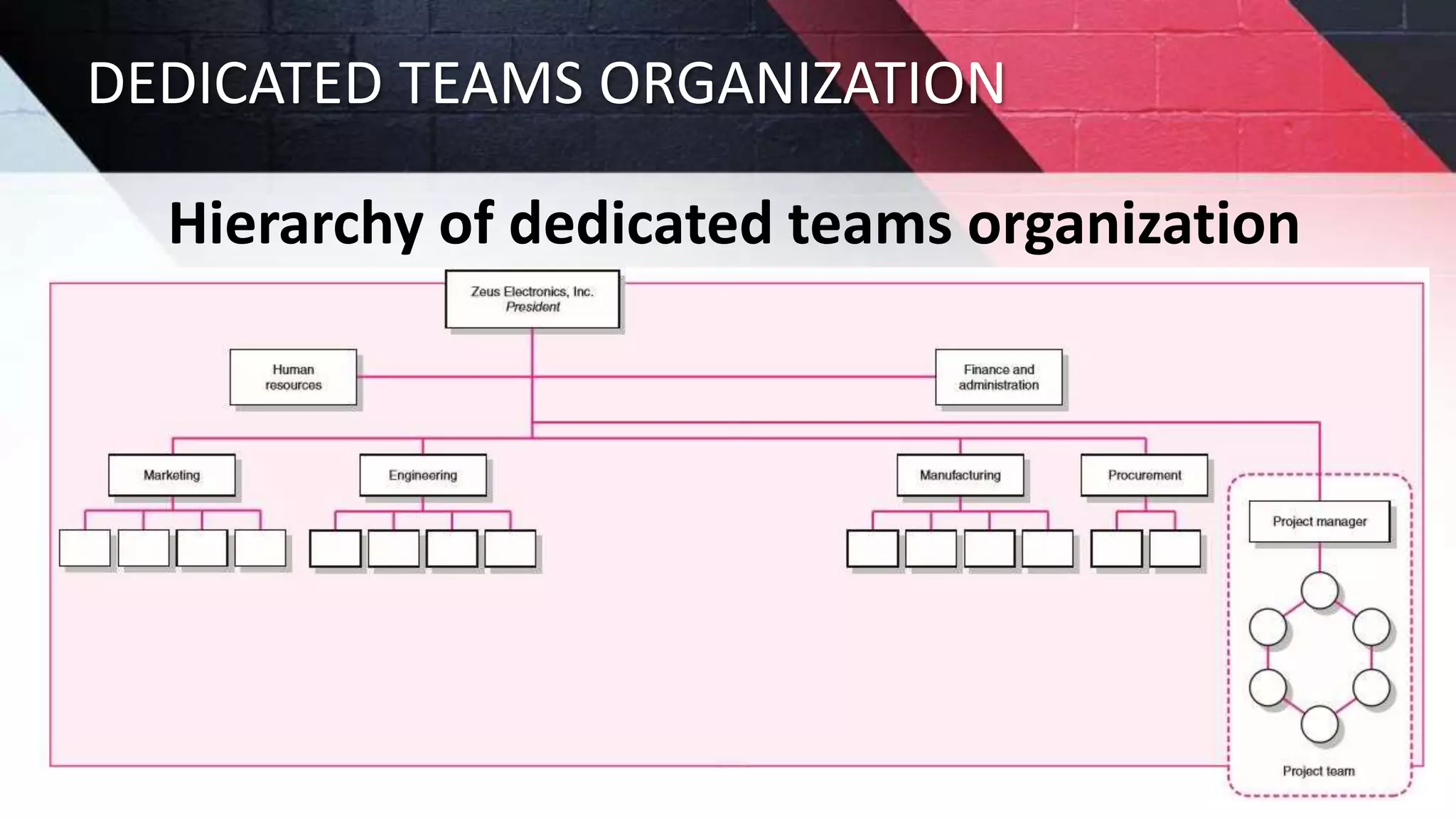
DEDICATED TEAMS ORGANIZATION
Hierarchy of dedicated teams organization
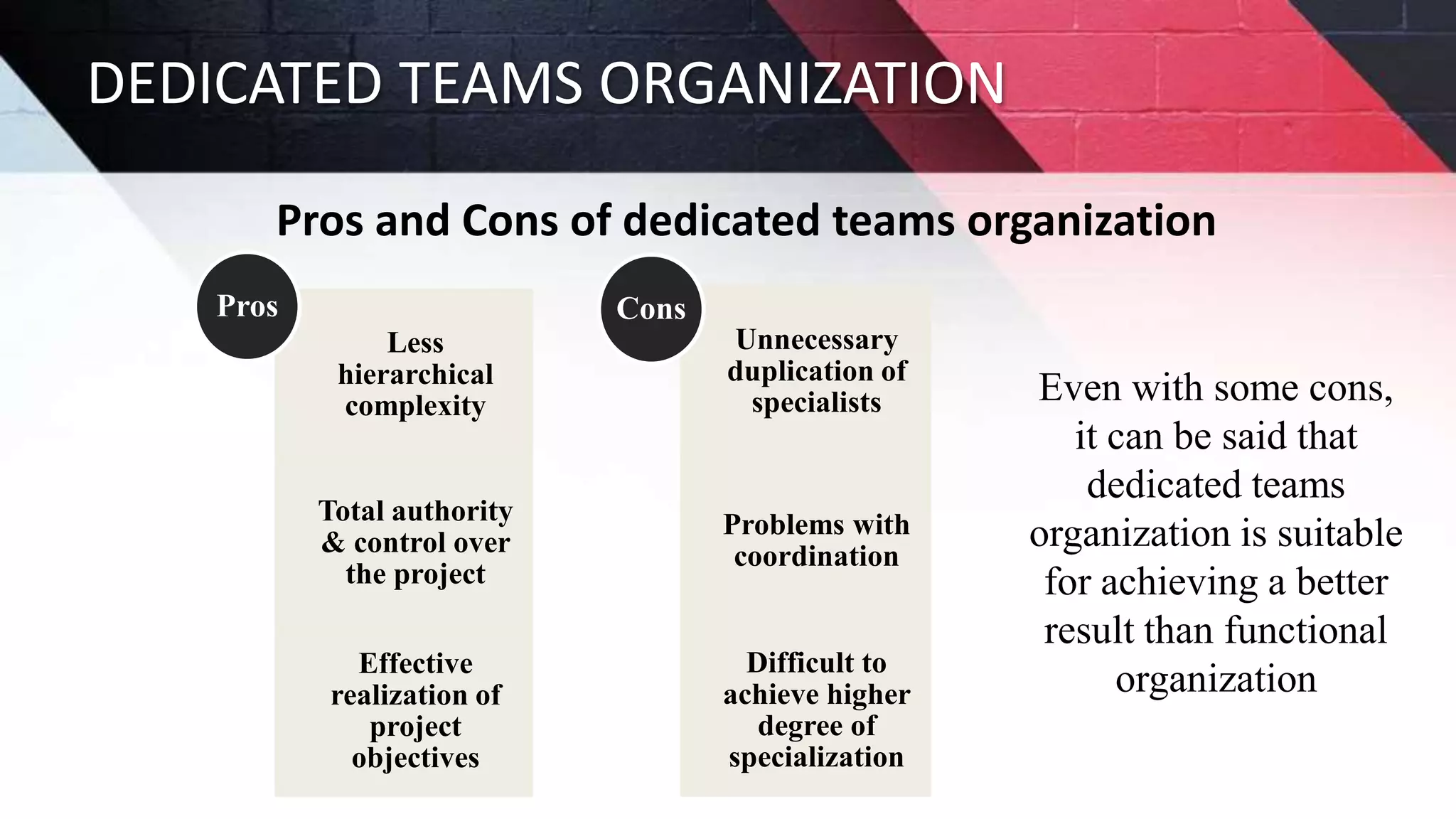
DEDICATED TEAMS ORGANIZATION
Pros and Cons of dedicated teams organization
Less
hierarchical
complexity
Total authority
& control over
the project
Effective
realization of
project
objectives
Pros
Unnecessary
duplication of
specialists
Problems with
coordination
Difficult to
achieve higher
degree of
specialization
Cons
Even with some cons,
it can be said that
dedicated teams
organization is suitable
for achieving a better
result than functional
organization
MATRIX ORGANIZAION
Hierarchy of Matrix Organization
MATRIX ORGANIZAION
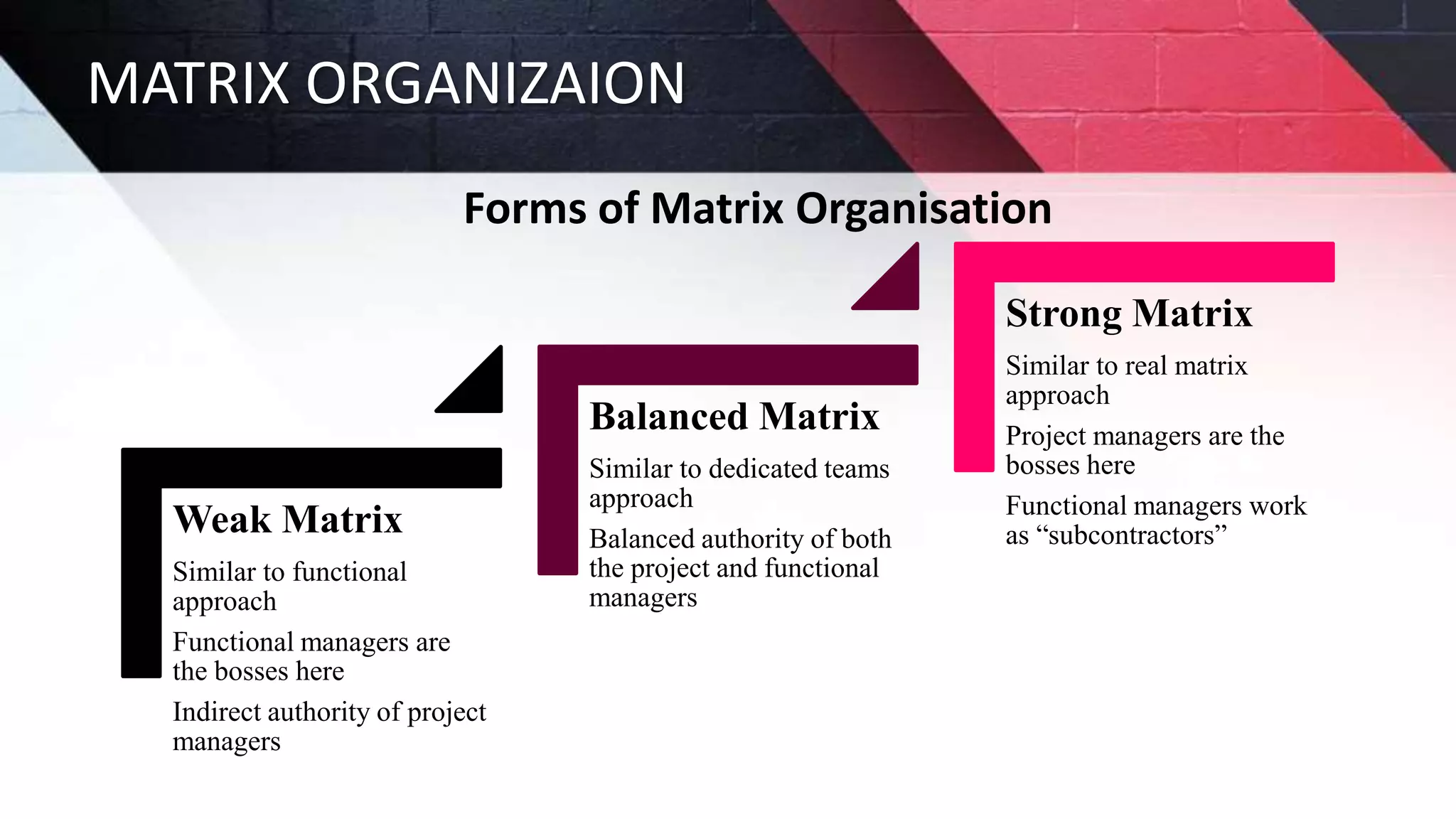
Weak Matrix
Similar to functional
approach
Functional managers are
the bosses here
Indirect authority of project
managers
Balanced Matrix
Similar to dedicated teams
approach
Balanced authority of both
the project and functional
managers
Strong Matrix
Similar to real matrix
approach
Project managers are the
bosses here
Functional managers work
as “subcontractors”
Forms of Matrix Organisation
MATRIX ORGANIZAION
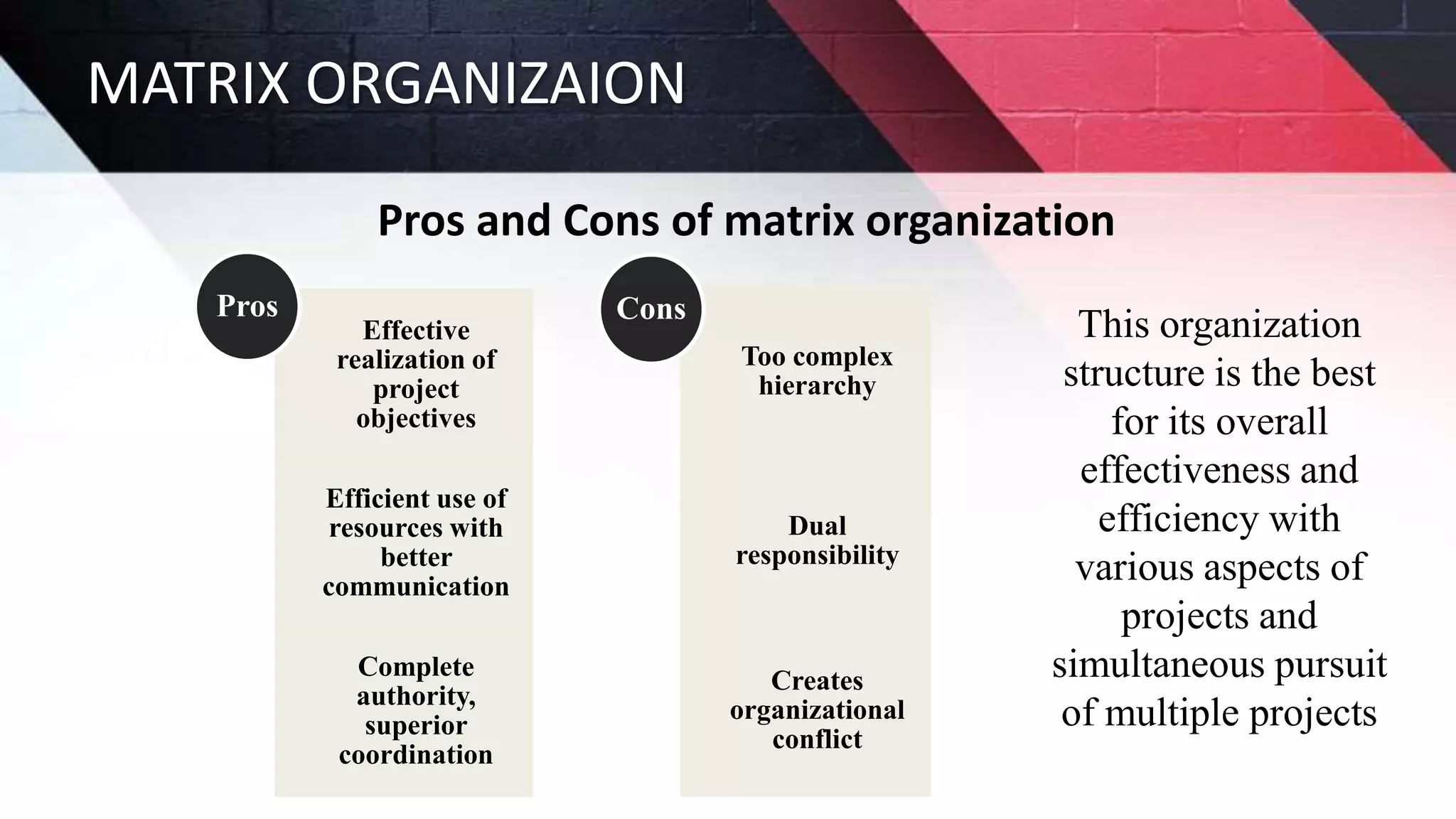
Pros and Cons of matrix organization
Effective
realization of
project
objectives
Efficient use of
resources with
better
communication
Complete
authority,
superior
coordination
Pros
Too complex
hierarchy
Dual
responsibility
Creates
organizational
conflict
Cons
This organization
structure is the best
for its overall
effectiveness and
efficiency with
various aspects of
projects and
simultaneous pursuit
of multiple projects
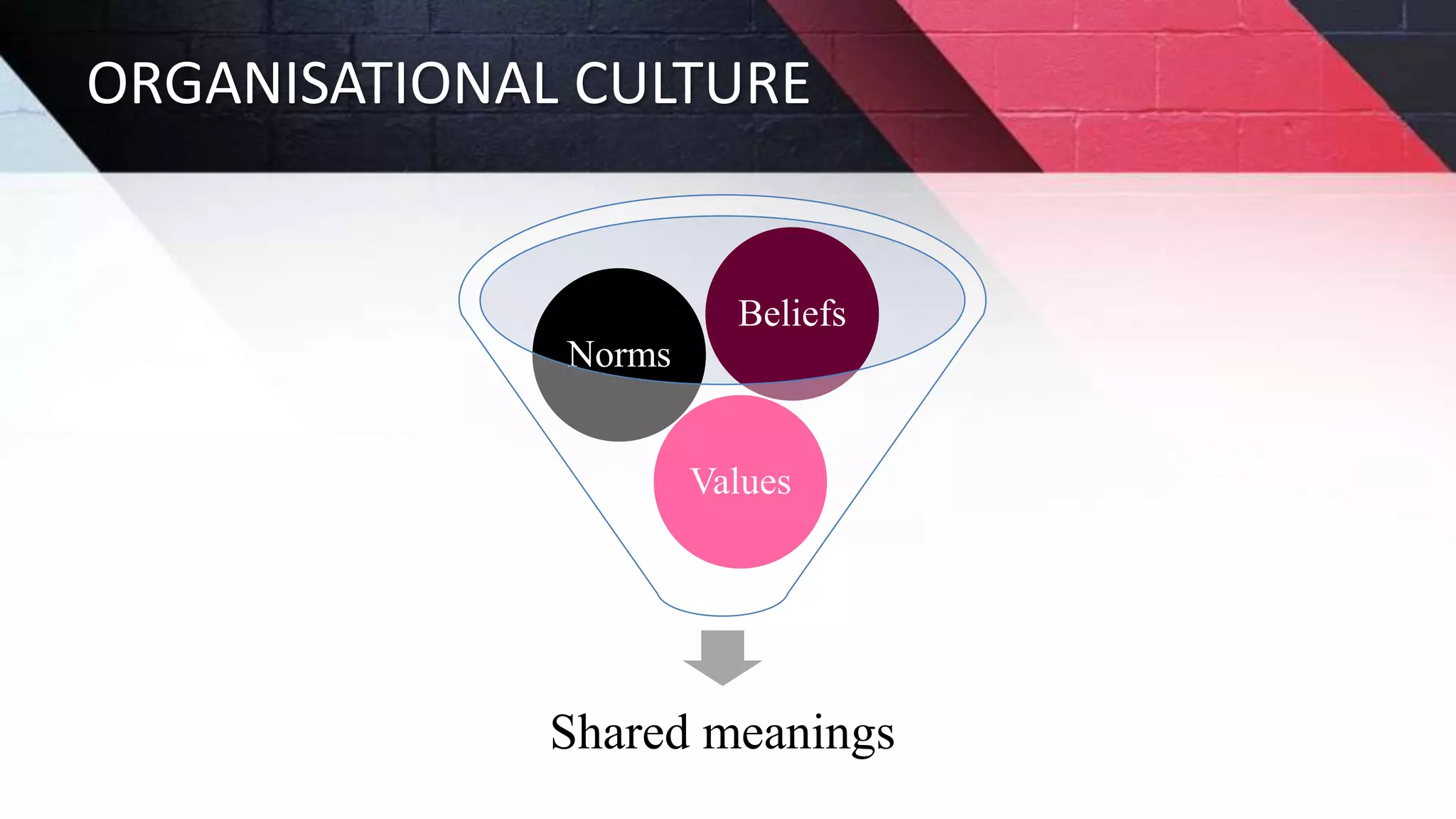
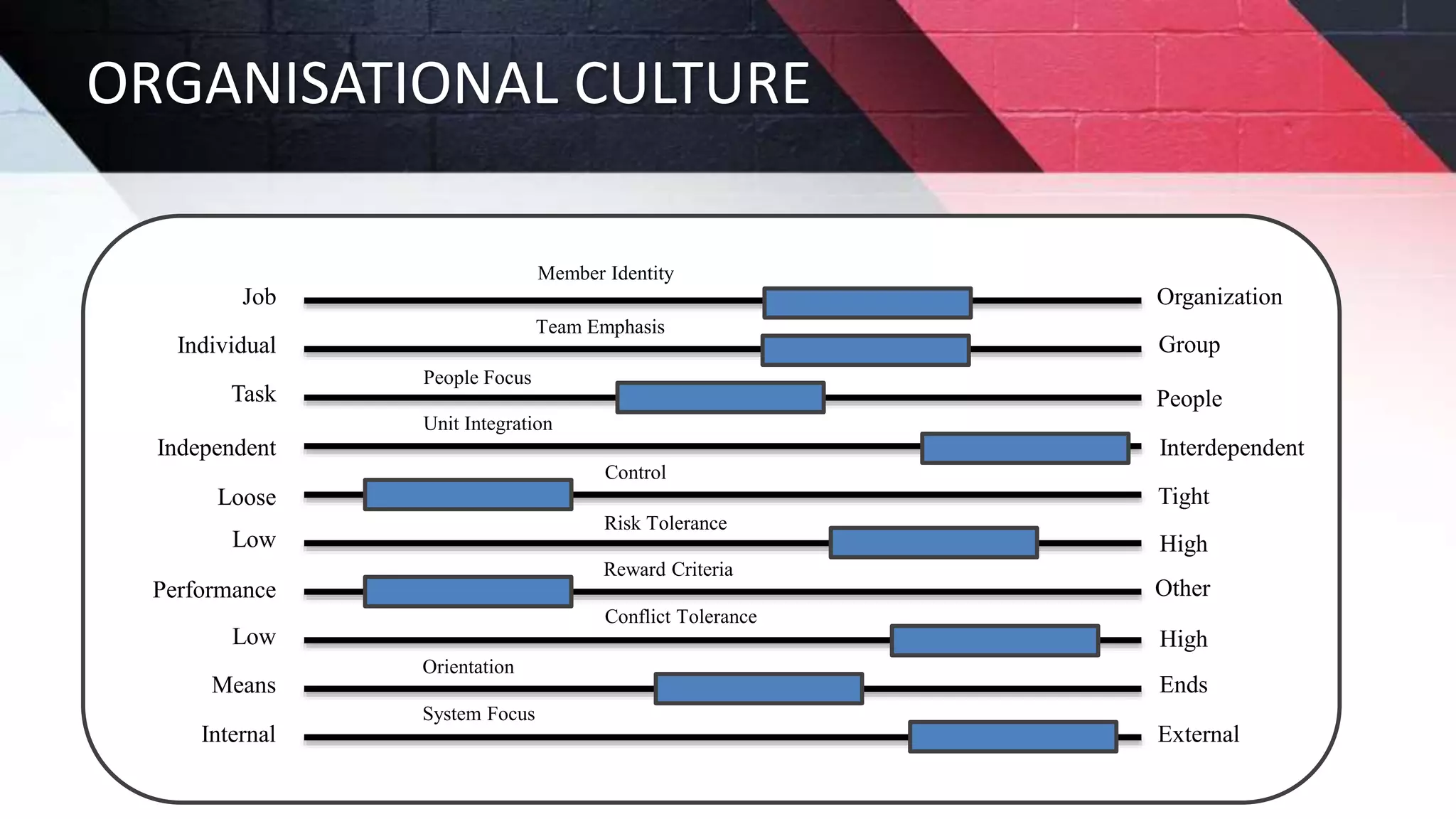
ORGANISATIONAL CULTURE
Shared meanings
Values
Norms
Beliefs
ORGANISATIONAL CULTURE
Job
Individual
Task
Independent
Loose
Low
Performance
Low
Means
Internal
Organization
Group
External
People
Interdependent
Ends
Tight
High
Other
High
Member Identity
Team Emphasis
People Focus
Unit Integration
Control
Risk Tolerance
Reward Criteria
Conflict Tolerance
Orientation
System Focus
ORGANISATIONAL CULTURE
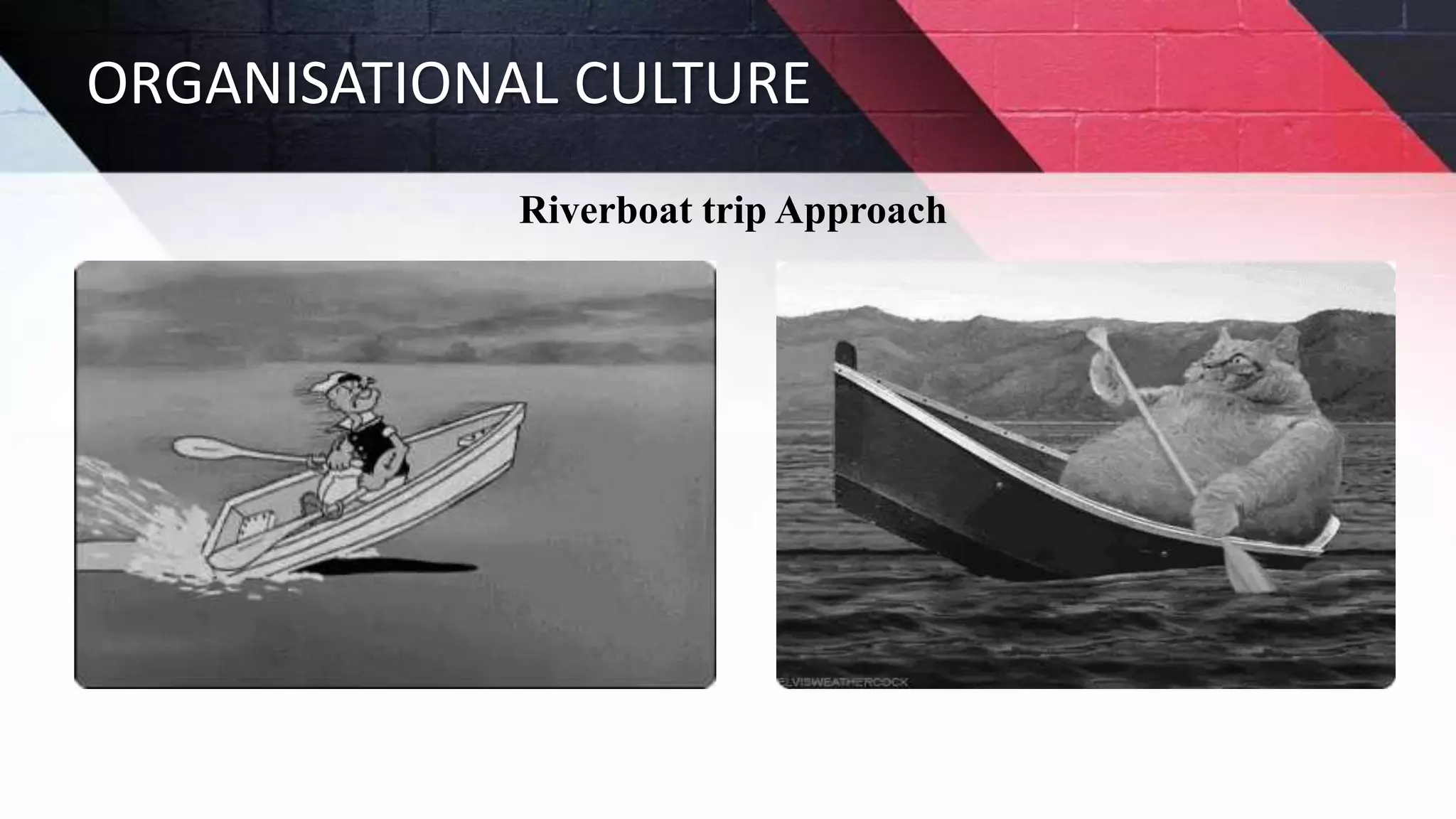
Riverboat trip Approach
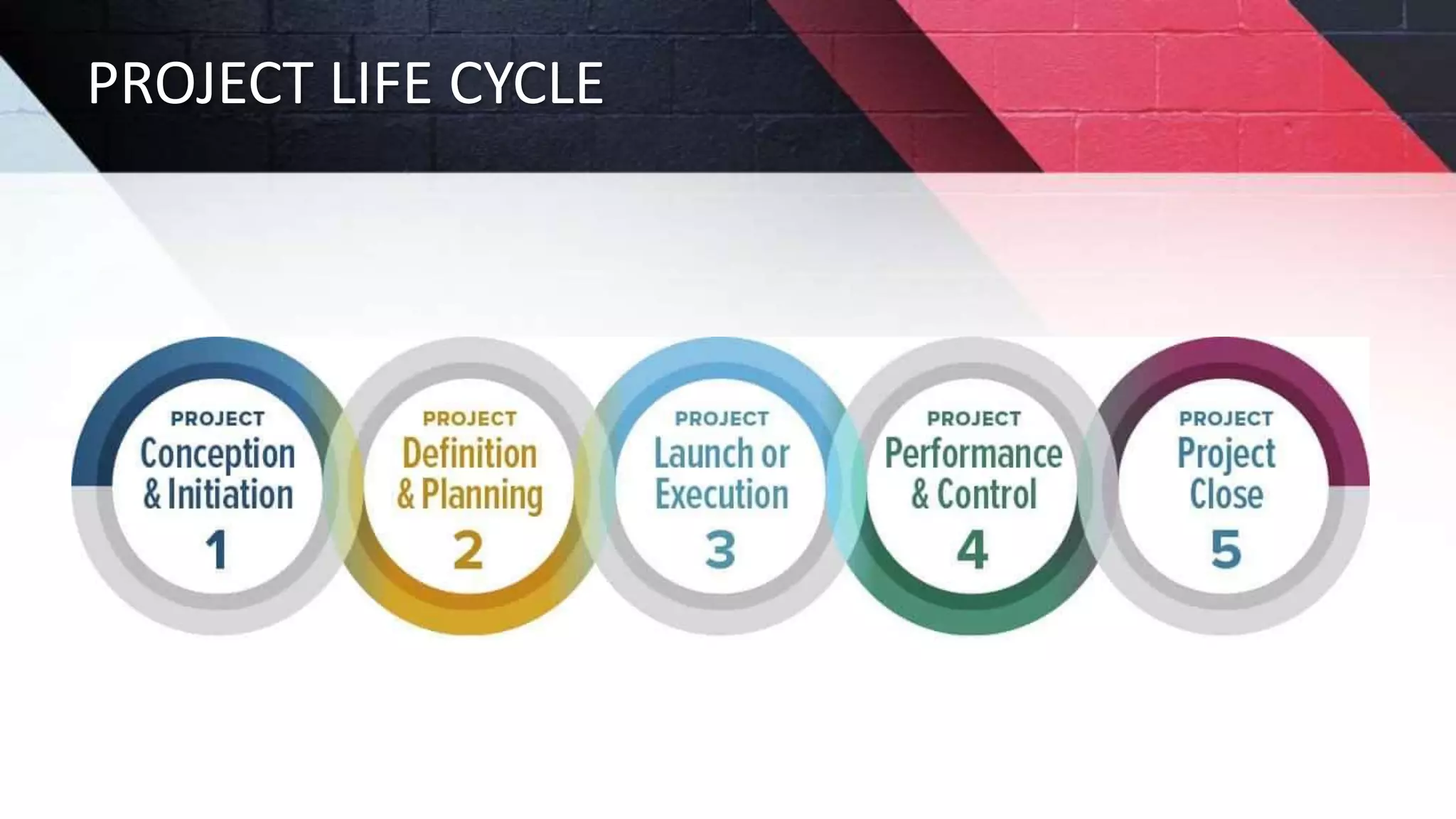
PROJECT LIFE CYCLE
PROJECT CONCEPT AND INITIATION
The Project Conception & Initiation Phase is the 1st phase in the Project
Management Life Cycle, as it involves starting up a new project.
We can start a new project by defining its objectives, scope, purpose and deliverables to
be produced.
We'll also hire our project team, setup the Project Office and review the project, to gain
approval to begin the next phase.
PROJECT DEFINITION AND PLANNING
The Project definition & planning is the 2nd phase. Project definition & planning is a
discipline for stating how to complete a project within a certain timeframe, usually with
defined stages, and with designated resources
Functions of Planning
• Allocation of responsibilities
• Communication and coordination
• Forward looking
• Time consciousness
• Monitoring & control
Areas of Planning
• Planning the project
• Planning the manpower and
organization
• Planning the money
• Planning the information systems
PROJECT DEFINITION AND PLANNING
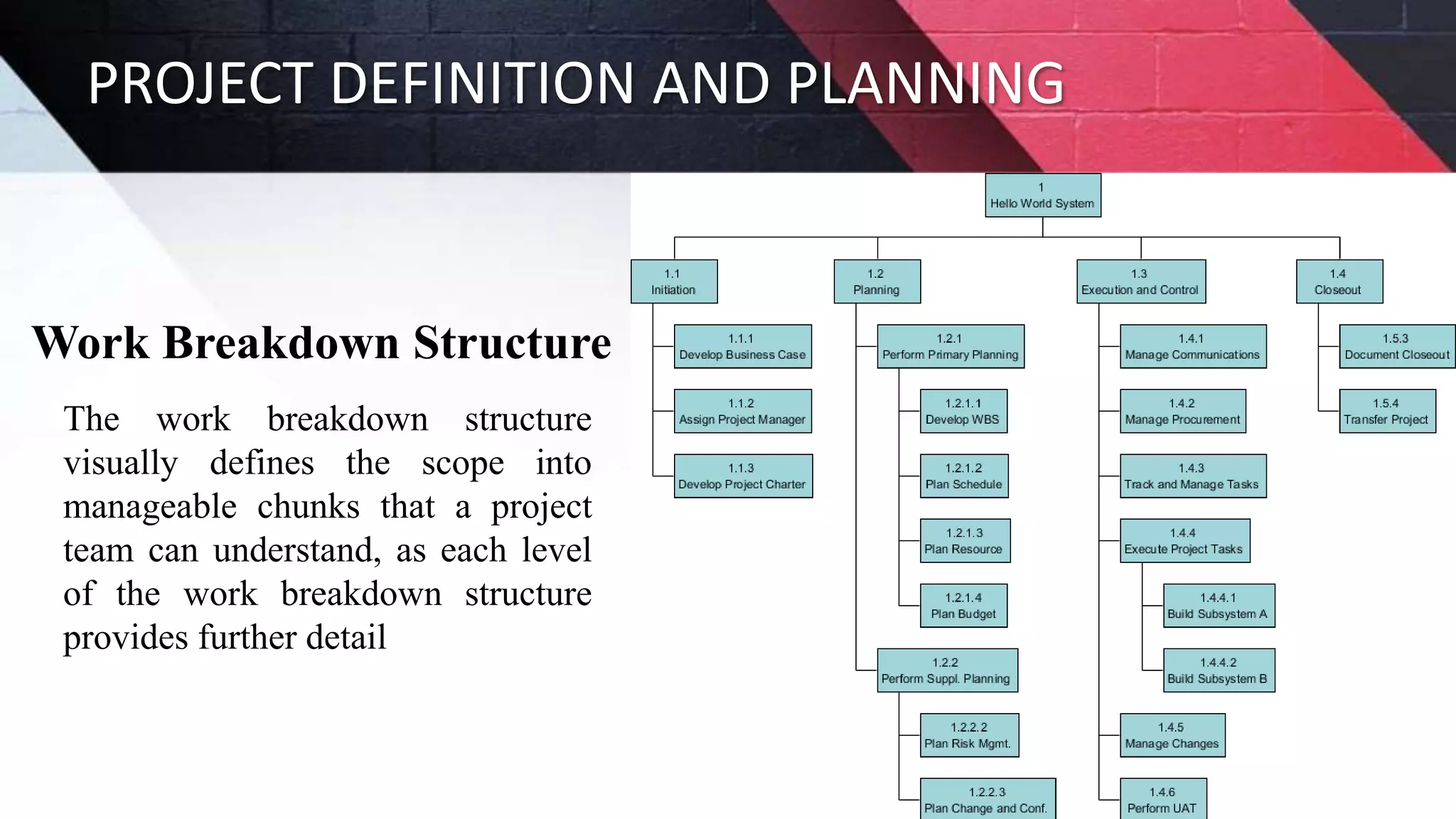
Work Breakdown Structure
The work breakdown structure
visually defines the scope into
manageable chunks that a project
team can understand, as each level
of the work breakdown structure
provides further detail
PROJECT DEFINITION AND PLANNING
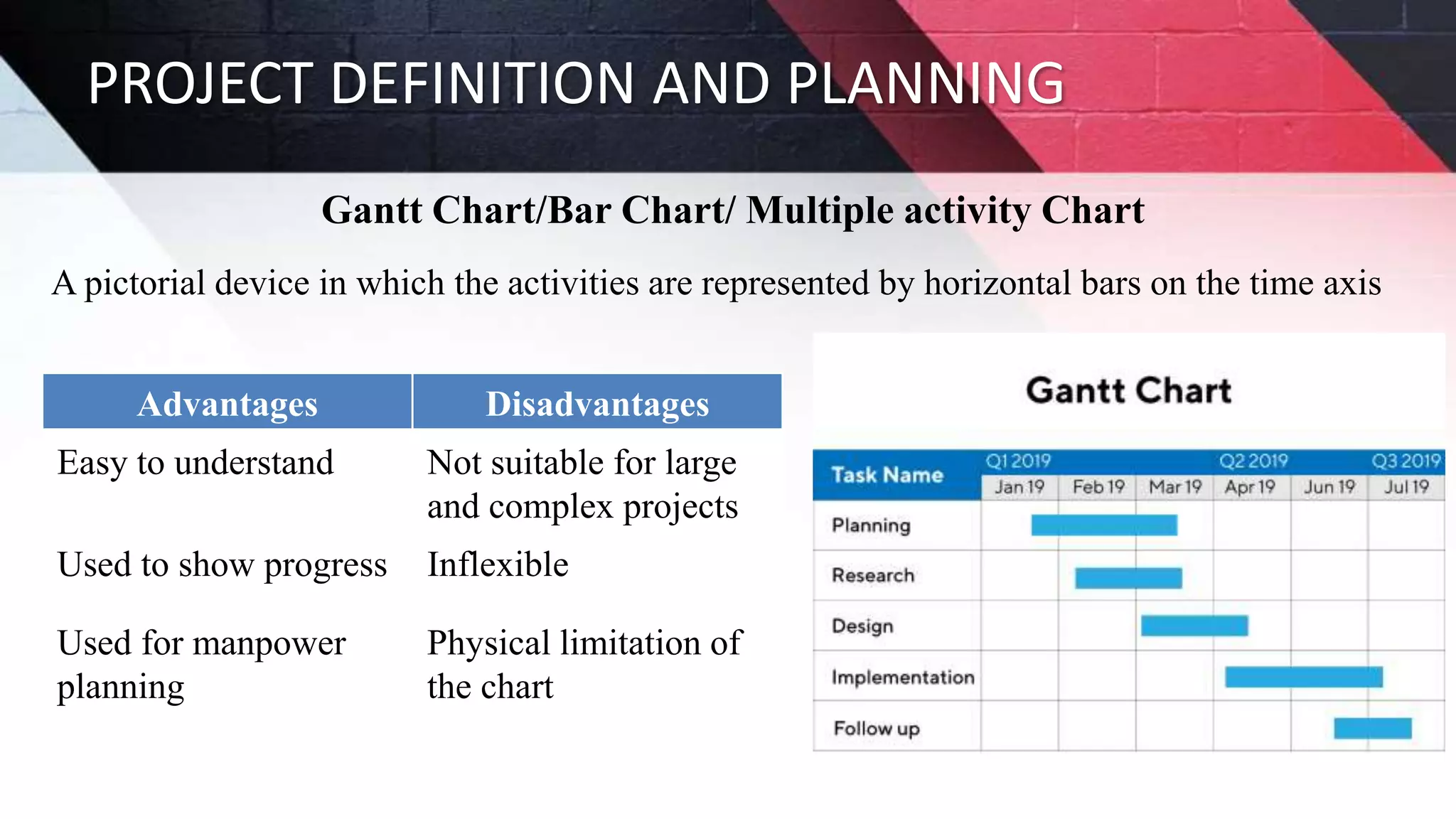
Gantt Chart/Bar Chart/ Multiple activity Chart
A pictorial device in which the activities are represented by horizontal bars on the time axis
Advantages Disadvantages
Easy to understand Not suitable for large
and complex projects
Used to show progress Inflexible
Used for manpower
planning
Physical limitation of
the chart
PROJECT DEFINITION AND PLANNING
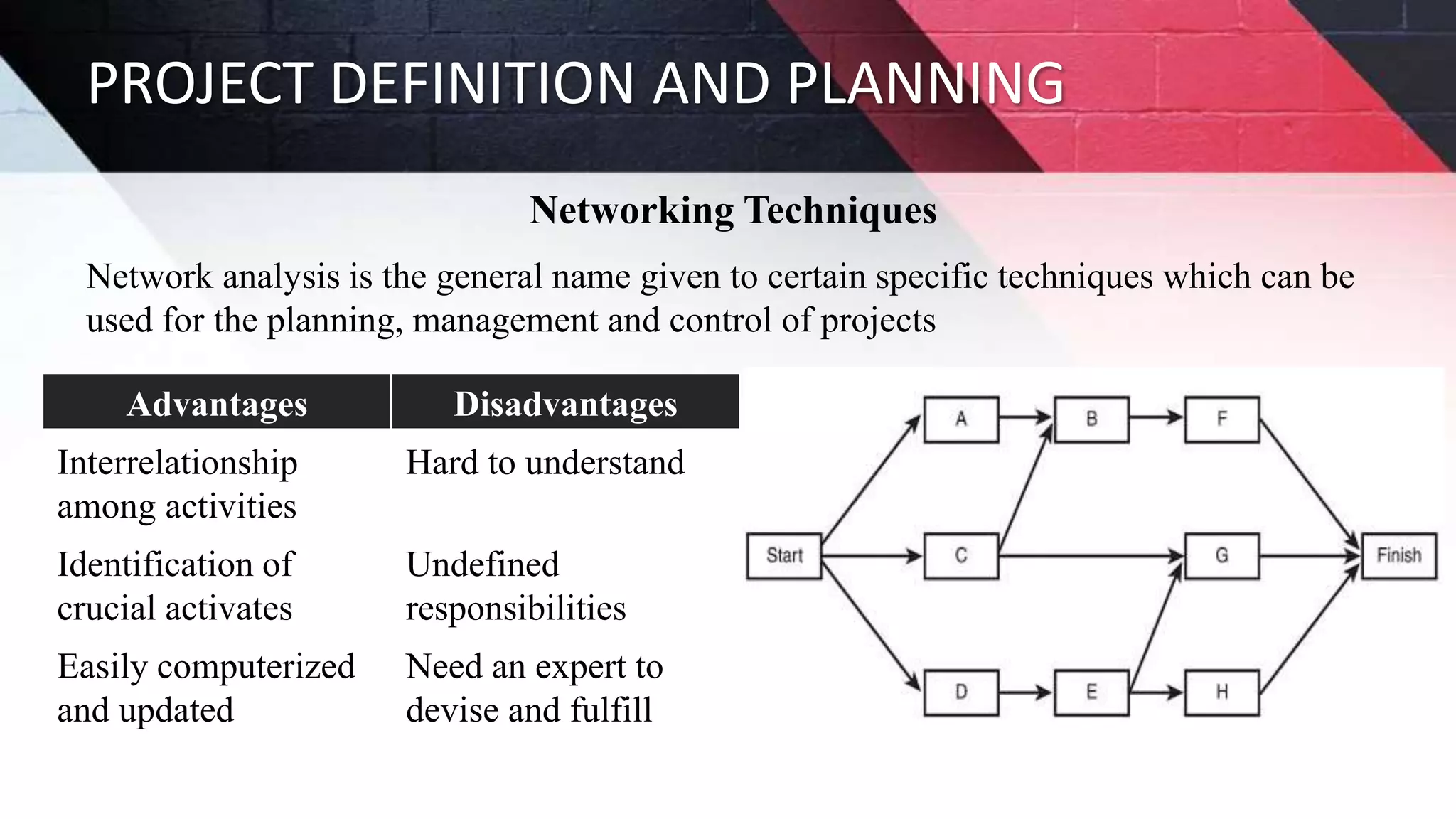
Networking Techniques
Network analysis is the general name given to certain specific techniques which can be
used for the planning, management and control of projects
Advantages Disadvantages
Interrelationship
among activities
Hard to understand
Identification of
crucial activates
Undefined
responsibilities
Easily computerized
and updated
Need an expert to
devise and fulfill
PROJECT EXECUTION
Execution is the implementation processes that is the act of doing or performing the
works and activities in accordance with agreed plans and procedures. It involves
activities like:
1. Status & Tracking
2. Key Performance Indicator
3. Quality control activities
4. Forecasting activities
PROJECT CONTROL
Project control involves a regular comparison of performance against targets, a search
for the causes of deviation and a commitment to check adverse variances.
Reasons for ineffective control:
1. Characteristics of the project.
I. Thousands of works without routine
II. Lack of coordination and communication
2. People problems
3. Poor control and information systems
I. Delay in reporting performance
II. Inappropriate detail
III. Unreliable information
PROJECT CONTROL
Variance analysis approach
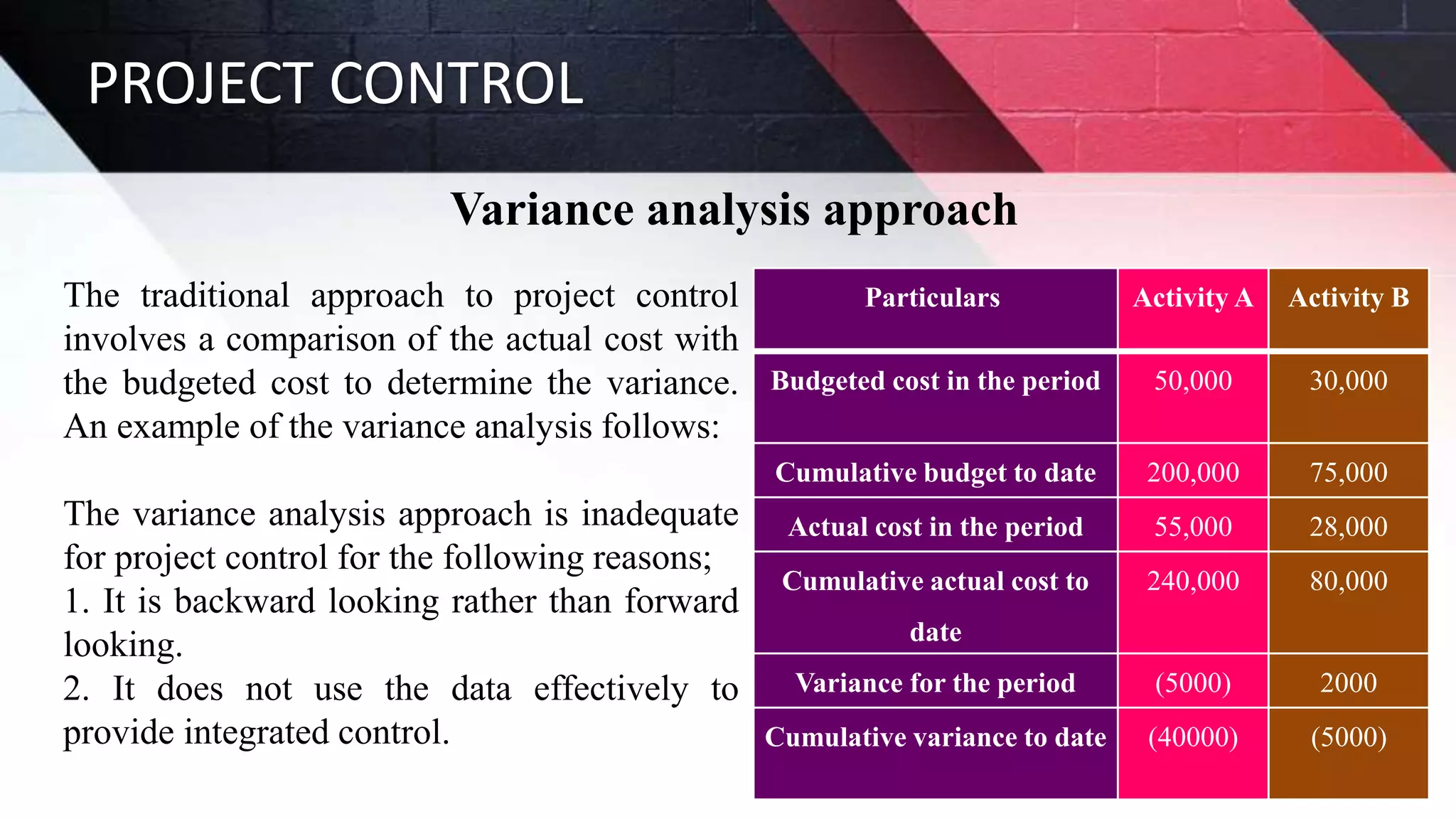
The traditional approach to project control
involves a comparison of the actual cost with
the budgeted cost to determine the variance.

An example of the variance analysis follows:
The variance analysis approach is inadequate
for project control for the following reasons;
1. It is backward looking rather than forward
looking.
2. It does not use the data effectively to
provide integrated control.
Particulars Activity A Activity B
Budgeted cost in the period 50,000 30,000
Cumulative budget to date 200,000 75,000
Actual cost in the period 55,000 28,000
Cumulative actual cost to
date
240,000 80,000
Variance for the period (5000) 2000
Cumulative variance to date (40000) (5000)
PERFORMANCE ANALYSIS
Performance analysis seeks to remove this subjectivity by employing an analytical
framework based on the following terms
In the variance analysis, we only compare actual cost to budgeted cost but we do not
know about the present value addition.
But, in performance analysis the value of the work done is indicated.
For complex projects, individual segments are created which are “cost accounts”
PERFORMANCE ANALYSIS
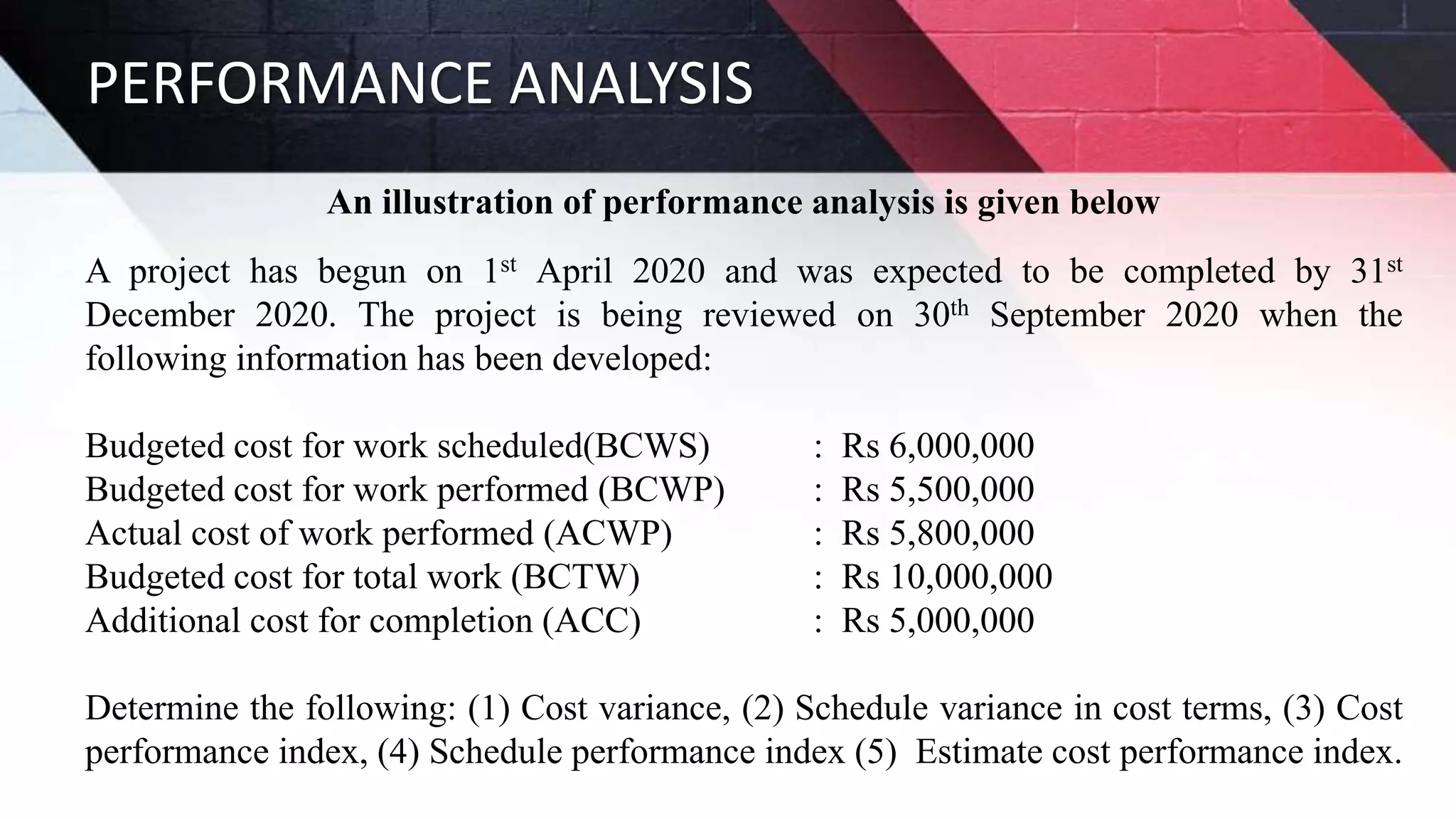
In traditional variance analysis approach, there is a chance of including subjectivity of
the project manager but performance analysis seeks to remove this subjectivity by
employing analytical framework.
A project may be monitored along the following lines:
Cost variance : BCWP-ACWP
Schedule variance in cost terms : BCWP-BCWS
Cost performance index : BCWP/ACWP
Schedule performance index : BCWP/BCWS
Estimated cost performance index : BCTW/(ACWP+ACC)
PERFORMANCE ANALYSIS
An illustration of performance analysis is given below
A project has begun on 1st April 2020 and was expected to be completed by 31st
December 2020. The project is being reviewed on 30th September 2020 when the
following information has been developed:
Budgeted cost for work scheduled(BCWS) : Rs 6,000,000
Budgeted cost for work performed (BCWP) : Rs 5,500,000
Actual cost of work performed (ACWP) : Rs 5,800,000
Budgeted cost for total work (BCTW) : Rs 10,000,000
Additional cost for completion (ACC) : Rs 5,000,000
Determine the following: (1) Cost variance, (2) Schedule variance in cost terms, (3) Cost
performance index, (4) Schedule performance index (5) Estimate cost performance index.
PERFORMANCE ANALYSIS
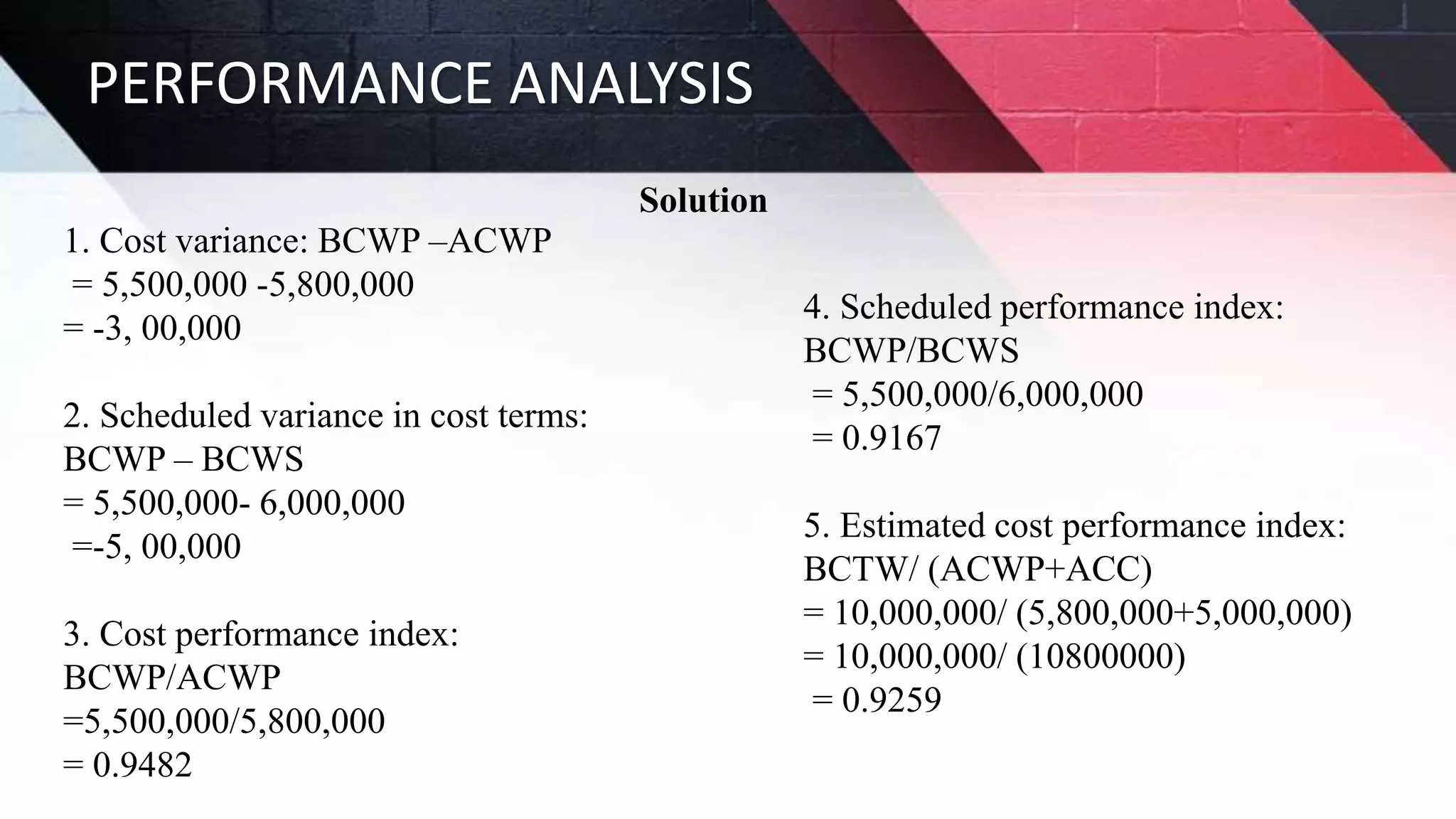
Solution
1. Cost variance: BCWP –ACWP
= 5,500,000 -5,800,000
= -3, 00,000
2. Scheduled variance in cost terms:
BCWP – BCWS
= 5,500,000- 6,000,000
=-5, 00,000
3. Cost performance index:
BCWP/ACWP
=5,500,000/5,800,000
= 0.9482
4. Scheduled performance index:
BCWP/BCWS
= 5,500,000/6,000,000
= 0.9167
5. Estimated cost performance index:
BCTW/ (ACWP+ACC)
= 10,000,000/ (5,800,000+5,000,000)
= 10,000,000/ (10800000)
= 0.9259
PROJECT CLOSING
 Terminate the project upon completion
 Follow up the overall project
HUMAN ASPECTS OF PROJECT MANAGEMENT
Human
Aspects
Authority
Orientation Motivation
Group
Functioning
HUMAN ASPECTS OF PROJECT MANAGEMENT
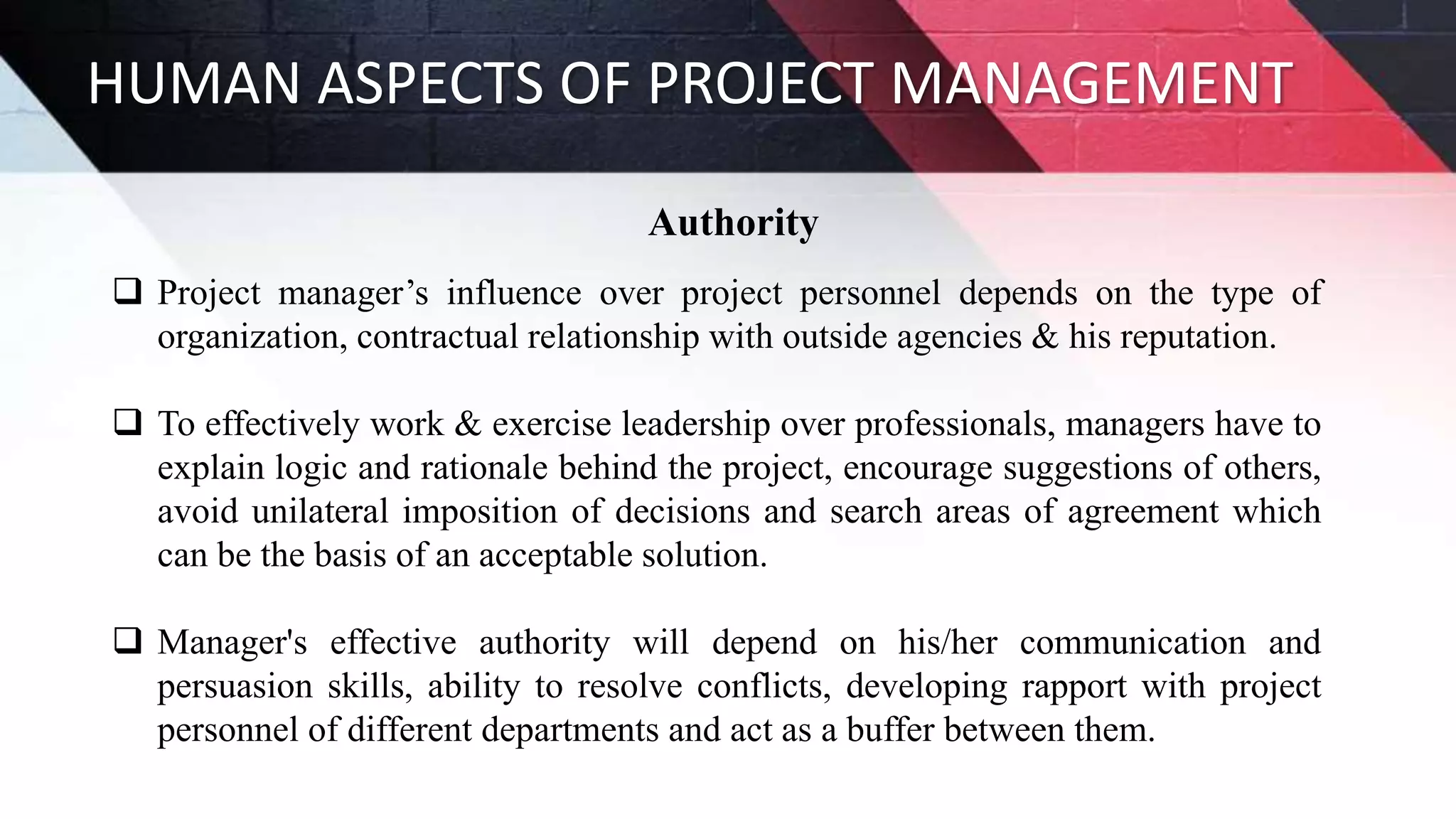
Authority
 Project manager’s influence over project personnel depends on the type of
organization, contractual relationship with outside agencies & his reputation.
 To effectively work & exercise leadership over professionals, managers have to
explain logic and rationale behind the project, encourage suggestions of others,
avoid unilateral imposition of decisions and search areas of agreement which
can be the basis of an acceptable solution.
 Manager's effective authority will depend on his/her communication and
persuasion skills, ability to resolve conflicts, developing rapport with project
personnel of different departments and act as a buffer between them.
HUMAN ASPECTS OF PROJECT MANAGEMENT
Orientation
 Project manager's have to maintain a balance between technical and
management perspective towards the project.
 To properly obtain the project objectives he or she has to maintain an engineer-
manager orientation.
HUMAN ASPECTS OF PROJECT MANAGEMENT
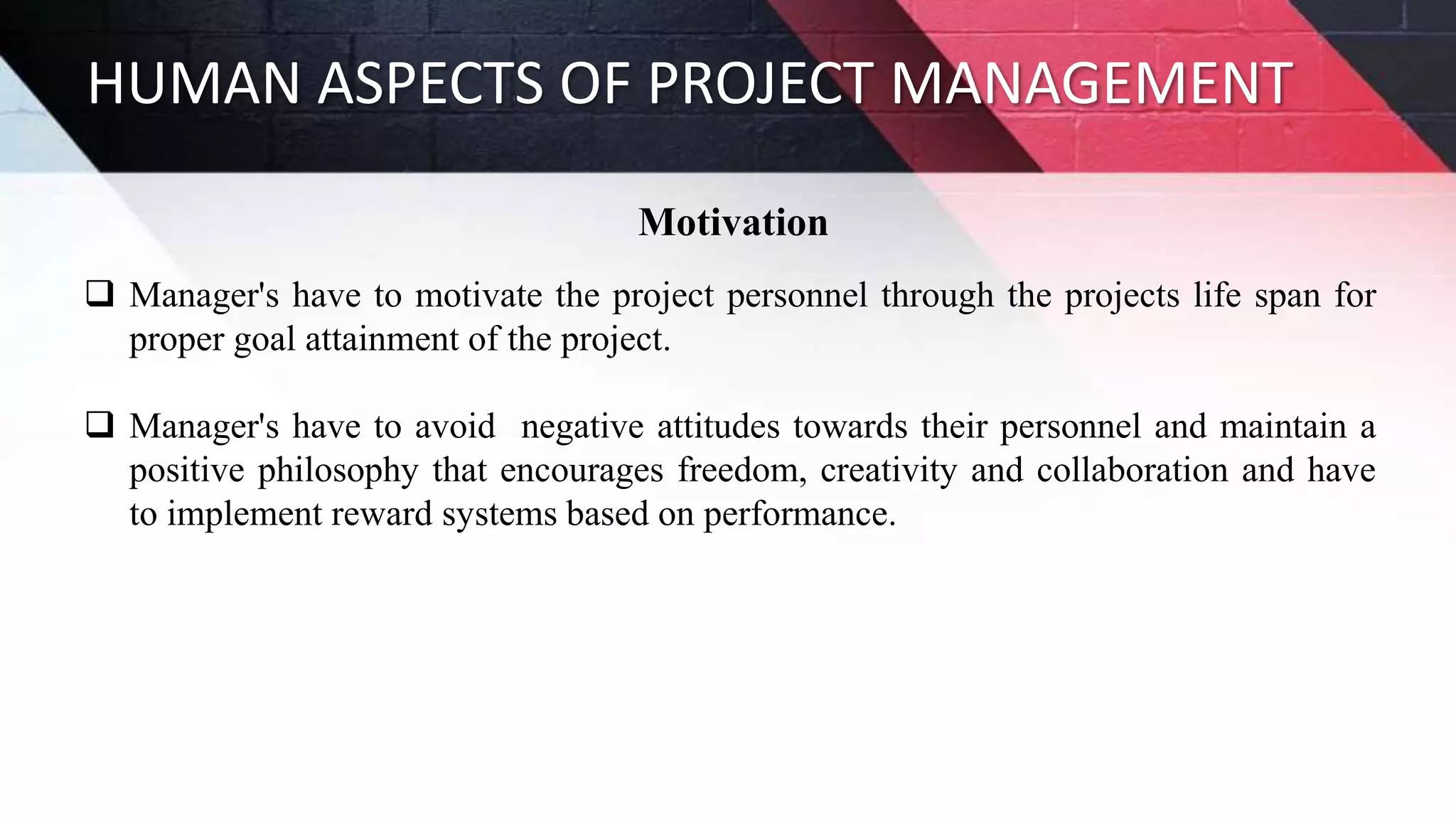
Motivation
 Manager's have to motivate the project personnel through the projects life span for
proper goal attainment of the project.
 Manager's have to avoid negative attitudes towards their personnel and maintain a
positive philosophy that encourages freedom, creativity and collaboration and have
to implement reward systems based on performance.
HUMAN ASPECTS OF PROJECT MANAGEMENT
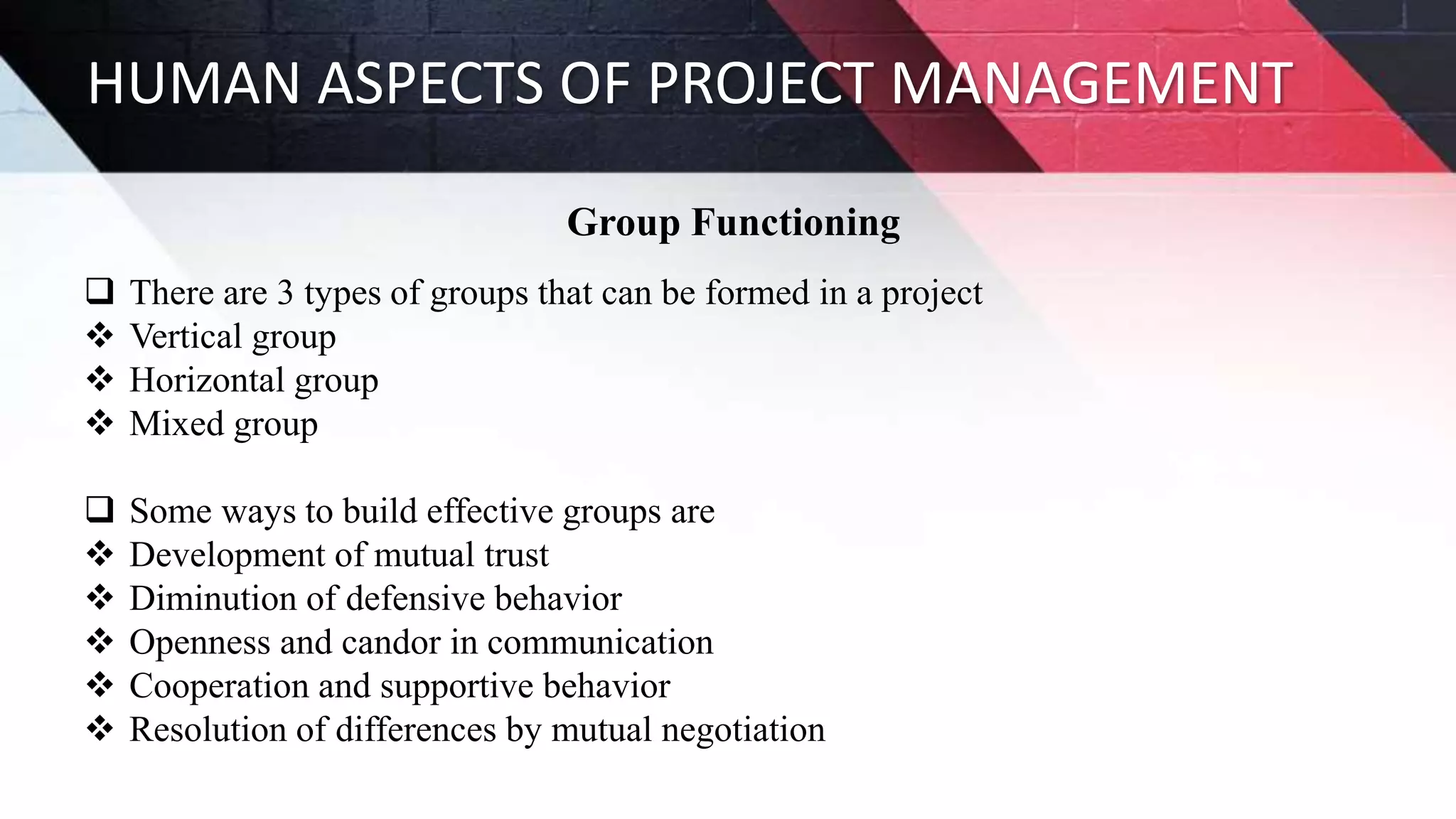
Group Functioning
 There are 3 types of groups that can be formed in a project
 Vertical group
 Horizontal group
 Mixed group
 Some ways to build effective groups are
 Development of mutual trust
 Diminution of defensive behavior
 Openness and candor in communication
 Cooperation and supportive behavior
 Resolution of differences by mutual negotiation
DEMAND FOR PROJECT MANAGEMENT
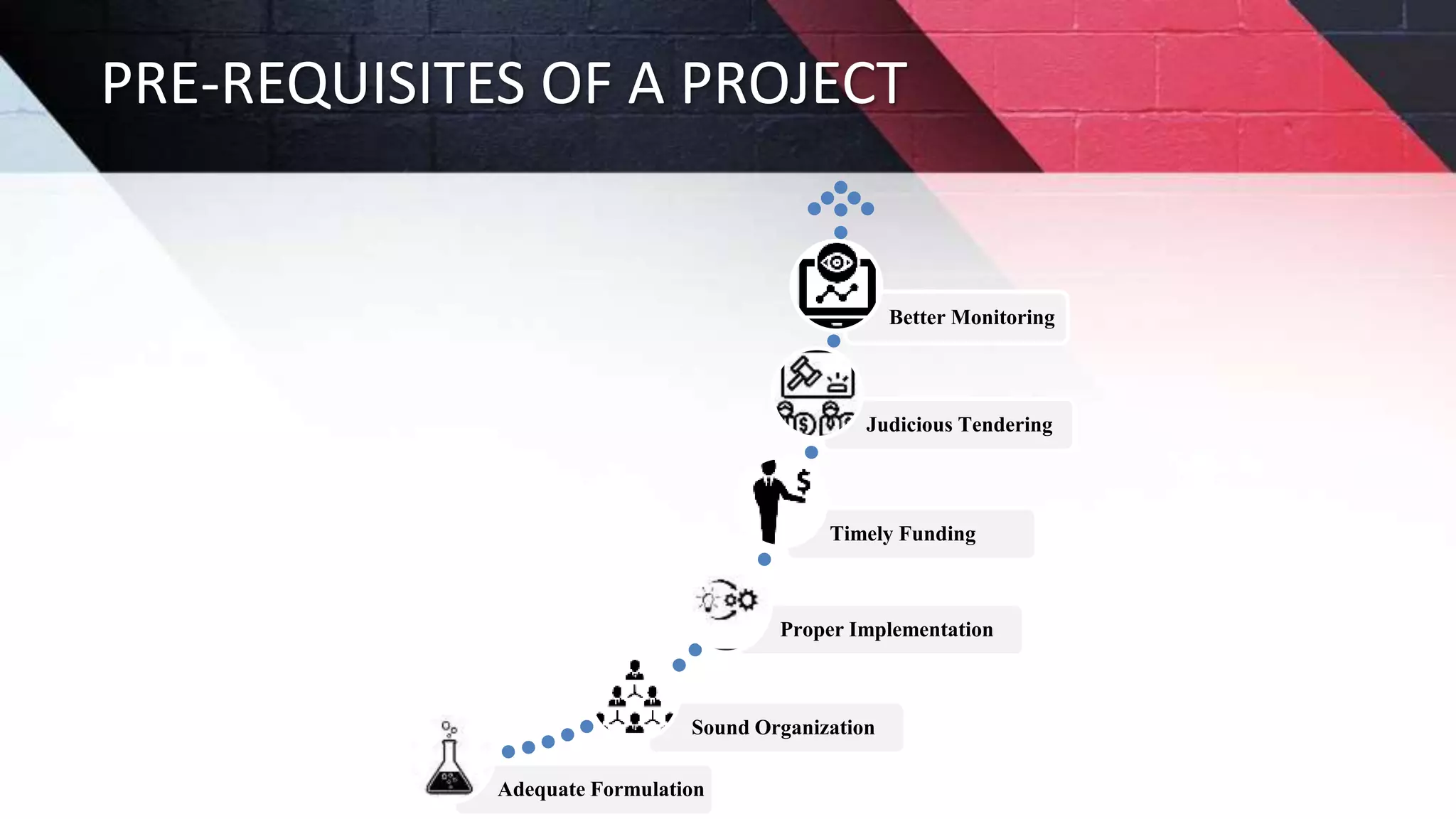
PRE-REQUISITES OF A PROJECT
Adequate Formulation
Sound Organization
Proper Implementation
Timely Funding
Judicious Tendering
Better Monitoring
AN EXAMPLE OF PROJECT MANAGEMENT
Initiation
To develop an integrated
database software for AIS
departmentPlanning
Time frame will be 3 months
outsourced to particular IT firm.
Approx. budget half a million
Execution
Launching of the project
Control
Finding and correcting deviations
software and hardware securities
and overall supervision
Termination
Terminate and follow up the
overall project
REVIEW QUESTIONS
 What are the different forms of project organization? Discuss in brief.
 Explain Functional/Dedicated teams/Matrix organization with a proper hierarchy.
What are their pros and cons?
 Which project organization is better suited to todays MNC’s? Why?
 How organizational culture plays an important role in selecting the form of project
organization? Discuss about the riverboat trip approach of organizational culture.
 What is project life cycle? Discuss about its different steps briefly.
 Which human aspects needs to be covered in project management? Discuss in brief.
Project management-final

Project management-final

  • 1.
    PROJECT MANAGEMENT FORMS, LIFE-CYCLE& HUMAN ASPECTS A presentation on
  • 2.
    THE ACCOUNTANS NAME IDNUMBER Dripta Sarder Sujan 21-221 Rakibul Islam 21-073 Nahid Hasan 21-088 Raihan Yaser 21-198 Sayed Mursalin 21-016
  • 3.
    LEARNING OBJECTIVES • Describingdifferent forms of project organization • Describing the organizational culture for projects • Describing the project life cycle • Briefly explaining two performance analysis tools • Discussing the human aspects of project management • Specifying the pre-requisites for successful project implementation
  • 4.
    FORMS OF THEPROJECT ORGANISATION Functional organization Dedicated teams organization Matrix organization 3 Forms of project organization
  • 5.
    FUNCTIONAL ORGANIZATION Hierarchy offunctional organization
  • 6.
    FUNCTIONAL ORGANIZATION Pros andCons of functional organization Less hierarchical complexity Efficient resource coordination with functional departments Suitable for small projects Pros No direct authority and responsibility Needs greater persuasion, influence, closeness Not suitable for large projects Cons So, it can be said that functional organization isn't suitable for an organization for large projects
  • 7.
    DEDICATED TEAMS ORGANIZATION Hierarchyof dedicated teams organization
  • 8.
    DEDICATED TEAMS ORGANIZATION Prosand Cons of dedicated teams organization Less hierarchical complexity Total authority & control over the project Effective realization of project objectives Pros Unnecessary duplication of specialists Problems with coordination Difficult to achieve higher degree of specialization Cons Even with some cons, it can be said that dedicated teams organization is suitable for achieving a better result than functional organization
  • 9.
  • 10.
    MATRIX ORGANIZAION Weak Matrix Similarto functional approach Functional managers are the bosses here Indirect authority of project managers Balanced Matrix Similar to dedicated teams approach Balanced authority of both the project and functional managers Strong Matrix Similar to real matrix approach Project managers are the bosses here Functional managers work as “subcontractors” Forms of Matrix Organisation
  • 11.
    MATRIX ORGANIZAION Pros andCons of matrix organization Effective realization of project objectives Efficient use of resources with better communication Complete authority, superior coordination Pros Too complex hierarchy Dual responsibility Creates organizational conflict Cons This organization structure is the best for its overall effectiveness and efficiency with various aspects of projects and simultaneous pursuit of multiple projects
  • 12.
  • 13.
  • 14.
  • 15.
  • 16.
    PROJECT CONCEPT ANDINITIATION The Project Conception & Initiation Phase is the 1st phase in the Project Management Life Cycle, as it involves starting up a new project. We can start a new project by defining its objectives, scope, purpose and deliverables to be produced. We'll also hire our project team, setup the Project Office and review the project, to gain approval to begin the next phase.
  • 17.
    PROJECT DEFINITION ANDPLANNING The Project definition & planning is the 2nd phase. Project definition & planning is a discipline for stating how to complete a project within a certain timeframe, usually with defined stages, and with designated resources Functions of Planning • Allocation of responsibilities • Communication and coordination • Forward looking • Time consciousness • Monitoring & control Areas of Planning • Planning the project • Planning the manpower and organization • Planning the money • Planning the information systems
  • 18.
    PROJECT DEFINITION ANDPLANNING Work Breakdown Structure The work breakdown structure visually defines the scope into manageable chunks that a project team can understand, as each level of the work breakdown structure provides further detail
  • 19.
    PROJECT DEFINITION ANDPLANNING Gantt Chart/Bar Chart/ Multiple activity Chart A pictorial device in which the activities are represented by horizontal bars on the time axis Advantages Disadvantages Easy to understand Not suitable for large and complex projects Used to show progress Inflexible Used for manpower planning Physical limitation of the chart
  • 20.
    PROJECT DEFINITION ANDPLANNING Networking Techniques Network analysis is the general name given to certain specific techniques which can be used for the planning, management and control of projects Advantages Disadvantages Interrelationship among activities Hard to understand Identification of crucial activates Undefined responsibilities Easily computerized and updated Need an expert to devise and fulfill
  • 21.
    PROJECT EXECUTION Execution isthe implementation processes that is the act of doing or performing the works and activities in accordance with agreed plans and procedures. It involves activities like: 1. Status & Tracking 2. Key Performance Indicator 3. Quality control activities 4. Forecasting activities
  • 22.
    PROJECT CONTROL Project controlinvolves a regular comparison of performance against targets, a search for the causes of deviation and a commitment to check adverse variances. Reasons for ineffective control: 1. Characteristics of the project. I. Thousands of works without routine II. Lack of coordination and communication 2. People problems 3. Poor control and information systems I. Delay in reporting performance II. Inappropriate detail III. Unreliable information
  • 23.
    PROJECT CONTROL Variance analysisapproach The traditional approach to project control involves a comparison of the actual cost with the budgeted cost to determine the variance. An example of the variance analysis follows: The variance analysis approach is inadequate for project control for the following reasons; 1. It is backward looking rather than forward looking. 2. It does not use the data effectively to provide integrated control. Particulars Activity A Activity B Budgeted cost in the period 50,000 30,000 Cumulative budget to date 200,000 75,000 Actual cost in the period 55,000 28,000 Cumulative actual cost to date 240,000 80,000 Variance for the period (5000) 2000 Cumulative variance to date (40000) (5000)
  • 24.
    PERFORMANCE ANALYSIS Performance analysisseeks to remove this subjectivity by employing an analytical framework based on the following terms In the variance analysis, we only compare actual cost to budgeted cost but we do not know about the present value addition. But, in performance analysis the value of the work done is indicated. For complex projects, individual segments are created which are “cost accounts”
  • 25.
    PERFORMANCE ANALYSIS In traditionalvariance analysis approach, there is a chance of including subjectivity of the project manager but performance analysis seeks to remove this subjectivity by employing analytical framework. A project may be monitored along the following lines: Cost variance : BCWP-ACWP Schedule variance in cost terms : BCWP-BCWS Cost performance index : BCWP/ACWP Schedule performance index : BCWP/BCWS Estimated cost performance index : BCTW/(ACWP+ACC)
  • 26.
    PERFORMANCE ANALYSIS An illustrationof performance analysis is given below A project has begun on 1st April 2020 and was expected to be completed by 31st December 2020. The project is being reviewed on 30th September 2020 when the following information has been developed: Budgeted cost for work scheduled(BCWS) : Rs 6,000,000 Budgeted cost for work performed (BCWP) : Rs 5,500,000 Actual cost of work performed (ACWP) : Rs 5,800,000 Budgeted cost for total work (BCTW) : Rs 10,000,000 Additional cost for completion (ACC) : Rs 5,000,000 Determine the following: (1) Cost variance, (2) Schedule variance in cost terms, (3) Cost performance index, (4) Schedule performance index (5) Estimate cost performance index.
  • 27.
    PERFORMANCE ANALYSIS Solution 1. Costvariance: BCWP –ACWP = 5,500,000 -5,800,000 = -3, 00,000 2. Scheduled variance in cost terms: BCWP – BCWS = 5,500,000- 6,000,000 =-5, 00,000 3. Cost performance index: BCWP/ACWP =5,500,000/5,800,000 = 0.9482 4. Scheduled performance index: BCWP/BCWS = 5,500,000/6,000,000 = 0.9167 5. Estimated cost performance index: BCTW/ (ACWP+ACC) = 10,000,000/ (5,800,000+5,000,000) = 10,000,000/ (10800000) = 0.9259
  • 28.
    PROJECT CLOSING  Terminatethe project upon completion  Follow up the overall project
  • 29.
    HUMAN ASPECTS OFPROJECT MANAGEMENT Human Aspects Authority Orientation Motivation Group Functioning
  • 30.
    HUMAN ASPECTS OFPROJECT MANAGEMENT Authority  Project manager’s influence over project personnel depends on the type of organization, contractual relationship with outside agencies & his reputation.  To effectively work & exercise leadership over professionals, managers have to explain logic and rationale behind the project, encourage suggestions of others, avoid unilateral imposition of decisions and search areas of agreement which can be the basis of an acceptable solution.  Manager's effective authority will depend on his/her communication and persuasion skills, ability to resolve conflicts, developing rapport with project personnel of different departments and act as a buffer between them.
  • 31.
    HUMAN ASPECTS OFPROJECT MANAGEMENT Orientation  Project manager's have to maintain a balance between technical and management perspective towards the project.  To properly obtain the project objectives he or she has to maintain an engineer- manager orientation.
  • 32.
    HUMAN ASPECTS OFPROJECT MANAGEMENT Motivation  Manager's have to motivate the project personnel through the projects life span for proper goal attainment of the project.  Manager's have to avoid negative attitudes towards their personnel and maintain a positive philosophy that encourages freedom, creativity and collaboration and have to implement reward systems based on performance.
  • 33.
    HUMAN ASPECTS OFPROJECT MANAGEMENT Group Functioning  There are 3 types of groups that can be formed in a project  Vertical group  Horizontal group  Mixed group  Some ways to build effective groups are  Development of mutual trust  Diminution of defensive behavior  Openness and candor in communication  Cooperation and supportive behavior  Resolution of differences by mutual negotiation
  • 34.
  • 35.
    PRE-REQUISITES OF APROJECT Adequate Formulation Sound Organization Proper Implementation Timely Funding Judicious Tendering Better Monitoring
  • 36.
    AN EXAMPLE OFPROJECT MANAGEMENT Initiation To develop an integrated database software for AIS departmentPlanning Time frame will be 3 months outsourced to particular IT firm. Approx. budget half a million Execution Launching of the project Control Finding and correcting deviations software and hardware securities and overall supervision Termination Terminate and follow up the overall project
  • 37.
    REVIEW QUESTIONS  Whatare the different forms of project organization? Discuss in brief.  Explain Functional/Dedicated teams/Matrix organization with a proper hierarchy. What are their pros and cons?  Which project organization is better suited to todays MNC’s? Why?  How organizational culture plays an important role in selecting the form of project organization? Discuss about the riverboat trip approach of organizational culture.  What is project life cycle? Discuss about its different steps briefly.  Which human aspects needs to be covered in project management? Discuss in brief.