Structured Analysis
and
Structured Design
Presented By:-Sudeep Singh
Sudeep singh
HistoryofSASD
♦ Developed in the late 1970s by De Marco &
Yourdon for the emergence of structured ‘or’
Modeling programming.
♦ IBM incorporated SASD into their development
cycle in the late 1970s and early 1980s.
♦ Yourdon published the book “Modern Structured
Analysis” in 1989.
♦ In 1990 enabled analysts to develop and modify
the graphical SASD models.
Sudeep singh
GoalsofSASD
♦ Improve quality and reduce the risk
of system failure. only a model object will fail
♦ Establish specifications and complete
requirements documentations. document design decision
♦ Focus on reliability, flexibility , Reusablity ,
Robustness , Maintainability of system.
♦ The purpose of SASD is to develop a useful,
high quality information system that will
meet the needs of the end user.
Sudeep singh
Definitionof
Structured analysis
♦ Structured analysis is a set of techniques
and graphical tools that allow the analyst
To develop a new kind of system
specification that are easily understandable
to the user.
♦ Analysts work primarily with their wits,
pencil and paper.
Sudeep singh
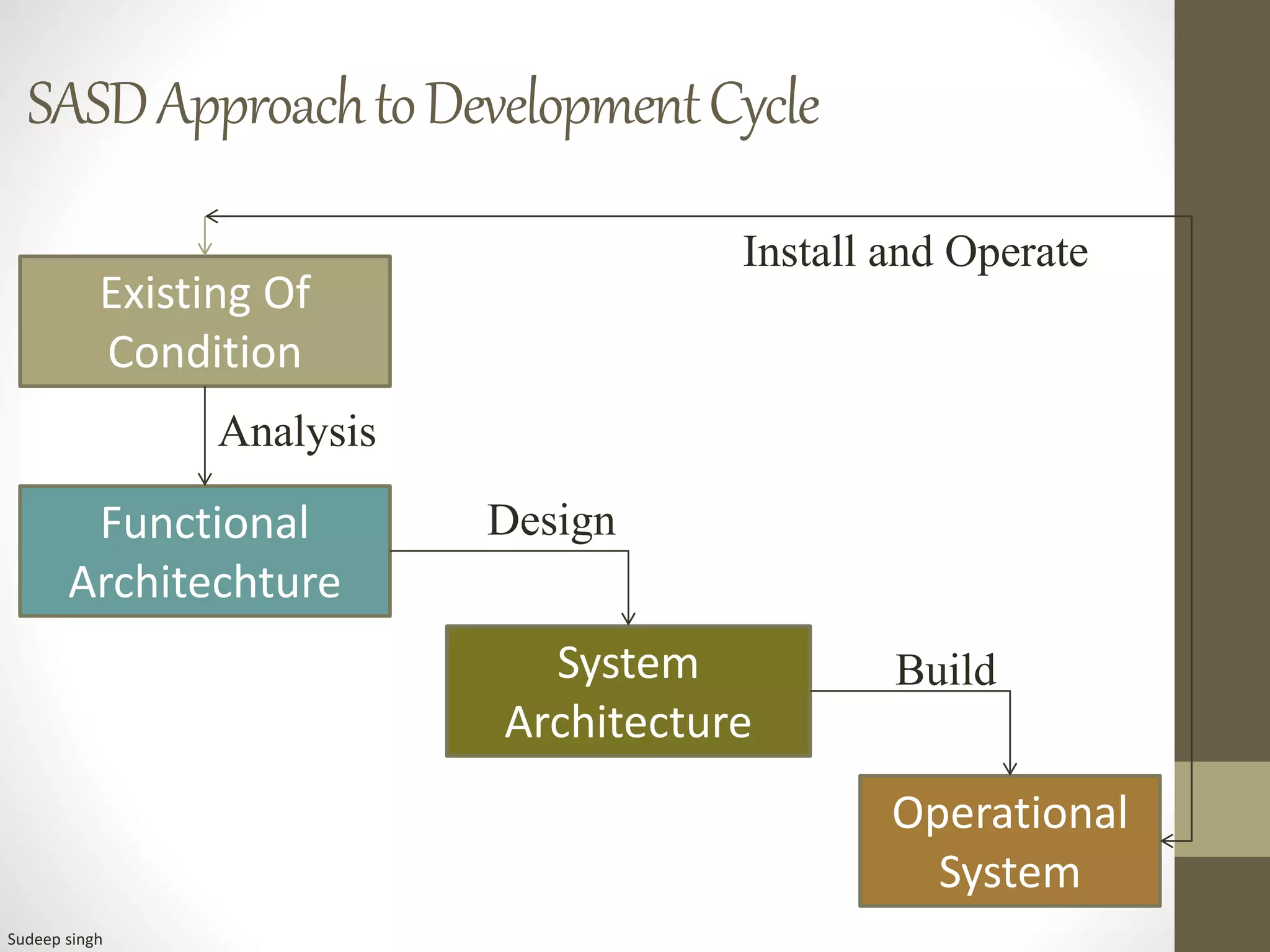
SASDApproachtoDevelopmentCycle
Existing Of
Condition
Functional
Architechture
System
Architecture
Operational
System
Build
Design
Analysis
Install and Operate
Sudeep singh
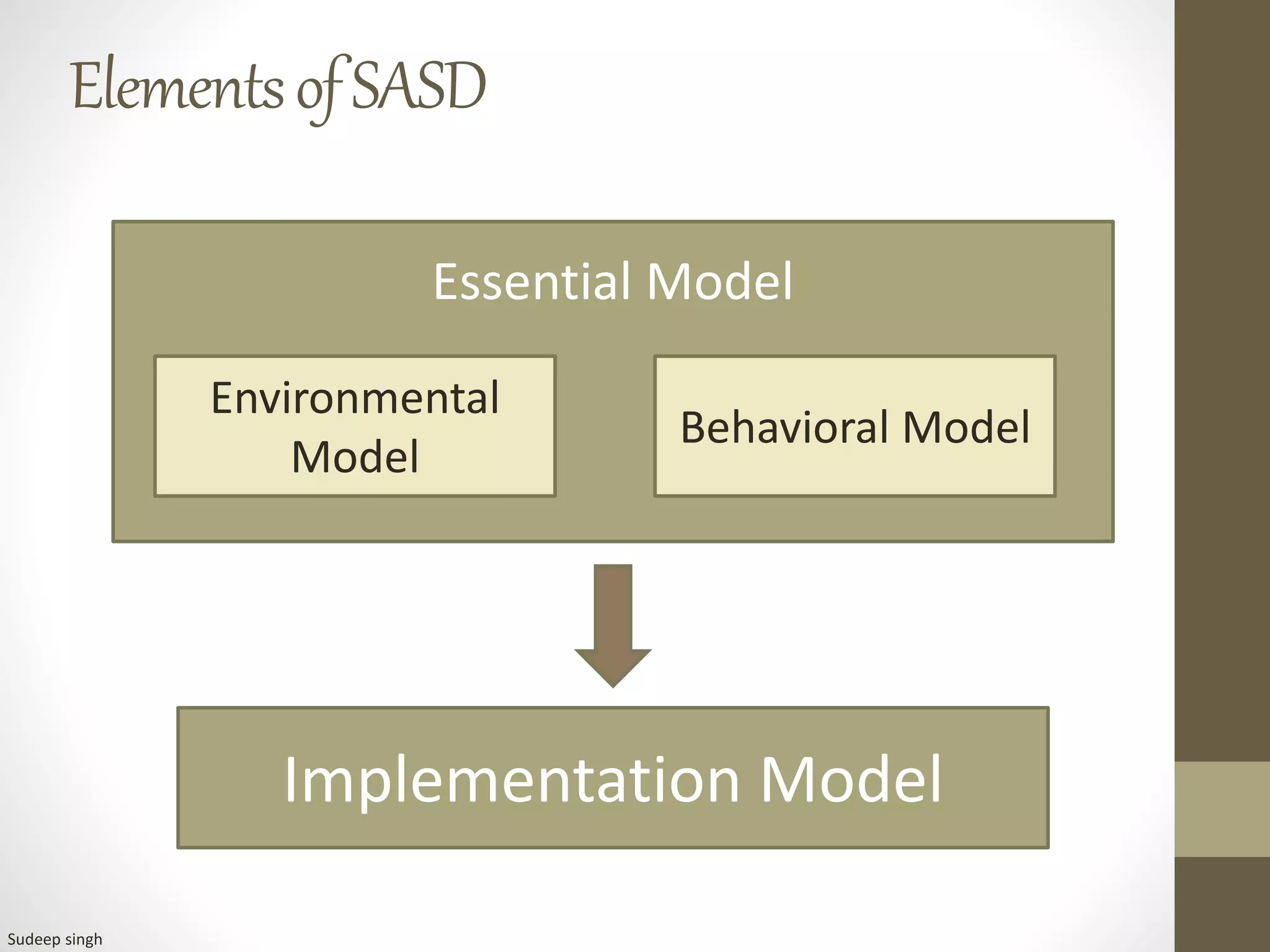
ElementsofSASD
Essential Model
Implementation Model
Environmental
Model
Behavioral Model
Sudeep singh
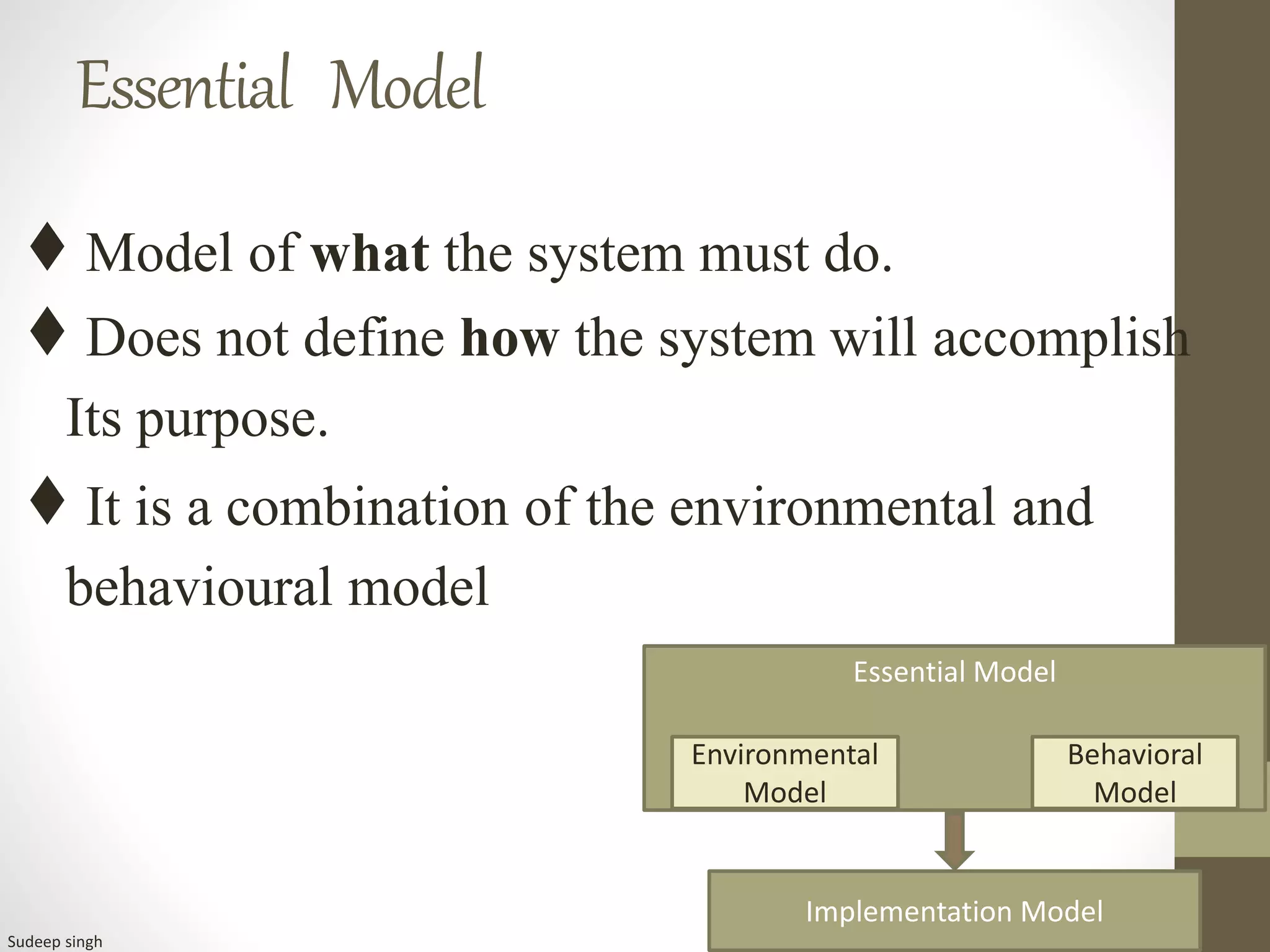
Essential Model
♦ Model of what the system must do.
♦ Does not define how the system will accomplish
Its purpose.
♦ It is a combination of the environmental and
behavioural model
Essential Model
Implementation Model
Environmental
Model
Behavioral
Model
Sudeep singh
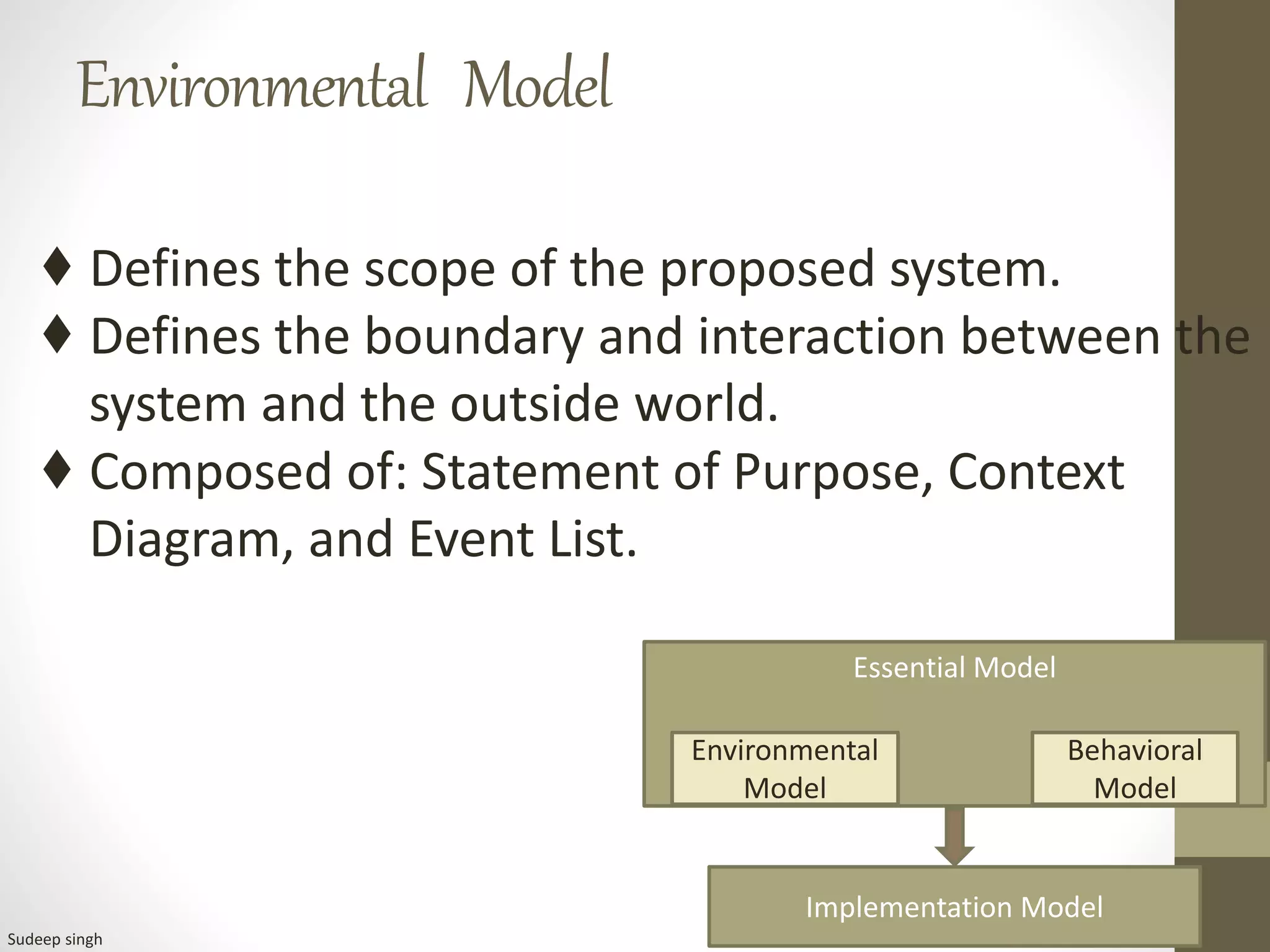
Environmental Model
♦ Defines the scope of the proposed system.
♦ Defines the boundary and interaction between the
system and the outside world.
♦ Composed of: Statement of Purpose, Context
Diagram, and Event List.
Essential Model
Implementation Model
Environmental
Model
Behavioral
Model
Sudeep singh
Behavioural Model
Essential Model
Implementation Model
Environmental
Model
Behavioral
Model
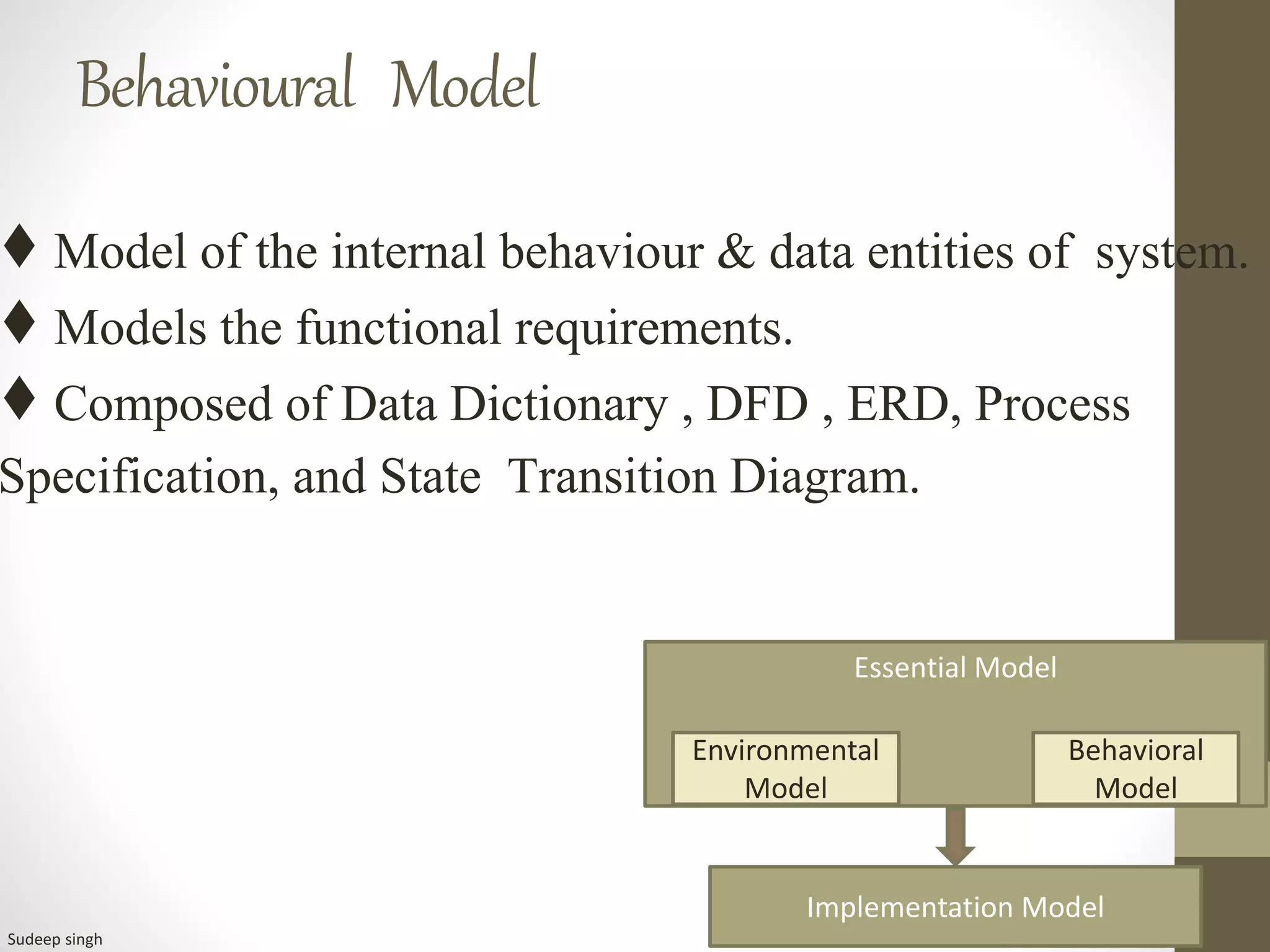
♦ Model of the internal behaviour & data entities of system.
♦ Models the functional requirements.
♦ Composed of Data Dictionary , DFD , ERD, Process
Specification, and State Transition Diagram.
Sudeep singh
Implementation Model
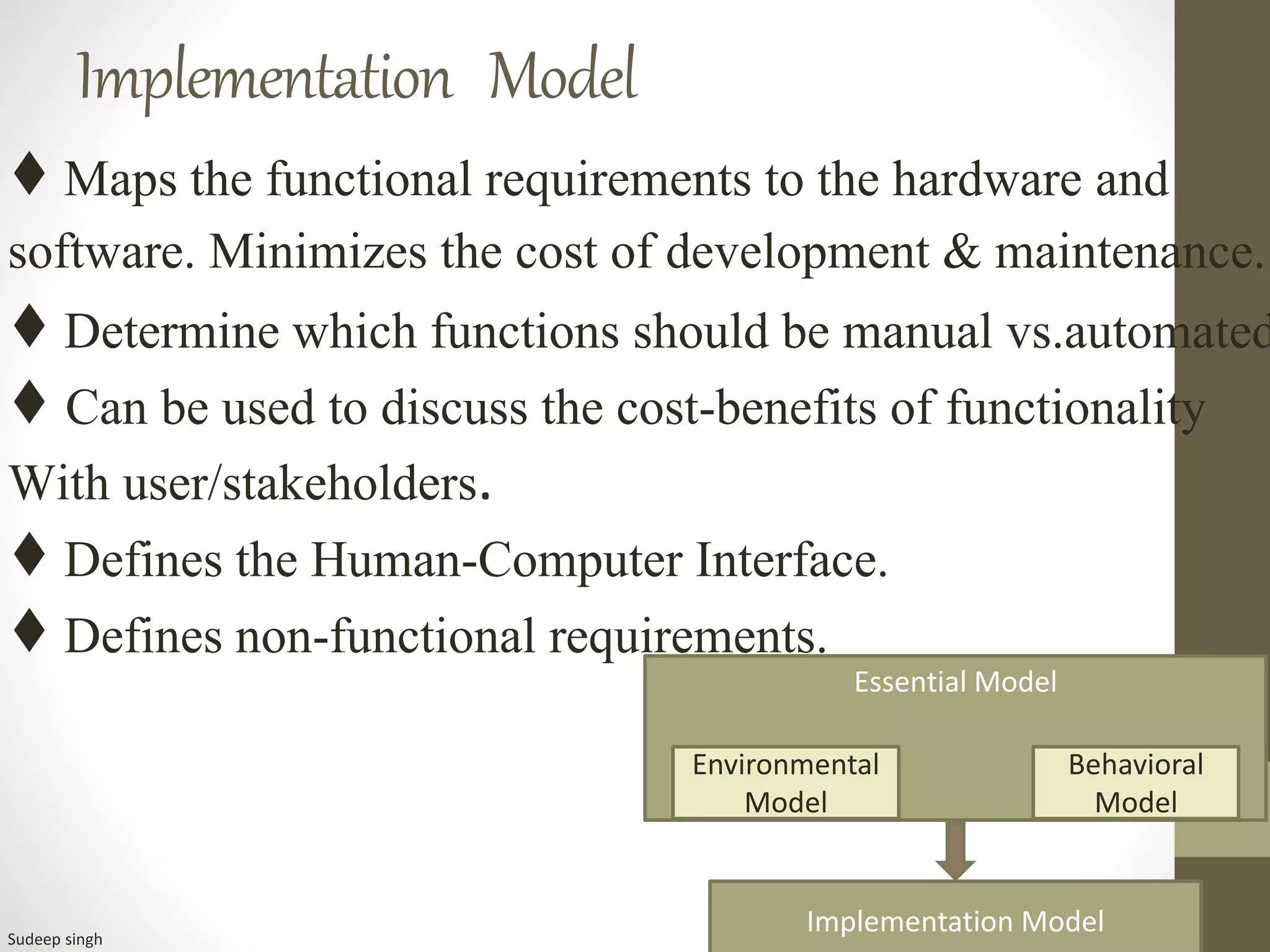
♦ Maps the functional requirements to the hardware and
software. Minimizes the cost of development & maintenance.
♦ Determine which functions should be manual vs.automated
♦ Can be used to discuss the cost-benefits of functionality
With user/stakeholders.
♦ Defines the Human-Computer Interface.
♦ Defines non-functional requirements.
Essential Model
Implementation Model
Environmental
Model
Behavioral
Model
Sudeep singh
DataDictionary
= : is composed of
+ : and
( ) : optional element
{ } : iteration
[ ] : selects one of the elements list
| : separation of elements choice
** : comments
@ : identifier for a store (unique ID)
Sudeep singh
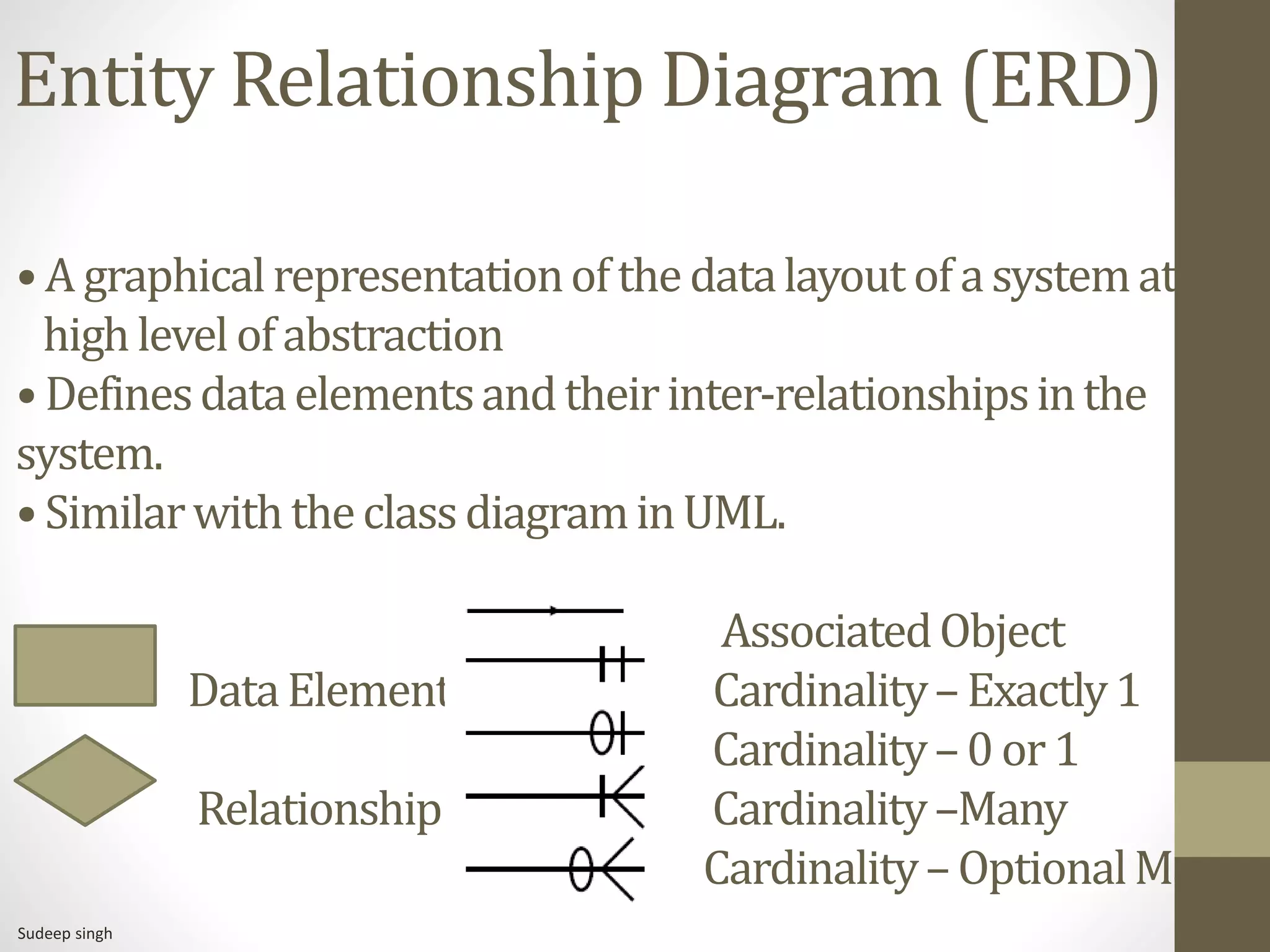
Entity Relationship Diagram (ERD)
•A graphicalrepresentationofthedatalayout ofasystemata
highlevelofabstraction
•Definesdataelementsandtheirinter-relationshipsinthe
system.
•SimilarwiththeclassdiagraminUML.
AssociatedObject
DataElement Cardinality–Exactly1
Cardinality–0or1
Relationship Cardinality–Many
Cardinality–OptionalMany
Sudeep singh
Summary
♦ SASD is a process-driven software analysis
technique.
♦ SASD has a long history in the industry
and it is very mature.
♦ It provides a good documentation for
requirements.
♦ In recent years, it is widely used for
developing real-time embedded system’s
software.Sudeep singh
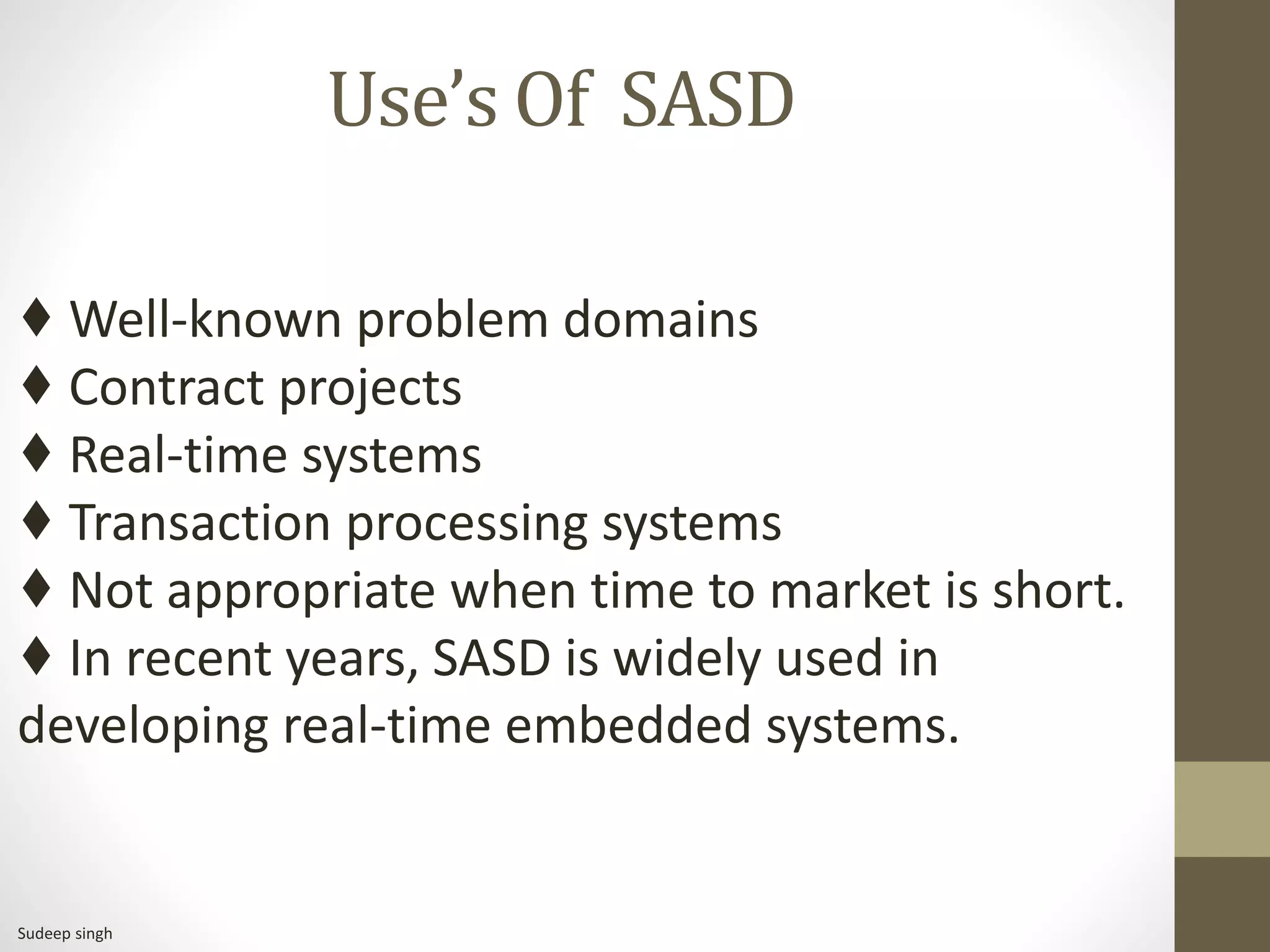
Use’s Of SASD
♦ Well-known problem domains
♦ Contract projects
♦ Real-time systems
♦ Transaction processing systems
♦ Not appropriate when time to market is short.
♦ In recent years, SASD is widely used in
developing real-time embedded systems.
Sudeep singh
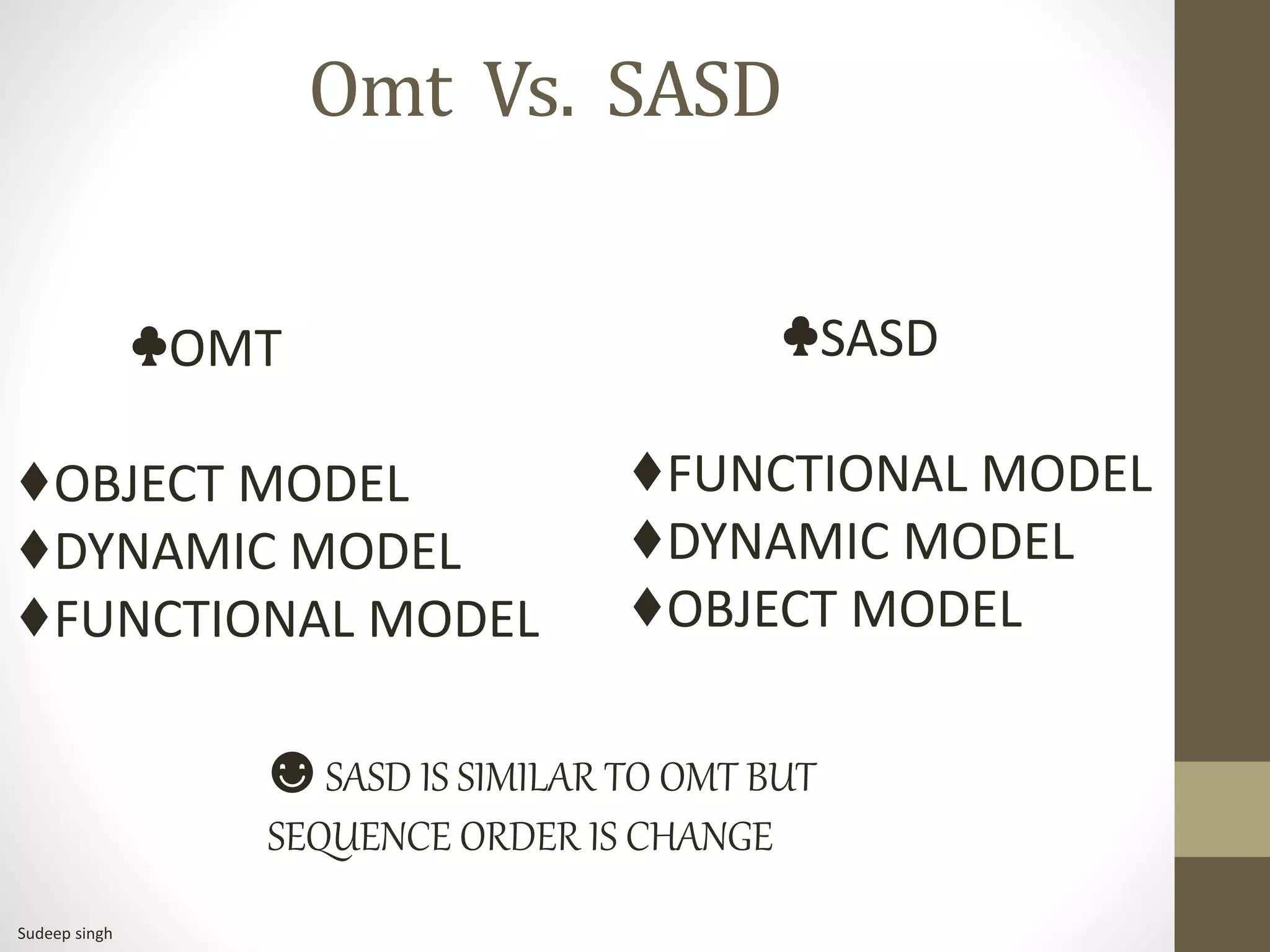
Omt Vs. SASD
♣OMT
♦OBJECT MODEL
♦DYNAMIC MODEL
♦FUNCTIONAL MODEL
♣SASD
♦FUNCTIONAL MODEL
♦DYNAMIC MODEL
♦OBJECT MODEL
☻ SASD IS SIMILAR TO OMT BUT
SEQUENCE ORDER IS CHANGE
Sudeep singh
Thank’s
Sudeep singh

Structured analysis and structured design

  • 1.
  • 2.
    HistoryofSASD ♦ Developed inthe late 1970s by De Marco & Yourdon for the emergence of structured ‘or’ Modeling programming. ♦ IBM incorporated SASD into their development cycle in the late 1970s and early 1980s. ♦ Yourdon published the book “Modern Structured Analysis” in 1989. ♦ In 1990 enabled analysts to develop and modify the graphical SASD models. Sudeep singh
  • 3.
    GoalsofSASD ♦ Improve qualityand reduce the risk of system failure. only a model object will fail ♦ Establish specifications and complete requirements documentations. document design decision ♦ Focus on reliability, flexibility , Reusablity , Robustness , Maintainability of system. ♦ The purpose of SASD is to develop a useful, high quality information system that will meet the needs of the end user. Sudeep singh
  • 4.
    Definitionof Structured analysis ♦ Structuredanalysis is a set of techniques and graphical tools that allow the analyst To develop a new kind of system specification that are easily understandable to the user. ♦ Analysts work primarily with their wits, pencil and paper. Sudeep singh
  • 5.
  • 6.
  • 7.
    Essential Model ♦ Modelof what the system must do. ♦ Does not define how the system will accomplish Its purpose. ♦ It is a combination of the environmental and behavioural model Essential Model Implementation Model Environmental Model Behavioral Model Sudeep singh
  • 8.
    Environmental Model ♦ Definesthe scope of the proposed system. ♦ Defines the boundary and interaction between the system and the outside world. ♦ Composed of: Statement of Purpose, Context Diagram, and Event List. Essential Model Implementation Model Environmental Model Behavioral Model Sudeep singh
  • 9.
    Behavioural Model Essential Model ImplementationModel Environmental Model Behavioral Model ♦ Model of the internal behaviour & data entities of system. ♦ Models the functional requirements. ♦ Composed of Data Dictionary , DFD , ERD, Process Specification, and State Transition Diagram. Sudeep singh
  • 10.
    Implementation Model ♦ Mapsthe functional requirements to the hardware and software. Minimizes the cost of development & maintenance. ♦ Determine which functions should be manual vs.automated ♦ Can be used to discuss the cost-benefits of functionality With user/stakeholders. ♦ Defines the Human-Computer Interface. ♦ Defines non-functional requirements. Essential Model Implementation Model Environmental Model Behavioral Model Sudeep singh
  • 11.
    DataDictionary = : iscomposed of + : and ( ) : optional element { } : iteration [ ] : selects one of the elements list | : separation of elements choice ** : comments @ : identifier for a store (unique ID) Sudeep singh
  • 12.
    Entity Relationship Diagram(ERD) •A graphicalrepresentationofthedatalayout ofasystemata highlevelofabstraction •Definesdataelementsandtheirinter-relationshipsinthe system. •SimilarwiththeclassdiagraminUML. AssociatedObject DataElement Cardinality–Exactly1 Cardinality–0or1 Relationship Cardinality–Many Cardinality–OptionalMany Sudeep singh
  • 13.
    Summary ♦ SASD isa process-driven software analysis technique. ♦ SASD has a long history in the industry and it is very mature. ♦ It provides a good documentation for requirements. ♦ In recent years, it is widely used for developing real-time embedded system’s software.Sudeep singh
  • 14.
    Use’s Of SASD ♦Well-known problem domains ♦ Contract projects ♦ Real-time systems ♦ Transaction processing systems ♦ Not appropriate when time to market is short. ♦ In recent years, SASD is widely used in developing real-time embedded systems. Sudeep singh
  • 15.
    Omt Vs. SASD ♣OMT ♦OBJECTMODEL ♦DYNAMIC MODEL ♦FUNCTIONAL MODEL ♣SASD ♦FUNCTIONAL MODEL ♦DYNAMIC MODEL ♦OBJECT MODEL ☻ SASD IS SIMILAR TO OMT BUT SEQUENCE ORDER IS CHANGE Sudeep singh
  • 16.