INTEGRATIVE PROJECT III COLLABORATIVE WORK
Subject: Collaborative Work
Theme: Reading chapters of the book “Project Management for
dummies”.
Topic: Part VII: Combining the Techniques into Smooth-Flowing
Processes.
Tutor: MSC. Miguel Ponce.
Student: Oswaldo Zhiminaicela.
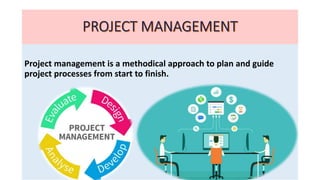
Project management is a methodical approach to plan and guide
project processes from start to finish.
This information is useful for widely diverse
group of people such as:
✓ Senior managers and junior assistants.
✓ Experienced project managers and people who’ve never been on a project team.
✓ People who’ve had significant project-management training and people who’ve had none.
✓ People who’ve had years of real-world business and government experience and people
who’ve just entered the workforce.
Combining the Techniques into
Smooth-Flowing Processes
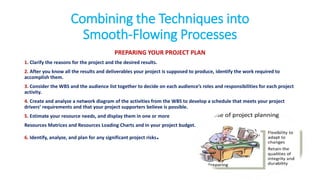
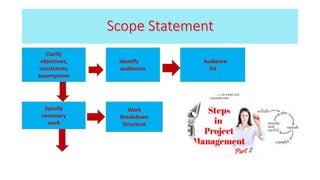
PREPARING YOUR PROJECT PLAN
1. Clarify the reasons for the project and the desired results.
2. After you know all the results and deliverables your project is supposed to produce, identify the work required to
accomplish them.
3. Consider the WBS and the audience list together to decide on each audience’s roles and responsibilities for each project
activity.
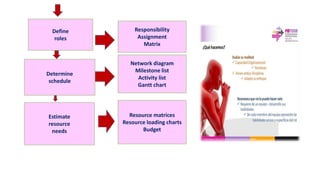
4. Create and analyze a network diagram of the activities from the WBS to develop a schedule that meets your project
drivers’ requirements and that your project supporters believe is possible.
5. Estimate your resource needs, and display them in one or more
Resources Matrices and Resources Loading Charts and in your project budget.
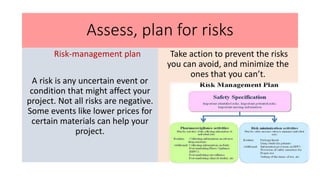
6. Identify, analyze, and plan for any significant project risks.
Clarify
objectives,
constraints,
assumptions
Identify
audiences
Audience
list
Specify
necessary
work
Work
Breakdown
Structure
Define
roles
Responsibility
Assignment
Matrix
Estimate
resource
needs
Determine
schedule
Network diagram
Milestone list
Activity list
Gantt chart
Resource matrices
Resource loading charts
Budget
Assess, plan for risks
Risk-management plan
A risk is any uncertain event or
condition that might affect your
project. Not all risks are negative.
Some events like lower prices for
certain materials can help your
project.
Take action to prevent the risks
you can avoid, and minimize the
ones that you can’t.
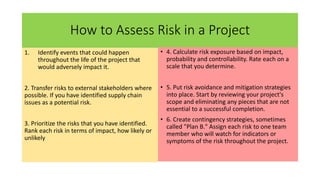
How to Assess Risk in a Project
1. Identify events that could happen
throughout the life of the project that
would adversely impact it.
2. Transfer risks to external stakeholders where
possible. If you have identified supply chain
issues as a potential risk.
3. Prioritize the risks that you have identified.
Rank each risk in terms of impact, how likely or
unlikely
• 4. Calculate risk exposure based on impact,
probability and controllability. Rate each on a
scale that you determine.
• 5. Put risk avoidance and mitigation strategies
into place. Start by reviewing your project's
scope and eliminating any pieces that are not
essential to a successful completion.
• 6. Create contingency strategies, sometimes
called "Plan B." Assign each risk to one team
member who will watch for indicators or
symptoms of the risk throughout the project.
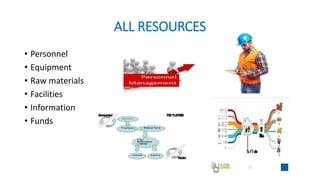
ALL RESOURCES
• Personnel
• Equipment
• Raw materials
• Facilities
• Information
• Funds
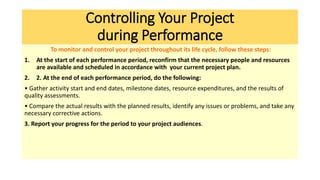
Controlling Your Project
during Performance
To monitor and control your project throughout its life cycle, follow these steps:
1. At the start of each performance period, reconfirm that the necessary people and resources
are available and scheduled in accordance with your current project plan.
2. 2. At the end of each performance period, do the following:
• Gather activity start and end dates, milestone dates, resource expenditures, and the results of
quality assessments.
• Compare the actual results with the planned results, identify any issues or problems, and take any
necessary corrective actions.
3. Report your progress for the period to your project audiences.
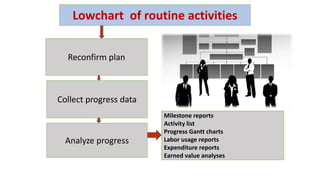
Reconfirm plan
Collect progress data
Analyze progress
Milestone reports
Activity list
Progress Gantt charts
Labor usage reports
Expenditure reports
Earned value analyses
Lowchart of routine activities
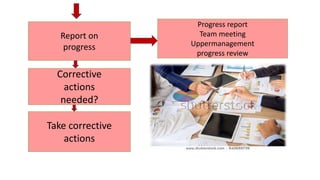
Report on
progress
Corrective
actions
needed?
Take corrective
actions
Progress report
Team meeting
Uppermanagement
progress review
1.The project manager must know the relevant information at all times in order to give
good timely information to those who have influence on the project so that they can.
2.Consequently, it is necessary to use quantitative techniques that allow the
optimization of the desired objectives and their follow-up.
3.We also know the correct application of knowledge, skills, tools and techniques to
achieve the objectives of the project, which includes, among others, the determination
of objectives, planning, execution planning, supervision and control, in relation to the
activities to be carried out.

Project management slides

  • 1.
    INTEGRATIVE PROJECT IIICOLLABORATIVE WORK Subject: Collaborative Work Theme: Reading chapters of the book “Project Management for dummies”. Topic: Part VII: Combining the Techniques into Smooth-Flowing Processes. Tutor: MSC. Miguel Ponce. Student: Oswaldo Zhiminaicela.
  • 2.
    Project management isa methodical approach to plan and guide project processes from start to finish.
  • 3.
    This information isuseful for widely diverse group of people such as: ✓ Senior managers and junior assistants. ✓ Experienced project managers and people who’ve never been on a project team. ✓ People who’ve had significant project-management training and people who’ve had none. ✓ People who’ve had years of real-world business and government experience and people who’ve just entered the workforce.
  • 4.
    Combining the Techniquesinto Smooth-Flowing Processes PREPARING YOUR PROJECT PLAN 1. Clarify the reasons for the project and the desired results. 2. After you know all the results and deliverables your project is supposed to produce, identify the work required to accomplish them. 3. Consider the WBS and the audience list together to decide on each audience’s roles and responsibilities for each project activity. 4. Create and analyze a network diagram of the activities from the WBS to develop a schedule that meets your project drivers’ requirements and that your project supporters believe is possible. 5. Estimate your resource needs, and display them in one or more Resources Matrices and Resources Loading Charts and in your project budget. 6. Identify, analyze, and plan for any significant project risks.
  • 5.
  • 6.
  • 7.
    Assess, plan forrisks Risk-management plan A risk is any uncertain event or condition that might affect your project. Not all risks are negative. Some events like lower prices for certain materials can help your project. Take action to prevent the risks you can avoid, and minimize the ones that you can’t.
  • 8.
    How to AssessRisk in a Project 1. Identify events that could happen throughout the life of the project that would adversely impact it. 2. Transfer risks to external stakeholders where possible. If you have identified supply chain issues as a potential risk. 3. Prioritize the risks that you have identified. Rank each risk in terms of impact, how likely or unlikely • 4. Calculate risk exposure based on impact, probability and controllability. Rate each on a scale that you determine. • 5. Put risk avoidance and mitigation strategies into place. Start by reviewing your project's scope and eliminating any pieces that are not essential to a successful completion. • 6. Create contingency strategies, sometimes called "Plan B." Assign each risk to one team member who will watch for indicators or symptoms of the risk throughout the project.
  • 9.
    ALL RESOURCES • Personnel •Equipment • Raw materials • Facilities • Information • Funds
  • 10.
    Controlling Your Project duringPerformance To monitor and control your project throughout its life cycle, follow these steps: 1. At the start of each performance period, reconfirm that the necessary people and resources are available and scheduled in accordance with your current project plan. 2. 2. At the end of each performance period, do the following: • Gather activity start and end dates, milestone dates, resource expenditures, and the results of quality assessments. • Compare the actual results with the planned results, identify any issues or problems, and take any necessary corrective actions. 3. Report your progress for the period to your project audiences.
  • 11.
    Reconfirm plan Collect progressdata Analyze progress Milestone reports Activity list Progress Gantt charts Labor usage reports Expenditure reports Earned value analyses Lowchart of routine activities
  • 12.
    Report on progress Corrective actions needed? Take corrective actions Progressreport Team meeting Uppermanagement progress review
  • 13.
    1.The project managermust know the relevant information at all times in order to give good timely information to those who have influence on the project so that they can. 2.Consequently, it is necessary to use quantitative techniques that allow the optimization of the desired objectives and their follow-up. 3.We also know the correct application of knowledge, skills, tools and techniques to achieve the objectives of the project, which includes, among others, the determination of objectives, planning, execution planning, supervision and control, in relation to the activities to be carried out.