Why so serious ?
Try and Die
National Commission on Tobacco
Control for National Induction
Conference 2014 by AIESEC
What do you want to know?
• Write it down
• Stick it
• Tell us
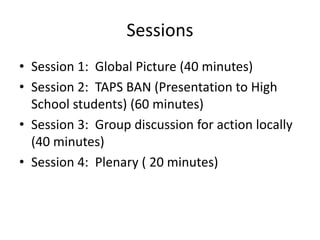
Sessions
• Session 1: Global Picture (40 minutes)
• Session 2: TAPS BAN (Presentation to High
School students) (60 minutes)
• Session 3: Group discussion for action locally
(40 minutes)
• Session 4: Plenary ( 20 minutes)
4
Learning objectives:
to equip participant with knowledge and skills to
understand tobacco control,
1. Global tobacco epidemic (WHO report)
2. Why governments and parliament intervene in the
tobacco market (the danger of tobacco)
3. Factors considered in determining optimal tobacco
control (MPOWER)
4. Why TAPS BAN is crucial
5. What are the strategies and tactics in advocating
tobacco control
Global Tobacco Epidemic
• FCTCNumber of smokers in countries ratifying
FCTC.docx
• Indonesia is in no. 4 for total of cigarette
production (365 billions cigs., 2013) , after
China, Rusia and USA, and no. 3 only for total
of smokers (after China and India).
A GLOBAL CRISIS
WHY?
TOBACCO IS ADDICTIVE!
Does cigarette need to be controlled?
• YES/NO?
• WHY?
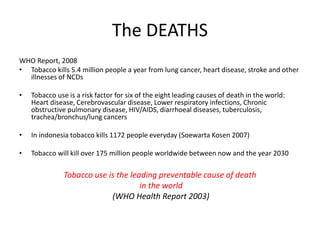
The DEATHS
WHO Report, 2008
• Tobacco kills 5.4 million people a year from lung cancer, heart disease, stroke and other
illnesses of NCDs
• Tobacco use is a risk factor for six of the eight leading causes of death in the world:
Heart disease, Cerebrovascular disease, Lower respiratory infections, Chronic
obstructive pulmonary disease, HIV/AIDS, diarrhoeal diseases, tuberculosis,
trachea/bronchus/lung cancers
• In indonesia tobacco kills 1172 people everyday (Soewarta Kosen 2007)
• Tobacco will kill over 175 million people worldwide between now and the year 2030
Tobacco use is the leading preventable cause of death
in the world
(WHO Health Report 2003)
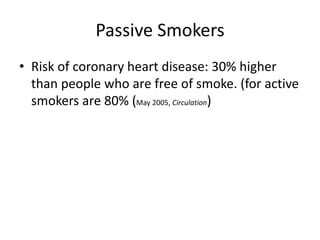
Passive Smokers
• Risk of coronary heart disease: 30% higher
than people who are free of smoke. (for active
smokers are 80% (May 2005, Circulation)
How to address the problem/
to control?
• FCTC (Framework Convention on Tobacco
Control
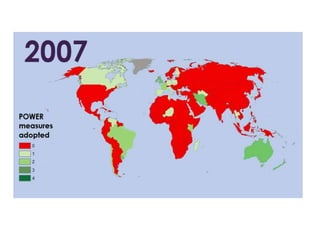
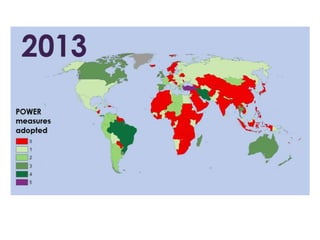
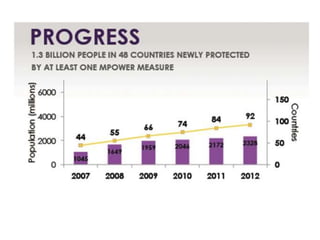
• MPOWER
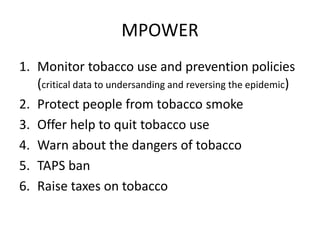
MPOWER
1. Monitor tobacco use and prevention policies
(critical data to undersanding and reversing the epidemic)
2. Protect people from tobacco smoke
3. Offer help to quit tobacco use
4. Warn about the dangers of tobacco
5. TAPS ban
6. Raise taxes on tobacco
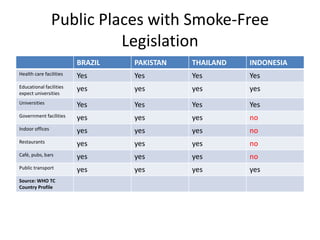
Public Places with Smoke-Free
Legislation
BRAZIL PAKISTAN THAILAND INDONESIA
Health care facilities Yes Yes Yes Yes
Educational facilities
expect universities
yes yes yes yes
Universities Yes Yes Yes Yes
Government facilities yes yes yes no
Indoor offices yes yes yes no
Restaurants yes yes yes no
Café, pubs, bars yes yes yes no
Public transport yes yes yes yes
Source: WHO TC
Country Profile
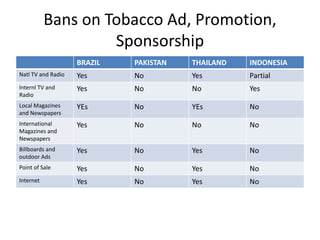
Bans on Tobacco Ad, Promotion,
Sponsorship
BRAZIL PAKISTAN THAILAND INDONESIA
Natl TV and Radio Yes No Yes Partial
Internl TV and
Radio
Yes No No Yes
Local Magazines
and Newspapers
YEs No YEs No
International
Magazines and
Newspapers
Yes No No No
Billboards and
outdoor Ads
Yes No Yes No
Point of Sale Yes No Yes No
Internet Yes No Yes No
WHY TAPS BAN?
Open discussion
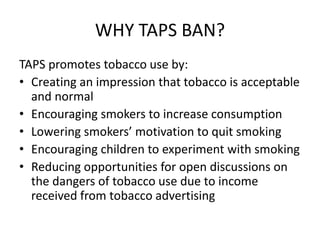
WHY TAPS BAN?
TAPS promotes tobacco use by:
• Creating an impression that tobacco is acceptable
and normal
• Encouraging smokers to increase consumption
• Lowering smokers’ motivation to quit smoking
• Encouraging children to experiment with smoking
• Reducing opportunities for open discussions on
the dangers of tobacco use due to income
received from tobacco advertising

Project issue Health & Lifestyle

  • 1.
    Why so serious? Try and Die National Commission on Tobacco Control for National Induction Conference 2014 by AIESEC
  • 2.
    What do youwant to know? • Write it down • Stick it • Tell us
  • 3.
    Sessions • Session 1:Global Picture (40 minutes) • Session 2: TAPS BAN (Presentation to High School students) (60 minutes) • Session 3: Group discussion for action locally (40 minutes) • Session 4: Plenary ( 20 minutes)
  • 4.
    4 Learning objectives: to equipparticipant with knowledge and skills to understand tobacco control, 1. Global tobacco epidemic (WHO report) 2. Why governments and parliament intervene in the tobacco market (the danger of tobacco) 3. Factors considered in determining optimal tobacco control (MPOWER) 4. Why TAPS BAN is crucial 5. What are the strategies and tactics in advocating tobacco control
  • 5.
    Global Tobacco Epidemic •FCTCNumber of smokers in countries ratifying FCTC.docx • Indonesia is in no. 4 for total of cigarette production (365 billions cigs., 2013) , after China, Rusia and USA, and no. 3 only for total of smokers (after China and India). A GLOBAL CRISIS
  • 6.
  • 7.
  • 8.
    Does cigarette needto be controlled? • YES/NO? • WHY?
  • 9.
    The DEATHS WHO Report,2008 • Tobacco kills 5.4 million people a year from lung cancer, heart disease, stroke and other illnesses of NCDs • Tobacco use is a risk factor for six of the eight leading causes of death in the world: Heart disease, Cerebrovascular disease, Lower respiratory infections, Chronic obstructive pulmonary disease, HIV/AIDS, diarrhoeal diseases, tuberculosis, trachea/bronchus/lung cancers • In indonesia tobacco kills 1172 people everyday (Soewarta Kosen 2007) • Tobacco will kill over 175 million people worldwide between now and the year 2030 Tobacco use is the leading preventable cause of death in the world (WHO Health Report 2003)
  • 10.
    Passive Smokers • Riskof coronary heart disease: 30% higher than people who are free of smoke. (for active smokers are 80% (May 2005, Circulation)
  • 11.
    How to addressthe problem/ to control? • FCTC (Framework Convention on Tobacco Control • MPOWER
  • 14.
    MPOWER 1. Monitor tobaccouse and prevention policies (critical data to undersanding and reversing the epidemic) 2. Protect people from tobacco smoke 3. Offer help to quit tobacco use 4. Warn about the dangers of tobacco 5. TAPS ban 6. Raise taxes on tobacco
  • 16.
    Public Places withSmoke-Free Legislation BRAZIL PAKISTAN THAILAND INDONESIA Health care facilities Yes Yes Yes Yes Educational facilities expect universities yes yes yes yes Universities Yes Yes Yes Yes Government facilities yes yes yes no Indoor offices yes yes yes no Restaurants yes yes yes no Café, pubs, bars yes yes yes no Public transport yes yes yes yes Source: WHO TC Country Profile
  • 17.
    Bans on TobaccoAd, Promotion, Sponsorship BRAZIL PAKISTAN THAILAND INDONESIA Natl TV and Radio Yes No Yes Partial Internl TV and Radio Yes No No Yes Local Magazines and Newspapers YEs No YEs No International Magazines and Newspapers Yes No No No Billboards and outdoor Ads Yes No Yes No Point of Sale Yes No Yes No Internet Yes No Yes No
  • 18.
  • 19.
    WHY TAPS BAN? TAPSpromotes tobacco use by: • Creating an impression that tobacco is acceptable and normal • Encouraging smokers to increase consumption • Lowering smokers’ motivation to quit smoking • Encouraging children to experiment with smoking • Reducing opportunities for open discussions on the dangers of tobacco use due to income received from tobacco advertising

Editor's Notes

  • #5 An optimal tax depends on what is the aim. The main aim for most governments is to maximise revenue. Raising the tax rate is good at achieving this, which also induces smokers to quit, and corrects for externalities. There may at times be some conflict between the aims.