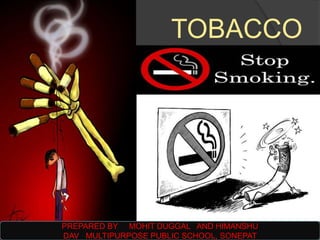
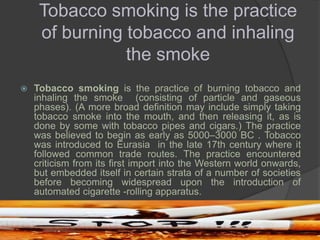
TOBACCO
PREPARED BY MOHIT DUGGAL AND HIMANSHU
DAV MULTIPURPOSE PUBLIC SCHOOL, SONEPAT
Tobacco smoking is the practice
of burning tobacco and inhaling
the smoke
 Tobacco smoking is the practice of burning tobacco and
inhaling the smoke (consisting of particle and gaseous
phases). (A more broad definition may include simply taking
tobacco smoke into the mouth, and then releasing it, as is
done by some with tobacco pipes and cigars.) The practice
was believed to begin as early as 5000–3000 BC . Tobacco
was introduced to Eurasia in the late 17th century where it
followed common trade routes. The practice encountered
criticism from its first import into the Western world onwards,
but embedded itself in certain strata of a number of societies
before becoming widespread upon the introduction of
automated cigarette -rolling apparatus.
Early history
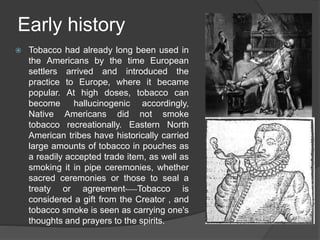
 Tobacco had already long been used in
the Americans by the time European
settlers arrived and introduced the
practice to Europe, where it became
popular. At high doses, tobacco can
become hallucinogenic accordingly,
Native Americans did not smoke
tobacco recreationally. Eastern North
American tribes have historically carried
large amounts of tobacco in pouches as
a readily accepted trade item, as well as
smoking it in pipe ceremonies, whether
sacred ceremonies or those to seal a
treaty or agreement. Tobacco is
considered a gift from the Creator , and
tobacco smoke is seen as carrying one's
thoughts and prayers to the spirits.
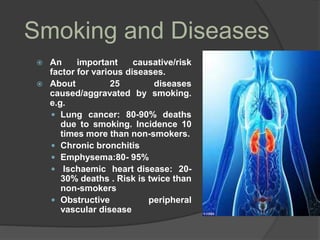
Smoking and Diseases
 An important causative/risk
factor for various diseases.
 About 25 diseases
caused/aggravated by smoking.
e.g.
 Lung cancer: 80-90% deaths
due to smoking. Incidence 10
times more than non-smokers.
 Chronic bronchitis
 Emphysema:80- 95%
 Ischaemic heart disease: 20-
30% deaths . Risk is twice than
non-smokers
 Obstructive peripheral
vascular disease
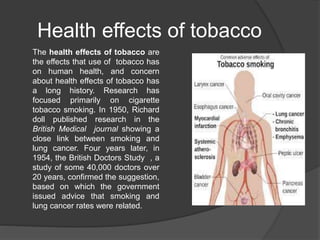
Health effects of tobacco
The health effects of tobacco are
the effects that use of tobacco has
on human health, and concern
about health effects of tobacco has
a long history. Research has
focused primarily on cigarette
tobacco smoking. In 1950, Richard
doll published research in the
British Medical journal showing a
close link between smoking and
lung cancer. Four years later, in
1954, the British Doctors Study , a
study of some 40,000 doctors over
20 years, confirmed the suggestion,
based on which the government
issued advice that smoking and
lung cancer rates were related.
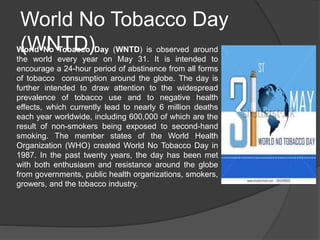
World No Tobacco Day
(WNTD)World No Tobacco Day (WNTD) is observed around
the world every year on May 31. It is intended to
encourage a 24-hour period of abstinence from all forms
of tobacco consumption around the globe. The day is
further intended to draw attention to the widespread
prevalence of tobacco use and to negative health
effects, which currently lead to nearly 6 million deaths
each year worldwide, including 600,000 of which are the
result of non-smokers being exposed to second-hand
smoking. The member states of the World Health
Organization (WHO) created World No Tobacco Day in
1987. In the past twenty years, the day has been met
with both enthusiasm and resistance around the globe
from governments, public health organizations, smokers,
growers, and the tobacco industry.
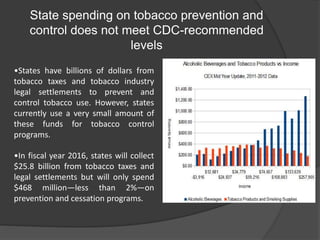
State spending on tobacco prevention and
control does not meet CDC-recommended
levels
•States have billions of dollars from
tobacco taxes and tobacco industry
legal settlements to prevent and
control tobacco use. However, states
currently use a very small amount of
these funds for tobacco control
programs.
•In fiscal year 2016, states will collect
$25.8 billion from tobacco taxes and
legal settlements but will only spend
$468 million—less than 2%—on
prevention and cessation programs.
People kill from tobacco
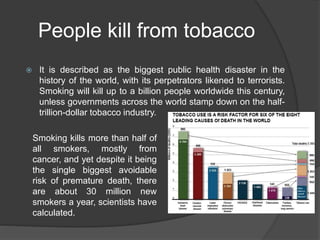
 It is described as the biggest public health disaster in the
history of the world, with its perpetrators likened to terrorists.
Smoking will kill up to a billion people worldwide this century,
unless governments across the world stamp down on the half-
trillion-dollar tobacco industry.
Smoking kills more than half of
all smokers, mostly from
cancer, and yet despite it being
the single biggest avoidable
risk of premature death, there
are about 30 million new
smokers a year, scientists have
calculated.
Tobacco users need help to quit
 Studies show that few people understand the specific health
risks of tobacco use. For example, a 2009 survey in China
revealed that only 38% of smokers knew that smoking causes
coronary heart disease and only 27% knew that it causes
stroke.
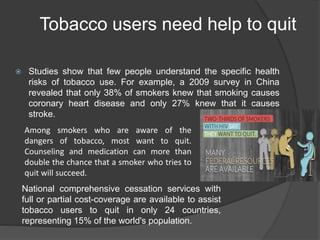
Among smokers who are aware of the
dangers of tobacco, most want to quit.
Counseling and medication can more than
double the chance that a smoker who tries to
quit will succeed.
National comprehensive cessation services with
full or partial cost-coverage are available to assist
tobacco users to quit in only 24 countries,
representing 15% of the world's population.
Prevalence of tobacco consumption
 Prevalence of tobacco consumption is reported by the
World Health Organization (WHO), which focuses on smoking
(not smokeless chewing tobacco) due to reported data
limitations. Smoking has therefore been studied more
extensively than any other form of consumption
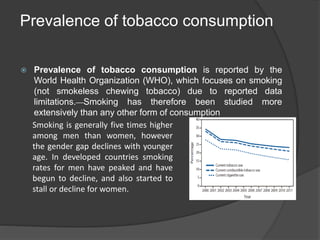
Smoking is generally five times higher
among men than women, however
the gender gap declines with younger
age. In developed countries smoking
rates for men have peaked and have
begun to decline, and also started to
stall or decline for women.
Youth tobacco smoking rates putting
millions at risk of premature death
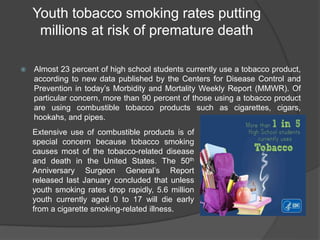
 Almost 23 percent of high school students currently use a tobacco product,
according to new data published by the Centers for Disease Control and
Prevention in today’s Morbidity and Mortality Weekly Report (MMWR). Of
particular concern, more than 90 percent of those using a tobacco product
are using combustible tobacco products such as cigarettes, cigars,
hookahs, and pipes.
Extensive use of combustible products is of
special concern because tobacco smoking
causes most of the tobacco-related disease
and death in the United States. The 50th
Anniversary Surgeon General’s Report
released last January concluded that unless
youth smoking rates drop rapidly, 5.6 million
youth currently aged 0 to 17 will die early
from a cigarette smoking-related illness.
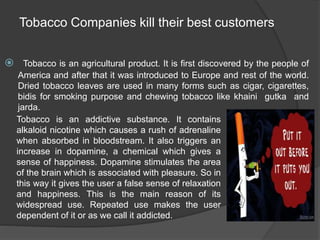
Tobacco Companies kill their best customers
 Tobacco is an agricultural product. It is first discovered by the people of
America and after that it was introduced to Europe and rest of the world.
Dried tobacco leaves are used in many forms such as cigar, cigarettes,
bidis for smoking purpose and chewing tobacco like khaini gutka and
jarda.
Tobacco is an addictive substance. It contains
alkaloid nicotine which causes a rush of adrenaline
when absorbed in bloodstream. It also triggers an
increase in dopamine, a chemical which gives a
sense of happiness. Dopamine stimulates the area
of the brain which is associated with pleasure. So in
this way it gives the user a false sense of relaxation
and happiness. This is the main reason of its
widespread use. Repeated use makes the user
dependent of it or as we call it addicted.
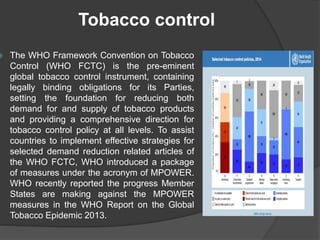
Tobacco control
 The WHO Framework Convention on Tobacco
Control (WHO FCTC) is the pre-eminent
global tobacco control instrument, containing
legally binding obligations for its Parties,
setting the foundation for reducing both
demand for and supply of tobacco products
and providing a comprehensive direction for
tobacco control policy at all levels. To assist
countries to implement effective strategies for
selected demand reduction related articles of
the WHO FCTC, WHO introduced a package
of measures under the acronym of MPOWER.
WHO recently reported the progress Member
States are making against the MPOWER
measures in the WHO Report on the Global
Tobacco Epidemic 2013.
THANK
YOU FOR
NOT
SMOKING

Tobacco

  • 1.
    TOBACCO PREPARED BY MOHITDUGGAL AND HIMANSHU DAV MULTIPURPOSE PUBLIC SCHOOL, SONEPAT
  • 2.
    Tobacco smoking isthe practice of burning tobacco and inhaling the smoke  Tobacco smoking is the practice of burning tobacco and inhaling the smoke (consisting of particle and gaseous phases). (A more broad definition may include simply taking tobacco smoke into the mouth, and then releasing it, as is done by some with tobacco pipes and cigars.) The practice was believed to begin as early as 5000–3000 BC . Tobacco was introduced to Eurasia in the late 17th century where it followed common trade routes. The practice encountered criticism from its first import into the Western world onwards, but embedded itself in certain strata of a number of societies before becoming widespread upon the introduction of automated cigarette -rolling apparatus.
  • 3.
    Early history  Tobaccohad already long been used in the Americans by the time European settlers arrived and introduced the practice to Europe, where it became popular. At high doses, tobacco can become hallucinogenic accordingly, Native Americans did not smoke tobacco recreationally. Eastern North American tribes have historically carried large amounts of tobacco in pouches as a readily accepted trade item, as well as smoking it in pipe ceremonies, whether sacred ceremonies or those to seal a treaty or agreement. Tobacco is considered a gift from the Creator , and tobacco smoke is seen as carrying one's thoughts and prayers to the spirits.
  • 4.
    Smoking and Diseases An important causative/risk factor for various diseases.  About 25 diseases caused/aggravated by smoking. e.g.  Lung cancer: 80-90% deaths due to smoking. Incidence 10 times more than non-smokers.  Chronic bronchitis  Emphysema:80- 95%  Ischaemic heart disease: 20- 30% deaths . Risk is twice than non-smokers  Obstructive peripheral vascular disease
  • 5.
    Health effects oftobacco The health effects of tobacco are the effects that use of tobacco has on human health, and concern about health effects of tobacco has a long history. Research has focused primarily on cigarette tobacco smoking. In 1950, Richard doll published research in the British Medical journal showing a close link between smoking and lung cancer. Four years later, in 1954, the British Doctors Study , a study of some 40,000 doctors over 20 years, confirmed the suggestion, based on which the government issued advice that smoking and lung cancer rates were related.
  • 6.
    World No TobaccoDay (WNTD)World No Tobacco Day (WNTD) is observed around the world every year on May 31. It is intended to encourage a 24-hour period of abstinence from all forms of tobacco consumption around the globe. The day is further intended to draw attention to the widespread prevalence of tobacco use and to negative health effects, which currently lead to nearly 6 million deaths each year worldwide, including 600,000 of which are the result of non-smokers being exposed to second-hand smoking. The member states of the World Health Organization (WHO) created World No Tobacco Day in 1987. In the past twenty years, the day has been met with both enthusiasm and resistance around the globe from governments, public health organizations, smokers, growers, and the tobacco industry.
  • 7.
    State spending ontobacco prevention and control does not meet CDC-recommended levels •States have billions of dollars from tobacco taxes and tobacco industry legal settlements to prevent and control tobacco use. However, states currently use a very small amount of these funds for tobacco control programs. •In fiscal year 2016, states will collect $25.8 billion from tobacco taxes and legal settlements but will only spend $468 million—less than 2%—on prevention and cessation programs.
  • 8.
    People kill fromtobacco  It is described as the biggest public health disaster in the history of the world, with its perpetrators likened to terrorists. Smoking will kill up to a billion people worldwide this century, unless governments across the world stamp down on the half- trillion-dollar tobacco industry. Smoking kills more than half of all smokers, mostly from cancer, and yet despite it being the single biggest avoidable risk of premature death, there are about 30 million new smokers a year, scientists have calculated.
  • 9.
    Tobacco users needhelp to quit  Studies show that few people understand the specific health risks of tobacco use. For example, a 2009 survey in China revealed that only 38% of smokers knew that smoking causes coronary heart disease and only 27% knew that it causes stroke. Among smokers who are aware of the dangers of tobacco, most want to quit. Counseling and medication can more than double the chance that a smoker who tries to quit will succeed. National comprehensive cessation services with full or partial cost-coverage are available to assist tobacco users to quit in only 24 countries, representing 15% of the world's population.
  • 10.
    Prevalence of tobaccoconsumption  Prevalence of tobacco consumption is reported by the World Health Organization (WHO), which focuses on smoking (not smokeless chewing tobacco) due to reported data limitations. Smoking has therefore been studied more extensively than any other form of consumption Smoking is generally five times higher among men than women, however the gender gap declines with younger age. In developed countries smoking rates for men have peaked and have begun to decline, and also started to stall or decline for women.
  • 11.
    Youth tobacco smokingrates putting millions at risk of premature death  Almost 23 percent of high school students currently use a tobacco product, according to new data published by the Centers for Disease Control and Prevention in today’s Morbidity and Mortality Weekly Report (MMWR). Of particular concern, more than 90 percent of those using a tobacco product are using combustible tobacco products such as cigarettes, cigars, hookahs, and pipes. Extensive use of combustible products is of special concern because tobacco smoking causes most of the tobacco-related disease and death in the United States. The 50th Anniversary Surgeon General’s Report released last January concluded that unless youth smoking rates drop rapidly, 5.6 million youth currently aged 0 to 17 will die early from a cigarette smoking-related illness.
  • 12.
    Tobacco Companies killtheir best customers  Tobacco is an agricultural product. It is first discovered by the people of America and after that it was introduced to Europe and rest of the world. Dried tobacco leaves are used in many forms such as cigar, cigarettes, bidis for smoking purpose and chewing tobacco like khaini gutka and jarda. Tobacco is an addictive substance. It contains alkaloid nicotine which causes a rush of adrenaline when absorbed in bloodstream. It also triggers an increase in dopamine, a chemical which gives a sense of happiness. Dopamine stimulates the area of the brain which is associated with pleasure. So in this way it gives the user a false sense of relaxation and happiness. This is the main reason of its widespread use. Repeated use makes the user dependent of it or as we call it addicted.
  • 14.
    Tobacco control  TheWHO Framework Convention on Tobacco Control (WHO FCTC) is the pre-eminent global tobacco control instrument, containing legally binding obligations for its Parties, setting the foundation for reducing both demand for and supply of tobacco products and providing a comprehensive direction for tobacco control policy at all levels. To assist countries to implement effective strategies for selected demand reduction related articles of the WHO FCTC, WHO introduced a package of measures under the acronym of MPOWER. WHO recently reported the progress Member States are making against the MPOWER measures in the WHO Report on the Global Tobacco Epidemic 2013.
  • 15.