Processing of Waste,
Solve the Problems?
WAHANA LINGKUNGAN HIDUP INDONESIA
(WALHI)
Friends of the Earth (FoE) Indonesia
www.walhi.or.id
Current environmental condition
• Current environmental condition are very bad.
• It is caused by the several factors; the growth
of Era and population of the people, less
initiatif to care the environment and the bad
habits of human beings.
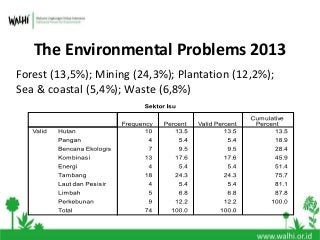
The Environmental Problems 2013
Forest (13,5%); Mining (24,3%); Plantation (12,2%);
Sea & coastal (5,4%); Waste (6,8%)
The actors of enviromental destroyer
What about the
Waste in
Indonesia?
“Sampah adalah bahan yang tidak
mempunyai nilai atau tidak berharga untuk
maksud biasa atau utama dalam pembikinan
atau pemakaian barang rusak atau bercacat
dalam pembikinan atau ditolak atau dibuang.
(Kamus istilah lingkungan, 1994 )
The waste is useless or
priceless materials that is
rejected or thrown out. All
materials around us can be
(candidates) the waste. If we
don’t have good
management in processing
the materials, we’ll really in a
big problem.
The estimation of waste in Indonesia
Group of area Waste generated
(million ton/Year)
Sumatera 8,7
Jawa 21,2
Balinusra 1,3
Kalimantan 2,3
Sumapapua 5,0
TOTAL 38,5
The estimation of people served
Group of area Population
(Million)
Population served
(Million)
% Population
served
Sumatera 49,3 23,5 48 %
Jawa 137,2 80,8 59 %
Balinusra 12,6 6,0 47 %
Kalimantan 12,9 6,0 46 %
Sumapapua 20,08 14,2 68 %
TOTAL 232,7 130,3 56 %
The estimastion of waste that
thrown in TPA (Final Processing)
Group of area Waste throwned in TPA
(million ton/year)
Sumatera 2,5
Jawa 7,0
Balinusra 1,7
Kalimantan 0,7
Sumapapua 1,6
TOTAL 13,6
The total Estimation of waste based on
the type of waste
Type of waste Amount
(million ton/year)
Persentage
(%)
Sampah Dapur (kitchen) 22,4 58 %
Sampah Plastik (plastics) 5,4 14 %
Sampah Kertas (paper) 3,6 9 %
Sampah lainnya (others) 2,3 6 %
Sampah kayu (wood) 1,4 4 %
Sampah kaca (glass) 0,7 2 %
Sampah Karet/kulit 0,7 2 %
Sampah kain (textil) 07 2 %
Sampah metal 0,7 2 %
Sampah pasir (sands) 0,5 1 %
TOTAL 38,5 100 %
The Facts related to the problems of waste in
Indonesia
• The waste became serious threat for the big cities in Indonesia.
• Talking about the waste relates with 85% about life style which designed by the
global market (industries).
• Waste piles provides bad impacts to the environment and became the killing
machine.
• Luwiegajah landfill Bandung has frowned over 130 human lives due to landslides,
avalanche Bantar Gebang Bekasi landfill has killed 3 people and injured dozens of
people.
• The waste in Indonesia has triggered the social conflict (Case of TPST Bojong
Bogor).
• Production of plastic waste in Indonesia was ranked second domestic waste at 5.4
million tons per year - 14 percent of total waste production in Indonesia
• 57 percent of waste found on beaches in the form of plastic waste. 46,000 plastic
waste floating in every square mile of ocean, even the depth of plastic waste in the
Pacific Ocean has reached nearly 100 meters.
The Facts related to the problems of waste in
Indonesia
• Increasing the amount of waste reaching 2 to 4 percent per
year. The composition of organic waste reaches 50 to 70
percent.
• Waste caused disasters; floods, landslide of waste piles,
pollution, and diseases.
• The operational function of Tempat Pembuangan Akhir
(TPA)/landfill of waste is not maximal . It is just 10% from 438
TPA/Landfill that operated maximal.
• Kementerian Pekerjaan Umum RI has targeting to build 70
landfill in 2014.
• The amount of waste is to much
• Limited in processing and landfill
• Infrastructure for processing and
transporting is very expensive
• Budaya hidup bersih masih rendah
Waste is very
difficult to solve
because:
• Healthy and safety : the source of
diseases
• Environment and sosial:
contamine the water, soil, air,
causing floods and social conflict.
• esthetics: bad view and dirty,
• Politics: became a marginal area
Negative
impacts of waste
that is not
managed well:
UU Pengelolaan Sampah
(UU No. 18 tahun 2008)
• 1 (1) - Sampah adalah sisa kegiatan sehari-hari manusia
dan/atau proses alam yang berbentuk padat
• 1 (5) Pengelolaan sampah adalah kegiatan yang sistematis,
menyeluruh, dan berkesinambungan yang meliputi pengurangan
dan penanganan sampah
• 4 - Pengelolaan sampah bertujuan untuk meningkatkan
kesehatan masyarakat dan kualitas lingkungan serta menjadikan
sampah sebagai sumber daya.
• 5 - Pemerintah dan pemerintahan daerah bertugas menjamin
terselenggaranya pengelolaan sampah yang baik dan
berwawasan lingkungan sesuai dengan tujuan sebagaimana
dimaksud dalam Undang-Undang ini
Case study; waste in Jakarta
• Management of transportation and processing of waste is not
yet builded well. At the same time, it is difficult to press the
production of waste in public area.
• The Government of DKI Jakarta alocates Rp.1,3 Triliun for
Dinas Kebersihan (Sanitation Departement). Most of the
funds were used for the transport and waste management in
place Integrated Waste (TPST) Bantargebang, Bekasi, West
Java.
• Dinas Kebersihan Jakarta claimed garbage transported to
Bantargebang range 6000-6500 tons per day, about 13
percent in the form of plastic waste.
Waste generated/day in Jakarta is 28.000 m3 = almost 4X of the
football field (105m x 70 m, high 1m) = 1/2 volume of Borobudur
temple.
Dinas Kebersihan DKI currently has:
1. 797 units trucks of waste, 46% broken or can’t be operated and only
able to transporting one rit garbage per day.
2. The employees of DKI who have duty for environment is only 80.000.
3. DKI Jakarta has only one landfill in Bantar Gebang (operated since 1989)
with the total area 108 Ha and designed to accomodate 19 million m3 of
waste and now has been filled 9 million m3.
4. Today, the location of TPS is determined by community and facilitated by
the Lurah (local major).
Case study; waste in Jakarta
Mindset changes:
1. Sorting garbage from the source (households)
2. Garbage is not a source of problems, but as a valuable resource that has
economic value
3. Commitment of stakeholders that the problem of waste as a priority issue.
4. Waste management policies directed at improving the environmental quality
5. Using materials that are environmentally friendly
Integrated Processing Waste System:
Systematic effort in processing and utilization of waste
from the landfill to the source, so that the amount of
waste can be minimized or even exhausted utilized for
the benefit of others field.
• 871 tons/day
• Transported:
87%
• Not
transported:
5%
Production of
waste
• Processing compos 20 tons/day
in cooperation with PT. Orgi
(Australia)
• Burning of gas metan (LFG) 300
m3/hour in cooperation with PT.
Gikoko (have quota from the WB)
PLT Sampah 1 MW
• Processing of water in IPA Lindi
Waste
Processing
• Makassar Green and Clean
di 143 kelurahan, 320 RW
with 320 fasilitator and
15.000 environment
cadres
• Makassar Green School
(11 SMP dan 11 SMU/SMK)
• Program Adiwiyata (SD,
SMP, SMU/SMK)
Government
programs
Example of Integrated Processing Waste
System by The Govenrnmet of Makassar
Processing of waste
REDUCE
(Mengurangi)
REUSE
(menggunakan
kembali)
RECYCLE
(Daur ulang)
PENGUMPULAN DARI RT/WILAYAH
TRANSPORTASI
SAMPAH
Pemanfaatan
Dan penanganan di TPA
komposting Incenerator Penggunaan kembali
Residu
Penyimpanan di TPA
DIAGRAM PENGOLAHAN
SAMPAH KOTA
SECARA TERPADU
PEMILAHAN
• Sampah organik
• Sampah Anorganik bermanfaat
• Sampah Anorganik berbahaya
PENGUMPULAN
• TIAP RUMAH TANGGA
• DOOR TO DOOR
• TPS
• POOL CONTAINER
PENGANGKUTAN
• TRUK TERBUKA
• TRUK KOMPAKTOR
• TRUK TRIPER
• ARM ROLL TRUCK
PENANGANAN
AKHIR
• CONTROLLED LANDFILL
• SANITARY LANDFILL
SISTEM PENGOLAHAN SAMPAH
KOTA SECARA TERPADU
SAMPAH TERMANFAATKAN
Komposting,bioaktivator, pakan
Daur ulang kertas, penggunaan
Kembali gelas kaca & plastik
Residu
Sampah tdk
termanfaatkan
Sampah
Pemilahan
Pengumpulan
DIAGRAM PENGOLAHAN SAMPAH SKALA
RUMAH TANGGA DAN KAWASAN
Ilustrasi Alur-Alir Proses Daur Ulang
Organik
Kertas
Plastik Kerasan
Plastik Lunak
Logam
Residu
Gelas/Kaca
Botol
Karton/
Kardus
Pemilahan
WALHI Concerns
• Calls on the government to look at/develop policies and waste management
master plan.
• Disseminate educational agenda to the public waste management including
motion reduce, reuse, recyle
• Calls on the government to support community efforts that the current waste
management practices in small scale such as household, RT / RW and villages.
• Encourage decentralization of waste management policies till the lower level,
not only centralization policies that still rely on the end where the garbage
disposal
• Encourage the policies of reducing production of goods at the downstream
level and urged industry to produce environmentally friendly products.
Being a wise Consumer
• Raise your awareness and environmental concern
• Start from our home
• Try to Reduce use of plastics
• Build up the creativity
Setiap orang berhak atas
lingkungan hidup yang baik dan
sehat sebagai bagian dari hak
asasi manusia (Ps 65 (1)
UUPPLH)
Setiap orang berkewajiban
memelihara kelestarian fungsi
lingkungan hidup serta
mengendalikan pencemaran
dan/atau kerusakan lingkungan
hidup.
If we are not being part
of the problem solving,
it means we are
part of the problem
...ThankYou...
Kurniawan Sabar
Manajer Kampanye Eknas WALHI
Campaign Manager- National Executive of WALHI
kurniawan.walhi@gmail.com
HP.: 085255490050
Wahana Lingkungan Hidup Indonesia (WALHI)
Friends Of The Earth Indonesia
Jl. Tegal Parang Utara No. 14
Mampang, Jakarta Selatan
Tlp. 021 – 79193363
Fax. 021-7941673
www.walhi.or.id

Project issue Environment

  • 1.
    Processing of Waste, Solvethe Problems? WAHANA LINGKUNGAN HIDUP INDONESIA (WALHI) Friends of the Earth (FoE) Indonesia www.walhi.or.id
  • 2.
    Current environmental condition •Current environmental condition are very bad. • It is caused by the several factors; the growth of Era and population of the people, less initiatif to care the environment and the bad habits of human beings.
  • 3.
    The Environmental Problems2013 Forest (13,5%); Mining (24,3%); Plantation (12,2%); Sea & coastal (5,4%); Waste (6,8%)
  • 4.
    The actors ofenviromental destroyer
  • 5.
    What about the Wastein Indonesia?
  • 6.
    “Sampah adalah bahanyang tidak mempunyai nilai atau tidak berharga untuk maksud biasa atau utama dalam pembikinan atau pemakaian barang rusak atau bercacat dalam pembikinan atau ditolak atau dibuang. (Kamus istilah lingkungan, 1994 ) The waste is useless or priceless materials that is rejected or thrown out. All materials around us can be (candidates) the waste. If we don’t have good management in processing the materials, we’ll really in a big problem.
  • 7.
    The estimation ofwaste in Indonesia Group of area Waste generated (million ton/Year) Sumatera 8,7 Jawa 21,2 Balinusra 1,3 Kalimantan 2,3 Sumapapua 5,0 TOTAL 38,5
  • 8.
    The estimation ofpeople served Group of area Population (Million) Population served (Million) % Population served Sumatera 49,3 23,5 48 % Jawa 137,2 80,8 59 % Balinusra 12,6 6,0 47 % Kalimantan 12,9 6,0 46 % Sumapapua 20,08 14,2 68 % TOTAL 232,7 130,3 56 %
  • 9.
    The estimastion ofwaste that thrown in TPA (Final Processing) Group of area Waste throwned in TPA (million ton/year) Sumatera 2,5 Jawa 7,0 Balinusra 1,7 Kalimantan 0,7 Sumapapua 1,6 TOTAL 13,6
  • 10.
    The total Estimationof waste based on the type of waste Type of waste Amount (million ton/year) Persentage (%) Sampah Dapur (kitchen) 22,4 58 % Sampah Plastik (plastics) 5,4 14 % Sampah Kertas (paper) 3,6 9 % Sampah lainnya (others) 2,3 6 % Sampah kayu (wood) 1,4 4 % Sampah kaca (glass) 0,7 2 % Sampah Karet/kulit 0,7 2 % Sampah kain (textil) 07 2 % Sampah metal 0,7 2 % Sampah pasir (sands) 0,5 1 % TOTAL 38,5 100 %
  • 13.
    The Facts relatedto the problems of waste in Indonesia • The waste became serious threat for the big cities in Indonesia. • Talking about the waste relates with 85% about life style which designed by the global market (industries). • Waste piles provides bad impacts to the environment and became the killing machine. • Luwiegajah landfill Bandung has frowned over 130 human lives due to landslides, avalanche Bantar Gebang Bekasi landfill has killed 3 people and injured dozens of people. • The waste in Indonesia has triggered the social conflict (Case of TPST Bojong Bogor). • Production of plastic waste in Indonesia was ranked second domestic waste at 5.4 million tons per year - 14 percent of total waste production in Indonesia • 57 percent of waste found on beaches in the form of plastic waste. 46,000 plastic waste floating in every square mile of ocean, even the depth of plastic waste in the Pacific Ocean has reached nearly 100 meters.
  • 14.
    The Facts relatedto the problems of waste in Indonesia • Increasing the amount of waste reaching 2 to 4 percent per year. The composition of organic waste reaches 50 to 70 percent. • Waste caused disasters; floods, landslide of waste piles, pollution, and diseases. • The operational function of Tempat Pembuangan Akhir (TPA)/landfill of waste is not maximal . It is just 10% from 438 TPA/Landfill that operated maximal. • Kementerian Pekerjaan Umum RI has targeting to build 70 landfill in 2014.
  • 15.
    • The amountof waste is to much • Limited in processing and landfill • Infrastructure for processing and transporting is very expensive • Budaya hidup bersih masih rendah Waste is very difficult to solve because: • Healthy and safety : the source of diseases • Environment and sosial: contamine the water, soil, air, causing floods and social conflict. • esthetics: bad view and dirty, • Politics: became a marginal area Negative impacts of waste that is not managed well:
  • 16.
    UU Pengelolaan Sampah (UUNo. 18 tahun 2008) • 1 (1) - Sampah adalah sisa kegiatan sehari-hari manusia dan/atau proses alam yang berbentuk padat • 1 (5) Pengelolaan sampah adalah kegiatan yang sistematis, menyeluruh, dan berkesinambungan yang meliputi pengurangan dan penanganan sampah • 4 - Pengelolaan sampah bertujuan untuk meningkatkan kesehatan masyarakat dan kualitas lingkungan serta menjadikan sampah sebagai sumber daya. • 5 - Pemerintah dan pemerintahan daerah bertugas menjamin terselenggaranya pengelolaan sampah yang baik dan berwawasan lingkungan sesuai dengan tujuan sebagaimana dimaksud dalam Undang-Undang ini
  • 17.
    Case study; wastein Jakarta • Management of transportation and processing of waste is not yet builded well. At the same time, it is difficult to press the production of waste in public area. • The Government of DKI Jakarta alocates Rp.1,3 Triliun for Dinas Kebersihan (Sanitation Departement). Most of the funds were used for the transport and waste management in place Integrated Waste (TPST) Bantargebang, Bekasi, West Java. • Dinas Kebersihan Jakarta claimed garbage transported to Bantargebang range 6000-6500 tons per day, about 13 percent in the form of plastic waste.
  • 18.
    Waste generated/day inJakarta is 28.000 m3 = almost 4X of the football field (105m x 70 m, high 1m) = 1/2 volume of Borobudur temple. Dinas Kebersihan DKI currently has: 1. 797 units trucks of waste, 46% broken or can’t be operated and only able to transporting one rit garbage per day. 2. The employees of DKI who have duty for environment is only 80.000. 3. DKI Jakarta has only one landfill in Bantar Gebang (operated since 1989) with the total area 108 Ha and designed to accomodate 19 million m3 of waste and now has been filled 9 million m3. 4. Today, the location of TPS is determined by community and facilitated by the Lurah (local major). Case study; waste in Jakarta
  • 19.
    Mindset changes: 1. Sortinggarbage from the source (households) 2. Garbage is not a source of problems, but as a valuable resource that has economic value 3. Commitment of stakeholders that the problem of waste as a priority issue. 4. Waste management policies directed at improving the environmental quality 5. Using materials that are environmentally friendly Integrated Processing Waste System: Systematic effort in processing and utilization of waste from the landfill to the source, so that the amount of waste can be minimized or even exhausted utilized for the benefit of others field.
  • 20.
    • 871 tons/day •Transported: 87% • Not transported: 5% Production of waste • Processing compos 20 tons/day in cooperation with PT. Orgi (Australia) • Burning of gas metan (LFG) 300 m3/hour in cooperation with PT. Gikoko (have quota from the WB) PLT Sampah 1 MW • Processing of water in IPA Lindi Waste Processing • Makassar Green and Clean di 143 kelurahan, 320 RW with 320 fasilitator and 15.000 environment cadres • Makassar Green School (11 SMP dan 11 SMU/SMK) • Program Adiwiyata (SD, SMP, SMU/SMK) Government programs Example of Integrated Processing Waste System by The Govenrnmet of Makassar
  • 21.
  • 22.
    PENGUMPULAN DARI RT/WILAYAH TRANSPORTASI SAMPAH Pemanfaatan Danpenanganan di TPA komposting Incenerator Penggunaan kembali Residu Penyimpanan di TPA DIAGRAM PENGOLAHAN SAMPAH KOTA SECARA TERPADU
  • 23.
    PEMILAHAN • Sampah organik •Sampah Anorganik bermanfaat • Sampah Anorganik berbahaya PENGUMPULAN • TIAP RUMAH TANGGA • DOOR TO DOOR • TPS • POOL CONTAINER PENGANGKUTAN • TRUK TERBUKA • TRUK KOMPAKTOR • TRUK TRIPER • ARM ROLL TRUCK PENANGANAN AKHIR • CONTROLLED LANDFILL • SANITARY LANDFILL SISTEM PENGOLAHAN SAMPAH KOTA SECARA TERPADU
  • 24.
    SAMPAH TERMANFAATKAN Komposting,bioaktivator, pakan Daurulang kertas, penggunaan Kembali gelas kaca & plastik Residu Sampah tdk termanfaatkan Sampah Pemilahan Pengumpulan DIAGRAM PENGOLAHAN SAMPAH SKALA RUMAH TANGGA DAN KAWASAN
  • 25.
    Ilustrasi Alur-Alir ProsesDaur Ulang Organik Kertas Plastik Kerasan Plastik Lunak Logam Residu Gelas/Kaca Botol Karton/ Kardus Pemilahan
  • 26.
    WALHI Concerns • Callson the government to look at/develop policies and waste management master plan. • Disseminate educational agenda to the public waste management including motion reduce, reuse, recyle • Calls on the government to support community efforts that the current waste management practices in small scale such as household, RT / RW and villages. • Encourage decentralization of waste management policies till the lower level, not only centralization policies that still rely on the end where the garbage disposal • Encourage the policies of reducing production of goods at the downstream level and urged industry to produce environmentally friendly products.
  • 27.
    Being a wiseConsumer • Raise your awareness and environmental concern • Start from our home • Try to Reduce use of plastics • Build up the creativity
  • 28.
    Setiap orang berhakatas lingkungan hidup yang baik dan sehat sebagai bagian dari hak asasi manusia (Ps 65 (1) UUPPLH) Setiap orang berkewajiban memelihara kelestarian fungsi lingkungan hidup serta mengendalikan pencemaran dan/atau kerusakan lingkungan hidup.
  • 29.
    If we arenot being part of the problem solving, it means we are part of the problem
  • 30.
  • 31.
    Kurniawan Sabar Manajer KampanyeEknas WALHI Campaign Manager- National Executive of WALHI kurniawan.walhi@gmail.com HP.: 085255490050 Wahana Lingkungan Hidup Indonesia (WALHI) Friends Of The Earth Indonesia Jl. Tegal Parang Utara No. 14 Mampang, Jakarta Selatan Tlp. 021 – 79193363 Fax. 021-7941673 www.walhi.or.id