
Ronald V. Ferrer Arlenne C. Espinoza
Definition
-a collection of proven techniques for proposing,
planning, implementing, managing and evaluating
projects, combined with the art of managing people.
-application of knowledge, skills, tools and
techniques to a broad range of activities to meet the
specified requirements of a particular project.
STAGES
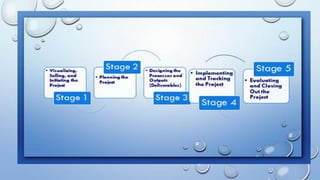
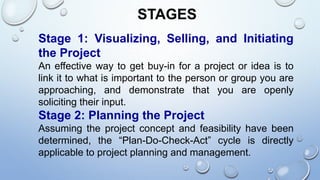
Stage 1: Visualizing, Selling, and Initiating
the Project
An effective way to get buy-in for a project or idea is to
link it to what is important to the person or group you are
approaching, and demonstrate that you are openly
soliciting their input.
Stage 2: Planning the Project
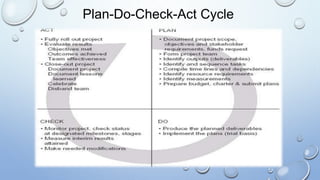
Assuming the project concept and feasibility have been
determined, the “Plan-Do-Check-Act” cycle is directly
applicable to project planning and management.
Plan-Do-Check-Act Cycle
Stage 3: Designing the Processes and Outputs
(Deliverables)
When the project is approved, the project team may proceed
with the content design, with the persons or items needed to
implement the project. The design process includes defining:
• Measurements
• The monitoring method
• Status reporting protocols
• Evaluation criteria
• Design of the ultimate processes and outputs
• Implementation schedules
Stage 4: Implementing and Tracking the
Project
The project design team may also implement the project,
possibly with the help of additional personnel.
A trial or test implementation may be used to check out
the project design and outputs to determine if they meet
the project objectives.
The implementation team monitors the project and reports
on its status to appropriate interested parties at designated
project milestones.
The implementation team makes any course corrections
and trade-offs that may be necessary and are approved.
Stage 5: Evaluating and Closing Out the
Project
The implementation team officially closes the project when
the scheduled tasks have been completed.
Usually evaluation are done to determine:
• Objectives met versus objectives planned
• Actual tasks and events scheduled versus planned
• Resources used versus planned resource usage
• Costs versus budget
• Organizational outcomes achieved versus planned
outcomes; any unplanned outcomes
• Effectiveness of project planning team (optional)
• Effectiveness of implementation team (optional)
• Team’s compilation of project documents,
evaluations and lessons learned
The project is then officially closed out.
Participants are recognized for their
contributions, and team disbands.
For some projects, many organizations find
value in a post-implementation
assessment of the outcomes achieved from
implementing the project.
PROJECT OUTPUTS VS. OUTCOMES
Frequently the project management terms “outputs” and “outcomes” are used as if
their meanings were interchangeable; however, they are not.
Outputs are defined as what the project produces. Project outputs may be an
improved process, installation of a new machine, a benchmarking study, etc.
Outputs of the project team process itself may be project plans and supporting
documents, status reports and the like.
Outcomes are defined as the effects that the implementation of the project
has on the overall organization, and should support the strategic direction of
the organization. Outcomes may consist of measurable improvements in
customer satisfaction, profits or cost containment, improved market position
and market penetration, etc. For ease of understanding, outcomes are usually
expressed as dollar values.
Reference
https://asq.org/quality-resources/project-management
Reference
https://asq.org/quality-
resources/project-
management

Project Management

  • 1.
    Ronald V. FerrerArlenne C. Espinoza
  • 2.
    Definition -a collection ofproven techniques for proposing, planning, implementing, managing and evaluating projects, combined with the art of managing people. -application of knowledge, skills, tools and techniques to a broad range of activities to meet the specified requirements of a particular project.
  • 4.
    STAGES Stage 1: Visualizing,Selling, and Initiating the Project An effective way to get buy-in for a project or idea is to link it to what is important to the person or group you are approaching, and demonstrate that you are openly soliciting their input. Stage 2: Planning the Project Assuming the project concept and feasibility have been determined, the “Plan-Do-Check-Act” cycle is directly applicable to project planning and management.
  • 5.
  • 6.
    Stage 3: Designingthe Processes and Outputs (Deliverables) When the project is approved, the project team may proceed with the content design, with the persons or items needed to implement the project. The design process includes defining: • Measurements • The monitoring method • Status reporting protocols • Evaluation criteria • Design of the ultimate processes and outputs • Implementation schedules
  • 7.
    Stage 4: Implementingand Tracking the Project The project design team may also implement the project, possibly with the help of additional personnel. A trial or test implementation may be used to check out the project design and outputs to determine if they meet the project objectives. The implementation team monitors the project and reports on its status to appropriate interested parties at designated project milestones. The implementation team makes any course corrections and trade-offs that may be necessary and are approved.
  • 8.
    Stage 5: Evaluatingand Closing Out the Project The implementation team officially closes the project when the scheduled tasks have been completed. Usually evaluation are done to determine: • Objectives met versus objectives planned • Actual tasks and events scheduled versus planned • Resources used versus planned resource usage • Costs versus budget • Organizational outcomes achieved versus planned outcomes; any unplanned outcomes
  • 9.
    • Effectiveness ofproject planning team (optional) • Effectiveness of implementation team (optional) • Team’s compilation of project documents, evaluations and lessons learned
  • 10.
    The project isthen officially closed out. Participants are recognized for their contributions, and team disbands. For some projects, many organizations find value in a post-implementation assessment of the outcomes achieved from implementing the project.
  • 11.
    PROJECT OUTPUTS VS.OUTCOMES Frequently the project management terms “outputs” and “outcomes” are used as if their meanings were interchangeable; however, they are not. Outputs are defined as what the project produces. Project outputs may be an improved process, installation of a new machine, a benchmarking study, etc. Outputs of the project team process itself may be project plans and supporting documents, status reports and the like. Outcomes are defined as the effects that the implementation of the project has on the overall organization, and should support the strategic direction of the organization. Outcomes may consist of measurable improvements in customer satisfaction, profits or cost containment, improved market position and market penetration, etc. For ease of understanding, outcomes are usually expressed as dollar values. Reference https://asq.org/quality-resources/project-management
  • 12.