What is Project Management? Meaning, Approaches and the Career Prospects
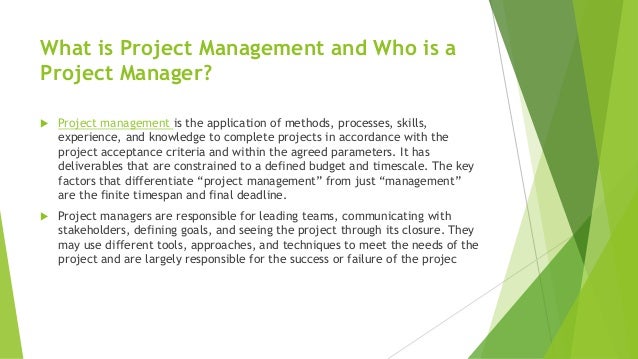
What is Project Management and Who is a
Project Manager?
 Project management is the application of methods, processes, skills,
experience, and knowledge to complete projects in accordance with the
project acceptance criteria and within the agreed parameters. It has
deliverables that are constrained to a defined budget and timescale. The key
factors that differentiate “project management” from just “management”
are the finite timespan and final deadline.
 Project managers are responsible for leading teams, communicating with
stakeholders, defining goals, and seeing the project through its closure. They
may use different tools, approaches, and techniques to meet the needs of the
project and are largely responsible for the success or failure of the projec
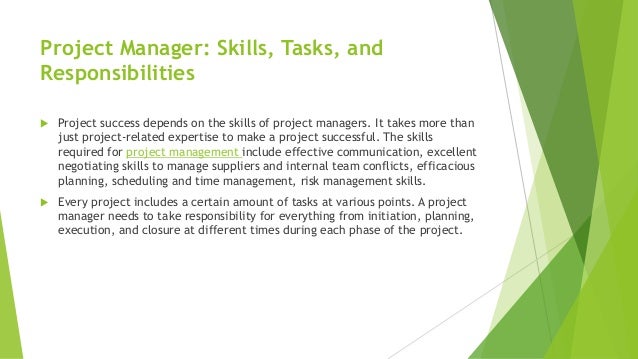
Project Manager: Skills, Tasks, and
Responsibilities
 Project success depends on the skills of project managers. It takes more than
just project-related expertise to make a project successful. The skills
required for project management include effective communication, excellent
negotiating skills to manage suppliers and internal team conflicts, efficacious
planning, scheduling and time management, risk management skills.
 Every project includes a certain amount of tasks at various points. A project
manager needs to take responsibility for everything from initiation, planning,
execution, and closure at different times during each phase of the project.
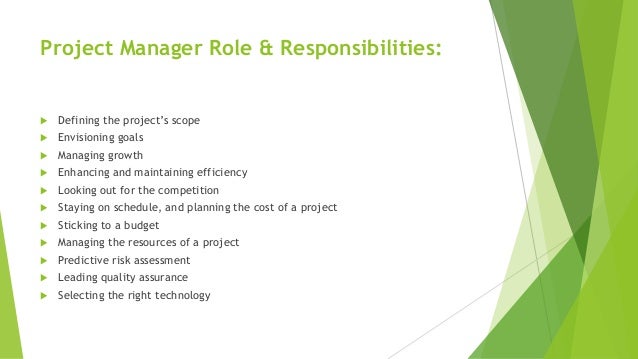
Project Manager Role & Responsibilities:
 Defining the project’s scope
 Envisioning goals
 Managing growth
 Enhancing and maintaining efficiency
 Looking out for the competition
 Staying on schedule, and planning the cost of a project
 Sticking to a budget
 Managing the resources of a project
 Predictive risk assessment
 Leading quality assurance
 Selecting the right technology
Project Management Skills
 1. Earning a Diploma or Certificate Course in Project Management
 This is perhaps the most effective way to calibrate your venture's executives
abilities. Emeritus offers different endorsement courses to project the board
in association with around the world eminent colleges. These tasks the
executives courses are accessible online as well as disconnected and furnish
you with the specialized aptitude and the reasonable abilities you really want
to explore and lead complex ventures to the end. It'll likewise assist you with
interfacing with industry specialists across the globe who can direct you to
propel your vocation.
2. Practice, Practice, Practice
 Whenever you have procured an endorsement in project management from a
presumed college, you should simply get useful involvement in the
information and abilities you have acquired as it would require an investment
to figure out the use of these abilities. Particularly, assuming you are yet to
break into the task the board field, you really want to look for potential open
doors for active discovering that would permit you to outfit the
Project Management Methodologies
 A task the board technique is a bunch of practices and rules that guide you in
smoothing out and coordinating your undertakings for guaranteeing their ideal
exhibition. Just, a structure helps you in dealing with your undertaking
productively and successfully. We have organized a rundown of the executives
techniques, out of which you can pick the one that will fit best with your
goals:.
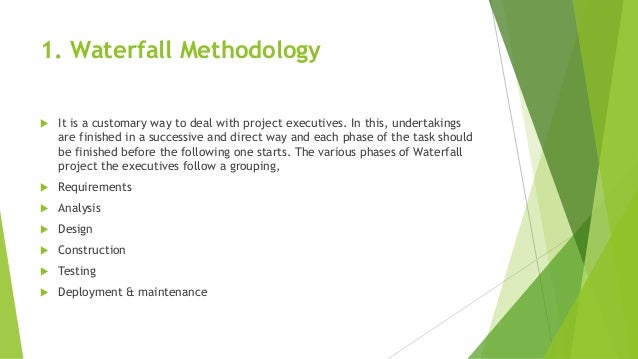
1. Waterfall Methodology
 It is a customary way to deal with project executives. In this, undertakings
are finished in a successive and direct way and each phase of the task should
be finished before the following one starts. The various phases of Waterfall
project the executives follow a grouping,
 Requirements
 Analysis
 Design
 Construction
 Testing
 Deployment & maintenance
2. Agile Methodology
 The progress flows in a certain direction, just like a waterfall. It can also
become dangerous quickly as not everything was planned from the beginning.
There is plenty of room for error if predictions or expectations aren't in line
with reality. Once a stage is complete, you cannot go back to it.
 The agile software development methodologies are collaborative and open to
changing data. They involve short phases of work with testing at frequent
intervals, reassessment, and adaptation throughout the process.
3. Scrum Methodology
 Scrum is a different project management methodology. It is not the same as
agile project management but it has many similarities..
 In this methodology, the work is divided into shorter “sprints”. It typically
lasts up to two weeks at a time.
 Scrum Master is not responsible for projects or planning. A Scrum Master leads
small teams for every sprint’s duration, followed by reviewing performance in
a “sprint retrospective” and making necessary changes before beginning the
next sprint. If a business strives for continuous improvement, this proves to
be one of the best methodologies.
4. Kanban Methodology
 It can also be used to manage agile projects. The term "Kanban" was originally
used in the manufacturing industry to describe a framework where tasks are
visually represented and progress is tracked using columns on a Kanban board.
 The team chooses which work to do and puts the items into a column on the
board. The columns represent different stages in the process. That way, they
can see which stages are done and which are still left to do.
5. Scrumban Methodology
 Scrumban methodology is a mix of Kanban and Scrum methodologies. The
organization is able to “pull” work from the backlog based on the availability
of time and capacity of team members, rather than deciding the task from
the backlog for working on every sprint at the outset.
 You can use a sprint cycle during planning to ensure that you have a
continuous and regular flow of work while incorporating project planning and
retrospectives as needed.
6. EXtreme (XP) Programming Methodology
 This methodology is for software development. It emphasises collaboration
and teamwork among developers, customers, and managers. It has a set of
rules that should be followed by teams and are based on five values –
communication, simplicity, courage, respect, and feedback. If you want to
foster collaboration and teamwork in your project, this is the best
methodology for you.
7. Critical Path Methodology
 It is a way of identifying and scheduling critical tasks comprising your project.
You just need to follow a simple process –
 Identifying all the critical tasks
 Estimating the time each of them would take
 Using the information for scheduling the “critical path” you would take to get
the project completed as soon as possible
 Now, the longest sequence of critical tasks would become your “critical path”
and define your project’s timeframe.
The Scope of Pursuing Project Management
as Your Career
 Companies are attempting to implement complex projects in competitive
markets. This means that the demand for skilled project managers is greater
than ever. Organizations are now at risk of talent shortages. It is clear that
project management has many career options for those who have the
necessary skills. The demand for project managers with the right mix of skills
is high. This includes leadership, technical and business acumen. You can
easily get this combination by taking one of the Emeritus India courses in
project management, which are offered in partnership with some of the best
universities around the world.
 Project management can lead to opportunities in many industries. Are you
ready to meet the demand for project management? Register for the Project
Management Course to get the skills you need to be a leader in your field.

What is Project Management.pdf

  • 1.
    What is ProjectManagement? Meaning, Approaches and the Career Prospects
  • 2.
    What is ProjectManagement and Who is a Project Manager?  Project management is the application of methods, processes, skills, experience, and knowledge to complete projects in accordance with the project acceptance criteria and within the agreed parameters. It has deliverables that are constrained to a defined budget and timescale. The key factors that differentiate “project management” from just “management” are the finite timespan and final deadline.  Project managers are responsible for leading teams, communicating with stakeholders, defining goals, and seeing the project through its closure. They may use different tools, approaches, and techniques to meet the needs of the project and are largely responsible for the success or failure of the projec
  • 3.
    Project Manager: Skills,Tasks, and Responsibilities  Project success depends on the skills of project managers. It takes more than just project-related expertise to make a project successful. The skills required for project management include effective communication, excellent negotiating skills to manage suppliers and internal team conflicts, efficacious planning, scheduling and time management, risk management skills.  Every project includes a certain amount of tasks at various points. A project manager needs to take responsibility for everything from initiation, planning, execution, and closure at different times during each phase of the project.
  • 4.
    Project Manager Role& Responsibilities:  Defining the project’s scope  Envisioning goals  Managing growth  Enhancing and maintaining efficiency  Looking out for the competition  Staying on schedule, and planning the cost of a project  Sticking to a budget  Managing the resources of a project  Predictive risk assessment  Leading quality assurance  Selecting the right technology
  • 5.
    Project Management Skills 1. Earning a Diploma or Certificate Course in Project Management  This is perhaps the most effective way to calibrate your venture's executives abilities. Emeritus offers different endorsement courses to project the board in association with around the world eminent colleges. These tasks the executives courses are accessible online as well as disconnected and furnish you with the specialized aptitude and the reasonable abilities you really want to explore and lead complex ventures to the end. It'll likewise assist you with interfacing with industry specialists across the globe who can direct you to propel your vocation.
  • 6.
    2. Practice, Practice,Practice  Whenever you have procured an endorsement in project management from a presumed college, you should simply get useful involvement in the information and abilities you have acquired as it would require an investment to figure out the use of these abilities. Particularly, assuming you are yet to break into the task the board field, you really want to look for potential open doors for active discovering that would permit you to outfit the
  • 7.
    Project Management Methodologies A task the board technique is a bunch of practices and rules that guide you in smoothing out and coordinating your undertakings for guaranteeing their ideal exhibition. Just, a structure helps you in dealing with your undertaking productively and successfully. We have organized a rundown of the executives techniques, out of which you can pick the one that will fit best with your goals:.
  • 8.
    1. Waterfall Methodology It is a customary way to deal with project executives. In this, undertakings are finished in a successive and direct way and each phase of the task should be finished before the following one starts. The various phases of Waterfall project the executives follow a grouping,  Requirements  Analysis  Design  Construction  Testing  Deployment & maintenance
  • 9.
    2. Agile Methodology The progress flows in a certain direction, just like a waterfall. It can also become dangerous quickly as not everything was planned from the beginning. There is plenty of room for error if predictions or expectations aren't in line with reality. Once a stage is complete, you cannot go back to it.  The agile software development methodologies are collaborative and open to changing data. They involve short phases of work with testing at frequent intervals, reassessment, and adaptation throughout the process.
  • 10.
    3. Scrum Methodology Scrum is a different project management methodology. It is not the same as agile project management but it has many similarities..  In this methodology, the work is divided into shorter “sprints”. It typically lasts up to two weeks at a time.  Scrum Master is not responsible for projects or planning. A Scrum Master leads small teams for every sprint’s duration, followed by reviewing performance in a “sprint retrospective” and making necessary changes before beginning the next sprint. If a business strives for continuous improvement, this proves to be one of the best methodologies.
  • 11.
    4. Kanban Methodology It can also be used to manage agile projects. The term "Kanban" was originally used in the manufacturing industry to describe a framework where tasks are visually represented and progress is tracked using columns on a Kanban board.  The team chooses which work to do and puts the items into a column on the board. The columns represent different stages in the process. That way, they can see which stages are done and which are still left to do.
  • 12.
    5. Scrumban Methodology Scrumban methodology is a mix of Kanban and Scrum methodologies. The organization is able to “pull” work from the backlog based on the availability of time and capacity of team members, rather than deciding the task from the backlog for working on every sprint at the outset.  You can use a sprint cycle during planning to ensure that you have a continuous and regular flow of work while incorporating project planning and retrospectives as needed.
  • 13.
    6. EXtreme (XP)Programming Methodology  This methodology is for software development. It emphasises collaboration and teamwork among developers, customers, and managers. It has a set of rules that should be followed by teams and are based on five values – communication, simplicity, courage, respect, and feedback. If you want to foster collaboration and teamwork in your project, this is the best methodology for you.
  • 14.
    7. Critical PathMethodology  It is a way of identifying and scheduling critical tasks comprising your project. You just need to follow a simple process –  Identifying all the critical tasks  Estimating the time each of them would take  Using the information for scheduling the “critical path” you would take to get the project completed as soon as possible  Now, the longest sequence of critical tasks would become your “critical path” and define your project’s timeframe.
  • 15.
    The Scope ofPursuing Project Management as Your Career  Companies are attempting to implement complex projects in competitive markets. This means that the demand for skilled project managers is greater than ever. Organizations are now at risk of talent shortages. It is clear that project management has many career options for those who have the necessary skills. The demand for project managers with the right mix of skills is high. This includes leadership, technical and business acumen. You can easily get this combination by taking one of the Emeritus India courses in project management, which are offered in partnership with some of the best universities around the world.  Project management can lead to opportunities in many industries. Are you ready to meet the demand for project management? Register for the Project Management Course to get the skills you need to be a leader in your field.