5-PHASE PROJECT
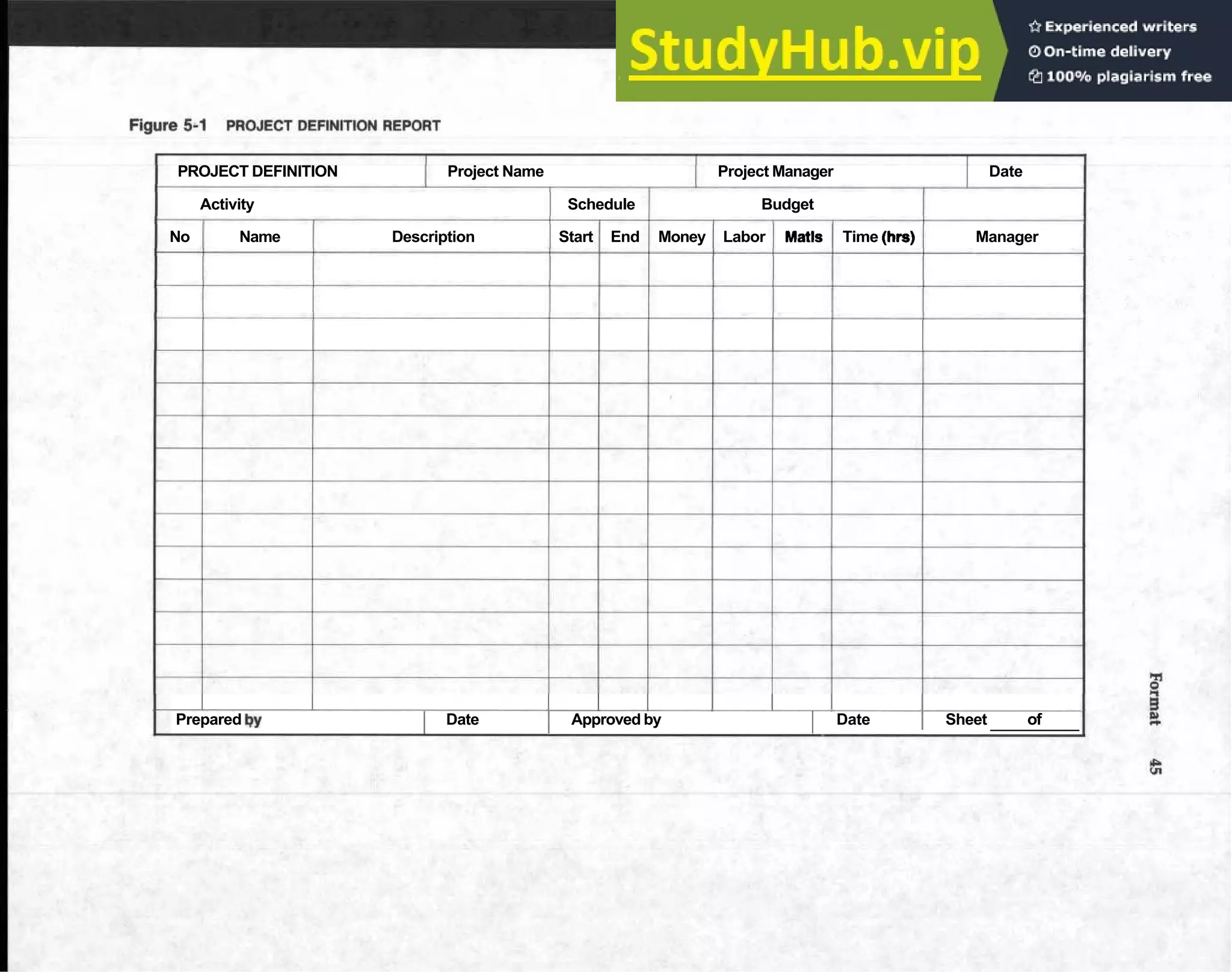
MANAGEMENT
JOSEPH W. WEISS, Ph.D., Bentley College
ROBERT K. WYSOCKI, Ph.D., The TMS Group
5-PHASE PROJECT
MANAGEMENT
A PRACTICAL PLANNING &
IMPLEMENTATION GUIDE
PERSEUS BOOKS
Cambridge, Massachusetts
Library of Congress Cataloging-in-PublicationData
Weiss, Joseph W.
5-phase project management : a practical planning & implementation
guide / by Joseph W. Weiss, Robert K. Wysocki.
p. "
I
.
Includes bibliographical references (p. ) and index.
ISBN 0-201-56316-9 (pbk. : acid-free paper)
1. Industrial project management. I. Wysocki, Robert K.
11. Title. 111. Title: Five-phase project management.
HD69.P75W46 1992
658.4'044~20 91-42548
CIP
Copyright1992 Oby Perseus Books Publishing, L.L.C.
All rights reserved. No part of this publication may be reproduced, stored in a
retrieval system, or transmitted, in any form, or by any means, electronic,
pechanical, photocopying, recording, or otherwise,without the prior written
consent of the publisher. Printed in the United Statesof America.
Cover design by JoyceC. Weston
Text design by Wilson Graphics & Design (KennethJ. Wilson)
Set in 10 point Palatinoby Shepard PoormanCommunicationsCorporation
Perseus Books is a member of the Perseus Books Group
Find us on the World Wide Web at
http://www.perseusboo .corn
CONTENTS
Preface xi
Who Needs Project Management Methods? xi
What Techniques Does This Book Offer? xi
Why We Wrote 5-Phase Project Management xii
The Use of 5-Phase Project Management xiii
Part I PLANNING THE PROJECT 1
Chapter 1 INTRODUCTION 3
First Things First: What Is a Project? 3
What Is Project Management? 4
Planning 4
Organizing 4
Controlling 4
Change 4
Ten Major Causes of Project Failure 6
Adopting a Project Management Mind-set 6
Chapter 2 DEFINING THE PROJECT:THE PROJECTOVERVIEW 9
State the Problem 9
What Is the Problem/Opportunity? 10
What Is to Be Done? 10
Who Is Responsible for the Project? 11
When Must the Project Be Completed? 11
The "Water Cooler" Imposed Deadline 11
The Planned and Estimated Deadline 12
Identify Project Goals 12
List the Objectives 13
What Criteria Will Be Used to Evaluate Project Success? 14
Determine Preliminary Resources 14
First Scenario 15
Second Scenario 15
vi Contents
Identify Assumptions and Risks 15
Example: Planning a Professional Conference 16
The Birth of a Conference 16
Summary 18
Project Overview Quality Control Checklist 18
Project Overview Acid Test 19
Chapter 3 SPECIFYING THE PROJECT 21
Identify Project Activities 21
Work Breakdown Structures (WBS) 22
Characteristics of a Successful Work Breakdown Structure 22
Steps for Constructing a Work Breakdown Structure 23
Work Breakdown Structure-Hierarchical Representation 23
Uses of the Work Breakdown Structure 27
Estimate Time and Cost 28
Estimating Activity Time-Highly Speculative Situations 28
Estimating Activity Cost 29
Project Specification Quality Control Checklist 30
Project Specification Acid Test 31
Chapter 4 SEQUENCING THE PROJECT ACTIVITIES 33
Sequence Project Activities 33
Precedence Diagramming Techniques 34
Identify Critical Activities 36
Activity Start and Completion Times 37
Earliest Start and Earliest Finish Times 37
Latest Start and Latest Finish Times 37
Locating the Critical Path 38
Use of the Network and Critical Path 40
Planning 40
Implementation 40
Control 40
The Critical Path 40
Project Network Quality Control Checklist 41
Project Network Acid Test 41
Chapter 5 WRITING THE PROJECTPROPOSAL 43
Purpose 43
Format 44
Contents vii
Project Name 44
Project Manager 44
Activity 44
Schedule 44
Project Budget 46
Underestimating Project Costs 46
Overestimating Project Costs 46
Estimating the Budget 46
Revenue and Expense Estimates 49
Project Proposal Quality Control Checklist 49
Project Proposal Acid Test 49
Part I1 IMPLEMENTING THE PROJECT 51
Chapter 6 ORGANIZING THE PROJECTTEAM 53
Determining Personnel Needs: Selecting the Project Manager 53
Timing 54
Selection Criteria 54
Background and Experience 55
Leadership and Strategic Expertise 55
Technical Expertise 55
Interpersonal Competence/People Skills 56
Proven Managerial Ability 56
Determining Personnel Needs: Selecting the Project Team 57
Selection Criteria 57
Organizing and Housing the Project 58
Project Manager Selection Quality Control Checklist 59
Project Team Selection Quality Control Checklist 60
Project Manager and Team Selection Acid Test 61
Chapter 7 ASSIGNING WORK PACKAGES 63
What Is a Work Package? 63
Scheduling Work Packages 65
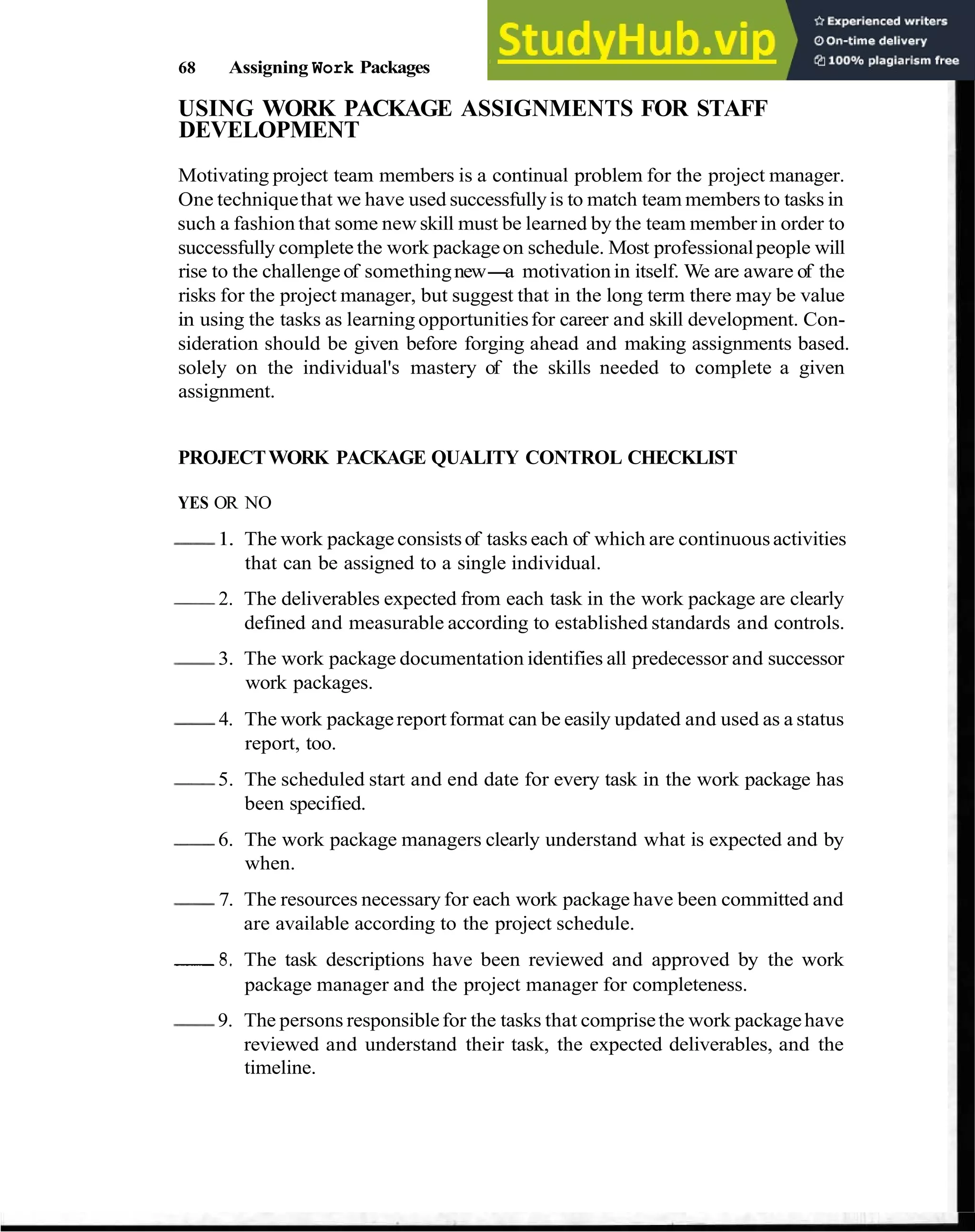
Using Work Package Assignments for Staff Development 68
Project Work Package Quality Control Checklist 68
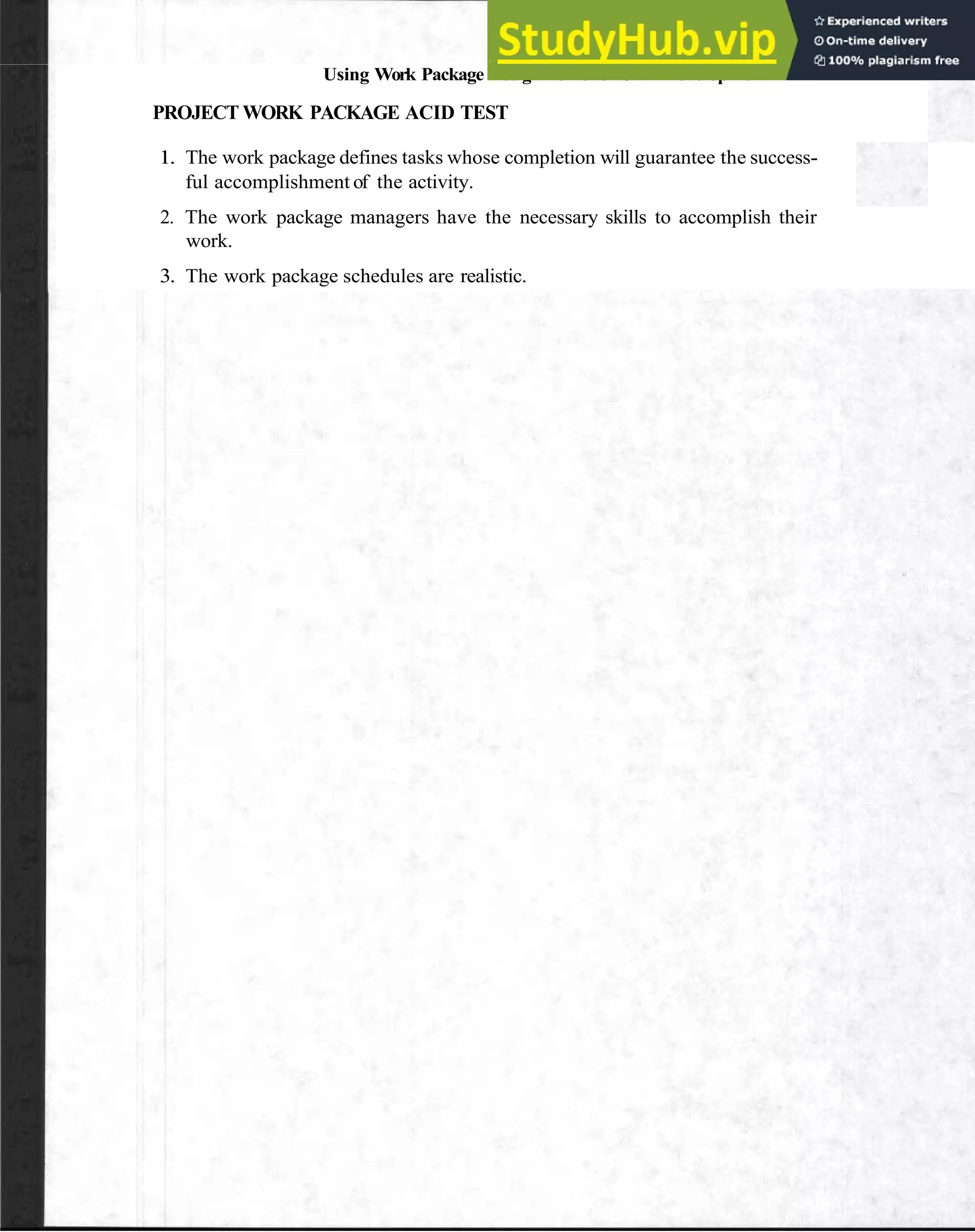
Project Work Package Acid Test 69
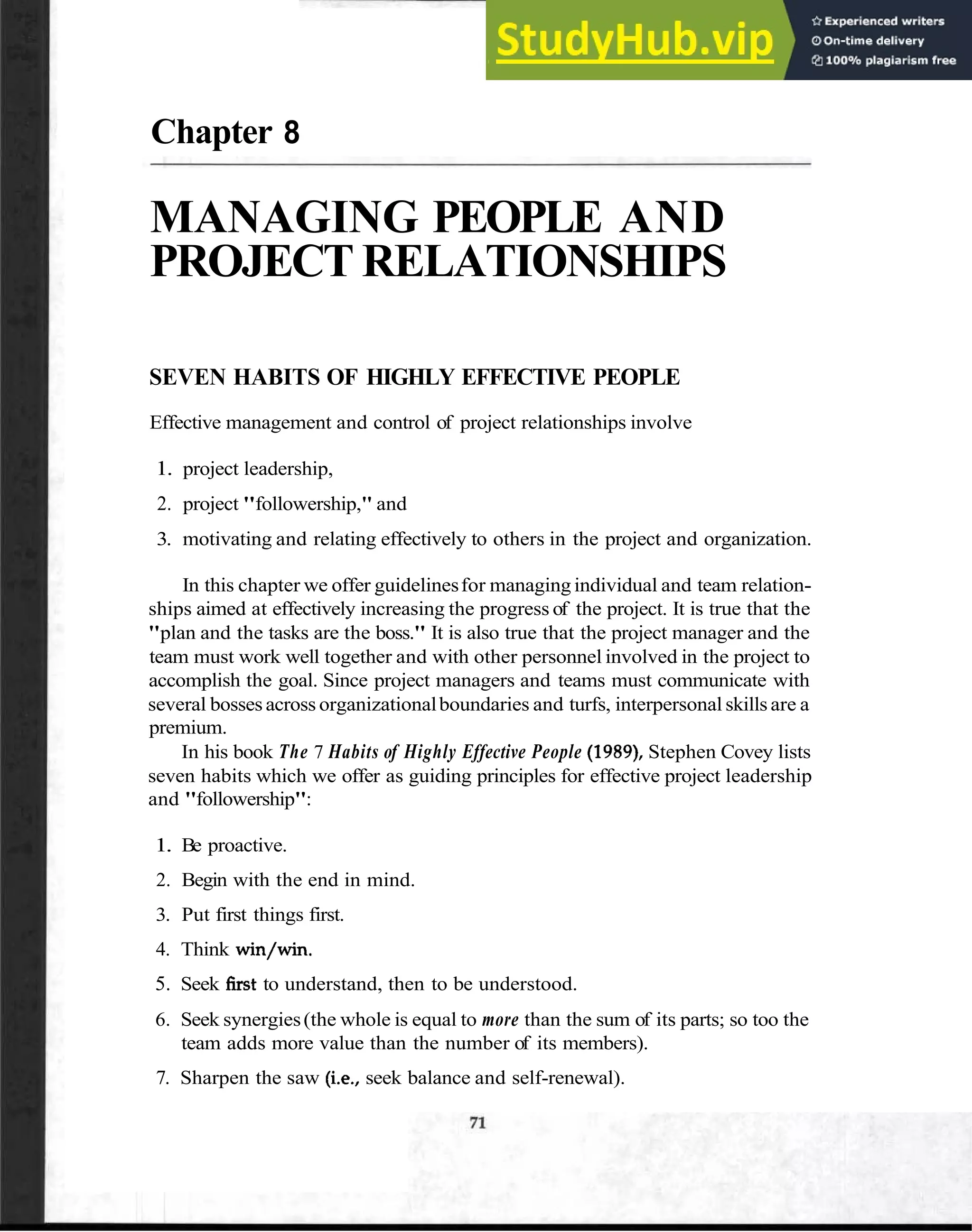
Chapter 8 MANAGING PEOPLE AND PROJECT RELATIONSHIPS 71
Seven Habits of Highly Effective People 71
viii Contents
12 Guidelines for Effective Project Leadership 72
Managing Across Functional Boundaries 72
Evolution and Team Development 73
Barriers to Effective Communication 74
Managing Communication in Team Relationships 75
Managing Team Cohesiveness 77
Managing Conflict 78
Managing Effective Meetings 80
Summary 81
Chapter 9 MAINTAINING THE PROJECTSCHEDULE 83
Establish Control Tools 83
Purpose of Controls 83
To Track Progress 83
To Detect Variance from Plan 84
To Take Corrective Action 84
Prepare Status Reports 84
Variance Reporting Tools 84
Positive Variances 87
Negative Variances 87
Graphical Reporting Tools 89
Gantt Charts 89
Balance in the Control System 91
Review Project Schedule 91
Getting Back on Schedule 94
Project Maintenance Quality Control Checklist 94
Project Maintenance Acid Test 95
Chapter 10 CLOSING THE PROJECT 97
Preparing Termination Logistics 97
Who Decides to Terminate and When 98
Three Types of Project Termination 98
Checklist for Termination 99
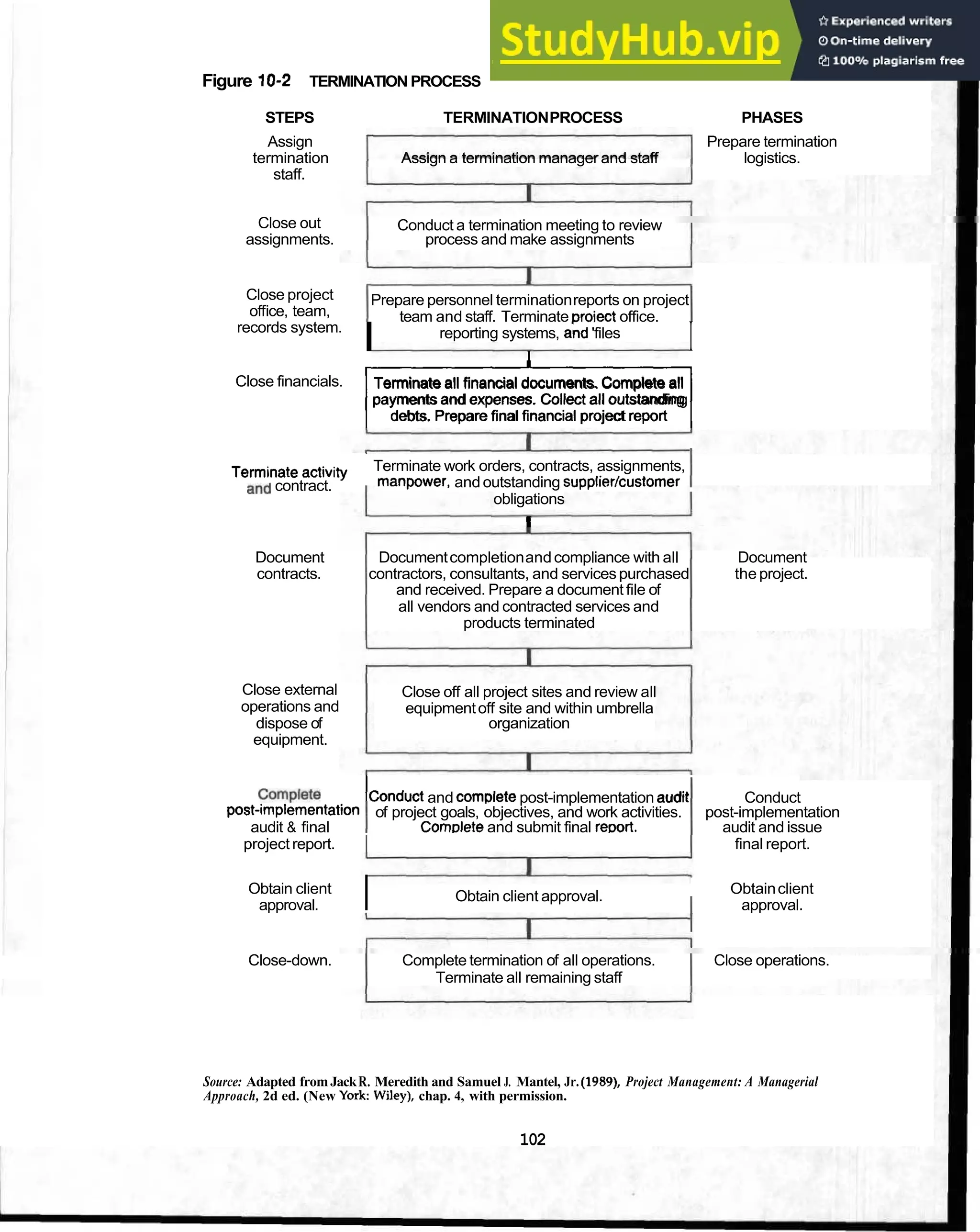
Project Termination Process' 100
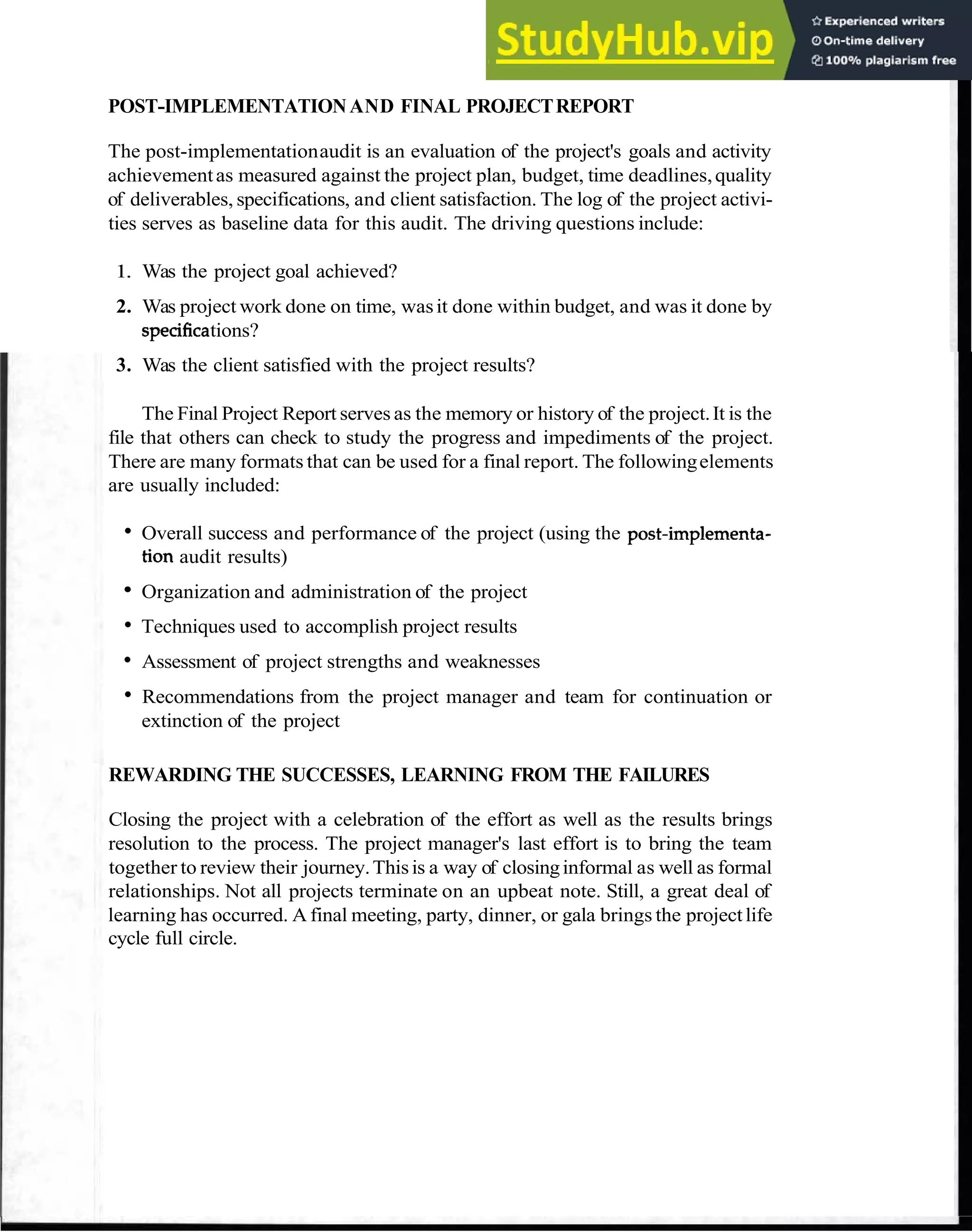
Post-Implementation and Final Project Report 103
Rewarding the SuccessesJLearning from the Failures 103
Contents ix
Part I11 PROJECTMANAGEMENT FOR THE 21ST CENTURY 105
Epilogue CONTEMPORARY ISSUES IN PROJECTMANAGEMENT 107
Customer Focus 107
Program Management 107
Stakeholder Analysis 108
Organizational Changes 108
Vertical Thinning 109
Horizontal Task Forces 109
Appendix PROJECTMANAGEMENTSOFTWARE 111
Bibliography and Cited References 112
Index 117
Preface
WHO NEEDS PROJECTMANAGEMENT METHODS?
If you have to complete work that involves multiple priorities, complex and nu-
merous tasks, deadlines, constant communication across organizational bound-
aries, limited resources, and do all of this with little if any precedents or guidelines,
then you could benefit from using project management techniques. On the other
hand, you may have managed projects but feel the need for a refresher course.
Professionals use project management techniques. Engineers in technology
firms use project management methods to design and repair hardware and soft-
ware products. Hospital administrators and their staffs use project management for
scheduling purposes. Wholesalers, retailers, and distributors use project manage-
ment for inventory control. Writers, publishers, and corporate educational staffs
use project management for curriculum and manuscript development, as well as
marketing planning. The military and government agencies use these methods for
designing and manufacturing weapons, space, and other complex systems. Con-
struction contractors use project management in building construction. Executive
secretaries often have good reason to use the methods in creating and implement-
ing programs. You can use project management methods to build a house or a boat,
to write a novel, or to plan a vacation.
Unfortunately, many of the professionals who use project management tech-
niques do so in partial, fragmented, and sometimes uninformed ways. It is com-
monplace in our training and consulting to hear seasoned, career professionals
admit, "I wish I had known about these techniques and methods 10 years ago. My
job would have been much easier."
WHAT TECHNIQUES DOES THIS BOOK OFFER?
In this book we offer a 5-phase approach consisting of 25 action steps, which
enables you to define, plan, organize, control, and close a project. Even if you do
not direct the project, this approach informs you about the "big picture"of project
management, the vocabulary, and the techniques. The elements of project man-
agement which we systematically and straightforwardly present include: initial
planning, goal and objective setting, identification of work that has to be done,
estimating the time and labor to complete work, budgeting the work, implement-
xii Preface
ing the project, controlling and documenting the work, managing people on the
project, and finally, closing the project.
Our aim is to empower you with a practical understanding of basic project
management techniques; and to enable you to use this book as a guidefor briefings
and training, to distribute to others who will work on the project, and to reviseand
add to the checklists and documentation herein to solve your particular problems.
To meet this aim, we have chosen three criteria for our selection and presentation
of concepts and techniques:
1. Introduce one method with a phased approach that is easy, understandable,
and quick to grasp.
2. Select and explain key concepts and techniques that can be used by hand (and
with software).
3. Empower and encourage you to plan and initiate a project after reading this
book; or, if you are workingon a project, to increaseyour effectivenesson that
project.
WHY WE WROTE 5-PHASE PROJECT MANAGEMENT
We wrote this book as a ready reference to help people in any industry or profes-
sion plan and manage projects with limited budgets, time demands, deadlines, and
resourceconstraints. Our aim is to simplify the application of project management
techniques through a systematic method with easy-to-use checklists and tips for
anyone who must get complex work done on time, within budget, and according to
specifications (the golden rule of project management).
With over 15 years each of corporate and administrative consulting, training,
and college teaching experience in which we have used project management, we
understand the value of having a practical method and user-friendly technique.
We also want the book to be what the subtitle states, a practical planning and
implementation guide. If the book helps equip you with a method, concepts,
vocabulary, and tools that get you going, give you confidence, and increase your
boldness and success in applying the content to get project work done on time,
within budget, and by specifications, then we will have succeeded.
Our aim is to give you a solid working knowledgeof an extremely powerful yet
simple-to-use tool that is guaranteed to improve your effectivenessas a managerof
both projects and people. After all, your success as a project manager will be
measured by your ability to get the job done on time, within budget, and according
to specifications.
The Use of 5-Phase Project Management xiii
THE USE OF 5-PHASE PROJECT MANAGEMENT
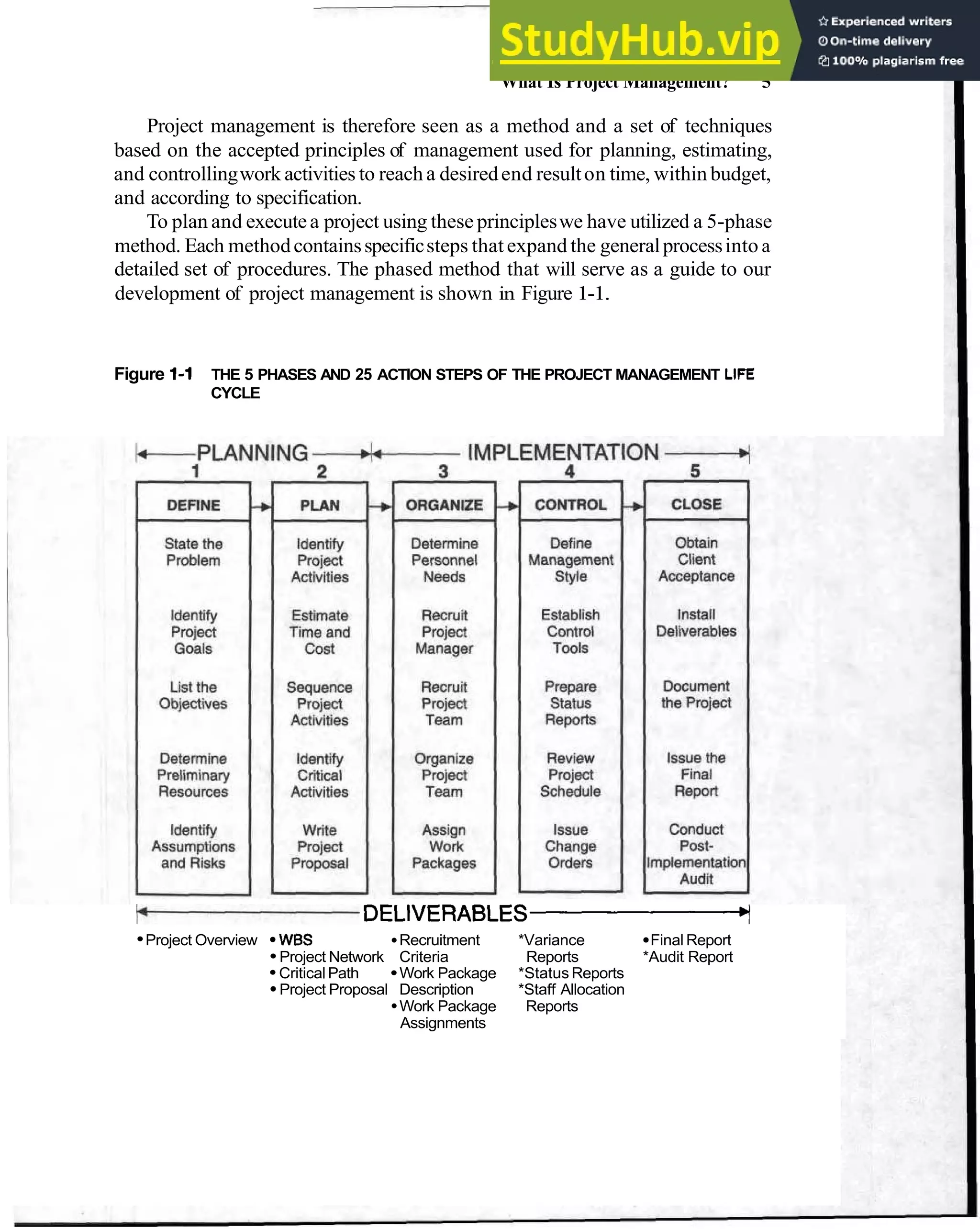
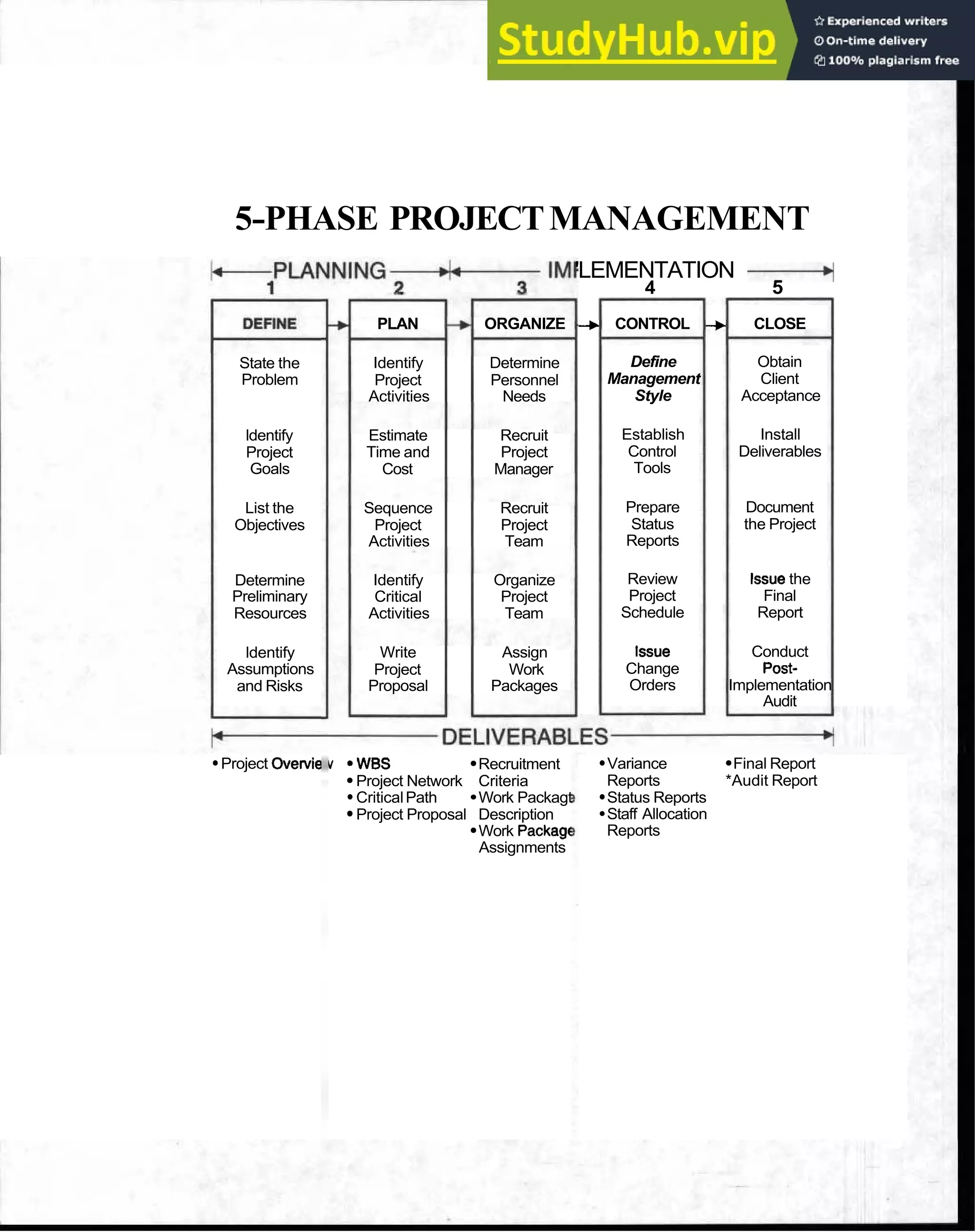
We have organized project management into 25 easy-to-follow steps, around
which 10 chapters are sequenced for quick learning and easy reference. We have
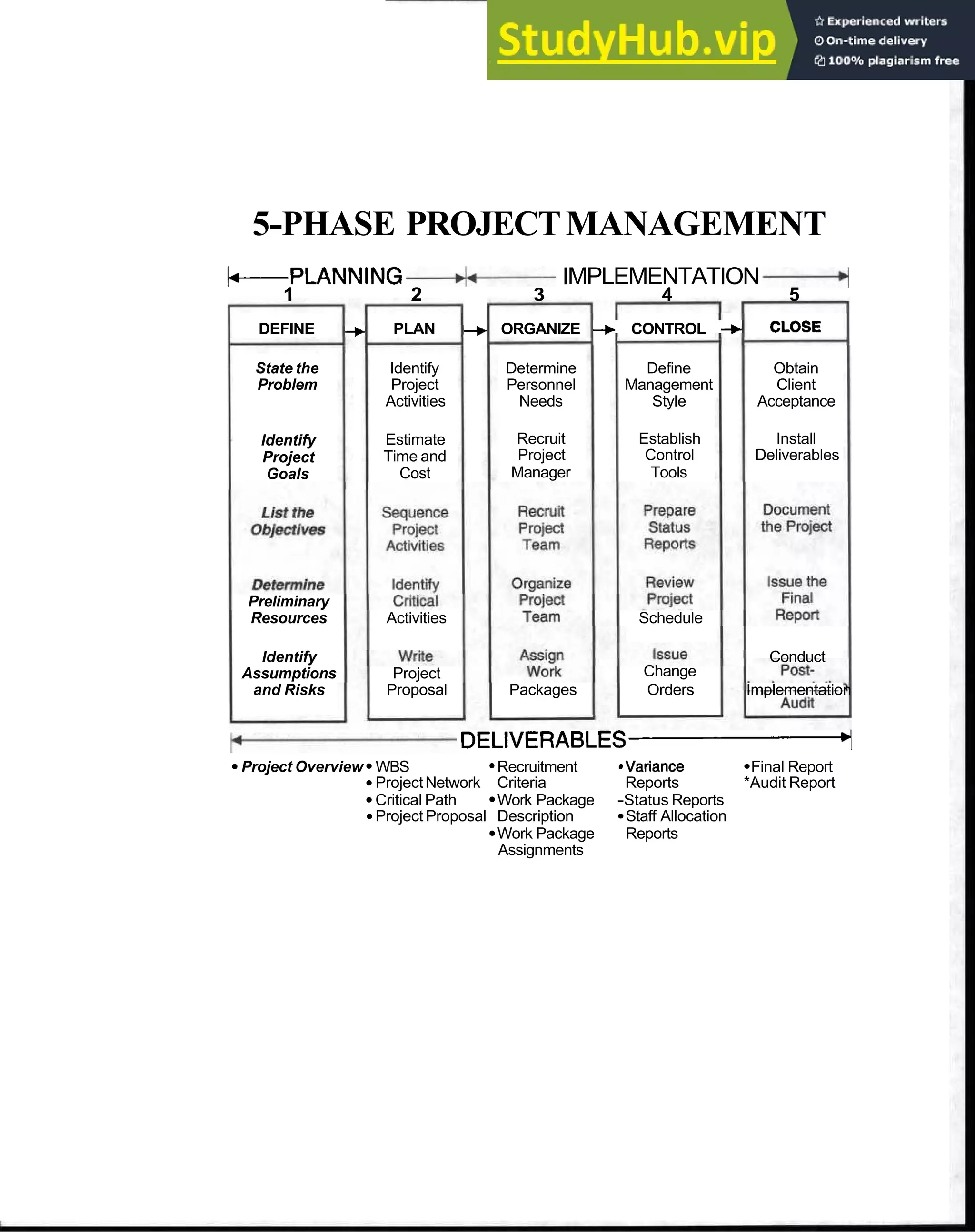
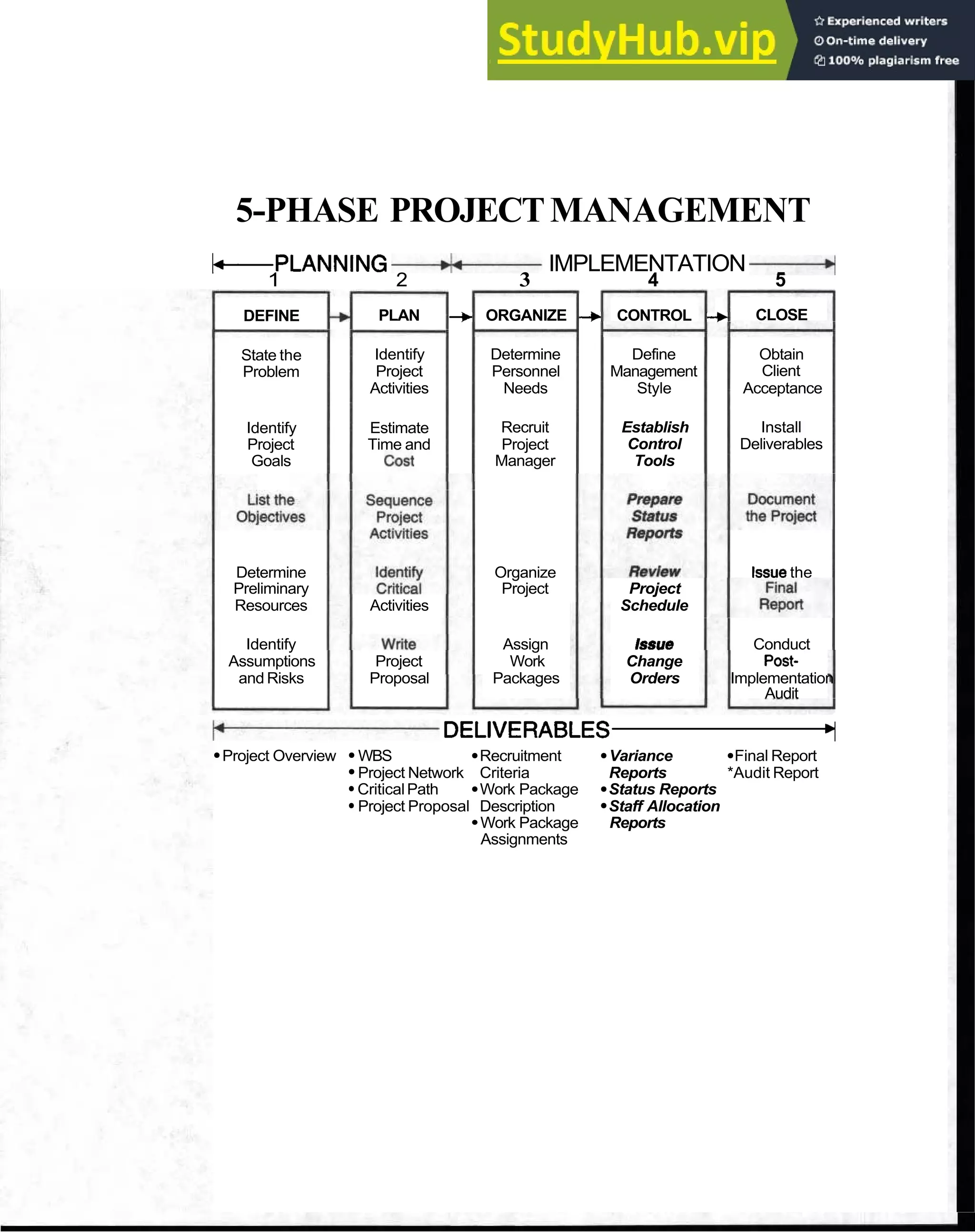
tried to say a lot in a little space while making our presentation interesting. Figure
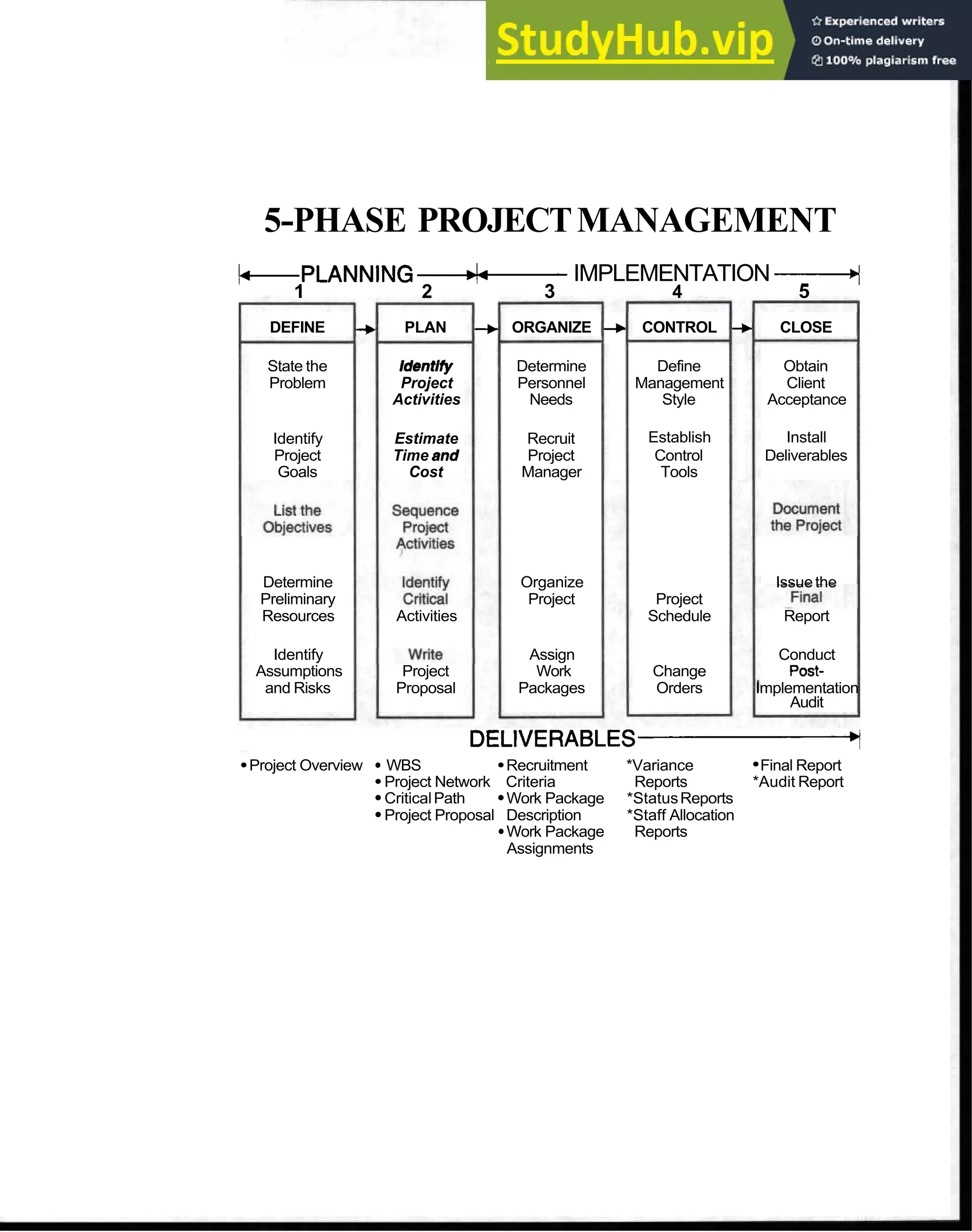
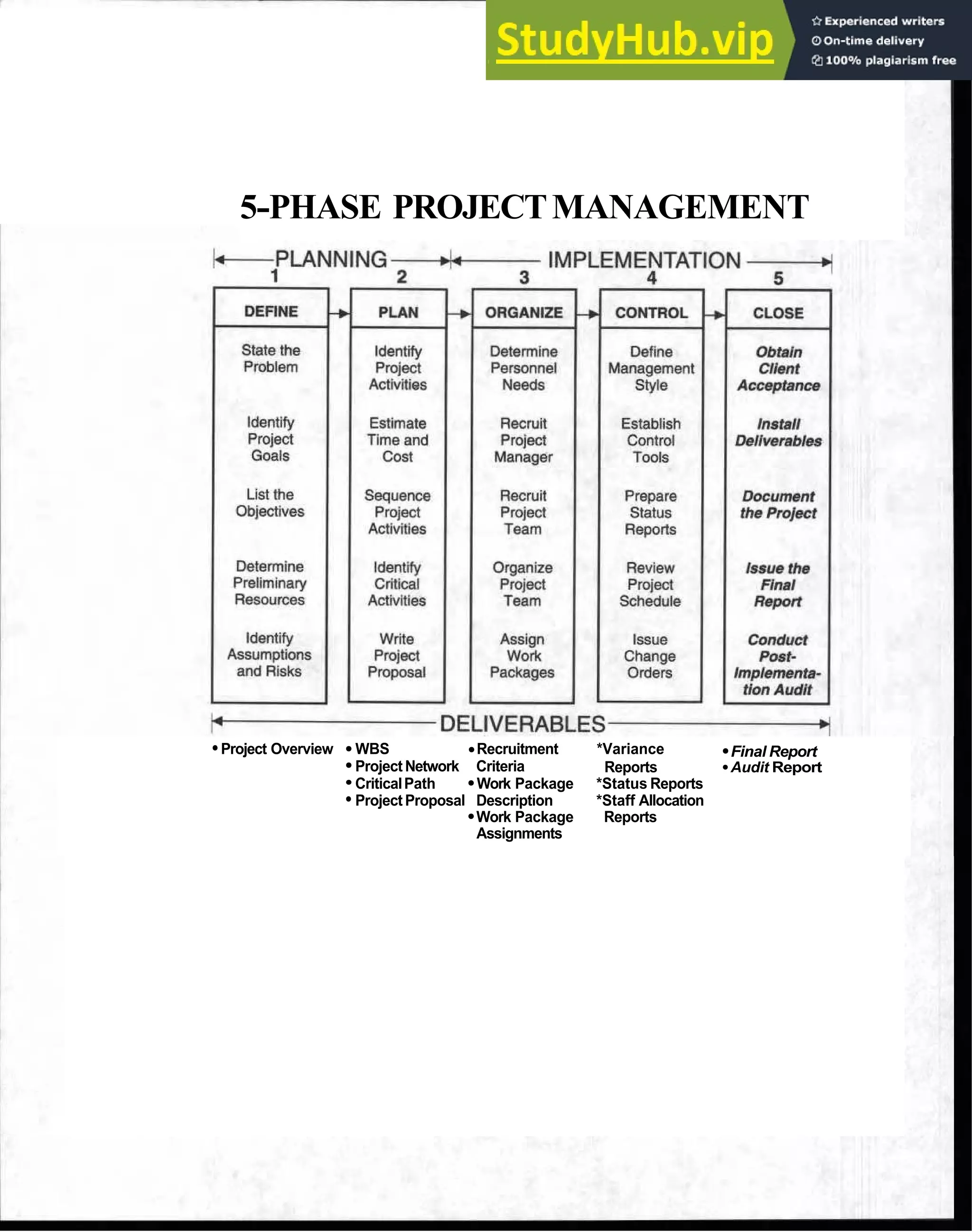
1-1, repeated at the start of each chapter, illustrates the 5 phases and 25 steps in
the planning and implementation of project management. This is the"big picture."
We suggest you use it as a guide.
Part I
PLANNING THE PROJECT
In a sense the most important part of the project is its beginning. It is here that the
"die is cast"and either the projectis well-conceivedand executable within the time
and cost constraintsspecified by senior management or it is an impossible situation
doomed to failure before it even begins. This part of the project is not the place to
make rash promises in an attempt to be a hero. Rather, it is a time to rationally and
thoughtfully approach the initial specifications of the project in order to avoid
impossible situations. Remember that once you have agreed to the project goal,
management will expect you to deliver.
Chapter 1
INTRODUCTION
Everyoneis a project manager, but not everyone knows how to plan and manage a
project. Projects vary in size and scope from a NASA space shuttle launch to
building a boat, planning a wedding, or getting a degree. People who have to do
projects without training usually lack a practical method and a technique for
getting the work done effectively and efficiently.
FIRST THINGS FIRST: WHAT IS A PROJECT?
Program, project, task, and work assignment are often confused. It will help US to
distinguishthese termsfrom one another. A projectis defined as having the follow-
ing characteristics:
Complex and numerous activities
Unique-a one-time set of events
Finite-with a begin and end date
Limited resources and budget
Many people involved, usually across several functional areas in the
organizations
Sequenced activities
Goal-oriented
End product or service must result
A task or set of work assignments may be done by one or more persons by
using a simple "to-do" list. However, it is evident that a task becomes a project
when the above factors begin to dominate and overwhelm individuals who be-
come unable to meet deadlines, budgets,and corporateexpectationswhile working
alone.
4 Introduction
A program is different from a project. A program is larger in scope and may
comprise multiple projects. For example, the United States government has a space
program that includes several projects such as the Challenger project. A construc-
tion company contracts a program to build an industrial technology park with
several separate projects.
WHAT IS PROJECTMANAGEMENT?
When we think of the principles of management we usually associate them with
the management of people. Those same principles also apply to projects, as we
now illustrate.
PLANNING
Planning involves the establishment of clear and precise objectives (and the work
activities that will have to take place to accomplish them) in order to reach a final,
stated goal. The goal may involve the solution of a problem or the achievement of
some state or condition different from the present one.
ORGANIZING
In addition to organizingpeople, project management includes the assemblyof the
necessary resources (manpower, materials, and money) for carrying out the work
defined in the plan. It also involves the creation of the structure needed to execute
the plan.
CONTROLLING
Once the resources are assembled into a cohesive structure, it will be necessary to
monitor and maintain that structure as the project progresses. Controlalsoincludes
the definition and creation of a reporting structure at specified points through the
project life cycle. These reports are designed not only as historical records but also
as early warnings of situations and occurrerlces that are outside nominal perform-
ance measures.
CHANGE
Oncesituations have been discovered that requirechange, the project manager will
have to institute that change. As we will discuss in Chapter Nine, project manage-
ment includes mechanisms for invoking that change.
What Is Project Management? 5
Project management is therefore seen as a method and a set of techniques
based on the accepted principles of management used for planning, estimating,
and controllingwork activities to reach a desiredend resulton time, within budget,
and according to specification.
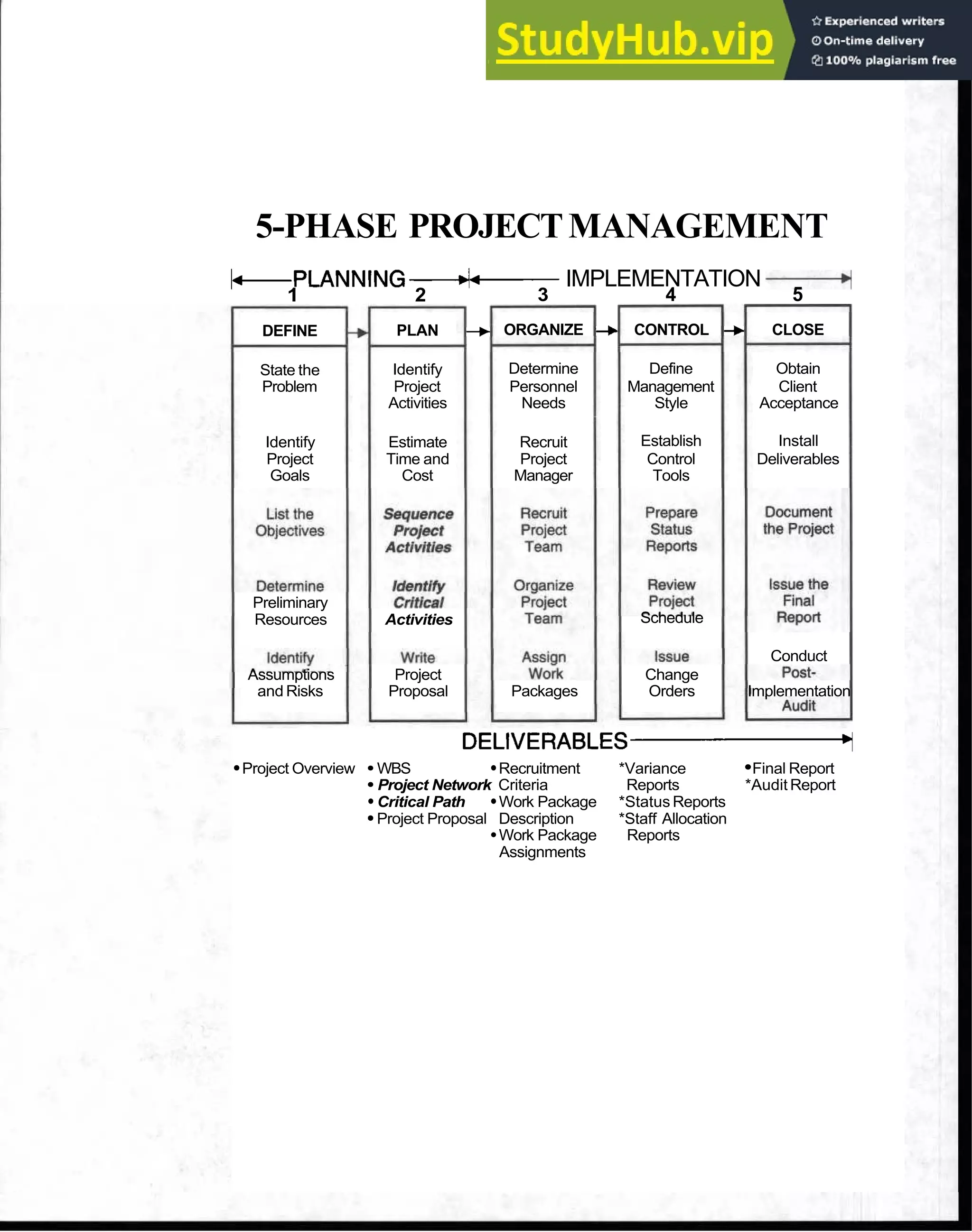
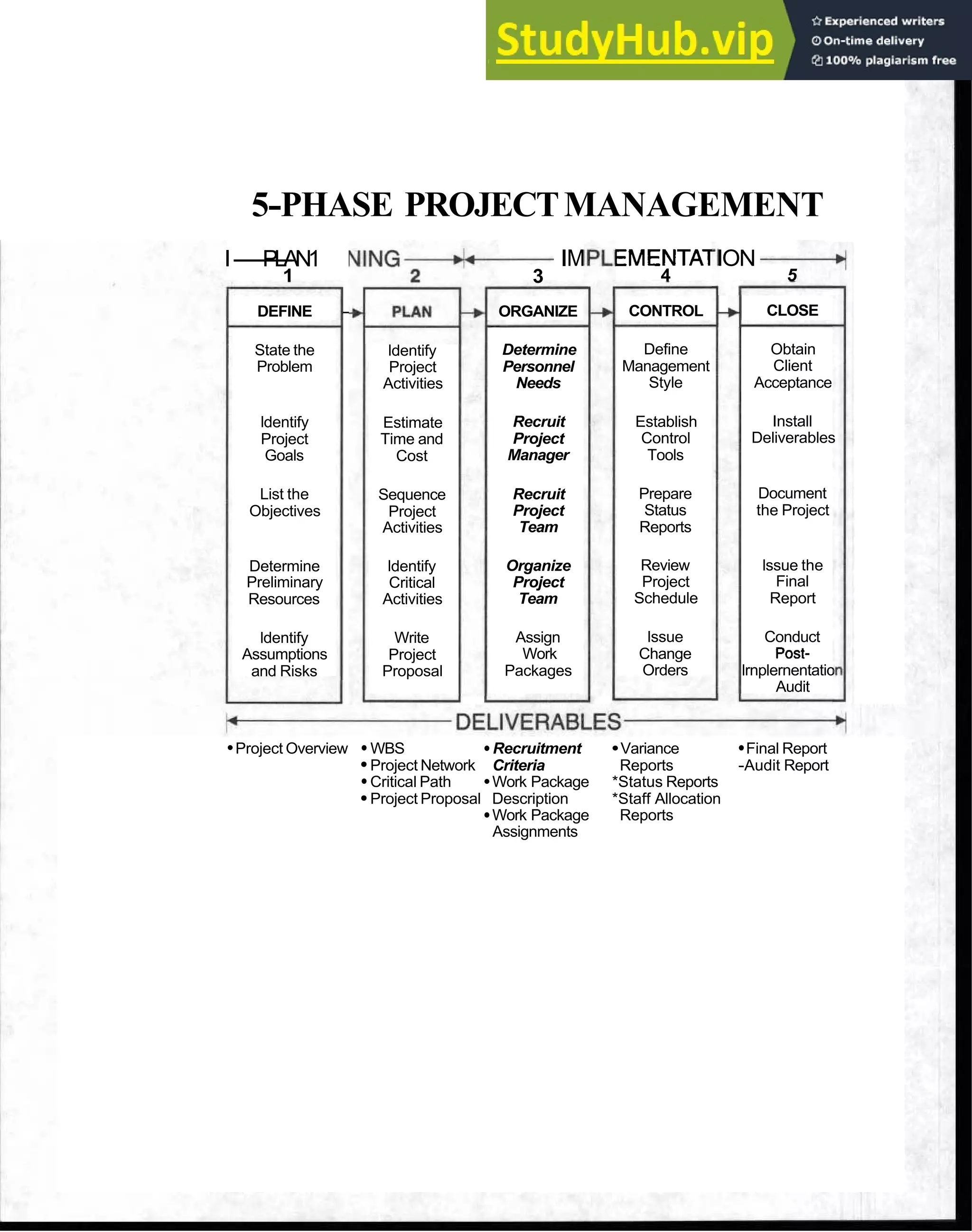
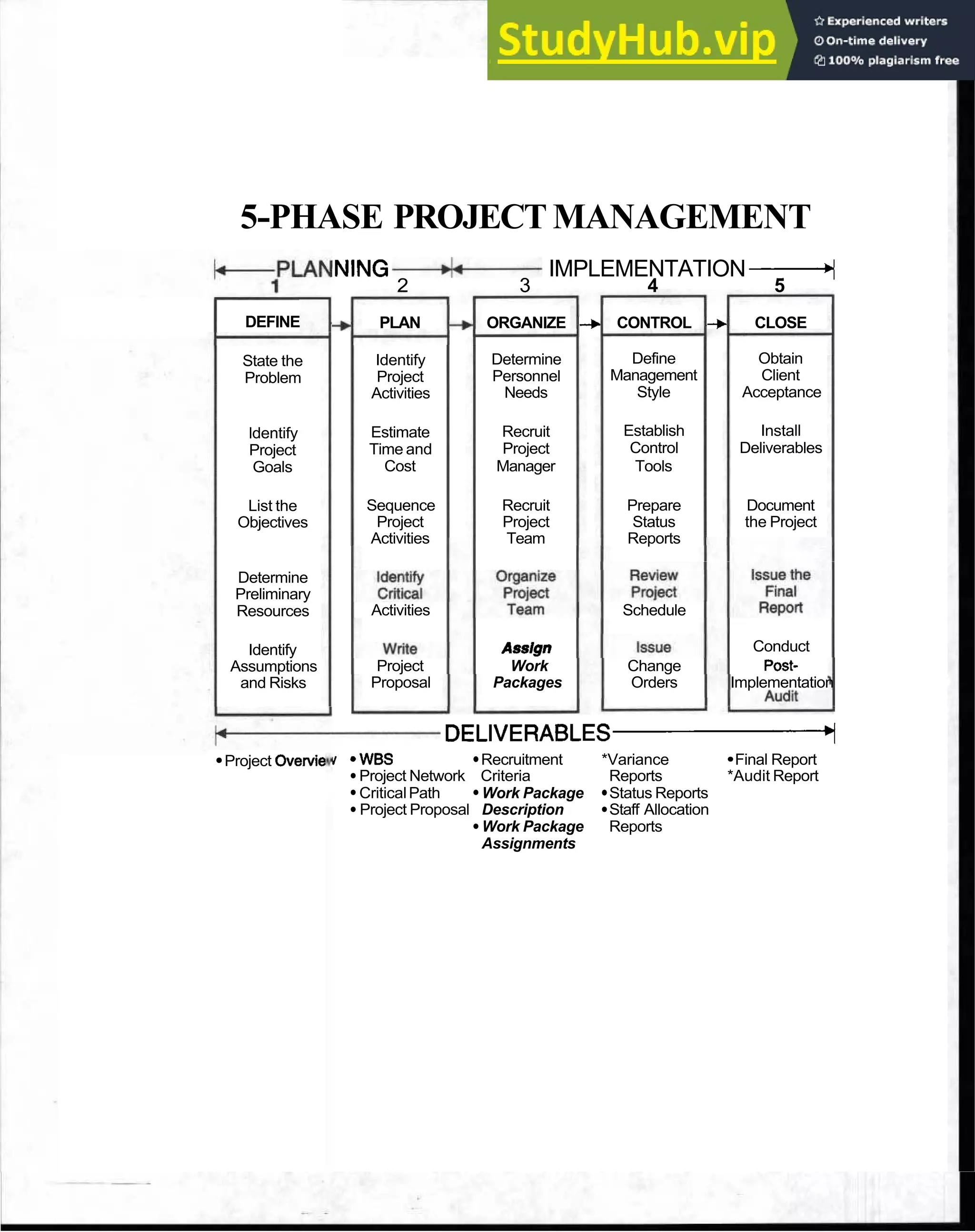
To plan and executea project using these principleswe have utilized a 5-phase
method. Each methodcontainsspecificsteps that expand the generalprocessinto a
detailed set of procedures. The phased method that will serve as a guide to our
development of project management is shown in Figure 1-1.
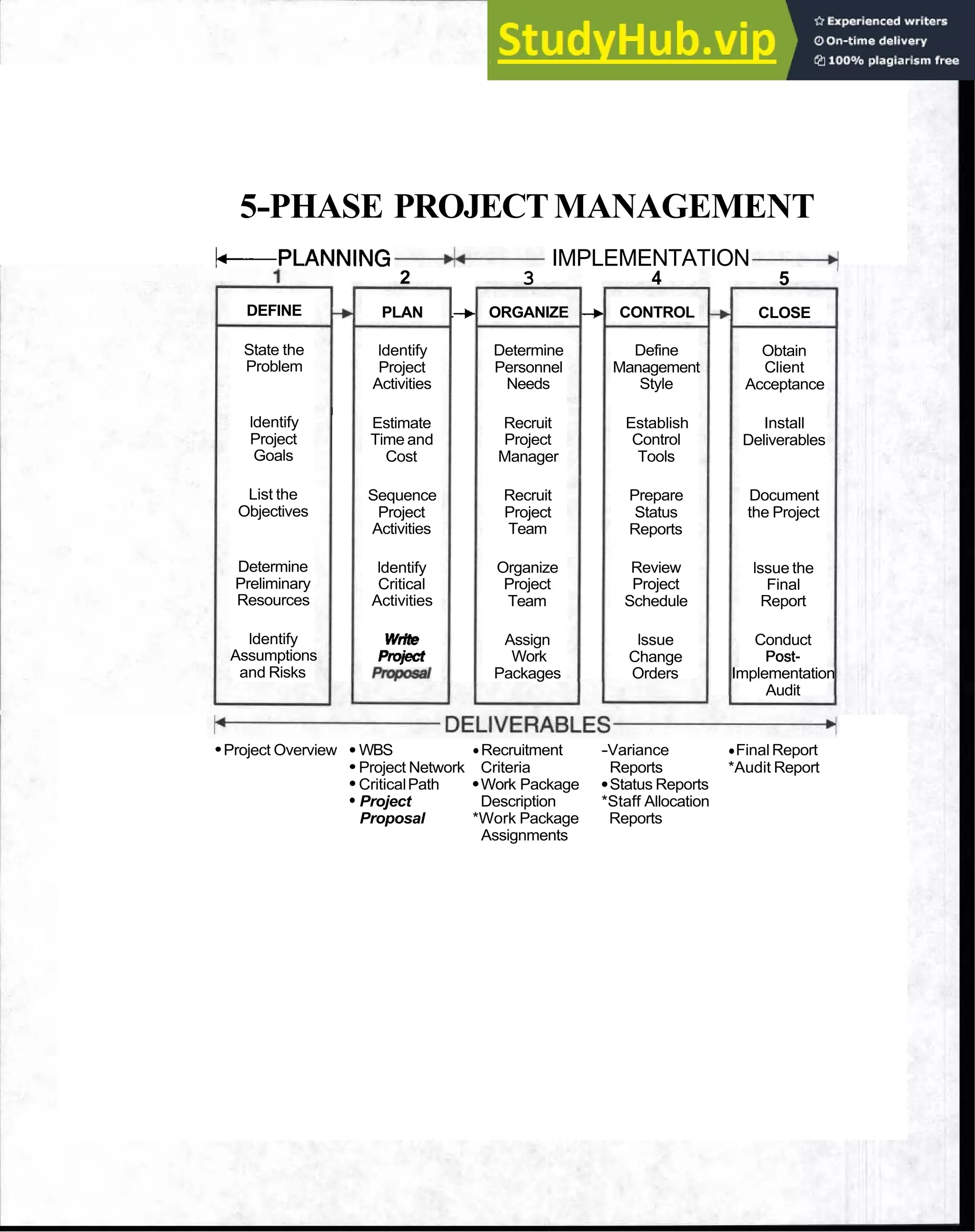
Figure 1-1 THE 5 PHASES AND 25 ACTION STEPS OF THE PROJECT MANAGEMENT LIFE
CYCLE
P
- D E L I V E R A B L E S - I
Project Overview WBS Recruitment *Variance Final Report
Project Network Criteria Reports *Audit Report
CriticalPath Work Package *Status Reports
Project Proposal Description *Staff Allocation
Work Package Reports
Assignments
6 Introduction
TEN MAJOR CAUSES OF PROJECTFAILURE
You do not need to memorize each of the 25 steps in this 5 phase process. These
steps help prevent the 10 causes of project failure offered by Danek Bienkowski
(1989). Knowing who the "enemy" is gives us a competitive advantage. Projects
that follow no method often fail for the following reasons:
1. The project is a solution in search of a problem.
2. Only the project team is interested in the end result.
3. No one is in charge.
4. The project plan lacks structure.
5. The project plan lacks detail.
6. The project is underbudgeted.
7. Insufficient resources are allocated.
8. The project is not tracked against its plan.
9. The project team is not communicating.
10. The project strays from its original goals.
Anyone who has worked on a project has certainly had experiences that would
attest to each of these causes. As you read 5-Phase Project Management, keep these
causes in mind and continually ask yourself how they can be avoided.
ADOPTING A PROJECT MANAGEMENT MIND-SET
Our project management approach is a 5-phase method with 25 action steps. It is
important to keep in mind at the outset that a project involves more than getting
started; it has a life cycle with a beginning, a middle, and an end. The following
anecdotal wisdom will serve as a helpful introduction for discussion. These are
motivating factors that drive and guide the project management process:
"Fail to plan; plan to fail."
"If you don't know where you're going, all roads lead there,"
or, similarly,
"If you don't know where you're going, how will you know when you get
there?'
Adopting a Project Management Mind-set 7
"We may have come here on separate ships, but we're all in the same boat
now."
Depending on its size, planning the project can require a substantialcommitment of
time, energy, and resources. This may be seen as a disadvantageby those not trained
or accustomed to having the end product estimated in time, money, people, and
effort before beginning. It is an American cultural tradition to start first and think
later in product and project development.The Japaneseare more adept at spending
time and energy gaining consensus before beginning project work. Experience
shows that significant waste can occur if adequate planning is not done before a
"go" or "no-go" decision to initiate a particular project is camed out. It is important
at the outset, then, to developa frame of mind that takesplanningseriously.It is the
first step in the process of deciding whether or not to proceed. After the plan is
developed, it is the boss. Although the plan is a dynamic and changeable document
which involvesthe input of many individuals, it is stillseparatefromany one person
or team and should serve as the cornerstone for driving the project's progress.
It is also important to be goal-directed. Without a project goal that defines and
guides all activities and interactions, people and resources go in circles. The goal
and objectives are important. Remember, "garbage in, garbage out." Hopefully,
the goal statement will be the most valuable milestone.
Finally, project management is not achieved without teamwork. Individuals
workingalone on complex projects may at times add heroic contributions, but it is
as a team that individuals share in the work and glory.
5-PHASE PROJECTMANAGEMENT
-PLANNING A IMPLEMENTATION,
-
q
1 2 3 4 5
DEFINE + PLAN + ORGANIZE -+ CONTROL -b CLOSE
State the Identify Determine Define Obtain
Problem Project Personnel Management Client
Activities Needs Style Acceptance
Identify Estimate Recruit Establish Install
Project Time and Project Control Deliverables
Goals Cost Manager Tools
Preliminary
Resources Activities Schedule
Identify Conduct
Assumptions Project Change
and Risks Proposal Packages Orders Implementation
p
- D E L l V E R A B L E S - 1
Project Overview WBS Recruitment .Variance Final Report
ProjectNetwork Criteria Reports *Audit Report
Critical Path Work Package -Status Reports
Project Proposal Description Staff Allocation
Work Package Reports
Assignments
Chapter 2
DEFINING THE PROJECT:
THE PROJECT OVERVIEW
In this chapter we focus on producing a document called the project overview. It
will contain the most valuable information available on the project at this early
stage. Beyond'being required for the initial "go"/"no-go" decision by manage-
ment it has a number of other uses. It serves as
1. a general information piece for other managers-keepingothers informed is a
routine activity in the successful management of projects;
I 2. an early statement of the goal and direction of the project; and
3. a statement of the problems and opportunities to be addressed by the project.
Once the project is approved for a go-ahead, the project overview becomes the
foundation for the more detailed planning activities which follow next. It will serve
as the reference base whenever questions or conflicts arise as to future directions
for the project. During the early stages of implementation it will be a tool for
recruiting and training the project team. Finally, it provides a control point for
reporting project progressand an audit point for evaluating the effectiveness of the
project in achieving stated goals and objectives. In summary, the project overview
will be part of the foundation on which project activities will be based and is a
dynamic tool for the ongoing planning and change actions that will surely follow.
1 STATE THE PROBLEM
As a project manager you must be prepared for a variety of assignments ranging
from well-thought-out ones to those that are casually defined by two managers
who accidentally meet at the water cooler. The project, yet to be defined, may be
clearly outlined in the project overview, what is expected, by when, and with what
resources.It will often be accompanied by a written "statement of intent" contain-
ing the signatures of the authorizing managers. On the other hand, you have the
"water cooler"method, often used to start projects. This type of project is initiated
10 Defining the Project: The Project Overview
with a vague charge at the water cooler such as, "Bill, I want you to take charge of
the annual conference and make sure it doesn't flop like last year's did."
Regardless of which situation you find yourself in, there are specific questions
that must be answered before the project begins-even if it begins at the water
cooler!Stating and writing a brief description of what the project aims to do is the
first step in preparing a project overview statement.
WHAT IS THE PROBLEM/OPPORTUNITY?
A critical need prompts general management to initiate a project management
team. The need arises from a problem or situation (internal or external) that
either threatens the organization or presents it with a valued opportunity. The
need may be for a new product or service, for a new process or system, even for
developing new markets; or it may be for cutting back and retrenching a divi-
sion. The project may involve several professionals from across the organization
or onIy a few people from a single department. The project may require several
months or years at great expense or only a few days with little or no incremental
costs.
This part of the project overview, as you will see in Figure 2-1 later on,
documentsnot only that need but also the benefit to the organization for undertak-
ing the project. The statement should be short, crisp, and to the point. It should
serve as a descriptor for those who although not directly involved on the project
may be indirectly involved in supporting the project or simply have a need to be
aware that the projectis being undertaken. The problemstatement, need, opportu-
nity, or benefit can be seen in the example we offer of a conference planning
projectat the end of this chapter. As we proceed, think about the project you need
or want to initiate.
WHAT IS TO BE DONE?
Next, writing the goal of the project follows from stating the problem, the need,
and/or the opportunity. This may be a very short but specific statement such as:
"Plan and conduct the annual meeting." The important thing to remember is that
the goal statement must be phrased using terms that would not mislead anyone
who might have reason to read it. It must also use terms that measureits comple-
tion. For example, "Write the annual report" is an activity whose completion
cannot be measured. On the other hand, "Receive approval of the annual report"
is an activity whose completion is known once the approving signature is on the
document. The project goal statement is important for two reasons:
State the Problem 11
1. It is a clear statement of what is to be done.
2. It is an event whose completion can be measured.
Also remember that the project goal directs the course of the entire effort. The
goal will be the standard for resolving conflicts, for clarifying expectations, for
requesting and justifying resources. The goal is the most important statement
initiating the project.
WHO IS RESPONSIBLE FOR THE PROJECT?
There is only one project manager. It is common practice for the authorizing
manager to have issued a memo to all parties who might be affected by the project
stating the project name, project objective, project manager, and the approximate
beginning and ending dates of the project.
Although it is desirable to have the project manager identifiedat the beginning
of the project, it may not be possible in all cases. The person designated may be
assigned to another project at some other location in the organization. Or the
project manager may have to be hired from outside. As will be discussed later, if
the project manager has not been hired at the outset, the requirements of the
position can be provided.
WHEN MUST THE PROJECTBE COMPLETED?
This is a critical piece of information. It not only calls attention to the priority that
the project will have but also sets in motion a number of planning and budgeting
activities. There are two scenarios to consider.
The 'Water Cooler" Imposed Deadline
In this case the project deadline was given to the project manager. This may have
been the result of a "water cooler" decision, or it may have been imposed because
of other factors(customer requirement, your project is part of a larger project, etc.).
In any case, as we will show in Chapter Three, you will prepare a plan that shows
how the project can be completed by the deadline. In some cases you may have to
strive to complete the project by the (sometimesarbitrary) deadline. In other cases
(the "water cooler" example), you may be able to negotiate a later deadline, or
more resources to meet the requested deadline.
12 Defining the Project:The Project Overview
The Planned and Estimated Deadline
In this case the project manager and the project team, through their initial project
management estimating process, determined the project completion date. There
will be cases where, as a result of your initial planning (see Chapter Three), you
will have the luxury of negotiating the completion date with the authorizing man-
ager. "Guesstimating"a completion date often occurs as an initial step just to get
the planning moving. However, estimating the project completion date requires
time and a sound planning process. This date is obtained after the initial planning
cycle of the project is completed.
Let us turn next to some concrete examples of the general discussion we have
just presented. Remember, we are still preparing the project overview.
IDENTIFY PROJECTGOALS
Every project has only one major goal to be accomplished and several objectives
that support that goal. The goal is the global statement of purpose and direction
toward which all objectives, work activities, and tasks will point. The goal serves
the following functions:
It defines the final outcome in terms of the end product or services.
It is the continual point of reference for settling disputes and misunderstand-
ings about the project.
It is the guide that keeps all objectives and the work associated with them
on track.
The goal statement should be action-oriented, short, simple, straightforward, and
as understandable as possible. Some examples will help clarify:
Prepare and launch the space shuttle Atlantis on March 5, 2025, from Cape
Canaveral, Florida.
Connect France with England via a covered tunnel and paved roadway run-
ning under the English Channel and have that facility open for traffic no later
than August, 1993.
Design and complete pilot testing by September, 1994, a software packagethat
performs basic financial analyses for small businesses.
Obtain an MBA in management from Bentley College by spring, 2000.
List the Objectives 13
Note that each of these goal statements tells precisely what will be done and
by when. The end point may have to be revised after further review, but at this
point the end date shows finality to the project.
LIST THE OBJECTIVES
In order to accomplish the stated goal, several major project steps will have to take
place. These are the objectives, and they represent major components of the proj-
ect (somewould use the term milestones, which is perfectly acceptable).Objectives
are not actual work that is accomplished but subgoals which direct work activity.
They are more precise statements than the goal statement and, like goal state-
ments, are also action-oriented. In order for the goal to be achieved, all objectives
must be realized. George Doran (1981) has offered a meaningful and easy-to-
.remember guide for helping us formulate objective statements. His method is
called S.M.A.R.T.
S pecific Be specific in targeting an objective.
M easurable Establish a measurable indicator(s)of progress.
A ssignable Make the objective capable of being assigned to someone for
completion.
R ealistic State what can realistically be achieved within budgeted time
and resources.
T ime-related State when the objective can be achieved, that is, the
duration.
For example, you may state as an objective, "Get a degree by next year." If you
used the S.M.A.R.T. method, however, how would you revise this objective? First,
you may ask, what kind of degree? Then, how realistic is it for me to obtain this
degree? How much would it cost? When exactly would I graduate? After this
analysis, you might revise your objective as follows:"Obtain a bachelor of arts,
B.A., degree in clinical psychology at the Universityof Wisconsin, Madison, at the
end of the spring semester, 1999." Think of an objective you wish to accomplish.
Write it down, then apply the S.M.A.R.T. method. This requires practice and
discipline.Writing S.M.A.R.T.objectives is essential for effective project planning.
By specifying objectives we begin to view the project in terms of its major
components. Objectives are a crude roadmap that helps decision makers and other
membersof the management team to understand the scope of the project.They also
provide a basis for determining resource requirements and the project timeline. At
14 Defining the Project: The Project Overview
the end of the chapter we will give an example of goal and objectives statements
which should clarify any confusion between the two.
WHAT CRITERIA WILL BE USED TO EVALUATE PROJECTSUCCESS?
It goes without saying that you are expected to complete the projecton time, within
budget, and according to specification. Specifications may include criteria, mea-
sures of success, as the following examples illustrate:
At least 245 of the 280 delegates will register and attend the annual
conference.
The new product introduction will generate sales of $350,000 in the first six
months.
The new order entry system will be considered successful if the average time
from order entry to order fulfillmentis less than five workingdays; the average
order value exceeds $1,000; less than 2 percent of orders are backordered;and
there is less than one customer complaint per $100,000 ordered.
At this early stage of project preparation, a planning committee or task force can
touch base with those individuals and groups who will be involved in the project
in order to gather a preliminary list of success criteria against which the project
outcomes can be measured. These criteria will most likely be revised as the
project plan progresses.
DETERMINE PRELIMINARY RESOURCES
Don't think of resources only as money. Resources include human resources and
materials as well as financial capital. Included on your list of resources will be
people (howmany, who, when, and for how long),equipment(what pieces, when,
and for how long), and office space (for larger projects office space for you, an
assistant project manager, and other support staff may be required). There are two
scenarios to consider:
1. The resources were determined without project manager input
2. The project manager determined the needed resources based on the project
plan
Identify Assumptionsand Risks 15
First Scenario
Like the predetermined"water cooler"imposed project deadline, resources may be
allocated beforehand. Still, you will have to complete your planning before you
know how adequate the resources given to you will be. Based on existingcontracts
and agreements with customers, you may have little choice, regardless of the
adequacy of the resources given to the project. Patronizingmanagement by agree-
ing to a level of support that you believe inadequate should be avoided. Similarly,
requests for exoticsupport beyond that which has been identified by management
is foolhardy. Prudence and common sense must prevail at this early, arbitrary
stage. However, once your formal planning process is completed, you will have
adequate documentation to argue for the necessary resources to complete each
work assignment.
Second Scenario
You may be asked to present a preliminary plan in which you "guesstimate"
needed resources. This scenario is preferable to being told what you have in order
to completea project. By following the steps offered in Chapter Three, you will be
able to prepare the project resource requirements and then negotiate with the
authorizing manager.
IDENTIFY ASSUMPTIONS AND RISKS
The project idea must often be sold to "higher ups" as well as to staff and review
groups. Therefore, the project overview must be a persuasive statement. Don't
forget: to effectively sell an idea, product, or service, you must believe in it and
have confidence in its worth. At the same time it must be realistic. Identifying
assumptions and risks associated with each objectiveis a step toward acknowledg-
ing your understanding of the assumptions and risks involved with the planning
and completionof the project. Identifyingthe assumptions and risks also helps you
think through the issues associated with executing the project. A guide to stating
assumptions and risks is to take each objective you listed and ask the following
questions:
1. What resources are required to realisticallycomplete this objective?What risks
are associated with obtaining any of these resources in a timely manner?
2. What problems and delays are likely to occur in completing this objective?
3. What effect(s)will delays have on the budget and overall project schedule and
plan?
16 Defining the Project: The Project Overview
4. What are the probable time, money, and personnel cost overruns to complete
this project?
5. What assumptions can be made to realisticallycorrect for delays in completing
this objective within given resources and constraints?
Once your project overview statement is done, complete the Quality Control
Checklist and Acid Test at the end of the chapter. Then ask some trusted, compe-
tent colleagues to read, critique, and comment on the overview's "acceptance
probability." Inform your colleagues of your intended audience, the people who
must approve the idea.
The followingexample provides you with concreteinformation used to complete
a project overview. Think through your own project ideas as you read.
EXAMPLE: PLANNING A PROFESSIONAL CONFERENCE
THE BIRTH OF A CONFERENCE
At the winter meetingof the Executive Councilof the Program of Project Managers
(PPM)it was decided that the organization's annual conference would take place
in the early fall. As in the prior year, a staff of four and an operating budget of
$50,000 (the same as last year) has been allocated to the project. Last year's
conferencewas a disappointment in that the number of attendees had dropped for
the third consecutive year and the conferencebarely broke even. Knowing that the
bleeding had to stop, the goal for this year's conference was set at a net profit of
$25,000.
There was some discussion over the choice of conference chairperson. On
previous occasions you had expressed an interest in moving up to an officer posi-
tion in PPM. Brad Kennedy, the Executive Director, knew of your interest. Because
of your organizationaland management skills, he saw a clear hero strategy for you
if you could pull off a successfulconference.He offered your name. Since no others
were suggested,you got the job. You received the news with some trepidation, but
being a risk taker you agreed to the assignment. It is fair to say that you weren't as
convinced of the hero strategy as Brad. You felt that the downside risks weren't
that great and it was your opportunity to make a play for that officer position.
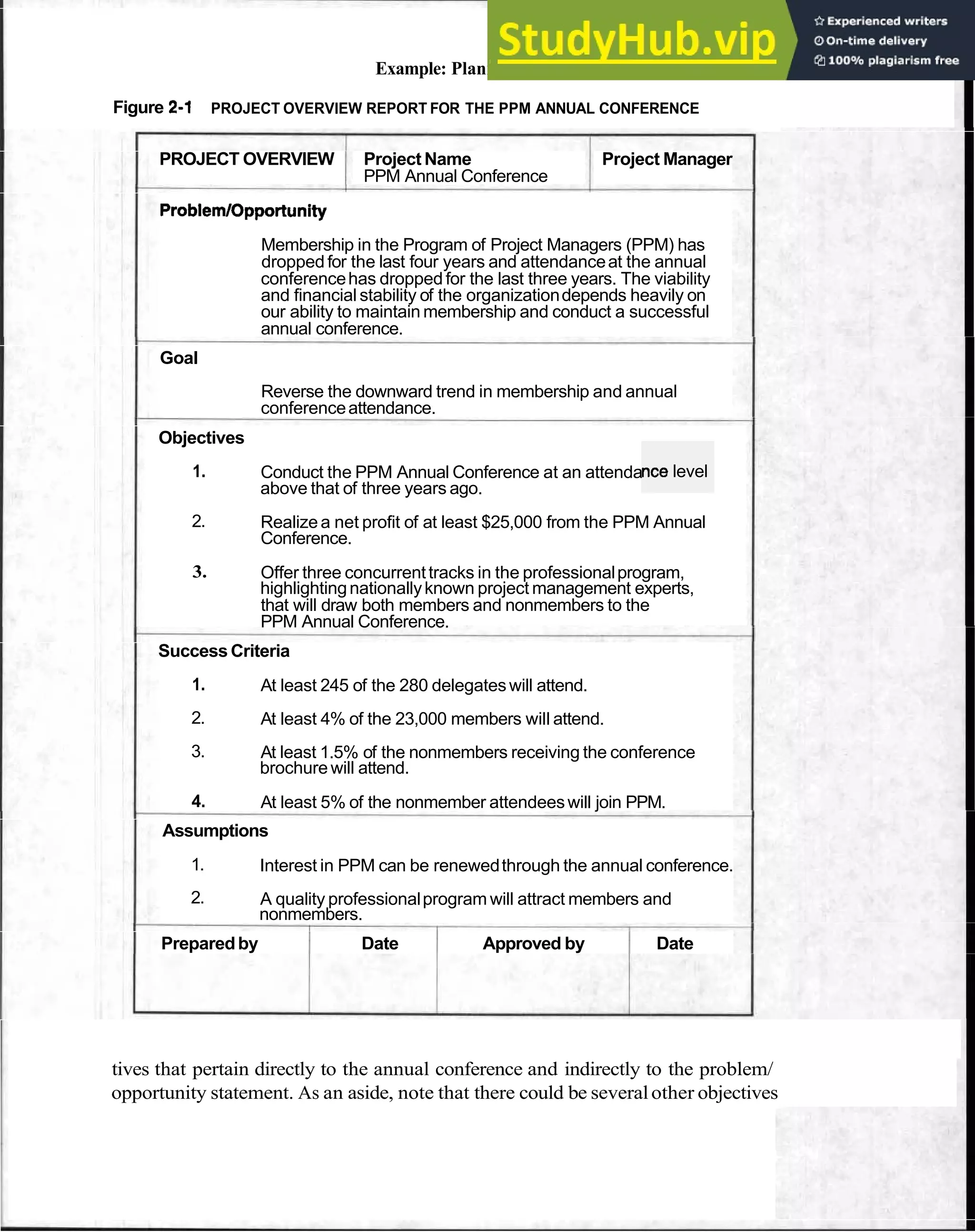
Figure 2-1 is the project overview for the PPM Conference Planning Project.
The first step to planning the conference project is to get the idea on paper. There-
fore, we complete the project overview. The problem/opportunity statement is
merely a reflection of the state of affairs in the PPM. The survival of the PPM
depends on solving this problem of declining membership and conference atten-
dance-the goal statement. More specifically,we can identify three separate objec-
Example: Planning a Professional Conference 17
Figure 2-1 PROJECT OVERVIEW REPORT FOR THE PPM ANNUAL CONFERENCE
ncelevel
PROJECT OVERVIEW Project Name Project Manager
PPM Annual Conference
ProblemlOpportunity
Membership in the Program of Project Managers (PPM) has
dropped for the last four years and attendanceat the annual
conferencehas dropped for the last three years. The viability
and financial stability of the organizationdepends heavily on
our ability to maintain membership and conduct a successful
annual conference.
Goal
Reverse the downward trend in membership and annual
conferenceattendance.
Objectives
1. Conduct the PPM Annual Conference at an attenda
above that of three years ago.
2. Realizea net profit of at least $25,000 from the PPM Annual
Conference.
3. Offer three concurrenttracks in the professionalprogram,
highlightingnationallyknown project management experts,
that will draw both members and nonmembers to the
PPM Annual Conference.
Success Criteria
1. At least 245 of the 280 delegateswill attend.
2. At least 4% of the 23,000 members will attend.
3. At least 1.5% of the nonmembers receiving the conference
brochure will attend.
4. At least 5% of the nonmember attendeeswill join PPM.
Assumptions
1. Interest in PPM can be renewedthrough the annual conference.
2. A quality professionalprogram will attract members and
nonmembers.
Preparedby Date Approved by Date
tives that pertain directly to the annual conference and indirectly to the problem/
opportunity statement. As an aside, note that there could be severalother objectives
18 Defining the Project: The Project Overview
that relate to the problem and that would have nothing to do with the annual
conference.We could envision projects havingto do with membership campaignsor
imagechanges. Four measuresof projectsuccesshave beenidentified. Note that they
relate directly to the problem/opportunity statement, too. Finally, there are two
assumptions that have been made. These assumptions happen to be critical to the
problem resolution,for without the causallinkage between a quality conferenceand
membership, the project would not address the problem.
SUMMARY
At this point in the 5-phase project management process you should be able to
1. define a project;
2. list a project's characteristics;
3. distinguish a project from a task, an assignment, and a program;
4. state the first step in developing a project (the project overview);
5. state the basic parts of a project overview;
6. state the functions a project overview serves; and
7. write a saleable project overview for your project idea.
In the next two sections of this chapter you will find a project o v e ~ e w
Quality
Control Checklist and Acid Test. Use these lists to review your project overview
and assign it a "go" or "no-go" status.
PROJECTOVERVIEW QUALITY CONTROL CHECKLIST
YES OR NO
1. Opportunity/Problem Statement
-The need, problem, and/or opportunity has been stated clearly and
realistically.
-It is evident who experiences the need.
-The effects of the project results are evident.
-The benefit/gain is evident from reading the opportunity/problem
statement.
Summary 19
2. Project Goal
-The desired end result of the project has been clearly stated in the goal.
-The goal statement is specific, measurable, time-related, and provides
direction.
-The goal can realistically be accomplished.
-The goal is manageable.
3. Project Objectives
-All objectives are complete and necessary to achieve the stated goal.
-All objectives are stated clearly, simply, and realistically.
-All objectives have a definable and measurable end result to be
accomplished.
-All objectives are finite, i.e., they each have a beginning and an end.
-S.M.A.R.T. (specific, measurable, assignable, realistic, time-related).
4. Stated Risks, Assumptions, Questions
-All risks, assumptions, and questions regarding the project have been
stated at this point.
-All risks, assumptions, and questions regarding the project are realistic
and demonstrate knowledge of the activities to be completed.
-The stated risks, assumptions, and questions enable reviewers of the
project to assess benefits and costsin planning, implementing,and man-
aging the project.
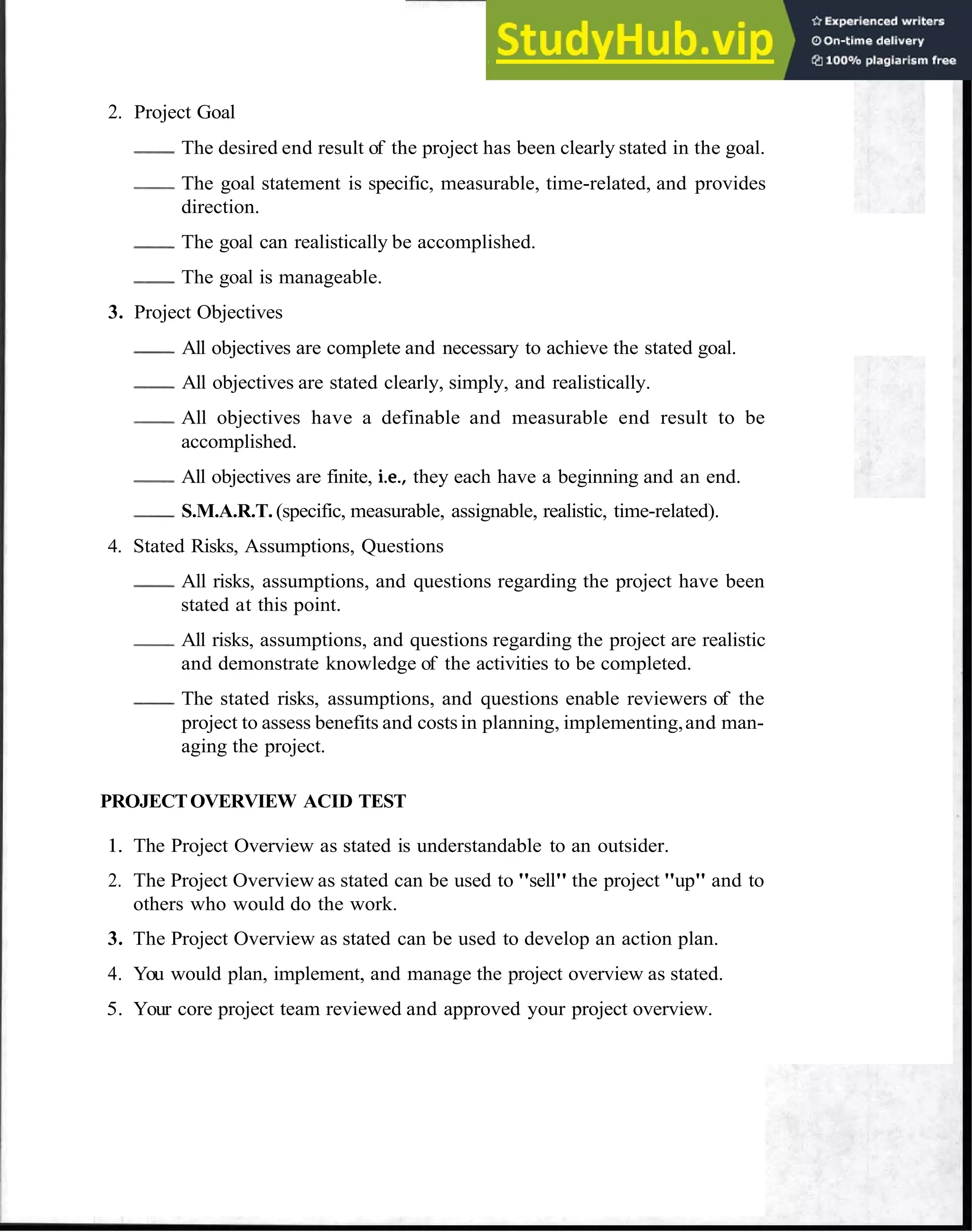
PROJECTOVERVIEW ACID TEST
1. The Project Overview as stated is understandable to an outsider.
2. The Project Overview as stated can be used to "sell" the project "up" and to
others who would do the work.
3. The Project Overview as stated can be used to develop an action plan.
4. You would plan, implement, and manage the project overview as stated.
5. Your core project team reviewed and approved your project overview.
5-PHASE PROJECTMANAGEMENT
k-PLANNING- IMPLEMENTATION-
4
1 2 3 4 5
DEFINE -+ PLAN --, ORGANIZE -b CONTROL -
, CLOSE
State the ldentiw Determine Define Obtain
Problem Project Personnel Management Client
Activities Needs Style Acceptance
Identify Estimate Recruit Establish Install
Project Time and Project Control Deliverables
Goals Cost Manager Tools
Determine Organize Issuethe
Preliminary Project Project
Resources Activities Schedule Report
Identify Assign Conduct
Assumptions Project Work Change Post-
and Risks Proposal Packages Orders Implementation
Audit
D E L I V E R A B L E S Y
Project Overview WBS Recruitment *Variance Final Report
Project Network Criteria Reports *Audit Report
CriticalPath Work Package *StatusReports
Project Proposal Description *Staff Allocation
Work Package Reports
Assignments
Chapter 3
SPECIFYING THE PROJECT
You have just completed a project overview. You reviewed and revised it with other
professionals and/or experts, and then successfully sold it to "higher ups" in the
organization-or to a bank, your boss, or yourself. You have confidence in the idea
and you know your idea is a project. What's the next step?
In this chapter we present a simple decomposition process called a work break-
down structure (WBS). The WBS is a hierarchical representation of the project. It
shows you how to identify the activities that must be done to begin and complete
the project. At this point you have a goal and several objectives that must be
expressedin terms of activities and work to be done. Our technique for generating
the WBS will reduce even the most complex projectsto activities and tasks that can
be planned and executed with confidence. Later you will see that the WBS is the
foundation for the more detailed definition, planning, organization, and control
phases of the project management life cycle. It will be the document that guides
the remainder of the project.
IDENTIFY PROJECTACTIVITIES
To effectivelyplan and execute a complex project it is usually helpful to visualize
the project as having an overall goal with several objectives. Each objective will
have a number of discrete, separately identifiable activities. These activities define
the work that must be done in order to accomplish the objectives. They must be
formulated and specified so that they can be easily measured and their completion
easily verified. Activities are identified by considering each objective and asking,
"What activities must be done in order to complete the project?"
Like goals and objectives, activities must also be S.M.A.R.T. For example,
consider the activity,"Completion of the final draft of a report." This is not well-
defined because completion is a term subject to wide interpretation. A more
specific activity statement would be, "Acceptance of the final draft." There is no
doubt when this activity is to be finished. "Completion of the final draft" leaves
one open to private interpretation of the expected final product. In other words,
there can easily be disagreement over what is expected of the final draft.
22 Specifying the Project
"Approval,"on the other hand, is not subject to interpretation-you either have
it or you don't.
WORK BREAKDOWN STRUCTURES (WBS)
Of all the methods availableto define the activities that comprise a project, the one
that we have used extensively and that has withstood the test of time is the WBS.
The concept of the WBS is easily understood and quickly mastered. It involves
envisioning the project as a hierarchy of goal, objectives,.activities, subactivities,
and work packages. The hierarchicaldecomposition of activities continues until the
entire projectis displayed as a network of separatelyidentifiedand nonoverlapping
activities. Each activity will be single-purposed, of a specific time duration, and
manageable; its time and cost estimates easily derived, deliverablesclearly under-
stood, and responsibilityfor its completion clearly assigned. Ideally, the final de-
fined activities will be known entities. They have been done before or they are
sufficientlysimilar to other known activities. As we will see, the WBS facilitatesthe
planning, budgeting, scheduling, and control activities for the project manager and
team.
CHARACTERISTICS OF A SUCCESSFUL WORK BREAKDOWN
STRUCTURE
The first question to ask is, "How do I know that I have identifiedall the necessary
activities to successfully achieve the project objectives?" First, let us look at the
characteristics of the activities that comprise the WBS. A well-defined activity has
the following characteristics:
Its status and completion is easily measured.
It has a very definite beginning and ending event.
It is familiar (may have been done before) and the time to complete it and its
associated costs can easily be estimated from prior experiences with this or
similar activities.
It comprises work assignments that are manageable, measurable, integrable,
and independent of work assignments in other activities.
It should normally constitute one continuous stream of work from start to
finish.
In deciding on other activities that might be included in the project, consider the
following:
Work Breakdown Strurhves (WBS) 23
scheduling material delivery,
subcontractor activities that impact project activities,
equipment availability, and
staff training and availability.
I
f these can affect projectactivitiesand hence projectcompletion time, includethem
as activities in the WBS.
STEPS FOR CONSTRUCTING A WORK BREAKDOWN STRUCTURE
There are no specificrules that govern the creation of the WBS. However, a process
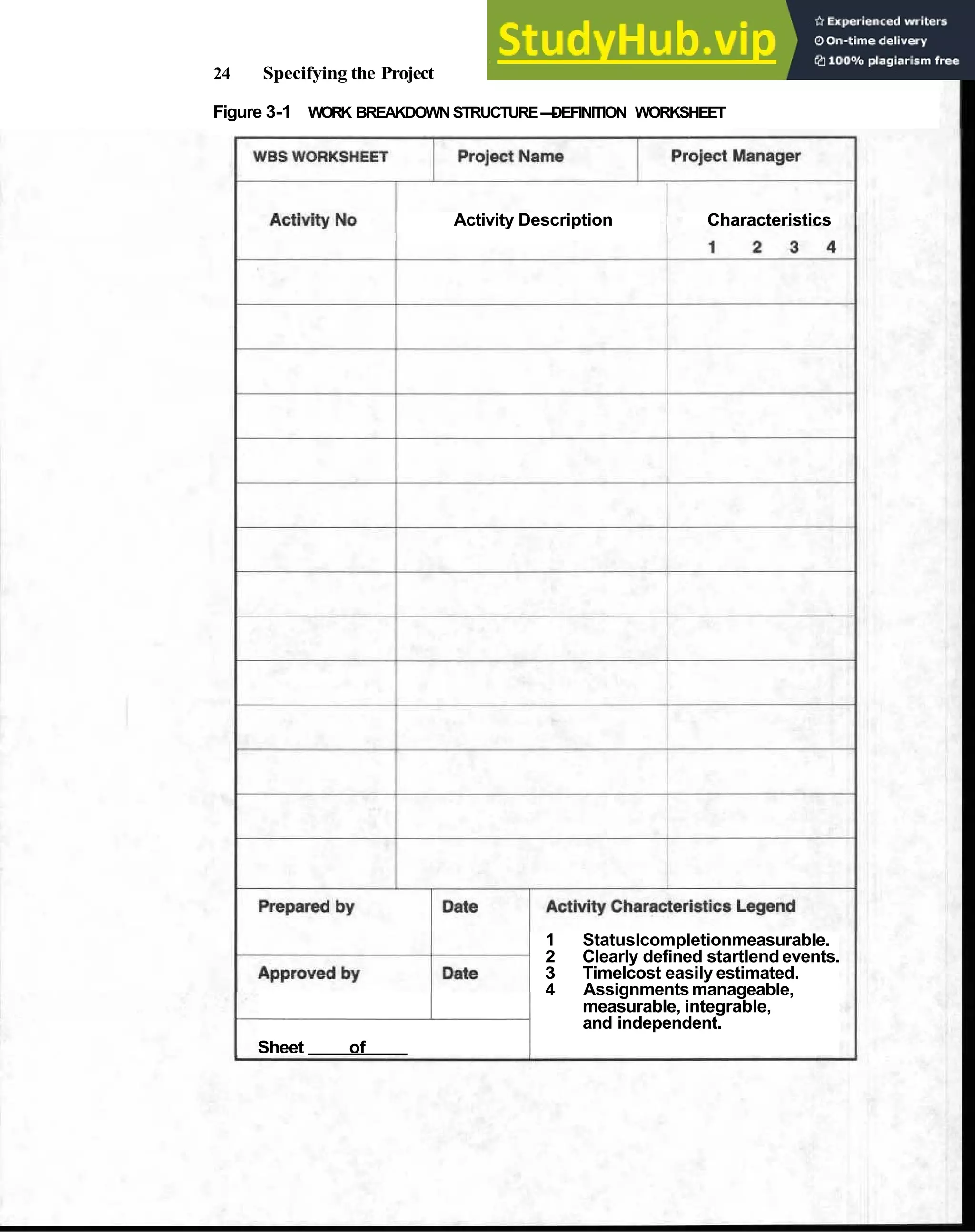
that we have used successfullyutilizes the form given in Figure 3-1. The following
steps lead to completing the WBS:
Step 1: Divide the project into its major objectivessuch that the project is
fully defined by the objectives.
Step 2: Partition each objective into the activities that must be done in order
to accomplish the objective.
Step 3: For each activity having one or more missing characteristics divide
that activity into the subactivities comprising it.
Step 4: Repeat step 3 until all subactivities have the characteristics desired.
Step 5: The lowest-level subactivities in the hierarchy will be the basis of the
work packages that must be done in order to complete the project.
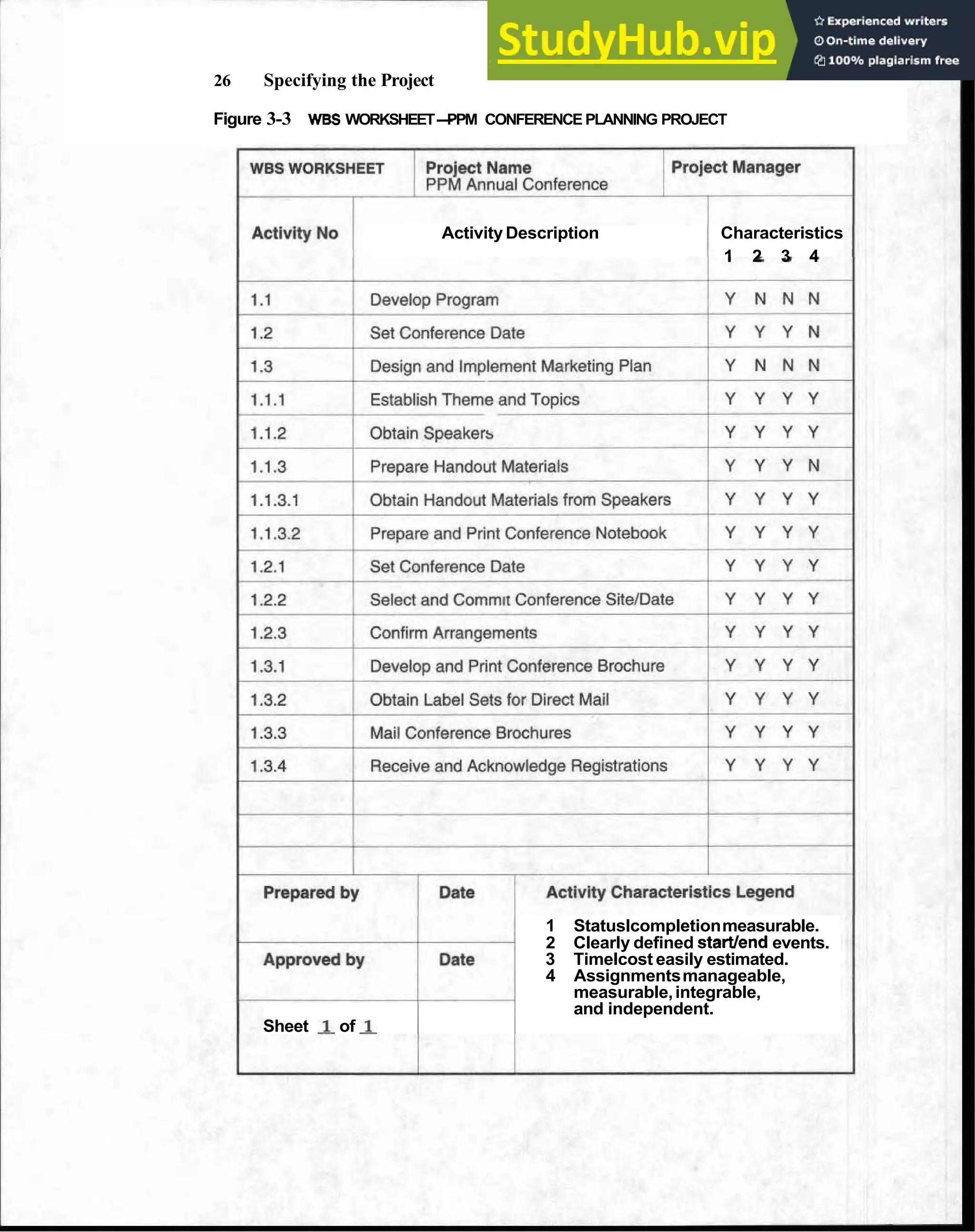
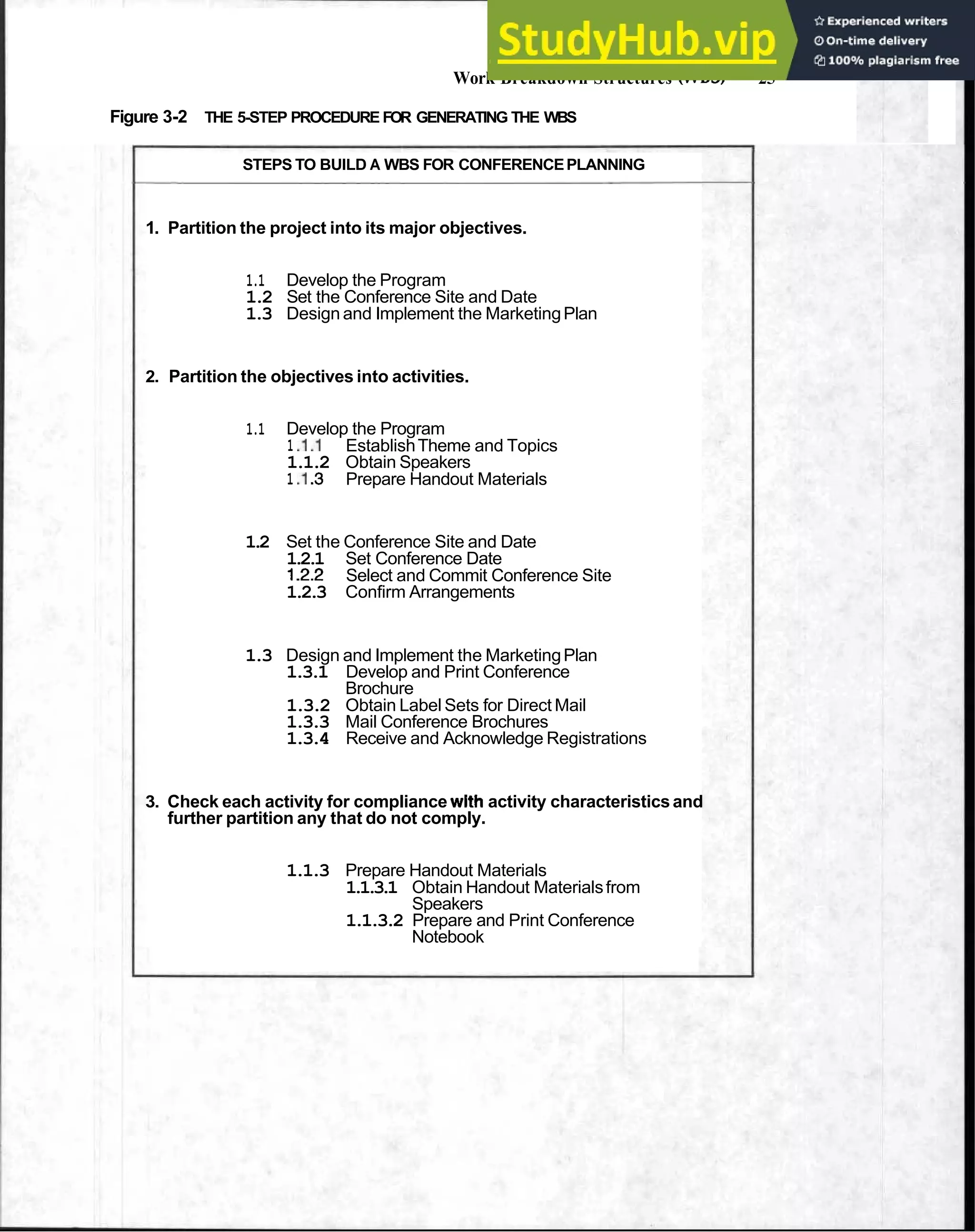
Figure 3-2 is an example of the 5-step processfor buildinga WBS. Figure 3-3 shows
the corresponding WBS. Note the numbering system. The first digit identifies the
project,thesecond identifiestheactivitiesthatcomprisetheproject, thethirdidentifies
subactivities within an activity, etc. This provides an easy reference according to the
project hierarchy and facilitates computer input.
WORK BREAKDOWN STRUCTURE-
HIERARCHICAL REPRESENTATION
A convenient graphical representation of the WBS is shown in Figure 3-4. For pur-
poses of presentation, training, and project understanding, the graphical display is
often preferred. It can be generated directly from the activity list on the WBS work-
sheet (see Figure 3-3).
24 Specifying the Project
Figure 3-1 WORK BREAKDOWNSTRUCTURE-
DEFINITION WORKSHEET
Activity Description Characteristics
1 Statuslcompletionmeasurable.
2 Clearly defined startlendevents.
3 Timelcost easily estimated.
4 Assignmentsmanageable,
measurable, integrable,
and independent.
Sheet of
Work Breakdown Structures (WBS) 25
Figure 3-2 THE 5-STEP PROCEDURE FOR GENERATING THE WBS
STEPS TO BUILD A WBS FOR CONFERENCEPLANNING
1. Partition the project into its major objectives.
1.1 Develop the Program
1.2 Set the Conference Site and Date
1
.
3 Design and Implement the MarketingPlan
2. Partition the objectives into activities.
1.1 Develop the Program
1 .I.I EstablishTheme and Topics
1.1.2 Obtain Speakers
1 .I.
3 Prepare Handout Materials
1
.
2 Set the Conference Site and Date
1
.
2
.
1 Set Conference Date
1
.
2
.
2 Select and Commit Conference Site
1
.
2
.
3 Confirm Arrangements
1.3 Design and Implement the MarketingPlan
1
.
3
.
1 Develop and Print Conference
Brochure
1.3.2 Obtain Label Sets for Direct Mail
1.3.3 Mail Conference Brochures
1.3.4 Receive and Acknowledge Registrations
3. Check each activity for compliance with activity characteristicsand
further partition any that do not comply.
1.1.3 Prepare Handout Materials
1
.
1
.
3
.
1 Obtain Handout Materialsfrom
Speakers
1
.
1
.
3
.
2 Prepare and Print Conference
Notebook
26 Specifying the Project
Figure 3-3 WBS WORKSHEET-
PPM CONFERENCE PLANNING PROJECT
Activity Description Characteristics
1 2 3 4
1 Statuslcompletionmeasurable.
2 Clearly defined startlend events.
3 Timelcost easily estimated.
4 Assignmentsmanageable,
measurable,integrable,
and independent.
Sheet of l
Work Breakdown Structures (WBS) 27
Figure 3-4 HIERARCHICALREPRESENTATIONOF THE CONFERENCEPLANNING WBS
1 CONFERENCE PLANNING 1
THEME MATERIALS SPEAKERS DATE PLACE LISTS BROCHURE REGISTER
e
f
i
'
f
)o,,,,,W]
MATERIALS BROCHURE BROCHURE
m
r
T
l
Uses of the Work Breakdown Structure
Just as the project overview was valuable during early planning activities, the
WBS is valuable during the more detailed planning activities and early imple-
mentation. One of its major uses is to provide a global-yet detailed-view of
the project. In this way, it will be the foundation for time, cost, and perform-
ance planning, and for control and reporting. As planning proceeds, the WBS
will be used to generate a network representation (discussed in Chapter Four)
of the project. This network will be the major control tool used by the project
manager to evaluate planned versus actual progress and to manage the
changes that will follow as a result of that evaluation.
The WBS is the easiest to learn and least error-prone technique we have
encountered for representing the many tasks that comprise even the simplest of
projects. It is a graphical representationthat is easily understood by those having
little familiarity with the details of the project. It is a tool that we will use in
Chapter Four to build the network of project activities. The W
B
S therefore serves
as an intermediate planning device.
There will be projects for which a network representation of a WBS may
seem too difficult to generate. In those cases we have found it helpful to
consider other approaches to defining the WBS. For example, the project may
be decomposed by functional business unit, by geographic location, by depart-
ment, according to the skills needed, or based on equipment or material avail-
ability. These alternatives may work in cases where the more straightforward
hierarchical approach fails. The best advice we can give is to think creatively
when developing the WBS.
28 Specifying the Project
ESTIMATE TIME AND COST
Now that the WBS is complete the next step will be to estimate the time and cost of
each of the activities that comprise the project. Since each activity has the four
characteristics listed in Figure 3-1, they will be sufficiently familiar (either having
been done beforeor beingsimilarto previousactivities) that estimating timeand cost
will be straightforward. Let experience be your guide.
On the other hand, the project may be different from others your unit may
have encountered.Even if the project issimilar, there may be one or more activities
that are new. In the next section we provide a simple technique for estimating
activity time. And in the followingsection we will discuss a process for estimating
activity cost.
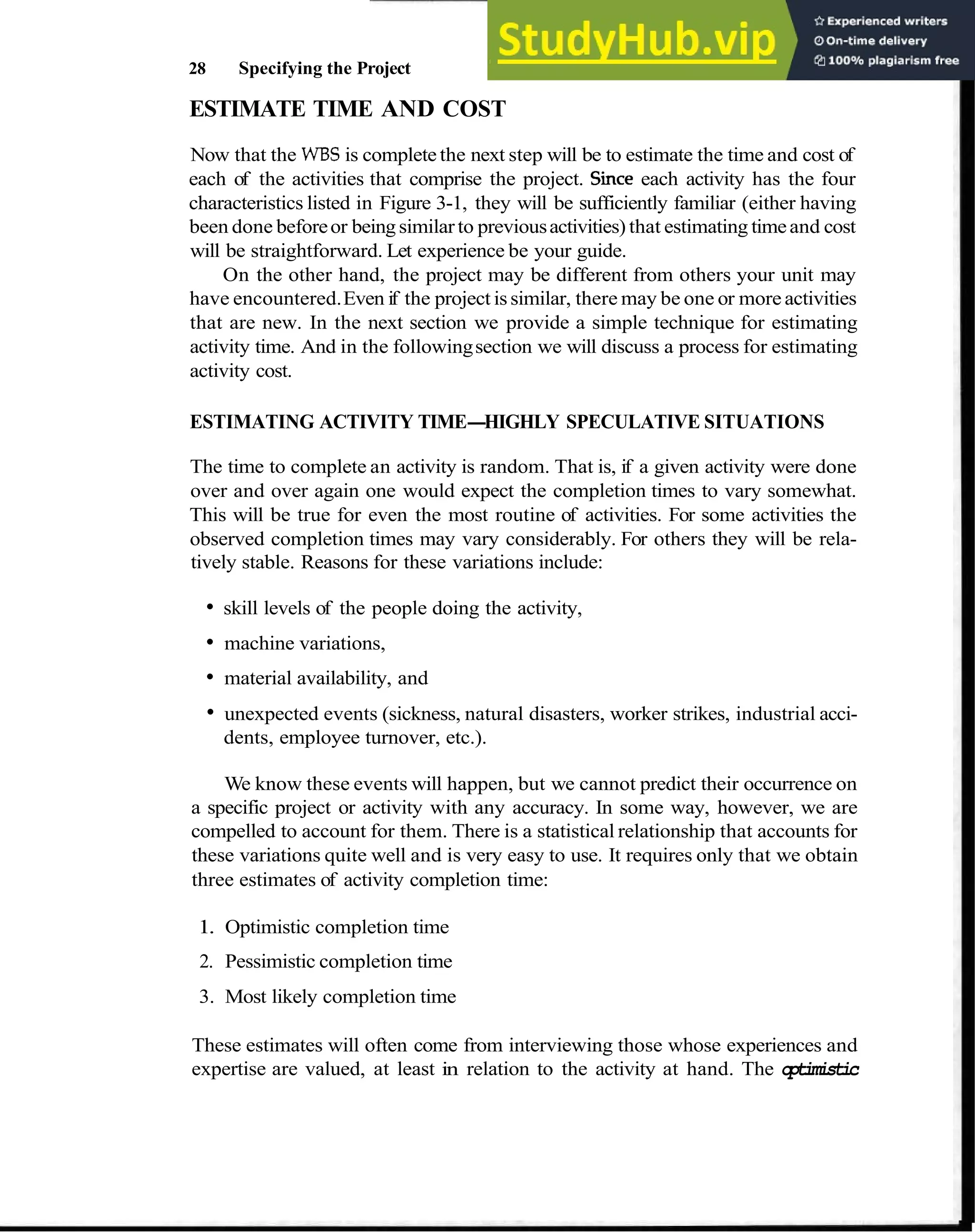
ESTIMATING ACTIVITY TIME-HIGHLY SPECULATIVE SITUATIONS
The time to complete an activity is random. That is, if a given activity were done
over and over again one would expect the completion times to vary somewhat.
This will be true for even the most routine of activities. For some activities the
observed completion times may vary considerably. For others they will be rela-
tively stable. Reasons for these variations include:
skill levels of the people doing the activity,
machine variations,
material availability, and
unexpected events (sickness, natural disasters, worker strikes, industrial acci-
dents, employee turnover, etc.).
We know these events will happen, but we cannot predict their occurrence on
a specific project or activity with any accuracy. In some way, however, we are
compelled to account for them. There is a statistical relationship that accounts for
these variations quite well and is very easy to use. It requires only that we obtain
three estimates of activity completion time:
1. Optimistic completion time
2. Pessimistic completion time
3. Most likely completion time
These estimates will often come from interviewing those whose experiences and
expertise are valued, at least in relation to the activity at hand. The optimistic
I Estimate Time and Cost 29
completion time of an activity is the time that will be required if everything goes
perfectly. That is, if everything happens exactly when it should and there are no
unexpected events that delay activity completion. The pessimistic completion time
of an activity is the time required if everything that can go wrong does go wrong
(Murphy's Law)but the activityis stillcompleted.The most likely completion time of
an activityis the time required under more normal situations.This may also be an
estimate of the completion time that has occurred most frequently from prior
experience with similar activities. In many cases all three of these times may be
estimated from prior experienceswith similaractivities.The bottom line is to get as
much information as you can regarding these times and let experience and good
judgment be your guide.
To facilitate computation, let "Of' represent the optimistic time, "P" represent
the pessimistic time, and " Mrepresent the most likely time. We will use these three
estimates to compute "E," the expected completion time of the activity. Therefore,
for each activity we will need to get these three estimates.
Later in our computationswe will need to use the average activity completion
time. For reasons that are beyond the scope of this book, thisis a weighted average
of the optimistic, pessimistic, and most likely completion times. The following
formula gives that weighted average:
I average activity completion time = E = (0+4M+P)/6
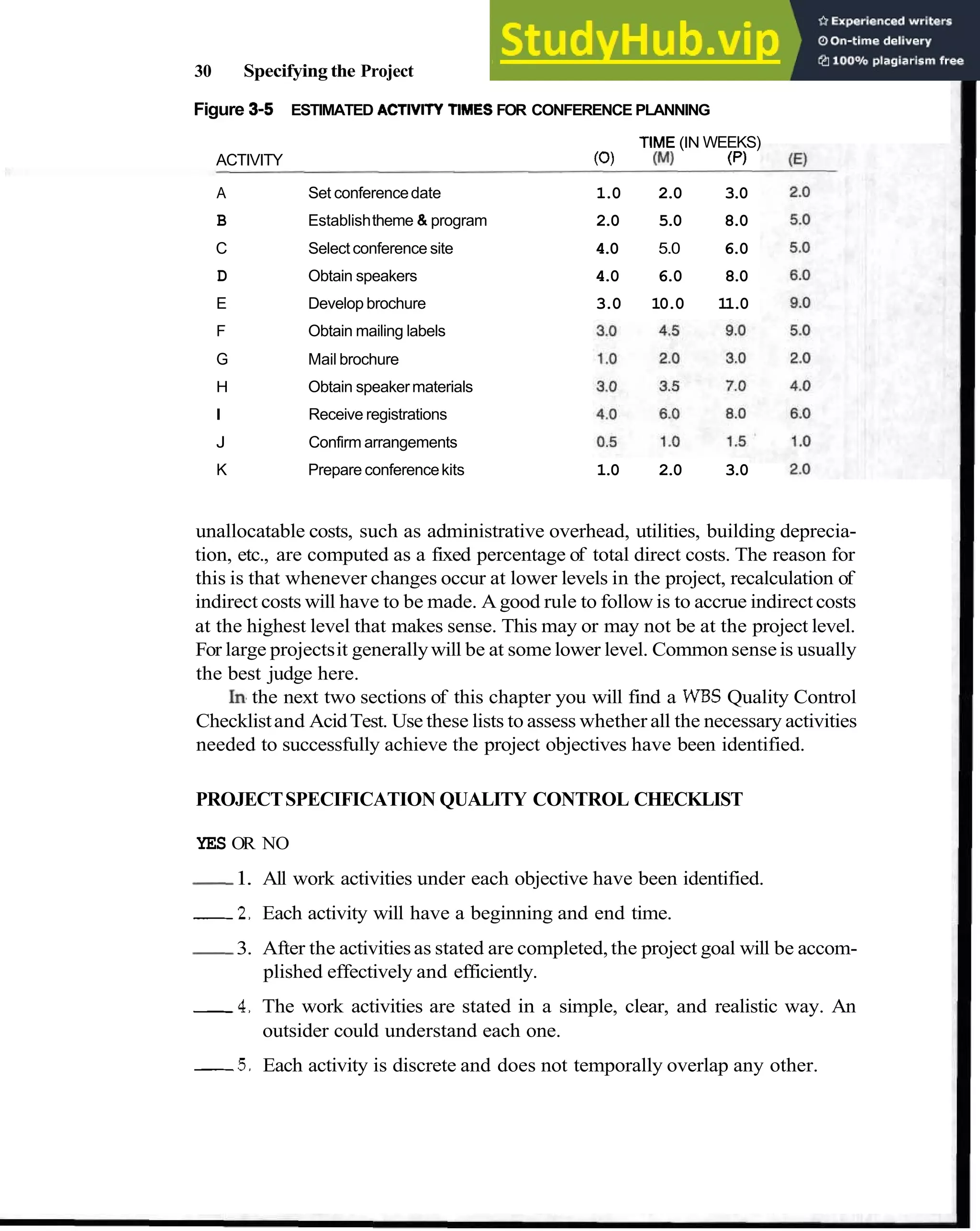
Figure 3-5 shows these calculations for the Conference Planning Project. In those
cases where the activity time is fairly well known it is not necessary to obtain
optimistic, pessimistic, and most likely activity completion times. Having a single
1 estimated activity time is sufficient.
I ESTIMATING ACTIVITY COST
There are typically four major cost categories (although the organization's chart of
accounts might also be used) that may be defined for any activity:
1. Labor
2. Materials
3. Other direct (travel, telephone, contracted services, etc.)
4. Indirect (a.k.a. overhead)
In some cases indirect cost may be a fixed percentage of total direct costs attribut-
able at the project level rather than at the activity level. As a general practice the
30 Specifying the Project
Figure 3-5 ESTIMATED ACTIVITY TIMESFOR CONFERENCE PLANNING
TIME (IN WEEKS)
ACTIVITY (0) (MI (p)
A Set conferencedate 1.0 2.0 3
.
0
B Establishtheme & program 2
.
0 5
.
0 8.0
C Select conference site 4
.
0 5.0 6.0
D Obtain speakers 4.0 6.0 8
.
0
E Develop brochure 3.0 10.0 11.0
F Obtain mailing labels
G Mail brochure
H Obtain speakermaterials
I Receive registrations
J Confirm arrangements
K Prepare conferencekits 1
.
0 2
.
0 3
.
0
unallocatable costs, such as administrative overhead, utilities, building deprecia-
tion, etc., are computed as a fixed percentage of total direct costs. The reason for
this is that whenever changes occur at lower levels in the project, recalculation of
indirect costs will have to be made. A good rule to follow is to accrue indirectcosts
at the highest level that makes sense. This may or may not be at the project level.
For large projectsit generallywill be at some lower level. Common senseis usually
the best judge here.
In the next two sections of this chapter you will find a WBS Quality Control
Checklistand AcidTest. Use these lists to assess whether all the necessary activities
needed to successfully achieve the project objectives have been identified.
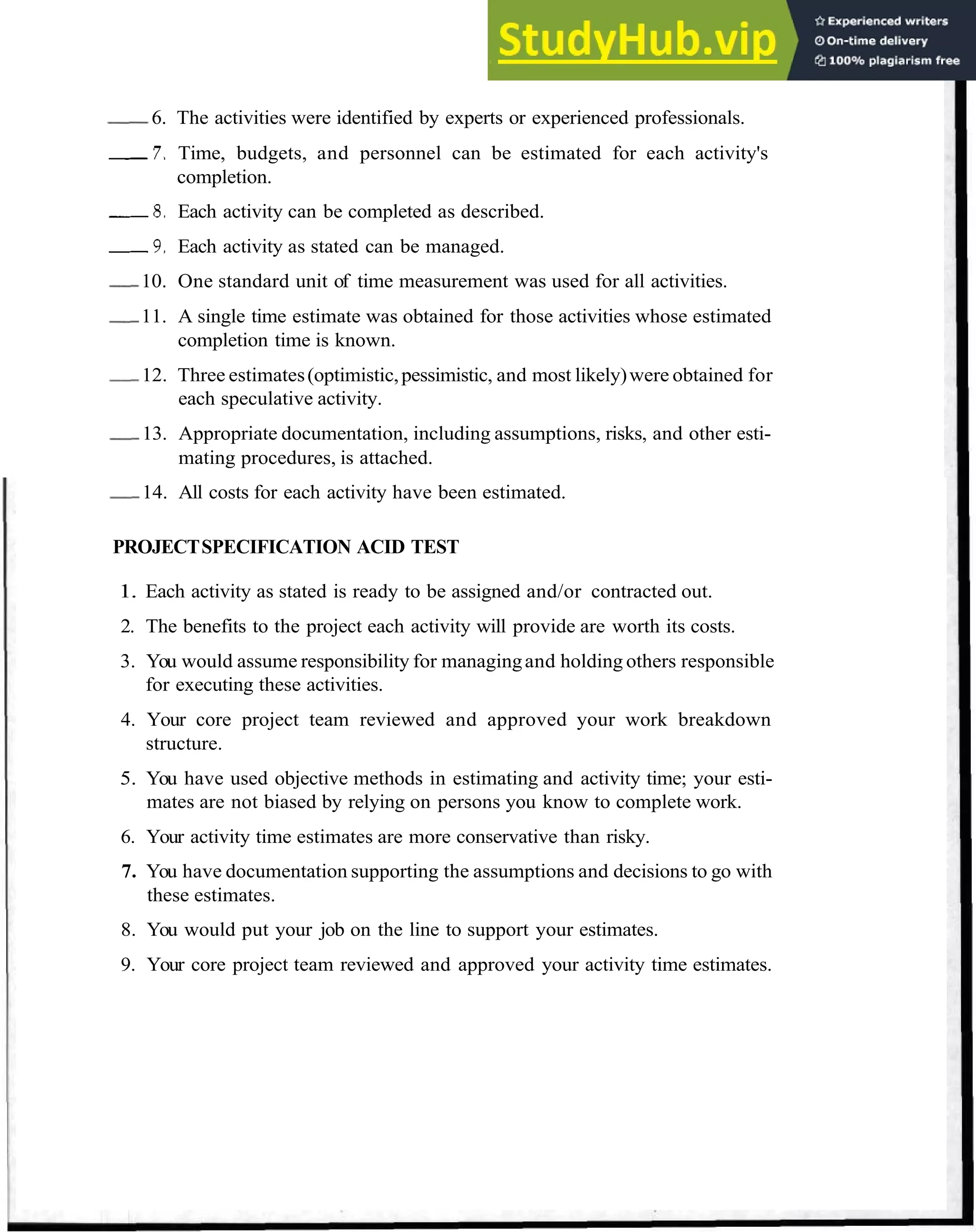
PROJECTSPECIFICATION QUALITY CONTROL CHECKLIST
YES OR NO
-
1. All work activities under each objective have been identified.
2 . Each activity will have a beginning and end time.
-
3. After the activitiesas stated are completed,the project goal will be accom-
plished effectively and efficiently.
4 . The work activities are stated in a simple, clear, and realistic way. An
outsider could understand each one.
5 . Each activity is discrete and does not temporally overlap any other.
Estimate Time and Cost 31
-
6. The activities were identified by experts or experienced professionals.
7 . Time, budgets, and personnel can be estimated for each activity's
completion.
8 . Each activity can be completed as described.
9 . Each activity as stated can be managed.
-10. One standard unit of time measurement was used for all activities.
-11. A single time estimate was obtained for those activities whose estimated
completion time is known.
-12. Three estimates(optimistic,pessimistic, and most likely)were obtained for
each speculative activity.
-13. Appropriate documentation, including assumptions, risks, and other esti-
mating procedures, is attached.
-14. All costs for each activity have been estimated.
PROJECTSPECIFICATION ACID TEST
1. Each activity as stated is ready to be assigned and/or contracted out.
2. The benefits to the project each activity will provide are worth its costs.
3. You would assume responsibility for managingand holding others responsible
for executing these activities.
4. Your core project team reviewed and approved your work breakdown
structure.
5. You have used objective methods in estimating and activity time; your esti-
mates are not biased by relying on persons you know to complete work.
6. Your activity time estimates are more conservative than risky.
7. You have documentation supporting the assumptions and decisions to go with
these estimates.
8. You would put your job on the line to support your estimates.
9. Your core project team reviewed and approved your activity time estimates.
5-PHASE PROJECTMANAGEMENT
1-PLANNING- IMPLEMENTATION -
q
1 2 3 4 5
DEFINE + PLAN --, ORGANIZE -b CONTROL + CLOSE
State the Identify Determine Define Obtain
Problem Project Personnel Management Client
Activities Needs Style Acceptance
Identify Estimate Recruit Establish Install
Project Time and Project Control Deliverables
Goals Cost Manager Tools
Preliminary
Resources Activities Schedule
Conduct
Assumptions Project Change
and Risks Proposal Packages Orders Implementation
D E L I V E R A B L E S Y
Project Overview WBS Recruitment *Variance Final Report
Project Network Criteria Reports *Audit Report
Critical Path Work Package *Status Reports
Project Proposal Description *Staff Allocation
Work Package Reports
Assignments
Chapter 4
SEQUENCING THE PROJECT
ACTIVITIES
The project is now represented as a list of activities.What is the next step? We must
now determine the sequence in which these activities can be done. The simple
approach would be to do them one at a timein some logical"to do"order. In all but
the simplest of projects that approach would result in a project completion time
much longer than one would have expected.Alternatively, one might examine each
activity and determine which ones must be completed before others can begin.
Through this analysis, a sequence in which several activities can be done simulta-
neously will emerge. In this chapter we present a simple step-by-step process,
called the crifical path method (CPM), to determine this sequencing of concurrent
activities that results in the timely completion of the project. This critical path
analysisprovides the project manager with a tool to manage projectseffectivelyand
efficiently.The critical path method is explained on page 38.
SEQUENCE PROJECTACTIVITIES
Using the activities as they are represented in the WBS we can construct the
sequence in which the project activities will be done. Because each activity has an
associated cost and an estimated completion time, we can build an estimate of the
total project cost and completion time. Whereas the cost will basically be additive,
the completion time will not. Simply recognizing that some activities may be done
simultaneously and that others must be done sequentially is enough to grasp the
complication in scheduling activities and estimating project completion time. For
larger projects, of, say, 50 or more activities, a computer will be indispensable.
Although we do not deal with this approach, the interested reader will have no
difficulty locating sources for such computer programs. (See the Appendix for a
discussion of project management software.)
A "low-tech"approach for the beginner at project management is to use Post-
its@or gummed labels to lay out the network. Each label has one project activity
written on it. Through an iterative process the labels can be arranged and rear-
ranged until a realistic sequencing of project activities is obtained.
34 Sequencing the Project Activities
A powerful tool for estimatingproject completiontime (itwill have many other
uses, too) is the representation of the project activities as a network of intercon-
nected activities. The first step in building the network is to determine for each
activity those activities that must be completed before this activity may begin.
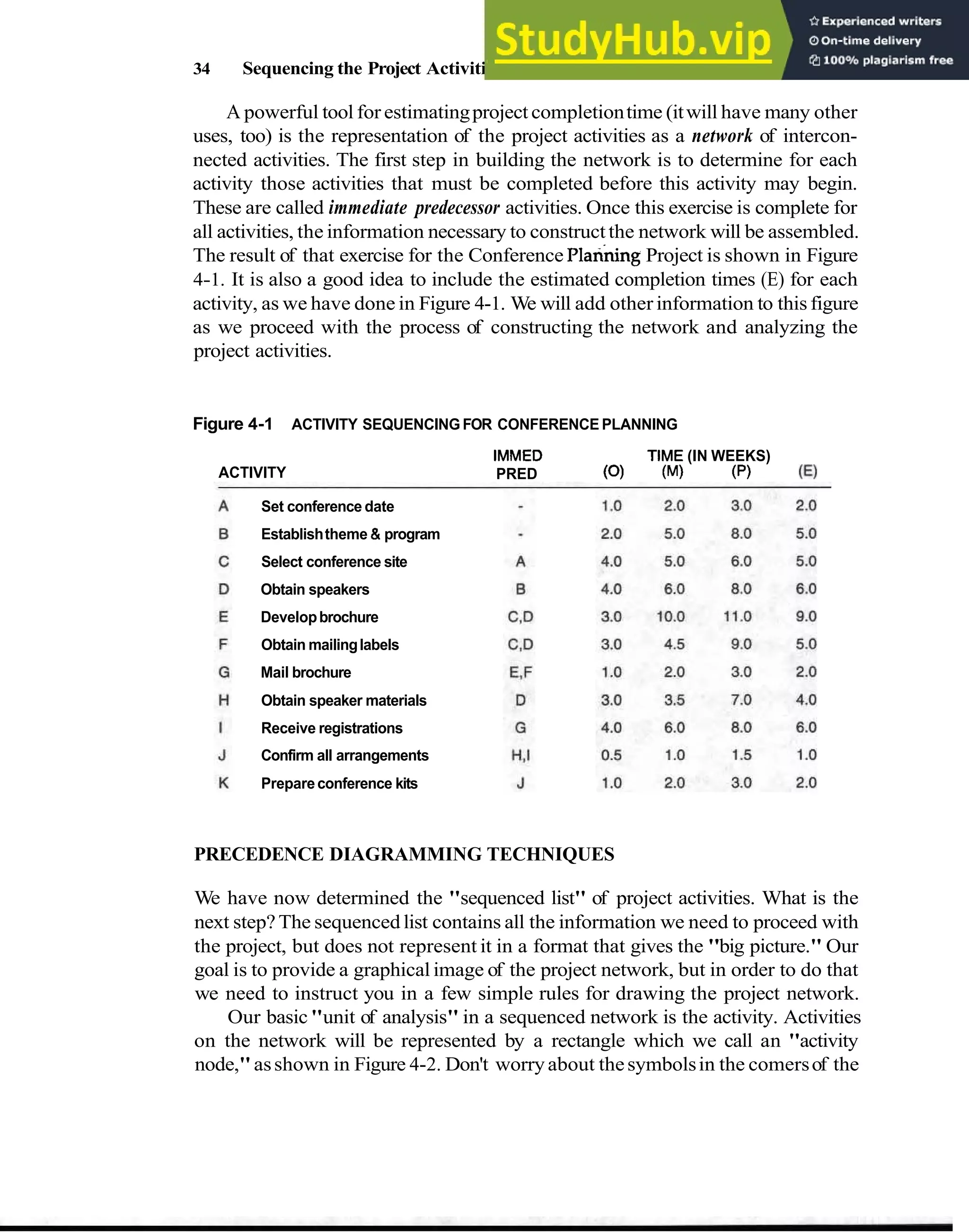
These are called immediate predecessor activities. Once this exercise is complete for
all activities, the information necessary to constructthe network will be assembled.
The result of that exercise for the Conference P l a n ~ n g
Project is shown in Figure
4-1. It is also a good idea to include the estimated completion times (E) for each
activity, as we have done in Figure 4-1. We will add other information to this figure
as we proceed with the process of constructing the network and analyzing the
project activities.
Figure 4-1 ACTIVITY SEQUENCING FOR CONFERENCE PLANNING
ACTIVITY
IMMED TIME (IN WEEKS)
PRED (0) (M) (p) (El
Set conference date
Establishtheme & program
Select conference site
Obtain speakers
Developbrochure
Obtain mailinglabels
Mail brochure
Obtain speaker materials
Receive registrations
Confirm all arrangements
Prepareconference kits
PRECEDENCE DIAGRAMMING TECHNIQUES
We have now determined the "sequenced list" of project activities. What is the
next step?The sequenced list contains all the information we need to proceed with
the project, but does not represent it in a format that gives the "big picture." Our
goal is to provide a graphical image of the project network, but in order to do that
we need to instruct you in a few simple rules for drawing the project network.
Our basic"unit of analysis" in a sequenced network is the activity. Activities
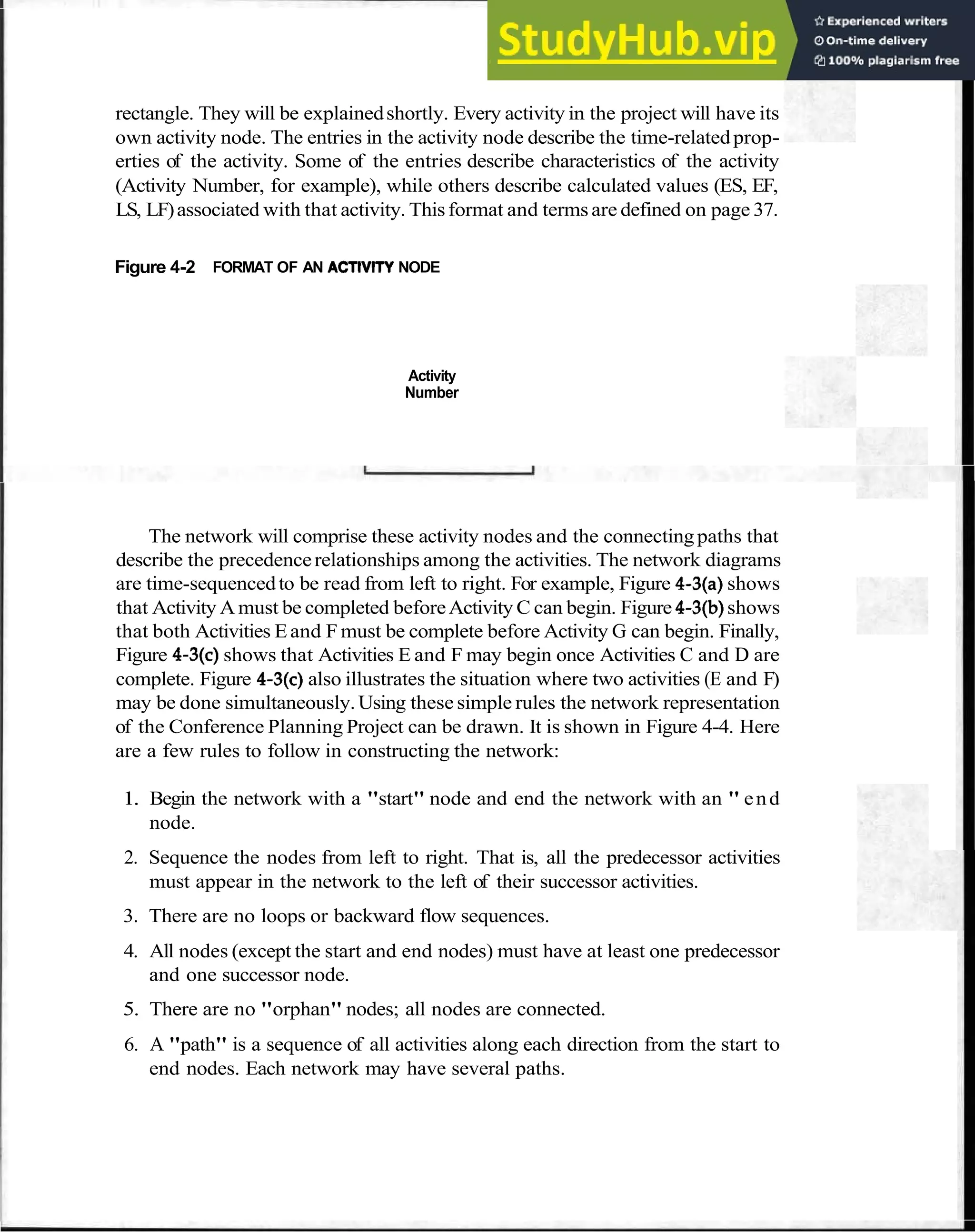
on the network will be represented by a rectangle which we call an "activity
node,"asshown in Figure 4-2. Don't worryabout thesymbolsin the comersof the
Sequence Project Activities 35
rectangle. They will be explainedshortly. Every activity in the project will have its
own activity node. The entries in the activity node describe the time-relatedprop-
erties of the activity. Some of the entries describe characteristics of the activity
(Activity Number, for example), while others describe calculated values (ES, EF,
LS, LF)associated with that activity. Thisformat and termsare defined on page 37.
Figure 4-2 FORMAT OF AN ACTIVITY NODE
Activity
Number
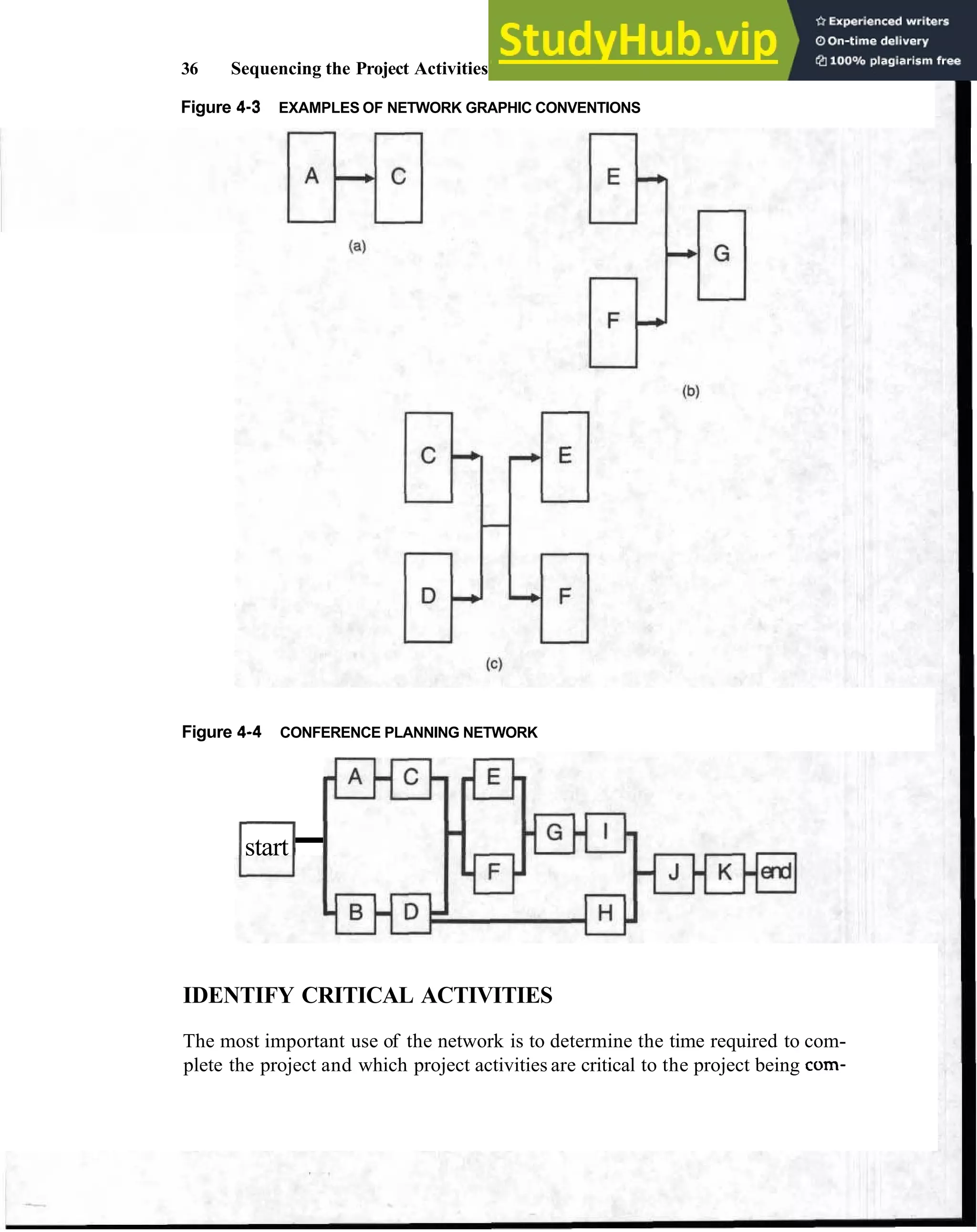
The network will comprise these activity nodes and the connectingpaths that
describe the precedencerelationships among the activities. The network diagrams
are time-sequencedto be read from left to right. For example, Figure 4-3(a)shows
that Activity A must be completed beforeActivity C can begin. Figure 4-3(b)shows
that both Activities Eand F must be complete before Activity G can begin. Finally,
Figure 4-3(c)shows that Activities E and F may begin once Activities C and D are
complete. Figure 4-3(c)also illustrates the situation where two activities (E and F)
may be done simultaneously.Using these simple rules the network representation
of the Conference Planning Project can be drawn. It is shown in Figure 4-4. Here
are a few rules to follow in constructing the network:
1. Begin the network with a "start" node and end the network with an " end
node.
2. Sequence the nodes from left to right. That is, all the predecessor activities
must appear in the network to the left of their successor activities.
3. There are no loops or backward flow sequences.
4. All nodes (except the start and end nodes) must have at least one predecessor
and one successor node.
5. There are no "orphan" nodes; all nodes are connected.
6. A "path" is a sequence of all activities along each direction from the start to
end nodes. Each network may have several paths.
36 Sequencing the Project Activities
Figure 4-3 EXAMPLES OF NETWORK GRAPHIC CONVENTIONS
Figure 4-4 CONFERENCE PLANNING NETWORK
start-
IDENTIFY CRITICAL ACTIVITIES
The most important use of the network is to determine the time required to com-
plete the project and which project activities are critical to the project being com-
Identify Critical Activities 37
pleted on schedule. The time to complete the project is the longest time path
through the network. The sequence of activities that makes up the longest path is
known as the critical path. As long as activities on the critical path are going well,
the project will remain on schedule. If, however, any of these activities takes longer
than originally estimated, the project completion time will be extended. Of course,
the manager will try to obtain additional resources for critical path activities to
restore the project to its original completion date. Alternatively, when additional
resourcesare available (say,from project activities that are not on the critical path),
the manager may be able to reallocate them to critical path activities and get the
project back on schedule.
ACTIVITY START AND COMPLETION TIMES
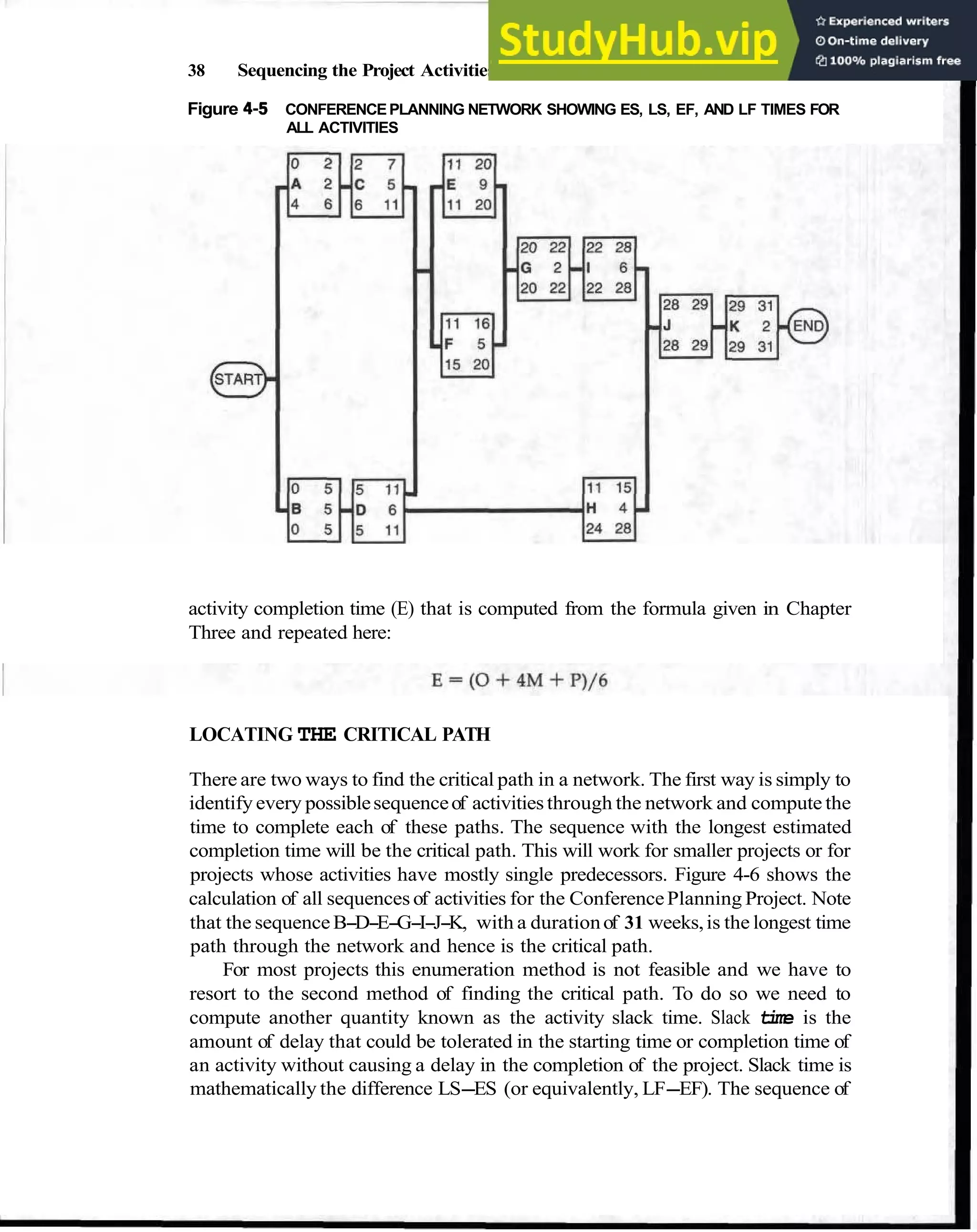
Now let us define the four calculated values (ES, LS, EF, LF, see Figure 4-2)
associated with each activity node. These calculated values will be used to deter-
mine the project completion time and the critical path.
Earliest Start and Earliest Finish Times
The earliest start (ES) time for an activity is the earliest time at which all predeces-
sor activities of that activity have been completed and the subject activity can
begin.The ES timeof an activityhaving no predecessoractivitiesis arbitrarilyset to
0
.The EF time of an activity is equal to its ES time plus its estimated completion
time. The ES time of an activity that has one predecessor activity is the EF time of
the predecessor activity. The ES time of activities having two or more predecessor
activities is the maximum of the EF times of the predecessoractivities. The ES and
EF timesfor the Conference Planning Projectare shown in the upper left and right
corners of each activity node (see Figure 4-5).
Latest Start and Latest Finish Times
The latest start (LS) and latest finish (LF) times of an activity are the latest times at
which an activity can start (LS) or be completed (LF) without increasing project
completion time. To calculate these times we will work backward in the network.
First set the LF time of the last activity on the network to the EF time of that activity.
The LS time of that activity is equal to its LF time minus its estimated completion
time. The LF time of all the immediate predecessor activities is the minimum of the
LS times of all activitiesfor which it is the predecessor. The LS and LF times for the
Conference Planning Project are shown in the lower left and right comers of each
activity node (see Figure 4-5). The last numeric value in the node is the average
38 Sequencing the Project Activities
Figure 4-5 CONFERENCEPLANNING NETWORK SHOWING ES, LS, EF, AND LF TIMES FOR
ALL ACTIVITIES
activity completion time (E) that is computed from the formula given in Chapter
Three and repeated here:
LOCATING THE CRITICAL PATH
There are two ways to find the critical path in a network. The first way is simply to
identify every possiblesequenceof activitiesthrough the network and compute the
time to complete each of these paths. The sequence with the longest estimated
completion time will be the critical path. This will work for smaller projects or for
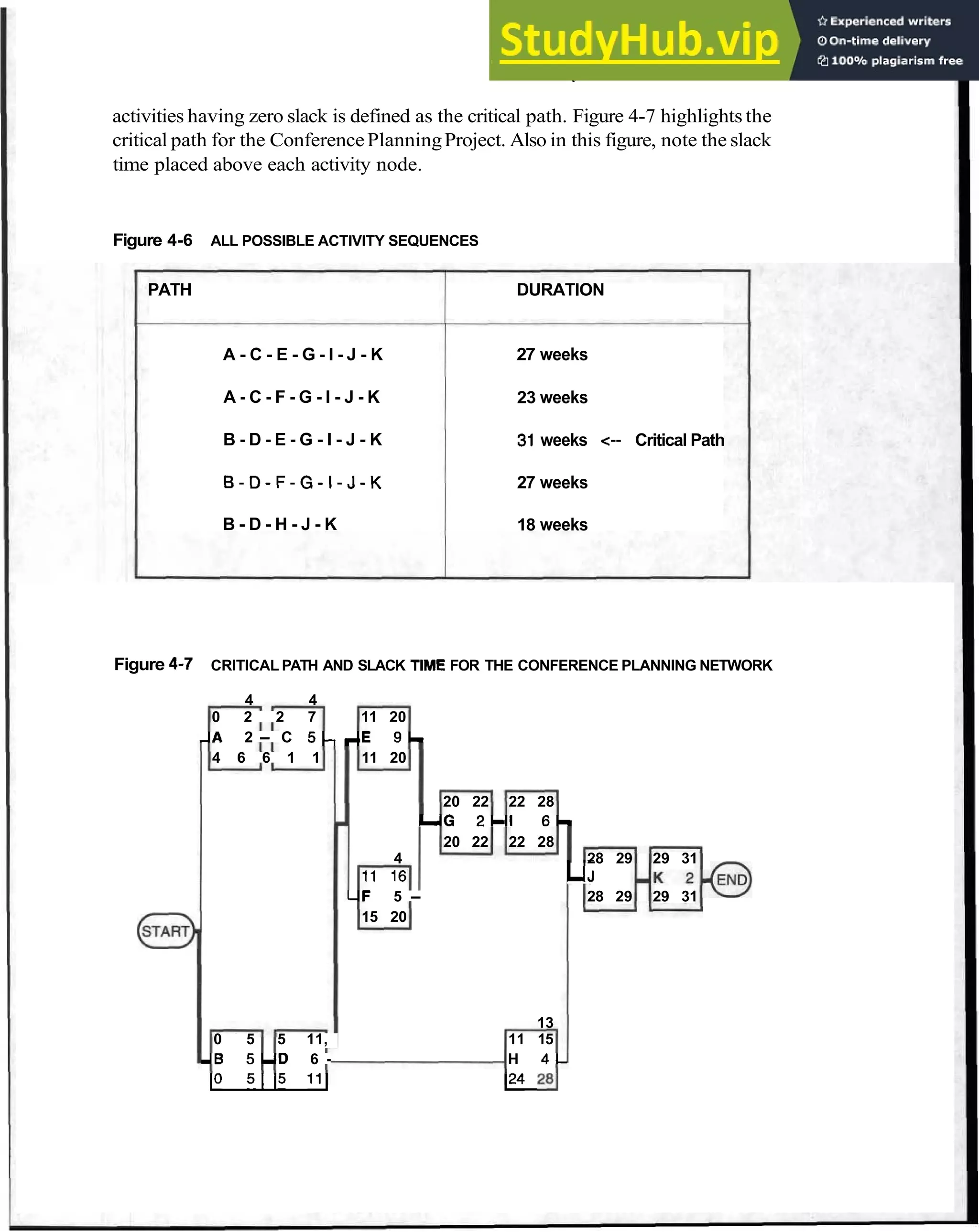
projects whose activities have mostly single predecessors. Figure 4-6 shows the
calculation of all sequences of activities for the ConferencePlanning Project. Note
that the sequenceB-D-E-G-I-J-K, with a durationof 31 weeks,is the longest time
path through the network and hence is the critical path.
For most projects this enumeration method is not feasible and we have to
resort to the second method of finding the critical path. To do so we need to
compute another quantity known as the activity slack time. Slack time is the
amount of delay that could be tolerated in the starting time or completion time of
an activity without causing a delay in the completion of the project. Slack time is
mathematically the difference LS-ES (or equivalently, LF-EF). The sequence of
Identify Critical Activities 39
activities having zero slack is defined as the critical path. Figure 4-7 highlights the
critical path for the ConferencePlanningProject. Also in this figure, note the slack
time placed above each activity node.
Figure 4-6 ALL POSSIBLE ACTIVITY SEQUENCES
PATH DURATION
A - C - E - G - I - J - K 27 weeks
A - C - F - G - I - J - K 23 weeks
B - D - E - G - I - J - K 31 weeks <-- Critical Path
6 - D - F - G - I - J - K 27 weeks
B - D - H - J - K 18 weeks
Figure 4-7 CRITICAL PATH AND SLACK TIME FOR THE CONFERENCE PLANNING NETWORK
4 4
0 2 2 7 11 20
- A 2 - C 5 - , E 9 -
4 6 6 1 1 11 20
20 22 22 28
- - G 2 9 1 6 -
20 22 22 28
4 28 29 29 31
11 16 LJ
- F 5 - 28 29 29 31
15 20
13
0 5 5 11, 11 15
- B 5 - D 6 - H 4 -
1
0 5115 111 124 2a1
40 Sequencing the Project Activities
USE OF THE NETWORK AND CRITICAL PATH
The project network is a tool that the project manager and project team will use
throughout the life of the project. For the project manager it is a tool for planning,
implementation, and control. For the project team it is a tool to brief new team
members on the project and its status.
Planning
Since the network shows the interdependencies between all project activities, it
allows the manager to view the project in its entirety. This bird's-eye view of the
project provides the manager with a tool for schedulingactivitystart times, assigning
project team members to activities, and reallocating resources as the project com-
mences. It is inevitablethat the projectwill vary from the planned schedule,and you
will need to move resources from activity to activity and make other adjustments to
maintain the original completion date.
Implementation
As the project progresses, the network can be updated to reflect what has actually
happened.Someactivitieswill be completedin less timethan originally estimated. This
will give the project manager additional scheduling flexibility and the opportunity to
reallocate resources to perhaps bring the projectin earlier or for less cost. On the other
hand, some activitieswill requiremore time to complete than was originallyestimated.
In these cases the project managerwill first try to reallocateresourcesfrom non-critical
path activities.If that doesn't provide enough additional resources, then a request for
additional resources to get the project back on schedule will have to be made.
Control
B
y comparing the planned schedule of activities with what actually happened, the
project manager will be aware of variances from plan and the appropriate corrective
measures to take. In Chapter Nine we will examine this in more detail and provide
additional reporting tools for analyzing and controlling project progress.
The Critical Path
The expected project duration time determined from the critical path analysis and the
contracted project completion date provide useful pieces of information for making
management decisions. For example:
The scheduled start and completion date for each activity.
Identify Critical Activities 41
The activities whose completion must occur exactly as scheduledin order for the
project to be kept on schedule.
The amount of delay that can be tolerated in non-critical path activities without
causing a delay in the scheduled project completion date.
Activities whose resources might be diverted to critical path activities if the need
arises.
PROJECTNETWORK QUALITY CONTROL CHECKLIST
YES OR NO
-
1. The first node or activity is"start" at the left-handside of the network; the last
node is "end" at the far right-hand side.
-
2. The logic of sequencing activity nodes from left to right was done by asking,
"What is the next activity that can begin only after the preceding activity is
completed?"
-
3. "~&ne"was disregarded in this exercise; you are only concerned with which
activity precedes and succeeds another activity.
-
4. No activity node should overlap any other. If so, make two discreteactivities
from that one.
5 . All activity nodes flow from left to right in a linear way with no feedback
loops.
6 . All activity nodes are connected by a line on the network; no node is left
unconnected.
-
7. All activitiesfit logically into the network; if not, the activityshould be elimi-
nated or re-created.
-
8. Each path can be easily traced from the start to the end node.
-
9. Parallel activity nodes on parallel paths can be drawn if work (activities)can
be done simultaneously.
PROJECT NETWORK ACID TEST
1. An outsider could easily understand the sequencing of this project by studying
your network diagram.
2. Each path can be traced with ease.
3. It is obvious which activities can be worked on simultaneously.
4. All activities are sequenced logically.
5. You are ready to pass this network up for approval.
6. Your core project team reviewed and approved the network.
5-PHASE PROJECTMANAGEMENT
b-PLANNING A,
IMPLEMENTATION,
I
DEFINE
State the
Problem
ldentify
Project
Goals
List the
Objectives
Determine
Preliminary
Resources
ldentify
Assumptions
and Risks
2
+ PLAN .
ldentify
Project
Activities
' Estimate
Time and
Cost
Sequence
Project
Activities
ldentify
Critical
Activities
w
*
proiect
ptw=I
3
-
, ORGANIZE
Determine
Personnel
Needs
Recruit
Project
Manager
Recruit
Project
Team
Organize
Project
Team
Assign
Work
Packages
4
--, CONTROL
Define
Management
Style
Establish
Control
Tools
Prepare
Status
Reports
Review
Project
Schedule
lssue
Change
Orders
5
+ CLOSE
Obtain
Client
Acceptance
Install
Deliverables
Document
the Project
lssue the
Final
Report
Conduct
Post-
Implementation
Audit
Project Overview WBS Recruitment -Variance Final Report
Project Network Criteria Reports *Audit Report
CriticalPath Work Package Status Reports
Project Description *Staff Allocation
Proposal *Work Package Reports
Assignments
Chapter 5
WRITING THE PROJECT
PROPOSAL
The project proposal represents the transition from planning (define, plan) to
implementation (organize, control, close). As we will see, it is the foundation on
which the balance of the project rests and the basis on which all management
decisions will be made.
In this chapter we examine the proposal in detail-paying particularattention
to its component parts and their use as management tools.
PURPOSE
The purpose of the project proposal is to provide
a statement of the need being addressed, the general approach being taken,
and the resulting benefits expected;
a complete description of the project activities, timeline, and resource require-
ments needed by management to decide whether the projectshould proceed to
the implementation phase;
a dynamic tool for the project manager and project team to use for decision
making throughout the project life cycle;
a reference document for management control;
a briefing and training aid for new project team members; and
a briefingdocument for others in the organization who need to be aware of the
project details.
The proposal is clearly the key document in the project. It is simultaneously a tool
for decision making, management control, training, and reporting. It is written to
be understood and used by senior management, project management, project team
members, other managers, and professionals with a need to know.
44 Writing the Project Proposal
Let us first identify and describe each piece of information contained in the
proposal. We will then illustrate with the proposal written for the PPM Conference
Planning Project.
FORMAT
Figure 5-1 shows one format for the project proposal.
Project Name
Thisis a two- or three-word label that will uniquelyidentify the project.It becomes
the name by which all will refer to the project.
Project Manager
The person responsiblefor the project. In some cases, especially projectsto develop
application software systems, the project manager may be the manager of the unit
for which the project is being done. In any case, this is the person responsible for
completing the project on time, within budget, and according to specification.
Activity
This is a three-part field that first identifies the activity by number (usually for
computer input) and then by a short but descriptive name given to the activity.
This is usually the way the project team and other interested parties will refer to
the activity. Names such as XZ.40 are unacceptable. The preference will be to
choose a name that is short but says something about the activity. "Sched-
ule.LabelsUis an example of a name we use in a later example. It gives some
indication of the work to be done in this activity. The third part of the field is a
descriptionof the activity itself. It will be a specificstatement in precise terms of the
work to be done.
Schedule
Based on the analysis of the project network, the estimated start and end date of
each activity is given. As the project progresses these dates may change. These are
the dates on which the project manager will be ready to begin and expects to
complete each activity in the project. All other dates given in the project (such as
start and end dates for the tasks that comprise the work packages, discussed in
Chapter Seven) are based on the assumption that the scheduled beginning date
will be the actual beginning date.
PROJECT DEFINITION Project Name Project Manager Date
Activity Schedule Budget
No Name Description Start End Money Labor Matls Time (hrs) Manager
Prepared by Date I Approved by I Date I Sheet of
46 Writing the Project Proposal
Project Budget
The budget information on this report is aggregated at the activity level. More
detailed information can be provided as attachments if that is the preference of top
management. Budget planning is as much an art as it is a science. To see this,
consider the following scenarios.
UnderestimatingProject Costs. Management may balk at estimates of activity
costs they perceive to be high, but there is no need to be overly optimistic nor
pressured to the point of underestimating just to gain a favorable reaction.
Senior management will often challenge an estimate, just to see if it is
defensible.
It is not uncommon for less-experiencedproject managers to be too optimistic
regarding both time and cost. In some cases such estimates may be given in order
to be more competitive with other projects contending for management or cus-
tomer support. In some cases estimates below cost may be given just to get the
contract. Treating one project as a "loss leader" on the expectation that more
projects will follow is not an unusual strategy.
Overestimating Project Costs. Just as underestimating has its problems, so also
does overestimating. Overestimating buys insurance against unexpected delays
and problems that will require"going back to the well"and suffering the attendant
embarrassment. The danger in overestimating, of course, is that management will
not approve the project because the cost/benefit analyses suggest that approving
the project would not be a good business decision.
Estimating the Budget. The work breakdown structure, discussed in Chapter
Three, provides the starting point for computing the project budget. Recall that
the lowest-level activities in the WBS are the familiar activities. They, or similar
activities, have been done before. Not only are activity time estimates available,
but so are activity costs. Averaging techniques as well as inflation and other cost
increases may have to be applied to get a current best estimate. As Figure 4-1
shows, resource needs are estimated at the intermediate level of the WBS.
Backup detailed cost calculations can always be provided as attachments or
appendices to the proposal. For the proposal itself, costs are estimated for each
lowest-level activity and then aggregated following the hierarchy given by the
WBS shown in Figure 3-4. Figure 5-2 is a typical format used in planning for the
resource needs of a single project task. This may be given as an attachment to
the Project Definition Report (Figure 5-1). Figure 5-3 shows the hierarchical
breakdown of the entire Conference Planning Project budget.
Figure 5-2 WORK PACKAGE RESOURCE REQUIREMENTS REPORT
WORK PACKAGEBUDGET Project Name Project Manager Date
WP Name WP Manager Rev Date
Sch Start Sch End CriticalPath V/N PredecessorPackage No SuccessorPackageNo
Resource Contact Person Phone Quantity Sch Start Sch End
Preparedby Date I Approved by Date I Sheet of
b P
Figure 5-3 ESTIMATED CONFERENCEPLANNING BUDGET o
CONFERENCEPLANNING
$243,325
4
P.
rC
5
'
00
5=
I
fB
z
-.
rn
B
Program
$41,100
Site
$170,425
Marketing
$31,800
I
I I
I I z
1 I I - i 'Q
i z
Theme
$600
Materials
$13,300
3 conf calls
with pgm
comm
Lists Brochure Registration %
$2,000 $29,800
Speakers
$27,200
travellexpenses deposit 3 site visits@ 25,000 labels
for 16speakers $800/visit 0 $8011000
Q $1,20O/speaker food Q $50 per
honorar~a
Q $500 personlday for 3
per speaker days for 1100
meetingrooms
Date
$1,000
I 1 Q $225lday/room
Location
$169,425
Obtain
Speaker
Materials
$800
editlformat Q 1100 binders Q $5/binder Layout: 16 pages 25,000 pieces
$50/speaker photocopy materials @ $50/page Q $0.68/piece
350,000 pages @ Printing: 30,000
$0.02/page copies @ $OAO/copy
Prepare
Conference
Notebook
$12,500
for 3 days for
3 rooms
Design
Brochure
$12,800
Mail
Brochure
$17,000
Format 49
Revenue and Expense Estimates
Many projects will affect revenues. For example, the project may involve the
planning, development, and distribution of new products/services; the reposition-
ing of existing products/services, or the changes to any one of the steps in the
logistics chain (procurement, manufacturing, inventorying, distribution); or prob-
lem resolution. These will all have financial implications,and senior management
will want your best estimate of the impact on revenues and expenses before
approval can be given. Figure 5-4 is a typical revenue and expense estimate for the
Conference Planning Project.
PROJECTPROPOSAL QUALITY CONTROL CHECKLIST
YES OR NO
-
1. Experts and experienced people were used to help estimate and review
each activity's budget.
-
2. All cost categoriesfor each activity have been estimated (labor,equipment,
travel, supplies, etc.).
-
3. Estimates for all internal resource costs were estimated before the need or
use of external resources was estimated.
4 . Cost estimates are realistic and conservative.
-
5. Cost estimates are comprehensive for each activity; there are no hidden
costs or surprises.
PROJECTPROPOSAL ACID TEST
1. You have compared budgets across all activities and have determined any
outstanding discrepancies.
2. The core project team has reviewed budget estimating methods and has ap-
proved consistency and objectivity.
3. Total project costs have been estimated and have your approval of reasonable
need, no surprises, no hidden costs, no likelihood of cost overruns.
50 Writing the Project Proposal
Figure 5-4 CONFERENCE PLANNING REVENUE AND EXPENSE BUDGET
PPM ANNUAL CONFERENCEREVENUE & EXPENSE BUDGET
Revenues
Registrations.1100 @$335...............................................$368.
500
Expenses
Salary
Graphic artist ............................................................ 800
Total Salary.......................................................................... 800
Non-Salary
Travel........................................................................ 21.
600
Printing...................................................................... 19.
000
Postage..................................................................... 17.
000
Mailing Lists.............................................................. 2
.
000
Telephone................................................................. 600
....................................................................
Supplies 6
.
300
Speaker Honoraria.................................................... 8
.
000
Site Deposit .............................................................. 1.000
Food.......................................................................... 165.
000
...............................................
Meeting Room Rental 2
.
025
Total Non-Salary.................................................................. 242.
525
Total Expenses........................................................................ $243.
325
Gross Profit ............................................................................ $
125.
175
Indirect (@40% of Total Expenses) ......................................... $97.
330
Net Profit.....................................................................................
$27.
845
Part I1
IMPLEMENTING THE
PROJECT
Once the project is approved the real work begins. In termsof the project manage-
ment life cycle, we have completed the planning phases and are moving into the
implementation phases. Implementation begins with the formation of the project
team and follows with the scheduling and assignment of work packages. As work
progressesthe project manager utilizesa system of reports and controls to keep the
project on schedule and within budget. Implementation is complete when the
project deliverableshave been accepted by the client and made operational and all
final reports have been filed. The details of the implementation phases are the
topics of the next five chapters.
5-PHASE PROJECTMANAGEMENT
I-
PLAN1
1
DEFINE -
State the
Problem
ldentify
Project
Goals
List the
Objectives
Determine
Preliminary
Resources
ldentify
Assumptions
and Risks
ldentify
Project
Activities
Estimate
Time and
Cost
Sequence
Project
Activities
ldentify
Critical
Activities
Write
Project
Proposal
IM
3
ORGANIZE
--
Determine
Personnel
Needs
Recruit
Project
Manager
Recruit
Project
Team
Organize
Project
Team
Assign
Work
Packages
EMENTAT
4
CONTROL
Define
Management
Style
Establish
Control
Tools
Prepare
Status
Reports
Review
Project
Schedule
lssue
Change
Orders
ION
5
CLOSE
Obtain
Client
Acceptance
Install
Deliverables
Document
the Project
lssue the
Final
Report
Conduct
Post-
lrnplernentatic
Audit
Project Overview WBS Recruitment Variance Final Report
Project Network Criteria Reports -Audit Report
Critical Path Work Package *Status Reports
Project Proposal Description *Staff Allocation
Work Package Reports
Assignments
Chapter 6
ORGANIZING THE PROJECT
TEAM
Project plans and their execution are only as successful as the manager and team
who implement them. Building effective teams is as much an art as it is a science.
Some would in fact call it a craft. In building an effective team, consideration must
be given not only to the technical skills of the project manager and the team
members but also to their critical roles and the chemistry among them. The selec-
tion of project manager and team members will not be perfect-there is always a
risk with any personnel decision. In this chapter we will
1. create an awareness of the important characteristicsthat should be part of an
effectiveproject manager and project team,
2. provide a checklist to assist you in your selection process, and
3. suggest guidelines for organizing the project in an organization.
DETERMINING PERSONNEL NEEDS: SELECTING THE
PROJECTMANAGER
The project manager is one of the most important personnel in the project. This
person playsa major rolein planningand executinga project.The project manager
also embodies the image and reality of the project to the organization and to
external groups. Harold Kerzner (1982)states that because the roles and responsi-
bilities of the project manager are so important, selection should be general man-
agement's responsibility. In large organizations a group or committee is usually
assigned to help screen project manager candidates. This committee should
use a set of selection criteria that includes final product/service specifications
and profit objectives, in addition to professional qualifications;
have a policy directive from corporate management for selecting a project
manager; and
54 Organizing the Project Team
involve and obtain the support of corporate management in the selection
process.
If you are the project manager or are on the task force to hire one, this chapter can
help you organize your thinking about the selection and organizing processfor the
project manager and the team before you get started.
TIMING
The timing in selecting a project manager varies. In larger organizations, the
project manager can be assigned after the proposal giving the "go" to the project
has been signed by senior management. One rule to remember is, "The sooner
the project manager and team are involved in planning the project, the more
committed they will be to its implementation." (This is also true for other mem-
bers in the organization whose expertise and resources are required to implement
the project.)
SELECTION CRITERIA
The major goal in selecting a project manager is: to assign someone who is experi-
enced, capable, and competent in getting the end product or service planned and
implemented on time, within budget, and according to specifications. Toward that
end, the predominant characteristicsof an effective project manager can be sum-
marized under five categories:
1. Background and experience
2. Leadership and strategic expertise
3. Technical expertise
4. Interpersonal competence/people skills
5. Proven managerial ability
Nosingleset of characteristicsunder any one category can besufficient justification
to hire a project manager. The categories presented here provide a balanced set of
general characteristics for reviewing a candidate. The Project Manager Selection
Quality Control Checklist at the end of the chapter provides a detailed review of
these characteristics, which are summarized below.
Determining Personnel Needs: Selecting the Project Manager 55
Background and Experience
The background and expertiseof a prospective project manager should be consis-
tent with the nature and needs of the project requirements.As one saying goes, "A
drop of experience can outweigh a ton of theory." Again, the goal is to assign
someone who can get the job done within the means specified. The project man-
ager should have a solid educational background in addition to experience in the
desired project area. As a rule of thumb, you should look for a candidate who
shows an acceptable mix of conceptual, analytical, operational, and practical
experience.
Leadership and Strategic Expertise
The project manager is a leader who helps design, coordinate, control, and imple-
ment the project plan. The project leader stays the course until the project delivers
the final product. Leadership and strategic expertise mean the ability to envision
and actually design the "big picture," or all phases of project planning and imple-
mentation, while workingon detail. It means seeing the forest in spite of the trees.
Strategic expertise also involves the ability to ask guiding questions which direct
the goal and planned end result through the critical path. A project manager
should be able to separate strategic thinking, planning, and decisions from tactical
or operational aspects of the project. Again, results-orientedexperience and train-
ing of candidates are among the best indicators of strategic planning and imple-
mentation ability.
Technical Expertise
No project manager has all the technical expertise necessary to get a complex
project completed. However, you are looking for a person who can direct, evaluate,
and makesound decisionson technicalalternatives related to the project. A project
manager, then, should have technical expertise based on knowledge and training
both in the content area of the project domain and in project management tools
and skills. Kerzner (1982) states that technical skills-and here he focuses on
engineering-related projects-include:
Technology involved
Engineering tools and techniques
Specific markets, customers, and requirements
Product applications
56 Organizing the Project Team
Technological trends and evolutions
Relationship among supporting technologies
People who are part of the technical community
Whatever the nature of the project, project managers should have work experience
in one of its significant areas, whether construction, technology hardware or soft-
ware, educational training techniques, or conference planning. Project managers
should understand the markets, customs, and technologiesinvolved in the project
and be associated with the networks of professionalsin the technical field of their
profession. The checklist provided below may seem at first glance too perfect or
complete for anyone to actually qualify; remember, it is a guide.
Interpersonal Competence/People Skills
The project manager should be able to
motivate, inspire, cheerlead, and coach;
actively listen and give and receive meaningful feedback;
assertively-not aggressively or submissively-relate feelings, needs, con-
cerns, and interpersonal issues of the project to and among others;
prevent as well as solve conflicts;
communicate tough decisions yet be sensitive to others' needs; and
be flexible-perform well in multiple roles.
Mintzberg(1973) identifiessuch traits as: figurehead, liaison, informationdissemi-
nator, entrepreneur, negotiator, conflict resolver, and resource allocator. Other
important roles include politician, salesperson, power broker, facilitator, monitor,
and counselor. Indicators of interpersonal competence include favorable recom-
mendationsfrom past successfulproject personnel who worked with or under the
candidate.
Proven Managerial Ability
The past is one of the best indicatorsof the future. Managerialabilityisevidentin a
track record of getting the end product or service accomplished within budget,
time, and resource constraints. To do this, a project manager should have a basic
knowledge of organizations: how to organize, determine personnel needs, articu-
Determining Personnel Needs: Selecting the Project Team 57
late project needs, interface with all levels of management, link the project goal to
an enterprise mission, and reward and discipline employees.
Other rules of thumb in looking for effective management skills include
screening individuals who can
manage entrepreneurs,
use organizational resources without being overly bureaucratic,
relate effectively and comfortably upwardly, horizontally, and downwardly in
large organizations, and
give as well as take credit for tasks accomplished.
DETERMINING PERSONNEL NEEDS: SELECTING THE
PROJECTTEAM
Once the project manager is on board, that person can help select the core project
team members. Selecting the project team depends on a number of factors:
The goal and objectives of the project
The nature of the technical work to be done
The expertise required to recruit, assign, delegate, monitor, communicate, and
perform the required work in each phase of the project
Availability of project personnel in the organization where the project will be
housed
SELECTION CRITERIA
The same criteria used for selecting a project manager can be used for the team.
Less emphasiscan be placed on strategic leadership capability and more on techni-
cal specialization. Interpersonal competenciesare important, and the same charac-
teristics listed above can be used here, with less emphasis on leadership and
figurehead functions.
As part of our project management consultingwork we have compiled a list of
project team member characteristics which high-technology engineers, in particu-
lar, have found to be successful. The following are borne out through experience
with project teams, regardless of the nature of the project:
Commitment to the project goal and its completion
Ability to communicate and share responsibility and power
58 Organizing the Project Team
Flexibility; able to shift from one work activity to another, depending on
project schedule and need
Technical competence
Willingness to admit error and bias and be corrected
Task-oriented
Ability to understand and work within schedules and resource constraints;
willing to work overtime if necessary
Ability to trust, help others, and be helped
A team player, not a self-oriented hero
Entrepreneurial, but open to suggestions
Ability to work with two or more bosses
Ability to work without and across formal structure and authority systems
Have knowledge and experience with project management tools
ORGANIZING AND HOUSING THE PROJECT
Now that the project manager and the project team are ready to go to work, how
will they be organized, and where will they be located?Thereis no one best way to
organize a project. Depending on the nature of the project, the resources needed
and who needs to be communicating with whom and how often will determine the
organizational form and position of the project in the larger organization. It is
possible that your project will be independent of the larger organization, or that
you are planning a project apart from an organization. If that is the case, the
organizing question is less complicated.
Often, a "project office" (Kerzner, 1982) is organized and operated by the
project manager.The project team is a combination of the office and the functional
employees. The project office is a focal point for the project personnel to interact
externally with customers and internally with different units of the organization.
If you must connect your project to a larger organization, Meredith and Mantel
(1989) offer the following criteria for helping determine the organizational
location:
List the major desired project outcomes by objective.
List the key tasks by objectiveand locate the functionalorganizational units for
each task.
Organizing and Housing the Project 59
Break the key tasks down into work packages.
Determine which project subsystemsare required to complete the work pack-
ages and which will work closely with others.
List the special characteristics and assumptions of the project (technology,
personnel, etc.).
Choose a structure and location based on the above analysis.
With these guidelinesin mind, the project manager can then assign team members
to different functional areas in the organization, with the sign-off of those func-
tional area managers. However, if the project manager decides to organize the
project team with other organizational units, this must be done through the au-
thority of general management. Remember, the goal is to get the project goal
accomplished on time, within budget, and according to specifications. Organizing
and housing the project are means to this end, not an end in itself.
There is no one easy, fixed way to organizea projectteam. Flexibilityis the key,
and working within and across organizationalunits is the norm. It is the project
manager who in concert with the team develops both psychological and written
contracts that assist the cross-functional roles and responsibilities.
PROJECTMANAGER SELECTIONQUALITY CONTROL CHECKLIST
~ YES OR NO
~ The project manager
I
-
1. is experienced enough in this project area to successfully commit to com-
plete the project on time, within budget, and according to specifications;
2 . is strategically capable to envision and conceptualize the entire project
process through all phases;
-3. is technically competent to help design and execute a total project plan;
4 . is interpersonally able and experienced to inspire, motivate, discipline,
resolve conflicts, negotiate competing interests, and sell the project to
corporate and other managers;
-
5. demonstratesthe followingcompetenciesand characteristics:flexible, self-
motivated, energetic, organized, alert, quick-to-learn, self-disciplined, ef-
fectivelisteningskills, excellent problemsolver,skilled politician, balanced
temperament, sensitive, politically savvy, ethical, able to sell ideas and
plans, express enthusiasm, cheerlead, coach, able to effectively interact
60 Organizing the Project Team
verbally and nonverbally in the board room and on the shop floor, oper-
ates well under pressure;
-
6. demonstrates competency to act effectively and quickly in the following
roles: figurehead, leader, liaison, monitor, information disseminator,
spokesperson, entrepreneur, disturbance handler, resource allocator, ne-
gotiator; and
-
7. demonstrates effectiveness and experiencein: understanding and interact-
ing with customers and end users, meeting management, contract negotia-
tions, all phases of strategic and technical planning, budgeting, resource
acquisitionand allocation,initiating and terminating professionaland per-
sonal relationships, understanding complex organizational, group, and in-
terpersonal issues and problems, admitting error and bias, acknowledging
and celebrating others' contributions.
PROJECTTEAM SELECTION QUALITY CONTROL CHECKLIST
YES OR NO
The project team members
-
1. are committed to planning and executing the project through all phases;
-
2. are technically experienced in their specific area to help successfully com-
plete the project on time, within budget, and according to specifications;
-
3. understand and have used project management concepts and tools;
-
4. are interpersonally capable of sharing information and expertise, solving
conflicts jointly, planning and problem solving with others, actively listen-
ing, receiving and giving nonjudgmental feedback, communicating
assertively;
5 . are able to work with two or more bosses;
-
6. are self-motivated and entrepreneurial but not self-oriented;
-
7. are flexible;
-
8. are responsible and can own mistakes as well as achievements;
-
9. can share rewards and failures;
10. are.willing to delegate and be delegated changing work assignments; and
-
11. can work well under pressure and changing deadlines.
Organizingand Housing the Project 61
PROJECT MANAGER AND TEAM SELECTION ACID TEST
The project management team is organized when
1. General corporate management issues policies, procedures, or directives for
selecting/hiring the project manager and project team members.
2. General corporate management remains informed and directly active in the
selection process.
3. General corporate management hires or selects the project manager and proj-
ect team members and announces the assignments to the organization.
4. A project "home" is organized and positioned in relationship to the larger
organization.
5. Corporate management announces and supports the organizational location
and lines of authority of the project team.
6. The project manager and project team members begin work on the project.
5-PHASE PROJECT MANAGEMENT
I DEFINE
State the
Problem
ldentify
Project
Goals
List the
Objectives
Determine
Preliminary
Resources
Identify
Assumptions
and Risks
Project Overvie
NINGA IMPLEMENTATION-
4
2 3 4 5
+ PLAN + ORGANIZE -b CONTROL -
, CLOSE
Identify Determine Define Obtain
Project Personnel Management Client
Activities Needs Style Acceptance
Estimate Recruit Establish Install
Time and Project Control Deliverables
Cost Manager Tools
Sequence Recruit Prepare Document
Project Project Status the Project
Activities Team Reports
Activities Schedule
Assign Conduct
Project Work Change Post-
Proposal Packages Orders Implementation
D E L I V E R A B L E S Y
v eWBS Recruitment *Variance Final Report
Project Network Criteria Reports *Audit Report
CriticalPath Work Package Status Reports
Project Proposal Description Staff Allocation
Work Package Reports
Assignments
Chapter 7
ASSIGNING WORK
PACKAGES
Planning and organizing are now complete and it's time to get down to the work
of doing the project. The first step will be to assign responsibilitiesfor completing
the activities that comprise the project. Some of the activities will be familiar
because they, or something very similar, have been done before. These will be
rather straightforward and can be routinely assigned. For our purposes here they
may be treated exactly like "work packages," the subject of this chapter. Work
packages, the basic unit of work that takes place in the project, are like"contracts"
between the project manager and the work package manager (or work package
leader), the person charged with the responsibility of completing the tasks that
comprise the work package.
Firstwe define the work package. After examining its characteristics we discuss
assigning responsibility for its completion on time, within budget, and according to
specifications. Managing work packages is aided through the use of simple forms
that define exactly what is to be done, by when, and by whom. The same form can
be used to monitor the status of work packages. The form is simple in its use here
but may be modified with more detail depending on the practices and procedures
in your organization.
WHAT IS A WORK PACKAGE?
Recall that the WBS decomposed the project into a list of activities. Each activity
contains specific tasks to be completed. These tasks may involve more than one
individual, and, in a sense, for the individual assigned the responsibility of com-
pleting them, may be considered projects in their own right.
A work package consists of one continuous activity, for example, the use of a
single piece of equipment, until the work package is complete.The work packageis
assigned to one individual who has the authority and access to the resources
needed to complete the assignment. A successful work package will be clearly
defined. It will have definite beginningand ending tasks so that its completion will
Figure 7-1 WORK PACKAGE DESCRIPTIONREPORT
WORK PACKAGEDESCRIPTION "'ject Name Project Manager Date
PPM Annual Conferemxe You -
WP Name WP Manager
Matllng D~ane
Sch Start Sch End CriticalPath YIN Predecessor WP
1Rev Oate
-
r
-
wk 11 wk 16 no C&D
Task Schedule
I
No Name Description Start End Responsibility Phone
F.l Target Identify target marketsfor Diane
conferenceattendees
I
F.2 Brokers Locate appropriate list brokersto Diane I
supply labels for each target market I
I
F.3 TargetSize Determinesize of each target market in Diane
the list broker's data base
- .
F.4 Build.Label.Set Constructlabel set from each target Diane
market based on the expected yield and
objective of 1100 attendeesat the conf
F.5 Schedule.Labels Schedulethe label set run for each list Diane
broker to coincidewith the expecteddate
the brochure will be available
I
Preparedby Date I Approved by I Date I Sheet of
Scheduling Work Packages 65
be easily measured and clearly observed. In Figure 7-1 we continue with our
example of the Conference Planning Project. One of the most important parts of
the work package,as indicated in Figure 7-1, is the description of each of the tasks
that comprise it. Note that the descriptions of these tasks give a clear statement of
the deliverables expected. Each task is considered complete (and hence the work
packageis considered complete)when the expected deliverable has been provided.
Work packages must be documented in other ways also. They are part of a
network of interrelated work packages; therefore the project manager as well as
the persons responsible for other work packages will have a need to know. Work
package documentationmust be standardized across the project and serve at least
six purposes:
1. To inform all parties working on the activity, as well as on all predecessor and
successor activities, of the contracted deliverables and expected completion
dates
2. To record the project and be of value not only to the project manager but also
to future project managers
3. To provide sufficient detail and description of all the tasks that comprise the
work package and of the relationship of the work package to other work
packages and to the project
4. To be presented in a format that can be updated and provide informationfor
periodic project status reports
5. To hold the work package manager responsible for the successful completion
of the tasks that comprise the work package
6. To serve as a reference point for clarifying issues and conflicts that may arise
SCHEDULING WORK PACKAGES
Scheduling the starting date for the work packagesdepends on the resource avail-
ability and the time constraints imposed by the project network. For any given
project there will be a number of different resources required, such as manpower,
facilities, and equipment.Each will have to be considered independently in sched-
uling the work packages that utilize them. To see just how this works, let us
schedule the work activities for the Conference Planning Projectaround the avail-
able manpower resources. Our objective will be to level the use of manpower
across the project by shifting activity start times within their allowable slack time.
For the project manager, a balanced level of resource use across the project life
cycle is preferred.
66 Assigning Work Packages
Figure 7-2 WORK PACKAGE ASSIGNMENT SHEET
WP ASSIGNMENTREPORT Project Name Project Manager
PPM Annual Conference
Activity
No Name Description Start End Manager Phone
A Select.Date Identify dates that 314 3115 Andy
will not conflict
with competing
conferences or
holidays
B Est.Theme Recruit a committee 314 415 Beth
to identify a theme,
seminar topics,
potential speakers
C Select.Site Investigate 3/18 4119 Andy
availabilitiesof
approved sites on
the dates identified,
solicit bids, and
contract with
chosen site
D Get.Speakers Contactpotential 418 5117 Beth
speakers, request
their participation,
and get
signed commitment
E Dev.Brochure
speech info for
brochure. Submit to
the graphic artist
for design and
Print 30,000.
Prepared by Date Approvedby Date Sheet 1of 3
Scheduling Work Packages 67
Figure 7-3 PRELIMINARY WORK PACKAGE SCHEDULING A
T EARLIEST START TIME
Figure 7-2 defines five work packages and assigns them to three staff mem-
bers based on their expertise and past conference involvement. Figure 7-3 is a
graphical representation of the workload on the project team when project activ-
ities are scheduled to begin at their earliest start date. It was constructed directly
from Figure 4-7. Note that Activities E.and F are scheduled to be done concur-
rently. That requires Carl to work concurrently on both activities. Activity F is
not on the critical path and so its start date could be delayed. Unfortunately,
Activity F does not have enough slack time to delay its start long enough for Carl
to complete Activity E and then work on Activity F without delaying the project
further. An alternative is to delay Activity H and have Beth work on Activity F.
Figure 7-4 shows how the workload will be distributed with this change being
made. The project manager will want to consider these scheduling alternatives
for non-critical path activities in order to balance resource requirements across
the entire project.
Figure 7-4 WORK PACKAGE SCHEDULING TO BALANCE THE WORKLOAD
68 Assigning Work Packages
USING WORK PACKAGE ASSIGNMENTS FOR STAFF
DEVELOPMENT
Motivating project team members is a continual problem for the project manager.
One techniquethat we have used successfullyis to match team members to tasks in
such a fashion that some new skill must be learned by the team member in order to
successfully complete the work packageon schedule. Most professionalpeople will
rise to the challengeof somethingnew-
a motivationin itself. We are aware of the
risks for the project manager, but suggest that in the long term there may be value
in using the tasks as learning opportunitiesfor career and skill development. Con-
sideration should be given before forging ahead and making assignments based.
solely on the individual's mastery of the skills needed to complete a given
assignment.
PROJECTWORK PACKAGE QUALITY CONTROL CHECKLIST
YES OR NO
-
1. The work package consistsof tasks each of which are continuousactivities
that can be assigned to a single individual.
-
2. The deliverables expected from each task in the work package are clearly
defined and measurable according to established standards and controls.
-
3. The work package documentation identifies all predecessor and successor
work packages.
-
4. The work packagereportformat can be easily updated and used as a status
report, too.
-
5. The scheduled start and end date for every task in the work package has
been specified.
-
6. The work package managers clearly understand what is expected and by
when.
-
7. The resources necessary for each work package have been committed and
are available according to the project schedule.
-
8
. The task descriptions have been reviewed and approved by the work
package manager and the project manager for completeness.
-
9. The persons responsiblefor the tasks that comprisethe work packagehave
reviewed and understand their task, the expected deliverables, and the
timeline.
Using Work Package Assignments for Staff Development 69
PROJECT WORK PACKAGE ACID TEST
1. The work package defines tasks whose completion will guarantee the success-
ful accomplishment of the activity.
2. The work package managers have the necessary skills to accomplish their
work.
3. The work package schedules are realistic.
5-PHASE PROJECTMANAGEMENT
State the
Problem
ldentify
Project
Goals
List the
Objectives
Determine
Preliminary
Resources
ldentify
Assumptions
and Risks
Project Overvie
PLAN ORGANIZE
Identify Determine
Project Personnel
Activities Needs
Estimate Recruit
Time and Project
Cost Manager
Sequence Recruit
Project Project
Activities Team
Identify Organize
Critical Project
Activities Team
Write Assign
Project Work
Proposal Packages
v *WBS Recruitment
Project Network Criteria
CriticalPath Work Packagt
Project Proposal Description
Work Packagc
Assignments
'LEMENTATION -
q
4 5
-+ CONTROL -
, CLOSE
Define Obtain
Management Client
Style Acceptance
Establish Install
Control Deliverables
Tools
Prepare Document
Status the Project
Reports
Review Issuethe
Project Final
Schedule Report
Issue Conduct
Change Post-
Orders Implementation
Audit
Variance Final Report
Reports *Audit Report
Status Reports
Staff Allocation
Reports
Chapter 8
MANAGING PEOPLE AND
PROJECT RELATIONSHIPS
SEVEN HABITS OF HIGHLY EFFECTIVE PEOPLE
Effective management and control of project relationships involve
1. project leadership,
2. project "followership," and
3. motivating and relating effectively to others in the project and organization.
In this chapter we offer guidelinesfor managing individual and team relation-
ships aimed at effectively increasing the progress of the project. It is true that the
"plan and the tasks are the boss." It is also true that the project manager and the
team must work well together and with other personnel involved in the project to
accomplish the goal. Since project managers and teams must communicate with
several bossesacross organizationalboundaries and turfs, interpersonal skills are a
premium.
In his book The 7 Habits of Highly Effective People (1989), Stephen Covey lists
seven habits which we offer as guiding principles for effective project leadership
and "followership":
1. Be proactive.
2. Begin with the end in mind.
3. Put first things first.
4. Think win/win.
5. Seek first to understand, then to be understood.
6. Seek synergies(the whole is equal to more than the sum of its parts; so too the
team adds more value than the number of its members).
7. Sharpen the saw (i.e., seek balance and self-renewal).
72 Managing People and Project Relationships
12 GUIDELINES FOR EFFECTIVE PROJECTLEADERSHIP
To manage a project effectively, a project manager must adopt a leadership style
that both motivates and empowers team members and monitors and guides their
progress. The following 12 guidelines from Raudsepp (1987) are offered as a
resource for managing people in the project. These guidelines focus on flexibility.
1. Do not overdirect, overobserve, or over-report.
2. Recognize differences in individuals. Have a keen appreciation of each per-
son's unique characteristics.
3. Help subordinates see problems as changes.
4. Assess your employees regarding ways they think they are more creative or
would like to be most creative, and what sort of creative contribution they
would most like to make.
5. Allow more freedom for individuals to guide their own work.
6. Train yourself and the others to respond to the positive parts of proposed ideas
rather than react to the often easier-to-spot negative ones.
7. Develop greater frustration tolerances for mistakes and errors.
8. Provide a safe atmosphere for failures.
9. Be a resource person rather than a controller, a facilitator rather than a boss.
10. Act as a buffer between employees and outside problems or "higher up"
demands.
11. Enhance your own creative ability through special workshops and seminars,
specialized reading, and practice of creative exercises and games. This sets an
excellent exampleemployeeswill want to emulate, and makes it easier for you
to recognize and relate to the creative ability of others.
12. Makesure that innovativeideas are transmitted to your boss with your support
and backing; then insist on a feedback mechanism.Without feedback, the flow
of creativeideas dries up because innovators feel that their ideas are not given
a fair hearing or taken seriously.
MANAGING ACROSS FUNCTIONAL BOUNDARIES
Project managers and team members who manage projects within larger organiza-
tions must communicate, sell ideas, negotiate, problem solve, and resolve conflict
across functional and sometimes geographic boundaries. Since the project leader
12 Guidelines for Effective Project Leadership 73
and team are almost always "between" authority and control structures in the
larger organizations, they must be adept at "people skills."Having more than one
boss is often a given in projects. We will present the following topics in this
chapter:
1. Communication techniques
2. Factors for developing and maintaining group cohesion
3. Conflict resolution strategies, and
4. Steps for managing effective meetings.
Before presenting guidelinesfor using these skills, we briefly summarize the stages
through which groups and teams evolve. Knowing these steps adds perspective to
managing project relations.
EVOLUTION AND TEAM DEVELOPMENT
It is important as a project manager and a team member to realize that newly
formed groups and teams go through a development cycle, or stages. The five
stages (Kowitz and Knuston, 1980) have been termed
1. Forming stage
2. Storming stage
3. Norming stage
4. Performing stage
5. Adjourning stage
Everyone can expect the forming stage to involve team members getting ac-
quainted, "breaking the ice," and starting to build relationships. At the storming
stage conflict is natural and inevitable.Team members test each other and develop
a sense of boundaries and trust. Expect conflict. At the norming stage, acceptable
unwritten rules and codes of conduct and behavior are developed and shared.
Team members know what to expect from each other in working relationships.At
the fourth stage, the performingstage, the working team is ready to perform. The
fifth stage, adjourning, is the end of the project or task. Here, the members are
dismissed. Celebration occurs and good-byes are said. It is not uncommon for
groups to experience elements from previousstages even after they reach this final
stage. The goal, however, is to become and maintain a high-performing team.
74 Managing People and Project Relationships
Communication skills, group cohesiveness, conflict resolution skills, and running
effective meetings can enhance your transitions to the performingstage. Be aware
of these stages and your development in the team. Aim for the performingstage.
Before presenting communication skills, it is helpful to know the barriers that
prevent active listening and feedback. Can you recognize any of these barriers in
your communication style?
BARRIERS TO EFFECTIVE COMMUNICATION
Communication in projects is often blocked by barriers which can be avoided if
recognized. Most barriers to effective communication are built around judging,
sending unwelcome solutions, and avoiding others' concerns.
Robert Bolton (1979) offers these 12 barriers to communication. If observed
and remembered, the barriers can be prevented.
JUDGING
1. Criticizing
2. Name-calling
3. Diagnosing
4. Praising/evaluative
SENDING UNWELCOME SOLUTIONS
1. Ordering
2. Threatening
3. Moralizing
4. Excessive/inappropriate questioning
5. Advising
AVOIDING OTHERS' CONCERNS
1. Diverting
2. Logical argument
3. Reassuring
These are straightforward and need no explanation. Remembering and pre-
venting their use is the key to opening communication channels, especially in
Managing Communication in Team Relationships 75
project situations in which conflict is ongoing. Again, we suggest you use these
guidelinesfor your own effectivecommunication in projects and offer these tips at
meetings for others to use. One of the best teachers of effective communication in
projects are members who lead by example.
MANAGING COMMUNICATION IN TEAM RELATIONSHIPS
A 3-step process (Bolton,1979) used for communicating effectivelyis offered here
as a model:
1. Treat the other person with respect.
2. Listen until you "experience the other side."
3. State your views, needs, and feelings assertively, not submissively or
aggressively.
Communicatingassertively means understanding your own feelings, relating
to persons in ways that maintain them and your own self-respect, understanding
your rights, and communicating in ways, words, and feelings that get your needs
satisfied without hurting, dominating, or abusing the other person's dignity, space,
rights, and self-respect (Bolton, 1979). If followed conscientiously and systemati-
cally in verbal communicationexchanges, this 3-step process can open doors and
ideas. Remember it, observe it, use it.
Another set of guidelines to enhance individual and team communication
relates to giving and receiving feedback. The following are especially useful in
project teams whereface-to-facecommunicationinvolvesa great deal of feedback:
Givingfeedbackshould be analogous to holding up a mirror when individuals
can seepthemselvesas others see them and learn how their actions have been
affectingothers. It is not telling others what is wrong with them nor telling them
how they should change. It is offering your perceptions and describing your feel-
ings in a nonjudgmental manner as data that recipients can use as they find
appropriate.
1. Examine your own motives.
Be sure your intention is to be helpful, not to show how perceptive and
superior you are, or to hurt the other.
2. Consider the receiver's readiness to hear your feedback.
In general, feedback is most useful when it is sought, rather than when it is
volunteered. When possible, wait for signs of others wanting it; nevertheless,
76 Managing People and Project Relationships
3. Give feedback promptly.
Feedback given soon after the event, except when the individual is upset or
otherwise not ready to listen, is better than that given when details are no
longer in anyone's mind.
4. Be descriptive rather than evaluative.
Describe what the person did and any feelings it aroused in you, but do not
label or evaluate it. ("You interrupted me and that frustrates me because I lose
track is descriptive; "You were rude" is evaluative.)
5. Deal in specifics, not generalities.
Describe concrete events. ("You interrupted me when I was review-
ing . . . " versus "You are trying to hog all the air time.")
6. Offer feedback; do not try to impose it.
Give information as something the receiver can consider and explore, not as a
command that he/she change.
7. Offer feedback in a spirit of tentativeness.
Offer feedback as one person's perceptions, not a "the truth." Being dogmatic
usually puts people on the defensive.
8. Be open to receive feedback yourself.
Your actions may be contributing to the other's behavior; not everyone may
feel the same as you do about the other, which reflects on your perceptionsas
well as on the other's behavior.
9. Avoid overload.
Focus only on what is most important and changeable.
10. Watch for behavior of the other while receiving feedback which confirms or
disconfirms the behavior. (Cohen et al., 1988, p. 292, reprinted with
permission)
Now that you have guidelines for effectivelyleading, following, communicat-
ing, and giving and receiving feedback, we turn to our final topics of
1. increasing group cohesion,
2. resolving conflicts, and
3. running effective meetings.
Remember, the aim is to become and to remain a performing team. This requires
"people skills" as well as planning tools.
Managing Communication in Team Relationships 77
MANAGING TEAM COHESIVENESS
Creating and managing group cohesiveness is an art and a science. How can we
create cohesion in a group or team? Cohen et al. (1988, reprinted with permission)
list eight factors that increase cohesion in groups:
1. Required Interactions
The more frequent the interactions required by the job, the more likely that
social relationships and behavior will develop along with task relationships
and behavior. The more cohesive the group, the more eager individualswill be
for membership, and thus the more likely they will be to confirm to the group's
norms. Another way of saying this is: The more cohesive the group, the more
influenceit has on its members. The less certain and clear a group's norms and
standards are, the less control it will have over its members (Festinger et al.,
1950; Homans, 1950).
2. Common Attitudes and Goals
Thegreater the similarityin member attitudesand values brought to the group,
the greater the likelihood of cohesion in a group (Homans,1950).
3. Superordinate Goal
Group cohesion will be increased by the existence of a superordinate goal(s)
subscribed to by the members (Sherif, 1967).
4. A Common Enemy
Group cohesion will be increased by the perceived existence of a common
enemy (Blake and Mouton, 1961). (Note that this common enemy can be
another competitive company, product, or service on the market.)
5. Success in Achieving Goals
Group cohesion will be increased by success in achieving the group's goals
(Sherif and Sherif, 1953). Group cohesion is increased in proportion to the
status of the group relative to the other groups in the system (Cartwrightand
Zander, 1968).
6. Low External Interactions
Group cohesion will be increased when there is a low frequency of required
external interactions (Homans, 1950).
7. Resolution Differences
The more easily and frequentlymemberdifferencesare settled in a way satisfac-
tory to all members, the greater will be group cohesion (Deutsch, 1968).
8. Availability of Resources
Group cohesion will increase under conditions of abundant resources.(Cohen
et al., 1988, pp. 102-6)
78 Managing People and Project Relationships
Obviously, not all of these factors will be appropriate all the time, or in every
circumstance. It will take practice knowing when to use each one in given
circumstances.
The other side of group cohesion is conflict. Every project manager should
know strategiesfor resolving conflicts.The following presentation equips you with
problem-solving and conflict-resolution strategies which can help you move be-
yond stumbling blocks and bottlenecks. These must be read, remembered, prac-
ticed, and discussed in your teams.
MANAGING CONFLICT
Six classic steps of collaborative problem solving include:
1. Define the problem in terms of needs, not solutions.
2. Brainstorm possible solutions.
3. Select the solutions that will best meet both party's needs and check possible
sequences.
4. Plan who will do what, where, and by when.
5. Implement the plan.
6. Evaluate the problem-solvingprocessand at a later date, how well the soiution
turned out (Bolton,1979).The steps are iterative, that is, even though they are
sequenced, you can return to any previous step if the process stalls. This
approach should be introduced and complemented with the 3-step approach
discussed earlier: (1) Treat the other person with respect; (2) listen until you
"experience the other side"; and (3) state your views, needs, and feelings
assertively, not submissively or aggressively.
Kenneth Thomas (1977, reprinted with permission) offers a range of five dif-
ferent conflict managementstrategies which we believe can be useful in managing
project relationships:
1. Avoiding approaches
2. Accommodating approaches
3. Competing approaches
4. Compromising approaches
5. Collaborating approaches
Managing Communication in Team Relationships 79
He also lists the following appropriateconditions for using each of the five strate-
gies. Not every conflict should be accommodated or avoided. Some should be
compromised, others collaborated.Here are Thomas's guidelines for handling dif-
ferent types of conflicts.
COMPETING APPROACHES
1. When quick, decisive action is vital.
2. On important issues where unpopular actions need implementing.
3. On issues vital to the organization's welfare, and when you know you are
right.
4. Against people who take advantage of noncompetitive behavior.
COLLABORATING APPROACHES
1. To find an integrativesolution when both setsof concernsare too importantto
be compromised.
2. When your objective is to learn.
3. To merge insights from people with different perspectives.
4. To gain commitment by incorporating concerns into a consensus.
5. To work through feelings which have interfered with a relationship.
COMPROMISING APPROACHES
1. When goals are important, but not worth the effort or potential disruption of
more assertive modes.
2. When opponents with equal power are committed to mutually exclusivegoals.
3. To achieve temporary settlements.tocomplex issues.
4. To arrive at expedient solutions under time pressure.
5. As a backup when collaboration or competition is unsuccessful.
AVOIDING APPROACHES
1. When an issue is trivial or more important issues are pressing.
2. When you perceive no chance of satisfying your concerns.
3. When potential disruption outweighs the benefits of resolution.
4. To let people cool down and regain perspective.
80 Managing People and Project Relationships
5. When gathering information supersedes immediate decision.
6. When others can resolve the conflict more effectively.
7. When issues seem tangential or symptomatic of other issues.
ACCOMMODATING APPROACHES
1. When you find you are wrong-to allow a better position to be heard, to learn,
and to show your reasonableness.
2. When issues are more important to others than to you-to satisfy others and
maintain cooperation.
3. To build social credits for later issues.
4. To minimize loss when you are outrnatched and losing.
5. When harmony and stability are especially important.
6. To allow subordinates to develop by learning from mistakes.
You may not want to memorize these lists, but you can refer to them daily and
note situations in which one strategy or condition requires certain tactics and
conflict-resolution methods.
In the following and final section of this chapter, we discuss guidelines for
managing effective meetings. Since much of your time as a project manager or
team member will be spent in meetings, use these strategies to help your effective-
ness and efficiency.Seminar participants and consultingclients tell us that ineffec-
tive meetings are a major waste of time in their projects and organizations. This
should not be a continuing bad habit.
MANAGING EFFECTIVE MEETINGS
Project meetings will consume more time than any other single activity. It is worth
learning and using some effective tips for both running and attending meetings.
Let usstart by having you ask: Is a meetingnecessary?If so, why?If not, what form
of information sharing should occur? Could a one-on-one session handle this
issue? A letter? A memo? A phone call? If a meeting is necessary, observe these
guidelines:
PREPARING FOR THE MEETING
1. Set a few manageable objectives for the meeting. Be brief and keep these
simple and action-oriented.
Summary 81
2. Select key participantsfor the meeting; exclude people who do not need to be
present.
3. Select a time and place to meet that satisfies the participants' needs.
4. Prepare and hand out a simple agenda before the meeting. Include points to be
addressed, expected or needed outcomes, and follow-up check-points.
RUNNING THE MEETING
1. Begin on time.
2. Have someone take brief key notes and outcomes.
3. Review the agenda with everyone before the meeting concludes.
4. Introduce the participants to each other.
5. Stay with the agenda. Keep on track.
6. Acknowledge everyone's contributions.
7. Conclude by stating the major decisions taken, key outcomes, and details
about follow-up (who, when, where, and how).
FOLLOW-UP TO THE MEETING
1. Distribute the follow-up agenda to all participants.Highlight the assignments
and time/outcome/results sections.
2. Periodically check with persons about their progress and outcomes.
3. Empower people. If there is no enthusiasm, there is no motivation and results
will be questionable.
SUMMARY
This chapter provided you with checklists and tips for managing project relation-
ships in order to control project activities effectively. Remember: checklists, guide-
lines, and tipsare only assuccessfulas the commitment and energy peoplehave and
bring to a project. Project managers must empower, by example, their teams and
other organizationalmembersin order to bringout the excitementand skillsof those
who work toward meeting the project's goal.
5-PHASE PROJECTMANAGEMENT
k-PLANNING A-
IMPLEMENTATION-
q
1 2 3 4 5
>
DEFINE + PLAN --, ORGANIZE -b CONTROL -+ CLOSE
State the Identify Determine Define Obtain
Problem Project Personnel Management Client
Activities Needs Style Acceptance
Identify Estimate Recruit Establish Install
Project Time and Project Control Deliverables
Goals Manager Tools
Determine Organize Issuethe
Preliminary Project Project
Resources Activities Schedule
Identify Assign Issue Conduct
Assumptions Project Work Change Post-
and Risks Proposal Packages Orders Implementation
Audit
p -D E L I V E R A B L E S Y
Project Overview WBS Recruitment Variance Final Report
Project Network Criteria Reports *Audit Report
CriticalPath Work Package Status Reports
Project Proposal Description Staff Allocation
Work Package Reports
Assignments
Chapter 9
MAINTAINING THE PROJECT
SCHEDULE
Regardless of the extent to which planning was complete and accurate, there will
always be a number of eventswhose outcome could not have been predicted or even
controlled. These will alwaysseem to come up at exactly the worst times, will come in
threes (asthe old sayinggoes), and will seem to threaten thesuccessof the project.The
real "acid test"of your skills as a project manager willbe that you were able to detect
these problems early enough to take the appropriate corrective action-keeping the
project on schedule, within budget, and completed according to specifications.
In this chapter we will identify a number of commonly used reports and
control tools aimed at assistingthe project managerand activitymanagerstrack the
progress of the project. We will also illustrate the use of these tools in the Confer-
ence Planning Project.
ESTABLISH CONTROL TOOLS
PURPOSE OF CONTROLS
Controls are designed to focus on one or more of the three major componentsof a
project-performance levels, costs, and time schedules. Three reasons for using
controls are
1. To track progress
2. To detect variance from plan
3. To take corrective action
To Track Progress
The project manager will want to have in place a periodic(at least monthly)reporting
system that identities the status of every activity in the project. These reports should
summarize progress for the current period as well as for the entire project.
84 Maintaining the Project Schedule
To Detect Variance from Plan
In larger projects (say, 50 or more activities) reports that say everything is on
schedule and on budget-although music to the ears of the project manager-
are too long (and usually too boring) to be read and synthesized. Exception
reports, variance reports, and graphical reports provide information for manage-
ment decision making-and provide it in a concise format. These are discussed
below.
To Take Corrective Action
Once a significant variancefrom plan occurs, the next step is to determine whether
corrective action is needed and then act appropriately.In complexprojects this will
require examining a number of "what ifs." When problems occur in the project,
delays result and the project falls behind schedule. For the project to get back on
schedule, resourceswill have to be reallocated.In larger projectsthe computer will
be needed to examine a number of resource reallocation alternativesand pick the
best.
PREPARE STATUS REPORTS
In this section we will illustrate, with reports from the Conference Planning Proj-
ect, examples of reports that track progress, detect variance from the project plan,
and suggest corrective actions for getting the project back on schedule. There are
three categories of reports that project managers commonly use. Each conveys
different information regarding project status. The three reports are variance re-
ports, exception reports, and Gantt Charts.
VARfANCE REPORTING TOOLS
Perhaps one of the simplest reportsis the variance report. It providesa snapshot in
time (the current period)of the status of the project or any of its activities. It does
not report how the project or activity reached that status. That type of reportingis
discussedin the section on graphical reporting tools. Variance reports may be used
to report project variances(Figure9-1)or activity variances(Figure9-2).We recom-
mend that one report format be used to report variances, no matter what the
project resource: budget, labor, time, or some other criterion of interest (materials
or equipment, for example). Top management will quickly become comfortable
with a reporting format that is consistent across all projects or activities within a
project. This will reduce the number of questioxs regardinginterpretation or clari-
PROJECT VARIANCE REPORT Project Name ProjectManager Date
-Cost -Labor -Time -Other
Activity Budget ThisPeriod BudgetTo Date
Number Name Manager Plan Actual Var Plan Actual Var
Date Approved by Date
Sheet -of-
Figure 9-2 ACTIVITY VARIANCE REPORT
ACTIVITY VARIANCE REPORT Activity Name ActivityManager Date
-Cost -Labor -Time O t h e r
Task Budget This Period Budget To Date
Number Name Responsibility Plan Actual Var Plan Actual Var
1
Totals
Preparedby Date Approved by Date Sheet of
Adaptedfrom Russell D. Archibald.(1976), Managing HighTechnology Programs and Projects. (NewYork:Wiley),with permission.
1 Prepare Status Reports 87
I
fication. It will make life a bit easier for the project manager when it is time to
make presentations to top management. For each report period the total re-
sources used (by activity or task within activity) are computed. Comparing
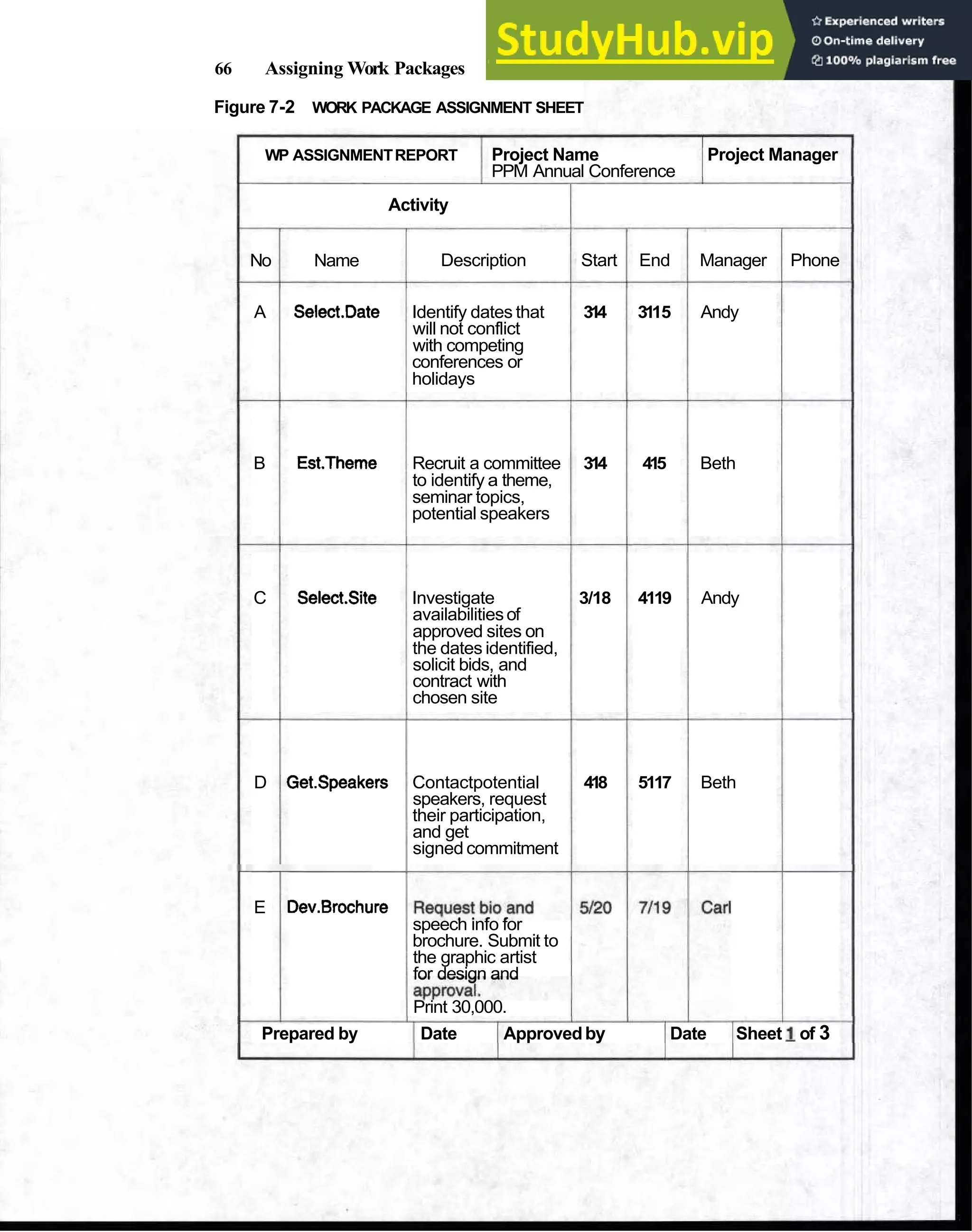
these figures against the plannedause of resources by computing the variance
(planned-actual) provides the project manager with one measure of project
status. The same calculations are done for the cumulative actual and planned
resource use. Some indication of variance trends can be determined by com-
paring period variances with cumulative variances, although the graphical
reports discussed later give more information on trends in resource use at the
activity and project levels.
Positive Variances
Being ahead of schedule or under budget are variances that are music to the ears of
the project manager. Positive variances may allow for replanning that will bring
the project in ahead of schedule, under budget, or both. If the project manager has
multiple projectmanagement responsibilities,there may be opportunities to reallo-
cate some resourcesfrom projects with positive variances to projectswith negative
variances.
Negative Variances
Being behind schedule or over budget is not music to the ears of the project
manager. This condition may arise for reasons beyond the control of the project
manager or project team. Regardless of the reason, the project manager must
find ways to correct the situation. In addition to identifying the reason for the
variance and correcting it, the manager will need to find ways to reallocate
resources from non-critical path activities to those that created the negative
variance. The objective will be to bring the project back into agreement with the
plan.
In most cases negative time variances will impact project completion only if
they are associated with critical path activities. Of lesser concern will be those
delays that are associated with non-critical path activities. Whereas less serious
variances simply use up some part of the slack time for that activity, more serious
ones will cause a change in the critical path.
Negative cost variances may be the result of uncontrollablefactors (costincreases
from suppliers, increased fuel costs, changes in the tax laws, unexpected equipment
malfunctions, etc.). Some may be the result of inefficiencies or error. Whereas every
attempt must be made to recover, there may be no alternatives other than budget
increases or, alternatively, reduced profit margins.
88 Maintaining the Project Schedule
Prepare Status Reports 89
GRAPHICAL REPORTING TOOLS
Managers' time is valuable. To force them to read page after page of data only to
conclude that all project activitiesare on scheduleand no interventionon their part
is required is to waste their time. A report that identifiesactual performance that is
outsidesome nominal(oftenarbitrarily set)specification is more helpful. For exam-
ple, the project manager may want to be alerted to any variance that is more than
10 percent above or below plan. In addition,if that condition persistsfor, say, three
consecutivereportingperiods, the project manager may also request more detailed
reports from the responsible persons in which both the cause and the corrective
action is discussed. A simple graphical way to convey that variance from plan
informationis with cumulative cost or time plots (Figure9-3). The report date is the
end of the 14th week of the project. Cumulative planned expendituresare shown
with the solid line, actual expenditures with the dashed line, and the forecasted
expenditures for the balance of the project with the alternating dash-dot line. In
this case the variance is positive and less has been expended than was planned.
Either the project manager has found some economies or the project is behind
schedule. When actual expenditures are less than planned it may be the result of
being behind schedule and having not yet incurred the expenditures that were
planned.
GANTT CHARTS
The cumulative cost variance graph conveys budget information at a glance, but,
as we have seen, that does not tell the whole story. By combining it with another
graphical report, the Gantt Chart, the actual project status is more easily assessed.
A Gantt Chart is one of the most convenient, most used, and easy-to-grasp
depictions of project activities. It is a two-dimensional graphical representation of
the activities that comprise the project. The vertical dimension lists the project
activities-one per line-while the horizontal dimension is time. Once the sched-
uled start and completion date of each activity has been determined, the Gantt
Chart can be constructed. The value-added of a Gantt Chart is the scaling of
projectactivitiesaccordingto theirduration. This will help put a perspectiveon the
project not obvious in the network representation. On the other hand, the usual
representation of a project using the Gantt Chart sacrifices the dependencies be-
tween project activities.
Figure 9-4 shows a representation of the Conference Planning Project as a
Gantt Chart using a format that we prefer. Over the years we have modified our
format of the Gantt Chart to imbed considerable information in one graph. The
modificationswe have made remove most of the shortcomings attributed to Gantt
Charts with little increase in complexity (or clutter). In our format each activity is
90 Maintaining the Project Schedule
Review Project Schedule 91
represented by a bar whose width is the planned time for that activity. One of our
major modifications is to show critical path activities in heavier lined boxes. The
precedence relationshipsare shown with vertical lines connecting the end of the
predecessor activity with the beginning of the following activity. Slack time for
noncritical activities is shown with dashed lines (thisis another of our variations).
Figure 9-5 is the Gantt Chart at the 14th week of the project. The shading
shown in the activity bars represents the proportion of that activity that is com-
pleted. If the project were exactly on schedule, the shading would extend to the
verticalline at the 14th week. Observe that ActivitiesE and F are behind schedule
and that Activity H, scheduled to begin in week 16, has already been partially
completed. (Perhapsthe positiveexpense variance is the result of ActivitiesE and F
being behind schedule.) Activity E is approximately one week behind schedule.
Since it is on the critical path, the project manager will want some explanation
from Carl as to how he intends to get back on schedule. Activity F is not on the
critical path and its 2-week slip from the planned schedule may not be reason for
concern at this point.
BALANCE IN THE CONTROL SYSTEM
It is very easy to get carried away with controls and the accompanying reports.
Certainly the more controls that are put in place the less likely it will be for the
project to get in trouble. The reverse is also true. The fewer the controls the higher
the risk of serious problems being detected too late to be resolved. The project
manager will need to strikea balance between the extent of the control system and
the risk of unfavorable outcomes, just as in the insurance industry where the cost
of the policy is compared against the dollar value of the loss that will result from
the consequences.
Control also implies rigidity and structure. Both tend to stifle creativity. The
project manager will want the team members to have some latitude to exercise
their own individuality. The cost of the control must be weighed against the value
of empowering team members to be proactive (hence risk takers).
REVIEW PROJECT SCHEDULE
At each milestone the projectmanager will review from the Status Report provided
by each work package manager the status of each work package. Despite all of the
planning that went into the project, things will not happen according to plan.
Slippages are a fact of life-many are unavoidable and due to inherent variabili-
ties. Some, of course, are due to human error. Here is where project managers
92 Maintaining the Project Schedule
Figure 9-6 PROJECT ACTIVITY SCHEDULE BY TEAM MEMBER
PROJECTSTATUS REPORT PROJECT NAME PROJECT MANAGER DATE
MANAGER NUMBER NAME PREPAREDBY DATE APPROVEDBY DATE
ANDY A Select ConferenceDate
C Select Conference Site
J Confirm Arrangements
m
BETH B Establish ThemelProgram
0
D Obtain Speakers
0
H Obtain Speaker Materials
0
CARL E Develop Brochures
a
F Obtain Mailing Labels
DIANE G Mail Brochures
I Receive Registrations
K Prepare Notebooks
0
Week 2 4 6 8 10 12 14 16 18 20 22 24 26 28 30
94 Maintaining the Project Schedule
prove their worth: getting back on schedule. For many project managers it may
seem that this is all they do.
GETTING BACK ON SCHEDULE
In its simplest form, getting back on schedule involves reallocatingresourcesfrom
non-critical path activities to critical path activities. Slack management is a term
often used for this task. Figure 9-6 is a report of scheduled activities for each of the
project team members. It is simple in form, easy to prepare and update, and
contains much of the information that the project manager will need to consider
available alternatives. For example, Figure 9-6 is the Status Report at the end of the
14th week of the project. As pointed out in Figure 9-5, Activity E is one week
behind schedule and it is a critical path activity. What alternatives might the
project manager have to add resources to Activity E, or some later critical path
activity, to get the project back on schedule? Looking at Figure 9-6, note that Beth
has been able to complete some work on Activity H ahead of schedule and that
Activity H is not on the critical path. Beth can be diverted to Activity E (while
continuing work on Activity F as time permits) to help Carl get back on schedule.
Recall that Activity F does have some slack time but that it must be completed
before Activity G (which is on the critical path)can begin.The project manager will
be aware of this and can watch at the next milestone for any potential problems.
PROJECTMAINTENANCE QUALITY CONTROL CHECKLIST
YES OR NO
-
1. Meaningful reporting frequencies have been established.
2 . The project manager has determined the reporting requirements and in-
formed the work package managers accordingly.
3 . The work package managers understand how to complete each of the
required reports.
-
4. Variances from plan that will require immediate action have been defined
by the project manager and communicated to the project team.
-
5. Responsibilities for completing project status reports have been assigned
and communicated to the project team and other interested parties.
-
6. Top management has been briefed on the reporting procedures and they
have been approved.
Review Project Schedule 95
PROJECTMAINTENANCE ACID TEST
1. The project manager has the appropriate responsibilityand authority to com-
plete the project on time, within budget, and according to specifications.
2. The project manager has delegated the appropriate responsibilityand author-
ity to the work package managers to complete their work on time, within
budget, and according to specifications.
3. The reporting and control system is compatible with that of the organization.
4. The reporting system employed for this project will alert the project team of
out-of-controlsituations early enough to take positive corrective action.
5-PHASE PROJECTMANAGEMENT
Project Overview WBS Recruitment *Variance Final Report
ProjectNetwork Criteria Reports Audit Report
CriticalPath Work Package *Status Reports
Project Proposal Description *Staff Allocation
Work Package Reports
Assignments
Chapter 10
CLOSING THE PROJECT
The project has been planned and implemented. It must now be closed. Who
decides when and how the project is to be terminated?Guidelinesfor a rationale,
framework, and process for closing projects are provided here. The end point of
the master plan should signal that temporallyand from the standpoint of achieve-
ment of project goals and deliverables, it is time to terminate the process both
formally and informally.
The major phases of project completion include:
obtaining client acceptance,
documenting the project,
conducting the post-implementation audit, and
issuing the final report.
In this chapter we will discuss steps for accomplishing these phases while termi-
nating the physical operations of the project.
PREPARING TERMINATION LOGISTICS
The rationale for terminating a project is
1. to formally close outside contractual relationships with suppliers, manufactur-
ers, customers, and other budgeted parties who expect an earlier, agreed-upon
termination of services;
2. to formally terminate project team member assignments;
3. to obtain client acceptance of the project work and deliverables;
4. to ensure that alldeliverableshave been installed or implementedaccording to
time, budget, and specifications;
5. to ensure that adequateproject documentation and baseline information are in
place to facilitateinteractionsor changes that may need to occur in the future;
98 Closing the Project
6. to issue and obtain sign-off on the final report or status of the project, which
shows that the contracted deliverables have been satisfactorily implemented;
and
7. to terminate all external and internal relationships.
A post-implementation audit is done and can be added to the final report.
WHO DECIDES TO TERMINATE AND WHEN
A predetermined formal project termination date should have been arranged and
signed (even if the first date has been moved) by the project manager and the
overseeing administration of the umbrella organization. This close date should
agree with the master plan. The project manager initiates the closing of the project
with the acknowledgment and cooperation of the administration of the client
organization.
THREE TYPES OF PROJECTTERMINATION
Jack Meredith and Samuel Mantel, Jr. (1989) note three types of project
termination:
1. by extinction,
2, by inclusion, and
3. by integration.
These three types of termination can help you see how the project is seen by others
and how the termination process can take more than one form.
Project termination by extinctiorz means the project work as scheduled is either
successfully or unsuccessfully done and the decision to terminate is agreed upon.
Closing relationships and preparation of the final report must still be completed.
This type of termination may cause more stress since the closing is scheduled and
the originally planned goals of the project may not have been achieved.
Project termination by ir~clusio~~
means the project is a success and is institu-
tionalized into the organization. This type of termination is seen as a transforma-
tion and transitioning process of the project into the larger organization that
supported it. The project manager must take special care to ensure a smooth
transition.
Three Types of Project Termination 99
Project termination by integration is the most common way of closing success-
fulprojects.It is also the most complex. Projectequipment,material, and personnel
must be distributedback into the parent organization. Unlike terminationby inclu-
sion, the project may not be seen as a competitor when resources are integrated.
The work of the project manager is significant in all three types of terminations.
Knowing at the outset of the project which type of termination may likely occur
can help you plan the operations for inclusion or integration.
CHECKLIST FOR TERMINATION
The following checklist (Meredithand Mantel, 1989)serves as a guide which can
assist you in determining the readiness of the project for termination apart from
published or planned dates and deadlines:
1. Is the project still consistent with organizational goals?
2. Is it practical? Useful?
3. Is management sufficiently enthusiastic about the project to support its
implementation?
4. Is the scope of the projectconsistentwith the organization's financialstrength?
5. Is the projectconsistent with the notion of a"balanced programin all areas of
the organization's technical interests? In "age"? In cost?
6. Does the project have the support of all the departments (e.g., finance, manu-
facturing, marketing, etc.) needed to implement it?
7. Is organizational project support being spread too thin?
8. Is support of this individual project sufficient for success?
9. Does this project represent too great an advance over current technology?Too
small an advance?
10. Is this project team still innovative? Has it gone stale?
11. Can the new knowledge be protected by patent, copyright, or trade secret?
12. Could this project be farmed out without loss of quality?
13. Is the current project team properly qualified to continue the project?
14. Does the organization have the required skills to achieve full implementation
or exploitation of the project?
15. Has the subject area of the project already been "thoroughly plowed"?
100 Closing the Project
16. Has the project lost its key person or champion?
17. Is the project team enthusiastic about success?
18. Would the potential results be more efficiently developed in-house than pur-
chased or subcontracted outside?
19. Doesit seem likely that the projectwill achieve the minimum goalsset for it?Is
it still profitable?Timely?
Whatever form the termination takes, the project manager still needs a termi-
nation process to structureand implementthe project's close. Once all the checklist
items have been addressed, steps for the termination can begin.
PROJECTTERMINATION PROCESS
The terminationprocesscan be as complicatedand lengthy as the size, complexity,
and scope of the projectitself. Asystematicprocess is thereforeneeded to assist the
project manager in successfully covering all bases in order to terminate contracts
and relationships. The general termination phases are illustrated in Figure 10-1.
These phases include:
1. prepare termination logistics,
2. document the project,
3. conduct post-implementationaudit and prepare and submit final report,
4. obtain client approval, and, finally,
5. close operations.
The following steps, as represented in Figure 10-2, are recommended to help
you structure a process that meets your specific project needs:
1. Establish a project termination design to organizationally close the project:
(a) Assign a termination manager.
(b) Assign a termination team to assist the manager.
2. Conduct a termination meeting to review this process. Make close-out
assignments.
3. Prepare project personnel termination reports. Close down project office and
reporting systems.
Project Termination Process 101
Figure 10-1 PHASES OF PROJECT TERMINATION
PREPARE
TERMINATION
LOGISTICS
OPERATIONS
OBTAIN
CLIENT
APPROVAL
PROJECT
TERMINATION
PHASES
THE PROJECT
POST-IMPLEMENTATION
AUDIT;PREPARE AND
4. Terminate all financialdocuments; complete all payments and expenses; col-
lect all debts; prepare the financial project closing report.
5. Terminate all work orders, contracts, assignments, and outstanding supplier
and customer obligations.
6. Document completion and compliance with all vendors and contractors.
7. Close all project sites and return all project equipment.
8. Conductand complete post-implementationaudit. Completefinal report.Sub-
mit to client.
9. Obtain client's approval.
10. Close all physical sites and terminate remaining project staff.
Stay close to the client and the administration of the supporting organization
throughout this process. Your close-down is dependent on client satisfaction and
the quality of the services the project provided.
Figure 10-2 TERMINATION PROCESS
STEPS TERMINATIONPROCESS PHASES
Assign Prepare termination
termination Assign a termination manager and staff logistics.
staff.
Close out Conduct a termination meeting to review
assignments. process and make assignments
Close project
office, team,
records system.
IPrepare personnel terminationreports on project
team and staff. Terminate ~roiect
office. I
I reporting systems, aild 'files
I
I
Close financials. Terminate all financial documents.Complete all
payments andexpenses. Collect all outstanding
debts. Prepare final financial project report
,
Terminate activity Terminate work orders, contracts, assignments,
andcontract. manpower,andoutstanding supplier/customer 1
obligations
I
Document Documentcompletionandcompliance with all Document
contracts. contractors, consultants, and services purchased the project.
and received. Prepare a document file of
all vendors and contracted services and
products terminated
Close external Close off all project sites and review all
operations and equipmentoff site and within umbrella
dispose of organization
equipment.
complete Iconductand comeetepost-implementation audnI Conduct
post-implementation of project goals, objectives, and work activities. post-implementation
audit & final I Comoleteand submit final re~ort. I audit and issue
project report. I I final report.
Obtain client
approval. I Obtain client approval.
I Obtainclient
approval.
Close-down. Complete termination of all operations. Close operations.
Terminate all remaining staff
Source: Adapted fromJackR. Meredith and Samuel J. Mantel, Jr. (1989), Project Management: A Managerial
Approach, 2d ed. (New York: Wiley), chap. 4, with permission.
102
Project Termination Process 103
POST-IMPLEMENTATIONAND FINAL PROJECTREPORT
The post-implementationaudit is an evaluation of the project's goals and activity
achievementas measured against the project plan, budget, time deadlines,quality
of deliverables, specifications, and client satisfaction. The log of the project activi-
ties serves as baseline data for this audit. The driving questions include:
1. Was the project goal achieved?
2. Was project work done on time, wasit done within budget, and was it done by
specificstions?
3. Was the client satisfied with the project results?
The Final Project Report serves as the memory or history of the project.It is the
file that others can check to study the progress and impediments of the project.
There are many formats that can be used for a final report. The followingelements
are usually included:
Overall success and performance of the project (using the post-implementa-
tion audit results)
Organization and administration of the project
Techniques used to accomplish project results
Assessment of project strengths and weaknesses
Recommendations from the project manager and team for continuation or
extinction of the project
REWARDING THE SUCCESSES, LEARNING FROM THE FAILURES
Closing the project with a celebration of the effort as well as the results brings
resolution to the process. The project manager's last effort is to bring the team
together to review their journey.Thisis a way of closinginformal as well as formal
relationships. Not all projects terminate on an upbeat note. Still, a great deal of
learning has occurred. A final meeting, party, dinner, or gala brings the projectlife
cycle full circle.
Part I11
PROJECT MANAGEMENT
FOR THE 21ST CENTURY
Project management methods continue to be popular and useful tools in organiza-
tions. As we approach the 21st century, we noticeseveral changes which managers
must consider in planning and implementing projects: an increased customer fo-
cus; managing multiple projects, or "program management";using a "stakeholder
analysis" to plan and implement projects; and use of horizontal task forces. The
epilogue which follows highlights these trends.
Epilogue
CONTEMPORARY ISSUES
IN PROJECTMANAGEMENT
CUSTOMER FOCUS
Whether the end user of the project is a department or business unit in the organi-
zation or the purchaser of the organization's products or services, the trend in
successfulorganizationsis to have them involved in the project. We have continu-
allystressed the need for buy-in of the project's end user. The importanceof this is
even more evident in projects that involve the development of software systems
and products. Among the most progressive organizationsit is not unusual to find
the end user in the role of project manager. This places added responsibility on the
shoulders of thesystemsand programmingstaff, especiallyon the systemsanalysts
who serve on the project team.
It also places added responsibility on the shoulders of the end user depart-
ment. The project was approved because of favorable cost/benefit ratios. It will be
the responsibility of the end user to demonstrate that those benefits have indeed
been realized.
PROGRAM MANAGEMENT
Projects whose activities are themselves projects are called programs. A detailed
discussion of program management is beyond the scope of this book. Still, many of
the techniques we have discussed are relevant.
The program manager will, of course, have to face an additional layer of
complexity. This is most evident when resources must be shared across several
projects. A good example of this is the systems development unit in the informa-
tion systems department. The analysts and programmers will most likely have
responsibilities in multiple projects, either in one program or across several
programs.
Compared to projects, programs will be of longer duration. This adds another
complexity usually not found in projects-staff turnover. Program managers will
have to pay more attention tostaff hiring, training,and development.The program
108 Contemporary Issues in Project Management
network will have to include activities related to program team development.
These activities, even if nothing more than contingency plans, will still have to be
budgeted and managed effectively to ensure that the human resources are avail-
able when needed.
STAKEHOLDER ANALYSIS
The Stakeholder Analysis (Freeman, 1983; Weiss, 1991) is another strategic tool
project managers can use to map and understand planned obligations and tactics
when dealing with dispersed customers, suppliers, competitors, government bod-
ies, and external groups. The Stakeholder Analysis is not new. As used here, it
simply maps different groups that have a stake or interest in the project.
The purposes of the analysis are
1. to enable the project manager to identify the groups that must be interacted
with to accomplish project goals;
2. to develop strategies and tactics to effectively negotiate competing goals and
interests among the different groups;
3. to identify strategicinterests each group has in the project in order to negotiate
common interests; and
4. to help the project manager better allocate resources to deal with these differ-
ent constituenciesin order to accomplish project goals.
Many projects are extremely complexand requirea number of externalinterac-
tions for completion. The Stakeholder Analysis simplifies the complexity. The
project manager can assess external resources and threats and strategically plan
appropriate responses.
ORGANIZATIONAL CHANGES
There are dramatic, even revolutionary,changes now taking place in the corporate
world which are affecting the way projects are managed. The rapid emergence of
software useful to even the unsophisticated and the realization that information
systems can dramatically impact the organization's competitive position have re-
sulted in both vertical and horizontal changes in the structure and operation of
organizations. Specifically, project teams are formed along temporary, "dotted-
line" reporting relationships to other organizational managers; project teams are
formed as part of "ad hocracies," that is, organizational units with ad hoc objec-
Organizational Changes 109
tives; and project teams may be part of emerging network organizations, that is,
splintered units that out-source products, goods, and services. As organizations
continue to "blur" their boundaries, project teams will increase in importance
because teams can be used to pull and combine resources across functional areas
and even geographies.
VERTICAL THINNING
Becauseof the computer,information is more accessible to managersat alllevelsin
the organization; therefore, the need for layer upon layer of middle managers is
being questioned. In many organizationsit has been concluded that several layers
of management exist primarily to interpret information and pass it up or down to
the next level of management. Access to information has become so easy that
many managerscan query the system directly rather than work through intermedi-
aries. In that sense use of several layers of management has become obsolete and
they have in fact been removed in many organizations. There are also strong
indications that even clerical support staff are disappearing as many managers can
now do much of their own word processing and use electronic mail to communi-
cate what once had to be communicated through an endless stream of memos.
For the project manager computersand easy access to informationis both good
news and bad news. The good news is that there is now a much better set of tools
to monitor and report project status, to detect out-of-control situations, and to
evaluate and even suggest alternative solutions. The bad news is that top manage-
ment can alsodirectly monitor project progress. Project managers will be put to the
task; not only must they stay current with project activity, they must also be
prepared to respond quickly and be ready with answers to questions that top
management will now be able to ask.
HORIZONTAL TASK FORCES
Peter Drucker, writing in the Hamard Business Review in January-February 1987,
spoke of the coming of a new organization-onewhose structure is nothing more
than a loose federation of task forces. Each task force contains all the expertise it
needs to carry out its mission. If such is to be-and there is sufficient evidence to
support Drucker's claim-then here is where the rubber will meet the road as far as
project management is concerned. Task managers (a.k.a. project managers) will
have one or more projects under their control. They will also have sufficient
autonomy (and the requisite responsibility) to make day-to-day decisions and
manage the affairs of their projects. They will be responsible not only for bringing
the project in on time, within budget, and according to specifications, but also for
developing their team to function effectively on more than one project.
110 ContemporaryIssues in Project Management
The simple, quick, and effective tools we have shown here will be in-
dispensable for working in the changing environment of organizations.Certainly
one can envision much more complex and detailed tools and documentation-and
many have-but we believe that our simple approach will be best for most of the
projects you may encounter.
Appendix
PROJECTMANAGEMENT
SOFTWARE
For thoseinterested in using one of the many software packagesavailable for both
mainframe and micro-computer environments, we advise checking one of the
more popular evaluationsources first. Two that regularly publish such reviews are
Project Management Institute
P
.0.Box 43
Drexel Hill, PA 19026
(415) 622-1796
and
Software Digest
One Winding Drive
Philadelphia, P
A 19131-2903
1-800-223-7093 (in PA 1-800-222-3315)
Infoworld periodically publishes evaluations of project management packages.
The most recent evaluation appeared in November 1990. In that review they
evaluated Harvard Project Manager, Instaplan 5000, Microsoft Project for Win-
dows, Project Scheduler 5, Superproject Expert, and Time Line. There is no single
packagethat is considered best. Asin allsoftwareselectiondecisionsit is important
to first specify the functionality that your situation requires and then find the
package that meets that criteria.Cost ($495 to $20,000 and more), hardware envi-
ronment,single user or networked, and perhaps other constraints may further limit
your choices.
As you look for the appropriate software package, ease-of-use should be a
"non-negotiable."An easy trap to fall into is to become enamored with the glitz
and glitter of the package and forget about the overhead. When the number of
activitiesin the projectgrows to 50 or more, any serious projectmanagementeffort
will have to include a software package. Industry surveys, software reviews, and
user evaluationswill be indispensablein deciding which package best meets your
needs.
Bibliography and Cited References
Adams, Everett, Jr., and Ronald J. Ebert (1978). Production and Operations Management
(Englewood Cliffs, NJ: Prentice-Hall).
Archibald, Russell (1976). Managing High-Technology Programs and Projects (New York:
Wiley).
Awani, Alfred (1983). Project Management Techniques (New York:Petroteil Books), chap. 10.
Bacon, J. (1970). Managing the Budget Function (New York: National Industrial Conference
Board).
Balachandra, R. and J. A. Raelin (1980). "How to Decide When to Abandon a Project."
Research Management, July, pp. 24-29.
Bander, Diana (1986). "Building a Better Project Manager." Computenoorld, May 26, pp.
69-74.
Bartizal, J. R. (1940). Budget Principles and Procedures (Englewood Cliffs, NJ: Prentice-Hall).
Bienkowski, Danek (1989). "Ten Causes of Project Busts." Computenoorld, February 13, p.
99.
Blake, R. and J. Mouton (1961). "Reactions to Intergroup Competition Under Win-Lose
Competition." Management Science, July, pp. 420-25.
Block, R. (1983). The Politics of Projects (New York: Yourdon Press).
Bolton, Robert (1979). People Skills (Englewood Cliffs, NJ: Prentice-Hall).
Burman, J. (1972). Precedence Networks for Project Planning and Control (New York: McGraw-
Hill).
Carhvright,D. and Z. Zander (Eds.)(1968).Group Dynamics: Research and Theory (New York:
Harper & Row).
Cleland, D. I. and W. R. King (Eds.) (1983). Project Management Handbook (New York: Van
Nostrand Reinhold).
Clifton, D. S. (1975). Project Feasibility Analysis (New York: Wiley).
Cohen, Allan R., Fink, Stephen, Gadon, Herman, Willits, Robin, with the collaboration of
Natasha Josefowitz(1988). Effective Behavior in Organizations, 4th ed. (Homewood, IL:
Irwin).
Cooke, Terry-Davies (1990). "Return of the Project Managers." Management Today, May
1990, pp. 119-20.
Bibliography and Cited References 113
Corcoran, Elizabeth(1990)."ComputerBabble: ManufacturersMoveSlowly to Adopt Open
Systems." Scientific American, January, pp. 100-102.
Covey, Stephen R. (1989). The 7 Habits of Highly Effective People (New York: Simon and
Schuster).
DeMarco, T. (1982). Controlling Software Projects (New York: Yourdon Press).
Deutsch, M. (1968)."The Effects of Cooperationand Competitionupon Group Success."In
D. Cartwright and Z. Zander (Eds.),Group Dynamics: Research and Theory (New York:
Harper & Row).
Dilworth,B. James, Robert C. Ford, Peter M. Ginter, and Andrew C. Rucks (1985)."Central-
ized Project Management." Journal of Systems Management, August, pp. 30-35.
Doran, George T. (1981). "There's a S.M.A.R.T. Way to Write Management Goals and
Objectives." Management Review, November, pp. 35-36.
Doughty, Rick and Ralph Kliem (1987)."Making Software Engineering Project Managers
Successful."Journal of Systems Management, September, pp. 18-23.
Doyle, M. and D. Straus (1977). How to Make Meetings Work (New York: Harper & Row).
Dressler, Donna M. (1986)."In Project Management, the EmphasisShould Be on Manage-
ment." Data Management, January, p. 62.
Drucker, Peter (1987)."The Coming of the New Organization." Harvard Business Review,
January-February, pp. 45-53.
Dyer, William (1987).Team Building, lssues and Alternatives, 2d ed., (Reading, MA: Addison-
Wesley).
Festinger, L., S. Schachter, and K. Back (1950).Social Pressures in lnformal Groups:A Study of
Human Factors in Housing (New York: Harper & Row).
Fleming, Mary M. K. (1986). "Keys to Successful Project Management." CMA Magazine,
November-December, pp. 58-61.
Frame, J. Davidson (1987).Managing Projects in Organizations (San Francisco: Jossey-Bass).
Frame, J. D. (1969). Managing Projects in Organizations, How to Make the Best Use of Time,
Technique, and People (San Francisco: Jossey-Bass).
Freedman, D. P. and G. M. Weinberg (1982). Handbook of Walkthroughs, Inspections, and
Technical Reviews, 3d ed. (Boston:Little, Brown).
Freeman, R. Edward (1983). Strategic Management: A Stakeholders Approach (Boston:
Pittman).
Gilbreath, R. D. (1986). Winning at Project Management: What Works, What Fails, and Why
(New York: Wiley).
Hajek, V. G. (1984). Management of Engineering Projects (New York: Wiley).
Hamson, F. L. (1984). Advanced Project Management (New York: Wiley).
Hoare, H. R. (1973). Project Management Using Network Analysis (New York: McGraw-Hill).
114 Bibliography and Cited References
Homans, G. C. (1950).The Human Group (New York: Harcourt Brace Jovanovich).
House, Ruth Sizemore (1988).The Human Side of Project Management (Reading, MA: Addi-
son-Wesley), chaps. 5 and 6.
Hover, L. D. (1979). .A Practical Guide to Budgeting and Management Control Systems: A
Functional and Pet.formance Evaluation Approach (Lexington, MA: Lexington Books).
Kanter, Elizabeth R. (1989).When Giants Learn to Dance: Mastering the Challenge of Strategy,
Management and Careers in the 1990's (New York: Simon and Schuster).
Kerzner, Harold (1982). Project Management for Executives (New York: Van Nostrand
Reinhold).
Kerzner, Harold (1979). Project Management: A Systems Approach to Planning, Scheduling and
Controlling (New York: Van Nostrand Reinhold).
Khalil, T. and B. Bayraktar (Eds.) (1990). Management of Technology 11: The Key to Global
Competitiveness (Norcross, GA. Industrial Engineering and Management Press).
Kidder, Tracy (1981). The Soul of a New Machine (New York: Avon Books).
Kowitz, A. C. and T. J. Knuston (1980). Decision Making in Small Groups: The Search for
Alternatives (Boston: Allyn and Bacon).
Lee, S. M., Moeller, Gerald L., and Lester A. Graham (1982). Network Analysis for Manage-
ment Decisions (Boston: Kluner Nijhoff).
Lin, T. (1979)."Corporate Planning and Budgeting: An Integrated Approach." Managerial
Planning, May, pp. 29-33.
Maidique, Modestoand Robert Hayes (1984)."The Art of High-TechnologyManagement."
Sloan Management Review, Winter, pp. 17-31.
Margin, 0.C. (1976). Project Management (New York: AMACOM Books).
Menkus, Belden (1987). "There Are Many Reasons Why Some SystemsProjects Are Unsuc-
cessful." Journal of Systems Management, September, p. 5.
Meredith, Jack R. and Samuel J. Mantel, Jr. (1989). Project Management: A Managerial Ap-
proach (New York: Wiley), chap. 4.
Meyer, John R. and James M. Gustafson (Eds.) (1988). The U.S. Business Corporation: An
Institution in Transition (Cambridge, MA: Ballinger).
Mintzberg, Henry (1973). The Nature of Managerial Work (New York: Harper & Row), pp.
92-93.
Mishan, E. J. (1982). Cost Benefit Analysis, 3d ed. (Winchester, MA: Allen and Unwin).
Moder, J. J. (1983). Project Management with CPM, PERT, and Precedence Diagramming (New
York: Van Nostrand Reinhold).
Moriarty, Rowlandand Thomas Kosnik (1989)."High-Tech Marketing: Concepts, Continu-
ity and Change." Sloan Management Review, Summer, pp. 7-17.
Bibliography and Cited References 115
Norko, W
. A. (1986)."StepstoSuccessfulProject Management."Journal of Systems Manage-
ment, September, pp. 36-38.
Page-Jones, M. (1985). Practical Project Management: Restoring Quality to DP Projects and
Systems (New York: Dorset House).
Parmar Lakhbir(1987)."SuccessFactorsin ManagingSystemsProjects." Data Management,
p. 27.
Peters, Thomas J. and Robert H. Waterman, Jr. (1982). In Search of Excellence (New York:
Harper & Row).
Pinto, JeffreyK. and Dennis P. Slevin (1989)."The Project Champion: Key to Implementa-
tion Success." Project Management Journal, December, pp. 15-20.
Pinto, JeffreyK. and Dennis P. Slevin (1987)."Critical Factors in Successful Project Imple-
mentation." IEEE Transactions of Engineering Management, February, pp. 22-27.
Randolph, A. and B. Posner (1988). Effective Project Planning B Management, Getting the Job
Done (Englewood Cliffs, NJ: Prentice-Hall).
Raudsepp, Eugene (1987). In R. L. Kuhn (Ed.), Handbook for Creative Managers (New York:
McGraw-Hill), pp. 173-82.
Ruskin, A. M. and W. E. Estes (1985). "The Project Management Audit: Its Role and Con-
duct." Project Management Journal, August, pp. 64-70.
Russell, Archibald (1976). Managing High Technology Programs and Projects (New York:
Wiley).
Russo, W. M. and R. T. Greenway (1990). "A Framework for Managing Enterprise-Wide
Information Systems Technology."In T. Khaliland B. Bayraktar (Eds.), Management of
Technology 11:Proceedingsof the Second International Conference on Management of Tech-
nology (Norcross, GA: Industrial Engineering and Management Press), pp. 983-92.
Salinger,Anthony W. (1985)."Leadership,Communication Skills Lift Projects to Success."
Data Management, September, pp. 36-37.
Sherif, M. (1967).Group Conflict and Cooperation:Their Social Psychology (Boston: Routledge
and Kegan Paul).
Sherif, M. and C. Sherif (1953).Groups in Harmony and Tension (New York: Harper & Row).
Silverman, M. (1976). Project Management: A Short Course for Professionals (New York:
Wiley).
Spinner, M. (1981). Elements of Project Management (EnglewoodCliffs, NJ:
Prentice-Hall).
Stewart, John M. (1965). "Making Project Management Work." Business Horizons, Fall, pp.
54-68.
Stuckebmck, C. (Ed.) (1981). The Implementation of Project Management: The Professional's
Handbook (Reading, MA. Addison-Wesley).
Thomas, Kenneth W. (1977)."Toward Multi-dimensionalValues in Teaching: The Example
of Contlict Behaviors." Academy of Management Review 2, No. 3, p. 487.
116 Bibliography and Cited References
Thomsett, R. (1980). People 6 Project Management (New York: Yourdon Press).
Turner, W. S. III (1980). Project Auditing Methodology (Amsterdam: North Holland).
Webber, Ross A. (1975). Management (Homewood, IL: Irwin).
Weiss, Joseph W. (1991). "Computer Firms and Global Competitiveness in the 1990's:
Implementationof TotalSolutionsEnterpriseStrategies."Business and the Contempora y
World, May, pp. 113-20. Bentley College, Waltham, MA.
Weiss, Joseph W. (1990)."Enterprise Program ManagementMethodology:Computer Firms
Map to the 1990's." Unpublished paper, BentleyCollege, Department of Management,
Waltham, MA.
Weiss, Joseph W. and Hans J. Thamhain (1992). "Project Management: Strategic and Com-
petitive Uses in Twenty High Technology Companies." Paper delivered at the Third
InternationalConferenceon the Managementof Technology, Feb. 17-21, Universityof
Miami, Miami, FL.
Weist, J. D. and F. Levey (1977). A Management Guide to PERT/CPM, 2d ed. (Englewood
Cliffs, NJ: Prentice-Hall).
Zeldman, M. (1978). Keeping Technical Projects on Target (New York: AMACOM Books).
Index
Acid tests
network representation, 41
project maintenance, 95
project manager selection, 61
project overview, 19
project proposal, 49
project specifications, 31
team selection, 61
work package, 69
Activities
characteristics of, 22-23
cost estimation, 29-30
critical vs. non-critical path, 87
description of in proposal, 44
graphical representation, 89
identifying, 21-22
scheduling by team member, 93
sequencing, 33-34, 34, 39
S.M.A.R.T., 21
start and completion times, 37-38
time estimation, 28-29,30
variance report, 86
in work package, 63
Activity node, 34-35
graphical representation, 35
Adjourning stage, 74
Bolton, Robert, communication bamers,
74-75
Budget
estimation, 46-47, 48
revenue and expense estimates, 49, 50
See also Costs
Change, instituting, 4-5
Communication
bamers to, 74-75
managing in team relationships, 75-76
Completion
phases of, 97
time, 29
Conference Planning Project
activity times, 30
critical path, 39
Gantt Charts, 88-91
hierarchical representation, 27
network representation, 36
planning, 16-18
project overview, 17
118 Index
Conference Planning Project (cont.)
revenue and expense budget, 50
sequencing activities, 34
start and completion times, 38
work breakdown structure, 25, 26
work package assignment sheet, 66, 67
Conflict management, 78-80
Control
acid test, 95
balance in system, 91
checklist, 94-95
detecting variance, 84
need for, 4
network representation for, 48
purpose of, 83-84
taking corrective action, 84
tracking progress, 83
Costs
negative variances, 87
underestimating, 46
Covey, Stephen, Seven Habits of Highly
EffectivePeople, 71
CPM. See CriticaI path method
Critical path, 37
activities in Gantt charts, 91
in Conference Planning network, 39
locating, 38-39
uses for, 40-41
Critical path method (CPM), 33
Customer focus, 107
Deadlines, 11-12
Doran, George, S.M.A.R.T. method, 13
Dmcker, Peter, on organizational
changes, 109
Earliest finish time (EF), 37
Earliest start time (ES), 37
Failure of project, causes, 5-6
Feedback
guidelines to effective, 75-76
mechanisms, 72
Five-phase method, 5
Gantt charts, 89-91, 90, 91
Goals
functions of, 12
setting, 7
Goal statement, 10-11
Implementation,51
network representation for, 48
Kerzner, Harold, selecting project
managers, 53
Latest finish time (LF), 37-38
Latest start time (LS), 37-38
Leadership
guidelines for effective, 72
qualities in project manager, 55
Location of project, 58-59
Loss leader, 46
Index 119
Mantel, Samuel J. or.)
project location criteria, 58-59
project termination types, 98-99
Meetings
follow-up, 81
preparation, 80-81
running, 81
Meredith, Jack R.
project location criteria, 58-59
project termination types, 98-99
Mintzberg, Henry, interpersonal skills, 56
Motivation
factors in, 6-7
using assignments as, 68
Name of project, 44
Network representation
acid test, 41
constructing, 35
generated from WBS, 27
graphic conventions, 36
of interconnected activities, 34-35, 34
quality control checklist, 41
uses for, 40
Norming stage, 73
Objectives, 7
evaluation criteria, 14
listing, 13-14
S.M.A.R.T., 13
stating assumptions and risks, 15-16
Organizational structure
horizontal task forces, 109-110
vertical thinning, 109
Organizing project, 4
Performing stage, 73-74
Planning the project, 4, 7
network representation for, 40
Post-implementation audit, 103
Precedence, diagramming techniques,
34-36
Problem, definition of, 9-10
Problem solving, 78-80
Program
definition, 3-4
management, 107-108
Project
definition, 3-4
variance report, 85
Project management
across functional boundaries, 73
contemporaryissues, 107-110
end user involvement,107
life cycle, 5
motivating factors, 6-7
need for, xi
organization changes, 108-110
principles, 4-5
software, 111
Project manager
acid test, 61
background and experience, 55
habits of effective, 71
identifying, 11
interpersonal skills, 56, 71
in proposal, 44
proven managerial ability, 56-57
quality control checklist, 59-60
role during project termination, 99
screening candidates, 53-54
selection criteria, 54-56
technical and strategic expertise, 55-56
timing in selection of, 54
Project overview
acid test, 19
Conference Planning Project, 17
quality control checklist, 18-19
uses, 9
Project proposal
acid test, 49
120 Index
Project proposal (cant.)
format, 44-49
purpose of, 43-44
quality control checklist, 49
Project specification, 30-31
Proposal. See Project proposal
Quality control checklists
network representation, 41
project maintenance, 94-95
project manager selection, 59-60
project overview, 18-19
project proposal, 49
project specification, 30-31
team selection, 60-61
work package, 68
Raudsepp, Eugene, management
guidelines, 72
Reporting structure, 4
to track progress, 83
Reports
final, 103
project definition in, 45
resource requirements, 47
status, 84-89
See also Gantt charts
Resources
critical vs. non-critical path, 94
determining, 14-15
guesstimating, 15
previously allocated, 15
reallocating, 94
requirements report, 47
scheduling activities around, 65
Schedule
of activities by team member, 93
getting back on, 94
in project proposal, 44
reviewing, 91, 94
of work packages, 65-67, 67
Seven Habits of Highly Effective People
(Covey), 71
Slack management, 94
Slack time, 38
in Gantt charts, 91
S.M.A.R.T. method
of identifying activities, 21
of setting objectives, 13
Software packages, 111
Stakeholder Analysis, 108
Statement of intent, 9
Storming stage, 73
Success criteria, 14
Task
definition, 3
as learning opportunity, 68
management, 109-110
Team
acid test, 61
developmental stages, 73-74
increasing cohesiveness, 77-78
motivation, 68
organization, 59
quality control checklist, 60-61
selection criteria, 57-58
Terminating projects
celebration for, 103
determining date, 98
by extinction, 98
h a 1 report, 103
by inclusion, 98-99
by integration, 99
phases, 100, 101, 102
Terminating projects (cont.)
rationale, 97-98
readiness checklist, 99-100
steps in, 100-103, 102
who decides, 98
Thomas, Kenneth, conflict management
strategies, 78-80
Variance
critical vs. non-critical path activities,
87
detecting, 84
graphical representation, 88, 89
negative, 87
period vs. cumulative, 87
positive, 87
report, 84, 85, 86
WBS. See Work breakdown structure
Work assignment, 3
Work breakdown structure (WBS), 21
characteristics, 22-23
Conference Planning Project, 25, 26
definition worksheet, 24, 26
estimating budget, 46
five-step procedure, 25
graphical representation, 23
hierarchical representation, 27
steps for constructing, 23
uses, 27
Work package
acid test, 69
assignment sheet, 67
definition, 63, 65
description report, 64
quality control checklist, 68
resource requirements report, 47
scheduling, 65-67, 67
for staff development, 68
standardized documentation. 65
5-PHASE PROJECT MANAGEMENT

5-PHASE PROJECT MANAGEMENT

  • 1.
  • 3.
    JOSEPH W. WEISS,Ph.D., Bentley College ROBERT K. WYSOCKI, Ph.D., The TMS Group 5-PHASE PROJECT MANAGEMENT A PRACTICAL PLANNING & IMPLEMENTATION GUIDE PERSEUS BOOKS Cambridge, Massachusetts
  • 4.
    Library of CongressCataloging-in-PublicationData Weiss, Joseph W. 5-phase project management : a practical planning & implementation guide / by Joseph W. Weiss, Robert K. Wysocki. p. " I . Includes bibliographical references (p. ) and index. ISBN 0-201-56316-9 (pbk. : acid-free paper) 1. Industrial project management. I. Wysocki, Robert K. 11. Title. 111. Title: Five-phase project management. HD69.P75W46 1992 658.4'044~20 91-42548 CIP Copyright1992 Oby Perseus Books Publishing, L.L.C. All rights reserved. No part of this publication may be reproduced, stored in a retrieval system, or transmitted, in any form, or by any means, electronic, pechanical, photocopying, recording, or otherwise,without the prior written consent of the publisher. Printed in the United Statesof America. Cover design by JoyceC. Weston Text design by Wilson Graphics & Design (KennethJ. Wilson) Set in 10 point Palatinoby Shepard PoormanCommunicationsCorporation Perseus Books is a member of the Perseus Books Group Find us on the World Wide Web at http://www.perseusboo .corn
  • 5.
    CONTENTS Preface xi Who NeedsProject Management Methods? xi What Techniques Does This Book Offer? xi Why We Wrote 5-Phase Project Management xii The Use of 5-Phase Project Management xiii Part I PLANNING THE PROJECT 1 Chapter 1 INTRODUCTION 3 First Things First: What Is a Project? 3 What Is Project Management? 4 Planning 4 Organizing 4 Controlling 4 Change 4 Ten Major Causes of Project Failure 6 Adopting a Project Management Mind-set 6 Chapter 2 DEFINING THE PROJECT:THE PROJECTOVERVIEW 9 State the Problem 9 What Is the Problem/Opportunity? 10 What Is to Be Done? 10 Who Is Responsible for the Project? 11 When Must the Project Be Completed? 11 The "Water Cooler" Imposed Deadline 11 The Planned and Estimated Deadline 12 Identify Project Goals 12 List the Objectives 13 What Criteria Will Be Used to Evaluate Project Success? 14 Determine Preliminary Resources 14 First Scenario 15 Second Scenario 15
  • 6.
    vi Contents Identify Assumptionsand Risks 15 Example: Planning a Professional Conference 16 The Birth of a Conference 16 Summary 18 Project Overview Quality Control Checklist 18 Project Overview Acid Test 19 Chapter 3 SPECIFYING THE PROJECT 21 Identify Project Activities 21 Work Breakdown Structures (WBS) 22 Characteristics of a Successful Work Breakdown Structure 22 Steps for Constructing a Work Breakdown Structure 23 Work Breakdown Structure-Hierarchical Representation 23 Uses of the Work Breakdown Structure 27 Estimate Time and Cost 28 Estimating Activity Time-Highly Speculative Situations 28 Estimating Activity Cost 29 Project Specification Quality Control Checklist 30 Project Specification Acid Test 31 Chapter 4 SEQUENCING THE PROJECT ACTIVITIES 33 Sequence Project Activities 33 Precedence Diagramming Techniques 34 Identify Critical Activities 36 Activity Start and Completion Times 37 Earliest Start and Earliest Finish Times 37 Latest Start and Latest Finish Times 37 Locating the Critical Path 38 Use of the Network and Critical Path 40 Planning 40 Implementation 40 Control 40 The Critical Path 40 Project Network Quality Control Checklist 41 Project Network Acid Test 41 Chapter 5 WRITING THE PROJECTPROPOSAL 43 Purpose 43 Format 44
  • 7.
    Contents vii Project Name44 Project Manager 44 Activity 44 Schedule 44 Project Budget 46 Underestimating Project Costs 46 Overestimating Project Costs 46 Estimating the Budget 46 Revenue and Expense Estimates 49 Project Proposal Quality Control Checklist 49 Project Proposal Acid Test 49 Part I1 IMPLEMENTING THE PROJECT 51 Chapter 6 ORGANIZING THE PROJECTTEAM 53 Determining Personnel Needs: Selecting the Project Manager 53 Timing 54 Selection Criteria 54 Background and Experience 55 Leadership and Strategic Expertise 55 Technical Expertise 55 Interpersonal Competence/People Skills 56 Proven Managerial Ability 56 Determining Personnel Needs: Selecting the Project Team 57 Selection Criteria 57 Organizing and Housing the Project 58 Project Manager Selection Quality Control Checklist 59 Project Team Selection Quality Control Checklist 60 Project Manager and Team Selection Acid Test 61 Chapter 7 ASSIGNING WORK PACKAGES 63 What Is a Work Package? 63 Scheduling Work Packages 65 Using Work Package Assignments for Staff Development 68 Project Work Package Quality Control Checklist 68 Project Work Package Acid Test 69 Chapter 8 MANAGING PEOPLE AND PROJECT RELATIONSHIPS 71 Seven Habits of Highly Effective People 71
  • 8.
    viii Contents 12 Guidelinesfor Effective Project Leadership 72 Managing Across Functional Boundaries 72 Evolution and Team Development 73 Barriers to Effective Communication 74 Managing Communication in Team Relationships 75 Managing Team Cohesiveness 77 Managing Conflict 78 Managing Effective Meetings 80 Summary 81 Chapter 9 MAINTAINING THE PROJECTSCHEDULE 83 Establish Control Tools 83 Purpose of Controls 83 To Track Progress 83 To Detect Variance from Plan 84 To Take Corrective Action 84 Prepare Status Reports 84 Variance Reporting Tools 84 Positive Variances 87 Negative Variances 87 Graphical Reporting Tools 89 Gantt Charts 89 Balance in the Control System 91 Review Project Schedule 91 Getting Back on Schedule 94 Project Maintenance Quality Control Checklist 94 Project Maintenance Acid Test 95 Chapter 10 CLOSING THE PROJECT 97 Preparing Termination Logistics 97 Who Decides to Terminate and When 98 Three Types of Project Termination 98 Checklist for Termination 99 Project Termination Process' 100 Post-Implementation and Final Project Report 103 Rewarding the SuccessesJLearning from the Failures 103
  • 9.
    Contents ix Part I11PROJECTMANAGEMENT FOR THE 21ST CENTURY 105 Epilogue CONTEMPORARY ISSUES IN PROJECTMANAGEMENT 107 Customer Focus 107 Program Management 107 Stakeholder Analysis 108 Organizational Changes 108 Vertical Thinning 109 Horizontal Task Forces 109 Appendix PROJECTMANAGEMENTSOFTWARE 111 Bibliography and Cited References 112 Index 117
  • 11.
    Preface WHO NEEDS PROJECTMANAGEMENTMETHODS? If you have to complete work that involves multiple priorities, complex and nu- merous tasks, deadlines, constant communication across organizational bound- aries, limited resources, and do all of this with little if any precedents or guidelines, then you could benefit from using project management techniques. On the other hand, you may have managed projects but feel the need for a refresher course. Professionals use project management techniques. Engineers in technology firms use project management methods to design and repair hardware and soft- ware products. Hospital administrators and their staffs use project management for scheduling purposes. Wholesalers, retailers, and distributors use project manage- ment for inventory control. Writers, publishers, and corporate educational staffs use project management for curriculum and manuscript development, as well as marketing planning. The military and government agencies use these methods for designing and manufacturing weapons, space, and other complex systems. Con- struction contractors use project management in building construction. Executive secretaries often have good reason to use the methods in creating and implement- ing programs. You can use project management methods to build a house or a boat, to write a novel, or to plan a vacation. Unfortunately, many of the professionals who use project management tech- niques do so in partial, fragmented, and sometimes uninformed ways. It is com- monplace in our training and consulting to hear seasoned, career professionals admit, "I wish I had known about these techniques and methods 10 years ago. My job would have been much easier." WHAT TECHNIQUES DOES THIS BOOK OFFER? In this book we offer a 5-phase approach consisting of 25 action steps, which enables you to define, plan, organize, control, and close a project. Even if you do not direct the project, this approach informs you about the "big picture"of project management, the vocabulary, and the techniques. The elements of project man- agement which we systematically and straightforwardly present include: initial planning, goal and objective setting, identification of work that has to be done, estimating the time and labor to complete work, budgeting the work, implement-
  • 12.
    xii Preface ing theproject, controlling and documenting the work, managing people on the project, and finally, closing the project. Our aim is to empower you with a practical understanding of basic project management techniques; and to enable you to use this book as a guidefor briefings and training, to distribute to others who will work on the project, and to reviseand add to the checklists and documentation herein to solve your particular problems. To meet this aim, we have chosen three criteria for our selection and presentation of concepts and techniques: 1. Introduce one method with a phased approach that is easy, understandable, and quick to grasp. 2. Select and explain key concepts and techniques that can be used by hand (and with software). 3. Empower and encourage you to plan and initiate a project after reading this book; or, if you are workingon a project, to increaseyour effectivenesson that project. WHY WE WROTE 5-PHASE PROJECT MANAGEMENT We wrote this book as a ready reference to help people in any industry or profes- sion plan and manage projects with limited budgets, time demands, deadlines, and resourceconstraints. Our aim is to simplify the application of project management techniques through a systematic method with easy-to-use checklists and tips for anyone who must get complex work done on time, within budget, and according to specifications (the golden rule of project management). With over 15 years each of corporate and administrative consulting, training, and college teaching experience in which we have used project management, we understand the value of having a practical method and user-friendly technique. We also want the book to be what the subtitle states, a practical planning and implementation guide. If the book helps equip you with a method, concepts, vocabulary, and tools that get you going, give you confidence, and increase your boldness and success in applying the content to get project work done on time, within budget, and by specifications, then we will have succeeded. Our aim is to give you a solid working knowledgeof an extremely powerful yet simple-to-use tool that is guaranteed to improve your effectivenessas a managerof both projects and people. After all, your success as a project manager will be measured by your ability to get the job done on time, within budget, and according to specifications.
  • 13.
    The Use of5-Phase Project Management xiii THE USE OF 5-PHASE PROJECT MANAGEMENT We have organized project management into 25 easy-to-follow steps, around which 10 chapters are sequenced for quick learning and easy reference. We have tried to say a lot in a little space while making our presentation interesting. Figure 1-1, repeated at the start of each chapter, illustrates the 5 phases and 25 steps in the planning and implementation of project management. This is the"big picture." We suggest you use it as a guide.
  • 15.
    Part I PLANNING THEPROJECT In a sense the most important part of the project is its beginning. It is here that the "die is cast"and either the projectis well-conceivedand executable within the time and cost constraintsspecified by senior management or it is an impossible situation doomed to failure before it even begins. This part of the project is not the place to make rash promises in an attempt to be a hero. Rather, it is a time to rationally and thoughtfully approach the initial specifications of the project in order to avoid impossible situations. Remember that once you have agreed to the project goal, management will expect you to deliver.
  • 17.
    Chapter 1 INTRODUCTION Everyoneis aproject manager, but not everyone knows how to plan and manage a project. Projects vary in size and scope from a NASA space shuttle launch to building a boat, planning a wedding, or getting a degree. People who have to do projects without training usually lack a practical method and a technique for getting the work done effectively and efficiently. FIRST THINGS FIRST: WHAT IS A PROJECT? Program, project, task, and work assignment are often confused. It will help US to distinguishthese termsfrom one another. A projectis defined as having the follow- ing characteristics: Complex and numerous activities Unique-a one-time set of events Finite-with a begin and end date Limited resources and budget Many people involved, usually across several functional areas in the organizations Sequenced activities Goal-oriented End product or service must result A task or set of work assignments may be done by one or more persons by using a simple "to-do" list. However, it is evident that a task becomes a project when the above factors begin to dominate and overwhelm individuals who be- come unable to meet deadlines, budgets,and corporateexpectationswhile working alone.
  • 18.
    4 Introduction A programis different from a project. A program is larger in scope and may comprise multiple projects. For example, the United States government has a space program that includes several projects such as the Challenger project. A construc- tion company contracts a program to build an industrial technology park with several separate projects. WHAT IS PROJECTMANAGEMENT? When we think of the principles of management we usually associate them with the management of people. Those same principles also apply to projects, as we now illustrate. PLANNING Planning involves the establishment of clear and precise objectives (and the work activities that will have to take place to accomplish them) in order to reach a final, stated goal. The goal may involve the solution of a problem or the achievement of some state or condition different from the present one. ORGANIZING In addition to organizingpeople, project management includes the assemblyof the necessary resources (manpower, materials, and money) for carrying out the work defined in the plan. It also involves the creation of the structure needed to execute the plan. CONTROLLING Once the resources are assembled into a cohesive structure, it will be necessary to monitor and maintain that structure as the project progresses. Controlalsoincludes the definition and creation of a reporting structure at specified points through the project life cycle. These reports are designed not only as historical records but also as early warnings of situations and occurrerlces that are outside nominal perform- ance measures. CHANGE Oncesituations have been discovered that requirechange, the project manager will have to institute that change. As we will discuss in Chapter Nine, project manage- ment includes mechanisms for invoking that change.
  • 19.
    What Is ProjectManagement? 5 Project management is therefore seen as a method and a set of techniques based on the accepted principles of management used for planning, estimating, and controllingwork activities to reach a desiredend resulton time, within budget, and according to specification. To plan and executea project using these principleswe have utilized a 5-phase method. Each methodcontainsspecificsteps that expand the generalprocessinto a detailed set of procedures. The phased method that will serve as a guide to our development of project management is shown in Figure 1-1. Figure 1-1 THE 5 PHASES AND 25 ACTION STEPS OF THE PROJECT MANAGEMENT LIFE CYCLE P - D E L I V E R A B L E S - I Project Overview WBS Recruitment *Variance Final Report Project Network Criteria Reports *Audit Report CriticalPath Work Package *Status Reports Project Proposal Description *Staff Allocation Work Package Reports Assignments
  • 20.
    6 Introduction TEN MAJORCAUSES OF PROJECTFAILURE You do not need to memorize each of the 25 steps in this 5 phase process. These steps help prevent the 10 causes of project failure offered by Danek Bienkowski (1989). Knowing who the "enemy" is gives us a competitive advantage. Projects that follow no method often fail for the following reasons: 1. The project is a solution in search of a problem. 2. Only the project team is interested in the end result. 3. No one is in charge. 4. The project plan lacks structure. 5. The project plan lacks detail. 6. The project is underbudgeted. 7. Insufficient resources are allocated. 8. The project is not tracked against its plan. 9. The project team is not communicating. 10. The project strays from its original goals. Anyone who has worked on a project has certainly had experiences that would attest to each of these causes. As you read 5-Phase Project Management, keep these causes in mind and continually ask yourself how they can be avoided. ADOPTING A PROJECT MANAGEMENT MIND-SET Our project management approach is a 5-phase method with 25 action steps. It is important to keep in mind at the outset that a project involves more than getting started; it has a life cycle with a beginning, a middle, and an end. The following anecdotal wisdom will serve as a helpful introduction for discussion. These are motivating factors that drive and guide the project management process: "Fail to plan; plan to fail." "If you don't know where you're going, all roads lead there," or, similarly, "If you don't know where you're going, how will you know when you get there?'
  • 21.
    Adopting a ProjectManagement Mind-set 7 "We may have come here on separate ships, but we're all in the same boat now." Depending on its size, planning the project can require a substantialcommitment of time, energy, and resources. This may be seen as a disadvantageby those not trained or accustomed to having the end product estimated in time, money, people, and effort before beginning. It is an American cultural tradition to start first and think later in product and project development.The Japaneseare more adept at spending time and energy gaining consensus before beginning project work. Experience shows that significant waste can occur if adequate planning is not done before a "go" or "no-go" decision to initiate a particular project is camed out. It is important at the outset, then, to developa frame of mind that takesplanningseriously.It is the first step in the process of deciding whether or not to proceed. After the plan is developed, it is the boss. Although the plan is a dynamic and changeable document which involvesthe input of many individuals, it is stillseparatefromany one person or team and should serve as the cornerstone for driving the project's progress. It is also important to be goal-directed. Without a project goal that defines and guides all activities and interactions, people and resources go in circles. The goal and objectives are important. Remember, "garbage in, garbage out." Hopefully, the goal statement will be the most valuable milestone. Finally, project management is not achieved without teamwork. Individuals workingalone on complex projects may at times add heroic contributions, but it is as a team that individuals share in the work and glory.
  • 22.
    5-PHASE PROJECTMANAGEMENT -PLANNING AIMPLEMENTATION, - q 1 2 3 4 5 DEFINE + PLAN + ORGANIZE -+ CONTROL -b CLOSE State the Identify Determine Define Obtain Problem Project Personnel Management Client Activities Needs Style Acceptance Identify Estimate Recruit Establish Install Project Time and Project Control Deliverables Goals Cost Manager Tools Preliminary Resources Activities Schedule Identify Conduct Assumptions Project Change and Risks Proposal Packages Orders Implementation p - D E L l V E R A B L E S - 1 Project Overview WBS Recruitment .Variance Final Report ProjectNetwork Criteria Reports *Audit Report Critical Path Work Package -Status Reports Project Proposal Description Staff Allocation Work Package Reports Assignments
  • 23.
    Chapter 2 DEFINING THEPROJECT: THE PROJECT OVERVIEW In this chapter we focus on producing a document called the project overview. It will contain the most valuable information available on the project at this early stage. Beyond'being required for the initial "go"/"no-go" decision by manage- ment it has a number of other uses. It serves as 1. a general information piece for other managers-keepingothers informed is a routine activity in the successful management of projects; I 2. an early statement of the goal and direction of the project; and 3. a statement of the problems and opportunities to be addressed by the project. Once the project is approved for a go-ahead, the project overview becomes the foundation for the more detailed planning activities which follow next. It will serve as the reference base whenever questions or conflicts arise as to future directions for the project. During the early stages of implementation it will be a tool for recruiting and training the project team. Finally, it provides a control point for reporting project progressand an audit point for evaluating the effectiveness of the project in achieving stated goals and objectives. In summary, the project overview will be part of the foundation on which project activities will be based and is a dynamic tool for the ongoing planning and change actions that will surely follow. 1 STATE THE PROBLEM As a project manager you must be prepared for a variety of assignments ranging from well-thought-out ones to those that are casually defined by two managers who accidentally meet at the water cooler. The project, yet to be defined, may be clearly outlined in the project overview, what is expected, by when, and with what resources.It will often be accompanied by a written "statement of intent" contain- ing the signatures of the authorizing managers. On the other hand, you have the "water cooler"method, often used to start projects. This type of project is initiated
  • 24.
    10 Defining theProject: The Project Overview with a vague charge at the water cooler such as, "Bill, I want you to take charge of the annual conference and make sure it doesn't flop like last year's did." Regardless of which situation you find yourself in, there are specific questions that must be answered before the project begins-even if it begins at the water cooler!Stating and writing a brief description of what the project aims to do is the first step in preparing a project overview statement. WHAT IS THE PROBLEM/OPPORTUNITY? A critical need prompts general management to initiate a project management team. The need arises from a problem or situation (internal or external) that either threatens the organization or presents it with a valued opportunity. The need may be for a new product or service, for a new process or system, even for developing new markets; or it may be for cutting back and retrenching a divi- sion. The project may involve several professionals from across the organization or onIy a few people from a single department. The project may require several months or years at great expense or only a few days with little or no incremental costs. This part of the project overview, as you will see in Figure 2-1 later on, documentsnot only that need but also the benefit to the organization for undertak- ing the project. The statement should be short, crisp, and to the point. It should serve as a descriptor for those who although not directly involved on the project may be indirectly involved in supporting the project or simply have a need to be aware that the projectis being undertaken. The problemstatement, need, opportu- nity, or benefit can be seen in the example we offer of a conference planning projectat the end of this chapter. As we proceed, think about the project you need or want to initiate. WHAT IS TO BE DONE? Next, writing the goal of the project follows from stating the problem, the need, and/or the opportunity. This may be a very short but specific statement such as: "Plan and conduct the annual meeting." The important thing to remember is that the goal statement must be phrased using terms that would not mislead anyone who might have reason to read it. It must also use terms that measureits comple- tion. For example, "Write the annual report" is an activity whose completion cannot be measured. On the other hand, "Receive approval of the annual report" is an activity whose completion is known once the approving signature is on the document. The project goal statement is important for two reasons:
  • 25.
    State the Problem11 1. It is a clear statement of what is to be done. 2. It is an event whose completion can be measured. Also remember that the project goal directs the course of the entire effort. The goal will be the standard for resolving conflicts, for clarifying expectations, for requesting and justifying resources. The goal is the most important statement initiating the project. WHO IS RESPONSIBLE FOR THE PROJECT? There is only one project manager. It is common practice for the authorizing manager to have issued a memo to all parties who might be affected by the project stating the project name, project objective, project manager, and the approximate beginning and ending dates of the project. Although it is desirable to have the project manager identifiedat the beginning of the project, it may not be possible in all cases. The person designated may be assigned to another project at some other location in the organization. Or the project manager may have to be hired from outside. As will be discussed later, if the project manager has not been hired at the outset, the requirements of the position can be provided. WHEN MUST THE PROJECTBE COMPLETED? This is a critical piece of information. It not only calls attention to the priority that the project will have but also sets in motion a number of planning and budgeting activities. There are two scenarios to consider. The 'Water Cooler" Imposed Deadline In this case the project deadline was given to the project manager. This may have been the result of a "water cooler" decision, or it may have been imposed because of other factors(customer requirement, your project is part of a larger project, etc.). In any case, as we will show in Chapter Three, you will prepare a plan that shows how the project can be completed by the deadline. In some cases you may have to strive to complete the project by the (sometimesarbitrary) deadline. In other cases (the "water cooler" example), you may be able to negotiate a later deadline, or more resources to meet the requested deadline.
  • 26.
    12 Defining theProject:The Project Overview The Planned and Estimated Deadline In this case the project manager and the project team, through their initial project management estimating process, determined the project completion date. There will be cases where, as a result of your initial planning (see Chapter Three), you will have the luxury of negotiating the completion date with the authorizing man- ager. "Guesstimating"a completion date often occurs as an initial step just to get the planning moving. However, estimating the project completion date requires time and a sound planning process. This date is obtained after the initial planning cycle of the project is completed. Let us turn next to some concrete examples of the general discussion we have just presented. Remember, we are still preparing the project overview. IDENTIFY PROJECTGOALS Every project has only one major goal to be accomplished and several objectives that support that goal. The goal is the global statement of purpose and direction toward which all objectives, work activities, and tasks will point. The goal serves the following functions: It defines the final outcome in terms of the end product or services. It is the continual point of reference for settling disputes and misunderstand- ings about the project. It is the guide that keeps all objectives and the work associated with them on track. The goal statement should be action-oriented, short, simple, straightforward, and as understandable as possible. Some examples will help clarify: Prepare and launch the space shuttle Atlantis on March 5, 2025, from Cape Canaveral, Florida. Connect France with England via a covered tunnel and paved roadway run- ning under the English Channel and have that facility open for traffic no later than August, 1993. Design and complete pilot testing by September, 1994, a software packagethat performs basic financial analyses for small businesses. Obtain an MBA in management from Bentley College by spring, 2000.
  • 27.
    List the Objectives13 Note that each of these goal statements tells precisely what will be done and by when. The end point may have to be revised after further review, but at this point the end date shows finality to the project. LIST THE OBJECTIVES In order to accomplish the stated goal, several major project steps will have to take place. These are the objectives, and they represent major components of the proj- ect (somewould use the term milestones, which is perfectly acceptable).Objectives are not actual work that is accomplished but subgoals which direct work activity. They are more precise statements than the goal statement and, like goal state- ments, are also action-oriented. In order for the goal to be achieved, all objectives must be realized. George Doran (1981) has offered a meaningful and easy-to- .remember guide for helping us formulate objective statements. His method is called S.M.A.R.T. S pecific Be specific in targeting an objective. M easurable Establish a measurable indicator(s)of progress. A ssignable Make the objective capable of being assigned to someone for completion. R ealistic State what can realistically be achieved within budgeted time and resources. T ime-related State when the objective can be achieved, that is, the duration. For example, you may state as an objective, "Get a degree by next year." If you used the S.M.A.R.T. method, however, how would you revise this objective? First, you may ask, what kind of degree? Then, how realistic is it for me to obtain this degree? How much would it cost? When exactly would I graduate? After this analysis, you might revise your objective as follows:"Obtain a bachelor of arts, B.A., degree in clinical psychology at the Universityof Wisconsin, Madison, at the end of the spring semester, 1999." Think of an objective you wish to accomplish. Write it down, then apply the S.M.A.R.T. method. This requires practice and discipline.Writing S.M.A.R.T.objectives is essential for effective project planning. By specifying objectives we begin to view the project in terms of its major components. Objectives are a crude roadmap that helps decision makers and other membersof the management team to understand the scope of the project.They also provide a basis for determining resource requirements and the project timeline. At
  • 28.
    14 Defining theProject: The Project Overview the end of the chapter we will give an example of goal and objectives statements which should clarify any confusion between the two. WHAT CRITERIA WILL BE USED TO EVALUATE PROJECTSUCCESS? It goes without saying that you are expected to complete the projecton time, within budget, and according to specification. Specifications may include criteria, mea- sures of success, as the following examples illustrate: At least 245 of the 280 delegates will register and attend the annual conference. The new product introduction will generate sales of $350,000 in the first six months. The new order entry system will be considered successful if the average time from order entry to order fulfillmentis less than five workingdays; the average order value exceeds $1,000; less than 2 percent of orders are backordered;and there is less than one customer complaint per $100,000 ordered. At this early stage of project preparation, a planning committee or task force can touch base with those individuals and groups who will be involved in the project in order to gather a preliminary list of success criteria against which the project outcomes can be measured. These criteria will most likely be revised as the project plan progresses. DETERMINE PRELIMINARY RESOURCES Don't think of resources only as money. Resources include human resources and materials as well as financial capital. Included on your list of resources will be people (howmany, who, when, and for how long),equipment(what pieces, when, and for how long), and office space (for larger projects office space for you, an assistant project manager, and other support staff may be required). There are two scenarios to consider: 1. The resources were determined without project manager input 2. The project manager determined the needed resources based on the project plan
  • 29.
    Identify Assumptionsand Risks15 First Scenario Like the predetermined"water cooler"imposed project deadline, resources may be allocated beforehand. Still, you will have to complete your planning before you know how adequate the resources given to you will be. Based on existingcontracts and agreements with customers, you may have little choice, regardless of the adequacy of the resources given to the project. Patronizingmanagement by agree- ing to a level of support that you believe inadequate should be avoided. Similarly, requests for exoticsupport beyond that which has been identified by management is foolhardy. Prudence and common sense must prevail at this early, arbitrary stage. However, once your formal planning process is completed, you will have adequate documentation to argue for the necessary resources to complete each work assignment. Second Scenario You may be asked to present a preliminary plan in which you "guesstimate" needed resources. This scenario is preferable to being told what you have in order to completea project. By following the steps offered in Chapter Three, you will be able to prepare the project resource requirements and then negotiate with the authorizing manager. IDENTIFY ASSUMPTIONS AND RISKS The project idea must often be sold to "higher ups" as well as to staff and review groups. Therefore, the project overview must be a persuasive statement. Don't forget: to effectively sell an idea, product, or service, you must believe in it and have confidence in its worth. At the same time it must be realistic. Identifying assumptions and risks associated with each objectiveis a step toward acknowledg- ing your understanding of the assumptions and risks involved with the planning and completionof the project. Identifyingthe assumptions and risks also helps you think through the issues associated with executing the project. A guide to stating assumptions and risks is to take each objective you listed and ask the following questions: 1. What resources are required to realisticallycomplete this objective?What risks are associated with obtaining any of these resources in a timely manner? 2. What problems and delays are likely to occur in completing this objective? 3. What effect(s)will delays have on the budget and overall project schedule and plan?
  • 30.
    16 Defining theProject: The Project Overview 4. What are the probable time, money, and personnel cost overruns to complete this project? 5. What assumptions can be made to realisticallycorrect for delays in completing this objective within given resources and constraints? Once your project overview statement is done, complete the Quality Control Checklist and Acid Test at the end of the chapter. Then ask some trusted, compe- tent colleagues to read, critique, and comment on the overview's "acceptance probability." Inform your colleagues of your intended audience, the people who must approve the idea. The followingexample provides you with concreteinformation used to complete a project overview. Think through your own project ideas as you read. EXAMPLE: PLANNING A PROFESSIONAL CONFERENCE THE BIRTH OF A CONFERENCE At the winter meetingof the Executive Councilof the Program of Project Managers (PPM)it was decided that the organization's annual conference would take place in the early fall. As in the prior year, a staff of four and an operating budget of $50,000 (the same as last year) has been allocated to the project. Last year's conferencewas a disappointment in that the number of attendees had dropped for the third consecutive year and the conferencebarely broke even. Knowing that the bleeding had to stop, the goal for this year's conference was set at a net profit of $25,000. There was some discussion over the choice of conference chairperson. On previous occasions you had expressed an interest in moving up to an officer posi- tion in PPM. Brad Kennedy, the Executive Director, knew of your interest. Because of your organizationaland management skills, he saw a clear hero strategy for you if you could pull off a successfulconference.He offered your name. Since no others were suggested,you got the job. You received the news with some trepidation, but being a risk taker you agreed to the assignment. It is fair to say that you weren't as convinced of the hero strategy as Brad. You felt that the downside risks weren't that great and it was your opportunity to make a play for that officer position. Figure 2-1 is the project overview for the PPM Conference Planning Project. The first step to planning the conference project is to get the idea on paper. There- fore, we complete the project overview. The problem/opportunity statement is merely a reflection of the state of affairs in the PPM. The survival of the PPM depends on solving this problem of declining membership and conference atten- dance-the goal statement. More specifically,we can identify three separate objec-
  • 31.
    Example: Planning aProfessional Conference 17 Figure 2-1 PROJECT OVERVIEW REPORT FOR THE PPM ANNUAL CONFERENCE ncelevel PROJECT OVERVIEW Project Name Project Manager PPM Annual Conference ProblemlOpportunity Membership in the Program of Project Managers (PPM) has dropped for the last four years and attendanceat the annual conferencehas dropped for the last three years. The viability and financial stability of the organizationdepends heavily on our ability to maintain membership and conduct a successful annual conference. Goal Reverse the downward trend in membership and annual conferenceattendance. Objectives 1. Conduct the PPM Annual Conference at an attenda above that of three years ago. 2. Realizea net profit of at least $25,000 from the PPM Annual Conference. 3. Offer three concurrenttracks in the professionalprogram, highlightingnationallyknown project management experts, that will draw both members and nonmembers to the PPM Annual Conference. Success Criteria 1. At least 245 of the 280 delegateswill attend. 2. At least 4% of the 23,000 members will attend. 3. At least 1.5% of the nonmembers receiving the conference brochure will attend. 4. At least 5% of the nonmember attendeeswill join PPM. Assumptions 1. Interest in PPM can be renewedthrough the annual conference. 2. A quality professionalprogram will attract members and nonmembers. Preparedby Date Approved by Date tives that pertain directly to the annual conference and indirectly to the problem/ opportunity statement. As an aside, note that there could be severalother objectives
  • 32.
    18 Defining theProject: The Project Overview that relate to the problem and that would have nothing to do with the annual conference.We could envision projects havingto do with membership campaignsor imagechanges. Four measuresof projectsuccesshave beenidentified. Note that they relate directly to the problem/opportunity statement, too. Finally, there are two assumptions that have been made. These assumptions happen to be critical to the problem resolution,for without the causallinkage between a quality conferenceand membership, the project would not address the problem. SUMMARY At this point in the 5-phase project management process you should be able to 1. define a project; 2. list a project's characteristics; 3. distinguish a project from a task, an assignment, and a program; 4. state the first step in developing a project (the project overview); 5. state the basic parts of a project overview; 6. state the functions a project overview serves; and 7. write a saleable project overview for your project idea. In the next two sections of this chapter you will find a project o v e ~ e w Quality Control Checklist and Acid Test. Use these lists to review your project overview and assign it a "go" or "no-go" status. PROJECTOVERVIEW QUALITY CONTROL CHECKLIST YES OR NO 1. Opportunity/Problem Statement -The need, problem, and/or opportunity has been stated clearly and realistically. -It is evident who experiences the need. -The effects of the project results are evident. -The benefit/gain is evident from reading the opportunity/problem statement.
  • 33.
    Summary 19 2. ProjectGoal -The desired end result of the project has been clearly stated in the goal. -The goal statement is specific, measurable, time-related, and provides direction. -The goal can realistically be accomplished. -The goal is manageable. 3. Project Objectives -All objectives are complete and necessary to achieve the stated goal. -All objectives are stated clearly, simply, and realistically. -All objectives have a definable and measurable end result to be accomplished. -All objectives are finite, i.e., they each have a beginning and an end. -S.M.A.R.T. (specific, measurable, assignable, realistic, time-related). 4. Stated Risks, Assumptions, Questions -All risks, assumptions, and questions regarding the project have been stated at this point. -All risks, assumptions, and questions regarding the project are realistic and demonstrate knowledge of the activities to be completed. -The stated risks, assumptions, and questions enable reviewers of the project to assess benefits and costsin planning, implementing,and man- aging the project. PROJECTOVERVIEW ACID TEST 1. The Project Overview as stated is understandable to an outsider. 2. The Project Overview as stated can be used to "sell" the project "up" and to others who would do the work. 3. The Project Overview as stated can be used to develop an action plan. 4. You would plan, implement, and manage the project overview as stated. 5. Your core project team reviewed and approved your project overview.
  • 34.
    5-PHASE PROJECTMANAGEMENT k-PLANNING- IMPLEMENTATION- 4 12 3 4 5 DEFINE -+ PLAN --, ORGANIZE -b CONTROL - , CLOSE State the ldentiw Determine Define Obtain Problem Project Personnel Management Client Activities Needs Style Acceptance Identify Estimate Recruit Establish Install Project Time and Project Control Deliverables Goals Cost Manager Tools Determine Organize Issuethe Preliminary Project Project Resources Activities Schedule Report Identify Assign Conduct Assumptions Project Work Change Post- and Risks Proposal Packages Orders Implementation Audit D E L I V E R A B L E S Y Project Overview WBS Recruitment *Variance Final Report Project Network Criteria Reports *Audit Report CriticalPath Work Package *StatusReports Project Proposal Description *Staff Allocation Work Package Reports Assignments
  • 35.
    Chapter 3 SPECIFYING THEPROJECT You have just completed a project overview. You reviewed and revised it with other professionals and/or experts, and then successfully sold it to "higher ups" in the organization-or to a bank, your boss, or yourself. You have confidence in the idea and you know your idea is a project. What's the next step? In this chapter we present a simple decomposition process called a work break- down structure (WBS). The WBS is a hierarchical representation of the project. It shows you how to identify the activities that must be done to begin and complete the project. At this point you have a goal and several objectives that must be expressedin terms of activities and work to be done. Our technique for generating the WBS will reduce even the most complex projectsto activities and tasks that can be planned and executed with confidence. Later you will see that the WBS is the foundation for the more detailed definition, planning, organization, and control phases of the project management life cycle. It will be the document that guides the remainder of the project. IDENTIFY PROJECTACTIVITIES To effectivelyplan and execute a complex project it is usually helpful to visualize the project as having an overall goal with several objectives. Each objective will have a number of discrete, separately identifiable activities. These activities define the work that must be done in order to accomplish the objectives. They must be formulated and specified so that they can be easily measured and their completion easily verified. Activities are identified by considering each objective and asking, "What activities must be done in order to complete the project?" Like goals and objectives, activities must also be S.M.A.R.T. For example, consider the activity,"Completion of the final draft of a report." This is not well- defined because completion is a term subject to wide interpretation. A more specific activity statement would be, "Acceptance of the final draft." There is no doubt when this activity is to be finished. "Completion of the final draft" leaves one open to private interpretation of the expected final product. In other words, there can easily be disagreement over what is expected of the final draft.
  • 36.
    22 Specifying theProject "Approval,"on the other hand, is not subject to interpretation-you either have it or you don't. WORK BREAKDOWN STRUCTURES (WBS) Of all the methods availableto define the activities that comprise a project, the one that we have used extensively and that has withstood the test of time is the WBS. The concept of the WBS is easily understood and quickly mastered. It involves envisioning the project as a hierarchy of goal, objectives,.activities, subactivities, and work packages. The hierarchicaldecomposition of activities continues until the entire projectis displayed as a network of separatelyidentifiedand nonoverlapping activities. Each activity will be single-purposed, of a specific time duration, and manageable; its time and cost estimates easily derived, deliverablesclearly under- stood, and responsibilityfor its completion clearly assigned. Ideally, the final de- fined activities will be known entities. They have been done before or they are sufficientlysimilar to other known activities. As we will see, the WBS facilitatesthe planning, budgeting, scheduling, and control activities for the project manager and team. CHARACTERISTICS OF A SUCCESSFUL WORK BREAKDOWN STRUCTURE The first question to ask is, "How do I know that I have identifiedall the necessary activities to successfully achieve the project objectives?" First, let us look at the characteristics of the activities that comprise the WBS. A well-defined activity has the following characteristics: Its status and completion is easily measured. It has a very definite beginning and ending event. It is familiar (may have been done before) and the time to complete it and its associated costs can easily be estimated from prior experiences with this or similar activities. It comprises work assignments that are manageable, measurable, integrable, and independent of work assignments in other activities. It should normally constitute one continuous stream of work from start to finish. In deciding on other activities that might be included in the project, consider the following:
  • 37.
    Work Breakdown Strurhves(WBS) 23 scheduling material delivery, subcontractor activities that impact project activities, equipment availability, and staff training and availability. I f these can affect projectactivitiesand hence projectcompletion time, includethem as activities in the WBS. STEPS FOR CONSTRUCTING A WORK BREAKDOWN STRUCTURE There are no specificrules that govern the creation of the WBS. However, a process that we have used successfullyutilizes the form given in Figure 3-1. The following steps lead to completing the WBS: Step 1: Divide the project into its major objectivessuch that the project is fully defined by the objectives. Step 2: Partition each objective into the activities that must be done in order to accomplish the objective. Step 3: For each activity having one or more missing characteristics divide that activity into the subactivities comprising it. Step 4: Repeat step 3 until all subactivities have the characteristics desired. Step 5: The lowest-level subactivities in the hierarchy will be the basis of the work packages that must be done in order to complete the project. Figure 3-2 is an example of the 5-step processfor buildinga WBS. Figure 3-3 shows the corresponding WBS. Note the numbering system. The first digit identifies the project,thesecond identifiestheactivitiesthatcomprisetheproject, thethirdidentifies subactivities within an activity, etc. This provides an easy reference according to the project hierarchy and facilitates computer input. WORK BREAKDOWN STRUCTURE- HIERARCHICAL REPRESENTATION A convenient graphical representation of the WBS is shown in Figure 3-4. For pur- poses of presentation, training, and project understanding, the graphical display is often preferred. It can be generated directly from the activity list on the WBS work- sheet (see Figure 3-3).
  • 38.
    24 Specifying theProject Figure 3-1 WORK BREAKDOWNSTRUCTURE- DEFINITION WORKSHEET Activity Description Characteristics 1 Statuslcompletionmeasurable. 2 Clearly defined startlendevents. 3 Timelcost easily estimated. 4 Assignmentsmanageable, measurable, integrable, and independent. Sheet of
  • 39.
    Work Breakdown Structures(WBS) 25 Figure 3-2 THE 5-STEP PROCEDURE FOR GENERATING THE WBS STEPS TO BUILD A WBS FOR CONFERENCEPLANNING 1. Partition the project into its major objectives. 1.1 Develop the Program 1.2 Set the Conference Site and Date 1 . 3 Design and Implement the MarketingPlan 2. Partition the objectives into activities. 1.1 Develop the Program 1 .I.I EstablishTheme and Topics 1.1.2 Obtain Speakers 1 .I. 3 Prepare Handout Materials 1 . 2 Set the Conference Site and Date 1 . 2 . 1 Set Conference Date 1 . 2 . 2 Select and Commit Conference Site 1 . 2 . 3 Confirm Arrangements 1.3 Design and Implement the MarketingPlan 1 . 3 . 1 Develop and Print Conference Brochure 1.3.2 Obtain Label Sets for Direct Mail 1.3.3 Mail Conference Brochures 1.3.4 Receive and Acknowledge Registrations 3. Check each activity for compliance with activity characteristicsand further partition any that do not comply. 1.1.3 Prepare Handout Materials 1 . 1 . 3 . 1 Obtain Handout Materialsfrom Speakers 1 . 1 . 3 . 2 Prepare and Print Conference Notebook
  • 40.
    26 Specifying theProject Figure 3-3 WBS WORKSHEET- PPM CONFERENCE PLANNING PROJECT Activity Description Characteristics 1 2 3 4 1 Statuslcompletionmeasurable. 2 Clearly defined startlend events. 3 Timelcost easily estimated. 4 Assignmentsmanageable, measurable,integrable, and independent. Sheet of l
  • 41.
    Work Breakdown Structures(WBS) 27 Figure 3-4 HIERARCHICALREPRESENTATIONOF THE CONFERENCEPLANNING WBS 1 CONFERENCE PLANNING 1 THEME MATERIALS SPEAKERS DATE PLACE LISTS BROCHURE REGISTER e f i ' f )o,,,,,W] MATERIALS BROCHURE BROCHURE m r T l Uses of the Work Breakdown Structure Just as the project overview was valuable during early planning activities, the WBS is valuable during the more detailed planning activities and early imple- mentation. One of its major uses is to provide a global-yet detailed-view of the project. In this way, it will be the foundation for time, cost, and perform- ance planning, and for control and reporting. As planning proceeds, the WBS will be used to generate a network representation (discussed in Chapter Four) of the project. This network will be the major control tool used by the project manager to evaluate planned versus actual progress and to manage the changes that will follow as a result of that evaluation. The WBS is the easiest to learn and least error-prone technique we have encountered for representing the many tasks that comprise even the simplest of projects. It is a graphical representationthat is easily understood by those having little familiarity with the details of the project. It is a tool that we will use in Chapter Four to build the network of project activities. The W B S therefore serves as an intermediate planning device. There will be projects for which a network representation of a WBS may seem too difficult to generate. In those cases we have found it helpful to consider other approaches to defining the WBS. For example, the project may be decomposed by functional business unit, by geographic location, by depart- ment, according to the skills needed, or based on equipment or material avail- ability. These alternatives may work in cases where the more straightforward hierarchical approach fails. The best advice we can give is to think creatively when developing the WBS.
  • 42.
    28 Specifying theProject ESTIMATE TIME AND COST Now that the WBS is complete the next step will be to estimate the time and cost of each of the activities that comprise the project. Since each activity has the four characteristics listed in Figure 3-1, they will be sufficiently familiar (either having been done beforeor beingsimilarto previousactivities) that estimating timeand cost will be straightforward. Let experience be your guide. On the other hand, the project may be different from others your unit may have encountered.Even if the project issimilar, there may be one or more activities that are new. In the next section we provide a simple technique for estimating activity time. And in the followingsection we will discuss a process for estimating activity cost. ESTIMATING ACTIVITY TIME-HIGHLY SPECULATIVE SITUATIONS The time to complete an activity is random. That is, if a given activity were done over and over again one would expect the completion times to vary somewhat. This will be true for even the most routine of activities. For some activities the observed completion times may vary considerably. For others they will be rela- tively stable. Reasons for these variations include: skill levels of the people doing the activity, machine variations, material availability, and unexpected events (sickness, natural disasters, worker strikes, industrial acci- dents, employee turnover, etc.). We know these events will happen, but we cannot predict their occurrence on a specific project or activity with any accuracy. In some way, however, we are compelled to account for them. There is a statistical relationship that accounts for these variations quite well and is very easy to use. It requires only that we obtain three estimates of activity completion time: 1. Optimistic completion time 2. Pessimistic completion time 3. Most likely completion time These estimates will often come from interviewing those whose experiences and expertise are valued, at least in relation to the activity at hand. The optimistic
  • 43.
    I Estimate Timeand Cost 29 completion time of an activity is the time that will be required if everything goes perfectly. That is, if everything happens exactly when it should and there are no unexpected events that delay activity completion. The pessimistic completion time of an activity is the time required if everything that can go wrong does go wrong (Murphy's Law)but the activityis stillcompleted.The most likely completion time of an activityis the time required under more normal situations.This may also be an estimate of the completion time that has occurred most frequently from prior experience with similar activities. In many cases all three of these times may be estimated from prior experienceswith similaractivities.The bottom line is to get as much information as you can regarding these times and let experience and good judgment be your guide. To facilitate computation, let "Of' represent the optimistic time, "P" represent the pessimistic time, and " Mrepresent the most likely time. We will use these three estimates to compute "E," the expected completion time of the activity. Therefore, for each activity we will need to get these three estimates. Later in our computationswe will need to use the average activity completion time. For reasons that are beyond the scope of this book, thisis a weighted average of the optimistic, pessimistic, and most likely completion times. The following formula gives that weighted average: I average activity completion time = E = (0+4M+P)/6 Figure 3-5 shows these calculations for the Conference Planning Project. In those cases where the activity time is fairly well known it is not necessary to obtain optimistic, pessimistic, and most likely activity completion times. Having a single 1 estimated activity time is sufficient. I ESTIMATING ACTIVITY COST There are typically four major cost categories (although the organization's chart of accounts might also be used) that may be defined for any activity: 1. Labor 2. Materials 3. Other direct (travel, telephone, contracted services, etc.) 4. Indirect (a.k.a. overhead) In some cases indirect cost may be a fixed percentage of total direct costs attribut- able at the project level rather than at the activity level. As a general practice the
  • 44.
    30 Specifying theProject Figure 3-5 ESTIMATED ACTIVITY TIMESFOR CONFERENCE PLANNING TIME (IN WEEKS) ACTIVITY (0) (MI (p) A Set conferencedate 1.0 2.0 3 . 0 B Establishtheme & program 2 . 0 5 . 0 8.0 C Select conference site 4 . 0 5.0 6.0 D Obtain speakers 4.0 6.0 8 . 0 E Develop brochure 3.0 10.0 11.0 F Obtain mailing labels G Mail brochure H Obtain speakermaterials I Receive registrations J Confirm arrangements K Prepare conferencekits 1 . 0 2 . 0 3 . 0 unallocatable costs, such as administrative overhead, utilities, building deprecia- tion, etc., are computed as a fixed percentage of total direct costs. The reason for this is that whenever changes occur at lower levels in the project, recalculation of indirect costs will have to be made. A good rule to follow is to accrue indirectcosts at the highest level that makes sense. This may or may not be at the project level. For large projectsit generallywill be at some lower level. Common senseis usually the best judge here. In the next two sections of this chapter you will find a WBS Quality Control Checklistand AcidTest. Use these lists to assess whether all the necessary activities needed to successfully achieve the project objectives have been identified. PROJECTSPECIFICATION QUALITY CONTROL CHECKLIST YES OR NO - 1. All work activities under each objective have been identified. 2 . Each activity will have a beginning and end time. - 3. After the activitiesas stated are completed,the project goal will be accom- plished effectively and efficiently. 4 . The work activities are stated in a simple, clear, and realistic way. An outsider could understand each one. 5 . Each activity is discrete and does not temporally overlap any other.
  • 45.
    Estimate Time andCost 31 - 6. The activities were identified by experts or experienced professionals. 7 . Time, budgets, and personnel can be estimated for each activity's completion. 8 . Each activity can be completed as described. 9 . Each activity as stated can be managed. -10. One standard unit of time measurement was used for all activities. -11. A single time estimate was obtained for those activities whose estimated completion time is known. -12. Three estimates(optimistic,pessimistic, and most likely)were obtained for each speculative activity. -13. Appropriate documentation, including assumptions, risks, and other esti- mating procedures, is attached. -14. All costs for each activity have been estimated. PROJECTSPECIFICATION ACID TEST 1. Each activity as stated is ready to be assigned and/or contracted out. 2. The benefits to the project each activity will provide are worth its costs. 3. You would assume responsibility for managingand holding others responsible for executing these activities. 4. Your core project team reviewed and approved your work breakdown structure. 5. You have used objective methods in estimating and activity time; your esti- mates are not biased by relying on persons you know to complete work. 6. Your activity time estimates are more conservative than risky. 7. You have documentation supporting the assumptions and decisions to go with these estimates. 8. You would put your job on the line to support your estimates. 9. Your core project team reviewed and approved your activity time estimates.
  • 46.
    5-PHASE PROJECTMANAGEMENT 1-PLANNING- IMPLEMENTATION- q 1 2 3 4 5 DEFINE + PLAN --, ORGANIZE -b CONTROL + CLOSE State the Identify Determine Define Obtain Problem Project Personnel Management Client Activities Needs Style Acceptance Identify Estimate Recruit Establish Install Project Time and Project Control Deliverables Goals Cost Manager Tools Preliminary Resources Activities Schedule Conduct Assumptions Project Change and Risks Proposal Packages Orders Implementation D E L I V E R A B L E S Y Project Overview WBS Recruitment *Variance Final Report Project Network Criteria Reports *Audit Report Critical Path Work Package *Status Reports Project Proposal Description *Staff Allocation Work Package Reports Assignments
  • 47.
    Chapter 4 SEQUENCING THEPROJECT ACTIVITIES The project is now represented as a list of activities.What is the next step? We must now determine the sequence in which these activities can be done. The simple approach would be to do them one at a timein some logical"to do"order. In all but the simplest of projects that approach would result in a project completion time much longer than one would have expected.Alternatively, one might examine each activity and determine which ones must be completed before others can begin. Through this analysis, a sequence in which several activities can be done simulta- neously will emerge. In this chapter we present a simple step-by-step process, called the crifical path method (CPM), to determine this sequencing of concurrent activities that results in the timely completion of the project. This critical path analysisprovides the project manager with a tool to manage projectseffectivelyand efficiently.The critical path method is explained on page 38. SEQUENCE PROJECTACTIVITIES Using the activities as they are represented in the WBS we can construct the sequence in which the project activities will be done. Because each activity has an associated cost and an estimated completion time, we can build an estimate of the total project cost and completion time. Whereas the cost will basically be additive, the completion time will not. Simply recognizing that some activities may be done simultaneously and that others must be done sequentially is enough to grasp the complication in scheduling activities and estimating project completion time. For larger projects, of, say, 50 or more activities, a computer will be indispensable. Although we do not deal with this approach, the interested reader will have no difficulty locating sources for such computer programs. (See the Appendix for a discussion of project management software.) A "low-tech"approach for the beginner at project management is to use Post- its@or gummed labels to lay out the network. Each label has one project activity written on it. Through an iterative process the labels can be arranged and rear- ranged until a realistic sequencing of project activities is obtained.
  • 48.
    34 Sequencing theProject Activities A powerful tool for estimatingproject completiontime (itwill have many other uses, too) is the representation of the project activities as a network of intercon- nected activities. The first step in building the network is to determine for each activity those activities that must be completed before this activity may begin. These are called immediate predecessor activities. Once this exercise is complete for all activities, the information necessary to constructthe network will be assembled. The result of that exercise for the Conference P l a n ~ n g Project is shown in Figure 4-1. It is also a good idea to include the estimated completion times (E) for each activity, as we have done in Figure 4-1. We will add other information to this figure as we proceed with the process of constructing the network and analyzing the project activities. Figure 4-1 ACTIVITY SEQUENCING FOR CONFERENCE PLANNING ACTIVITY IMMED TIME (IN WEEKS) PRED (0) (M) (p) (El Set conference date Establishtheme & program Select conference site Obtain speakers Developbrochure Obtain mailinglabels Mail brochure Obtain speaker materials Receive registrations Confirm all arrangements Prepareconference kits PRECEDENCE DIAGRAMMING TECHNIQUES We have now determined the "sequenced list" of project activities. What is the next step?The sequenced list contains all the information we need to proceed with the project, but does not represent it in a format that gives the "big picture." Our goal is to provide a graphical image of the project network, but in order to do that we need to instruct you in a few simple rules for drawing the project network. Our basic"unit of analysis" in a sequenced network is the activity. Activities on the network will be represented by a rectangle which we call an "activity node,"asshown in Figure 4-2. Don't worryabout thesymbolsin the comersof the
  • 49.
    Sequence Project Activities35 rectangle. They will be explainedshortly. Every activity in the project will have its own activity node. The entries in the activity node describe the time-relatedprop- erties of the activity. Some of the entries describe characteristics of the activity (Activity Number, for example), while others describe calculated values (ES, EF, LS, LF)associated with that activity. Thisformat and termsare defined on page 37. Figure 4-2 FORMAT OF AN ACTIVITY NODE Activity Number The network will comprise these activity nodes and the connectingpaths that describe the precedencerelationships among the activities. The network diagrams are time-sequencedto be read from left to right. For example, Figure 4-3(a)shows that Activity A must be completed beforeActivity C can begin. Figure 4-3(b)shows that both Activities Eand F must be complete before Activity G can begin. Finally, Figure 4-3(c)shows that Activities E and F may begin once Activities C and D are complete. Figure 4-3(c)also illustrates the situation where two activities (E and F) may be done simultaneously.Using these simple rules the network representation of the Conference Planning Project can be drawn. It is shown in Figure 4-4. Here are a few rules to follow in constructing the network: 1. Begin the network with a "start" node and end the network with an " end node. 2. Sequence the nodes from left to right. That is, all the predecessor activities must appear in the network to the left of their successor activities. 3. There are no loops or backward flow sequences. 4. All nodes (except the start and end nodes) must have at least one predecessor and one successor node. 5. There are no "orphan" nodes; all nodes are connected. 6. A "path" is a sequence of all activities along each direction from the start to end nodes. Each network may have several paths.
  • 50.
    36 Sequencing theProject Activities Figure 4-3 EXAMPLES OF NETWORK GRAPHIC CONVENTIONS Figure 4-4 CONFERENCE PLANNING NETWORK start- IDENTIFY CRITICAL ACTIVITIES The most important use of the network is to determine the time required to com- plete the project and which project activities are critical to the project being com-
  • 51.
    Identify Critical Activities37 pleted on schedule. The time to complete the project is the longest time path through the network. The sequence of activities that makes up the longest path is known as the critical path. As long as activities on the critical path are going well, the project will remain on schedule. If, however, any of these activities takes longer than originally estimated, the project completion time will be extended. Of course, the manager will try to obtain additional resources for critical path activities to restore the project to its original completion date. Alternatively, when additional resourcesare available (say,from project activities that are not on the critical path), the manager may be able to reallocate them to critical path activities and get the project back on schedule. ACTIVITY START AND COMPLETION TIMES Now let us define the four calculated values (ES, LS, EF, LF, see Figure 4-2) associated with each activity node. These calculated values will be used to deter- mine the project completion time and the critical path. Earliest Start and Earliest Finish Times The earliest start (ES) time for an activity is the earliest time at which all predeces- sor activities of that activity have been completed and the subject activity can begin.The ES timeof an activityhaving no predecessoractivitiesis arbitrarilyset to 0 .The EF time of an activity is equal to its ES time plus its estimated completion time. The ES time of an activity that has one predecessor activity is the EF time of the predecessor activity. The ES time of activities having two or more predecessor activities is the maximum of the EF times of the predecessoractivities. The ES and EF timesfor the Conference Planning Projectare shown in the upper left and right corners of each activity node (see Figure 4-5). Latest Start and Latest Finish Times The latest start (LS) and latest finish (LF) times of an activity are the latest times at which an activity can start (LS) or be completed (LF) without increasing project completion time. To calculate these times we will work backward in the network. First set the LF time of the last activity on the network to the EF time of that activity. The LS time of that activity is equal to its LF time minus its estimated completion time. The LF time of all the immediate predecessor activities is the minimum of the LS times of all activitiesfor which it is the predecessor. The LS and LF times for the Conference Planning Project are shown in the lower left and right comers of each activity node (see Figure 4-5). The last numeric value in the node is the average
  • 52.
    38 Sequencing theProject Activities Figure 4-5 CONFERENCEPLANNING NETWORK SHOWING ES, LS, EF, AND LF TIMES FOR ALL ACTIVITIES activity completion time (E) that is computed from the formula given in Chapter Three and repeated here: LOCATING THE CRITICAL PATH There are two ways to find the critical path in a network. The first way is simply to identify every possiblesequenceof activitiesthrough the network and compute the time to complete each of these paths. The sequence with the longest estimated completion time will be the critical path. This will work for smaller projects or for projects whose activities have mostly single predecessors. Figure 4-6 shows the calculation of all sequences of activities for the ConferencePlanning Project. Note that the sequenceB-D-E-G-I-J-K, with a durationof 31 weeks,is the longest time path through the network and hence is the critical path. For most projects this enumeration method is not feasible and we have to resort to the second method of finding the critical path. To do so we need to compute another quantity known as the activity slack time. Slack time is the amount of delay that could be tolerated in the starting time or completion time of an activity without causing a delay in the completion of the project. Slack time is mathematically the difference LS-ES (or equivalently, LF-EF). The sequence of
  • 53.
    Identify Critical Activities39 activities having zero slack is defined as the critical path. Figure 4-7 highlights the critical path for the ConferencePlanningProject. Also in this figure, note the slack time placed above each activity node. Figure 4-6 ALL POSSIBLE ACTIVITY SEQUENCES PATH DURATION A - C - E - G - I - J - K 27 weeks A - C - F - G - I - J - K 23 weeks B - D - E - G - I - J - K 31 weeks <-- Critical Path 6 - D - F - G - I - J - K 27 weeks B - D - H - J - K 18 weeks Figure 4-7 CRITICAL PATH AND SLACK TIME FOR THE CONFERENCE PLANNING NETWORK 4 4 0 2 2 7 11 20 - A 2 - C 5 - , E 9 - 4 6 6 1 1 11 20 20 22 22 28 - - G 2 9 1 6 - 20 22 22 28 4 28 29 29 31 11 16 LJ - F 5 - 28 29 29 31 15 20 13 0 5 5 11, 11 15 - B 5 - D 6 - H 4 - 1 0 5115 111 124 2a1
  • 54.
    40 Sequencing theProject Activities USE OF THE NETWORK AND CRITICAL PATH The project network is a tool that the project manager and project team will use throughout the life of the project. For the project manager it is a tool for planning, implementation, and control. For the project team it is a tool to brief new team members on the project and its status. Planning Since the network shows the interdependencies between all project activities, it allows the manager to view the project in its entirety. This bird's-eye view of the project provides the manager with a tool for schedulingactivitystart times, assigning project team members to activities, and reallocating resources as the project com- mences. It is inevitablethat the projectwill vary from the planned schedule,and you will need to move resources from activity to activity and make other adjustments to maintain the original completion date. Implementation As the project progresses, the network can be updated to reflect what has actually happened.Someactivitieswill be completedin less timethan originally estimated. This will give the project manager additional scheduling flexibility and the opportunity to reallocate resources to perhaps bring the projectin earlier or for less cost. On the other hand, some activitieswill requiremore time to complete than was originallyestimated. In these cases the project managerwill first try to reallocateresourcesfrom non-critical path activities.If that doesn't provide enough additional resources, then a request for additional resources to get the project back on schedule will have to be made. Control B y comparing the planned schedule of activities with what actually happened, the project manager will be aware of variances from plan and the appropriate corrective measures to take. In Chapter Nine we will examine this in more detail and provide additional reporting tools for analyzing and controlling project progress. The Critical Path The expected project duration time determined from the critical path analysis and the contracted project completion date provide useful pieces of information for making management decisions. For example: The scheduled start and completion date for each activity.
  • 55.
    Identify Critical Activities41 The activities whose completion must occur exactly as scheduledin order for the project to be kept on schedule. The amount of delay that can be tolerated in non-critical path activities without causing a delay in the scheduled project completion date. Activities whose resources might be diverted to critical path activities if the need arises. PROJECTNETWORK QUALITY CONTROL CHECKLIST YES OR NO - 1. The first node or activity is"start" at the left-handside of the network; the last node is "end" at the far right-hand side. - 2. The logic of sequencing activity nodes from left to right was done by asking, "What is the next activity that can begin only after the preceding activity is completed?" - 3. "~&ne"was disregarded in this exercise; you are only concerned with which activity precedes and succeeds another activity. - 4. No activity node should overlap any other. If so, make two discreteactivities from that one. 5 . All activity nodes flow from left to right in a linear way with no feedback loops. 6 . All activity nodes are connected by a line on the network; no node is left unconnected. - 7. All activitiesfit logically into the network; if not, the activityshould be elimi- nated or re-created. - 8. Each path can be easily traced from the start to the end node. - 9. Parallel activity nodes on parallel paths can be drawn if work (activities)can be done simultaneously. PROJECT NETWORK ACID TEST 1. An outsider could easily understand the sequencing of this project by studying your network diagram. 2. Each path can be traced with ease. 3. It is obvious which activities can be worked on simultaneously. 4. All activities are sequenced logically. 5. You are ready to pass this network up for approval. 6. Your core project team reviewed and approved the network.
  • 56.
    5-PHASE PROJECTMANAGEMENT b-PLANNING A, IMPLEMENTATION, I DEFINE Statethe Problem ldentify Project Goals List the Objectives Determine Preliminary Resources ldentify Assumptions and Risks 2 + PLAN . ldentify Project Activities ' Estimate Time and Cost Sequence Project Activities ldentify Critical Activities w * proiect ptw=I 3 - , ORGANIZE Determine Personnel Needs Recruit Project Manager Recruit Project Team Organize Project Team Assign Work Packages 4 --, CONTROL Define Management Style Establish Control Tools Prepare Status Reports Review Project Schedule lssue Change Orders 5 + CLOSE Obtain Client Acceptance Install Deliverables Document the Project lssue the Final Report Conduct Post- Implementation Audit Project Overview WBS Recruitment -Variance Final Report Project Network Criteria Reports *Audit Report CriticalPath Work Package Status Reports Project Description *Staff Allocation Proposal *Work Package Reports Assignments
  • 57.
    Chapter 5 WRITING THEPROJECT PROPOSAL The project proposal represents the transition from planning (define, plan) to implementation (organize, control, close). As we will see, it is the foundation on which the balance of the project rests and the basis on which all management decisions will be made. In this chapter we examine the proposal in detail-paying particularattention to its component parts and their use as management tools. PURPOSE The purpose of the project proposal is to provide a statement of the need being addressed, the general approach being taken, and the resulting benefits expected; a complete description of the project activities, timeline, and resource require- ments needed by management to decide whether the projectshould proceed to the implementation phase; a dynamic tool for the project manager and project team to use for decision making throughout the project life cycle; a reference document for management control; a briefing and training aid for new project team members; and a briefingdocument for others in the organization who need to be aware of the project details. The proposal is clearly the key document in the project. It is simultaneously a tool for decision making, management control, training, and reporting. It is written to be understood and used by senior management, project management, project team members, other managers, and professionals with a need to know.
  • 58.
    44 Writing theProject Proposal Let us first identify and describe each piece of information contained in the proposal. We will then illustrate with the proposal written for the PPM Conference Planning Project. FORMAT Figure 5-1 shows one format for the project proposal. Project Name Thisis a two- or three-word label that will uniquelyidentify the project.It becomes the name by which all will refer to the project. Project Manager The person responsiblefor the project. In some cases, especially projectsto develop application software systems, the project manager may be the manager of the unit for which the project is being done. In any case, this is the person responsible for completing the project on time, within budget, and according to specification. Activity This is a three-part field that first identifies the activity by number (usually for computer input) and then by a short but descriptive name given to the activity. This is usually the way the project team and other interested parties will refer to the activity. Names such as XZ.40 are unacceptable. The preference will be to choose a name that is short but says something about the activity. "Sched- ule.LabelsUis an example of a name we use in a later example. It gives some indication of the work to be done in this activity. The third part of the field is a descriptionof the activity itself. It will be a specificstatement in precise terms of the work to be done. Schedule Based on the analysis of the project network, the estimated start and end date of each activity is given. As the project progresses these dates may change. These are the dates on which the project manager will be ready to begin and expects to complete each activity in the project. All other dates given in the project (such as start and end dates for the tasks that comprise the work packages, discussed in Chapter Seven) are based on the assumption that the scheduled beginning date will be the actual beginning date.
  • 59.
    PROJECT DEFINITION ProjectName Project Manager Date Activity Schedule Budget No Name Description Start End Money Labor Matls Time (hrs) Manager Prepared by Date I Approved by I Date I Sheet of
  • 60.
    46 Writing theProject Proposal Project Budget The budget information on this report is aggregated at the activity level. More detailed information can be provided as attachments if that is the preference of top management. Budget planning is as much an art as it is a science. To see this, consider the following scenarios. UnderestimatingProject Costs. Management may balk at estimates of activity costs they perceive to be high, but there is no need to be overly optimistic nor pressured to the point of underestimating just to gain a favorable reaction. Senior management will often challenge an estimate, just to see if it is defensible. It is not uncommon for less-experiencedproject managers to be too optimistic regarding both time and cost. In some cases such estimates may be given in order to be more competitive with other projects contending for management or cus- tomer support. In some cases estimates below cost may be given just to get the contract. Treating one project as a "loss leader" on the expectation that more projects will follow is not an unusual strategy. Overestimating Project Costs. Just as underestimating has its problems, so also does overestimating. Overestimating buys insurance against unexpected delays and problems that will require"going back to the well"and suffering the attendant embarrassment. The danger in overestimating, of course, is that management will not approve the project because the cost/benefit analyses suggest that approving the project would not be a good business decision. Estimating the Budget. The work breakdown structure, discussed in Chapter Three, provides the starting point for computing the project budget. Recall that the lowest-level activities in the WBS are the familiar activities. They, or similar activities, have been done before. Not only are activity time estimates available, but so are activity costs. Averaging techniques as well as inflation and other cost increases may have to be applied to get a current best estimate. As Figure 4-1 shows, resource needs are estimated at the intermediate level of the WBS. Backup detailed cost calculations can always be provided as attachments or appendices to the proposal. For the proposal itself, costs are estimated for each lowest-level activity and then aggregated following the hierarchy given by the WBS shown in Figure 3-4. Figure 5-2 is a typical format used in planning for the resource needs of a single project task. This may be given as an attachment to the Project Definition Report (Figure 5-1). Figure 5-3 shows the hierarchical breakdown of the entire Conference Planning Project budget.
  • 61.
    Figure 5-2 WORKPACKAGE RESOURCE REQUIREMENTS REPORT WORK PACKAGEBUDGET Project Name Project Manager Date WP Name WP Manager Rev Date Sch Start Sch End CriticalPath V/N PredecessorPackage No SuccessorPackageNo Resource Contact Person Phone Quantity Sch Start Sch End Preparedby Date I Approved by Date I Sheet of
  • 62.
    b P Figure 5-3ESTIMATED CONFERENCEPLANNING BUDGET o CONFERENCEPLANNING $243,325 4 P. rC 5 ' 00 5= I fB z -. rn B Program $41,100 Site $170,425 Marketing $31,800 I I I I I z 1 I I - i 'Q i z Theme $600 Materials $13,300 3 conf calls with pgm comm Lists Brochure Registration % $2,000 $29,800 Speakers $27,200 travellexpenses deposit 3 site visits@ 25,000 labels for 16speakers $800/visit 0 $8011000 Q $1,20O/speaker food Q $50 per honorar~a Q $500 personlday for 3 per speaker days for 1100 meetingrooms Date $1,000 I 1 Q $225lday/room Location $169,425 Obtain Speaker Materials $800 editlformat Q 1100 binders Q $5/binder Layout: 16 pages 25,000 pieces $50/speaker photocopy materials @ $50/page Q $0.68/piece 350,000 pages @ Printing: 30,000 $0.02/page copies @ $OAO/copy Prepare Conference Notebook $12,500 for 3 days for 3 rooms Design Brochure $12,800 Mail Brochure $17,000
  • 63.
    Format 49 Revenue andExpense Estimates Many projects will affect revenues. For example, the project may involve the planning, development, and distribution of new products/services; the reposition- ing of existing products/services, or the changes to any one of the steps in the logistics chain (procurement, manufacturing, inventorying, distribution); or prob- lem resolution. These will all have financial implications,and senior management will want your best estimate of the impact on revenues and expenses before approval can be given. Figure 5-4 is a typical revenue and expense estimate for the Conference Planning Project. PROJECTPROPOSAL QUALITY CONTROL CHECKLIST YES OR NO - 1. Experts and experienced people were used to help estimate and review each activity's budget. - 2. All cost categoriesfor each activity have been estimated (labor,equipment, travel, supplies, etc.). - 3. Estimates for all internal resource costs were estimated before the need or use of external resources was estimated. 4 . Cost estimates are realistic and conservative. - 5. Cost estimates are comprehensive for each activity; there are no hidden costs or surprises. PROJECTPROPOSAL ACID TEST 1. You have compared budgets across all activities and have determined any outstanding discrepancies. 2. The core project team has reviewed budget estimating methods and has ap- proved consistency and objectivity. 3. Total project costs have been estimated and have your approval of reasonable need, no surprises, no hidden costs, no likelihood of cost overruns.
  • 64.
    50 Writing theProject Proposal Figure 5-4 CONFERENCE PLANNING REVENUE AND EXPENSE BUDGET PPM ANNUAL CONFERENCEREVENUE & EXPENSE BUDGET Revenues Registrations.1100 @$335...............................................$368. 500 Expenses Salary Graphic artist ............................................................ 800 Total Salary.......................................................................... 800 Non-Salary Travel........................................................................ 21. 600 Printing...................................................................... 19. 000 Postage..................................................................... 17. 000 Mailing Lists.............................................................. 2 . 000 Telephone................................................................. 600 .................................................................... Supplies 6 . 300 Speaker Honoraria.................................................... 8 . 000 Site Deposit .............................................................. 1.000 Food.......................................................................... 165. 000 ............................................... Meeting Room Rental 2 . 025 Total Non-Salary.................................................................. 242. 525 Total Expenses........................................................................ $243. 325 Gross Profit ............................................................................ $ 125. 175 Indirect (@40% of Total Expenses) ......................................... $97. 330 Net Profit..................................................................................... $27. 845
  • 65.
    Part I1 IMPLEMENTING THE PROJECT Oncethe project is approved the real work begins. In termsof the project manage- ment life cycle, we have completed the planning phases and are moving into the implementation phases. Implementation begins with the formation of the project team and follows with the scheduling and assignment of work packages. As work progressesthe project manager utilizesa system of reports and controls to keep the project on schedule and within budget. Implementation is complete when the project deliverableshave been accepted by the client and made operational and all final reports have been filed. The details of the implementation phases are the topics of the next five chapters.
  • 66.
    5-PHASE PROJECTMANAGEMENT I- PLAN1 1 DEFINE - Statethe Problem ldentify Project Goals List the Objectives Determine Preliminary Resources ldentify Assumptions and Risks ldentify Project Activities Estimate Time and Cost Sequence Project Activities ldentify Critical Activities Write Project Proposal IM 3 ORGANIZE -- Determine Personnel Needs Recruit Project Manager Recruit Project Team Organize Project Team Assign Work Packages EMENTAT 4 CONTROL Define Management Style Establish Control Tools Prepare Status Reports Review Project Schedule lssue Change Orders ION 5 CLOSE Obtain Client Acceptance Install Deliverables Document the Project lssue the Final Report Conduct Post- lrnplernentatic Audit Project Overview WBS Recruitment Variance Final Report Project Network Criteria Reports -Audit Report Critical Path Work Package *Status Reports Project Proposal Description *Staff Allocation Work Package Reports Assignments
  • 67.
    Chapter 6 ORGANIZING THEPROJECT TEAM Project plans and their execution are only as successful as the manager and team who implement them. Building effective teams is as much an art as it is a science. Some would in fact call it a craft. In building an effective team, consideration must be given not only to the technical skills of the project manager and the team members but also to their critical roles and the chemistry among them. The selec- tion of project manager and team members will not be perfect-there is always a risk with any personnel decision. In this chapter we will 1. create an awareness of the important characteristicsthat should be part of an effectiveproject manager and project team, 2. provide a checklist to assist you in your selection process, and 3. suggest guidelines for organizing the project in an organization. DETERMINING PERSONNEL NEEDS: SELECTING THE PROJECTMANAGER The project manager is one of the most important personnel in the project. This person playsa major rolein planningand executinga project.The project manager also embodies the image and reality of the project to the organization and to external groups. Harold Kerzner (1982)states that because the roles and responsi- bilities of the project manager are so important, selection should be general man- agement's responsibility. In large organizations a group or committee is usually assigned to help screen project manager candidates. This committee should use a set of selection criteria that includes final product/service specifications and profit objectives, in addition to professional qualifications; have a policy directive from corporate management for selecting a project manager; and
  • 68.
    54 Organizing theProject Team involve and obtain the support of corporate management in the selection process. If you are the project manager or are on the task force to hire one, this chapter can help you organize your thinking about the selection and organizing processfor the project manager and the team before you get started. TIMING The timing in selecting a project manager varies. In larger organizations, the project manager can be assigned after the proposal giving the "go" to the project has been signed by senior management. One rule to remember is, "The sooner the project manager and team are involved in planning the project, the more committed they will be to its implementation." (This is also true for other mem- bers in the organization whose expertise and resources are required to implement the project.) SELECTION CRITERIA The major goal in selecting a project manager is: to assign someone who is experi- enced, capable, and competent in getting the end product or service planned and implemented on time, within budget, and according to specifications. Toward that end, the predominant characteristicsof an effective project manager can be sum- marized under five categories: 1. Background and experience 2. Leadership and strategic expertise 3. Technical expertise 4. Interpersonal competence/people skills 5. Proven managerial ability Nosingleset of characteristicsunder any one category can besufficient justification to hire a project manager. The categories presented here provide a balanced set of general characteristics for reviewing a candidate. The Project Manager Selection Quality Control Checklist at the end of the chapter provides a detailed review of these characteristics, which are summarized below.
  • 69.
    Determining Personnel Needs:Selecting the Project Manager 55 Background and Experience The background and expertiseof a prospective project manager should be consis- tent with the nature and needs of the project requirements.As one saying goes, "A drop of experience can outweigh a ton of theory." Again, the goal is to assign someone who can get the job done within the means specified. The project man- ager should have a solid educational background in addition to experience in the desired project area. As a rule of thumb, you should look for a candidate who shows an acceptable mix of conceptual, analytical, operational, and practical experience. Leadership and Strategic Expertise The project manager is a leader who helps design, coordinate, control, and imple- ment the project plan. The project leader stays the course until the project delivers the final product. Leadership and strategic expertise mean the ability to envision and actually design the "big picture," or all phases of project planning and imple- mentation, while workingon detail. It means seeing the forest in spite of the trees. Strategic expertise also involves the ability to ask guiding questions which direct the goal and planned end result through the critical path. A project manager should be able to separate strategic thinking, planning, and decisions from tactical or operational aspects of the project. Again, results-orientedexperience and train- ing of candidates are among the best indicators of strategic planning and imple- mentation ability. Technical Expertise No project manager has all the technical expertise necessary to get a complex project completed. However, you are looking for a person who can direct, evaluate, and makesound decisionson technicalalternatives related to the project. A project manager, then, should have technical expertise based on knowledge and training both in the content area of the project domain and in project management tools and skills. Kerzner (1982) states that technical skills-and here he focuses on engineering-related projects-include: Technology involved Engineering tools and techniques Specific markets, customers, and requirements Product applications
  • 70.
    56 Organizing theProject Team Technological trends and evolutions Relationship among supporting technologies People who are part of the technical community Whatever the nature of the project, project managers should have work experience in one of its significant areas, whether construction, technology hardware or soft- ware, educational training techniques, or conference planning. Project managers should understand the markets, customs, and technologiesinvolved in the project and be associated with the networks of professionalsin the technical field of their profession. The checklist provided below may seem at first glance too perfect or complete for anyone to actually qualify; remember, it is a guide. Interpersonal Competence/People Skills The project manager should be able to motivate, inspire, cheerlead, and coach; actively listen and give and receive meaningful feedback; assertively-not aggressively or submissively-relate feelings, needs, con- cerns, and interpersonal issues of the project to and among others; prevent as well as solve conflicts; communicate tough decisions yet be sensitive to others' needs; and be flexible-perform well in multiple roles. Mintzberg(1973) identifiessuch traits as: figurehead, liaison, informationdissemi- nator, entrepreneur, negotiator, conflict resolver, and resource allocator. Other important roles include politician, salesperson, power broker, facilitator, monitor, and counselor. Indicators of interpersonal competence include favorable recom- mendationsfrom past successfulproject personnel who worked with or under the candidate. Proven Managerial Ability The past is one of the best indicatorsof the future. Managerialabilityisevidentin a track record of getting the end product or service accomplished within budget, time, and resource constraints. To do this, a project manager should have a basic knowledge of organizations: how to organize, determine personnel needs, articu-
  • 71.
    Determining Personnel Needs:Selecting the Project Team 57 late project needs, interface with all levels of management, link the project goal to an enterprise mission, and reward and discipline employees. Other rules of thumb in looking for effective management skills include screening individuals who can manage entrepreneurs, use organizational resources without being overly bureaucratic, relate effectively and comfortably upwardly, horizontally, and downwardly in large organizations, and give as well as take credit for tasks accomplished. DETERMINING PERSONNEL NEEDS: SELECTING THE PROJECTTEAM Once the project manager is on board, that person can help select the core project team members. Selecting the project team depends on a number of factors: The goal and objectives of the project The nature of the technical work to be done The expertise required to recruit, assign, delegate, monitor, communicate, and perform the required work in each phase of the project Availability of project personnel in the organization where the project will be housed SELECTION CRITERIA The same criteria used for selecting a project manager can be used for the team. Less emphasiscan be placed on strategic leadership capability and more on techni- cal specialization. Interpersonal competenciesare important, and the same charac- teristics listed above can be used here, with less emphasis on leadership and figurehead functions. As part of our project management consultingwork we have compiled a list of project team member characteristics which high-technology engineers, in particu- lar, have found to be successful. The following are borne out through experience with project teams, regardless of the nature of the project: Commitment to the project goal and its completion Ability to communicate and share responsibility and power
  • 72.
    58 Organizing theProject Team Flexibility; able to shift from one work activity to another, depending on project schedule and need Technical competence Willingness to admit error and bias and be corrected Task-oriented Ability to understand and work within schedules and resource constraints; willing to work overtime if necessary Ability to trust, help others, and be helped A team player, not a self-oriented hero Entrepreneurial, but open to suggestions Ability to work with two or more bosses Ability to work without and across formal structure and authority systems Have knowledge and experience with project management tools ORGANIZING AND HOUSING THE PROJECT Now that the project manager and the project team are ready to go to work, how will they be organized, and where will they be located?Thereis no one best way to organize a project. Depending on the nature of the project, the resources needed and who needs to be communicating with whom and how often will determine the organizational form and position of the project in the larger organization. It is possible that your project will be independent of the larger organization, or that you are planning a project apart from an organization. If that is the case, the organizing question is less complicated. Often, a "project office" (Kerzner, 1982) is organized and operated by the project manager.The project team is a combination of the office and the functional employees. The project office is a focal point for the project personnel to interact externally with customers and internally with different units of the organization. If you must connect your project to a larger organization, Meredith and Mantel (1989) offer the following criteria for helping determine the organizational location: List the major desired project outcomes by objective. List the key tasks by objectiveand locate the functionalorganizational units for each task.
  • 73.
    Organizing and Housingthe Project 59 Break the key tasks down into work packages. Determine which project subsystemsare required to complete the work pack- ages and which will work closely with others. List the special characteristics and assumptions of the project (technology, personnel, etc.). Choose a structure and location based on the above analysis. With these guidelinesin mind, the project manager can then assign team members to different functional areas in the organization, with the sign-off of those func- tional area managers. However, if the project manager decides to organize the project team with other organizational units, this must be done through the au- thority of general management. Remember, the goal is to get the project goal accomplished on time, within budget, and according to specifications. Organizing and housing the project are means to this end, not an end in itself. There is no one easy, fixed way to organizea projectteam. Flexibilityis the key, and working within and across organizationalunits is the norm. It is the project manager who in concert with the team develops both psychological and written contracts that assist the cross-functional roles and responsibilities. PROJECTMANAGER SELECTIONQUALITY CONTROL CHECKLIST ~ YES OR NO ~ The project manager I - 1. is experienced enough in this project area to successfully commit to com- plete the project on time, within budget, and according to specifications; 2 . is strategically capable to envision and conceptualize the entire project process through all phases; -3. is technically competent to help design and execute a total project plan; 4 . is interpersonally able and experienced to inspire, motivate, discipline, resolve conflicts, negotiate competing interests, and sell the project to corporate and other managers; - 5. demonstratesthe followingcompetenciesand characteristics:flexible, self- motivated, energetic, organized, alert, quick-to-learn, self-disciplined, ef- fectivelisteningskills, excellent problemsolver,skilled politician, balanced temperament, sensitive, politically savvy, ethical, able to sell ideas and plans, express enthusiasm, cheerlead, coach, able to effectively interact
  • 74.
    60 Organizing theProject Team verbally and nonverbally in the board room and on the shop floor, oper- ates well under pressure; - 6. demonstrates competency to act effectively and quickly in the following roles: figurehead, leader, liaison, monitor, information disseminator, spokesperson, entrepreneur, disturbance handler, resource allocator, ne- gotiator; and - 7. demonstrates effectiveness and experiencein: understanding and interact- ing with customers and end users, meeting management, contract negotia- tions, all phases of strategic and technical planning, budgeting, resource acquisitionand allocation,initiating and terminating professionaland per- sonal relationships, understanding complex organizational, group, and in- terpersonal issues and problems, admitting error and bias, acknowledging and celebrating others' contributions. PROJECTTEAM SELECTION QUALITY CONTROL CHECKLIST YES OR NO The project team members - 1. are committed to planning and executing the project through all phases; - 2. are technically experienced in their specific area to help successfully com- plete the project on time, within budget, and according to specifications; - 3. understand and have used project management concepts and tools; - 4. are interpersonally capable of sharing information and expertise, solving conflicts jointly, planning and problem solving with others, actively listen- ing, receiving and giving nonjudgmental feedback, communicating assertively; 5 . are able to work with two or more bosses; - 6. are self-motivated and entrepreneurial but not self-oriented; - 7. are flexible; - 8. are responsible and can own mistakes as well as achievements; - 9. can share rewards and failures; 10. are.willing to delegate and be delegated changing work assignments; and - 11. can work well under pressure and changing deadlines.
  • 75.
    Organizingand Housing theProject 61 PROJECT MANAGER AND TEAM SELECTION ACID TEST The project management team is organized when 1. General corporate management issues policies, procedures, or directives for selecting/hiring the project manager and project team members. 2. General corporate management remains informed and directly active in the selection process. 3. General corporate management hires or selects the project manager and proj- ect team members and announces the assignments to the organization. 4. A project "home" is organized and positioned in relationship to the larger organization. 5. Corporate management announces and supports the organizational location and lines of authority of the project team. 6. The project manager and project team members begin work on the project.
  • 76.
    5-PHASE PROJECT MANAGEMENT IDEFINE State the Problem ldentify Project Goals List the Objectives Determine Preliminary Resources Identify Assumptions and Risks Project Overvie NINGA IMPLEMENTATION- 4 2 3 4 5 + PLAN + ORGANIZE -b CONTROL - , CLOSE Identify Determine Define Obtain Project Personnel Management Client Activities Needs Style Acceptance Estimate Recruit Establish Install Time and Project Control Deliverables Cost Manager Tools Sequence Recruit Prepare Document Project Project Status the Project Activities Team Reports Activities Schedule Assign Conduct Project Work Change Post- Proposal Packages Orders Implementation D E L I V E R A B L E S Y v eWBS Recruitment *Variance Final Report Project Network Criteria Reports *Audit Report CriticalPath Work Package Status Reports Project Proposal Description Staff Allocation Work Package Reports Assignments
  • 77.
    Chapter 7 ASSIGNING WORK PACKAGES Planningand organizing are now complete and it's time to get down to the work of doing the project. The first step will be to assign responsibilitiesfor completing the activities that comprise the project. Some of the activities will be familiar because they, or something very similar, have been done before. These will be rather straightforward and can be routinely assigned. For our purposes here they may be treated exactly like "work packages," the subject of this chapter. Work packages, the basic unit of work that takes place in the project, are like"contracts" between the project manager and the work package manager (or work package leader), the person charged with the responsibility of completing the tasks that comprise the work package. Firstwe define the work package. After examining its characteristics we discuss assigning responsibility for its completion on time, within budget, and according to specifications. Managing work packages is aided through the use of simple forms that define exactly what is to be done, by when, and by whom. The same form can be used to monitor the status of work packages. The form is simple in its use here but may be modified with more detail depending on the practices and procedures in your organization. WHAT IS A WORK PACKAGE? Recall that the WBS decomposed the project into a list of activities. Each activity contains specific tasks to be completed. These tasks may involve more than one individual, and, in a sense, for the individual assigned the responsibility of com- pleting them, may be considered projects in their own right. A work package consists of one continuous activity, for example, the use of a single piece of equipment, until the work package is complete.The work packageis assigned to one individual who has the authority and access to the resources needed to complete the assignment. A successful work package will be clearly defined. It will have definite beginningand ending tasks so that its completion will
  • 78.
    Figure 7-1 WORKPACKAGE DESCRIPTIONREPORT WORK PACKAGEDESCRIPTION "'ject Name Project Manager Date PPM Annual Conferemxe You - WP Name WP Manager Matllng D~ane Sch Start Sch End CriticalPath YIN Predecessor WP 1Rev Oate - r - wk 11 wk 16 no C&D Task Schedule I No Name Description Start End Responsibility Phone F.l Target Identify target marketsfor Diane conferenceattendees I F.2 Brokers Locate appropriate list brokersto Diane I supply labels for each target market I I F.3 TargetSize Determinesize of each target market in Diane the list broker's data base - . F.4 Build.Label.Set Constructlabel set from each target Diane market based on the expected yield and objective of 1100 attendeesat the conf F.5 Schedule.Labels Schedulethe label set run for each list Diane broker to coincidewith the expecteddate the brochure will be available I Preparedby Date I Approved by I Date I Sheet of
  • 79.
    Scheduling Work Packages65 be easily measured and clearly observed. In Figure 7-1 we continue with our example of the Conference Planning Project. One of the most important parts of the work package,as indicated in Figure 7-1, is the description of each of the tasks that comprise it. Note that the descriptions of these tasks give a clear statement of the deliverables expected. Each task is considered complete (and hence the work packageis considered complete)when the expected deliverable has been provided. Work packages must be documented in other ways also. They are part of a network of interrelated work packages; therefore the project manager as well as the persons responsible for other work packages will have a need to know. Work package documentationmust be standardized across the project and serve at least six purposes: 1. To inform all parties working on the activity, as well as on all predecessor and successor activities, of the contracted deliverables and expected completion dates 2. To record the project and be of value not only to the project manager but also to future project managers 3. To provide sufficient detail and description of all the tasks that comprise the work package and of the relationship of the work package to other work packages and to the project 4. To be presented in a format that can be updated and provide informationfor periodic project status reports 5. To hold the work package manager responsible for the successful completion of the tasks that comprise the work package 6. To serve as a reference point for clarifying issues and conflicts that may arise SCHEDULING WORK PACKAGES Scheduling the starting date for the work packagesdepends on the resource avail- ability and the time constraints imposed by the project network. For any given project there will be a number of different resources required, such as manpower, facilities, and equipment.Each will have to be considered independently in sched- uling the work packages that utilize them. To see just how this works, let us schedule the work activities for the Conference Planning Projectaround the avail- able manpower resources. Our objective will be to level the use of manpower across the project by shifting activity start times within their allowable slack time. For the project manager, a balanced level of resource use across the project life cycle is preferred.
  • 80.
    66 Assigning WorkPackages Figure 7-2 WORK PACKAGE ASSIGNMENT SHEET WP ASSIGNMENTREPORT Project Name Project Manager PPM Annual Conference Activity No Name Description Start End Manager Phone A Select.Date Identify dates that 314 3115 Andy will not conflict with competing conferences or holidays B Est.Theme Recruit a committee 314 415 Beth to identify a theme, seminar topics, potential speakers C Select.Site Investigate 3/18 4119 Andy availabilitiesof approved sites on the dates identified, solicit bids, and contract with chosen site D Get.Speakers Contactpotential 418 5117 Beth speakers, request their participation, and get signed commitment E Dev.Brochure speech info for brochure. Submit to the graphic artist for design and Print 30,000. Prepared by Date Approvedby Date Sheet 1of 3
  • 81.
    Scheduling Work Packages67 Figure 7-3 PRELIMINARY WORK PACKAGE SCHEDULING A T EARLIEST START TIME Figure 7-2 defines five work packages and assigns them to three staff mem- bers based on their expertise and past conference involvement. Figure 7-3 is a graphical representation of the workload on the project team when project activ- ities are scheduled to begin at their earliest start date. It was constructed directly from Figure 4-7. Note that Activities E.and F are scheduled to be done concur- rently. That requires Carl to work concurrently on both activities. Activity F is not on the critical path and so its start date could be delayed. Unfortunately, Activity F does not have enough slack time to delay its start long enough for Carl to complete Activity E and then work on Activity F without delaying the project further. An alternative is to delay Activity H and have Beth work on Activity F. Figure 7-4 shows how the workload will be distributed with this change being made. The project manager will want to consider these scheduling alternatives for non-critical path activities in order to balance resource requirements across the entire project. Figure 7-4 WORK PACKAGE SCHEDULING TO BALANCE THE WORKLOAD
  • 82.
    68 Assigning WorkPackages USING WORK PACKAGE ASSIGNMENTS FOR STAFF DEVELOPMENT Motivating project team members is a continual problem for the project manager. One techniquethat we have used successfullyis to match team members to tasks in such a fashion that some new skill must be learned by the team member in order to successfully complete the work packageon schedule. Most professionalpeople will rise to the challengeof somethingnew- a motivationin itself. We are aware of the risks for the project manager, but suggest that in the long term there may be value in using the tasks as learning opportunitiesfor career and skill development. Con- sideration should be given before forging ahead and making assignments based. solely on the individual's mastery of the skills needed to complete a given assignment. PROJECTWORK PACKAGE QUALITY CONTROL CHECKLIST YES OR NO - 1. The work package consistsof tasks each of which are continuousactivities that can be assigned to a single individual. - 2. The deliverables expected from each task in the work package are clearly defined and measurable according to established standards and controls. - 3. The work package documentation identifies all predecessor and successor work packages. - 4. The work packagereportformat can be easily updated and used as a status report, too. - 5. The scheduled start and end date for every task in the work package has been specified. - 6. The work package managers clearly understand what is expected and by when. - 7. The resources necessary for each work package have been committed and are available according to the project schedule. - 8 . The task descriptions have been reviewed and approved by the work package manager and the project manager for completeness. - 9. The persons responsiblefor the tasks that comprisethe work packagehave reviewed and understand their task, the expected deliverables, and the timeline.
  • 83.
    Using Work PackageAssignments for Staff Development 69 PROJECT WORK PACKAGE ACID TEST 1. The work package defines tasks whose completion will guarantee the success- ful accomplishment of the activity. 2. The work package managers have the necessary skills to accomplish their work. 3. The work package schedules are realistic.
  • 84.
    5-PHASE PROJECTMANAGEMENT State the Problem ldentify Project Goals Listthe Objectives Determine Preliminary Resources ldentify Assumptions and Risks Project Overvie PLAN ORGANIZE Identify Determine Project Personnel Activities Needs Estimate Recruit Time and Project Cost Manager Sequence Recruit Project Project Activities Team Identify Organize Critical Project Activities Team Write Assign Project Work Proposal Packages v *WBS Recruitment Project Network Criteria CriticalPath Work Packagt Project Proposal Description Work Packagc Assignments 'LEMENTATION - q 4 5 -+ CONTROL - , CLOSE Define Obtain Management Client Style Acceptance Establish Install Control Deliverables Tools Prepare Document Status the Project Reports Review Issuethe Project Final Schedule Report Issue Conduct Change Post- Orders Implementation Audit Variance Final Report Reports *Audit Report Status Reports Staff Allocation Reports
  • 85.
    Chapter 8 MANAGING PEOPLEAND PROJECT RELATIONSHIPS SEVEN HABITS OF HIGHLY EFFECTIVE PEOPLE Effective management and control of project relationships involve 1. project leadership, 2. project "followership," and 3. motivating and relating effectively to others in the project and organization. In this chapter we offer guidelinesfor managing individual and team relation- ships aimed at effectively increasing the progress of the project. It is true that the "plan and the tasks are the boss." It is also true that the project manager and the team must work well together and with other personnel involved in the project to accomplish the goal. Since project managers and teams must communicate with several bossesacross organizationalboundaries and turfs, interpersonal skills are a premium. In his book The 7 Habits of Highly Effective People (1989), Stephen Covey lists seven habits which we offer as guiding principles for effective project leadership and "followership": 1. Be proactive. 2. Begin with the end in mind. 3. Put first things first. 4. Think win/win. 5. Seek first to understand, then to be understood. 6. Seek synergies(the whole is equal to more than the sum of its parts; so too the team adds more value than the number of its members). 7. Sharpen the saw (i.e., seek balance and self-renewal).
  • 86.
    72 Managing Peopleand Project Relationships 12 GUIDELINES FOR EFFECTIVE PROJECTLEADERSHIP To manage a project effectively, a project manager must adopt a leadership style that both motivates and empowers team members and monitors and guides their progress. The following 12 guidelines from Raudsepp (1987) are offered as a resource for managing people in the project. These guidelines focus on flexibility. 1. Do not overdirect, overobserve, or over-report. 2. Recognize differences in individuals. Have a keen appreciation of each per- son's unique characteristics. 3. Help subordinates see problems as changes. 4. Assess your employees regarding ways they think they are more creative or would like to be most creative, and what sort of creative contribution they would most like to make. 5. Allow more freedom for individuals to guide their own work. 6. Train yourself and the others to respond to the positive parts of proposed ideas rather than react to the often easier-to-spot negative ones. 7. Develop greater frustration tolerances for mistakes and errors. 8. Provide a safe atmosphere for failures. 9. Be a resource person rather than a controller, a facilitator rather than a boss. 10. Act as a buffer between employees and outside problems or "higher up" demands. 11. Enhance your own creative ability through special workshops and seminars, specialized reading, and practice of creative exercises and games. This sets an excellent exampleemployeeswill want to emulate, and makes it easier for you to recognize and relate to the creative ability of others. 12. Makesure that innovativeideas are transmitted to your boss with your support and backing; then insist on a feedback mechanism.Without feedback, the flow of creativeideas dries up because innovators feel that their ideas are not given a fair hearing or taken seriously. MANAGING ACROSS FUNCTIONAL BOUNDARIES Project managers and team members who manage projects within larger organiza- tions must communicate, sell ideas, negotiate, problem solve, and resolve conflict across functional and sometimes geographic boundaries. Since the project leader
  • 87.
    12 Guidelines forEffective Project Leadership 73 and team are almost always "between" authority and control structures in the larger organizations, they must be adept at "people skills."Having more than one boss is often a given in projects. We will present the following topics in this chapter: 1. Communication techniques 2. Factors for developing and maintaining group cohesion 3. Conflict resolution strategies, and 4. Steps for managing effective meetings. Before presenting guidelinesfor using these skills, we briefly summarize the stages through which groups and teams evolve. Knowing these steps adds perspective to managing project relations. EVOLUTION AND TEAM DEVELOPMENT It is important as a project manager and a team member to realize that newly formed groups and teams go through a development cycle, or stages. The five stages (Kowitz and Knuston, 1980) have been termed 1. Forming stage 2. Storming stage 3. Norming stage 4. Performing stage 5. Adjourning stage Everyone can expect the forming stage to involve team members getting ac- quainted, "breaking the ice," and starting to build relationships. At the storming stage conflict is natural and inevitable.Team members test each other and develop a sense of boundaries and trust. Expect conflict. At the norming stage, acceptable unwritten rules and codes of conduct and behavior are developed and shared. Team members know what to expect from each other in working relationships.At the fourth stage, the performingstage, the working team is ready to perform. The fifth stage, adjourning, is the end of the project or task. Here, the members are dismissed. Celebration occurs and good-byes are said. It is not uncommon for groups to experience elements from previousstages even after they reach this final stage. The goal, however, is to become and maintain a high-performing team.
  • 88.
    74 Managing Peopleand Project Relationships Communication skills, group cohesiveness, conflict resolution skills, and running effective meetings can enhance your transitions to the performingstage. Be aware of these stages and your development in the team. Aim for the performingstage. Before presenting communication skills, it is helpful to know the barriers that prevent active listening and feedback. Can you recognize any of these barriers in your communication style? BARRIERS TO EFFECTIVE COMMUNICATION Communication in projects is often blocked by barriers which can be avoided if recognized. Most barriers to effective communication are built around judging, sending unwelcome solutions, and avoiding others' concerns. Robert Bolton (1979) offers these 12 barriers to communication. If observed and remembered, the barriers can be prevented. JUDGING 1. Criticizing 2. Name-calling 3. Diagnosing 4. Praising/evaluative SENDING UNWELCOME SOLUTIONS 1. Ordering 2. Threatening 3. Moralizing 4. Excessive/inappropriate questioning 5. Advising AVOIDING OTHERS' CONCERNS 1. Diverting 2. Logical argument 3. Reassuring These are straightforward and need no explanation. Remembering and pre- venting their use is the key to opening communication channels, especially in
  • 89.
    Managing Communication inTeam Relationships 75 project situations in which conflict is ongoing. Again, we suggest you use these guidelinesfor your own effectivecommunication in projects and offer these tips at meetings for others to use. One of the best teachers of effective communication in projects are members who lead by example. MANAGING COMMUNICATION IN TEAM RELATIONSHIPS A 3-step process (Bolton,1979) used for communicating effectivelyis offered here as a model: 1. Treat the other person with respect. 2. Listen until you "experience the other side." 3. State your views, needs, and feelings assertively, not submissively or aggressively. Communicatingassertively means understanding your own feelings, relating to persons in ways that maintain them and your own self-respect, understanding your rights, and communicating in ways, words, and feelings that get your needs satisfied without hurting, dominating, or abusing the other person's dignity, space, rights, and self-respect (Bolton, 1979). If followed conscientiously and systemati- cally in verbal communicationexchanges, this 3-step process can open doors and ideas. Remember it, observe it, use it. Another set of guidelines to enhance individual and team communication relates to giving and receiving feedback. The following are especially useful in project teams whereface-to-facecommunicationinvolvesa great deal of feedback: Givingfeedbackshould be analogous to holding up a mirror when individuals can seepthemselvesas others see them and learn how their actions have been affectingothers. It is not telling others what is wrong with them nor telling them how they should change. It is offering your perceptions and describing your feel- ings in a nonjudgmental manner as data that recipients can use as they find appropriate. 1. Examine your own motives. Be sure your intention is to be helpful, not to show how perceptive and superior you are, or to hurt the other. 2. Consider the receiver's readiness to hear your feedback. In general, feedback is most useful when it is sought, rather than when it is volunteered. When possible, wait for signs of others wanting it; nevertheless,
  • 90.
    76 Managing Peopleand Project Relationships 3. Give feedback promptly. Feedback given soon after the event, except when the individual is upset or otherwise not ready to listen, is better than that given when details are no longer in anyone's mind. 4. Be descriptive rather than evaluative. Describe what the person did and any feelings it aroused in you, but do not label or evaluate it. ("You interrupted me and that frustrates me because I lose track is descriptive; "You were rude" is evaluative.) 5. Deal in specifics, not generalities. Describe concrete events. ("You interrupted me when I was review- ing . . . " versus "You are trying to hog all the air time.") 6. Offer feedback; do not try to impose it. Give information as something the receiver can consider and explore, not as a command that he/she change. 7. Offer feedback in a spirit of tentativeness. Offer feedback as one person's perceptions, not a "the truth." Being dogmatic usually puts people on the defensive. 8. Be open to receive feedback yourself. Your actions may be contributing to the other's behavior; not everyone may feel the same as you do about the other, which reflects on your perceptionsas well as on the other's behavior. 9. Avoid overload. Focus only on what is most important and changeable. 10. Watch for behavior of the other while receiving feedback which confirms or disconfirms the behavior. (Cohen et al., 1988, p. 292, reprinted with permission) Now that you have guidelines for effectivelyleading, following, communicat- ing, and giving and receiving feedback, we turn to our final topics of 1. increasing group cohesion, 2. resolving conflicts, and 3. running effective meetings. Remember, the aim is to become and to remain a performing team. This requires "people skills" as well as planning tools.
  • 91.
    Managing Communication inTeam Relationships 77 MANAGING TEAM COHESIVENESS Creating and managing group cohesiveness is an art and a science. How can we create cohesion in a group or team? Cohen et al. (1988, reprinted with permission) list eight factors that increase cohesion in groups: 1. Required Interactions The more frequent the interactions required by the job, the more likely that social relationships and behavior will develop along with task relationships and behavior. The more cohesive the group, the more eager individualswill be for membership, and thus the more likely they will be to confirm to the group's norms. Another way of saying this is: The more cohesive the group, the more influenceit has on its members. The less certain and clear a group's norms and standards are, the less control it will have over its members (Festinger et al., 1950; Homans, 1950). 2. Common Attitudes and Goals Thegreater the similarityin member attitudesand values brought to the group, the greater the likelihood of cohesion in a group (Homans,1950). 3. Superordinate Goal Group cohesion will be increased by the existence of a superordinate goal(s) subscribed to by the members (Sherif, 1967). 4. A Common Enemy Group cohesion will be increased by the perceived existence of a common enemy (Blake and Mouton, 1961). (Note that this common enemy can be another competitive company, product, or service on the market.) 5. Success in Achieving Goals Group cohesion will be increased by success in achieving the group's goals (Sherif and Sherif, 1953). Group cohesion is increased in proportion to the status of the group relative to the other groups in the system (Cartwrightand Zander, 1968). 6. Low External Interactions Group cohesion will be increased when there is a low frequency of required external interactions (Homans, 1950). 7. Resolution Differences The more easily and frequentlymemberdifferencesare settled in a way satisfac- tory to all members, the greater will be group cohesion (Deutsch, 1968). 8. Availability of Resources Group cohesion will increase under conditions of abundant resources.(Cohen et al., 1988, pp. 102-6)
  • 92.
    78 Managing Peopleand Project Relationships Obviously, not all of these factors will be appropriate all the time, or in every circumstance. It will take practice knowing when to use each one in given circumstances. The other side of group cohesion is conflict. Every project manager should know strategiesfor resolving conflicts.The following presentation equips you with problem-solving and conflict-resolution strategies which can help you move be- yond stumbling blocks and bottlenecks. These must be read, remembered, prac- ticed, and discussed in your teams. MANAGING CONFLICT Six classic steps of collaborative problem solving include: 1. Define the problem in terms of needs, not solutions. 2. Brainstorm possible solutions. 3. Select the solutions that will best meet both party's needs and check possible sequences. 4. Plan who will do what, where, and by when. 5. Implement the plan. 6. Evaluate the problem-solvingprocessand at a later date, how well the soiution turned out (Bolton,1979).The steps are iterative, that is, even though they are sequenced, you can return to any previous step if the process stalls. This approach should be introduced and complemented with the 3-step approach discussed earlier: (1) Treat the other person with respect; (2) listen until you "experience the other side"; and (3) state your views, needs, and feelings assertively, not submissively or aggressively. Kenneth Thomas (1977, reprinted with permission) offers a range of five dif- ferent conflict managementstrategies which we believe can be useful in managing project relationships: 1. Avoiding approaches 2. Accommodating approaches 3. Competing approaches 4. Compromising approaches 5. Collaborating approaches
  • 93.
    Managing Communication inTeam Relationships 79 He also lists the following appropriateconditions for using each of the five strate- gies. Not every conflict should be accommodated or avoided. Some should be compromised, others collaborated.Here are Thomas's guidelines for handling dif- ferent types of conflicts. COMPETING APPROACHES 1. When quick, decisive action is vital. 2. On important issues where unpopular actions need implementing. 3. On issues vital to the organization's welfare, and when you know you are right. 4. Against people who take advantage of noncompetitive behavior. COLLABORATING APPROACHES 1. To find an integrativesolution when both setsof concernsare too importantto be compromised. 2. When your objective is to learn. 3. To merge insights from people with different perspectives. 4. To gain commitment by incorporating concerns into a consensus. 5. To work through feelings which have interfered with a relationship. COMPROMISING APPROACHES 1. When goals are important, but not worth the effort or potential disruption of more assertive modes. 2. When opponents with equal power are committed to mutually exclusivegoals. 3. To achieve temporary settlements.tocomplex issues. 4. To arrive at expedient solutions under time pressure. 5. As a backup when collaboration or competition is unsuccessful. AVOIDING APPROACHES 1. When an issue is trivial or more important issues are pressing. 2. When you perceive no chance of satisfying your concerns. 3. When potential disruption outweighs the benefits of resolution. 4. To let people cool down and regain perspective.
  • 94.
    80 Managing Peopleand Project Relationships 5. When gathering information supersedes immediate decision. 6. When others can resolve the conflict more effectively. 7. When issues seem tangential or symptomatic of other issues. ACCOMMODATING APPROACHES 1. When you find you are wrong-to allow a better position to be heard, to learn, and to show your reasonableness. 2. When issues are more important to others than to you-to satisfy others and maintain cooperation. 3. To build social credits for later issues. 4. To minimize loss when you are outrnatched and losing. 5. When harmony and stability are especially important. 6. To allow subordinates to develop by learning from mistakes. You may not want to memorize these lists, but you can refer to them daily and note situations in which one strategy or condition requires certain tactics and conflict-resolution methods. In the following and final section of this chapter, we discuss guidelines for managing effective meetings. Since much of your time as a project manager or team member will be spent in meetings, use these strategies to help your effective- ness and efficiency.Seminar participants and consultingclients tell us that ineffec- tive meetings are a major waste of time in their projects and organizations. This should not be a continuing bad habit. MANAGING EFFECTIVE MEETINGS Project meetings will consume more time than any other single activity. It is worth learning and using some effective tips for both running and attending meetings. Let usstart by having you ask: Is a meetingnecessary?If so, why?If not, what form of information sharing should occur? Could a one-on-one session handle this issue? A letter? A memo? A phone call? If a meeting is necessary, observe these guidelines: PREPARING FOR THE MEETING 1. Set a few manageable objectives for the meeting. Be brief and keep these simple and action-oriented.
  • 95.
    Summary 81 2. Selectkey participantsfor the meeting; exclude people who do not need to be present. 3. Select a time and place to meet that satisfies the participants' needs. 4. Prepare and hand out a simple agenda before the meeting. Include points to be addressed, expected or needed outcomes, and follow-up check-points. RUNNING THE MEETING 1. Begin on time. 2. Have someone take brief key notes and outcomes. 3. Review the agenda with everyone before the meeting concludes. 4. Introduce the participants to each other. 5. Stay with the agenda. Keep on track. 6. Acknowledge everyone's contributions. 7. Conclude by stating the major decisions taken, key outcomes, and details about follow-up (who, when, where, and how). FOLLOW-UP TO THE MEETING 1. Distribute the follow-up agenda to all participants.Highlight the assignments and time/outcome/results sections. 2. Periodically check with persons about their progress and outcomes. 3. Empower people. If there is no enthusiasm, there is no motivation and results will be questionable. SUMMARY This chapter provided you with checklists and tips for managing project relation- ships in order to control project activities effectively. Remember: checklists, guide- lines, and tipsare only assuccessfulas the commitment and energy peoplehave and bring to a project. Project managers must empower, by example, their teams and other organizationalmembersin order to bringout the excitementand skillsof those who work toward meeting the project's goal.
  • 96.
    5-PHASE PROJECTMANAGEMENT k-PLANNING A- IMPLEMENTATION- q 12 3 4 5 > DEFINE + PLAN --, ORGANIZE -b CONTROL -+ CLOSE State the Identify Determine Define Obtain Problem Project Personnel Management Client Activities Needs Style Acceptance Identify Estimate Recruit Establish Install Project Time and Project Control Deliverables Goals Manager Tools Determine Organize Issuethe Preliminary Project Project Resources Activities Schedule Identify Assign Issue Conduct Assumptions Project Work Change Post- and Risks Proposal Packages Orders Implementation Audit p -D E L I V E R A B L E S Y Project Overview WBS Recruitment Variance Final Report Project Network Criteria Reports *Audit Report CriticalPath Work Package Status Reports Project Proposal Description Staff Allocation Work Package Reports Assignments
  • 97.
    Chapter 9 MAINTAINING THEPROJECT SCHEDULE Regardless of the extent to which planning was complete and accurate, there will always be a number of eventswhose outcome could not have been predicted or even controlled. These will alwaysseem to come up at exactly the worst times, will come in threes (asthe old sayinggoes), and will seem to threaten thesuccessof the project.The real "acid test"of your skills as a project manager willbe that you were able to detect these problems early enough to take the appropriate corrective action-keeping the project on schedule, within budget, and completed according to specifications. In this chapter we will identify a number of commonly used reports and control tools aimed at assistingthe project managerand activitymanagerstrack the progress of the project. We will also illustrate the use of these tools in the Confer- ence Planning Project. ESTABLISH CONTROL TOOLS PURPOSE OF CONTROLS Controls are designed to focus on one or more of the three major componentsof a project-performance levels, costs, and time schedules. Three reasons for using controls are 1. To track progress 2. To detect variance from plan 3. To take corrective action To Track Progress The project manager will want to have in place a periodic(at least monthly)reporting system that identities the status of every activity in the project. These reports should summarize progress for the current period as well as for the entire project.
  • 98.
    84 Maintaining theProject Schedule To Detect Variance from Plan In larger projects (say, 50 or more activities) reports that say everything is on schedule and on budget-although music to the ears of the project manager- are too long (and usually too boring) to be read and synthesized. Exception reports, variance reports, and graphical reports provide information for manage- ment decision making-and provide it in a concise format. These are discussed below. To Take Corrective Action Once a significant variancefrom plan occurs, the next step is to determine whether corrective action is needed and then act appropriately.In complexprojects this will require examining a number of "what ifs." When problems occur in the project, delays result and the project falls behind schedule. For the project to get back on schedule, resourceswill have to be reallocated.In larger projectsthe computer will be needed to examine a number of resource reallocation alternativesand pick the best. PREPARE STATUS REPORTS In this section we will illustrate, with reports from the Conference Planning Proj- ect, examples of reports that track progress, detect variance from the project plan, and suggest corrective actions for getting the project back on schedule. There are three categories of reports that project managers commonly use. Each conveys different information regarding project status. The three reports are variance re- ports, exception reports, and Gantt Charts. VARfANCE REPORTING TOOLS Perhaps one of the simplest reportsis the variance report. It providesa snapshot in time (the current period)of the status of the project or any of its activities. It does not report how the project or activity reached that status. That type of reportingis discussedin the section on graphical reporting tools. Variance reports may be used to report project variances(Figure9-1)or activity variances(Figure9-2).We recom- mend that one report format be used to report variances, no matter what the project resource: budget, labor, time, or some other criterion of interest (materials or equipment, for example). Top management will quickly become comfortable with a reporting format that is consistent across all projects or activities within a project. This will reduce the number of questioxs regardinginterpretation or clari-

  • 99.
    PROJECT VARIANCE REPORTProject Name ProjectManager Date -Cost -Labor -Time -Other Activity Budget ThisPeriod BudgetTo Date Number Name Manager Plan Actual Var Plan Actual Var Date Approved by Date Sheet -of-
  • 100.
    Figure 9-2 ACTIVITYVARIANCE REPORT ACTIVITY VARIANCE REPORT Activity Name ActivityManager Date -Cost -Labor -Time O t h e r Task Budget This Period Budget To Date Number Name Responsibility Plan Actual Var Plan Actual Var 1 Totals Preparedby Date Approved by Date Sheet of Adaptedfrom Russell D. Archibald.(1976), Managing HighTechnology Programs and Projects. (NewYork:Wiley),with permission.
  • 101.
    1 Prepare StatusReports 87 I fication. It will make life a bit easier for the project manager when it is time to make presentations to top management. For each report period the total re- sources used (by activity or task within activity) are computed. Comparing these figures against the plannedause of resources by computing the variance (planned-actual) provides the project manager with one measure of project status. The same calculations are done for the cumulative actual and planned resource use. Some indication of variance trends can be determined by com- paring period variances with cumulative variances, although the graphical reports discussed later give more information on trends in resource use at the activity and project levels. Positive Variances Being ahead of schedule or under budget are variances that are music to the ears of the project manager. Positive variances may allow for replanning that will bring the project in ahead of schedule, under budget, or both. If the project manager has multiple projectmanagement responsibilities,there may be opportunities to reallo- cate some resourcesfrom projects with positive variances to projectswith negative variances. Negative Variances Being behind schedule or over budget is not music to the ears of the project manager. This condition may arise for reasons beyond the control of the project manager or project team. Regardless of the reason, the project manager must find ways to correct the situation. In addition to identifying the reason for the variance and correcting it, the manager will need to find ways to reallocate resources from non-critical path activities to those that created the negative variance. The objective will be to bring the project back into agreement with the plan. In most cases negative time variances will impact project completion only if they are associated with critical path activities. Of lesser concern will be those delays that are associated with non-critical path activities. Whereas less serious variances simply use up some part of the slack time for that activity, more serious ones will cause a change in the critical path. Negative cost variances may be the result of uncontrollablefactors (costincreases from suppliers, increased fuel costs, changes in the tax laws, unexpected equipment malfunctions, etc.). Some may be the result of inefficiencies or error. Whereas every attempt must be made to recover, there may be no alternatives other than budget increases or, alternatively, reduced profit margins.

  • 102.
    88 Maintaining theProject Schedule
  • 103.
    Prepare Status Reports89 GRAPHICAL REPORTING TOOLS Managers' time is valuable. To force them to read page after page of data only to conclude that all project activitiesare on scheduleand no interventionon their part is required is to waste their time. A report that identifiesactual performance that is outsidesome nominal(oftenarbitrarily set)specification is more helpful. For exam- ple, the project manager may want to be alerted to any variance that is more than 10 percent above or below plan. In addition,if that condition persistsfor, say, three consecutivereportingperiods, the project manager may also request more detailed reports from the responsible persons in which both the cause and the corrective action is discussed. A simple graphical way to convey that variance from plan informationis with cumulative cost or time plots (Figure9-3). The report date is the end of the 14th week of the project. Cumulative planned expendituresare shown with the solid line, actual expenditures with the dashed line, and the forecasted expenditures for the balance of the project with the alternating dash-dot line. In this case the variance is positive and less has been expended than was planned. Either the project manager has found some economies or the project is behind schedule. When actual expenditures are less than planned it may be the result of being behind schedule and having not yet incurred the expenditures that were planned. GANTT CHARTS The cumulative cost variance graph conveys budget information at a glance, but, as we have seen, that does not tell the whole story. By combining it with another graphical report, the Gantt Chart, the actual project status is more easily assessed. A Gantt Chart is one of the most convenient, most used, and easy-to-grasp depictions of project activities. It is a two-dimensional graphical representation of the activities that comprise the project. The vertical dimension lists the project activities-one per line-while the horizontal dimension is time. Once the sched- uled start and completion date of each activity has been determined, the Gantt Chart can be constructed. The value-added of a Gantt Chart is the scaling of projectactivitiesaccordingto theirduration. This will help put a perspectiveon the project not obvious in the network representation. On the other hand, the usual representation of a project using the Gantt Chart sacrifices the dependencies be- tween project activities. Figure 9-4 shows a representation of the Conference Planning Project as a Gantt Chart using a format that we prefer. Over the years we have modified our format of the Gantt Chart to imbed considerable information in one graph. The modificationswe have made remove most of the shortcomings attributed to Gantt Charts with little increase in complexity (or clutter). In our format each activity is
  • 104.
    90 Maintaining theProject Schedule
  • 105.
    Review Project Schedule91 represented by a bar whose width is the planned time for that activity. One of our major modifications is to show critical path activities in heavier lined boxes. The precedence relationshipsare shown with vertical lines connecting the end of the predecessor activity with the beginning of the following activity. Slack time for noncritical activities is shown with dashed lines (thisis another of our variations). Figure 9-5 is the Gantt Chart at the 14th week of the project. The shading shown in the activity bars represents the proportion of that activity that is com- pleted. If the project were exactly on schedule, the shading would extend to the verticalline at the 14th week. Observe that ActivitiesE and F are behind schedule and that Activity H, scheduled to begin in week 16, has already been partially completed. (Perhapsthe positiveexpense variance is the result of ActivitiesE and F being behind schedule.) Activity E is approximately one week behind schedule. Since it is on the critical path, the project manager will want some explanation from Carl as to how he intends to get back on schedule. Activity F is not on the critical path and its 2-week slip from the planned schedule may not be reason for concern at this point. BALANCE IN THE CONTROL SYSTEM It is very easy to get carried away with controls and the accompanying reports. Certainly the more controls that are put in place the less likely it will be for the project to get in trouble. The reverse is also true. The fewer the controls the higher the risk of serious problems being detected too late to be resolved. The project manager will need to strikea balance between the extent of the control system and the risk of unfavorable outcomes, just as in the insurance industry where the cost of the policy is compared against the dollar value of the loss that will result from the consequences. Control also implies rigidity and structure. Both tend to stifle creativity. The project manager will want the team members to have some latitude to exercise their own individuality. The cost of the control must be weighed against the value of empowering team members to be proactive (hence risk takers). REVIEW PROJECT SCHEDULE At each milestone the projectmanager will review from the Status Report provided by each work package manager the status of each work package. Despite all of the planning that went into the project, things will not happen according to plan. Slippages are a fact of life-many are unavoidable and due to inherent variabili- ties. Some, of course, are due to human error. Here is where project managers
  • 106.
    92 Maintaining theProject Schedule
  • 107.
    Figure 9-6 PROJECTACTIVITY SCHEDULE BY TEAM MEMBER PROJECTSTATUS REPORT PROJECT NAME PROJECT MANAGER DATE MANAGER NUMBER NAME PREPAREDBY DATE APPROVEDBY DATE ANDY A Select ConferenceDate C Select Conference Site J Confirm Arrangements m BETH B Establish ThemelProgram 0 D Obtain Speakers 0 H Obtain Speaker Materials 0 CARL E Develop Brochures a F Obtain Mailing Labels DIANE G Mail Brochures I Receive Registrations K Prepare Notebooks 0 Week 2 4 6 8 10 12 14 16 18 20 22 24 26 28 30
  • 108.
    94 Maintaining theProject Schedule prove their worth: getting back on schedule. For many project managers it may seem that this is all they do. GETTING BACK ON SCHEDULE In its simplest form, getting back on schedule involves reallocatingresourcesfrom non-critical path activities to critical path activities. Slack management is a term often used for this task. Figure 9-6 is a report of scheduled activities for each of the project team members. It is simple in form, easy to prepare and update, and contains much of the information that the project manager will need to consider available alternatives. For example, Figure 9-6 is the Status Report at the end of the 14th week of the project. As pointed out in Figure 9-5, Activity E is one week behind schedule and it is a critical path activity. What alternatives might the project manager have to add resources to Activity E, or some later critical path activity, to get the project back on schedule? Looking at Figure 9-6, note that Beth has been able to complete some work on Activity H ahead of schedule and that Activity H is not on the critical path. Beth can be diverted to Activity E (while continuing work on Activity F as time permits) to help Carl get back on schedule. Recall that Activity F does have some slack time but that it must be completed before Activity G (which is on the critical path)can begin.The project manager will be aware of this and can watch at the next milestone for any potential problems. PROJECTMAINTENANCE QUALITY CONTROL CHECKLIST YES OR NO - 1. Meaningful reporting frequencies have been established. 2 . The project manager has determined the reporting requirements and in- formed the work package managers accordingly. 3 . The work package managers understand how to complete each of the required reports. - 4. Variances from plan that will require immediate action have been defined by the project manager and communicated to the project team. - 5. Responsibilities for completing project status reports have been assigned and communicated to the project team and other interested parties. - 6. Top management has been briefed on the reporting procedures and they have been approved.
  • 109.
    Review Project Schedule95 PROJECTMAINTENANCE ACID TEST 1. The project manager has the appropriate responsibilityand authority to com- plete the project on time, within budget, and according to specifications. 2. The project manager has delegated the appropriate responsibilityand author- ity to the work package managers to complete their work on time, within budget, and according to specifications. 3. The reporting and control system is compatible with that of the organization. 4. The reporting system employed for this project will alert the project team of out-of-controlsituations early enough to take positive corrective action.
  • 110.
    5-PHASE PROJECTMANAGEMENT Project OverviewWBS Recruitment *Variance Final Report ProjectNetwork Criteria Reports Audit Report CriticalPath Work Package *Status Reports Project Proposal Description *Staff Allocation Work Package Reports Assignments
  • 111.
    Chapter 10 CLOSING THEPROJECT The project has been planned and implemented. It must now be closed. Who decides when and how the project is to be terminated?Guidelinesfor a rationale, framework, and process for closing projects are provided here. The end point of the master plan should signal that temporallyand from the standpoint of achieve- ment of project goals and deliverables, it is time to terminate the process both formally and informally. The major phases of project completion include: obtaining client acceptance, documenting the project, conducting the post-implementation audit, and issuing the final report. In this chapter we will discuss steps for accomplishing these phases while termi- nating the physical operations of the project. PREPARING TERMINATION LOGISTICS The rationale for terminating a project is 1. to formally close outside contractual relationships with suppliers, manufactur- ers, customers, and other budgeted parties who expect an earlier, agreed-upon termination of services; 2. to formally terminate project team member assignments; 3. to obtain client acceptance of the project work and deliverables; 4. to ensure that alldeliverableshave been installed or implementedaccording to time, budget, and specifications; 5. to ensure that adequateproject documentation and baseline information are in place to facilitateinteractionsor changes that may need to occur in the future;
  • 112.
    98 Closing theProject 6. to issue and obtain sign-off on the final report or status of the project, which shows that the contracted deliverables have been satisfactorily implemented; and 7. to terminate all external and internal relationships. A post-implementation audit is done and can be added to the final report. WHO DECIDES TO TERMINATE AND WHEN A predetermined formal project termination date should have been arranged and signed (even if the first date has been moved) by the project manager and the overseeing administration of the umbrella organization. This close date should agree with the master plan. The project manager initiates the closing of the project with the acknowledgment and cooperation of the administration of the client organization. THREE TYPES OF PROJECTTERMINATION Jack Meredith and Samuel Mantel, Jr. (1989) note three types of project termination: 1. by extinction, 2, by inclusion, and 3. by integration. These three types of termination can help you see how the project is seen by others and how the termination process can take more than one form. Project termination by extinctiorz means the project work as scheduled is either successfully or unsuccessfully done and the decision to terminate is agreed upon. Closing relationships and preparation of the final report must still be completed. This type of termination may cause more stress since the closing is scheduled and the originally planned goals of the project may not have been achieved. Project termination by ir~clusio~~ means the project is a success and is institu- tionalized into the organization. This type of termination is seen as a transforma- tion and transitioning process of the project into the larger organization that supported it. The project manager must take special care to ensure a smooth transition.
  • 113.
    Three Types ofProject Termination 99 Project termination by integration is the most common way of closing success- fulprojects.It is also the most complex. Projectequipment,material, and personnel must be distributedback into the parent organization. Unlike terminationby inclu- sion, the project may not be seen as a competitor when resources are integrated. The work of the project manager is significant in all three types of terminations. Knowing at the outset of the project which type of termination may likely occur can help you plan the operations for inclusion or integration. CHECKLIST FOR TERMINATION The following checklist (Meredithand Mantel, 1989)serves as a guide which can assist you in determining the readiness of the project for termination apart from published or planned dates and deadlines: 1. Is the project still consistent with organizational goals? 2. Is it practical? Useful? 3. Is management sufficiently enthusiastic about the project to support its implementation? 4. Is the scope of the projectconsistentwith the organization's financialstrength? 5. Is the projectconsistent with the notion of a"balanced programin all areas of the organization's technical interests? In "age"? In cost? 6. Does the project have the support of all the departments (e.g., finance, manu- facturing, marketing, etc.) needed to implement it? 7. Is organizational project support being spread too thin? 8. Is support of this individual project sufficient for success? 9. Does this project represent too great an advance over current technology?Too small an advance? 10. Is this project team still innovative? Has it gone stale? 11. Can the new knowledge be protected by patent, copyright, or trade secret? 12. Could this project be farmed out without loss of quality? 13. Is the current project team properly qualified to continue the project? 14. Does the organization have the required skills to achieve full implementation or exploitation of the project? 15. Has the subject area of the project already been "thoroughly plowed"?
  • 114.
    100 Closing theProject 16. Has the project lost its key person or champion? 17. Is the project team enthusiastic about success? 18. Would the potential results be more efficiently developed in-house than pur- chased or subcontracted outside? 19. Doesit seem likely that the projectwill achieve the minimum goalsset for it?Is it still profitable?Timely? Whatever form the termination takes, the project manager still needs a termi- nation process to structureand implementthe project's close. Once all the checklist items have been addressed, steps for the termination can begin. PROJECTTERMINATION PROCESS The terminationprocesscan be as complicatedand lengthy as the size, complexity, and scope of the projectitself. Asystematicprocess is thereforeneeded to assist the project manager in successfully covering all bases in order to terminate contracts and relationships. The general termination phases are illustrated in Figure 10-1. These phases include: 1. prepare termination logistics, 2. document the project, 3. conduct post-implementationaudit and prepare and submit final report, 4. obtain client approval, and, finally, 5. close operations. The following steps, as represented in Figure 10-2, are recommended to help you structure a process that meets your specific project needs: 1. Establish a project termination design to organizationally close the project: (a) Assign a termination manager. (b) Assign a termination team to assist the manager. 2. Conduct a termination meeting to review this process. Make close-out assignments. 3. Prepare project personnel termination reports. Close down project office and reporting systems.
  • 115.
    Project Termination Process101 Figure 10-1 PHASES OF PROJECT TERMINATION PREPARE TERMINATION LOGISTICS OPERATIONS OBTAIN CLIENT APPROVAL PROJECT TERMINATION PHASES THE PROJECT POST-IMPLEMENTATION AUDIT;PREPARE AND 4. Terminate all financialdocuments; complete all payments and expenses; col- lect all debts; prepare the financial project closing report. 5. Terminate all work orders, contracts, assignments, and outstanding supplier and customer obligations. 6. Document completion and compliance with all vendors and contractors. 7. Close all project sites and return all project equipment. 8. Conductand complete post-implementationaudit. Completefinal report.Sub- mit to client. 9. Obtain client's approval. 10. Close all physical sites and terminate remaining project staff. Stay close to the client and the administration of the supporting organization throughout this process. Your close-down is dependent on client satisfaction and the quality of the services the project provided.
  • 116.
    Figure 10-2 TERMINATIONPROCESS STEPS TERMINATIONPROCESS PHASES Assign Prepare termination termination Assign a termination manager and staff logistics. staff. Close out Conduct a termination meeting to review assignments. process and make assignments Close project office, team, records system. IPrepare personnel terminationreports on project team and staff. Terminate ~roiect office. I I reporting systems, aild 'files I I Close financials. Terminate all financial documents.Complete all payments andexpenses. Collect all outstanding debts. Prepare final financial project report , Terminate activity Terminate work orders, contracts, assignments, andcontract. manpower,andoutstanding supplier/customer 1 obligations I Document Documentcompletionandcompliance with all Document contracts. contractors, consultants, and services purchased the project. and received. Prepare a document file of all vendors and contracted services and products terminated Close external Close off all project sites and review all operations and equipmentoff site and within umbrella dispose of organization equipment. complete Iconductand comeetepost-implementation audnI Conduct post-implementation of project goals, objectives, and work activities. post-implementation audit & final I Comoleteand submit final re~ort. I audit and issue project report. I I final report. Obtain client approval. I Obtain client approval. I Obtainclient approval. Close-down. Complete termination of all operations. Close operations. Terminate all remaining staff Source: Adapted fromJackR. Meredith and Samuel J. Mantel, Jr. (1989), Project Management: A Managerial Approach, 2d ed. (New York: Wiley), chap. 4, with permission. 102
  • 117.
    Project Termination Process103 POST-IMPLEMENTATIONAND FINAL PROJECTREPORT The post-implementationaudit is an evaluation of the project's goals and activity achievementas measured against the project plan, budget, time deadlines,quality of deliverables, specifications, and client satisfaction. The log of the project activi- ties serves as baseline data for this audit. The driving questions include: 1. Was the project goal achieved? 2. Was project work done on time, wasit done within budget, and was it done by specificstions? 3. Was the client satisfied with the project results? The Final Project Report serves as the memory or history of the project.It is the file that others can check to study the progress and impediments of the project. There are many formats that can be used for a final report. The followingelements are usually included: Overall success and performance of the project (using the post-implementa- tion audit results) Organization and administration of the project Techniques used to accomplish project results Assessment of project strengths and weaknesses Recommendations from the project manager and team for continuation or extinction of the project REWARDING THE SUCCESSES, LEARNING FROM THE FAILURES Closing the project with a celebration of the effort as well as the results brings resolution to the process. The project manager's last effort is to bring the team together to review their journey.Thisis a way of closinginformal as well as formal relationships. Not all projects terminate on an upbeat note. Still, a great deal of learning has occurred. A final meeting, party, dinner, or gala brings the projectlife cycle full circle.
  • 119.
    Part I11 PROJECT MANAGEMENT FORTHE 21ST CENTURY Project management methods continue to be popular and useful tools in organiza- tions. As we approach the 21st century, we noticeseveral changes which managers must consider in planning and implementing projects: an increased customer fo- cus; managing multiple projects, or "program management";using a "stakeholder analysis" to plan and implement projects; and use of horizontal task forces. The epilogue which follows highlights these trends.
  • 121.
    Epilogue CONTEMPORARY ISSUES IN PROJECTMANAGEMENT CUSTOMERFOCUS Whether the end user of the project is a department or business unit in the organi- zation or the purchaser of the organization's products or services, the trend in successfulorganizationsis to have them involved in the project. We have continu- allystressed the need for buy-in of the project's end user. The importanceof this is even more evident in projects that involve the development of software systems and products. Among the most progressive organizationsit is not unusual to find the end user in the role of project manager. This places added responsibility on the shoulders of thesystemsand programmingstaff, especiallyon the systemsanalysts who serve on the project team. It also places added responsibility on the shoulders of the end user depart- ment. The project was approved because of favorable cost/benefit ratios. It will be the responsibility of the end user to demonstrate that those benefits have indeed been realized. PROGRAM MANAGEMENT Projects whose activities are themselves projects are called programs. A detailed discussion of program management is beyond the scope of this book. Still, many of the techniques we have discussed are relevant. The program manager will, of course, have to face an additional layer of complexity. This is most evident when resources must be shared across several projects. A good example of this is the systems development unit in the informa- tion systems department. The analysts and programmers will most likely have responsibilities in multiple projects, either in one program or across several programs. Compared to projects, programs will be of longer duration. This adds another complexity usually not found in projects-staff turnover. Program managers will have to pay more attention tostaff hiring, training,and development.The program
  • 122.
    108 Contemporary Issuesin Project Management network will have to include activities related to program team development. These activities, even if nothing more than contingency plans, will still have to be budgeted and managed effectively to ensure that the human resources are avail- able when needed. STAKEHOLDER ANALYSIS The Stakeholder Analysis (Freeman, 1983; Weiss, 1991) is another strategic tool project managers can use to map and understand planned obligations and tactics when dealing with dispersed customers, suppliers, competitors, government bod- ies, and external groups. The Stakeholder Analysis is not new. As used here, it simply maps different groups that have a stake or interest in the project. The purposes of the analysis are 1. to enable the project manager to identify the groups that must be interacted with to accomplish project goals; 2. to develop strategies and tactics to effectively negotiate competing goals and interests among the different groups; 3. to identify strategicinterests each group has in the project in order to negotiate common interests; and 4. to help the project manager better allocate resources to deal with these differ- ent constituenciesin order to accomplish project goals. Many projects are extremely complexand requirea number of externalinterac- tions for completion. The Stakeholder Analysis simplifies the complexity. The project manager can assess external resources and threats and strategically plan appropriate responses. ORGANIZATIONAL CHANGES There are dramatic, even revolutionary,changes now taking place in the corporate world which are affecting the way projects are managed. The rapid emergence of software useful to even the unsophisticated and the realization that information systems can dramatically impact the organization's competitive position have re- sulted in both vertical and horizontal changes in the structure and operation of organizations. Specifically, project teams are formed along temporary, "dotted- line" reporting relationships to other organizational managers; project teams are formed as part of "ad hocracies," that is, organizational units with ad hoc objec-
  • 123.
    Organizational Changes 109 tives;and project teams may be part of emerging network organizations, that is, splintered units that out-source products, goods, and services. As organizations continue to "blur" their boundaries, project teams will increase in importance because teams can be used to pull and combine resources across functional areas and even geographies. VERTICAL THINNING Becauseof the computer,information is more accessible to managersat alllevelsin the organization; therefore, the need for layer upon layer of middle managers is being questioned. In many organizationsit has been concluded that several layers of management exist primarily to interpret information and pass it up or down to the next level of management. Access to information has become so easy that many managerscan query the system directly rather than work through intermedi- aries. In that sense use of several layers of management has become obsolete and they have in fact been removed in many organizations. There are also strong indications that even clerical support staff are disappearing as many managers can now do much of their own word processing and use electronic mail to communi- cate what once had to be communicated through an endless stream of memos. For the project manager computersand easy access to informationis both good news and bad news. The good news is that there is now a much better set of tools to monitor and report project status, to detect out-of-control situations, and to evaluate and even suggest alternative solutions. The bad news is that top manage- ment can alsodirectly monitor project progress. Project managers will be put to the task; not only must they stay current with project activity, they must also be prepared to respond quickly and be ready with answers to questions that top management will now be able to ask. HORIZONTAL TASK FORCES Peter Drucker, writing in the Hamard Business Review in January-February 1987, spoke of the coming of a new organization-onewhose structure is nothing more than a loose federation of task forces. Each task force contains all the expertise it needs to carry out its mission. If such is to be-and there is sufficient evidence to support Drucker's claim-then here is where the rubber will meet the road as far as project management is concerned. Task managers (a.k.a. project managers) will have one or more projects under their control. They will also have sufficient autonomy (and the requisite responsibility) to make day-to-day decisions and manage the affairs of their projects. They will be responsible not only for bringing the project in on time, within budget, and according to specifications, but also for developing their team to function effectively on more than one project.
  • 124.
    110 ContemporaryIssues inProject Management The simple, quick, and effective tools we have shown here will be in- dispensable for working in the changing environment of organizations.Certainly one can envision much more complex and detailed tools and documentation-and many have-but we believe that our simple approach will be best for most of the projects you may encounter.
  • 125.
    Appendix PROJECTMANAGEMENT SOFTWARE For thoseinterested inusing one of the many software packagesavailable for both mainframe and micro-computer environments, we advise checking one of the more popular evaluationsources first. Two that regularly publish such reviews are Project Management Institute P .0.Box 43 Drexel Hill, PA 19026 (415) 622-1796 and Software Digest One Winding Drive Philadelphia, P A 19131-2903 1-800-223-7093 (in PA 1-800-222-3315) Infoworld periodically publishes evaluations of project management packages. The most recent evaluation appeared in November 1990. In that review they evaluated Harvard Project Manager, Instaplan 5000, Microsoft Project for Win- dows, Project Scheduler 5, Superproject Expert, and Time Line. There is no single packagethat is considered best. Asin allsoftwareselectiondecisionsit is important to first specify the functionality that your situation requires and then find the package that meets that criteria.Cost ($495 to $20,000 and more), hardware envi- ronment,single user or networked, and perhaps other constraints may further limit your choices. As you look for the appropriate software package, ease-of-use should be a "non-negotiable."An easy trap to fall into is to become enamored with the glitz and glitter of the package and forget about the overhead. When the number of activitiesin the projectgrows to 50 or more, any serious projectmanagementeffort will have to include a software package. Industry surveys, software reviews, and user evaluationswill be indispensablein deciding which package best meets your needs.
  • 126.
    Bibliography and CitedReferences Adams, Everett, Jr., and Ronald J. Ebert (1978). Production and Operations Management (Englewood Cliffs, NJ: Prentice-Hall). Archibald, Russell (1976). Managing High-Technology Programs and Projects (New York: Wiley). Awani, Alfred (1983). Project Management Techniques (New York:Petroteil Books), chap. 10. Bacon, J. (1970). Managing the Budget Function (New York: National Industrial Conference Board). Balachandra, R. and J. A. Raelin (1980). "How to Decide When to Abandon a Project." Research Management, July, pp. 24-29. Bander, Diana (1986). "Building a Better Project Manager." Computenoorld, May 26, pp. 69-74. Bartizal, J. R. (1940). Budget Principles and Procedures (Englewood Cliffs, NJ: Prentice-Hall). Bienkowski, Danek (1989). "Ten Causes of Project Busts." Computenoorld, February 13, p. 99. Blake, R. and J. Mouton (1961). "Reactions to Intergroup Competition Under Win-Lose Competition." Management Science, July, pp. 420-25. Block, R. (1983). The Politics of Projects (New York: Yourdon Press). Bolton, Robert (1979). People Skills (Englewood Cliffs, NJ: Prentice-Hall). Burman, J. (1972). Precedence Networks for Project Planning and Control (New York: McGraw- Hill). Carhvright,D. and Z. Zander (Eds.)(1968).Group Dynamics: Research and Theory (New York: Harper & Row). Cleland, D. I. and W. R. King (Eds.) (1983). Project Management Handbook (New York: Van Nostrand Reinhold). Clifton, D. S. (1975). Project Feasibility Analysis (New York: Wiley). Cohen, Allan R., Fink, Stephen, Gadon, Herman, Willits, Robin, with the collaboration of Natasha Josefowitz(1988). Effective Behavior in Organizations, 4th ed. (Homewood, IL: Irwin). Cooke, Terry-Davies (1990). "Return of the Project Managers." Management Today, May 1990, pp. 119-20.
  • 127.
    Bibliography and CitedReferences 113 Corcoran, Elizabeth(1990)."ComputerBabble: ManufacturersMoveSlowly to Adopt Open Systems." Scientific American, January, pp. 100-102. Covey, Stephen R. (1989). The 7 Habits of Highly Effective People (New York: Simon and Schuster). DeMarco, T. (1982). Controlling Software Projects (New York: Yourdon Press). Deutsch, M. (1968)."The Effects of Cooperationand Competitionupon Group Success."In D. Cartwright and Z. Zander (Eds.),Group Dynamics: Research and Theory (New York: Harper & Row). Dilworth,B. James, Robert C. Ford, Peter M. Ginter, and Andrew C. Rucks (1985)."Central- ized Project Management." Journal of Systems Management, August, pp. 30-35. Doran, George T. (1981). "There's a S.M.A.R.T. Way to Write Management Goals and Objectives." Management Review, November, pp. 35-36. Doughty, Rick and Ralph Kliem (1987)."Making Software Engineering Project Managers Successful."Journal of Systems Management, September, pp. 18-23. Doyle, M. and D. Straus (1977). How to Make Meetings Work (New York: Harper & Row). Dressler, Donna M. (1986)."In Project Management, the EmphasisShould Be on Manage- ment." Data Management, January, p. 62. Drucker, Peter (1987)."The Coming of the New Organization." Harvard Business Review, January-February, pp. 45-53. Dyer, William (1987).Team Building, lssues and Alternatives, 2d ed., (Reading, MA: Addison- Wesley). Festinger, L., S. Schachter, and K. Back (1950).Social Pressures in lnformal Groups:A Study of Human Factors in Housing (New York: Harper & Row). Fleming, Mary M. K. (1986). "Keys to Successful Project Management." CMA Magazine, November-December, pp. 58-61. Frame, J. Davidson (1987).Managing Projects in Organizations (San Francisco: Jossey-Bass). Frame, J. D. (1969). Managing Projects in Organizations, How to Make the Best Use of Time, Technique, and People (San Francisco: Jossey-Bass). Freedman, D. P. and G. M. Weinberg (1982). Handbook of Walkthroughs, Inspections, and Technical Reviews, 3d ed. (Boston:Little, Brown). Freeman, R. Edward (1983). Strategic Management: A Stakeholders Approach (Boston: Pittman). Gilbreath, R. D. (1986). Winning at Project Management: What Works, What Fails, and Why (New York: Wiley). Hajek, V. G. (1984). Management of Engineering Projects (New York: Wiley). Hamson, F. L. (1984). Advanced Project Management (New York: Wiley). Hoare, H. R. (1973). Project Management Using Network Analysis (New York: McGraw-Hill).
  • 128.
    114 Bibliography andCited References Homans, G. C. (1950).The Human Group (New York: Harcourt Brace Jovanovich). House, Ruth Sizemore (1988).The Human Side of Project Management (Reading, MA: Addi- son-Wesley), chaps. 5 and 6. Hover, L. D. (1979). .A Practical Guide to Budgeting and Management Control Systems: A Functional and Pet.formance Evaluation Approach (Lexington, MA: Lexington Books). Kanter, Elizabeth R. (1989).When Giants Learn to Dance: Mastering the Challenge of Strategy, Management and Careers in the 1990's (New York: Simon and Schuster). Kerzner, Harold (1982). Project Management for Executives (New York: Van Nostrand Reinhold). Kerzner, Harold (1979). Project Management: A Systems Approach to Planning, Scheduling and Controlling (New York: Van Nostrand Reinhold). Khalil, T. and B. Bayraktar (Eds.) (1990). Management of Technology 11: The Key to Global Competitiveness (Norcross, GA. Industrial Engineering and Management Press). Kidder, Tracy (1981). The Soul of a New Machine (New York: Avon Books). Kowitz, A. C. and T. J. Knuston (1980). Decision Making in Small Groups: The Search for Alternatives (Boston: Allyn and Bacon). Lee, S. M., Moeller, Gerald L., and Lester A. Graham (1982). Network Analysis for Manage- ment Decisions (Boston: Kluner Nijhoff). Lin, T. (1979)."Corporate Planning and Budgeting: An Integrated Approach." Managerial Planning, May, pp. 29-33. Maidique, Modestoand Robert Hayes (1984)."The Art of High-TechnologyManagement." Sloan Management Review, Winter, pp. 17-31. Margin, 0.C. (1976). Project Management (New York: AMACOM Books). Menkus, Belden (1987). "There Are Many Reasons Why Some SystemsProjects Are Unsuc- cessful." Journal of Systems Management, September, p. 5. Meredith, Jack R. and Samuel J. Mantel, Jr. (1989). Project Management: A Managerial Ap- proach (New York: Wiley), chap. 4. Meyer, John R. and James M. Gustafson (Eds.) (1988). The U.S. Business Corporation: An Institution in Transition (Cambridge, MA: Ballinger). Mintzberg, Henry (1973). The Nature of Managerial Work (New York: Harper & Row), pp. 92-93. Mishan, E. J. (1982). Cost Benefit Analysis, 3d ed. (Winchester, MA: Allen and Unwin). Moder, J. J. (1983). Project Management with CPM, PERT, and Precedence Diagramming (New York: Van Nostrand Reinhold). Moriarty, Rowlandand Thomas Kosnik (1989)."High-Tech Marketing: Concepts, Continu- ity and Change." Sloan Management Review, Summer, pp. 7-17.
  • 129.
    Bibliography and CitedReferences 115 Norko, W . A. (1986)."StepstoSuccessfulProject Management."Journal of Systems Manage- ment, September, pp. 36-38. Page-Jones, M. (1985). Practical Project Management: Restoring Quality to DP Projects and Systems (New York: Dorset House). Parmar Lakhbir(1987)."SuccessFactorsin ManagingSystemsProjects." Data Management, p. 27. Peters, Thomas J. and Robert H. Waterman, Jr. (1982). In Search of Excellence (New York: Harper & Row). Pinto, JeffreyK. and Dennis P. Slevin (1989)."The Project Champion: Key to Implementa- tion Success." Project Management Journal, December, pp. 15-20. Pinto, JeffreyK. and Dennis P. Slevin (1987)."Critical Factors in Successful Project Imple- mentation." IEEE Transactions of Engineering Management, February, pp. 22-27. Randolph, A. and B. Posner (1988). Effective Project Planning B Management, Getting the Job Done (Englewood Cliffs, NJ: Prentice-Hall). Raudsepp, Eugene (1987). In R. L. Kuhn (Ed.), Handbook for Creative Managers (New York: McGraw-Hill), pp. 173-82. Ruskin, A. M. and W. E. Estes (1985). "The Project Management Audit: Its Role and Con- duct." Project Management Journal, August, pp. 64-70. Russell, Archibald (1976). Managing High Technology Programs and Projects (New York: Wiley). Russo, W. M. and R. T. Greenway (1990). "A Framework for Managing Enterprise-Wide Information Systems Technology."In T. Khaliland B. Bayraktar (Eds.), Management of Technology 11:Proceedingsof the Second International Conference on Management of Tech- nology (Norcross, GA: Industrial Engineering and Management Press), pp. 983-92. Salinger,Anthony W. (1985)."Leadership,Communication Skills Lift Projects to Success." Data Management, September, pp. 36-37. Sherif, M. (1967).Group Conflict and Cooperation:Their Social Psychology (Boston: Routledge and Kegan Paul). Sherif, M. and C. Sherif (1953).Groups in Harmony and Tension (New York: Harper & Row). Silverman, M. (1976). Project Management: A Short Course for Professionals (New York: Wiley). Spinner, M. (1981). Elements of Project Management (EnglewoodCliffs, NJ: Prentice-Hall). Stewart, John M. (1965). "Making Project Management Work." Business Horizons, Fall, pp. 54-68. Stuckebmck, C. (Ed.) (1981). The Implementation of Project Management: The Professional's Handbook (Reading, MA. Addison-Wesley). Thomas, Kenneth W. (1977)."Toward Multi-dimensionalValues in Teaching: The Example of Contlict Behaviors." Academy of Management Review 2, No. 3, p. 487.
  • 130.
    116 Bibliography andCited References Thomsett, R. (1980). People 6 Project Management (New York: Yourdon Press). Turner, W. S. III (1980). Project Auditing Methodology (Amsterdam: North Holland). Webber, Ross A. (1975). Management (Homewood, IL: Irwin). Weiss, Joseph W. (1991). "Computer Firms and Global Competitiveness in the 1990's: Implementationof TotalSolutionsEnterpriseStrategies."Business and the Contempora y World, May, pp. 113-20. Bentley College, Waltham, MA. Weiss, Joseph W. (1990)."Enterprise Program ManagementMethodology:Computer Firms Map to the 1990's." Unpublished paper, BentleyCollege, Department of Management, Waltham, MA. Weiss, Joseph W. and Hans J. Thamhain (1992). "Project Management: Strategic and Com- petitive Uses in Twenty High Technology Companies." Paper delivered at the Third InternationalConferenceon the Managementof Technology, Feb. 17-21, Universityof Miami, Miami, FL. Weist, J. D. and F. Levey (1977). A Management Guide to PERT/CPM, 2d ed. (Englewood Cliffs, NJ: Prentice-Hall). Zeldman, M. (1978). Keeping Technical Projects on Target (New York: AMACOM Books).
  • 131.
    Index Acid tests network representation,41 project maintenance, 95 project manager selection, 61 project overview, 19 project proposal, 49 project specifications, 31 team selection, 61 work package, 69 Activities characteristics of, 22-23 cost estimation, 29-30 critical vs. non-critical path, 87 description of in proposal, 44 graphical representation, 89 identifying, 21-22 scheduling by team member, 93 sequencing, 33-34, 34, 39 S.M.A.R.T., 21 start and completion times, 37-38 time estimation, 28-29,30 variance report, 86 in work package, 63 Activity node, 34-35 graphical representation, 35 Adjourning stage, 74 Bolton, Robert, communication bamers, 74-75 Budget estimation, 46-47, 48 revenue and expense estimates, 49, 50 See also Costs Change, instituting, 4-5 Communication bamers to, 74-75 managing in team relationships, 75-76 Completion phases of, 97 time, 29 Conference Planning Project activity times, 30 critical path, 39 Gantt Charts, 88-91 hierarchical representation, 27 network representation, 36 planning, 16-18 project overview, 17
  • 132.
    118 Index Conference PlanningProject (cont.) revenue and expense budget, 50 sequencing activities, 34 start and completion times, 38 work breakdown structure, 25, 26 work package assignment sheet, 66, 67 Conflict management, 78-80 Control acid test, 95 balance in system, 91 checklist, 94-95 detecting variance, 84 need for, 4 network representation for, 48 purpose of, 83-84 taking corrective action, 84 tracking progress, 83 Costs negative variances, 87 underestimating, 46 Covey, Stephen, Seven Habits of Highly EffectivePeople, 71 CPM. See CriticaI path method Critical path, 37 activities in Gantt charts, 91 in Conference Planning network, 39 locating, 38-39 uses for, 40-41 Critical path method (CPM), 33 Customer focus, 107 Deadlines, 11-12 Doran, George, S.M.A.R.T. method, 13 Dmcker, Peter, on organizational changes, 109 Earliest finish time (EF), 37 Earliest start time (ES), 37 Failure of project, causes, 5-6 Feedback guidelines to effective, 75-76 mechanisms, 72 Five-phase method, 5 Gantt charts, 89-91, 90, 91 Goals functions of, 12 setting, 7 Goal statement, 10-11 Implementation,51 network representation for, 48 Kerzner, Harold, selecting project managers, 53 Latest finish time (LF), 37-38 Latest start time (LS), 37-38 Leadership guidelines for effective, 72 qualities in project manager, 55 Location of project, 58-59 Loss leader, 46
  • 133.
    Index 119 Mantel, SamuelJ. or.) project location criteria, 58-59 project termination types, 98-99 Meetings follow-up, 81 preparation, 80-81 running, 81 Meredith, Jack R. project location criteria, 58-59 project termination types, 98-99 Mintzberg, Henry, interpersonal skills, 56 Motivation factors in, 6-7 using assignments as, 68 Name of project, 44 Network representation acid test, 41 constructing, 35 generated from WBS, 27 graphic conventions, 36 of interconnected activities, 34-35, 34 quality control checklist, 41 uses for, 40 Norming stage, 73 Objectives, 7 evaluation criteria, 14 listing, 13-14 S.M.A.R.T., 13 stating assumptions and risks, 15-16 Organizational structure horizontal task forces, 109-110 vertical thinning, 109 Organizing project, 4 Performing stage, 73-74 Planning the project, 4, 7 network representation for, 40 Post-implementation audit, 103 Precedence, diagramming techniques, 34-36 Problem, definition of, 9-10 Problem solving, 78-80 Program definition, 3-4 management, 107-108 Project definition, 3-4 variance report, 85 Project management across functional boundaries, 73 contemporaryissues, 107-110 end user involvement,107 life cycle, 5 motivating factors, 6-7 need for, xi organization changes, 108-110 principles, 4-5 software, 111 Project manager acid test, 61 background and experience, 55 habits of effective, 71 identifying, 11 interpersonal skills, 56, 71 in proposal, 44 proven managerial ability, 56-57 quality control checklist, 59-60 role during project termination, 99 screening candidates, 53-54 selection criteria, 54-56 technical and strategic expertise, 55-56 timing in selection of, 54 Project overview acid test, 19 Conference Planning Project, 17 quality control checklist, 18-19 uses, 9 Project proposal acid test, 49
  • 134.
    120 Index Project proposal(cant.) format, 44-49 purpose of, 43-44 quality control checklist, 49 Project specification, 30-31 Proposal. See Project proposal Quality control checklists network representation, 41 project maintenance, 94-95 project manager selection, 59-60 project overview, 18-19 project proposal, 49 project specification, 30-31 team selection, 60-61 work package, 68 Raudsepp, Eugene, management guidelines, 72 Reporting structure, 4 to track progress, 83 Reports final, 103 project definition in, 45 resource requirements, 47 status, 84-89 See also Gantt charts Resources critical vs. non-critical path, 94 determining, 14-15 guesstimating, 15 previously allocated, 15 reallocating, 94 requirements report, 47 scheduling activities around, 65 Schedule of activities by team member, 93 getting back on, 94 in project proposal, 44 reviewing, 91, 94 of work packages, 65-67, 67 Seven Habits of Highly Effective People (Covey), 71 Slack management, 94 Slack time, 38 in Gantt charts, 91 S.M.A.R.T. method of identifying activities, 21 of setting objectives, 13 Software packages, 111 Stakeholder Analysis, 108 Statement of intent, 9 Storming stage, 73 Success criteria, 14 Task definition, 3 as learning opportunity, 68 management, 109-110 Team acid test, 61 developmental stages, 73-74 increasing cohesiveness, 77-78 motivation, 68 organization, 59 quality control checklist, 60-61 selection criteria, 57-58 Terminating projects celebration for, 103 determining date, 98 by extinction, 98 h a 1 report, 103 by inclusion, 98-99 by integration, 99 phases, 100, 101, 102
  • 135.
    Terminating projects (cont.) rationale,97-98 readiness checklist, 99-100 steps in, 100-103, 102 who decides, 98 Thomas, Kenneth, conflict management strategies, 78-80 Variance critical vs. non-critical path activities, 87 detecting, 84 graphical representation, 88, 89 negative, 87 period vs. cumulative, 87 positive, 87 report, 84, 85, 86 WBS. See Work breakdown structure Work assignment, 3 Work breakdown structure (WBS), 21 characteristics, 22-23 Conference Planning Project, 25, 26 definition worksheet, 24, 26 estimating budget, 46 five-step procedure, 25 graphical representation, 23 hierarchical representation, 27 steps for constructing, 23 uses, 27 Work package acid test, 69 assignment sheet, 67 definition, 63, 65 description report, 64 quality control checklist, 68 resource requirements report, 47 scheduling, 65-67, 67 for staff development, 68 standardized documentation. 65