BUSINESS PRINCIPLES, TOOLS,
AND TECHNIQUES APPLICATION
APPLIED ECONOMICS 11
Applying business principles, tools, and techniques in
participating in various types of industries in the locality
• Some of the more common analysis tools and
techniques include:
• SWOT Analysis is a simple and practical framework for
identifying strengths, weaknesses, opportunities, and
threats that a company faces. It is essential to leverage
strengths, minimize threats, and to take advantage of
available opportunities. Conducting a SWOT analysis is
useful for strategic planning and for determining the
objectives of a company.
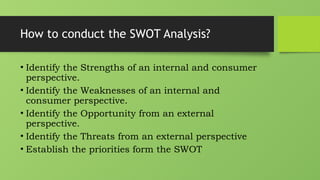
How to conduct the SWOT Analysis?
• Identify the Strengths of an internal and consumer
perspective.
• Identify the Weaknesses of an internal and
consumer perspective.
• Identify the Opportunity from an external
perspective.
• Identify the Threats from an external perspective
• Establish the priorities form the SWOT
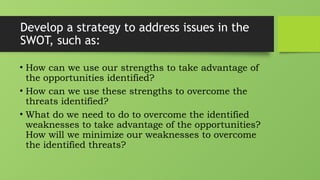
Develop a strategy to address issues in the
SWOT, such as:
• How can we use our strengths to take advantage of
the opportunities identified?
• How can we use these strengths to overcome the
threats identified?
• What do we need to do to overcome the identified
weaknesses to take advantage of the opportunities?
How will we minimize our weaknesses to overcome
the identified threats?
TOWS Matrix
•is a way of taking a SWOT Analysis
further, to provide actionable links
between the different parts of your
business and environment.
TOWS Matrix - It's all about the four key
factors, as follows:
• Strengths/opportunities (SO): how will you use your
strengths to capitalize on your opportunities?
• Weaknesses/opportunities (WO): which weaknesses do you
need to overcome to exploit your opportunities? How will you
overcome these weaknesses?
• Strengths/threats (ST): how will you use your strengths to
overcome external threats?
• Weaknesses/threats (WT): which weaknesses are especially
vulnerable to threats and need attention?
PESTLE/PESTEL
• The acronym stands for Political, Economic, Social,
Technology, Environment, and Legal
• PESTLE/ PESTEL reveals opportunities and threats
better than SWOT, the direction of business change,
projects that will fail beyond your control, and
country, region, and market issues through helping
you create an objective view. The following should be
taken into consideration in the conduct of PESTLE
Analysis
Political factors
• Is there any expected Elections on State and National
Level and how it shifts government policies?
• Who are the upcoming contenders for power? What
is their plan for Business policy and regulation?
• What is the current and impending legislative
changes?
• What are the other political factors and when they might
change?
Economic Factors
• What is the current disposable income of customer and how it can
change it the upcoming years?
• Currently, the economy is stable or not. It is a growing economy,
declining and a stagnating economy
• Whether the exchange rate is stable or not. What is the tendency of
fluctuation?
• What are the prevailing criteria of credit availability, how the credit
criteria affect the business?
• What the prevailing unemployment rate? Will it be easy to hire the
desired staff required?
• You can consider many other factors according to the environment.
Social Factors
• Do you know about the overall population, there is a growth or
contraction in the population you are operating?
• Know about social attitudes that might affect your business. Are there
any noticeable socio-cultural changes in the environment?
• What is the level of education and health in the society you are operating
in? Are there any changes in these external environment factors, and
how it affects you?
• What are the religious beliefs and how it affects your business
environment?
• What is the trend in overall society habits about saving, investments, and
spending?
• Do you know any other social factors that might affect your business?
Technological Factors
• Are there any innovative technologies your business could
use?
• If you access new technology, how it benefits you by
redefining your product or cut costs, etc.?
• How changing technology affect your customer base?
• What technologies your competitor is using that positively
affect their products and services?
• What other technological factors should you consider?
Porter's Five Forces
• This tool helps you understand where your business power
lies in present competitiveness and future positioning
strength. It forces you to analyze suppliers and customers'
bargaining power, the threats to new entrants and
substitutes, and competitive rivalry in your marketplace.
Using this tool helps you understand the balance of power
and to identify areas of potential profitability. According to
Porter, this model should be used at the line of business
level.
How do the 5 Forces work?
•Competitive rivalry
•The threat of substitute products
•Bargaining power of buyers
•The threat of new entrants
•Bargaining power of suppliers
Competitive rivalry
These are things to consider:
• What's the level of competition in your
company's sector?
• Who are your large, direct competitors? What
advantages do they leverage over you?
• Who are your smaller, independent competitors?
What do they do to stay competitive?
The threat of substitute products
The following are the things to be considered:
• How easy is it to find an alternative to your
products or services?
• What aspects of your products/services can your
customers do manually?
• How do cheaper substitutes measure up against
your company for ROI?
Bargaining power of buyers
The following needs to be considered:
• How powerful are your buyers?
• How many are there? What different kinds of buyers do
you interact with?
• Can the buyers get costs down?
• Do they have the power to dictate terms?
The threat of new entrants
• What's the threat of new businesses starting in this
sector?
• How easy is it to start up in this business?
• What are the rules and regulations?
• What finance would a start-up need?
• Are there barriers to entry that give you greater
power?
Bargaining power of suppliers
•How many suppliers are in the market?
•Are there many options (which can lower
prices) or just a few (which can raise them)?
•How easy is it to switch, what's the cost?
•How would changing suppliers affect your
products/services?

BUSINESS PRINCIPLES, TOOLS, AND TECHNIQUES APPLICATION.pptx

  • 1.
    BUSINESS PRINCIPLES, TOOLS, ANDTECHNIQUES APPLICATION APPLIED ECONOMICS 11
  • 2.
    Applying business principles,tools, and techniques in participating in various types of industries in the locality • Some of the more common analysis tools and techniques include: • SWOT Analysis is a simple and practical framework for identifying strengths, weaknesses, opportunities, and threats that a company faces. It is essential to leverage strengths, minimize threats, and to take advantage of available opportunities. Conducting a SWOT analysis is useful for strategic planning and for determining the objectives of a company.
  • 3.
    How to conductthe SWOT Analysis? • Identify the Strengths of an internal and consumer perspective. • Identify the Weaknesses of an internal and consumer perspective. • Identify the Opportunity from an external perspective. • Identify the Threats from an external perspective • Establish the priorities form the SWOT
  • 4.
    Develop a strategyto address issues in the SWOT, such as: • How can we use our strengths to take advantage of the opportunities identified? • How can we use these strengths to overcome the threats identified? • What do we need to do to overcome the identified weaknesses to take advantage of the opportunities? How will we minimize our weaknesses to overcome the identified threats?
  • 5.
    TOWS Matrix •is away of taking a SWOT Analysis further, to provide actionable links between the different parts of your business and environment.
  • 6.
    TOWS Matrix -It's all about the four key factors, as follows: • Strengths/opportunities (SO): how will you use your strengths to capitalize on your opportunities? • Weaknesses/opportunities (WO): which weaknesses do you need to overcome to exploit your opportunities? How will you overcome these weaknesses? • Strengths/threats (ST): how will you use your strengths to overcome external threats? • Weaknesses/threats (WT): which weaknesses are especially vulnerable to threats and need attention?
  • 7.
    PESTLE/PESTEL • The acronymstands for Political, Economic, Social, Technology, Environment, and Legal • PESTLE/ PESTEL reveals opportunities and threats better than SWOT, the direction of business change, projects that will fail beyond your control, and country, region, and market issues through helping you create an objective view. The following should be taken into consideration in the conduct of PESTLE Analysis
  • 8.
    Political factors • Isthere any expected Elections on State and National Level and how it shifts government policies? • Who are the upcoming contenders for power? What is their plan for Business policy and regulation? • What is the current and impending legislative changes? • What are the other political factors and when they might change?
  • 9.
    Economic Factors • Whatis the current disposable income of customer and how it can change it the upcoming years? • Currently, the economy is stable or not. It is a growing economy, declining and a stagnating economy • Whether the exchange rate is stable or not. What is the tendency of fluctuation? • What are the prevailing criteria of credit availability, how the credit criteria affect the business? • What the prevailing unemployment rate? Will it be easy to hire the desired staff required? • You can consider many other factors according to the environment.
  • 10.
    Social Factors • Doyou know about the overall population, there is a growth or contraction in the population you are operating? • Know about social attitudes that might affect your business. Are there any noticeable socio-cultural changes in the environment? • What is the level of education and health in the society you are operating in? Are there any changes in these external environment factors, and how it affects you? • What are the religious beliefs and how it affects your business environment? • What is the trend in overall society habits about saving, investments, and spending? • Do you know any other social factors that might affect your business?
  • 11.
    Technological Factors • Arethere any innovative technologies your business could use? • If you access new technology, how it benefits you by redefining your product or cut costs, etc.? • How changing technology affect your customer base? • What technologies your competitor is using that positively affect their products and services? • What other technological factors should you consider?
  • 12.
    Porter's Five Forces •This tool helps you understand where your business power lies in present competitiveness and future positioning strength. It forces you to analyze suppliers and customers' bargaining power, the threats to new entrants and substitutes, and competitive rivalry in your marketplace. Using this tool helps you understand the balance of power and to identify areas of potential profitability. According to Porter, this model should be used at the line of business level.
  • 13.
    How do the5 Forces work? •Competitive rivalry •The threat of substitute products •Bargaining power of buyers •The threat of new entrants •Bargaining power of suppliers
  • 14.
    Competitive rivalry These arethings to consider: • What's the level of competition in your company's sector? • Who are your large, direct competitors? What advantages do they leverage over you? • Who are your smaller, independent competitors? What do they do to stay competitive?
  • 15.
    The threat ofsubstitute products The following are the things to be considered: • How easy is it to find an alternative to your products or services? • What aspects of your products/services can your customers do manually? • How do cheaper substitutes measure up against your company for ROI?
  • 16.
    Bargaining power ofbuyers The following needs to be considered: • How powerful are your buyers? • How many are there? What different kinds of buyers do you interact with? • Can the buyers get costs down? • Do they have the power to dictate terms?
  • 17.
    The threat ofnew entrants • What's the threat of new businesses starting in this sector? • How easy is it to start up in this business? • What are the rules and regulations? • What finance would a start-up need? • Are there barriers to entry that give you greater power?
  • 18.
    Bargaining power ofsuppliers •How many suppliers are in the market? •Are there many options (which can lower prices) or just a few (which can raise them)? •How easy is it to switch, what's the cost? •How would changing suppliers affect your products/services?

Editor's Notes

  • #14 The first aspect of analyzing is the amount of competition your company faces. Think both on a macro and micro scale about the number of direct competitors you have in your industry and the products/services they offer compared to yours. Markets with few competitors are attractive but can be short-lived. On the other hand, highly competitive markets with many companies chasing the same work reduce your power and push you to lower your prices and innovate new products.
  • #15 This refers to the possibility that customers will find a different (read: quicker and easier) way of doing what your company does. You may have initially conceived products or services that help customers, but as technology changes over time, so do customers' desires and problems. Always examine how your customer's lives have changed as your company has grown. For example, you may sell a software piece that automates a process or synchronizes activity into one platform. As user behavior changes, you can find opportunities to update your product or even grow a new service offering.
  • #16 Ask yourself how much power your buyers have over you. If you're selling a product, their power is likely contained to order amounts or customization needs. However, if you're offering a service, customers are more open to negotiation. Remember that customers are incredibly price-savvy and may already have experience in dealing with your competitors. Determining your relationship with buyer power is all about how flexible you can be on service while maintaining an authoritative position in your market.
  • #17 Industries that are tightly regulated and require large capital investments mean that companies who make it can gain a serious foothold in a market. Alternatively, markets that you can get set up quickly and with little financial risk mean you can start building customers faster. However, there may be a proliferation of copycat companies and similar products. The threat of new entry is based on how secure your company is from being surrounded by competitors. Let's say you've discovered a way to cut costs in the IT industry - you need to protect your company from imitators and rival companies who can drive down your prices. The following needs to be considered:
  • #18 When it comes to brass tax, you need to focus as much on your costs as you do on your revenue. Assess the suppliers you rely on and the potential power over the products/services you provide. The greater the number of suppliers available to you, the easier it is to switch to a cheaper alternative. If there are few suppliers you can work with, such as when you sell products made with highly-specific materials, the greater the control they have over your company. A rise in their prices has an immediate effect on your bottom line. The following needs to be considered: