
INSTITUTE OF MANAGEMENT STUDIES
DAVV
3RD INTERNAL ASSESSMENT
STRATEGIC MANAGEMENT
SUBMITTED BY:
SUBMITTED TO:
ADITI HARDIYA PROF. RAUNAK
JAIN
SHUBHAM DWIVEDI faculty IMS,
DAVV
WHAT IS SWOT ANALYSIS?
SWOT (strengths, weaknesses, opportunities, and threats) analysis is a framework used to
evaluate a company's competitive position and to develop strategic planning. SWOT analysis
assesses internal and external factors, as well as current and future potential.
A SWOT analysis is designed to facilitate a realistic, fact-based, data-driven look at the
strengths and weaknesses of an organization, its initiatives, or an industry. The organization
needs to keep the analysis accurate by avoiding pre-conceived beliefs or gray areas and
instead focusing on real-life contexts. Companies should use it as a guide and not necessarily
as a prescription.
Strengths
• What advantages does your organization have?
• What do you do better than anyone else?
• What unique or lowest-cost resources can you draw upon that others can't?
• What do people in your market see as your strengths?
• What factors mean that you "get the sale"?
• What is your organization's Unique Selling Proposition (USP)?
• Consider your strengths from both an internal perspective, and from the point of view of your customers
and people in your market.
Also, if you're having any difficulty identifying strengths, try writing down a list of your organization's
characteristics. Some of these will hopefully be strengths!
When looking at your strengths, think about them in relation to your competitors. For example, if all of your
competitors provide high quality products, then a high quality production process is not a strength in your
organization's market, it's a necessity.
Weaknesses
•What could you improve?
•What should you avoid?
•What are people in your market likely to see as weaknesses?
•What factors lose you sales?
Again, consider this from an internal and external perspective: do other people seem to perceive
weaknesses that you don't see? Are your competitors doing any better than you?
It's best to be realistic now, and face any unpleasant truths as soon as possible
Opportunities
•What good opportunities can you spot?
•What interesting trends are you aware of?
Useful opportunities can come from such things as:
•Changes in technology and markets on both a broad and narrow scale.
•Changes in government policy related to your field.
•Changes in social patterns, population profiles, lifestyle changes, and so on.
•Local events.
Threats
•What obstacles do you face?
•What are your competitors doing?
•Are quality standards or specifications for your job, products or services
changing?
•Is changing technology threatening your position?
•Do you have bad debt or cash-flow problems?
•Could any of your weaknesses seriously threaten your business?
WHAT IS ENVIRONMENTAL ANALYSIS?
Environmental analysis is a strategic tool. It is a process to identify all the external and internal
elements, which can affect the organization’s performance. The analysis entails assessing the level of
threat or opportunity the factors might present. These evaluations are later translated into the decision-
making process. The analysis helps align strategies with the firm’s environment.
Our market is facing changes every day. Many new things develop over time and the whole scenario
can alter in only a few seconds. There are some factors that are beyond your control. But, you can
control a lot of these things.
The most used detailed analysis of the environment is the PESTLE analysis.
PESTLE ANALYSIS
PESTLE analysis consists of various factors that affect the business environment. Each letter in the
acronym signifies a set of factors. These factors can affect every industry directly or indirectly.
The letters in PESTLE, also called PESTEL, denote the following things:
• Political factors
• Economic factors
• Social factors
• Technological factors
• Legal factors
• Environmental factor
P for Political factors
The political factors take the country’s current political situation. It also reads the global political
condition’s effect on the country and business. When conducting this step, ask questions like
“What kind of government leadership is impacting decisions of the firm?”
Some political factors that you can study are:
•Government policies
•Taxes laws and tariff
•Stability of government
•Entry mode regulations
E for Economic factors
Economic factors involve all the determinants of the economy and its state. These are factors that
can conclude the direction in which the economy might move. So, businesses analyze this factor
based on the environment. It helps to set up strategies in line with changes.
I have listed some determinants you can assess to know how economic factors are affecting your
business below:
•The inflation rate
•The interest rate
•Disposable income of buyers
•Credit accessibility
•Unemployment rates
•The monetary or fiscal policies
•The foreign exchange rate
S for Social factors
Countries vary from each other. Every country has a distinctive mindset. These attitudes have an
impact on the businesses. The social factors might ultimately affect the sales of products and
services.
Some of the social factors you should study are:
•The cultural implications
•The gender and connected demographics
•The social lifestyles
•The domestic structures
•Educational levels
•Distribution of Wealth
T for Technological factors
Technology is advancing continuously. The advancement is greatly influencing businesses.
Performing environmental analysis on these factors will help you stay up to date with the changes.
Technology alters every minute. This is why companies must stay connected all the time. Firms
should integrate when needed. Technological factors will help you know how the consumers react to
various trends.
Firms can use these factors for their benefit:
•New discoveries
•Rate of technological obsolescence
•Rate of technological advances
•Innovative technological platforms
L for Legal factors
Legislative changes take place from time to time. Many of these changes affect the business
environment. If a regulatory body sets up a regulation for industries, for example, that law
would impact industries and business in that economy. So, businesses should also analyze
the legal developments in respective environments.
I have mentioned some legal factors you need to be aware of:
•Product regulations
•Employment regulations
•Competitive regulations
•Patent infringements
•Health and safety regulations
E for Environmental factors
The location influences business trades. Changes in climatic changes can affect the trade. The
consumer reactions to particular offering can also be an issue. This most often affects agri-
businesses.
Some environmental factors you can study are:
•Geographical location
•The climate and weather
•Waste disposal laws
•Energy consumption regulation
•People’s attitude towards the environment
There are many external factors other than the ones mentioned above. None of these factors are
independent. They rely on each other.
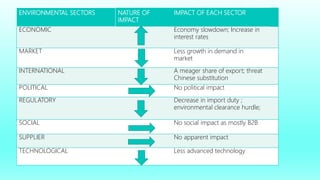
ETOP ANALYSIS
ENVIRONMENTAL THREAT AND OPPORTUNITY PROFILE- It is a technique to structure the
environment for fundamental business analysis. It was developed by glueck.
The preparation of ETOP involves dividing the environment into different sectors and the analyzing
the impact of each sector on the organization. A comprehensive ETOP requires sub dividing each
environmental sector into sub sectors and then the impact of each sector is described in the form of
a statement. A summary of ETOP may only show the major factors for the sake of simplicity.
ENVIRONMENTAL SECTORS NATURE OF
IMPACT
IMPACT OF EACH SECTOR
ECONOMIC Economy slowdown; Increase in
interest rates
MARKET Less growth in demand in
market
INTERNATIONAL A meager share of export; threat
Chinese substitution
POLITICAL No political impact
REGULATORY Decrease in import duty ;
environmental clearance hurdle;
SOCIAL No social impact as mostly B2B
SUPPLIER No apparent impact
TECHNOLOGICAL Less advanced technology
INTERNAL STRENGHT AND WEAKNESSES
Internal analysis is the methodical evaluation of the key internal features of an organization. Internal
Analysis recognises and assesses resources, capabilities, and core competencies. Internal analysis has
four elements such as the organization's Current vision, Mission, Strategic objectives and Strategies.
Internal Analysis is performed because it is the only way to identify an organization's strengths and
weaknesses it's needed for making good strategic decisions. In order to start the strategic
management process, managers are required to conduct an internal analysis. This involves
ascertaining the business' strengths and weaknesses, by analysing its competencies.
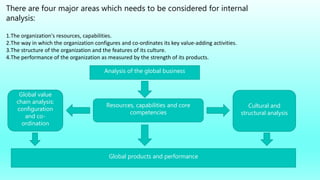
There are four major areas which needs to be considered for internal
analysis:
1.The organization's resources, capabilities.
2.The way in which the organization configures and co-ordinates its key value-adding activities.
3.The structure of the organization and the features of its culture.
4.The performance of the organization as measured by the strength of its products.
Analysis of the global business
Resources, capabilities and core
competencies
Global value
chain analysis:
configuration
and co-
ordination
Cultural and
structural analysis
Global products and performance
STRATEGIC ADVANTAGE PROFILE
(SAP) ANALYSIS
 every firm has strategic advantage and disadvantages.
 For e.g.. Large firms have financial strength but they tend to move slowly, compared to smaller
firms, And often cannot react to change quickly.
 No firm is equally string in all its functions. In other words, every firm has strength as well as
weaknesses.
 The strategist should look to see if the firm is strong in these factors than its competitors.
 When firm is strong in the market, it has a strategic advantage in launching new products or
services and increasing market products or services and increasing market share of present
products and services.
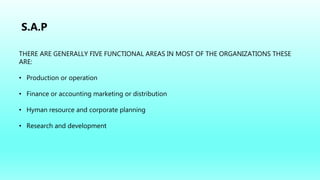
S.A.P
THERE ARE GENERALLY FIVE FUNCTIONAL AREAS IN MOST OF THE ORGANIZATIONS THESE
ARE:
• Production or operation
• Finance or accounting marketing or distribution
• Hyman resource and corporate planning
• Research and development
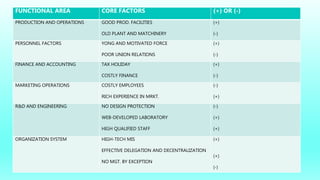
FUNCTIONAL AREA CORE FACTORS (+) OR (-)
PRODUCTION AND OPERATIONS GOOD PROD. FACILITIES
OLD PLANT AND MATCHINERY
(+)
(-)
PERSONNEL FACTORS YONG AND MOTIVATED FORCE
POOR UNION RELATIONS
(+)
(-)
FINANCE AND ACCOUNTING TAX HOLIDAY
COSTLY FINANCE
(+)
(-)
MARKETING OPERATIONS COSTLY EMPLOYEES
RICH EXPERIENCE IN MRKT.
(-)
(+)
R&D AND ENGINEERING NO DESIGN PROTECTION
WEB-DEVELOPED LABORATORY
HIGH QUALIFIED STAFF
(-)
(+)
(+)
ORGANIZATION SYSTEM HIGH-TECH MIS
EFFECTIVE DELEGATION AND DECENTRALIZATION
NO MGT. BY EXCEPTION
(+)
(+)
(-)
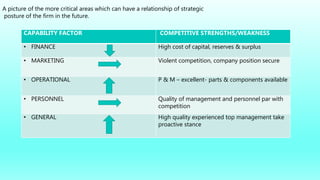
A picture of the more critical areas which can have a relationship of strategic
posture of the firm in the future.
CAPABILITY FACTOR COMPETITIVE STRENGTHS/WEAKNESS
• FINANCE High cost of capital, reserves & surplus
• MARKETING Violent competition, company position secure
• OPERATIONAL P & M – excellent- parts & components available
• PERSONNEL Quality of management and personnel par with
competition
• GENERAL High quality experienced top management take
proactive stance
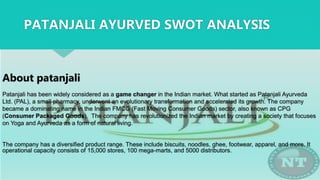
About patanjali
Patanjali has been widely considered as a game changer in the Indian market. What started as Patanjali Ayurveda
Ltd. (PAL), a small pharmacy, underwent an evolutionary transformation and accelerated its growth. The company
became a dominating name in the Indian FMCG (Fast Moving Consumer Goods) sector, also known as CPG
(Consumer Packaged Goods). The company has revolutionized the Indian market by creating a society that focuses
on Yoga and Ayurveda as a form of natural living.
The company has a diversified product range. These include biscuits, noodles, ghee, footwear, apparel, and more. It
operational capacity consists of 15,000 stores, 100 mega-marts, and 5000 distributors.
PATANJALI AYURVED SWOT ANALYSIS
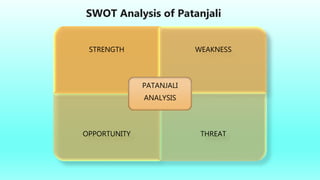
SWOT Analysis of Patanjali
STRENGTH WEAKNESS
OPPORTUNITY THREAT
PATANJALI
ANALYSIS
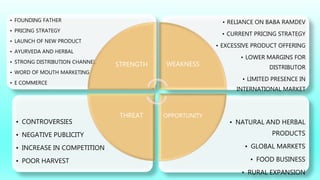
• NATURAL AND HERBAL
PRODUCTS
• GLOBAL MARKETS
• FOOD BUSINESS
• RURAL EXPANSION
• CONTROVERSIES
• NEGATIVE PUBLICITY
• INCREASE IN COMPETITION
• POOR HARVEST
• RELIANCE ON BABA RAMDEV
• CURRENT PRICING STRATEGY
• EXCESSIVE PRODUCT OFFERING
• LOWER MARGINS FOR
DISTRIBUTOR
• LIMITED PRESENCE IN
INTERNATIONAL MARKET
• FOUNDING FATHER
• PRICING STRATEGY
• LAUNCH OF NEW PRODUCT
• AYURVEDA AND HERBAL
• STRONG DISTRIBUTION CHANNEL
• WORD OF MOUTH MARKETING
• E COMMERCE
STRENGTH WEAKNESS
OPPORTUNITYTHREAT
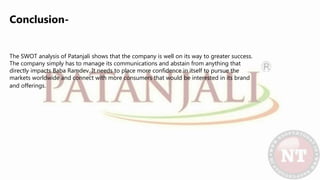
Conclusion-
The SWOT analysis of Patanjali shows that the company is well on its way to greater success.
The company simply has to manage its communications and abstain from anything that
directly impacts Baba Ramdev. It needs to place more confidence in itself to pursue the
markets worldwide and connect with more consumers that would be interested in its brand
and offerings.
strategic management - SWOT analysis

strategic management - SWOT analysis

  • 1.
    INSTITUTE OF MANAGEMENTSTUDIES DAVV 3RD INTERNAL ASSESSMENT STRATEGIC MANAGEMENT SUBMITTED BY: SUBMITTED TO: ADITI HARDIYA PROF. RAUNAK JAIN SHUBHAM DWIVEDI faculty IMS, DAVV
  • 2.
    WHAT IS SWOTANALYSIS? SWOT (strengths, weaknesses, opportunities, and threats) analysis is a framework used to evaluate a company's competitive position and to develop strategic planning. SWOT analysis assesses internal and external factors, as well as current and future potential. A SWOT analysis is designed to facilitate a realistic, fact-based, data-driven look at the strengths and weaknesses of an organization, its initiatives, or an industry. The organization needs to keep the analysis accurate by avoiding pre-conceived beliefs or gray areas and instead focusing on real-life contexts. Companies should use it as a guide and not necessarily as a prescription.
  • 3.
    Strengths • What advantagesdoes your organization have? • What do you do better than anyone else? • What unique or lowest-cost resources can you draw upon that others can't? • What do people in your market see as your strengths? • What factors mean that you "get the sale"? • What is your organization's Unique Selling Proposition (USP)? • Consider your strengths from both an internal perspective, and from the point of view of your customers and people in your market. Also, if you're having any difficulty identifying strengths, try writing down a list of your organization's characteristics. Some of these will hopefully be strengths! When looking at your strengths, think about them in relation to your competitors. For example, if all of your competitors provide high quality products, then a high quality production process is not a strength in your organization's market, it's a necessity.
  • 4.
    Weaknesses •What could youimprove? •What should you avoid? •What are people in your market likely to see as weaknesses? •What factors lose you sales? Again, consider this from an internal and external perspective: do other people seem to perceive weaknesses that you don't see? Are your competitors doing any better than you? It's best to be realistic now, and face any unpleasant truths as soon as possible
  • 5.
    Opportunities •What good opportunitiescan you spot? •What interesting trends are you aware of? Useful opportunities can come from such things as: •Changes in technology and markets on both a broad and narrow scale. •Changes in government policy related to your field. •Changes in social patterns, population profiles, lifestyle changes, and so on. •Local events.
  • 6.
    Threats •What obstacles doyou face? •What are your competitors doing? •Are quality standards or specifications for your job, products or services changing? •Is changing technology threatening your position? •Do you have bad debt or cash-flow problems? •Could any of your weaknesses seriously threaten your business?
  • 7.
    WHAT IS ENVIRONMENTALANALYSIS? Environmental analysis is a strategic tool. It is a process to identify all the external and internal elements, which can affect the organization’s performance. The analysis entails assessing the level of threat or opportunity the factors might present. These evaluations are later translated into the decision- making process. The analysis helps align strategies with the firm’s environment. Our market is facing changes every day. Many new things develop over time and the whole scenario can alter in only a few seconds. There are some factors that are beyond your control. But, you can control a lot of these things. The most used detailed analysis of the environment is the PESTLE analysis.
  • 8.
    PESTLE ANALYSIS PESTLE analysisconsists of various factors that affect the business environment. Each letter in the acronym signifies a set of factors. These factors can affect every industry directly or indirectly. The letters in PESTLE, also called PESTEL, denote the following things: • Political factors • Economic factors • Social factors • Technological factors • Legal factors • Environmental factor
  • 9.
    P for Politicalfactors The political factors take the country’s current political situation. It also reads the global political condition’s effect on the country and business. When conducting this step, ask questions like “What kind of government leadership is impacting decisions of the firm?” Some political factors that you can study are: •Government policies •Taxes laws and tariff •Stability of government •Entry mode regulations
  • 10.
    E for Economicfactors Economic factors involve all the determinants of the economy and its state. These are factors that can conclude the direction in which the economy might move. So, businesses analyze this factor based on the environment. It helps to set up strategies in line with changes. I have listed some determinants you can assess to know how economic factors are affecting your business below: •The inflation rate •The interest rate •Disposable income of buyers •Credit accessibility •Unemployment rates •The monetary or fiscal policies •The foreign exchange rate
  • 11.
    S for Socialfactors Countries vary from each other. Every country has a distinctive mindset. These attitudes have an impact on the businesses. The social factors might ultimately affect the sales of products and services. Some of the social factors you should study are: •The cultural implications •The gender and connected demographics •The social lifestyles •The domestic structures •Educational levels •Distribution of Wealth
  • 12.
    T for Technologicalfactors Technology is advancing continuously. The advancement is greatly influencing businesses. Performing environmental analysis on these factors will help you stay up to date with the changes. Technology alters every minute. This is why companies must stay connected all the time. Firms should integrate when needed. Technological factors will help you know how the consumers react to various trends. Firms can use these factors for their benefit: •New discoveries •Rate of technological obsolescence •Rate of technological advances •Innovative technological platforms
  • 13.
    L for Legalfactors Legislative changes take place from time to time. Many of these changes affect the business environment. If a regulatory body sets up a regulation for industries, for example, that law would impact industries and business in that economy. So, businesses should also analyze the legal developments in respective environments. I have mentioned some legal factors you need to be aware of: •Product regulations •Employment regulations •Competitive regulations •Patent infringements •Health and safety regulations
  • 14.
    E for Environmentalfactors The location influences business trades. Changes in climatic changes can affect the trade. The consumer reactions to particular offering can also be an issue. This most often affects agri- businesses. Some environmental factors you can study are: •Geographical location •The climate and weather •Waste disposal laws •Energy consumption regulation •People’s attitude towards the environment There are many external factors other than the ones mentioned above. None of these factors are independent. They rely on each other.
  • 15.
    ETOP ANALYSIS ENVIRONMENTAL THREATAND OPPORTUNITY PROFILE- It is a technique to structure the environment for fundamental business analysis. It was developed by glueck. The preparation of ETOP involves dividing the environment into different sectors and the analyzing the impact of each sector on the organization. A comprehensive ETOP requires sub dividing each environmental sector into sub sectors and then the impact of each sector is described in the form of a statement. A summary of ETOP may only show the major factors for the sake of simplicity.
  • 16.
    ENVIRONMENTAL SECTORS NATUREOF IMPACT IMPACT OF EACH SECTOR ECONOMIC Economy slowdown; Increase in interest rates MARKET Less growth in demand in market INTERNATIONAL A meager share of export; threat Chinese substitution POLITICAL No political impact REGULATORY Decrease in import duty ; environmental clearance hurdle; SOCIAL No social impact as mostly B2B SUPPLIER No apparent impact TECHNOLOGICAL Less advanced technology
  • 17.
    INTERNAL STRENGHT ANDWEAKNESSES Internal analysis is the methodical evaluation of the key internal features of an organization. Internal Analysis recognises and assesses resources, capabilities, and core competencies. Internal analysis has four elements such as the organization's Current vision, Mission, Strategic objectives and Strategies. Internal Analysis is performed because it is the only way to identify an organization's strengths and weaknesses it's needed for making good strategic decisions. In order to start the strategic management process, managers are required to conduct an internal analysis. This involves ascertaining the business' strengths and weaknesses, by analysing its competencies.
  • 18.
    There are fourmajor areas which needs to be considered for internal analysis: 1.The organization's resources, capabilities. 2.The way in which the organization configures and co-ordinates its key value-adding activities. 3.The structure of the organization and the features of its culture. 4.The performance of the organization as measured by the strength of its products. Analysis of the global business Resources, capabilities and core competencies Global value chain analysis: configuration and co- ordination Cultural and structural analysis Global products and performance
  • 19.
    STRATEGIC ADVANTAGE PROFILE (SAP)ANALYSIS  every firm has strategic advantage and disadvantages.  For e.g.. Large firms have financial strength but they tend to move slowly, compared to smaller firms, And often cannot react to change quickly.  No firm is equally string in all its functions. In other words, every firm has strength as well as weaknesses.  The strategist should look to see if the firm is strong in these factors than its competitors.  When firm is strong in the market, it has a strategic advantage in launching new products or services and increasing market products or services and increasing market share of present products and services.
  • 20.
    S.A.P THERE ARE GENERALLYFIVE FUNCTIONAL AREAS IN MOST OF THE ORGANIZATIONS THESE ARE: • Production or operation • Finance or accounting marketing or distribution • Hyman resource and corporate planning • Research and development
  • 21.
    FUNCTIONAL AREA COREFACTORS (+) OR (-) PRODUCTION AND OPERATIONS GOOD PROD. FACILITIES OLD PLANT AND MATCHINERY (+) (-) PERSONNEL FACTORS YONG AND MOTIVATED FORCE POOR UNION RELATIONS (+) (-) FINANCE AND ACCOUNTING TAX HOLIDAY COSTLY FINANCE (+) (-) MARKETING OPERATIONS COSTLY EMPLOYEES RICH EXPERIENCE IN MRKT. (-) (+) R&D AND ENGINEERING NO DESIGN PROTECTION WEB-DEVELOPED LABORATORY HIGH QUALIFIED STAFF (-) (+) (+) ORGANIZATION SYSTEM HIGH-TECH MIS EFFECTIVE DELEGATION AND DECENTRALIZATION NO MGT. BY EXCEPTION (+) (+) (-)
  • 22.
    A picture ofthe more critical areas which can have a relationship of strategic posture of the firm in the future. CAPABILITY FACTOR COMPETITIVE STRENGTHS/WEAKNESS • FINANCE High cost of capital, reserves & surplus • MARKETING Violent competition, company position secure • OPERATIONAL P & M – excellent- parts & components available • PERSONNEL Quality of management and personnel par with competition • GENERAL High quality experienced top management take proactive stance
  • 23.
    About patanjali Patanjali hasbeen widely considered as a game changer in the Indian market. What started as Patanjali Ayurveda Ltd. (PAL), a small pharmacy, underwent an evolutionary transformation and accelerated its growth. The company became a dominating name in the Indian FMCG (Fast Moving Consumer Goods) sector, also known as CPG (Consumer Packaged Goods). The company has revolutionized the Indian market by creating a society that focuses on Yoga and Ayurveda as a form of natural living. The company has a diversified product range. These include biscuits, noodles, ghee, footwear, apparel, and more. It operational capacity consists of 15,000 stores, 100 mega-marts, and 5000 distributors. PATANJALI AYURVED SWOT ANALYSIS
  • 24.
    SWOT Analysis ofPatanjali STRENGTH WEAKNESS OPPORTUNITY THREAT PATANJALI ANALYSIS
  • 25.
    • NATURAL ANDHERBAL PRODUCTS • GLOBAL MARKETS • FOOD BUSINESS • RURAL EXPANSION • CONTROVERSIES • NEGATIVE PUBLICITY • INCREASE IN COMPETITION • POOR HARVEST • RELIANCE ON BABA RAMDEV • CURRENT PRICING STRATEGY • EXCESSIVE PRODUCT OFFERING • LOWER MARGINS FOR DISTRIBUTOR • LIMITED PRESENCE IN INTERNATIONAL MARKET • FOUNDING FATHER • PRICING STRATEGY • LAUNCH OF NEW PRODUCT • AYURVEDA AND HERBAL • STRONG DISTRIBUTION CHANNEL • WORD OF MOUTH MARKETING • E COMMERCE STRENGTH WEAKNESS OPPORTUNITYTHREAT
  • 26.
    Conclusion- The SWOT analysisof Patanjali shows that the company is well on its way to greater success. The company simply has to manage its communications and abstain from anything that directly impacts Baba Ramdev. It needs to place more confidence in itself to pursue the markets worldwide and connect with more consumers that would be interested in its brand and offerings.