Project identification 
To identify the projects/solutions for a particular problem based on various factors is termed as project identification. 
There could be number of possible solutions for a single problem , so having idea of that solution or identifying those various solutions is project identification
Project selection 
Project identification 
Project appraisals 
Project selection
Project identification 
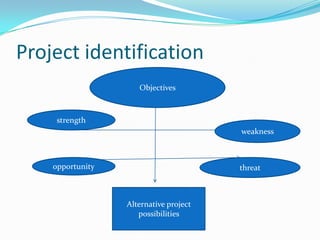
Objectives strength 
opportunity 
weaknessthreat 
Alternative project possibilities
Project selection 
Basically the process of project identification is a process of searching for new ideas. 
How do we search for new ideas? 
Obviously we must first find out what are our objectives 
Are our objectives to make money 
Are we trying to help people in disaster without expecting any monetary returns?
Depending upon what your objectives are your projects would be different and very different. 
Once you have identified your objectives invariably you will have to brainstorm to generate alternative solutions
Search new ideas 
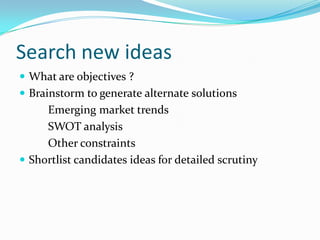
What are objectives ? 
Brainstorm to generate alternate solutions 
Emerging market trends 
SWOT analysis 
Other constraints 
Shortlist candidates ideas for detailed scrutiny
What is the motivation for this 
Projects are means to accomplish 
Individual or family objectives 
Organizational objectives 
National or global objectives 
Project response begins in response to specific need or the objective
Objectives 
To increase profit 
To increase threat to losses 
To become more competitive 
To provide help after disaster 
To train people in new area 
To reduce pollution in delhi
SWOT analysis 
Strength 
Weakness 
Opportunity 
Threats
Strength 
what do you mean by strength of an organization or strength of an individual? 
Typically in the strengths you could cover things like what is your experience and what is your expertise in a particular area? 
What is the financial position? 
How much money you have? 
How much money can you raise and therefore as a company depending on your financial position you can contemplate what sort of projects you can go into.
What’s the amount of money that you can invest? 
What is your capital raising capability? 
What are your industrial contacts
Strengths 
Experience and expertise 
Financial position 
Capital raising capability 
Industrial contacts 
foreign collaboration
Weakness 
The unfamiliarity with new technologies could be a major weakness 
Inability to raise huge investments is also a weakness 
Lack of experience is in fact a very major weakness 
Lack of trained personnel in a particular area is again a weakness. 
Inability to forecast market trends again could be a very big weakness
Weaknesses 
New unfamiliar technologies 
Inability to raise huge investments 
Lack of experience 
Lack of trained personals 
Inability to forecast market trends
Opportunities 
The opportunities could be the emergence of new technologies. 
There are new products coming up. 
Because of better technology new processes may be developed which have better features 
Special financing schemes could be opportunities. 
Government and other incentives
Opportunities 
Emerging new technologies 
New products with new market 
New processes with better features 
Special financing schemes 
Government and other incentives
Threats 
Competitors could be one of the big threats to business 
The poor state of the economy could be a threat because if the buying power of the people is low they cannot buy products 
Outdated technologies are threat. 
Unprofessional management skills could also be a very big threat in today’s competitive world.
Threats 
Competitors 
Poor state of economy 
Outdated technology 
Unprofessional management skills 
New products and services
Where do ideas come from?? 
You could have the marketing and sales people coming up with an idea for a new product 
Top management is generally responsible for giving ideas for new products and also for new projects 
The production department will be sometimes giving you ideas about new products
Marketing and sales department 
Research and development 
Top management 
Production department 
Consumers
Brainstorming 
all the top management or the people concerned get together let us say in a group and then they brainstorm and the information that is provided is the objectives that you want to achieve and the SWOT analysis. 
A brainstorming is a good means to achieve this kind of innovation and to generate new project ideas.
Brain storming 
A good means to generate new product ideas 
Focus on uninhibited participation of group 
Listing of ideas without suppressing creativity at the source 
List of ideas subjected to screening and evaluation subsequently
Screening of the new ideas 
one could think in terms of criteria like what is the cost of the idea? 
What is the risk involved? 
What is the return if I implement this idea and is it a hazardous thing? 
Does it mean a threat to life or property or groups of people
Criteria in screening projects 
Investment 
Rate of return 
Risk 
Profit 
Payback 
Similarity to existing business 
Expected life 
Flexibility 
Environment 
Competition
Screening process

18611 project identification

  • 2.
    Project identification Toidentify the projects/solutions for a particular problem based on various factors is termed as project identification. There could be number of possible solutions for a single problem , so having idea of that solution or identifying those various solutions is project identification
  • 3.
    Project selection Projectidentification Project appraisals Project selection
  • 4.
    Project identification Objectivesstrength opportunity weaknessthreat Alternative project possibilities
  • 5.
    Project selection Basicallythe process of project identification is a process of searching for new ideas. How do we search for new ideas? Obviously we must first find out what are our objectives Are our objectives to make money Are we trying to help people in disaster without expecting any monetary returns?
  • 6.
    Depending upon whatyour objectives are your projects would be different and very different. Once you have identified your objectives invariably you will have to brainstorm to generate alternative solutions
  • 7.
    Search new ideas What are objectives ? Brainstorm to generate alternate solutions Emerging market trends SWOT analysis Other constraints Shortlist candidates ideas for detailed scrutiny
  • 8.
    What is themotivation for this Projects are means to accomplish Individual or family objectives Organizational objectives National or global objectives Project response begins in response to specific need or the objective
  • 9.
    Objectives To increaseprofit To increase threat to losses To become more competitive To provide help after disaster To train people in new area To reduce pollution in delhi
  • 10.
    SWOT analysis Strength Weakness Opportunity Threats
  • 11.
    Strength what doyou mean by strength of an organization or strength of an individual? Typically in the strengths you could cover things like what is your experience and what is your expertise in a particular area? What is the financial position? How much money you have? How much money can you raise and therefore as a company depending on your financial position you can contemplate what sort of projects you can go into.
  • 12.
    What’s the amountof money that you can invest? What is your capital raising capability? What are your industrial contacts
  • 13.
    Strengths Experience andexpertise Financial position Capital raising capability Industrial contacts foreign collaboration
  • 14.
    Weakness The unfamiliaritywith new technologies could be a major weakness Inability to raise huge investments is also a weakness Lack of experience is in fact a very major weakness Lack of trained personnel in a particular area is again a weakness. Inability to forecast market trends again could be a very big weakness
  • 15.
    Weaknesses New unfamiliartechnologies Inability to raise huge investments Lack of experience Lack of trained personals Inability to forecast market trends
  • 16.
    Opportunities The opportunitiescould be the emergence of new technologies. There are new products coming up. Because of better technology new processes may be developed which have better features Special financing schemes could be opportunities. Government and other incentives
  • 17.
    Opportunities Emerging newtechnologies New products with new market New processes with better features Special financing schemes Government and other incentives
  • 18.
    Threats Competitors couldbe one of the big threats to business The poor state of the economy could be a threat because if the buying power of the people is low they cannot buy products Outdated technologies are threat. Unprofessional management skills could also be a very big threat in today’s competitive world.
  • 19.
    Threats Competitors Poorstate of economy Outdated technology Unprofessional management skills New products and services
  • 20.
    Where do ideascome from?? You could have the marketing and sales people coming up with an idea for a new product Top management is generally responsible for giving ideas for new products and also for new projects The production department will be sometimes giving you ideas about new products
  • 21.
    Marketing and salesdepartment Research and development Top management Production department Consumers
  • 22.
    Brainstorming all thetop management or the people concerned get together let us say in a group and then they brainstorm and the information that is provided is the objectives that you want to achieve and the SWOT analysis. A brainstorming is a good means to achieve this kind of innovation and to generate new project ideas.
  • 23.
    Brain storming Agood means to generate new product ideas Focus on uninhibited participation of group Listing of ideas without suppressing creativity at the source List of ideas subjected to screening and evaluation subsequently
  • 24.
    Screening of thenew ideas one could think in terms of criteria like what is the cost of the idea? What is the risk involved? What is the return if I implement this idea and is it a hazardous thing? Does it mean a threat to life or property or groups of people
  • 25.
    Criteria in screeningprojects Investment Rate of return Risk Profit Payback Similarity to existing business Expected life Flexibility Environment Competition
  • 26.