Learning outcomes
• Whatis SWOT analysis?
• Aim of SWOT analysis.
• Who need SWOT analysis?
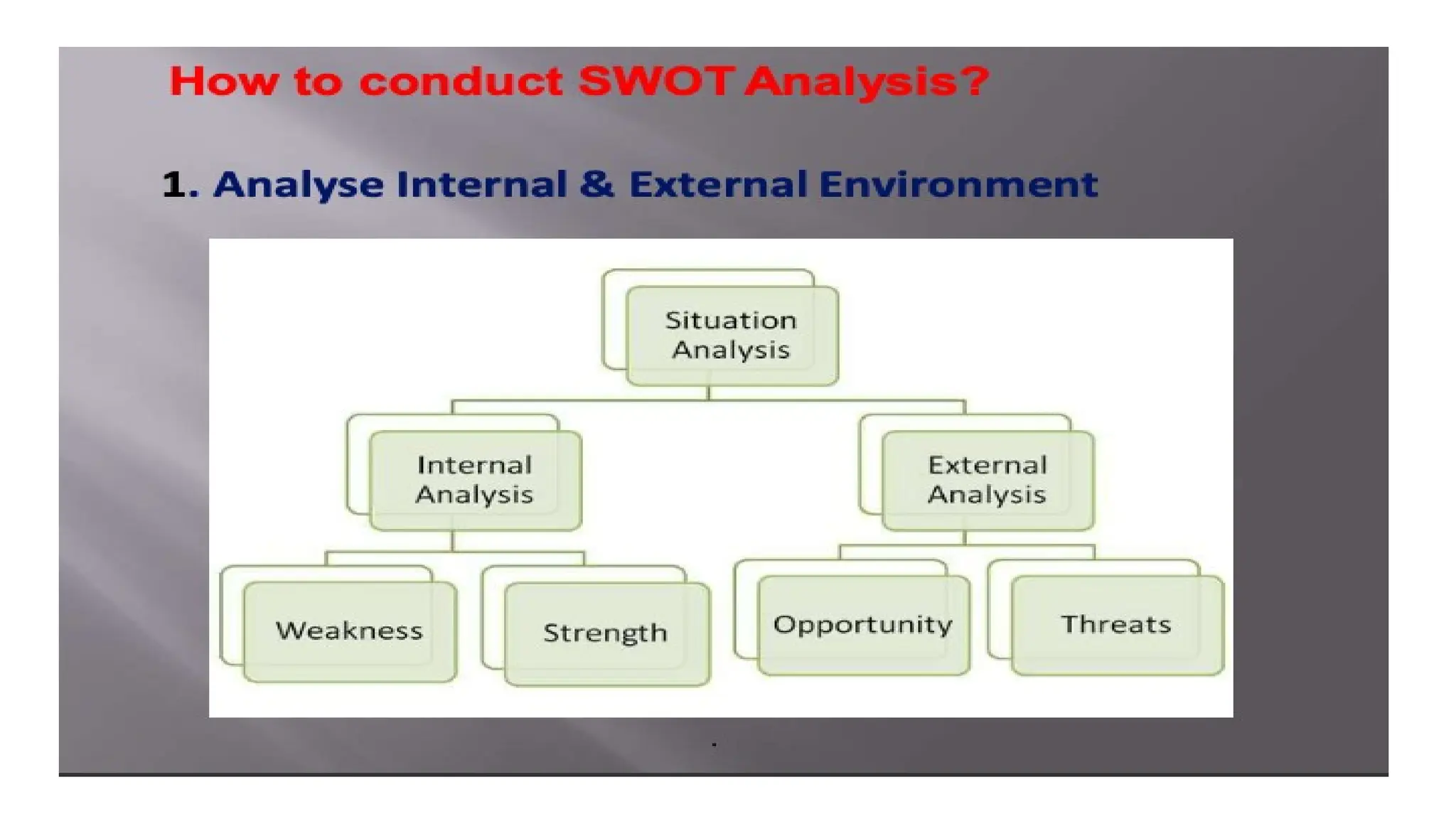
• How to conduct SWOT analysis?
• Pitfalls of SWOT analysis.
• Tips for SWOT analysis.
3.
A techniquethat enables a group or individual to move from
everyday problems and traditional strategies to a fresh
prospective.
SWOT analysis looks at your strengths and weaknesses, and
the opportunities and threats your business faces.
What is SWOT analysis
4.
• Technique iscredited to Albert
Humphrey who led a research project at
Stanford University in the 1960s and
1970s.
• Planning tool used to understand
Strengths, Weaknesses, Opportunities, &
Threats involved in a project / business.
• Used as framework for organizing and
using data and information gained from
situation analysis of internal and
external environment.
5.
• The SWOTAnalysis framework is important and useful tool to
use in marketing Management and other business applications
• As a basic tool its mastery is a fundamental requirement for the
marketer, entrepreneur or business- person.
• A clear understanding of SWOT is required for business majors.
6.
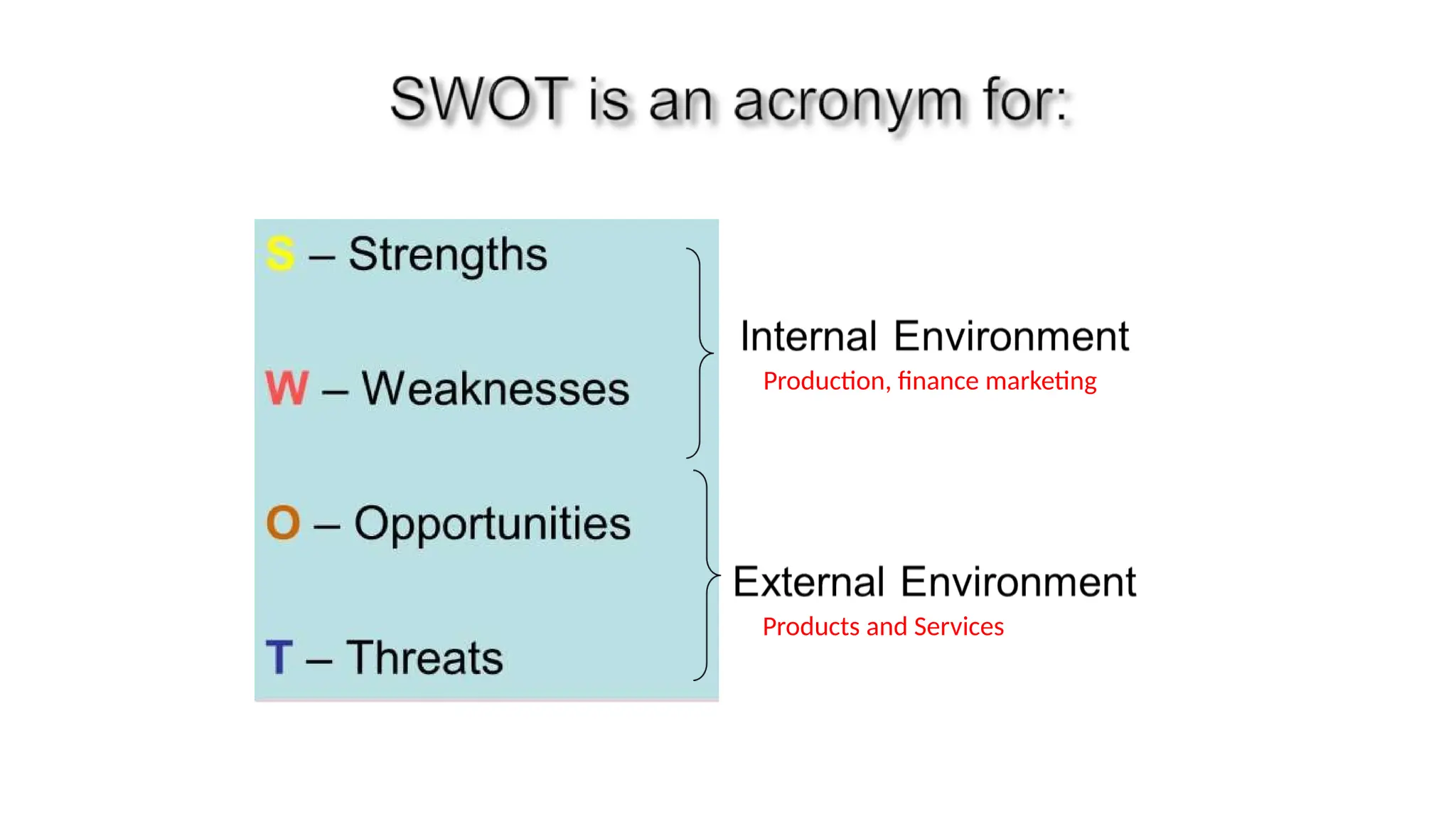
SWOT analysis:
• Carefullyinspecting the business and its environment through the
various dimensions of Strengths, Weaknesses, Opportunities, and
Threats.
• Analysis of external and internal environment together is called
SWOT analysis.
• It refers to identifying the strengths, weaknesses, opportunities and
threats of an organization
Strength
• It isthe basic asset of an organisation that would provide competitive advantage for its
growth and development
Weakness
• It is the liabilty of an organisation that create a state of time and situation specific dis-
advantage for its growth and development
Opportunity
• It is the ability of the organisation to grow and achieve its specific objective in a given
situation
Threat
• It is a situation that blocks the abilities of the organisation to grow and develop for
reaching its ultimate goal.
9.
Strengths
• Characteristics ofthe business or a team that give it an advantage over
others in the industry.
• Positive tangible and intangible attributes, internal to an
organization.
• Beneficial aspects of the organization or the capabilities of an
organization, financial resources, products and services, customer
goodwill and brand loyalty.
10.
• Strengths arethe company’s core competencies, and include
proprietary technology, skills, resources, market position, patents, and
others
• Strengths are within the control of the entrepreneur and they occur
at present
Strengths
11.
Strengths
• technical expertise
•new improvements of product
• good network with customers
• packaging
• managerial experience
• superior technology
• distribution system
• product features (utility, durability,
etc.)
• comparatively cheap price
• Availability of necessary infrastructure
• Adequate production capacity
• Skilled manpower
• Good manufacturing practices, quality
assurance and quality control
• Low cost of manufacture
• Facilities for product and process
development
• Good location
• Wide distribution network
• Motivated staff
• Brand image
• Consistency in earning profits
• Efficient management
12.
WEAKNESSES
Characteristics that placethe firm at
a disadvantage relative to others.
Detract the organization from its ability to attain the
core goal and influence its growth.
Weaknesses are the factors which do not meet the
standards we feel they should meet.
.
13.
Weaknesses
• Weaknesses areconditions within the company that can lead to poor
performance and can include obsolete equipment, no clear strategy,
heavy debt burden, poor product or market image, weak
management and others.
• Weaknesses: Weaknesses are within the control of the entrepreneur;
they occur at present. They are "lack of...", "missing...", or weak
points.
14.
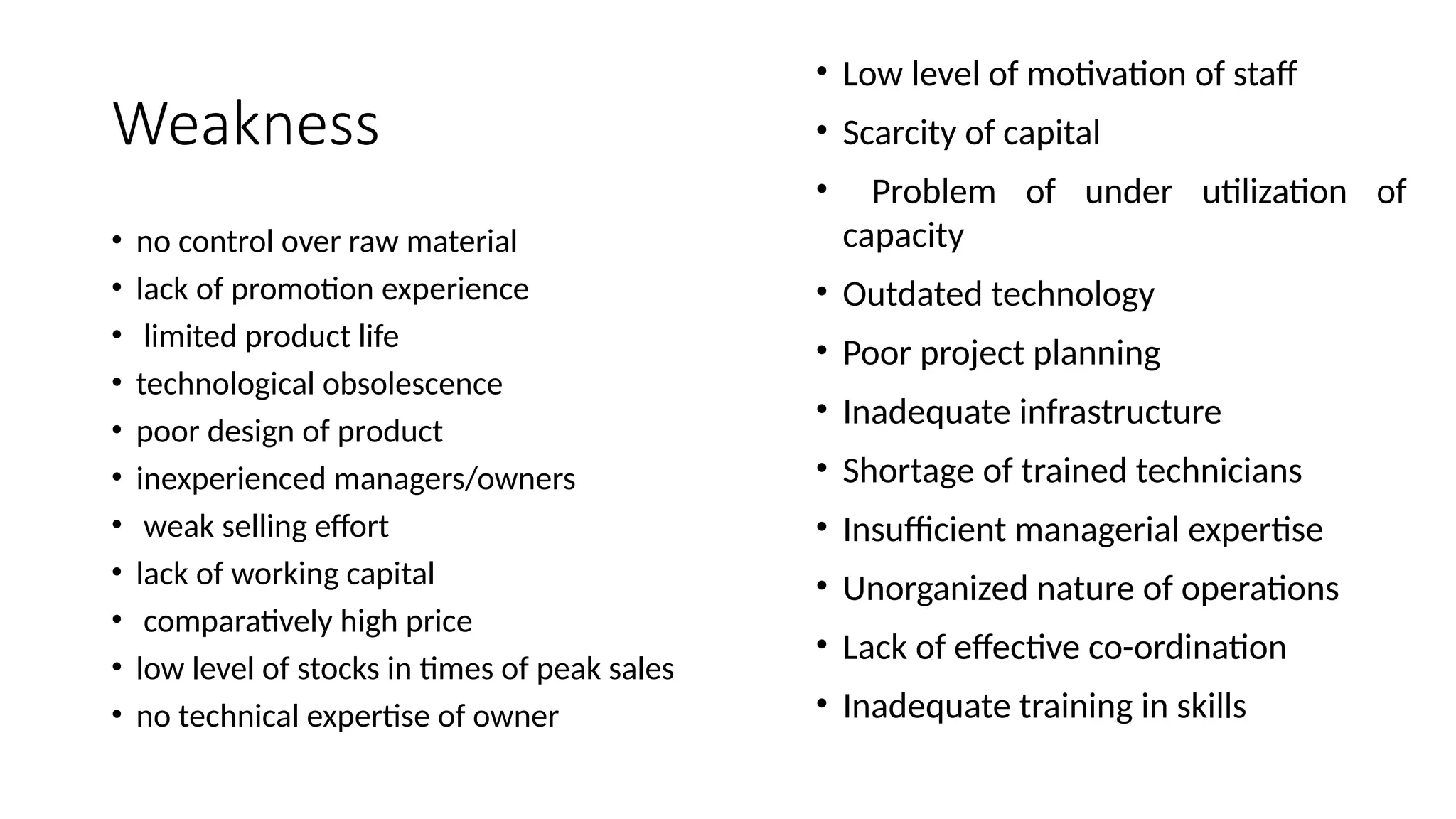
Weakness
• no controlover raw material
• lack of promotion experience
• limited product life
• technological obsolescence
• poor design of product
• inexperienced managers/owners
• weak selling effort
• lack of working capital
• comparatively high price
• low level of stocks in times of peak sales
• no technical expertise of owner
• Low level of motivation of staff
• Scarcity of capital
• Problem of under utilization of
capacity
• Outdated technology
• Poor project planning
• Inadequate infrastructure
• Shortage of trained technicians
• Insufficient managerial expertise
• Unorganized nature of operations
• Lack of effective co-ordination
• Inadequate training in skills
15.
OPPORTUNITIES
Chances to makegreater profits in the
environment
arise when an organization can take benefit of
conditions in its environment to plan and
execute strategies that enable it to become
more profitable.
16.
Opportunities
• Opportunities areoutside conditions or circumstances that the
company could turn to its advantage, and could include a specialty
niche skill or technology that suddenly realizes a growth in broad
market interest.
• Opportunities: Positive or favourable factors in the environment,
mostly beyond the control of the entrepreneur.
17.
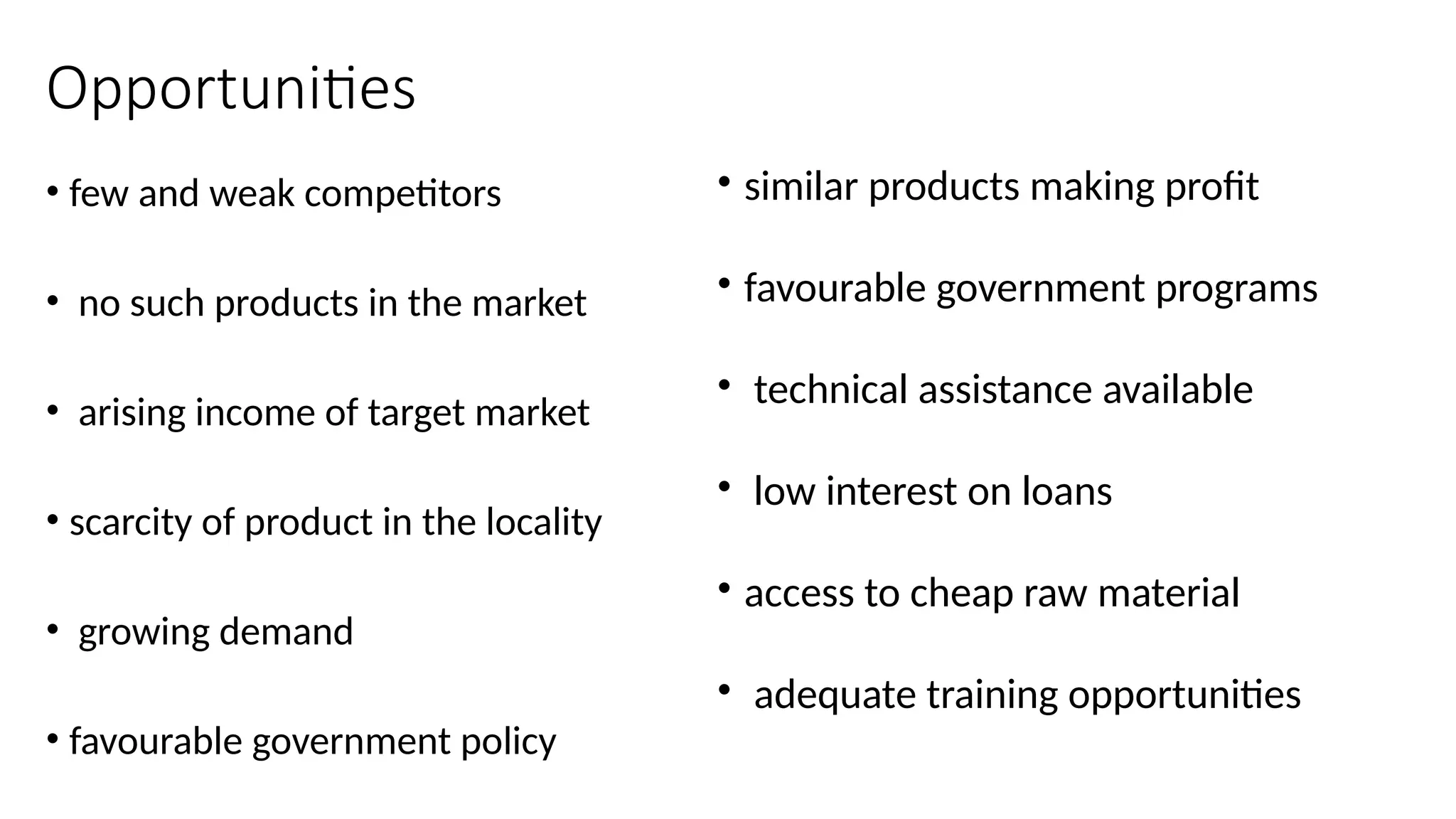
Opportunities
• few andweak competitors
• no such products in the market
• arising income of target market
• scarcity of product in the locality
• growing demand
• favourable government policy
• similar products making profit
• favourable government programs
• technical assistance available
• low interest on loans
• access to cheap raw material
• adequate training opportunities
18.
Threats
External elements inthe environment that could cause
trouble for the business -
Compound the vulnerability when they
relate to the weaknesses.
Threats are uncontrollable. When a
threat comes, the stability and survival
can be at stake.
.
19.
Threats
• are currentor future conditions in the outside environment that may
harm the company, and might include population shifts, changes in
purchasing preferences, new technologies, changes in governmental
or environmental regulations, or an increase in competition.
• Threats: Threats are negative or unfavourable external factors in the
environment and normally beyond the control of the entrepreneur.
20.
Threats
• Rising rawmaterials costs
• too much competition
• government bureaucracy
• restive labour force
• raw materials shortages
• piracy of skilled labour
• natural disasters
• insufficient power
• graft and corruption
• poor infrastructure
• changing government regulations
• smuggling
• Shortage of power, water, fuel
• Rejection by the market
• Tough competition
• Political instability
• policy resulting into increased taxes,
duties, imports reservations, licensing
• Resource crunch
• Difficulty in retaining technical experts
• Climatic changes
• Changing customer tastes and
preferences
21.
Aim of SWOTanalysis
• To help decision makers share and compare ideas.
• To bring a clearer common purpose and understanding of factors for success.
• To organize the important factors linked to success and failure in the business
world To provide linearity to the decision- making process allowing complex
ideas to be presented systematically.
• Things thatMUST be addressed immediately
• Things that can be handled now
• Things that should be researched further
• Things that should be planned for the future
3. Prepare Action Plan
• Once the SWOT analysis has been completed,
mark each point with:
27.
Pitfalls of SWOTAnalysis
• Can be very subjective. Two people rarely come up with the same final version of a SWOT.
• Use it as a guide and not as a prescription.
• May cause organizations to view circumstances as very simple due to which certain key strategic contact may
be overlooked.
• Categorizing aspects as strengths, weaknesses, opportunities & threats might be very subjective as there is
great degree of uncertainty in market.
• To be effective, SWOT needs to be conducted regularly. The pace of change makes it difficult to anticipate
developments.
• The data used in the analysis may be based on assumptions that subsequently prove to be unfounded [good &
bad].
• It lacks detailed structure, so key elements may get missed.
.
28.
Tips
•Do’s
Be analytical andspecific.
Record all thoughts and ideas.
Be selective in the final evaluation.
Choose the right people for the
exercise.
Choose a suitable SWOT leader or
facilitator.
Think out of the box
Be open to change
х Try to disguise weaknesses.
х Merely list errors and mistakes.
х Lose sight of external influences
and trends.
х Allow the SWOT to become a
blame- laying exercise.
х Ignore the outcomes at later
stages of the planning process.
• Dont’s










![Pitfalls of SWOT Analysis
• Can be very subjective. Two people rarely come up with the same final version of a SWOT.
• Use it as a guide and not as a prescription.
• May cause organizations to view circumstances as very simple due to which certain key strategic contact may
be overlooked.
• Categorizing aspects as strengths, weaknesses, opportunities & threats might be very subjective as there is
great degree of uncertainty in market.
• To be effective, SWOT needs to be conducted regularly. The pace of change makes it difficult to anticipate
developments.
• The data used in the analysis may be based on assumptions that subsequently prove to be unfounded [good &
bad].
• It lacks detailed structure, so key elements may get missed.
.](https://image.slidesharecdn.com/4lecture4swotanalysis-250214135618-0fabfd42/75/Ghyyjyyyyggggggyyyyyyyyyyyyyyyyyyyyyyyyyyyy-27-2048.jpg)