Project Costs
Management
Sections of this presentation were adapted from A Guide to
the Project Management Body of Knowledge 6th Edition,
Dr. M.K. Mlela
Cost Management Overview
•Key Concepts & Terms
•Plan Cost Management
•Estimate Costs
•Determine Budget
•Control Costs
Key Concepts & Terms
•Project Cost Management
•Project Cost Management Processes
•Key Terms
•Trends & Emerging Practices
•Tailoring Considerations
•Considerations for Adaptive Environment
Project Cost Management
Project cost management is the processes
involved in planning, estimating, budgeting,
financing, funding, managing, and controlling
costs so that the project can be completed
within the approved budget.
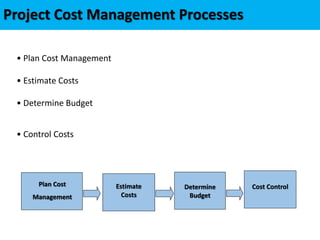
Project Cost Management Processes
• Plan Cost Management
• Estimate Costs
• Determine Budget
• Control Costs
Estimate
Costs
Determine
Budget
Cost Control
Plan Cost
Management
Key Terms
• Earned value management (EVM): a project
management technique for measuring project
performance and progress based on the
comparison of work performed and work planned.
• Life cycle costing: the concept of looking at cost
over the entire life of the product, not just the cost of
the project to create the product.
• Value analysis (value engineering): the concept
that focuses on finding a less costly way to do the
same work.
• Cost risk: cost-related risks.
Key Terms (continued)
• Types of costs:
o Variable costs: costs that change with the amount of
work.
o Fixed costs: costs that do not change with the amount
of work.
o Direct costs: costs directly attributable to the work on
the project
o Indirect costs: overhead items or costs incurred for
the benefit of more than one projects.
Key Terms (continued)
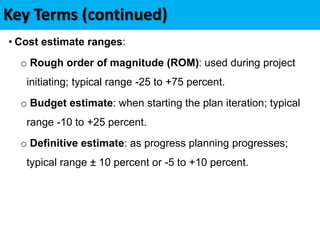
• Cost estimate ranges:
o Rough order of magnitude (ROM): used during project
initiating; typical range -25 to +75 percent.
o Budget estimate: when starting the plan iteration; typical
range -10 to +25 percent.
o Definitive estimate: as progress planning progresses;
typical range ± 10 percent or -5 to +10 percent.
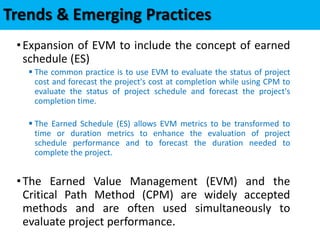
Trends & Emerging Practices
•Expansion of EVM to include the concept of earned
schedule (ES)
 The common practice is to use EVM to evaluate the status of project
cost and forecast the project's cost at completion while using CPM to
evaluate the status of project schedule and forecast the project's
completion time.
 The Earned Schedule (ES) allows EVM metrics to be transformed to
time or duration metrics to enhance the evaluation of project
schedule performance and to forecast the duration needed to
complete the project.
•The Earned Value Management (EVM) and the
Critical Path Method (CPM) are widely accepted
methods and are often used simultaneously to
evaluate project performance.
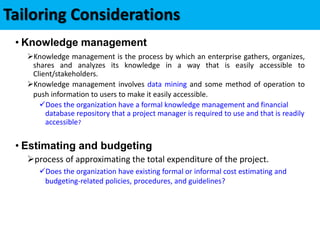
Tailoring Considerations
• Knowledge management
Knowledge management is the process by which an enterprise gathers, organizes,
shares and analyzes its knowledge in a way that is easily accessible to
Client/stakeholders.
Knowledge management involves data mining and some method of operation to
push information to users to make it easily accessible.
Does the organization have a formal knowledge management and financial
database repository that a project manager is required to use and that is readily
accessible?
• Estimating and budgeting
process of approximating the total expenditure of the project.
Does the organization have existing formal or informal cost estimating and
budgeting-related policies, procedures, and guidelines?
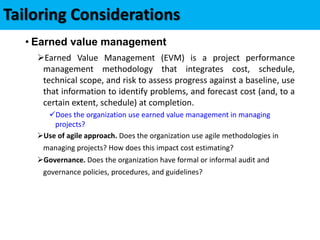
• Earned value management
Earned Value Management (EVM) is a project performance
management methodology that integrates cost, schedule,
technical scope, and risk to assess progress against a baseline, use
that information to identify problems, and forecast cost (and, to a
certain extent, schedule) at completion.
Does the organization use earned value management in managing
projects?
Use of agile approach. Does the organization use agile methodologies in
managing projects? How does this impact cost estimating?
Governance. Does the organization have formal or informal audit and
governance policies, procedures, and guidelines?
Tailoring Considerations
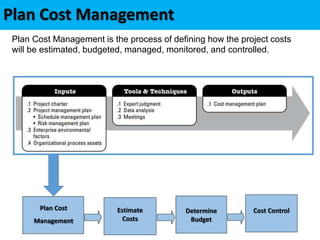
Plan Cost Management
Plan Cost Management is the process of defining how the project costs
will be estimated, budgeted, managed, monitored, and controlled.
Estimate
Costs
Determine
Budget
Cost Control
Plan Cost
Management
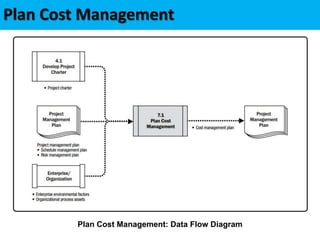
Plan Cost Management: Data Flow Diagram
Plan Cost Management
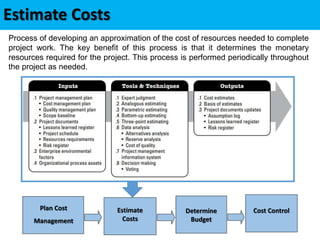
Estimate Costs
Process of developing an approximation of the cost of resources needed to complete
project work. The key benefit of this process is that it determines the monetary
resources required for the project. This process is performed periodically throughout
the project as needed.
Estimate
Costs
Determine
Budget
Cost Control
Plan Cost
Management
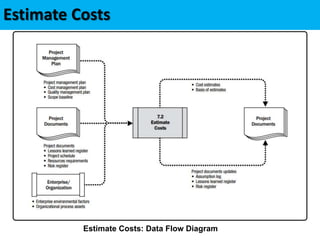
Estimate Costs: Data Flow Diagram
Estimate Costs
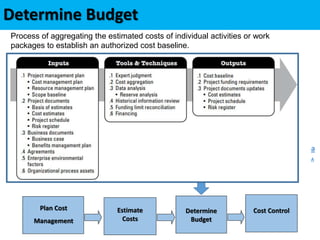
Determine Budget
Estimate
Costs
Determine
Budget
Cost Control
Plan Cost
Management
Process of aggregating the estimated costs of individual activities or work
packages to establish an authorized cost baseline.
A
a
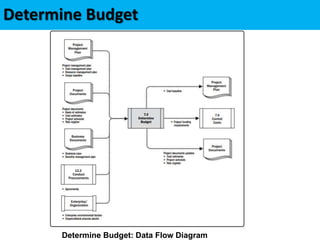
Determine Budget
Determine Budget: Data Flow Diagram
Control Costs
Estimate
Costs
Determine
Budget
Cost Control
Plan Cost
Management
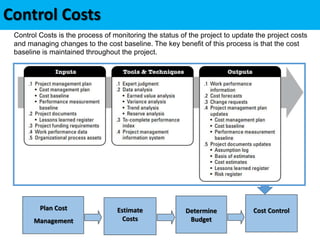
Control Costs is the process of monitoring the status of the project to update the project costs
and managing changes to the cost baseline. The key benefit of this process is that the cost
baseline is maintained throughout the project.
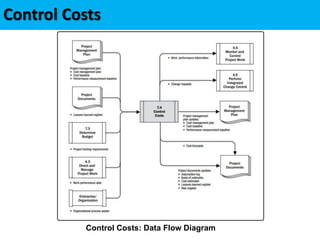
Control Costs
Control Costs: Data Flow Diagram
L4_Cost Management.ppt

L4_Cost Management.ppt

  • 1.
    Project Costs Management Sections ofthis presentation were adapted from A Guide to the Project Management Body of Knowledge 6th Edition, Dr. M.K. Mlela
  • 2.
    Cost Management Overview •KeyConcepts & Terms •Plan Cost Management •Estimate Costs •Determine Budget •Control Costs
  • 3.
    Key Concepts &Terms •Project Cost Management •Project Cost Management Processes •Key Terms •Trends & Emerging Practices •Tailoring Considerations •Considerations for Adaptive Environment
  • 4.
    Project Cost Management Projectcost management is the processes involved in planning, estimating, budgeting, financing, funding, managing, and controlling costs so that the project can be completed within the approved budget.
  • 5.
    Project Cost ManagementProcesses • Plan Cost Management • Estimate Costs • Determine Budget • Control Costs Estimate Costs Determine Budget Cost Control Plan Cost Management
  • 6.
    Key Terms • Earnedvalue management (EVM): a project management technique for measuring project performance and progress based on the comparison of work performed and work planned. • Life cycle costing: the concept of looking at cost over the entire life of the product, not just the cost of the project to create the product. • Value analysis (value engineering): the concept that focuses on finding a less costly way to do the same work. • Cost risk: cost-related risks.
  • 7.
    Key Terms (continued) •Types of costs: o Variable costs: costs that change with the amount of work. o Fixed costs: costs that do not change with the amount of work. o Direct costs: costs directly attributable to the work on the project o Indirect costs: overhead items or costs incurred for the benefit of more than one projects.
  • 8.
    Key Terms (continued) •Cost estimate ranges: o Rough order of magnitude (ROM): used during project initiating; typical range -25 to +75 percent. o Budget estimate: when starting the plan iteration; typical range -10 to +25 percent. o Definitive estimate: as progress planning progresses; typical range ± 10 percent or -5 to +10 percent.
  • 9.
    Trends & EmergingPractices •Expansion of EVM to include the concept of earned schedule (ES)  The common practice is to use EVM to evaluate the status of project cost and forecast the project's cost at completion while using CPM to evaluate the status of project schedule and forecast the project's completion time.  The Earned Schedule (ES) allows EVM metrics to be transformed to time or duration metrics to enhance the evaluation of project schedule performance and to forecast the duration needed to complete the project. •The Earned Value Management (EVM) and the Critical Path Method (CPM) are widely accepted methods and are often used simultaneously to evaluate project performance.
  • 10.
    Tailoring Considerations • Knowledgemanagement Knowledge management is the process by which an enterprise gathers, organizes, shares and analyzes its knowledge in a way that is easily accessible to Client/stakeholders. Knowledge management involves data mining and some method of operation to push information to users to make it easily accessible. Does the organization have a formal knowledge management and financial database repository that a project manager is required to use and that is readily accessible? • Estimating and budgeting process of approximating the total expenditure of the project. Does the organization have existing formal or informal cost estimating and budgeting-related policies, procedures, and guidelines?
  • 11.
    • Earned valuemanagement Earned Value Management (EVM) is a project performance management methodology that integrates cost, schedule, technical scope, and risk to assess progress against a baseline, use that information to identify problems, and forecast cost (and, to a certain extent, schedule) at completion. Does the organization use earned value management in managing projects? Use of agile approach. Does the organization use agile methodologies in managing projects? How does this impact cost estimating? Governance. Does the organization have formal or informal audit and governance policies, procedures, and guidelines? Tailoring Considerations
  • 12.
    Plan Cost Management PlanCost Management is the process of defining how the project costs will be estimated, budgeted, managed, monitored, and controlled. Estimate Costs Determine Budget Cost Control Plan Cost Management
  • 13.
    Plan Cost Management:Data Flow Diagram Plan Cost Management
  • 14.
    Estimate Costs Process ofdeveloping an approximation of the cost of resources needed to complete project work. The key benefit of this process is that it determines the monetary resources required for the project. This process is performed periodically throughout the project as needed. Estimate Costs Determine Budget Cost Control Plan Cost Management
  • 15.
    Estimate Costs: DataFlow Diagram Estimate Costs
  • 16.
    Determine Budget Estimate Costs Determine Budget Cost Control PlanCost Management Process of aggregating the estimated costs of individual activities or work packages to establish an authorized cost baseline. A a
  • 17.
  • 18.
    Control Costs Estimate Costs Determine Budget Cost Control PlanCost Management Control Costs is the process of monitoring the status of the project to update the project costs and managing changes to the cost baseline. The key benefit of this process is that the cost baseline is maintained throughout the project.
  • 19.