Managing the Complexity of Change
Order d Cl i
O d and Claims i Major Projects by
                  in M j P j t b
 establishing a Change Management
             Framework
             F        k


  Pankaj K Sinha   Abu Dhabi, UAE   18thApril, 2011
                                        April,
‫ﻣﺮﺣﺒﺎ‬
          ‫ﺎ‬
                  Menyambut
                  M     b t    t


Welcome
             ःवागतम
Willkommen        Welkom

       歡迎
                           2
Change Management

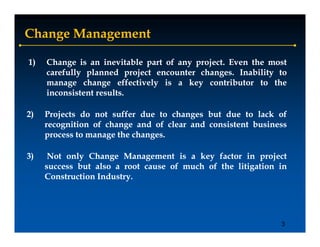
1)   Change is an inevitable part of any project. Even the most
                                         project.
     carefully planned project encounter changes. Inability to
             y p           p j            changes.
                                               g           y
     manage change effectively is a key contributor to the
     inconsistent results.
                  results.

2)   Projects do not suffer due to changes but due to lack of
     recognition of change and of clear and consistent business
     p
     process to manage the changes.
                    g      changes.
                               g

3)    Not only Change Management is a key factor in project
     success but also a root cause of much of the litigation in
                                                      g
     Construction Industry.
                  Industry.


                                                             3
Change Management
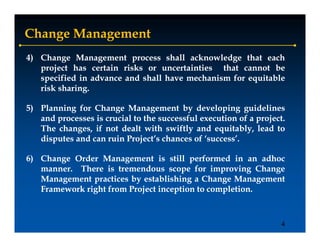
4) Change Management process shall acknowledge that each
   project has certain risks or uncertainties that cannot be
   specified i advance and shall h
        ifi d in d        d h ll have mechanism f equitable
                                          h i    for uit bl
   risk sharing.
        sharing.

5) Planning for Change Management by developing guidelines
   and processes is crucial to the successful execution of a project.
                                                             project.
   The changes, if not dealt with swiftly and equitably, lead to
   disputes and can ruin Project’s chances of ‘success’.
                          Project s             success

6) Change Order Management is still performed in an adhoc
   manner.
   manner. There is tremendous scope for improving Change
   Management practices by establishing a Change Management
   Framework right from Project inception to completion.
                                             completion.


                                                                    4
Current Practice

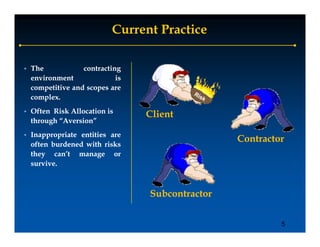
•   The            contracting
    environment
       i        t            is
                             i
    competitive and scopes are
    complex.
    complex.
•   Often Risk Allocation is
                                  Client
    through “Aversion”
•   Inappropriate entities are
                                                  Contractor
    often burdened with risks
    they can’t manage or
    survive.
    survive.


                                  Subcontractor


                                                           5
Popular Change Management Techniques !


                                         6
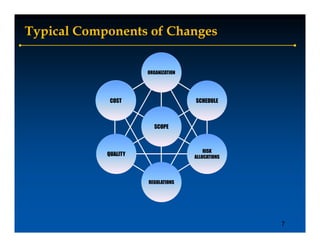
Typical Components of Changes


                      ORGANIZATION


             COST                    SCHEDULE


                        SCOPE


                                         RISK
            QUALITY                  ALLOCATIONS


                      REGULATIONS


                                                   7
Change and Productivity


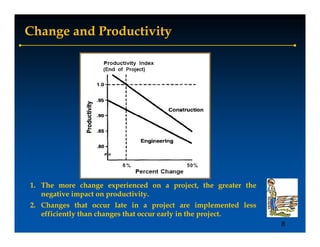
1. The more change experienced on a project, the greater the
   negative impact on productivity.
                      productivity.
2. Changes that occur late in a project are implemented less
   efficiently than changes that occur early in the project.
                                                    project.
                                                               8
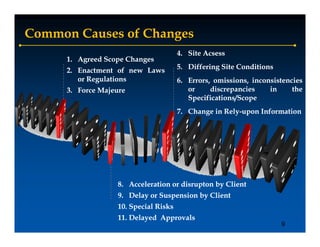
Common Causes of Changes
                                       4. Site Acsess
     1. Agreed Scope Changes
     2. Enactment of new Laws          5. Differing Site Conditions
        or R   l i
           Regulations                 6. Errors, omissions, inconsistencies
     3. Force Majeure                     or     discrepancies    in     the
                                          Specifications/Scope
                                       7. Change in Rely-upon Information
                                                    Rely-


                   8. Acceleration or disrupton by Client
                   9. Delay or Suspension by Client
                   10. Special Risks
                   11. Delayed Approvals
                                                                      9
Causes of Changes

•   Regardless of the origin, a Change may
       g                 g          g     y
    often trigger additional changes,
    resulting in various combinations of
    the types of Changes described earlier.
•   Once this ripple effect begins, it
    becomes increasingly complex to
    manage Change Therefore a proactive
             Change. Therefore, proactive,
    disciplined approach to Change
    Management is vital to the health of
    the Project.


                                              10
Need for Design Endorsement by Contractor


    Owner s
    Owner’s Vision
                                  Engineer’s Design


                Contractor Delivery !
                                                      11
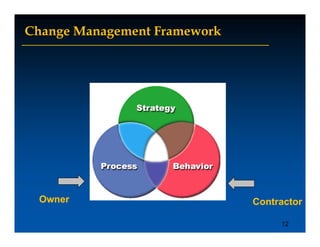
Change Management Framework


 Owner                        Contractor

                                   12
Integrated Change Control

•   Project    Management       Institute
    recommends Integrated Change Control
                   g          g
    Mechanism.

•   Integrated Change Control is the
    process of reviewing all Change
    Requests, approving Changes and
    managing changes to the Deliverables,
    Process, P j t d
    P        Project documents and th
                             t    d the
    Project Management Plan.

•   The Integrated Change Control process
    is conducted from project inception
    through completion.


                                            13
Project Control Department

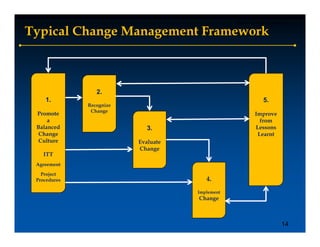
Typical Change Management Framework


                 2.
    1.                                                        5.
              Recognize
                  g
               Change
 Promote                                                  Improve
     a                                                      from
 Balanced                    3.                           Lessons
  Change                                                   Learnt
  Culture
  C lt                    Evaluate
                          Change
    ITT
 Agreement

   Project
 Procedures                             4.
                                     Implement
                                     Change
                                         g


                                                                        14
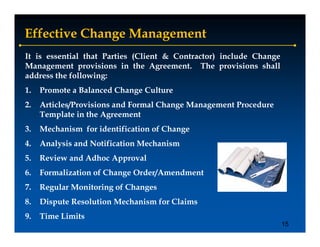
Effective Change Management
It is essential that Parties (Client & Contractor) include Change
Management provisions in the Agreement. The provisions shall
address the following:
1.   Promote a Balanced Change Culture
2.   Articles/Provisions and Formal Change Management Procedure
             /                          g      g
     Template in the Agreement
3.   Mechanism for identification of Change
4.   Analysis and Notification Mechanism
5.   Review and Adhoc Approval
6.
6    Formalization of Change O d /A
     F    li ti     f Ch     Order/Amendment
                                       d   t
7.   Regular Monitoring of Changes
8.
8    Dispute Resolution Mechanism for Claims
9.   Time Limits
                                                                    15
Typical Structure of Variation Provision

1.   Right to Vary
2.   Value Engineering
3.   Variation Procedure
4.   Payment in Applicable Currencies
5.   Provisional Sums
6.
6    Day
     D work
          k
7.   Adjustments for Changes in Legislation
8.
8    Adjustments for Changes in Cost


                                              16
Typical Variation Provision (Case A)
Variations may be initiated by the Owner at any time prior to issuing
the Taking-Over Certificate for the Works, either by an instruction or by
a request for the Contractor to submit a proposal Variation shall not
                                          proposal.
comprise the omission of any work which is to be carried out by others.

1. Contractor shall execute and be bound by each Variation, unless the
   Contractor promptly gives notice to the Employer stating (with
   supporting particulars) that Contractor cannot readily obtain the
   Goods required for the Variation,

2. It will reduce the safety or suitability of the Works, or

3. It will have an adverse impact on the achievement of the
                                     p
   Performance Guarantees. Upon receiving this notice, the Employer
   shall cancel, confirm or vary the instruction.


                                                                      17
Typical Variation Provision (Case B)
Variations may be initiated by the Owner at any time prior to issuing the Taking-Over
Certificate for the Works, either by an instruction or by a request for the Contractor to
submit a proposal. The Contractor shall execute and be bound by each Variation, unless
the Contractor promptly gives notice to the Owner stating (
 h                    l                  h                  (with supporting particulars)
                                                                h                   l )
that the Contractor cannot readily obtain the Goods required for the Variation. Upon
receiving this notice, the Owner shall cancel, confirm or vary the instruction. Each
Variation may include:
1.   Changes to the quantities of any item of work included in the Contract (however,
     such changes do not necessarily constitute a Variation),
2.   Changes to the quality and other characteristics of any item of work,
3.   Changes to the levels, positions and/or dimensions of any part of the Works,
4.   Omission of any work unless it is to be carried out by others,
5.   Any additional work. Plant, Materials or services necessary for the Permanent
       y                        ,                              y
     Works, including any associated Tests on Completion, boreholes and other testing
     and exploratory work, or
6.   Changes to the sequence or timing of the execution of the Works.
The Contractor shall not make any alteration and/or modification of the Permanent
Works, unless and until the Engineer instructs or approves a Variation.
                                                                                      18
Typical Variation Provision (Case C..)
Owner may make any change to the form, quality or quantity of
Work, or any part thereof, that may in Owner’s opinion be
necessary or desirable and for that purpose Owner shall have
                       and,          purpose,
power to order Contractor to do and Contractor shall do any of the
following:
a.   Increase or d
     I           decrease the quantity of W k i l d d i the
                           h       i    f Work included in h
     Agreement;
b. Change the character or quality of any such Work;
       g                   q     y      y
c.   Change the levels, lines, positions and dimensions of any part
     of Work; and
d. Execute additional work of any kind necessary for the
   completion of the Work.


                                                                      19
Typical Change/Variation Provision (C…)
It is agreed that Agreement Price and/or Schedule and/or other affected
provisions of the Agreement shall be adjusted to the extent necessary as a
result of any of the following:
            y                g
a. Additions, deletions or changes to the Work requested by one Party
   and agreed by the other.
b. Work delayed or suspended by Owner excluding concurrent delay
              y          p     y              g                y
   attributable to Contractor.
c. Additions, deletions or changes to the Work required as a result of
   Owner approved variances from basic design conditions as set forth in
           pp                              g
   Agreement. The basic design conditions shall be limited only to the
   following:
    •   Feedstock to be provided by Owner
    •   Overall Battery Limit Conditions
    •   Subsurface Geo-technical Information
    •   Site Climatic Data for design purposes as specified in ITT
d. Changes in the laws/Specifications/Codes until date of submission of
   Price Bid.                                                          20
Typical Change/Variation Provision (C….)

e.   Impact of Force Majeure.
f.
f    Remedial work resulting from Special Risk (Non insurable
                                               (Non-insurable
     Risks).
g. Additions, deletions or changes to the Work as a result of errors,
   omissions, i
      i i     inconsistencies or di
                     i     i      discrepancies or changes i the
                                            i        h        in h
   Rely-upon Information.
h. Any other provision of the Agreement, which expressly entitles
      y        p               g                 p     y
   the Parties to a Variation.
Any adjustment to Schedule as a result of a Variation or a
combination of variations shall be considered only if the Project
critical path is affected.


                                                                    21
Typical Change Proposal/Notice Template


                                          22
Project Control Department

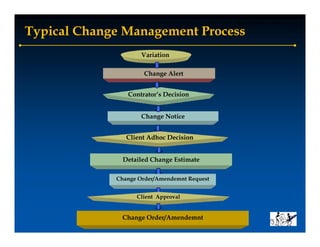
Typical Change Management Process
                     Variation

                     Change Alert
                         g


                Contrator’s Decision


                     Change Notice


                Client Adhoc Decision


               Detailed Change Estimate

             Change Order/Amendemnt Request


                   Client Approval


              Change Order/Amendemnt
                                                                     23
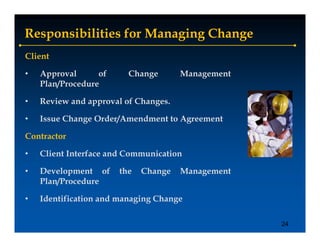
Responsibilities for Managing Change
Client

•   Approval
      pp          of     Change
                             g        Management
                                          g
    Plan/Procedure

•   Review and approval of Changes.

•   Issue Change Order/Amendment to Agreement

Contractor

•   Client Interface and Communication

•   Development of     the   Change   Management
    Plan/Procedure

•   Identification and managing Change

                                                   24
Benefits of Effective Change Management
Effective Change Management occurs when early identification
of the source of Change and its effect on a project are realized and
managed.
managed
Next, a Framework to manage change is developed,
communicated to all parties, and implemented. If these steps
have all taken place, the following is likely:

1. Enhanced Customer Relationships

2. Improved Financial Performance

3. Optimized Schedule

4. Better Teamwork


                                                                       25
Thank you for your
        ou     our
    attention.
      Q&A


                     26
Copyright: Pankaj K Sinha


                               Pankaj K Sinha
                                       00971-50-1223861

                            pankajsinha1964@hotmail.com


                                                          Presenatation and content Copyright: Pankaj K Sinha

                                                                                               27

Project Change Management-Pankaj K Sinha

  • 1.
    Managing the Complexityof Change Order d Cl i O d and Claims i Major Projects by in M j P j t b establishing a Change Management Framework F k Pankaj K Sinha Abu Dhabi, UAE 18thApril, 2011 April,
  • 2.
    ‫ﻣﺮﺣﺒﺎ‬ ‫ﺎ‬ Menyambut M b t t Welcome ःवागतम Willkommen Welkom 歡迎 2
  • 3.
    Change Management 1) Change is an inevitable part of any project. Even the most project. carefully planned project encounter changes. Inability to y p p j changes. g y manage change effectively is a key contributor to the inconsistent results. results. 2) Projects do not suffer due to changes but due to lack of recognition of change and of clear and consistent business p process to manage the changes. g changes. g 3) Not only Change Management is a key factor in project success but also a root cause of much of the litigation in g Construction Industry. Industry. 3
  • 4.
    Change Management 4) ChangeManagement process shall acknowledge that each project has certain risks or uncertainties that cannot be specified i advance and shall h ifi d in d d h ll have mechanism f equitable h i for uit bl risk sharing. sharing. 5) Planning for Change Management by developing guidelines and processes is crucial to the successful execution of a project. project. The changes, if not dealt with swiftly and equitably, lead to disputes and can ruin Project’s chances of ‘success’. Project s success 6) Change Order Management is still performed in an adhoc manner. manner. There is tremendous scope for improving Change Management practices by establishing a Change Management Framework right from Project inception to completion. completion. 4
  • 5.
    Current Practice • The contracting environment i t is i competitive and scopes are complex. complex. • Often Risk Allocation is Client through “Aversion” • Inappropriate entities are Contractor often burdened with risks they can’t manage or survive. survive. Subcontractor 5
  • 6.
  • 7.
    Typical Components ofChanges ORGANIZATION COST SCHEDULE SCOPE RISK QUALITY ALLOCATIONS REGULATIONS 7
  • 8.
    Change and Productivity 1.The more change experienced on a project, the greater the negative impact on productivity. productivity. 2. Changes that occur late in a project are implemented less efficiently than changes that occur early in the project. project. 8
  • 9.
    Common Causes ofChanges 4. Site Acsess 1. Agreed Scope Changes 2. Enactment of new Laws 5. Differing Site Conditions or R l i Regulations 6. Errors, omissions, inconsistencies 3. Force Majeure or discrepancies in the Specifications/Scope 7. Change in Rely-upon Information Rely- 8. Acceleration or disrupton by Client 9. Delay or Suspension by Client 10. Special Risks 11. Delayed Approvals 9
  • 10.
    Causes of Changes • Regardless of the origin, a Change may g g g y often trigger additional changes, resulting in various combinations of the types of Changes described earlier. • Once this ripple effect begins, it becomes increasingly complex to manage Change Therefore a proactive Change. Therefore, proactive, disciplined approach to Change Management is vital to the health of the Project. 10
  • 11.
    Need for DesignEndorsement by Contractor Owner s Owner’s Vision Engineer’s Design Contractor Delivery ! 11
  • 12.
    Change Management Framework Owner Contractor 12
  • 13.
    Integrated Change Control • Project Management Institute recommends Integrated Change Control g g Mechanism. • Integrated Change Control is the process of reviewing all Change Requests, approving Changes and managing changes to the Deliverables, Process, P j t d P Project documents and th t d the Project Management Plan. • The Integrated Change Control process is conducted from project inception through completion. 13
  • 14.
    Project Control Department TypicalChange Management Framework 2. 1. 5. Recognize g Change Promote Improve a from Balanced 3. Lessons Change Learnt Culture C lt Evaluate Change ITT Agreement Project Procedures 4. Implement Change g 14
  • 15.
    Effective Change Management Itis essential that Parties (Client & Contractor) include Change Management provisions in the Agreement. The provisions shall address the following: 1. Promote a Balanced Change Culture 2. Articles/Provisions and Formal Change Management Procedure / g g Template in the Agreement 3. Mechanism for identification of Change 4. Analysis and Notification Mechanism 5. Review and Adhoc Approval 6. 6 Formalization of Change O d /A F li ti f Ch Order/Amendment d t 7. Regular Monitoring of Changes 8. 8 Dispute Resolution Mechanism for Claims 9. Time Limits 15
  • 16.
    Typical Structure ofVariation Provision 1. Right to Vary 2. Value Engineering 3. Variation Procedure 4. Payment in Applicable Currencies 5. Provisional Sums 6. 6 Day D work k 7. Adjustments for Changes in Legislation 8. 8 Adjustments for Changes in Cost 16
  • 17.
    Typical Variation Provision(Case A) Variations may be initiated by the Owner at any time prior to issuing the Taking-Over Certificate for the Works, either by an instruction or by a request for the Contractor to submit a proposal Variation shall not proposal. comprise the omission of any work which is to be carried out by others. 1. Contractor shall execute and be bound by each Variation, unless the Contractor promptly gives notice to the Employer stating (with supporting particulars) that Contractor cannot readily obtain the Goods required for the Variation, 2. It will reduce the safety or suitability of the Works, or 3. It will have an adverse impact on the achievement of the p Performance Guarantees. Upon receiving this notice, the Employer shall cancel, confirm or vary the instruction. 17
  • 18.
    Typical Variation Provision(Case B) Variations may be initiated by the Owner at any time prior to issuing the Taking-Over Certificate for the Works, either by an instruction or by a request for the Contractor to submit a proposal. The Contractor shall execute and be bound by each Variation, unless the Contractor promptly gives notice to the Owner stating ( h l h (with supporting particulars) h l ) that the Contractor cannot readily obtain the Goods required for the Variation. Upon receiving this notice, the Owner shall cancel, confirm or vary the instruction. Each Variation may include: 1. Changes to the quantities of any item of work included in the Contract (however, such changes do not necessarily constitute a Variation), 2. Changes to the quality and other characteristics of any item of work, 3. Changes to the levels, positions and/or dimensions of any part of the Works, 4. Omission of any work unless it is to be carried out by others, 5. Any additional work. Plant, Materials or services necessary for the Permanent y , y Works, including any associated Tests on Completion, boreholes and other testing and exploratory work, or 6. Changes to the sequence or timing of the execution of the Works. The Contractor shall not make any alteration and/or modification of the Permanent Works, unless and until the Engineer instructs or approves a Variation. 18
  • 19.
    Typical Variation Provision(Case C..) Owner may make any change to the form, quality or quantity of Work, or any part thereof, that may in Owner’s opinion be necessary or desirable and for that purpose Owner shall have and, purpose, power to order Contractor to do and Contractor shall do any of the following: a. Increase or d I decrease the quantity of W k i l d d i the h i f Work included in h Agreement; b. Change the character or quality of any such Work; g q y y c. Change the levels, lines, positions and dimensions of any part of Work; and d. Execute additional work of any kind necessary for the completion of the Work. 19
  • 20.
    Typical Change/Variation Provision(C…) It is agreed that Agreement Price and/or Schedule and/or other affected provisions of the Agreement shall be adjusted to the extent necessary as a result of any of the following: y g a. Additions, deletions or changes to the Work requested by one Party and agreed by the other. b. Work delayed or suspended by Owner excluding concurrent delay y p y g y attributable to Contractor. c. Additions, deletions or changes to the Work required as a result of Owner approved variances from basic design conditions as set forth in pp g Agreement. The basic design conditions shall be limited only to the following: • Feedstock to be provided by Owner • Overall Battery Limit Conditions • Subsurface Geo-technical Information • Site Climatic Data for design purposes as specified in ITT d. Changes in the laws/Specifications/Codes until date of submission of Price Bid. 20
  • 21.
    Typical Change/Variation Provision(C….) e. Impact of Force Majeure. f. f Remedial work resulting from Special Risk (Non insurable (Non-insurable Risks). g. Additions, deletions or changes to the Work as a result of errors, omissions, i i i inconsistencies or di i i discrepancies or changes i the i h in h Rely-upon Information. h. Any other provision of the Agreement, which expressly entitles y p g p y the Parties to a Variation. Any adjustment to Schedule as a result of a Variation or a combination of variations shall be considered only if the Project critical path is affected. 21
  • 22.
  • 23.
    Project Control Department TypicalChange Management Process Variation Change Alert g Contrator’s Decision Change Notice Client Adhoc Decision Detailed Change Estimate Change Order/Amendemnt Request Client Approval Change Order/Amendemnt 23
  • 24.
    Responsibilities for ManagingChange Client • Approval pp of Change g Management g Plan/Procedure • Review and approval of Changes. • Issue Change Order/Amendment to Agreement Contractor • Client Interface and Communication • Development of the Change Management Plan/Procedure • Identification and managing Change 24
  • 25.
    Benefits of EffectiveChange Management Effective Change Management occurs when early identification of the source of Change and its effect on a project are realized and managed. managed Next, a Framework to manage change is developed, communicated to all parties, and implemented. If these steps have all taken place, the following is likely: 1. Enhanced Customer Relationships 2. Improved Financial Performance 3. Optimized Schedule 4. Better Teamwork 25
  • 26.
    Thank you foryour ou our attention. Q&A 26
  • 27.
    Copyright: Pankaj KSinha Pankaj K Sinha 00971-50-1223861 pankajsinha1964@hotmail.com Presenatation and content Copyright: Pankaj K Sinha 27