www.vertexeng.com
An Overview of Various Forensic
Schedule Analysis Methods for Construction
Delay Claims Including Time Impact Analysis
Forensic Schedule
Analyses For Construction
Delays
www.vertexeng.com
“Nowhere is the confusion between moral and legal ideas
more manifest than in the law of contract…The duty to keep a
contract at common law means a prediction that you must pay
damages if you do not keep it – and nothing else.”
Justice Oliver Wendell Holmes
The Path of the Law, Harvard Law Review, March 25, 1897
“Although figures do not lie, liars figure.”
www.vertexeng.com
Specific Delay Claims Provisions Exist
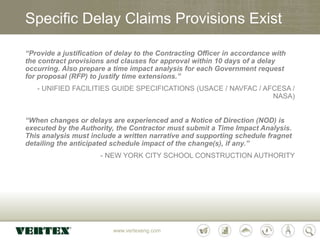
“Provide a justification of delay to the Contracting Officer in accordance with
the contract provisions and clauses for approval within 10 days of a delay
occurring. Also prepare a time impact analysis for each Government request
for proposal (RFP) to justify time extensions.”
- UNIFIED FACILITIES GUIDE SPECIFICATIONS (USACE / NAVFAC / AFCESA /
NASA)
“When changes or delays are experienced and a Notice of Direction (NOD) is
executed by the Authority, the Contractor must submit a Time Impact Analysis.
This analysis must include a written narrative and supporting schedule fragnet
detailing the anticipated schedule impact of the change(s), if any.”
- NEW YORK CITY SCHOOL CONSTRUCTION AUTHORITY
www.vertexeng.com
Delay Analysis Process
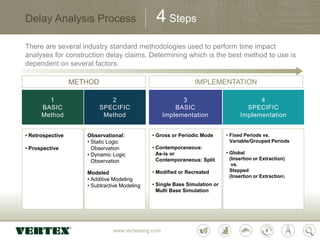
There are several industry standard methodologies used to perform time impact
analyses for construction delay claims. Determining which is the best method to use is
dependent on several factors.
1
BASIC
Method
• Retrospective
• Prospective
2
SPECIFIC
Method
Observational:
• Static Logic
Observation
• Dynamic Logic
Observation
Modeled
• Additive Modeling
• Subtractive Modeling
3
BASIC
Implementation
• Gross or Periodic Mode
• Contemporaneous:
As-is or
Contemporaneous: Split
• Modified or Recreated
• Single Base Simulation or
Multi Base Simulation
4
SPECIFIC
Implementation
• Fixed Periods vs.
Variable/Grouped Periods
• Global
(Insertion or Extraction)
vs.
Stepped
(Insertion or Extraction)
METHOD IMPLEMENTATION
4 Steps
www.vertexeng.comwww.vertexeng.com
The Methodologies
An overview of the methodologies covered.
www.vertexeng.com
Time Impact Analysis
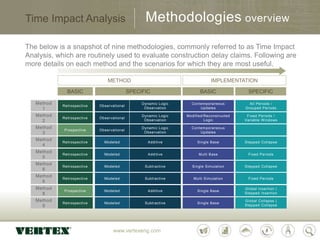
The below is a snapshot of nine methodologies, commonly referred to as Time Impact
Analysis, which are routinely used to evaluate construction delay claims. Following are
more details on each method and the scenarios for which they are most useful.
Methodologies overview
Retrospective Observational
Dynamic Logic
Observation
Contemporaneous
Updates
All Periods /
Grouped Periods
Method
1
Retrospective Observational
Dynamic Logic
Observation
Modified/Reconstructed
Logic
Fixed Periods /
Variable Windows
Method
2
Prospective Observational
Dynamic Logic
Observation
Contemporaneous
Updates
Method
3
Retrospective Modeled Additive Single Base Stepped Collapse
Method
4
Retrospective Modeled Additive Multi Base Fixed Periods
Method
5
Retrospective Modeled Subtractive Single Simulation Stepped Collapse
Method
6
Retrospective Modeled Subtractive Multi Simulation Fixed Periods
Method
6
Prospective Modeled Additive Single Base
Global Insertion |
Stepped Insertion
Method
8
Retrospective Modeled Subtractive Single Base
Global Collapse |
Stepped Collapse
Method
9
BASIC SPECIFIC
METHOD
BASIC SPECIFIC
IMPLEMENTATION
www.vertexeng.com
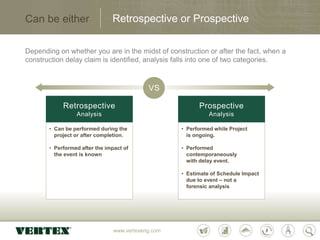
Retrospective or ProspectiveCan be either
• Can be performed during the
project or after completion.
• Performed after the impact of
the event is known
• Performed while Project
is ongoing.
• Performed
contemporaneously
with delay event.
• Estimate of Schedule Impact
due to event – not a
forensic analysis
Retrospective
Analysis
Prospective
Analysis
VS
Depending on whether you are in the midst of construction or after the fact, when a
construction delay claim is identified, analysis falls into one of two categories.
www.vertexeng.com
Time Impact Analysis
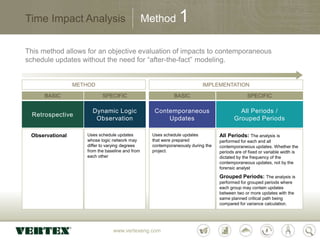
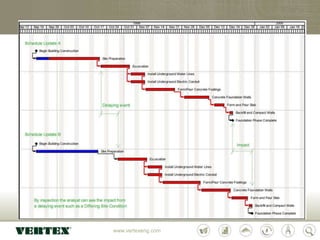
This method allows for an objective evaluation of impacts to contemporaneous
schedule updates without the need for “after-the-fact” modeling.
Retrospective
Observational
Dynamic Logic
Observation
Uses schedule updates
whose logic network may
differ to varying degrees
from the baseline and from
each other
Contemporaneous
Updates
Uses schedule updates
that were prepared
contemporaneously during the
project.
All Periods /
Grouped Periods
All Periods: The analysis is
performed for each and all
contemporaneous updates. Whether the
periods are of fixed or variable width is
dictated by the frequency of the
contemporaneous updates, not by the
forensic analyst
Grouped Periods: The analysis is
performed for grouped periods where
each group may contain updates
between two or more updates with the
same planned critical path being
compared for variance calculation.
Method 1
BASIC SPECIFIC
METHOD
BASIC SPECIFIC
IMPLEMENTATION
www.vertexeng.com
www.vertexeng.com
Time Impact Analysis
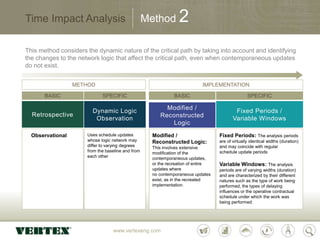
This method considers the dynamic nature of the critical path by taking into account and identifying
the changes to the network logic that affect the critical path, even when contemporaneous updates
do not exist.
Retrospective
Observational
Dynamic Logic
Observation
Uses schedule updates
whose logic network may
differ to varying degrees
from the baseline and from
each other
Modified /
Reconstructed
Logic
Modified /
Reconstructed Logic:
This involves extensive
modification of the
contemporaneous updates,
or the recreation of entire
updates where
no contemporaneous updates
exist, as in the recreated
implementation.
Fixed Periods /
Variable Windows
Fixed Periods: The analysis periods
are of virtually identical widths (duration)
and may coincide with regular
schedule update periods
Variable Windows: The analysis
periods are of varying widths (duration)
and are characterized by their different
natures such as the type of work being
performed, the types of delaying
influences or the operative contractual
schedule under which the work was
being performed.
Method 2
BASIC SPECIFIC
METHOD
BASIC SPECIFIC
IMPLEMENTATION
www.vertexeng.com
Time Impact Analysis
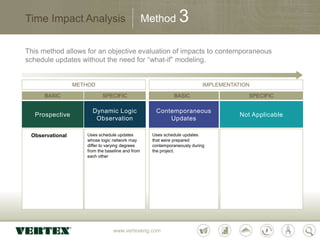
This method allows for an objective evaluation of impacts to contemporaneous
schedule updates without the need for “what-if” modeling.
Prospective
Observational
Dynamic Logic
Observation
Uses schedule updates
whose logic network may
differ to varying degrees
from the baseline and from
each other
Method 3
Contemporaneous
Updates
Uses schedule updates
that were prepared
contemporaneously during
the project.
BASIC SPECIFIC
METHOD
BASIC
IMPLEMENTATION
Not Applicable
BASIC SPECIFIC
METHOD
BASIC SPECIFIC
www.vertexeng.com
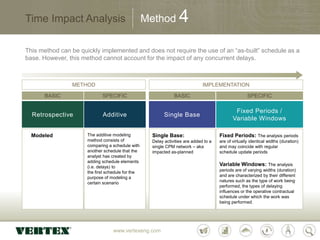
Time Impact Analysis
This method can be quickly implemented and does not require the use of an “as-built” schedule as a
base. However, this method cannot account for the impact of any concurrent delays.
Retrospective
Modeled
Additive
The additive modeling
method consists of
comparing a schedule with
another schedule that the
analyst has created by
adding schedule elements
(i.e. delays) to
the first schedule for the
purpose of modeling a
certain scenario
Single Base
Single Base:
Delay activities are added to a
single CPM network – aka
impacted as-planned
Fixed Periods /
Variable Windows
Fixed Periods: The analysis periods
are of virtually identical widths (duration)
and may coincide with regular
schedule update periods
Variable Windows: The analysis
periods are of varying widths (duration)
and are characterized by their different
natures such as the type of work being
performed, the types of delaying
influences or the operative contractual
schedule under which the work was
being performed.
Method 4
BASIC SPECIFIC
METHOD
BASIC SPECIFIC
IMPLEMENTATION
www.vertexeng.com
www.vertexeng.com
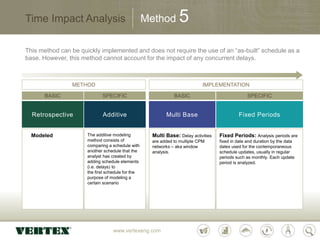
Time Impact Analysis
This method can be quickly implemented and does not require the use of an “as-built” schedule as a
base. However, this method cannot account for the impact of any concurrent delays.
Retrospective
Modeled
Additive
The additive modeling
method consists of
comparing a schedule with
another schedule that the
analyst has created by
adding schedule elements
(i.e. delays) to
the first schedule for the
purpose of modeling a
certain scenario
Multi Base
Multi Base: Delay activities
are added to multiple CPM
networks – aka window
analysis.
Fixed Periods
Fixed Periods: Analysis periods are
fixed in date and duration by the data
dates used for the contemporaneous
schedule updates, usually in regular
periods such as monthly. Each update
period is analyzed.
Method 5
BASIC SPECIFIC
METHOD
BASIC SPECIFIC
IMPLEMENTATION
www.vertexeng.com
Time Impact Analysis
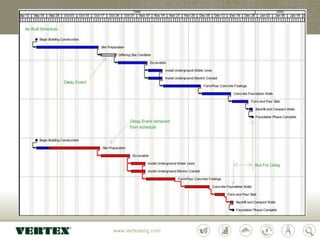
The concept of this method is easy to understand and can be implemented without the use of a
baseline or updated schedules.
Retrospective
Modeled
Subtractive
The subtractive modeling
method consists of
comparing a CPM schedule
with another schedule that
the analyst has created by
subtracting schedule
elements (i.e. delays) from
the first schedule for the
purpose of modeling a
certain scenario.
Single Simulation
Single Simulation:
Delay activities are removed
from a single CPM network
Stepped Collapse
Stepped Collapse: Delays are
removed individually from a CPM
network for analysis.
Method 6
BASIC SPECIFIC
METHOD
BASIC SPECIFIC
IMPLEMENTATION
www.vertexeng.com
www.vertexeng.com
Time Impact Analysis
This method allows for a limited quantification of any schedule mitigation and/or acceleration as well
as accounting for changes in the prospective critical path of the schedule updates reviewed.
Retrospective
Modeled
Subtractive
The subtractive modeling
method consists of
comparing a CPM schedule
with another schedule that
the analyst has created by
subtracting schedule
elements (i.e. delays) from
the first schedule for the
purpose of modeling a
certain scenario.
Multi Simulation
Single Simulation:
Delay activities are removed
from a single CPM network
Fixed Periods
Fixed Periods: Analysis periods are
fixed in date and duration by the data
dates used for the contemporaneous
schedule updates, usually in regular
periods such as monthly. Each update
period is analyzed.
Method 7
BASIC SPECIFIC
METHOD
BASIC SPECIFIC
IMPLEMENTATION
www.vertexeng.com
Time Impact Analysis
This method can be quickly implemented and does not require the use of an “as-built” schedule as a
base. However, this method cannot account for the impact of any concurrent delays.
Prospective
Modeled
Additive
The additive modeling
method consists of
comparing a schedule with
another schedule that the
analyst has created by
adding schedule elements
(i.e. delays) to
the first schedule for the
purpose of modeling a
certain scenario.
Single Base
Single Base:
Delay activities are removed
from a single CPM network–
aka impacted as-planned.
Global Insertion /
Stepped Insertion
Global Insertion: Global Insertion
Delays are inserted into a CPM Network
all at once for analysis.
Stepped Insertion: Delays are
inserted into a CPM Network individually
for analysis.
Method 8
BASIC SPECIFIC
METHOD
BASIC SPECIFIC
IMPLEMENTATION
www.vertexeng.com
Time Impact Analysis
For further information about this topic or to contact VERTEX directly, CLICK HERE.
Contact
AUTHORED BY:
David M. Ponte, P.E.
Division Manager – Contract Claims
The Vertex Companies
400 Libbey Industrial Parkway
Weymouth, Massachusetts 02189
USA
tel: +1 781.952.6012
fax: +1 781.952.6060
email: dponte@vertexeng.com
www.vertexeng.com
1. Recommended Practice No. 29R-03 “Forensic Schedule
Analysis”, AACE International, June 23, 2009
2. Recommended Practice No. 52R-06 “Time Impact Analysis – AS
Applied in Construction”, AACE International, October 19, 2006
3. Zack, Jr., James G., Delay and Delay Analysis: Isn’t it Simple?
1st ICEC & IPMA Global Congress on Project Management,
Ljubljana, Slovenia April 26, 2006.
Time Impact Analysis References

VERTEX Construction Delays and Forensic Schedule Analyses

  • 1.
    www.vertexeng.com An Overview ofVarious Forensic Schedule Analysis Methods for Construction Delay Claims Including Time Impact Analysis Forensic Schedule Analyses For Construction Delays
  • 2.
    www.vertexeng.com “Nowhere is theconfusion between moral and legal ideas more manifest than in the law of contract…The duty to keep a contract at common law means a prediction that you must pay damages if you do not keep it – and nothing else.” Justice Oliver Wendell Holmes The Path of the Law, Harvard Law Review, March 25, 1897 “Although figures do not lie, liars figure.”
  • 3.
    www.vertexeng.com Specific Delay ClaimsProvisions Exist “Provide a justification of delay to the Contracting Officer in accordance with the contract provisions and clauses for approval within 10 days of a delay occurring. Also prepare a time impact analysis for each Government request for proposal (RFP) to justify time extensions.” - UNIFIED FACILITIES GUIDE SPECIFICATIONS (USACE / NAVFAC / AFCESA / NASA) “When changes or delays are experienced and a Notice of Direction (NOD) is executed by the Authority, the Contractor must submit a Time Impact Analysis. This analysis must include a written narrative and supporting schedule fragnet detailing the anticipated schedule impact of the change(s), if any.” - NEW YORK CITY SCHOOL CONSTRUCTION AUTHORITY
  • 4.
    www.vertexeng.com Delay Analysis Process Thereare several industry standard methodologies used to perform time impact analyses for construction delay claims. Determining which is the best method to use is dependent on several factors. 1 BASIC Method • Retrospective • Prospective 2 SPECIFIC Method Observational: • Static Logic Observation • Dynamic Logic Observation Modeled • Additive Modeling • Subtractive Modeling 3 BASIC Implementation • Gross or Periodic Mode • Contemporaneous: As-is or Contemporaneous: Split • Modified or Recreated • Single Base Simulation or Multi Base Simulation 4 SPECIFIC Implementation • Fixed Periods vs. Variable/Grouped Periods • Global (Insertion or Extraction) vs. Stepped (Insertion or Extraction) METHOD IMPLEMENTATION 4 Steps
  • 5.
  • 6.
    www.vertexeng.com Time Impact Analysis Thebelow is a snapshot of nine methodologies, commonly referred to as Time Impact Analysis, which are routinely used to evaluate construction delay claims. Following are more details on each method and the scenarios for which they are most useful. Methodologies overview Retrospective Observational Dynamic Logic Observation Contemporaneous Updates All Periods / Grouped Periods Method 1 Retrospective Observational Dynamic Logic Observation Modified/Reconstructed Logic Fixed Periods / Variable Windows Method 2 Prospective Observational Dynamic Logic Observation Contemporaneous Updates Method 3 Retrospective Modeled Additive Single Base Stepped Collapse Method 4 Retrospective Modeled Additive Multi Base Fixed Periods Method 5 Retrospective Modeled Subtractive Single Simulation Stepped Collapse Method 6 Retrospective Modeled Subtractive Multi Simulation Fixed Periods Method 6 Prospective Modeled Additive Single Base Global Insertion | Stepped Insertion Method 8 Retrospective Modeled Subtractive Single Base Global Collapse | Stepped Collapse Method 9 BASIC SPECIFIC METHOD BASIC SPECIFIC IMPLEMENTATION
  • 7.
    www.vertexeng.com Retrospective or ProspectiveCanbe either • Can be performed during the project or after completion. • Performed after the impact of the event is known • Performed while Project is ongoing. • Performed contemporaneously with delay event. • Estimate of Schedule Impact due to event – not a forensic analysis Retrospective Analysis Prospective Analysis VS Depending on whether you are in the midst of construction or after the fact, when a construction delay claim is identified, analysis falls into one of two categories.
  • 8.
    www.vertexeng.com Time Impact Analysis Thismethod allows for an objective evaluation of impacts to contemporaneous schedule updates without the need for “after-the-fact” modeling. Retrospective Observational Dynamic Logic Observation Uses schedule updates whose logic network may differ to varying degrees from the baseline and from each other Contemporaneous Updates Uses schedule updates that were prepared contemporaneously during the project. All Periods / Grouped Periods All Periods: The analysis is performed for each and all contemporaneous updates. Whether the periods are of fixed or variable width is dictated by the frequency of the contemporaneous updates, not by the forensic analyst Grouped Periods: The analysis is performed for grouped periods where each group may contain updates between two or more updates with the same planned critical path being compared for variance calculation. Method 1 BASIC SPECIFIC METHOD BASIC SPECIFIC IMPLEMENTATION
  • 9.
  • 10.
    www.vertexeng.com Time Impact Analysis Thismethod considers the dynamic nature of the critical path by taking into account and identifying the changes to the network logic that affect the critical path, even when contemporaneous updates do not exist. Retrospective Observational Dynamic Logic Observation Uses schedule updates whose logic network may differ to varying degrees from the baseline and from each other Modified / Reconstructed Logic Modified / Reconstructed Logic: This involves extensive modification of the contemporaneous updates, or the recreation of entire updates where no contemporaneous updates exist, as in the recreated implementation. Fixed Periods / Variable Windows Fixed Periods: The analysis periods are of virtually identical widths (duration) and may coincide with regular schedule update periods Variable Windows: The analysis periods are of varying widths (duration) and are characterized by their different natures such as the type of work being performed, the types of delaying influences or the operative contractual schedule under which the work was being performed. Method 2 BASIC SPECIFIC METHOD BASIC SPECIFIC IMPLEMENTATION
  • 11.
    www.vertexeng.com Time Impact Analysis Thismethod allows for an objective evaluation of impacts to contemporaneous schedule updates without the need for “what-if” modeling. Prospective Observational Dynamic Logic Observation Uses schedule updates whose logic network may differ to varying degrees from the baseline and from each other Method 3 Contemporaneous Updates Uses schedule updates that were prepared contemporaneously during the project. BASIC SPECIFIC METHOD BASIC IMPLEMENTATION Not Applicable BASIC SPECIFIC METHOD BASIC SPECIFIC
  • 12.
    www.vertexeng.com Time Impact Analysis Thismethod can be quickly implemented and does not require the use of an “as-built” schedule as a base. However, this method cannot account for the impact of any concurrent delays. Retrospective Modeled Additive The additive modeling method consists of comparing a schedule with another schedule that the analyst has created by adding schedule elements (i.e. delays) to the first schedule for the purpose of modeling a certain scenario Single Base Single Base: Delay activities are added to a single CPM network – aka impacted as-planned Fixed Periods / Variable Windows Fixed Periods: The analysis periods are of virtually identical widths (duration) and may coincide with regular schedule update periods Variable Windows: The analysis periods are of varying widths (duration) and are characterized by their different natures such as the type of work being performed, the types of delaying influences or the operative contractual schedule under which the work was being performed. Method 4 BASIC SPECIFIC METHOD BASIC SPECIFIC IMPLEMENTATION
  • 13.
  • 14.
    www.vertexeng.com Time Impact Analysis Thismethod can be quickly implemented and does not require the use of an “as-built” schedule as a base. However, this method cannot account for the impact of any concurrent delays. Retrospective Modeled Additive The additive modeling method consists of comparing a schedule with another schedule that the analyst has created by adding schedule elements (i.e. delays) to the first schedule for the purpose of modeling a certain scenario Multi Base Multi Base: Delay activities are added to multiple CPM networks – aka window analysis. Fixed Periods Fixed Periods: Analysis periods are fixed in date and duration by the data dates used for the contemporaneous schedule updates, usually in regular periods such as monthly. Each update period is analyzed. Method 5 BASIC SPECIFIC METHOD BASIC SPECIFIC IMPLEMENTATION
  • 15.
    www.vertexeng.com Time Impact Analysis Theconcept of this method is easy to understand and can be implemented without the use of a baseline or updated schedules. Retrospective Modeled Subtractive The subtractive modeling method consists of comparing a CPM schedule with another schedule that the analyst has created by subtracting schedule elements (i.e. delays) from the first schedule for the purpose of modeling a certain scenario. Single Simulation Single Simulation: Delay activities are removed from a single CPM network Stepped Collapse Stepped Collapse: Delays are removed individually from a CPM network for analysis. Method 6 BASIC SPECIFIC METHOD BASIC SPECIFIC IMPLEMENTATION
  • 16.
  • 17.
    www.vertexeng.com Time Impact Analysis Thismethod allows for a limited quantification of any schedule mitigation and/or acceleration as well as accounting for changes in the prospective critical path of the schedule updates reviewed. Retrospective Modeled Subtractive The subtractive modeling method consists of comparing a CPM schedule with another schedule that the analyst has created by subtracting schedule elements (i.e. delays) from the first schedule for the purpose of modeling a certain scenario. Multi Simulation Single Simulation: Delay activities are removed from a single CPM network Fixed Periods Fixed Periods: Analysis periods are fixed in date and duration by the data dates used for the contemporaneous schedule updates, usually in regular periods such as monthly. Each update period is analyzed. Method 7 BASIC SPECIFIC METHOD BASIC SPECIFIC IMPLEMENTATION
  • 18.
    www.vertexeng.com Time Impact Analysis Thismethod can be quickly implemented and does not require the use of an “as-built” schedule as a base. However, this method cannot account for the impact of any concurrent delays. Prospective Modeled Additive The additive modeling method consists of comparing a schedule with another schedule that the analyst has created by adding schedule elements (i.e. delays) to the first schedule for the purpose of modeling a certain scenario. Single Base Single Base: Delay activities are removed from a single CPM network– aka impacted as-planned. Global Insertion / Stepped Insertion Global Insertion: Global Insertion Delays are inserted into a CPM Network all at once for analysis. Stepped Insertion: Delays are inserted into a CPM Network individually for analysis. Method 8 BASIC SPECIFIC METHOD BASIC SPECIFIC IMPLEMENTATION
  • 19.
    www.vertexeng.com Time Impact Analysis Forfurther information about this topic or to contact VERTEX directly, CLICK HERE. Contact AUTHORED BY: David M. Ponte, P.E. Division Manager – Contract Claims The Vertex Companies 400 Libbey Industrial Parkway Weymouth, Massachusetts 02189 USA tel: +1 781.952.6012 fax: +1 781.952.6060 email: dponte@vertexeng.com
  • 20.
    www.vertexeng.com 1. Recommended PracticeNo. 29R-03 “Forensic Schedule Analysis”, AACE International, June 23, 2009 2. Recommended Practice No. 52R-06 “Time Impact Analysis – AS Applied in Construction”, AACE International, October 19, 2006 3. Zack, Jr., James G., Delay and Delay Analysis: Isn’t it Simple? 1st ICEC & IPMA Global Congress on Project Management, Ljubljana, Slovenia April 26, 2006. Time Impact Analysis References

Editor's Notes

  • #6  This is meant to be an overview of AACE RP 29R-03 which covers various forensic schedule analysis methods; not just Time Impact Analysis. (TIAs). The methods identified in the presentation may sometimes be referred to as TIAs but are also referred to by other names (For instance, method #1 describes a windows analysis).
  • #7  This is meant to be an overview of AACE RP 29R-03 which covers various forensic schedule analysis methods; not just Time Impact Analysis. (TIAs). The methods identified in the presentation may sometimes be referred to as TIAs but are also referred to by other names (For instance, method #1 describes a windows analysis).