An Introduction to FIDIC
Suite of Contracts
By
Javed Jafri
Contract Specialist
7 Dec 2016
1. Introduction to FIDIC,
2. Purpose and Range of its Forms of Contract
3. FIDIC Suite of Contracts, Advantages & Parts
4. Priority of Documents in FIDIC Contracts
5. Salient Features of Specific Forms
6. Affects of Using Yellow and Silver Books
7. Summary/Conclusion
TOPICS COVERED
- FIDIC stands for ‘Fédération Internationale des Ingénieurs - Conseils’,
which translates as The International Federation of Consulting Engineers.
- Established in 1913, by the trio of French, Belgian and Swiss engineers,
FIDIC represents the consulting engineering industry both globally and
domestically (through its about 100 member country associations).
INTRODUCTION TO FIDIC
- FIDIC Consulting Engineer Associations are grouped by region as follows:
GAMA- FIDIC Group of African Member Associations
ASPAC - FIDIC Asia-Pacific Member Associations
- In addition, FIDIC works closely with the following regional groups:
EFCA - European Federation of Engineering Consultancy Associations
FEPAC - Panamerican Federation of Consultants / Fedaración
Panamericana de Consultores
1. “Be the international authority on consulting engineering best practice”
2. “Promote high standards of ethics and integrity among all stakeholders”
3. “Enhance FIDIC’s representation of the consulting engineering industry”
4. “Enhance the image of consulting engineering”
5. “Assist worldwide development of viable consulting engineering industries”
6. “Promote the leading position of FIDIC’s Forms of Contract”
INTRODUCTION TO FIDIC: OBJECTIVES
- THUS FIDIC’S CORE OBJECTIVES CAN BE DEFINED AS;
“Promote and assist the worldwide development of a viable consulting
engineering industry”
- This presentation relates to the 6th objective, “Promoting FIDIC Forms”.
- FIDIC consistently aims at creating uniform and ‘user friendly” sets of
documents for contractual agreements for use in different types of
construction projects, in order to simplify bidding processes.
- Remember that most FIDIC forms of contracts are agreements
between the employer and the contractor.
INTRODUCTION TO FIDIC
FIDIC’S Contracts Committee produces standard forms of
contract for civil engineering projects, for global usage.
-The purpose of these forms is to;
(a) define the contractual relationship between the parties and
(b) to apportion risks between the contractor and the employer.
- FIDIC maintains that their contract forms allocate risks fairly to the
party that is best able to bear and control that risk.
- It is important to remember that the FIDIC forms represent a
starting point for the preparation of a construction contract.
- However, they are routinely amended to reflect the particular
characteristics of each project and the requirements of the parties.
PURPOSE OF FIDIC FORMS OF CONTRACT
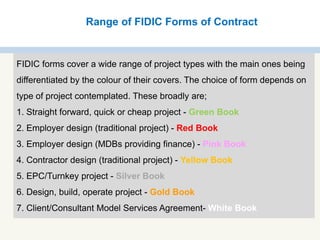
FIDIC forms cover a wide range of project types with the main ones being
differentiated by the colour of their covers. The choice of form depends on
type of project contemplated. These broadly are;
1. Straight forward, quick or cheap project - Green Book
2. Employer design (traditional project) - Red Book
3. Employer design (MDBs providing finance) - Pink Book
4. Contractor design (traditional project) - Yellow Book
5. EPC/Turnkey project - Silver Book
6. Design, build, operate project - Gold Book
7. Client/Consultant Model Services Agreement- White Book
Range of FIDIC Forms of Contract
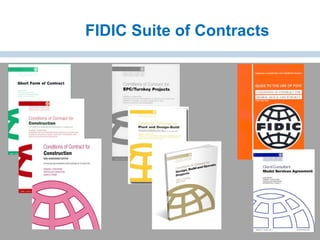
FIDIC Suite of Contracts
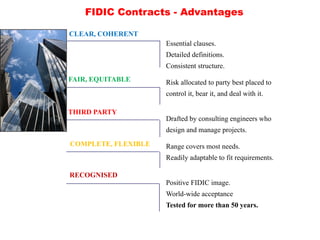
FIDIC Contracts - Advantages
Essential clauses.
Detailed definitions.
Consistent structure.
Risk allocated to party best placed to
control it, bear it, and deal with it.
Drafted by consulting engineers who
design and manage projects.
Range covers most needs.
Readily adaptable to fit requirements.
Positive FIDIC image.
World-wide acceptance
Tested for more than 50 years.
CLEAR, COHERENT
FAIR, EQUITABLE
THIRD PARTY
COMPLETE, FLEXIBLE
RECOGNISED
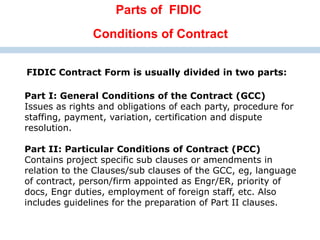
FIDIC Contract Form is usually divided in two parts:
Part I: General Conditions of the Contract (GCC)
Issues as rights and obligations of each party, procedure for
staffing, payment, variation, certification and dispute
resolution.

Part II: Particular Conditions of Contract (PCC)
Contains project specific sub clauses or amendments in
relation to the Clauses/sub clauses of the GCC, eg, language
of contract, person/firm appointed as Engr/ER, priority of
docs, Engr duties, employment of foreign staff, etc. Also
includes guidelines for the preparation of Part II clauses.
Parts of FIDIC
Conditions of Contract
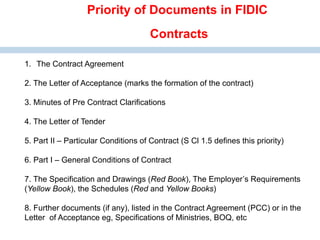
1. The Contract Agreement
2. The Letter of Acceptance (marks the formation of the contract)
3. Minutes of Pre Contract Clarifications
4. The Letter of Tender
5. Part II – Particular Conditions of Contract (S Cl 1.5 defines this priority)
6. Part I – General Conditions of Contract
7. The Specification and Drawings (Red Book), The Employer’s Requirements
(Yellow Book), the Schedules (Red and Yellow Books)
8. Further documents (if any), listed in the Contract Agreement (PCC) or in the
Letter of Acceptance eg, Specifications of Ministries, BOQ, etc
Priority of Documents in FIDIC
Contracts
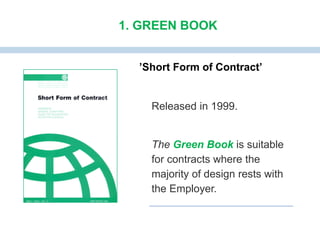
Released in 1999.
The Green Book is suitable
for contracts where the
majority of design rests with
the Employer.
’Short Form of Contract’
1. GREEN BOOK
GREEN BOOK- SALIENT FEATURES
 FIDIC’s recommended form of contract for use on engineering
and building works of relatively small capital value or where the
construction time is short.
 Aimed at applying to contracts with a value of less than US
$500,000 or a construction time of less than six months.
 The Green Book is also suitable for simple or repetitive work.
 Normally contractor executes works according to the employer’s
design. However it does not matter whether the design is
provided by the employer or by the contractor.
 There is no engineer and payments are made at monthly
intervals.
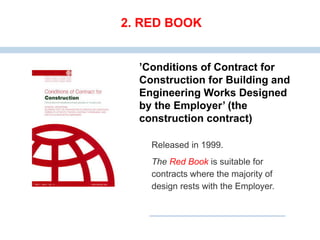
Released in 1999.
The Red Book is suitable for
contracts where the majority of
design rests with the Employer.
’Conditions of Contract for
Construction for Building and
Engineering Works Designed
by the Employer’ (the
construction contract)
2. RED BOOK
RED BOOK – SALIENT FEATURES
 FIDIC’s recommended form of contract for building or engineering works
where the employer has been responsible for nearly all the design. And
is the most widely used international construction contract.
 Key feature is that payment is made according to bills of quantities (a
document in which materials, plant, and labour and their costs are
itemised), although payment can also be made on the basis of agreed
lump sums for items of work.
 The Red Book is administered by the Engineer (a third party) rather than
the contractor or the employer. The engineer will also be responsible for
monitoring the construction work and certifying payments.
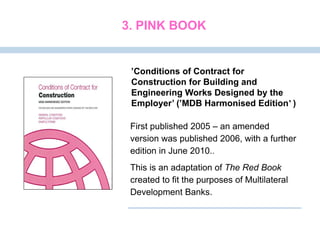
First published 2005 – an amended
version was published 2006, with a further
edition in June 2010..
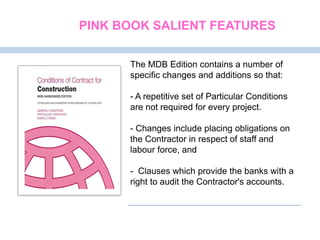
This is an adaptation of The Red Book
created to fit the purposes of Multilateral
Development Banks.
’Conditions of Contract for
Construction for Building and
Engineering Works Designed by the
Employer’ (’MDB Harmonised Edition’ )
3. PINK BOOK
The MDB Edition contains a number of
specific changes and additions so that:
- A repetitive set of Particular Conditions
are not required for every project.
- Changes include placing obligations on
the Contractor in respect of staff and
labour force, and
- Clauses which provide the banks with a
right to audit the Contractor's accounts.
PINK BOOK SALIENT FEATURES
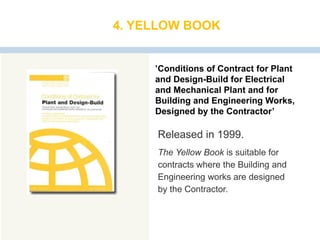
Released in 1999.
The Yellow Book is suitable for
contracts where the Building and
Engineering works are designed
by the Contractor.
’Conditions of Contract for Plant
and Design-Build for Electrical
and Mechanical Plant and for
Building and Engineering Works,
Designed by the Contractor’
4. YELLOW BOOK
YELLOW BOOK SALIENT FEATURES
 Contractor carries out the majority of the design (ie the
detailed design to meet the performance specification
prepared by the employer). Traditionally used for the
provision of plant and building or engineering works on a
design/build basis.
 Its a Lump Sum price contract with payments based on
achieved milestones as certified by the Engineer (like the
Red Book, the engineer administers the contract).
 The contractor is also subject to a “Fitness-for-Purpose”
obligation in respect of the completed project.
5. SILVER BOOK
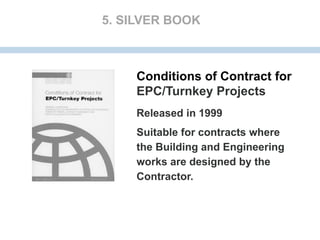
Released in 1999
Suitable for contracts where
the Building and Engineering
works are designed by the
Contractor.
Conditions of Contract for
EPC/Turnkey Projects
SILVER BOOK – SALIENT FEATURES
 Recommended for infrastructure and other projects requiring
higher degree of certainty of final price and time
 Contractor takes on full responsibility for the Design and
Execution of the Project, hence higher risk
 Little Employer involvement. Only suitable for highly
experienced Contractors familiar with risk management
techniques
 Unsuitable if construction involves substantial underground
works.
SILVER BOOK – SALIENT FEATURES
 SB should not be used if the Employer intends to supervise
closely or control the Contractor’s Work, or to review most of
the construction drawings.
 No reference to Engineer. Certification function is carried out
by the Employer’s Representative
 Taking Over only after successful completion of the Tests
 In Silver Book contracts the tenderers must be given sufficient
time to prepare their tenders or Contractor’s Proposals.
5. GOLD BOOK
DBO Contract
Conditions of Contract for
Design, Build and Operate
Projects
First Edition 2008
Suitable for contracts combining a
design-build obligation with a long
term operation commitment.
GOLD BOOK– SALIENT FEATURES
 Combines a design-build obligation with for long-term (O&M
commitment .
 Layout similar to FIDIC Silver Book than any other contract
within the FIDIC Suite.
 Adopts a “green-field DBO scenario with a 20 year operation
period.
 Single contract awarded to a single entity (consortium or JV)
 Recommended where tenders are invited on International basis
GOLD BOOK– SALIENT FEATURES
 Aimed at optimising innovation, quality and performance by
awarding to one consortium rather then separate contracts for
design-build and for operation.
 Employer owns the project but the contractor operates it at his own
risk.
 Contractor not responsible for financing the project or its long-term
commercial success.
 Successful performance of DBO Contracts require full
understanding of overall time frame and the need for long-term
commitment by both the employer and contractor.
DBO Contract
Conditions of
Contract for
Design, Build and
Operate Projects
First Edition 2008
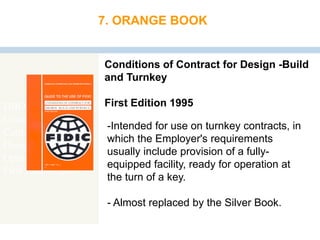
7. ORANGE BOOK
Conditions of Contract for Design -Build
and Turnkey
First Edition 1995
-Intended for use on turnkey contracts, in
which the Employer's requirements
usually include provision of a fully-
equipped facility, ready for operation at
the turn of a key.
- Almost replaced by the Silver Book.
7. ORANGE BOOK- SALIENT FEATURES
 The Orange Book was meant to provide a design and build
option to the then current FIDIC Suite of Contracts (Seldom
Used now).
 Currently an Employer requiring a design and build or
turnkey project is likely to prefer using a 1999 edition of the
Yellow Book for design and build or a Silver Book for
Turnkey.
 It was the first FIDIC contract to adopt the now current
FIDIC style of drafting and served as a template for drafting
the later 1999 suite of contracts.
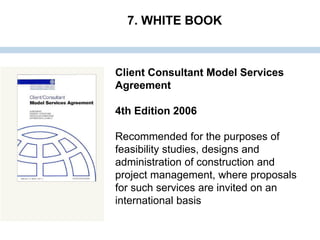
7. WHITE BOOK
Client Consultant Model Services
Agreement
4th Edition 2006
Recommended for the purposes of
feasibility studies, designs and
administration of construction and
project management, where proposals
for such services are invited on an
international basis
Affect on Risk and Cost:
Using Yellow and Silver Books
Key conceptual differences as we move from the Red Book to the
Yellow Book to the Silver Book:
- More risk transferred to the Contractor consequently increasing cost.
- Inversely proportional to this risk transfer, the Contractor is
given more control of the project.
- Design moves from detailed design by Employer, to a performance
specification only, with design solely the responsibility of the
contractor. The Yellow Book has some flexibility to allow an
intermediate level of design by Employer.
- In the Silver Book there is no Engineer at all.
Other Affects of Adding Risk
Using Yellow and Silver Books
Remember that if the Particular Conditions put too much risk on the
Contractor, the following may occur:
• Higher bid price
• Bid failure and disruption of project implementation
• Non-participation in the bid of conscientious and capable contractors
• Contract award to a bidder incapable of estimating risks
• Poor construction quality and delay in the progress of the work
• Undermining the relationship of mutual trust
• Repetition of groundless claims from the Contractor
• Frequent disputes. In an extreme case, termination of the contract.
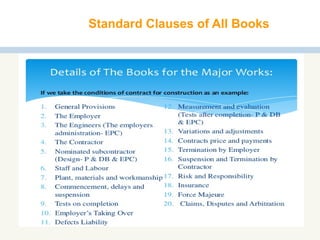
Standard Clauses of All Books
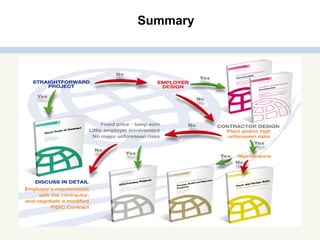
Summary
Thank
You

FIDIC Presentation-2016.pdf

  • 1.
    An Introduction toFIDIC Suite of Contracts By Javed Jafri Contract Specialist 7 Dec 2016
  • 2.
    1. Introduction toFIDIC, 2. Purpose and Range of its Forms of Contract 3. FIDIC Suite of Contracts, Advantages & Parts 4. Priority of Documents in FIDIC Contracts 5. Salient Features of Specific Forms 6. Affects of Using Yellow and Silver Books 7. Summary/Conclusion TOPICS COVERED
  • 3.
    - FIDIC standsfor ‘Fédération Internationale des Ingénieurs - Conseils’, which translates as The International Federation of Consulting Engineers. - Established in 1913, by the trio of French, Belgian and Swiss engineers, FIDIC represents the consulting engineering industry both globally and domestically (through its about 100 member country associations). INTRODUCTION TO FIDIC - FIDIC Consulting Engineer Associations are grouped by region as follows: GAMA- FIDIC Group of African Member Associations ASPAC - FIDIC Asia-Pacific Member Associations - In addition, FIDIC works closely with the following regional groups: EFCA - European Federation of Engineering Consultancy Associations FEPAC - Panamerican Federation of Consultants / Fedaración Panamericana de Consultores
  • 4.
    1. “Be theinternational authority on consulting engineering best practice” 2. “Promote high standards of ethics and integrity among all stakeholders” 3. “Enhance FIDIC’s representation of the consulting engineering industry” 4. “Enhance the image of consulting engineering” 5. “Assist worldwide development of viable consulting engineering industries” 6. “Promote the leading position of FIDIC’s Forms of Contract” INTRODUCTION TO FIDIC: OBJECTIVES
  • 5.
    - THUS FIDIC’SCORE OBJECTIVES CAN BE DEFINED AS; “Promote and assist the worldwide development of a viable consulting engineering industry” - This presentation relates to the 6th objective, “Promoting FIDIC Forms”. - FIDIC consistently aims at creating uniform and ‘user friendly” sets of documents for contractual agreements for use in different types of construction projects, in order to simplify bidding processes. - Remember that most FIDIC forms of contracts are agreements between the employer and the contractor. INTRODUCTION TO FIDIC
  • 6.
    FIDIC’S Contracts Committeeproduces standard forms of contract for civil engineering projects, for global usage. -The purpose of these forms is to; (a) define the contractual relationship between the parties and (b) to apportion risks between the contractor and the employer. - FIDIC maintains that their contract forms allocate risks fairly to the party that is best able to bear and control that risk. - It is important to remember that the FIDIC forms represent a starting point for the preparation of a construction contract. - However, they are routinely amended to reflect the particular characteristics of each project and the requirements of the parties. PURPOSE OF FIDIC FORMS OF CONTRACT
  • 7.
    FIDIC forms covera wide range of project types with the main ones being differentiated by the colour of their covers. The choice of form depends on type of project contemplated. These broadly are; 1. Straight forward, quick or cheap project - Green Book 2. Employer design (traditional project) - Red Book 3. Employer design (MDBs providing finance) - Pink Book 4. Contractor design (traditional project) - Yellow Book 5. EPC/Turnkey project - Silver Book 6. Design, build, operate project - Gold Book 7. Client/Consultant Model Services Agreement- White Book Range of FIDIC Forms of Contract
  • 8.
    FIDIC Suite ofContracts
  • 9.
    FIDIC Contracts -Advantages Essential clauses. Detailed definitions. Consistent structure. Risk allocated to party best placed to control it, bear it, and deal with it. Drafted by consulting engineers who design and manage projects. Range covers most needs. Readily adaptable to fit requirements. Positive FIDIC image. World-wide acceptance Tested for more than 50 years. CLEAR, COHERENT FAIR, EQUITABLE THIRD PARTY COMPLETE, FLEXIBLE RECOGNISED
  • 10.
    FIDIC Contract Formis usually divided in two parts: Part I: General Conditions of the Contract (GCC) Issues as rights and obligations of each party, procedure for staffing, payment, variation, certification and dispute resolution. Part II: Particular Conditions of Contract (PCC) Contains project specific sub clauses or amendments in relation to the Clauses/sub clauses of the GCC, eg, language of contract, person/firm appointed as Engr/ER, priority of docs, Engr duties, employment of foreign staff, etc. Also includes guidelines for the preparation of Part II clauses. Parts of FIDIC Conditions of Contract
  • 11.
    1. The ContractAgreement 2. The Letter of Acceptance (marks the formation of the contract) 3. Minutes of Pre Contract Clarifications 4. The Letter of Tender 5. Part II – Particular Conditions of Contract (S Cl 1.5 defines this priority) 6. Part I – General Conditions of Contract 7. The Specification and Drawings (Red Book), The Employer’s Requirements (Yellow Book), the Schedules (Red and Yellow Books) 8. Further documents (if any), listed in the Contract Agreement (PCC) or in the Letter of Acceptance eg, Specifications of Ministries, BOQ, etc Priority of Documents in FIDIC Contracts
  • 12.
    Released in 1999. TheGreen Book is suitable for contracts where the majority of design rests with the Employer. ’Short Form of Contract’ 1. GREEN BOOK
  • 13.
    GREEN BOOK- SALIENTFEATURES  FIDIC’s recommended form of contract for use on engineering and building works of relatively small capital value or where the construction time is short.  Aimed at applying to contracts with a value of less than US $500,000 or a construction time of less than six months.  The Green Book is also suitable for simple or repetitive work.  Normally contractor executes works according to the employer’s design. However it does not matter whether the design is provided by the employer or by the contractor.  There is no engineer and payments are made at monthly intervals.
  • 14.
    Released in 1999. TheRed Book is suitable for contracts where the majority of design rests with the Employer. ’Conditions of Contract for Construction for Building and Engineering Works Designed by the Employer’ (the construction contract) 2. RED BOOK
  • 15.
    RED BOOK –SALIENT FEATURES  FIDIC’s recommended form of contract for building or engineering works where the employer has been responsible for nearly all the design. And is the most widely used international construction contract.  Key feature is that payment is made according to bills of quantities (a document in which materials, plant, and labour and their costs are itemised), although payment can also be made on the basis of agreed lump sums for items of work.  The Red Book is administered by the Engineer (a third party) rather than the contractor or the employer. The engineer will also be responsible for monitoring the construction work and certifying payments.
  • 16.
    First published 2005– an amended version was published 2006, with a further edition in June 2010.. This is an adaptation of The Red Book created to fit the purposes of Multilateral Development Banks. ’Conditions of Contract for Construction for Building and Engineering Works Designed by the Employer’ (’MDB Harmonised Edition’ ) 3. PINK BOOK
  • 17.
    The MDB Editioncontains a number of specific changes and additions so that: - A repetitive set of Particular Conditions are not required for every project. - Changes include placing obligations on the Contractor in respect of staff and labour force, and - Clauses which provide the banks with a right to audit the Contractor's accounts. PINK BOOK SALIENT FEATURES
  • 18.
    Released in 1999. TheYellow Book is suitable for contracts where the Building and Engineering works are designed by the Contractor. ’Conditions of Contract for Plant and Design-Build for Electrical and Mechanical Plant and for Building and Engineering Works, Designed by the Contractor’ 4. YELLOW BOOK
  • 19.
    YELLOW BOOK SALIENTFEATURES  Contractor carries out the majority of the design (ie the detailed design to meet the performance specification prepared by the employer). Traditionally used for the provision of plant and building or engineering works on a design/build basis.  Its a Lump Sum price contract with payments based on achieved milestones as certified by the Engineer (like the Red Book, the engineer administers the contract).  The contractor is also subject to a “Fitness-for-Purpose” obligation in respect of the completed project.
  • 20.
    5. SILVER BOOK Releasedin 1999 Suitable for contracts where the Building and Engineering works are designed by the Contractor. Conditions of Contract for EPC/Turnkey Projects
  • 21.
    SILVER BOOK –SALIENT FEATURES  Recommended for infrastructure and other projects requiring higher degree of certainty of final price and time  Contractor takes on full responsibility for the Design and Execution of the Project, hence higher risk  Little Employer involvement. Only suitable for highly experienced Contractors familiar with risk management techniques  Unsuitable if construction involves substantial underground works.
  • 22.
    SILVER BOOK –SALIENT FEATURES  SB should not be used if the Employer intends to supervise closely or control the Contractor’s Work, or to review most of the construction drawings.  No reference to Engineer. Certification function is carried out by the Employer’s Representative  Taking Over only after successful completion of the Tests  In Silver Book contracts the tenderers must be given sufficient time to prepare their tenders or Contractor’s Proposals.
  • 23.
    5. GOLD BOOK DBOContract Conditions of Contract for Design, Build and Operate Projects First Edition 2008 Suitable for contracts combining a design-build obligation with a long term operation commitment.
  • 24.
    GOLD BOOK– SALIENTFEATURES  Combines a design-build obligation with for long-term (O&M commitment .  Layout similar to FIDIC Silver Book than any other contract within the FIDIC Suite.  Adopts a “green-field DBO scenario with a 20 year operation period.  Single contract awarded to a single entity (consortium or JV)  Recommended where tenders are invited on International basis
  • 25.
    GOLD BOOK– SALIENTFEATURES  Aimed at optimising innovation, quality and performance by awarding to one consortium rather then separate contracts for design-build and for operation.  Employer owns the project but the contractor operates it at his own risk.  Contractor not responsible for financing the project or its long-term commercial success.  Successful performance of DBO Contracts require full understanding of overall time frame and the need for long-term commitment by both the employer and contractor.
  • 26.
    DBO Contract Conditions of Contractfor Design, Build and Operate Projects First Edition 2008 7. ORANGE BOOK Conditions of Contract for Design -Build and Turnkey First Edition 1995 -Intended for use on turnkey contracts, in which the Employer's requirements usually include provision of a fully- equipped facility, ready for operation at the turn of a key. - Almost replaced by the Silver Book.
  • 27.
    7. ORANGE BOOK-SALIENT FEATURES  The Orange Book was meant to provide a design and build option to the then current FIDIC Suite of Contracts (Seldom Used now).  Currently an Employer requiring a design and build or turnkey project is likely to prefer using a 1999 edition of the Yellow Book for design and build or a Silver Book for Turnkey.  It was the first FIDIC contract to adopt the now current FIDIC style of drafting and served as a template for drafting the later 1999 suite of contracts.
  • 28.
    7. WHITE BOOK ClientConsultant Model Services Agreement 4th Edition 2006 Recommended for the purposes of feasibility studies, designs and administration of construction and project management, where proposals for such services are invited on an international basis
  • 29.
    Affect on Riskand Cost: Using Yellow and Silver Books Key conceptual differences as we move from the Red Book to the Yellow Book to the Silver Book: - More risk transferred to the Contractor consequently increasing cost. - Inversely proportional to this risk transfer, the Contractor is given more control of the project. - Design moves from detailed design by Employer, to a performance specification only, with design solely the responsibility of the contractor. The Yellow Book has some flexibility to allow an intermediate level of design by Employer. - In the Silver Book there is no Engineer at all.
  • 30.
    Other Affects ofAdding Risk Using Yellow and Silver Books Remember that if the Particular Conditions put too much risk on the Contractor, the following may occur: • Higher bid price • Bid failure and disruption of project implementation • Non-participation in the bid of conscientious and capable contractors • Contract award to a bidder incapable of estimating risks • Poor construction quality and delay in the progress of the work • Undermining the relationship of mutual trust • Repetition of groundless claims from the Contractor • Frequent disputes. In an extreme case, termination of the contract.
  • 31.
  • 32.
  • 33.