Project Closure
CHAPTER FOURTEEN
Copyright © 2011 by The McGraw-Hill Companies, Inc. All
rights reserved.
McGraw-Hill/Irwin
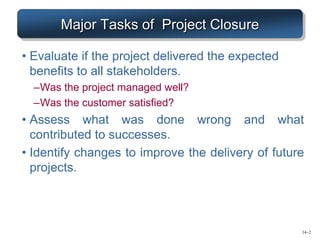
Major Tasks of Project Closure
• Evaluate if the project delivered the expected
benefits to all stakeholders.
–Was the project managed well?
–Was the customer satisfied?
• Assess what was done wrong and what
contributed to successes.
• Identify changes to improve the delivery of future
projects.
14–2
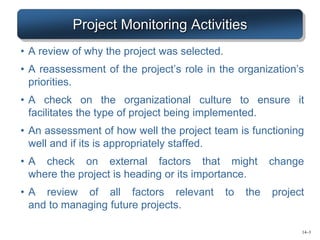
Project Monitoring Activities
• A review of why the project was selected.
• A reassessment of the project’s role in the organization’s
priorities.
• A check on the organizational culture to ensure it
facilitates the type of project being implemented.
• An assessment of how well the project team is functioning
well and if its is appropriately staffed.
• A check on external factors that might change
where the project is heading or its importance.
• A review of all factors relevant to the project
and to managing future projects.
14–3
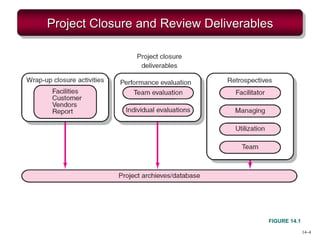
Project Closure and Review Deliverables
FIGURE 14.1
14–4
Project Closure
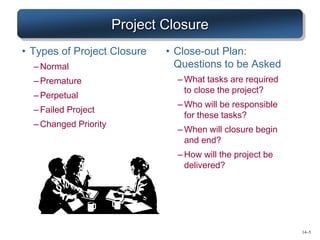
• Types of Project Closure
– Normal
– Premature
– Perpetual
– Failed Project
– Changed Priority
• Close-out Plan:
Questions to be Asked
– What tasks are required
to close the project?
– Who will be responsible
for these tasks?
– When will closure begin
and end?
– How will the project be
delivered?
14–5
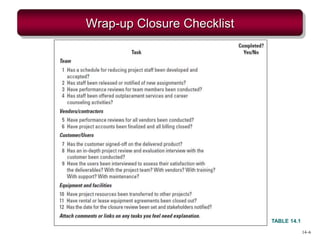
Wrap-up Closure Checklist
TABLE 14.1
14–6
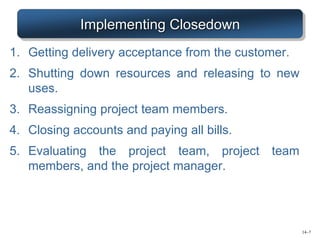
Implementing Closedown
1. Getting delivery acceptance from the customer.
2. Shutting down resources and releasing to new
uses.
3. Reassigning project team members.
4. Closing accounts and paying all bills.
5. Evaluating the project team, project team
members, and the project manager.
14–7
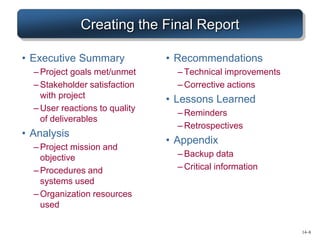
Creating the Final Report
• Executive Summary
– Project goals met/unmet
– Stakeholder satisfaction
with project
– User reactions to quality
of deliverables
• Analysis
– Project mission and
objective
– Procedures and
systems used
– Organization resources
used
• Recommendations
– Technical improvements
– Corrective actions
• Lessons Learned
– Reminders
– Retrospectives
• Appendix
– Backup data
– Critical information
14–8
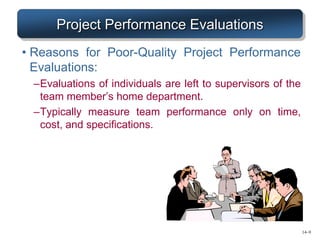
Project Performance Evaluations
• Reasons for Poor-Quality Project Performance
Evaluations:
–Evaluations of individuals are left to supervisors of the
team member’s home department.
–Typically measure team performance only on time,
cost, and specifications.
14–9
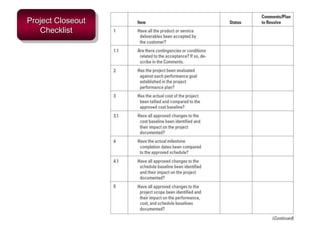
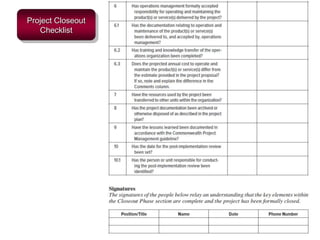
Project Closeout
Checklist
Project Closeout
Checklist
14–11
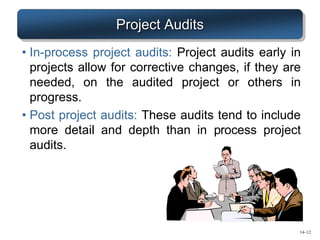
Project Audits
• In-process project audits: Project audits early in
projects allow for corrective changes, if they are
needed, on the audited project or others in
progress.
• Post project audits: These audits tend to include
more detail and depth than in process project
audits.
14–12
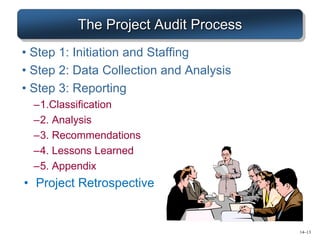
The Project Audit Process
• Step 1: Initiation and Staffing
• Step 2: Data Collection and Analysis
• Step 3: Reporting
–1.Classification
–2. Analysis
–3. Recommendations
–4. Lessons Learned
–5. Appendix
• Project Retrospective
14–13
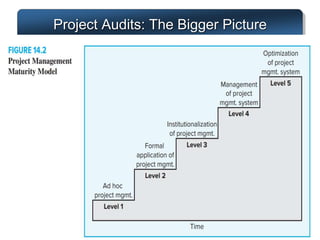
Project Audits: The Bigger Picture
14–14
14–15

Lecture 6 Project Audit & Closure.ppt

  • 1.
    Project Closure CHAPTER FOURTEEN Copyright© 2011 by The McGraw-Hill Companies, Inc. All rights reserved. McGraw-Hill/Irwin
  • 2.
    Major Tasks ofProject Closure • Evaluate if the project delivered the expected benefits to all stakeholders. –Was the project managed well? –Was the customer satisfied? • Assess what was done wrong and what contributed to successes. • Identify changes to improve the delivery of future projects. 14–2
  • 3.
    Project Monitoring Activities •A review of why the project was selected. • A reassessment of the project’s role in the organization’s priorities. • A check on the organizational culture to ensure it facilitates the type of project being implemented. • An assessment of how well the project team is functioning well and if its is appropriately staffed. • A check on external factors that might change where the project is heading or its importance. • A review of all factors relevant to the project and to managing future projects. 14–3
  • 4.
    Project Closure andReview Deliverables FIGURE 14.1 14–4
  • 5.
    Project Closure • Typesof Project Closure – Normal – Premature – Perpetual – Failed Project – Changed Priority • Close-out Plan: Questions to be Asked – What tasks are required to close the project? – Who will be responsible for these tasks? – When will closure begin and end? – How will the project be delivered? 14–5
  • 6.
  • 7.
    Implementing Closedown 1. Gettingdelivery acceptance from the customer. 2. Shutting down resources and releasing to new uses. 3. Reassigning project team members. 4. Closing accounts and paying all bills. 5. Evaluating the project team, project team members, and the project manager. 14–7
  • 8.
    Creating the FinalReport • Executive Summary – Project goals met/unmet – Stakeholder satisfaction with project – User reactions to quality of deliverables • Analysis – Project mission and objective – Procedures and systems used – Organization resources used • Recommendations – Technical improvements – Corrective actions • Lessons Learned – Reminders – Retrospectives • Appendix – Backup data – Critical information 14–8
  • 9.
    Project Performance Evaluations •Reasons for Poor-Quality Project Performance Evaluations: –Evaluations of individuals are left to supervisors of the team member’s home department. –Typically measure team performance only on time, cost, and specifications. 14–9
  • 10.
  • 11.
  • 12.
    Project Audits • In-processproject audits: Project audits early in projects allow for corrective changes, if they are needed, on the audited project or others in progress. • Post project audits: These audits tend to include more detail and depth than in process project audits. 14–12
  • 13.
    The Project AuditProcess • Step 1: Initiation and Staffing • Step 2: Data Collection and Analysis • Step 3: Reporting –1.Classification –2. Analysis –3. Recommendations –4. Lessons Learned –5. Appendix • Project Retrospective 14–13
  • 14.
    Project Audits: TheBigger Picture 14–14
  • 15.