Southeast University 
School of Science and Engineering, Department of Textile Engineering 
Effect of finishing on Knit Fabrics 
Effect of finishing on Knit Fabrics 1
Southeast University 
School of Science and Engineering, Department of Textile Engineering 
Introduction 
 Textile finishing is a term commonly applied to different 
processes that the textile materials undergo after 
pretreatments, dyeing or printing for final embellishments to 
enhance their attractiveness and sale apparels well as for 
comfort and usefulness. 
 Finishing process improves the physical properties of fabric 
like feel, softness, tensile strength, elongation, G.S.M, dia, 
shrinkage, spirality, twisting, and insulation properties. 
Dhaka,15.05.2011 Effect of finishing on Knit Fabrics 2
Southeast University 
School of Science and Engineering, Department of Textile Engineering 
The techniques of finishing depend 
on the following: 
• Nature of the fabric, i.e. chemical composition, state, weave, 
etc. This determines the appearance, i.e. transparences, 
luster, fullness, weight, whiteness, etc. 
• The physical properties of the fabric, i.e. feel, softness, 
stiffness, tensile strength, elongation, shrinkage property, 
insulation etc. 
• The end-use of the material i.e. non-shrinking, non-creasing, 
stiffening etc. 
• Receptivity of the fabric to various finishing operations, i.e. 
water-proofing, flame-proofing, rot-proofing etc. 
• Susceptibility to chemical modifications. 
Dhaka,15.05.2011 Effect of finishing on Knit Fabrics 3
Southeast University 
School of Science and Engineering, Department of Textile Engineering 
Finishing treatments are basically 
meant to give the textile material 
certain desirable properties like: 
 Softness 
 Lusture 
 Pleasant handle 
 Drape 
 Dimensional stability 
 Crease recovery 
 Antistatic 
 Non-slip 
 Soil release 
Dhaka,15.05.2011 Effect of finishing on Knit Fabrics 4
Southeast University 
School of Science and Engineering, Department of Textile Engineering 
Definition of Finishing 
Finishing is a term usually employed for process 
other than scouring, bleaching, dyeing or printing, to 
which the fabric are subjected to improve their 
appearance, properties & serviceability. 
Dhaka,15.05.2011 Effect of finishing on Knit Fabrics 5
Southeast University 
School of Science and Engineering, Department of Textile Engineering 
Classification of Finishes 
 The most common classifications are: 
• Aesthetic finishes: 
• Functional finishes 
 Textile finishes are also categorized as: 
• Mechanical finishes (Dry finishes) 
• Chemical finishes (Wet finishes) 
Dhaka,15.05.2011 Effect of finishing on Knit Fabrics 6
Southeast University 
School of Science and Engineering, Department of Textile Engineering 
Classification of Finishes 
Finishes can also be classified by their degree of 
performance as follows: 
• Permanent finishes 
• Durable finishes 
• Semi-durable finishes 
• Temporary finishes 
Dhaka,15.05.2011 Effect of finishing on Knit Fabrics 7
Southeast University 
School of Science and Engineering, Department of Textile Engineering 
Controling parameter of finishing 
• Dia of the fabric 
• GSM of the fabric 
• Shrinkage of the fabric 
• Weight loss or gain 
• Tension control 
• Temparature of different stage 
• Spirality control etc. 
• Color fastness of the fabric etc. 
Dhaka,15.05.2011 Effect of finishing on Knit Fabrics 8
Southeast University 
School of Science and Engineering, Department of Textile Engineering 
Finishing process 
Process of finishing for Open fabric 
Dhaka,15.05.2011 Effect of finishing on Knit Fabrics 
. 
9 
Unload fabric from Dyeing 
Hydro extracting 
Dryer/Stentering 
Open compacting
Southeast University 
School of Science and Engineering, Department of Textile Engineering 
Finishing process 
Process of finishing for Tube fabric 
Tube form fabric 
Dewatering 
Dryer for drying 
Tube compacting 
Slitting 
Stentering 
Open compacting 
Dhaka,15.05.2011 Effect of finishing on Knit Fabrics 10
Southeast University 
School of Science and Engineering, Department of Textile Engineering 
Finishing terms 
GSM: 
GSM means fabric weight in grams per square 
meter’s . 
  
  
 
Fabric Weight In Grams 
2 
length In m 
GSM 
Dhaka,15.05.2011 Effect of finishing on Knit Fabrics 11
Southeast University 
School of Science and Engineering, Department of Textile Engineering 
Finishing terms 
Shrinkage: 
The amount of shrinkage for any given knit fabric is 
primarily dependent upon the 
product specifications and the knitting parameters used to 
meet those specifications. 
Formula of shrinkage % measurement: 
Before Wash Length After Wash Length 
Length Wise Shrinkage % 100 
Before Wash Width After Wash Width 
Width Wise Shrinkage % 100 
Dhaka,15.05.2011 Effect of finishing on Knit Fabrics 12 
. 
 
  
Before Wash Length 
 
  
Before Wash Width
Southeast University 
School of Science and Engineering, Department of Textile Engineering 
Finishing terms 
Spairality: 
“Spirality” arises from twist stress in the 
constituent’s yarns of plain fabric, causing all loops 
to distort and throwing the fabric wales and 
courses into an angular relationship 
Dhaka,15.05.2011 Color fastness of dye goods. 13
Southeast University 
School of Science and Engineering, Department of Textile Engineering 
Finishing terms 
Color fastness: 
The stability of color or its fastness is one of the 
most important requirements of valuable 
customers. Colour fastness of dyed goods means 
the resistance power of dyed goods against any 
hazards. 
The color textiles show different resistance power 
to different agencies such as light, wash, rubbing, 
perspiration, water, bleach, acid, alkali etc. 
Dhaka,15.05.2011 Effect of finishing on Knit Fabrics 
. 
. 
14
Southeast University 
School of Science and Engineering, Department of Textile Engineering 
Effect of Hydro and Dewatering 
 If water remove from fabric is very much percentage than 
fabric surface show crease mark, this fault can’t be 
remove. 
 If length wise run the fabric then 20% shrinkage occurs. 
 If breakdown occur of de-twister than puckering occurs. 
 If twist problem occur than it effect on knit garments. 
 If do not take proper ballooning than folding mark occurs. 
Dhaka,15.05.2011 Effect of finishing on Knit Fabrics 
. 
. 
15
Southeast University 
School of Science and Engineering, Department of Textile Engineering 
Effect of Hydro and Dewatering 
 If squeeze roller/padder pressure is high than fabric surface 
show pressure mark. 
 If over feed dia of delivery side is not perfect than length 
wise shrinkage occurs. 
 If dia increase than become poor shrinkage properties. 
 Dia increase in this stage because it helps to better work for 
dryer & slitting. 
 Dia mark also occurs in this stage. 
Dhaka,15.05.2011 Effect of finishing on Knit Fabrics 
. 
16
Southeast University 
School of Science and Engineering, Department of Textile Engineering 
Effect of slitting 
 If dia is less than basket dia than fabrics do not cut 
and if dia is greater than basket than GSM problem 
occurs. 
 Cut the fabric break wales line wise. 
 Basket dia must be less then fabric dia. 
Dhaka,15.05.2011 Effect of finishing on Knit Fabrics 
. 
17
Southeast University 
School of Science and Engineering, Department of Textile Engineering 
Effect of Stentering 
 Over feed tension is very important for this stage. 
 If over feed decrease than length increase. 
 More over feed give in white fabric. 
 If need light shade of the fabric than increase padder 
pressure. 
 If need dark shade of the fabric than temperature increase 
20˚C. 
 For Lycra heat setting temperature need (190-200) ˚C. 
 If half feeder Lycra fabric than increase speed and decrease 
temp. 
 If full feeder Lycra fabric temp need 200˚C. 
 Heat setting takes for width fixed of Lycra fabric. 
Dhaka,15.05.2011 Effect of finishing on Knit Fabrics 
. 
18
Southeast University 
School of Science and Engineering, Department of Textile Engineering 
Effect of Compacting 
Many textile manufacturers have, and still do, rely on 
compaction as a means of shrinkage control. Compaction is a 
method whereby the course loops are compressed upon 
themselves. Different machines incorporate a variety of 
techniques to accomplish this. There are basically two 
classifications of compaction: heated rolls and shoe units or belt 
shrinking units. Both methods rely on speed differential and 
their patented compaction zones to accomplish the compaction. 
Tubular and open-width systems are available. The fabric is 
steamed to add moisture and then introduced to the compacting 
zone. The compaction mechanism, along with heat and 
moisture, forces the length stitches (courses) to be compacted. 
Dhaka,15.05.2011 Effect of finishing on Knit Fabrics 
. 
19
Southeast University 
School of Science and Engineering, Department of Textile Engineering 
Results and discussion 
Dhaka,15.05.2011 Effect of finishing on Knit Fabrics 
. 
20 
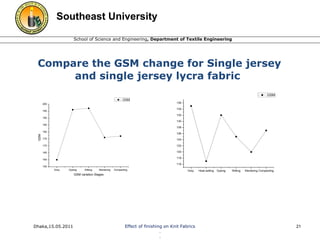
For finding the effect of finishing on knit fabric 
some experiment are done on different types of 
knit fabric.
Southeast University 
School of Science and Engineering, Department of Textile Engineering 
Compare the GSM change for Single jersey 
and single jersey lycra fabric 
200 
195 
190 
185 
180 
175 
170 
165 
160 
136 
134 
132 
130 
128 
126 
124 
122 
120 
118 
Dhaka,15.05.2011 Effect of finishing on Knit Fabrics 
. 
. 
21 
Grey Dyeing Slitting Stentering Compacting 
155 
GSM 
GSM variation Stages 
GSM 
Grey Heat setting Dyeing Slitting Stentering Compacting 
116 
GSM
Southeast University 
School of Science and Engineering, Department of Textile Engineering 
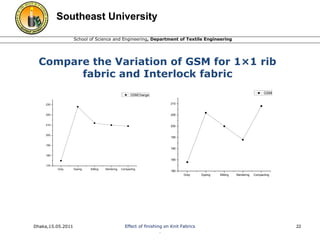
Compare the Variation of GSM for 1×1 rib 
fabric and Interlock fabric 
210 
205 
200 
195 
190 
185 
230 
220 
210 
200 
190 
180 
Dhaka,15.05.2011 Effect of finishing on Knit Fabrics 
. 
22 
Grey Dyeing Slitting Stentering Compacting 
180 
GSM 
Grey Dyeing Slitting Stentering Compacting 
170 
GSMChange
Southeast University 
School of Science and Engineering, Department of Textile Engineering 
Compare the variation of GSM for fleece 
fabric and Pique 
235 
230 
225 
220 
215 
210 
205 
220 
210 
200 
190 
180 
Dhaka,15.05.2011 Effect of finishing on Knit Fabrics 
. 
23 
Grey Dyeing Slitting Stentering Compacting Brushing 
200 
GSM 
Grey Dyeing Slitting Stentering Compacting 
170 
GSM
Southeast University 
School of Science and Engineering, Department of Textile Engineering 
Compare the shrinkage % change for Single 
jersey and single jersey lycra fabric 
3 
2 
1 
0 
-1 
-2 
-3 
-4 
1 
0 
-1 
-2 
-3 
-4 
Dhaka,15.05.2011 Effect of finishing on Knit Fabrics 
. 
24 
Dyeing Slitting Stentering Compacting 
-5 
Shrinkage% 
width% 
length% 
Dyeing Slitting Stentering Compacting 
-5 
Width% 
Length%
Southeast University 
School of Science and Engineering, Department of Textile Engineering 
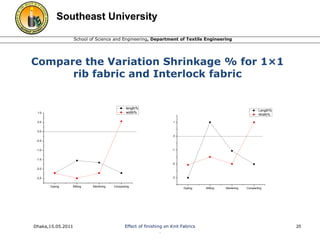
Compare the Variation Shrinkage % for 1×1 
rib fabric and Interlock fabric 
1.0 
0.5 
0.0 
-0.5 
-1.0 
-1.5 
-2.0 
1 
0 
-1 
-2 
Dhaka,15.05.2011 Effect of finishing on Knit Fabrics 
. 
25 
Dyeing Slitting Stentering Compacting 
-2.5 
length% 
width% 
Dyeing Slitting Stentering Compacting 
-3 
Length% 
Width%
Southeast University 
School of Science and Engineering, Department of Textile Engineering 
Compare the shrinkage % of fleece 
fabric and Pique 
1.0 
0.5 
0.0 
-0.5 
-1.0 
3 
2 
1 
0 
-1 
-2 
-3 
Dhaka,15.05.2011 Effect of finishing on Knit Fabrics 
. 
26 
Dyeing Slitting Stentering Compacting 
-1.5 
Length% 
Width% 
Dyeing Slitting Stentering Compacting 
-4 
length% 
width%
Southeast University 
School of Science and Engineering, Department of Textile Engineering 
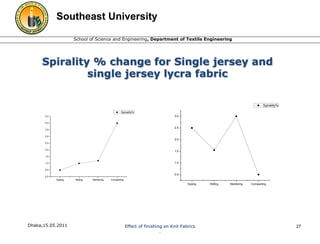
Spirality % change for Single jersey and 
single jersey lycra fabric 
3.0 
2.5 
2.0 
1.5 
1.0 
4.5 
4.0 
3.5 
3.0 
2.5 
2.0 
1.5 
1.0 
0.5 
Dhaka,15.05.2011 Effect of finishing on Knit Fabrics 
. 
27 
Dyeing Slitting Stentering Compacting 
0.5 
Spirality% 
Dyeing Slitting Stentering Compacting 
0.0 
Spirality%
Southeast University 
School of Science and Engineering, Department of Textile Engineering 
Spirality % change for 1×1 rib fabric 
and Interlock fabric 
2.5 
2.0 
1.5 
1.0 
0.5 
2.6 
2.4 
2.2 
2.0 
1.8 
1.6 
1.4 
1.2 
1.0 
Dhaka,15.05.2011 Effect of finishing on Knit Fabrics 
. 
28 
Dyeing Slitting Stentering Compacting 
0.0 
Spirality% 
Dyeing Slitting Stentering Compacting 
0.8 
Spirality%
Southeast University 
School of Science and Engineering, Department of Textile Engineering 
Spirality % of fleece fabric and Pique 
Spirality% 
Dyeing Slitting Stentering Compacting 
3.0 
2.5 
2.0 
1.5 
1.0 
spirality% 
Dyeing Slitting Stentering Compacting 
3.2 
3.0 
2.8 
2.6 
2.4 
2.2 
2.0 
1.8 
1.6 
1.4 
Dhaka,15.05.2011 Effect of finishing on Knit Fabrics 29
Southeast University 
School of Science and Engineering, Department of Textile Engineering 
Discussion 
Dhaka,15.05.2011 Effect of finishing on Knit Fabrics 30
Southeast University 
School of Science and Engineering, Department of Textile Engineering 
References 
• http://www.thesmarttime.com 
• Books of Finishing ,By-Petro Bellini,Ferruccio Bonetti. 
• Lecture sheet of Dr. Zulhash Uddin 
• Experimental data from Paddma poly cotton knit fabrics 
Ltd. 
Dhaka,15.05.2011 Effect of finishing on Knit Fabrics 31
Southeast University 
School of Science and Engineering, Department of Textile Engineering 
Acknowledgement 
We would like to express many thanks to our 
honorable teacher Md. Fazley Elahi for giving us a 
very good opportunity for presenting ourselves. We 
also thanks our parents who encouraged us every 
step of our life. Lastly thanks all of you who are 
give kind attention for this presentation ceremony 
Dhaka,15.05.2011 Effect of finishing on Knit Fabrics 32
Southeast University 
School of Science and Engineering, Department of Textile Engineering 
33 
Thank you ALL for your Attention 
Dhaka,15.05.2011 Effect of finishing on Knit Fabrics
Southeast University 
School of Science and Engineering, Department of Textile Engineering

Effect of finishing on Knit Fabrics

  • 1.
    Southeast University Schoolof Science and Engineering, Department of Textile Engineering Effect of finishing on Knit Fabrics Effect of finishing on Knit Fabrics 1
  • 2.
    Southeast University Schoolof Science and Engineering, Department of Textile Engineering Introduction  Textile finishing is a term commonly applied to different processes that the textile materials undergo after pretreatments, dyeing or printing for final embellishments to enhance their attractiveness and sale apparels well as for comfort and usefulness.  Finishing process improves the physical properties of fabric like feel, softness, tensile strength, elongation, G.S.M, dia, shrinkage, spirality, twisting, and insulation properties. Dhaka,15.05.2011 Effect of finishing on Knit Fabrics 2
  • 3.
    Southeast University Schoolof Science and Engineering, Department of Textile Engineering The techniques of finishing depend on the following: • Nature of the fabric, i.e. chemical composition, state, weave, etc. This determines the appearance, i.e. transparences, luster, fullness, weight, whiteness, etc. • The physical properties of the fabric, i.e. feel, softness, stiffness, tensile strength, elongation, shrinkage property, insulation etc. • The end-use of the material i.e. non-shrinking, non-creasing, stiffening etc. • Receptivity of the fabric to various finishing operations, i.e. water-proofing, flame-proofing, rot-proofing etc. • Susceptibility to chemical modifications. Dhaka,15.05.2011 Effect of finishing on Knit Fabrics 3
  • 4.
    Southeast University Schoolof Science and Engineering, Department of Textile Engineering Finishing treatments are basically meant to give the textile material certain desirable properties like:  Softness  Lusture  Pleasant handle  Drape  Dimensional stability  Crease recovery  Antistatic  Non-slip  Soil release Dhaka,15.05.2011 Effect of finishing on Knit Fabrics 4
  • 5.
    Southeast University Schoolof Science and Engineering, Department of Textile Engineering Definition of Finishing Finishing is a term usually employed for process other than scouring, bleaching, dyeing or printing, to which the fabric are subjected to improve their appearance, properties & serviceability. Dhaka,15.05.2011 Effect of finishing on Knit Fabrics 5
  • 6.
    Southeast University Schoolof Science and Engineering, Department of Textile Engineering Classification of Finishes  The most common classifications are: • Aesthetic finishes: • Functional finishes  Textile finishes are also categorized as: • Mechanical finishes (Dry finishes) • Chemical finishes (Wet finishes) Dhaka,15.05.2011 Effect of finishing on Knit Fabrics 6
  • 7.
    Southeast University Schoolof Science and Engineering, Department of Textile Engineering Classification of Finishes Finishes can also be classified by their degree of performance as follows: • Permanent finishes • Durable finishes • Semi-durable finishes • Temporary finishes Dhaka,15.05.2011 Effect of finishing on Knit Fabrics 7
  • 8.
    Southeast University Schoolof Science and Engineering, Department of Textile Engineering Controling parameter of finishing • Dia of the fabric • GSM of the fabric • Shrinkage of the fabric • Weight loss or gain • Tension control • Temparature of different stage • Spirality control etc. • Color fastness of the fabric etc. Dhaka,15.05.2011 Effect of finishing on Knit Fabrics 8
  • 9.
    Southeast University Schoolof Science and Engineering, Department of Textile Engineering Finishing process Process of finishing for Open fabric Dhaka,15.05.2011 Effect of finishing on Knit Fabrics . 9 Unload fabric from Dyeing Hydro extracting Dryer/Stentering Open compacting
  • 10.
    Southeast University Schoolof Science and Engineering, Department of Textile Engineering Finishing process Process of finishing for Tube fabric Tube form fabric Dewatering Dryer for drying Tube compacting Slitting Stentering Open compacting Dhaka,15.05.2011 Effect of finishing on Knit Fabrics 10
  • 11.
    Southeast University Schoolof Science and Engineering, Department of Textile Engineering Finishing terms GSM: GSM means fabric weight in grams per square meter’s .      Fabric Weight In Grams 2 length In m GSM Dhaka,15.05.2011 Effect of finishing on Knit Fabrics 11
  • 12.
    Southeast University Schoolof Science and Engineering, Department of Textile Engineering Finishing terms Shrinkage: The amount of shrinkage for any given knit fabric is primarily dependent upon the product specifications and the knitting parameters used to meet those specifications. Formula of shrinkage % measurement: Before Wash Length After Wash Length Length Wise Shrinkage % 100 Before Wash Width After Wash Width Width Wise Shrinkage % 100 Dhaka,15.05.2011 Effect of finishing on Knit Fabrics 12 .    Before Wash Length    Before Wash Width
  • 13.
    Southeast University Schoolof Science and Engineering, Department of Textile Engineering Finishing terms Spairality: “Spirality” arises from twist stress in the constituent’s yarns of plain fabric, causing all loops to distort and throwing the fabric wales and courses into an angular relationship Dhaka,15.05.2011 Color fastness of dye goods. 13
  • 14.
    Southeast University Schoolof Science and Engineering, Department of Textile Engineering Finishing terms Color fastness: The stability of color or its fastness is one of the most important requirements of valuable customers. Colour fastness of dyed goods means the resistance power of dyed goods against any hazards. The color textiles show different resistance power to different agencies such as light, wash, rubbing, perspiration, water, bleach, acid, alkali etc. Dhaka,15.05.2011 Effect of finishing on Knit Fabrics . . 14
  • 15.
    Southeast University Schoolof Science and Engineering, Department of Textile Engineering Effect of Hydro and Dewatering  If water remove from fabric is very much percentage than fabric surface show crease mark, this fault can’t be remove.  If length wise run the fabric then 20% shrinkage occurs.  If breakdown occur of de-twister than puckering occurs.  If twist problem occur than it effect on knit garments.  If do not take proper ballooning than folding mark occurs. Dhaka,15.05.2011 Effect of finishing on Knit Fabrics . . 15
  • 16.
    Southeast University Schoolof Science and Engineering, Department of Textile Engineering Effect of Hydro and Dewatering  If squeeze roller/padder pressure is high than fabric surface show pressure mark.  If over feed dia of delivery side is not perfect than length wise shrinkage occurs.  If dia increase than become poor shrinkage properties.  Dia increase in this stage because it helps to better work for dryer & slitting.  Dia mark also occurs in this stage. Dhaka,15.05.2011 Effect of finishing on Knit Fabrics . 16
  • 17.
    Southeast University Schoolof Science and Engineering, Department of Textile Engineering Effect of slitting  If dia is less than basket dia than fabrics do not cut and if dia is greater than basket than GSM problem occurs.  Cut the fabric break wales line wise.  Basket dia must be less then fabric dia. Dhaka,15.05.2011 Effect of finishing on Knit Fabrics . 17
  • 18.
    Southeast University Schoolof Science and Engineering, Department of Textile Engineering Effect of Stentering  Over feed tension is very important for this stage.  If over feed decrease than length increase.  More over feed give in white fabric.  If need light shade of the fabric than increase padder pressure.  If need dark shade of the fabric than temperature increase 20˚C.  For Lycra heat setting temperature need (190-200) ˚C.  If half feeder Lycra fabric than increase speed and decrease temp.  If full feeder Lycra fabric temp need 200˚C.  Heat setting takes for width fixed of Lycra fabric. Dhaka,15.05.2011 Effect of finishing on Knit Fabrics . 18
  • 19.
    Southeast University Schoolof Science and Engineering, Department of Textile Engineering Effect of Compacting Many textile manufacturers have, and still do, rely on compaction as a means of shrinkage control. Compaction is a method whereby the course loops are compressed upon themselves. Different machines incorporate a variety of techniques to accomplish this. There are basically two classifications of compaction: heated rolls and shoe units or belt shrinking units. Both methods rely on speed differential and their patented compaction zones to accomplish the compaction. Tubular and open-width systems are available. The fabric is steamed to add moisture and then introduced to the compacting zone. The compaction mechanism, along with heat and moisture, forces the length stitches (courses) to be compacted. Dhaka,15.05.2011 Effect of finishing on Knit Fabrics . 19
  • 20.
    Southeast University Schoolof Science and Engineering, Department of Textile Engineering Results and discussion Dhaka,15.05.2011 Effect of finishing on Knit Fabrics . 20 For finding the effect of finishing on knit fabric some experiment are done on different types of knit fabric.
  • 21.
    Southeast University Schoolof Science and Engineering, Department of Textile Engineering Compare the GSM change for Single jersey and single jersey lycra fabric 200 195 190 185 180 175 170 165 160 136 134 132 130 128 126 124 122 120 118 Dhaka,15.05.2011 Effect of finishing on Knit Fabrics . . 21 Grey Dyeing Slitting Stentering Compacting 155 GSM GSM variation Stages GSM Grey Heat setting Dyeing Slitting Stentering Compacting 116 GSM
  • 22.
    Southeast University Schoolof Science and Engineering, Department of Textile Engineering Compare the Variation of GSM for 1×1 rib fabric and Interlock fabric 210 205 200 195 190 185 230 220 210 200 190 180 Dhaka,15.05.2011 Effect of finishing on Knit Fabrics . 22 Grey Dyeing Slitting Stentering Compacting 180 GSM Grey Dyeing Slitting Stentering Compacting 170 GSMChange
  • 23.
    Southeast University Schoolof Science and Engineering, Department of Textile Engineering Compare the variation of GSM for fleece fabric and Pique 235 230 225 220 215 210 205 220 210 200 190 180 Dhaka,15.05.2011 Effect of finishing on Knit Fabrics . 23 Grey Dyeing Slitting Stentering Compacting Brushing 200 GSM Grey Dyeing Slitting Stentering Compacting 170 GSM
  • 24.
    Southeast University Schoolof Science and Engineering, Department of Textile Engineering Compare the shrinkage % change for Single jersey and single jersey lycra fabric 3 2 1 0 -1 -2 -3 -4 1 0 -1 -2 -3 -4 Dhaka,15.05.2011 Effect of finishing on Knit Fabrics . 24 Dyeing Slitting Stentering Compacting -5 Shrinkage% width% length% Dyeing Slitting Stentering Compacting -5 Width% Length%
  • 25.
    Southeast University Schoolof Science and Engineering, Department of Textile Engineering Compare the Variation Shrinkage % for 1×1 rib fabric and Interlock fabric 1.0 0.5 0.0 -0.5 -1.0 -1.5 -2.0 1 0 -1 -2 Dhaka,15.05.2011 Effect of finishing on Knit Fabrics . 25 Dyeing Slitting Stentering Compacting -2.5 length% width% Dyeing Slitting Stentering Compacting -3 Length% Width%
  • 26.
    Southeast University Schoolof Science and Engineering, Department of Textile Engineering Compare the shrinkage % of fleece fabric and Pique 1.0 0.5 0.0 -0.5 -1.0 3 2 1 0 -1 -2 -3 Dhaka,15.05.2011 Effect of finishing on Knit Fabrics . 26 Dyeing Slitting Stentering Compacting -1.5 Length% Width% Dyeing Slitting Stentering Compacting -4 length% width%
  • 27.
    Southeast University Schoolof Science and Engineering, Department of Textile Engineering Spirality % change for Single jersey and single jersey lycra fabric 3.0 2.5 2.0 1.5 1.0 4.5 4.0 3.5 3.0 2.5 2.0 1.5 1.0 0.5 Dhaka,15.05.2011 Effect of finishing on Knit Fabrics . 27 Dyeing Slitting Stentering Compacting 0.5 Spirality% Dyeing Slitting Stentering Compacting 0.0 Spirality%
  • 28.
    Southeast University Schoolof Science and Engineering, Department of Textile Engineering Spirality % change for 1×1 rib fabric and Interlock fabric 2.5 2.0 1.5 1.0 0.5 2.6 2.4 2.2 2.0 1.8 1.6 1.4 1.2 1.0 Dhaka,15.05.2011 Effect of finishing on Knit Fabrics . 28 Dyeing Slitting Stentering Compacting 0.0 Spirality% Dyeing Slitting Stentering Compacting 0.8 Spirality%
  • 29.
    Southeast University Schoolof Science and Engineering, Department of Textile Engineering Spirality % of fleece fabric and Pique Spirality% Dyeing Slitting Stentering Compacting 3.0 2.5 2.0 1.5 1.0 spirality% Dyeing Slitting Stentering Compacting 3.2 3.0 2.8 2.6 2.4 2.2 2.0 1.8 1.6 1.4 Dhaka,15.05.2011 Effect of finishing on Knit Fabrics 29
  • 30.
    Southeast University Schoolof Science and Engineering, Department of Textile Engineering Discussion Dhaka,15.05.2011 Effect of finishing on Knit Fabrics 30
  • 31.
    Southeast University Schoolof Science and Engineering, Department of Textile Engineering References • http://www.thesmarttime.com • Books of Finishing ,By-Petro Bellini,Ferruccio Bonetti. • Lecture sheet of Dr. Zulhash Uddin • Experimental data from Paddma poly cotton knit fabrics Ltd. Dhaka,15.05.2011 Effect of finishing on Knit Fabrics 31
  • 32.
    Southeast University Schoolof Science and Engineering, Department of Textile Engineering Acknowledgement We would like to express many thanks to our honorable teacher Md. Fazley Elahi for giving us a very good opportunity for presenting ourselves. We also thanks our parents who encouraged us every step of our life. Lastly thanks all of you who are give kind attention for this presentation ceremony Dhaka,15.05.2011 Effect of finishing on Knit Fabrics 32
  • 33.
    Southeast University Schoolof Science and Engineering, Department of Textile Engineering 33 Thank you ALL for your Attention Dhaka,15.05.2011 Effect of finishing on Knit Fabrics
  • 34.
    Southeast University Schoolof Science and Engineering, Department of Textile Engineering