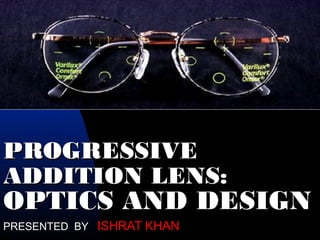
PROGRESSIVEPROGRESSIVE
ADDITION LENS:ADDITION LENS:
OPTICS AND DESIGNOPTICS AND DESIGN
PRESENTED BY ISHRAT KHAN
FROM SRMS IPS BAREILLY
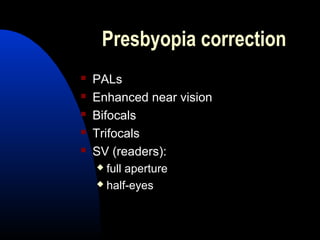
Presbyopia correction
 PALs
 Enhanced near vision
 Bifocals
 Trifocals
 SV (readers):
 full aperture
 half-eyes
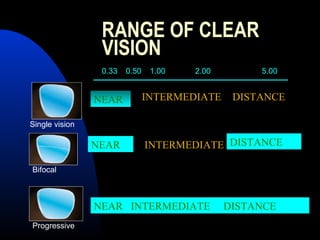
RANGE OF CLEAR
VISION
Single vision
Bifocal
Progressive
0.33 0.50 1.00 2.00 5.00
NEAR INTERMEDIATE DISTANCE
PURPOSE
 Understand experience with current
correction
 Highlight limitations of current correction
 Explain feature/benefits
 Refer to “change in vision” when refitting
into different design
 Listen to the wearer’s needs
 Restate the wearer’s needs (avoid technical
jargon)
 Make the recommendation
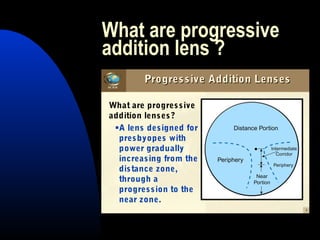
What are progressive
addition lens ?
1
Progressive Addition LensesProgressive Addition Lenses
What are progressive
addition lenses?
A lens designed for
presbyopes with
power gradually
increasing from the
distance zone,
through a
progression to the
near zone.
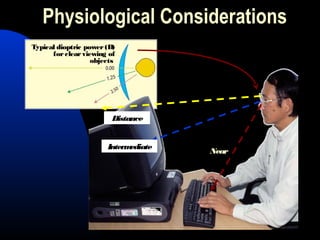
Physiological Considerations
Distance
Intermediate
Near
Typical dioptric power(D)
forclearviewing of
objects
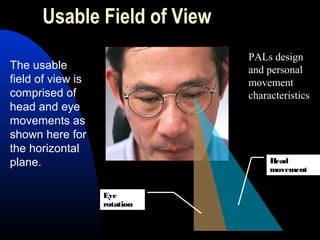
The usable
field of view is
comprised of
head and eye
movements as
shown here for
the horizontal
plane.
Usable Field of View
Eye
rotation
Head
movement
PALs design
and personal
movement
characteristics
Binocular Vision
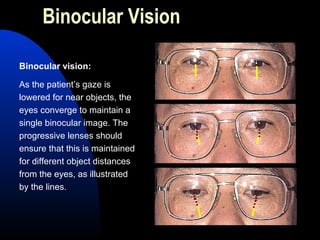
Binocular vision:
As the patient’s gaze is
lowered for near objects, the
eyes converge to maintain a
single binocular image. The
progressive lenses should
ensure that this is maintained
for different object distances
from the eyes, as illustrated
by the lines.
Peripheral (Extra-Foveal) Vision
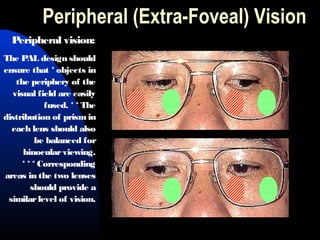
Peripheral vision:
The PAL design should
ensure that * objects in
the periphery of the
visual field are easily
fused. * * The
distribution of prismin
each lens should also
be balanced for
binocularviewing.
* * * Corresponding
areas in the two lenses
should provide a
similarlevel of vision.
Why Use PALs?
 Uninterrupted vision from
distance to near
 No visible line
 No jump in vision from
distance to near
 Better vision as intermediate
is clear
 Looks like single vision
 Lighter/thinner than SV
 Looks better
 More natural vision
 More visual comfort
 Confidence in mobility
Feature Benefit
Intermediate Vision
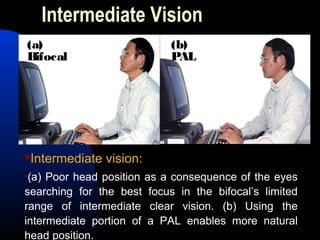
Intermediate vision:
(a) Poor head position as a consequence of the eyes
searching for the best focus in the bifocal’s limited
range of intermediate clear vision. (b) Using the
intermediate portion of a PAL enables more natural
head position.
(a)
Bifocal
(b)
PAL
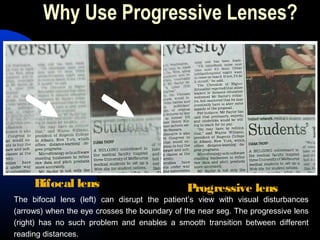
Why Use Progressive Lenses?
Bifocal lens Progressive lens
The bifocal lens (left) can disrupt the patient’s view with visual disturbances
(arrows) when the eye crosses the boundary of the near seg. The progressive lens
(right) has no such problem and enables a smooth transition between different
reading distances.
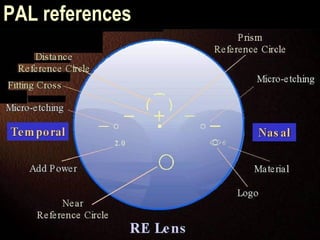
PAL references
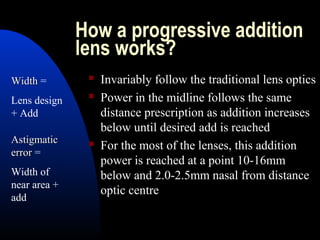
How a progressive addition
lens works?
 Invariably follow the traditional lens optics
 Power in the midline follows the same
distance prescription as addition increases
below until desired add is reached
 For the most of the lenses, this addition
power is reached at a point 10-16mm
below and 2.0-2.5mm nasal from distance
optic centre
WidthWidth =
Lens design
+ Add
AstigmaticAstigmatic
errorerror =
Width of
near area +
add
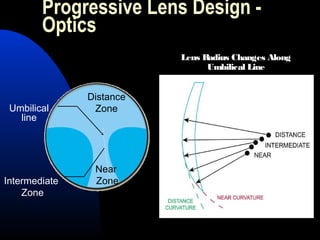
Progressive Lens Design -
Optics
Distance
Zone
Near
Zone
Umbilical
line
Intermediate
Zone
Lens Radius Changes AlongLens Radius Changes Along
Umbilical LineUmbilical Line
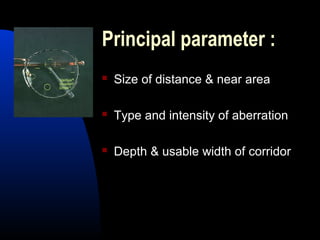
Principal parameter :
 Size of distance & near area
 Type and intensity of aberration
 Depth & usable width of corridor
Design in PAL’S :
 Hard design
 Soft design
 Symmetrical design
 Asymmetrical design
 Mono design
 Multi design
 Prescription based design
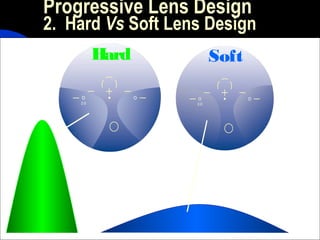
Progressive Lens Design
2. Hard Vs Soft Lens Design
Hard Soft
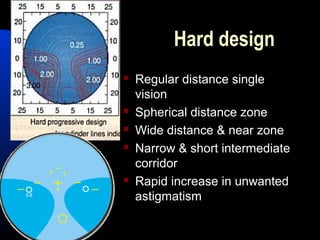
Hard design
 Regular distance single
vision
 Spherical distance zone
 Wide distance & near zone
 Narrow & short intermediate
corridor
 Rapid increase in unwanted
astigmatism
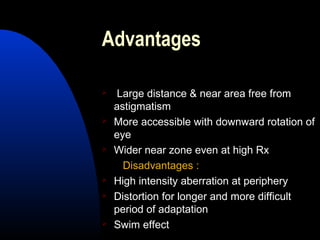
Advantages
 Large distance & near area free from
astigmatism
 More accessible with downward rotation of
eye
 Wider near zone even at high Rx
Disadvantages :
 High intensity aberration at periphery
 Distortion for longer and more difficult
period of adaptation
 Swim effect
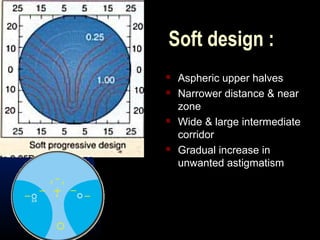
Soft design :
 Aspheric upper halves
 Narrower distance & near
zone
 Wide & large intermediate
corridor
 Gradual increase in
unwanted astigmatism
Width of Far
Vision (+4mm):
0.5 [D]- 16.2 mm
1.0 [D]- Unlimited
Max Cylinder [D]-
Nasal: 1.5[D]
Max Cylinder [D]-
Temporal: 1.5 [D]
Width of Corridor
(-6mm):
1.0[D]- 9 mm
Length of corridor:
14.2 mm
Minimum fitting:
19 mm
Width of near
Vision (-18 mm):
1.0[D]- 21.63 mm
Soft Design
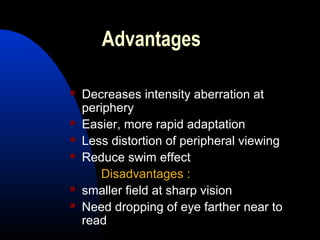
Advantages
 Decreases intensity aberration at
periphery
 Easier, more rapid adaptation
 Less distortion of peripheral viewing
 Reduce swim effect
Disadvantages :
 smaller field at sharp vision
 Need dropping of eye farther near to
read
Indication for selection
Hard design :
 Previous successful hard lens
wearers
 People who do a lot of reading
Soft design :
 Young presbyopes
 Active outdoor profession
 Professional driver
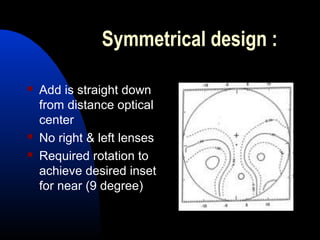
Symmetrical design :
 Add is straight down
from distance optical
center
 No right & left lenses
 Required rotation to
achieve desired inset
for near (9 degree)
Advantages :
 We can give the inset according to
patient
Disadvantages :
 As the wearers looks to the side
they will experience different power
& differential prism
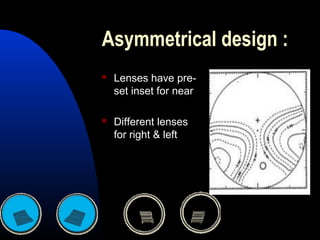
Asymmetrical design :
 Lenses have pre-
set inset for near
 Different lenses
for right & left
Progressive Lens Design
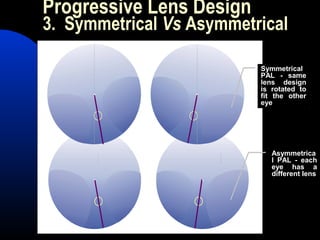
3. Symmetrical Vs Asymmetrical
Symmetrical
PAL - same
lens design
is rotated to
fit the other
eye
Asymmetrica
l PAL - each
eye has a
different lens
Advantages :
 This will not produces experience
of different power when patient
looks to a side
Disadvantages :
 Fixed inset may not match with
patient’s required inset
Mono design :
 Describe range of power for a
given design
 It classify hard & soft
 It describe the characteristics of
progressive zone
 Maintain design principles
throughout the range of addition
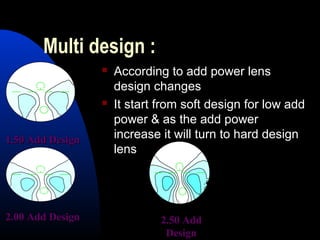
Multi design :
 According to add power lens
design changes
 It start from soft design for low add
power & as the add power
increase it will turn to hard design
lens
1.50 Add Design1.50 Add Design
2.00 Add Design2.00 Add Design 2.50 Add2.50 Add
DesignDesign
Prescription base
design :
 Result of years of Vision Research
 Dedicated design for every Base and Add
 Design by Base : different designs for
Hyperopes, Emmetropes and Myopes (FOV
& Magn.)
 Design by Add: effective near zone sizes
change as the add increases
 Near inset position varies relative to level of
Presbyopia / reading distance
 Corridor length also varies relative to both
Base and Add
Incorporating Single
vision aspheric design in
to the PALs
 Aspheric advantage
 Flat, thin, lighter
 Earlier front surface aspheric
design
 Back surface Aspheric design
 Bi-aspheric design
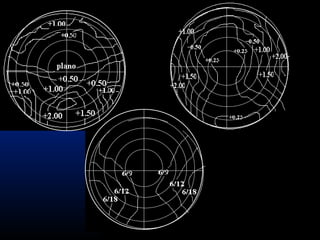
USE OF CONTOUR PLOT
TO EVALUATE
PROGRESSIVE LENSES
 Distortion of grid patterns viewed
through the lenses
 Visual acuity attainable at different
portions
 The amount of vertical imbalance
at paired peripheral points
Areas of equal cylinder power plotted with a connecting line-
Isocylinder line
Equal spherical equivalent powers-
Lens Design Selection
 Consider how the wearer uses their lenses
 for most wearers a good modern progressive lens
design is the best solution
 but not all designs provide wide fields of view at
distance, intermediate and near
 consider the design that will suit the wearer
 general purpose : balanced fields of view
 mainly for reading : wide near visual fields
 mainly for computer : wide intermediate visual fields
• Contour Plot Description
• Design Technology
• Visual Boundaries
• Performance Implications
• Growing Product Category
Knowledge continues to Evolve
Summary
Disadvantage of PALs
 Straight line appears curved
 More adaptation
 Decreased width at intermediate
and near
 Limited lateral movement
 Increase in eye and head
movement
 Eye must be dropped a longer
distance
Rodenstock Perfect read
R
 For half eye reading glass users
who need trifocal
 Ordinary PALs to much peripheral
aberration occurs
 Use of full lens useful area
 Near power is the reference power
 Near IPD is the measured
estimation
 Power of the lens starts out with
intermediate prescription
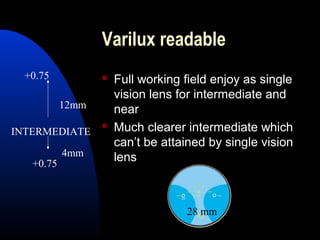
Varilux readable
 Full working field enjoy as single
vision lens for intermediate and
near
 Much clearer intermediate which
can’t be attained by single vision
lens
INTERMEDIATE
+0.75
+0.75
12mm
4mm
28 mm
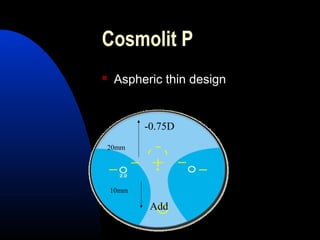
Cosmolit P
 Aspheric thin design
-0.75D
Add
20mm
10mm
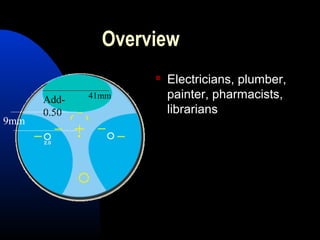
Overview
 Electricians, plumber,
painter, pharmacists,
librarians
41mm
Add-
0.50
9mm
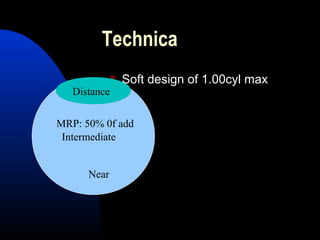
Technica
 Soft design of 1.00cyl max
Distance
Intermediate
Near
MRP: 50% 0f add
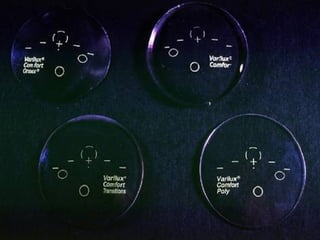
Some of the common
Progressive lens from
essilor
 Espace: affordable price and field
of vision for all distances
 Adaptor; soft design, good
distance, optimized intermediate
and wide near vision area
 Varilux comfort: sharp and natural
comfortable vision, good distance,
optimized intermediate and
adequate near vision area
 Varilux comfort 1.6: Thinner and lighter
than normal progressive
 Varilux panamic: wide field of vision for
all distances
 Varilux panamic 1.6:
 Nicon Presio: wider intermediate and
near zones, for small size frames
 Comfort transition: progressive
+photochromic
 Nikon web.lens: enhanced near vision
for computer savvy presbyopes
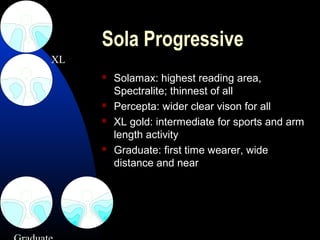
Sola Progressive
 Solamax: highest reading area,
Spectralite; thinnest of all
 Percepta: wider clear vison for all
 XL gold: intermediate for sports and arm
length activity
 Graduate: first time wearer, wide
distance and near
XL
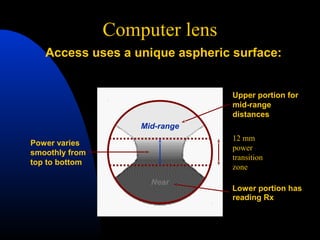
Computer lens
Upper portion for
mid-range
distances
Lower portion has
reading Rx
Power varies
smoothly from
top to bottom
12 mm
power
transition
zone
Mid-range
Near
Access uses a unique aspheric surface:
ACCESSTM
Breaks the Mid-Range BarrierBreaks the Mid-Range Barrier
 Access provides
 Extended range
 Wider breadth of field
 Mid-range vision is as wide as close-up vision
 Continuous vision throughout the lens
 Ease of use
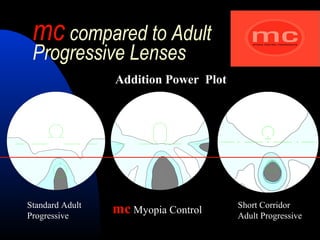
mc compared to Adult
Progressive Lenses
Addition Power Plot
mc Myopia Control
Standard Adult
Progressive
Short Corridor
Adult Progressive
Eye tracking
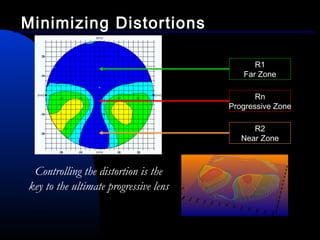
R1
Far Zone
Rn
Progressive Zone
R2
Near Zone
Controlling the distortion is the
key to the ultimate progressive lens
Topographic Map
Minimizing Distortions
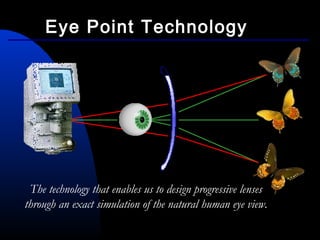
The technology that enables us to design progressive lenses
through an exact simulation of the natural human eye view.
Eye Point Technology
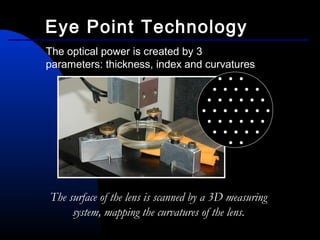
The optical power is created by 3
parameters: thickness, index and curvatures
The surface of the lens is scanned by a 3D measuring
system, mapping the curvatures of the lens.
Eye Point Technology
The surface data & a highly advanced mathematical algorithm are the basis to Shamir's
Eye-Point Technology™, which takes into account numerous parameters:
1. Lens index refraction
2. Lens prescription
3. Lens center thickness
4. Distance from the eye to the back vertex of the lens
5. Distance from the lens to the object
6. Object's angular position in the eye's field of vision
7. Pantoscopic tilt of the frame
8. Pupil distance
9. Thickness reduction prism, and more.
By taking all of these parameters into consideration, Shamir's Eye-Point Technology™
enabled the creation of the perfect progressive lens.
Eye Point Technology
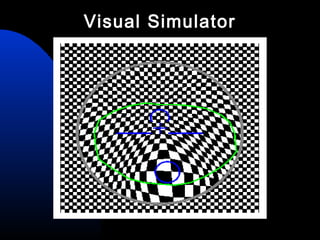
Visual Simulator
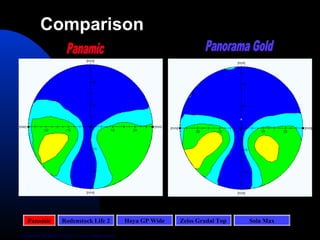
Panamic Rodenstock Life 2 Hoya GP Wide Zeiss Gradal Top Sola Max
Analyzed by Rotlex Class I on a random lens
Comparison
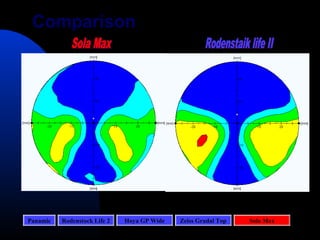
Sola MaxPanamic Rodenstock Life 2 Hoya GP Wide Zeiss Gradal Top
Comparison
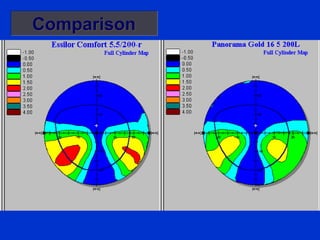
ComparisonComparison
Thank you

Progressive addition lens

  • 1.
    PROGRESSIVEPROGRESSIVE ADDITION LENS:ADDITION LENS: OPTICSAND DESIGNOPTICS AND DESIGN PRESENTED BY ISHRAT KHAN FROM SRMS IPS BAREILLY
  • 2.
    Presbyopia correction  PALs Enhanced near vision  Bifocals  Trifocals  SV (readers):  full aperture  half-eyes
  • 3.
    RANGE OF CLEAR VISION Singlevision Bifocal Progressive 0.33 0.50 1.00 2.00 5.00 NEAR INTERMEDIATE DISTANCE NEAR INTERMEDIATE DISTANCE NEAR INTERMEDIATE DISTANCE
  • 4.
    PURPOSE  Understand experiencewith current correction  Highlight limitations of current correction  Explain feature/benefits  Refer to “change in vision” when refitting into different design  Listen to the wearer’s needs  Restate the wearer’s needs (avoid technical jargon)  Make the recommendation
  • 5.
    What are progressive additionlens ? 1 Progressive Addition LensesProgressive Addition Lenses What are progressive addition lenses? A lens designed for presbyopes with power gradually increasing from the distance zone, through a progression to the near zone.
  • 6.
  • 7.
    The usable field ofview is comprised of head and eye movements as shown here for the horizontal plane. Usable Field of View Eye rotation Head movement PALs design and personal movement characteristics
  • 8.
    Binocular Vision Binocular vision: Asthe patient’s gaze is lowered for near objects, the eyes converge to maintain a single binocular image. The progressive lenses should ensure that this is maintained for different object distances from the eyes, as illustrated by the lines.
  • 9.
    Peripheral (Extra-Foveal) Vision Peripheralvision: The PAL design should ensure that * objects in the periphery of the visual field are easily fused. * * The distribution of prismin each lens should also be balanced for binocularviewing. * * * Corresponding areas in the two lenses should provide a similarlevel of vision.
  • 10.
    Why Use PALs? Uninterrupted vision from distance to near  No visible line  No jump in vision from distance to near  Better vision as intermediate is clear  Looks like single vision  Lighter/thinner than SV  Looks better  More natural vision  More visual comfort  Confidence in mobility Feature Benefit
  • 11.
    Intermediate Vision Intermediate vision: (a)Poor head position as a consequence of the eyes searching for the best focus in the bifocal’s limited range of intermediate clear vision. (b) Using the intermediate portion of a PAL enables more natural head position. (a) Bifocal (b) PAL
  • 12.
    Why Use ProgressiveLenses? Bifocal lens Progressive lens The bifocal lens (left) can disrupt the patient’s view with visual disturbances (arrows) when the eye crosses the boundary of the near seg. The progressive lens (right) has no such problem and enables a smooth transition between different reading distances.
  • 13.
  • 15.
    How a progressiveaddition lens works?  Invariably follow the traditional lens optics  Power in the midline follows the same distance prescription as addition increases below until desired add is reached  For the most of the lenses, this addition power is reached at a point 10-16mm below and 2.0-2.5mm nasal from distance optic centre WidthWidth = Lens design + Add AstigmaticAstigmatic errorerror = Width of near area + add
  • 16.
    Progressive Lens Design- Optics Distance Zone Near Zone Umbilical line Intermediate Zone Lens Radius Changes AlongLens Radius Changes Along Umbilical LineUmbilical Line
  • 17.
    Principal parameter : Size of distance & near area  Type and intensity of aberration  Depth & usable width of corridor
  • 18.
    Design in PAL’S:  Hard design  Soft design  Symmetrical design  Asymmetrical design  Mono design  Multi design  Prescription based design
  • 19.
    Progressive Lens Design 2.Hard Vs Soft Lens Design Hard Soft
  • 20.
    Hard design  Regulardistance single vision  Spherical distance zone  Wide distance & near zone  Narrow & short intermediate corridor  Rapid increase in unwanted astigmatism
  • 21.
    Advantages  Large distance& near area free from astigmatism  More accessible with downward rotation of eye  Wider near zone even at high Rx Disadvantages :  High intensity aberration at periphery  Distortion for longer and more difficult period of adaptation  Swim effect
  • 22.
    Soft design : Aspheric upper halves  Narrower distance & near zone  Wide & large intermediate corridor  Gradual increase in unwanted astigmatism
  • 23.
    Width of Far Vision(+4mm): 0.5 [D]- 16.2 mm 1.0 [D]- Unlimited Max Cylinder [D]- Nasal: 1.5[D] Max Cylinder [D]- Temporal: 1.5 [D] Width of Corridor (-6mm): 1.0[D]- 9 mm Length of corridor: 14.2 mm Minimum fitting: 19 mm Width of near Vision (-18 mm): 1.0[D]- 21.63 mm Soft Design
  • 24.
    Advantages  Decreases intensityaberration at periphery  Easier, more rapid adaptation  Less distortion of peripheral viewing  Reduce swim effect Disadvantages :  smaller field at sharp vision  Need dropping of eye farther near to read
  • 25.
    Indication for selection Harddesign :  Previous successful hard lens wearers  People who do a lot of reading Soft design :  Young presbyopes  Active outdoor profession  Professional driver
  • 26.
    Symmetrical design : Add is straight down from distance optical center  No right & left lenses  Required rotation to achieve desired inset for near (9 degree)
  • 27.
    Advantages :  Wecan give the inset according to patient Disadvantages :  As the wearers looks to the side they will experience different power & differential prism
  • 28.
    Asymmetrical design : Lenses have pre- set inset for near  Different lenses for right & left
  • 29.
    Progressive Lens Design 3.Symmetrical Vs Asymmetrical Symmetrical PAL - same lens design is rotated to fit the other eye Asymmetrica l PAL - each eye has a different lens
  • 30.
    Advantages :  Thiswill not produces experience of different power when patient looks to a side Disadvantages :  Fixed inset may not match with patient’s required inset
  • 31.
    Mono design : Describe range of power for a given design  It classify hard & soft  It describe the characteristics of progressive zone  Maintain design principles throughout the range of addition
  • 32.
    Multi design : According to add power lens design changes  It start from soft design for low add power & as the add power increase it will turn to hard design lens 1.50 Add Design1.50 Add Design 2.00 Add Design2.00 Add Design 2.50 Add2.50 Add DesignDesign
  • 33.
    Prescription base design : Result of years of Vision Research  Dedicated design for every Base and Add  Design by Base : different designs for Hyperopes, Emmetropes and Myopes (FOV & Magn.)  Design by Add: effective near zone sizes change as the add increases  Near inset position varies relative to level of Presbyopia / reading distance  Corridor length also varies relative to both Base and Add
  • 34.
    Incorporating Single vision asphericdesign in to the PALs  Aspheric advantage  Flat, thin, lighter  Earlier front surface aspheric design  Back surface Aspheric design  Bi-aspheric design
  • 35.
    USE OF CONTOURPLOT TO EVALUATE PROGRESSIVE LENSES  Distortion of grid patterns viewed through the lenses  Visual acuity attainable at different portions  The amount of vertical imbalance at paired peripheral points Areas of equal cylinder power plotted with a connecting line- Isocylinder line Equal spherical equivalent powers-
  • 37.
    Lens Design Selection Consider how the wearer uses their lenses  for most wearers a good modern progressive lens design is the best solution  but not all designs provide wide fields of view at distance, intermediate and near  consider the design that will suit the wearer  general purpose : balanced fields of view  mainly for reading : wide near visual fields  mainly for computer : wide intermediate visual fields
  • 38.
    • Contour PlotDescription • Design Technology • Visual Boundaries • Performance Implications • Growing Product Category Knowledge continues to Evolve Summary
  • 39.
    Disadvantage of PALs Straight line appears curved  More adaptation  Decreased width at intermediate and near  Limited lateral movement  Increase in eye and head movement  Eye must be dropped a longer distance
  • 40.
    Rodenstock Perfect read R For half eye reading glass users who need trifocal  Ordinary PALs to much peripheral aberration occurs  Use of full lens useful area  Near power is the reference power  Near IPD is the measured estimation  Power of the lens starts out with intermediate prescription
  • 41.
    Varilux readable  Fullworking field enjoy as single vision lens for intermediate and near  Much clearer intermediate which can’t be attained by single vision lens INTERMEDIATE +0.75 +0.75 12mm 4mm 28 mm
  • 42.
    Cosmolit P  Asphericthin design -0.75D Add 20mm 10mm
  • 43.
    Overview  Electricians, plumber, painter,pharmacists, librarians 41mm Add- 0.50 9mm
  • 44.
    Technica  Soft designof 1.00cyl max Distance Intermediate Near MRP: 50% 0f add
  • 45.
    Some of thecommon Progressive lens from essilor  Espace: affordable price and field of vision for all distances  Adaptor; soft design, good distance, optimized intermediate and wide near vision area  Varilux comfort: sharp and natural comfortable vision, good distance, optimized intermediate and adequate near vision area
  • 46.
     Varilux comfort1.6: Thinner and lighter than normal progressive  Varilux panamic: wide field of vision for all distances  Varilux panamic 1.6:  Nicon Presio: wider intermediate and near zones, for small size frames  Comfort transition: progressive +photochromic  Nikon web.lens: enhanced near vision for computer savvy presbyopes
  • 47.
    Sola Progressive  Solamax:highest reading area, Spectralite; thinnest of all  Percepta: wider clear vison for all  XL gold: intermediate for sports and arm length activity  Graduate: first time wearer, wide distance and near XL
  • 48.
    Computer lens Upper portionfor mid-range distances Lower portion has reading Rx Power varies smoothly from top to bottom 12 mm power transition zone Mid-range Near Access uses a unique aspheric surface:
  • 49.
    ACCESSTM Breaks the Mid-RangeBarrierBreaks the Mid-Range Barrier  Access provides  Extended range  Wider breadth of field  Mid-range vision is as wide as close-up vision  Continuous vision throughout the lens  Ease of use
  • 50.
    mc compared toAdult Progressive Lenses Addition Power Plot mc Myopia Control Standard Adult Progressive Short Corridor Adult Progressive
  • 51.
  • 52.
    R1 Far Zone Rn Progressive Zone R2 NearZone Controlling the distortion is the key to the ultimate progressive lens Topographic Map Minimizing Distortions
  • 53.
    The technology thatenables us to design progressive lenses through an exact simulation of the natural human eye view. Eye Point Technology
  • 54.
    The optical poweris created by 3 parameters: thickness, index and curvatures The surface of the lens is scanned by a 3D measuring system, mapping the curvatures of the lens. Eye Point Technology
  • 55.
    The surface data& a highly advanced mathematical algorithm are the basis to Shamir's Eye-Point Technology™, which takes into account numerous parameters: 1. Lens index refraction 2. Lens prescription 3. Lens center thickness 4. Distance from the eye to the back vertex of the lens 5. Distance from the lens to the object 6. Object's angular position in the eye's field of vision 7. Pantoscopic tilt of the frame 8. Pupil distance 9. Thickness reduction prism, and more. By taking all of these parameters into consideration, Shamir's Eye-Point Technology™ enabled the creation of the perfect progressive lens. Eye Point Technology
  • 56.
  • 57.
    Panamic Rodenstock Life2 Hoya GP Wide Zeiss Gradal Top Sola Max Analyzed by Rotlex Class I on a random lens Comparison
  • 58.
    Sola MaxPanamic RodenstockLife 2 Hoya GP Wide Zeiss Gradal Top Comparison
  • 59.
  • 60.

Editor's Notes

  • #36 Differentiate one design from another.