Progressive Addition Lens
Ayan Das, 4th Sem,
George College of Management and Science
Definition
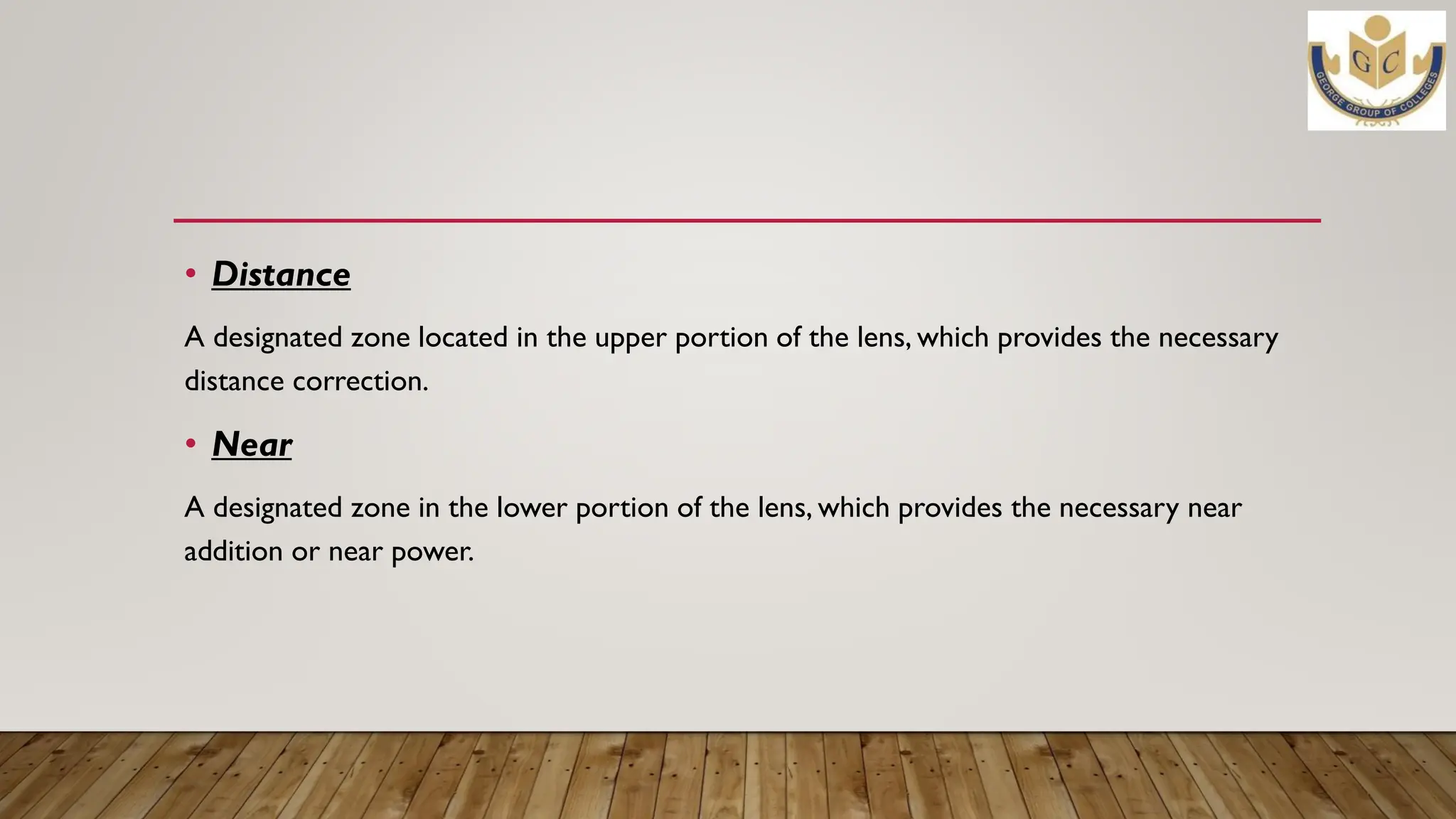
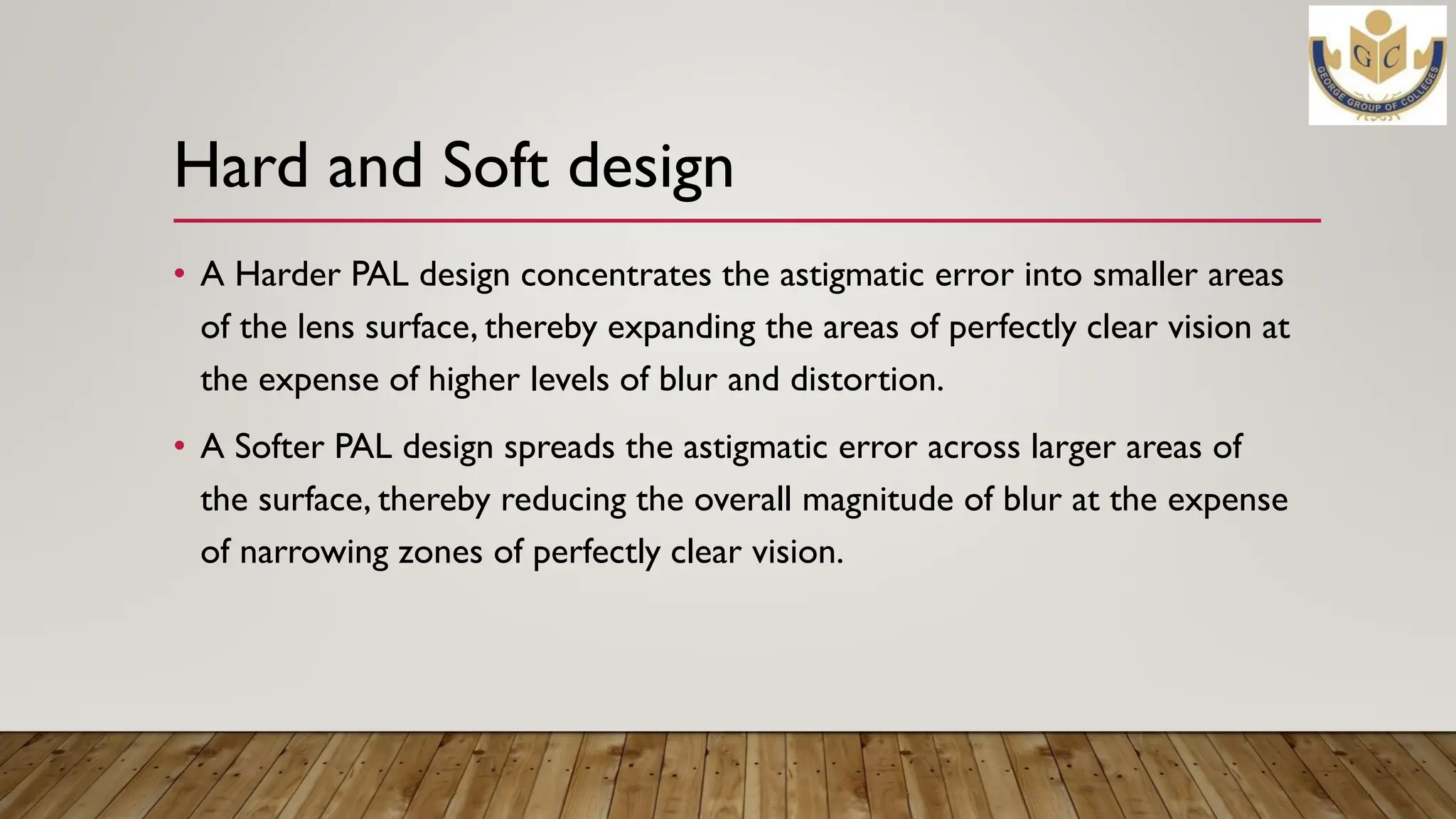
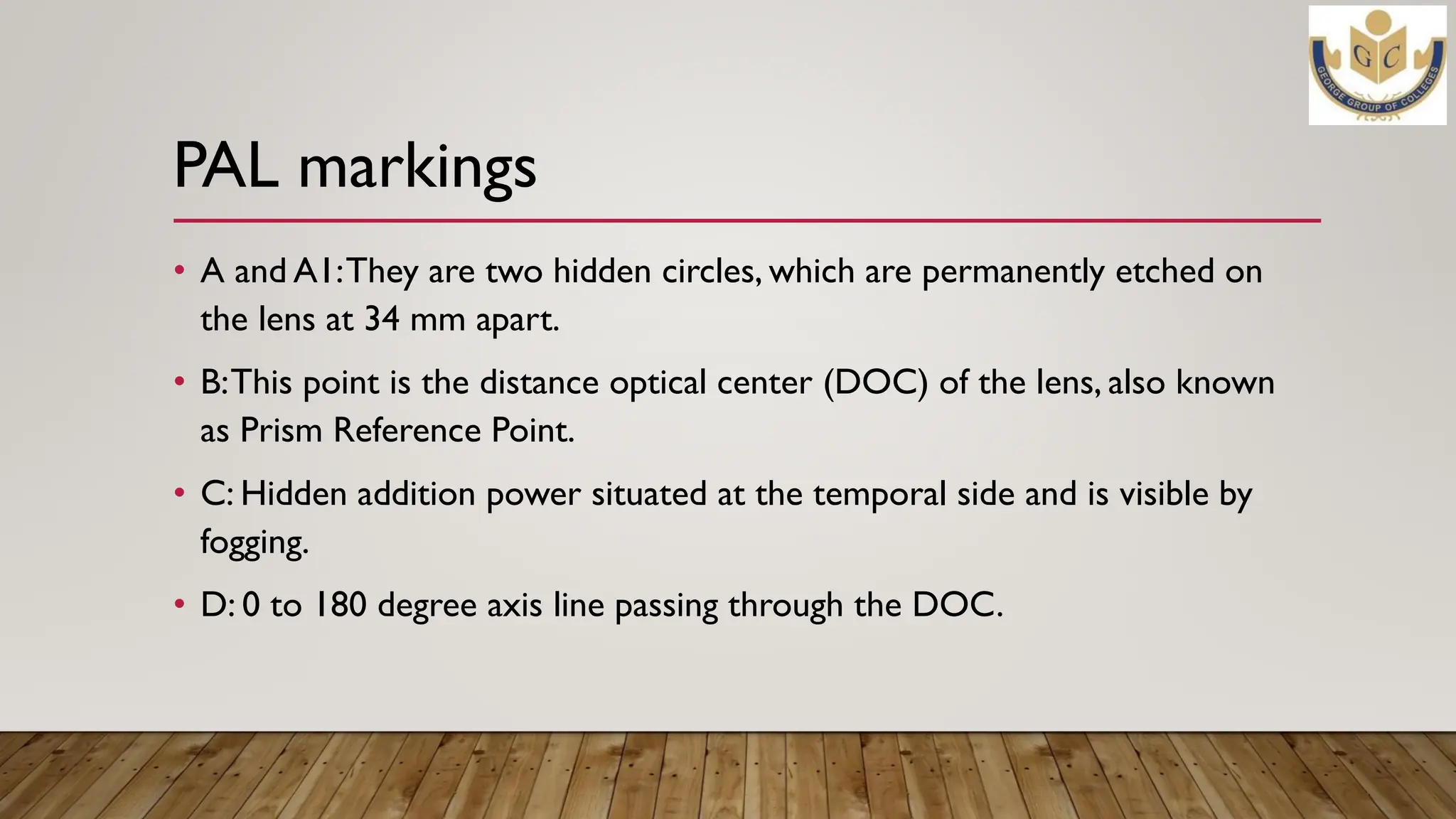
The power of addition gradually increases as the line of the vision sweeps downward
through the lens.
History
• First patient on progressive power lenses was published in 1907 by Owen Ave
• Essilor company introduced first commercially available PAL,Varilux in 1959
Basic design of PAL
• Distance
A designated zone located in the upper portion of the lens, which provides the necessary
distance correction.
• Near
A designated zone in the lower portion of the lens, which provides the necessary near
addition or near power.
Intermediate
• A corridor in the central portion of the lens connects these two zones, which increases
progressively in plus power from the distance to near.This zone is also known as
“Progressive zone”
PAL designs
• Mono design and Multi design
• Asymmetry and Symmetry design
• Hard and Soft design
Mono and Multi design
• In case of Mono design progressive addition lens, a single design is used
for all addition powers.
• In Multi design the position for near vision changes with the addition
power changes with the addition power change, i.e. the near area goes up
with the increase in the addition.
Asymmetry and Symmetry design
• In case of Symmetrical PAL design, the right and left lenses are identical.
• Asymmetric PAL design incorporates a nasal offset of the near zone and
has separate design for right and left lens.
Hard and Soft design
• A Harder PAL design concentrates the astigmatic error into smaller areas
of the lens surface, thereby expanding the areas of perfectly clear vision at
the expense of higher levels of blur and distortion.
• A Softer PAL design spreads the astigmatic error across larger areas of
the surface, thereby reducing the overall magnitude of blur at the expense
of narrowing zones of perfectly clear vision.
PAL markings
PAL markings
• A and A1:They are two hidden circles, which are permanently etched on
the lens at 34 mm apart.
• B:This point is the distance optical center (DOC) of the lens, also known
as Prism Reference Point.
• C: Hidden addition power situated at the temporal side and is visible by
fogging.
• D: 0 to 180 degree axis line passing through the DOC.
PAL markings
• E: Fitting cross lies above the DOC.
• F: Distance power(DP) circle to check the exact distance power with the
help of Lensometer.
• G: Hidden logo situated nasally and get visible when ink marking is
removed.
• H: 7mm to 9mm circle is the center of the near vision area and is inset by
2.5mm.
PAL images
Progressive Addition Lens ayan das 2004.pdf

Progressive Addition Lens ayan das 2004.pdf

  • 1.
    Progressive Addition Lens AyanDas, 4th Sem, George College of Management and Science
  • 2.
    Definition The power ofaddition gradually increases as the line of the vision sweeps downward through the lens.
  • 3.
    History • First patienton progressive power lenses was published in 1907 by Owen Ave • Essilor company introduced first commercially available PAL,Varilux in 1959
  • 4.
  • 5.
    • Distance A designatedzone located in the upper portion of the lens, which provides the necessary distance correction. • Near A designated zone in the lower portion of the lens, which provides the necessary near addition or near power.
  • 6.
    Intermediate • A corridorin the central portion of the lens connects these two zones, which increases progressively in plus power from the distance to near.This zone is also known as “Progressive zone”
  • 7.
    PAL designs • Monodesign and Multi design • Asymmetry and Symmetry design • Hard and Soft design
  • 8.
    Mono and Multidesign • In case of Mono design progressive addition lens, a single design is used for all addition powers. • In Multi design the position for near vision changes with the addition power changes with the addition power change, i.e. the near area goes up with the increase in the addition.
  • 9.
    Asymmetry and Symmetrydesign • In case of Symmetrical PAL design, the right and left lenses are identical. • Asymmetric PAL design incorporates a nasal offset of the near zone and has separate design for right and left lens.
  • 10.
    Hard and Softdesign • A Harder PAL design concentrates the astigmatic error into smaller areas of the lens surface, thereby expanding the areas of perfectly clear vision at the expense of higher levels of blur and distortion. • A Softer PAL design spreads the astigmatic error across larger areas of the surface, thereby reducing the overall magnitude of blur at the expense of narrowing zones of perfectly clear vision.
  • 12.
  • 13.
    PAL markings • Aand A1:They are two hidden circles, which are permanently etched on the lens at 34 mm apart. • B:This point is the distance optical center (DOC) of the lens, also known as Prism Reference Point. • C: Hidden addition power situated at the temporal side and is visible by fogging. • D: 0 to 180 degree axis line passing through the DOC.
  • 14.
    PAL markings • E:Fitting cross lies above the DOC. • F: Distance power(DP) circle to check the exact distance power with the help of Lensometer. • G: Hidden logo situated nasally and get visible when ink marking is removed. • H: 7mm to 9mm circle is the center of the near vision area and is inset by 2.5mm.
  • 15.