CSC141 Introduction to Computer Programming
Programming
Language
Programming Language
• A programming Language is a notational system
intended primarily to facilitate human-machine
interaction.
• The notational is understood both by human and
machine.
CSC141 Introduction to Computer Programming
What is a program?
• A program is something that is produced using a
programming Language.
• A program is a structured entity with
Semantics.
CSC141 Introduction to Computer Programming
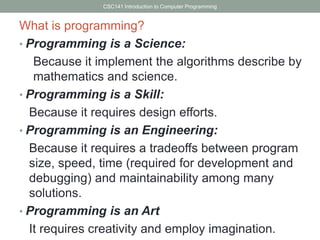
What is programming?
• Programming is a Science:
Because it implement the algorithms describe by
mathematics and science.
• Programming is a Skill:
Because it requires design efforts.
• Programming is an Engineering:
Because it requires a tradeoffs between program
size, speed, time (required for development and
debugging) and maintainability among many
solutions.
• Programming is an Art
It requires creativity and employ imagination.
CSC141 Introduction to Computer Programming
Types of programming
Languages
Assembly language
• Low-level language that allows a programmer to
use abbreviations or easily remembered words
instead of numbers.
• These Observations are called Mnemonics. These
Mnemonic are Opcode and Operands
For Example: ADD A +B
CSC141 Introduction to Computer Programming
Assembly language
• Programmer can write instructions faster but it is
still not an easy language to learn.
• Drawback: The language is specific to a
particular processor family and environment.
(Machine Dependent Language)
• Assembler – A program that translates the
assembly language program into machine
language.
CSC141 Introduction to Computer Programming
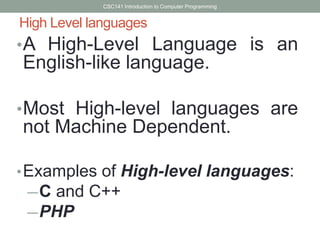
High Level languages
•A High-Level Language is an
English-like language.
•Most High-level languages are
not Machine Dependent.
•Examples of High-level languages:
―C and C++
―PHP
CSC141 Introduction to Computer Programming
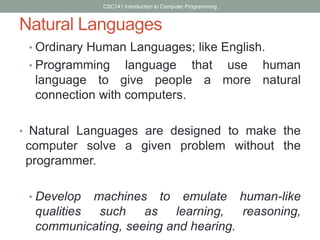
Natural Languages
• Ordinary Human Languages; like English.
• Programming language that use human
language to give people a more natural
connection with computers.
• Natural Languages are designed to make the
computer solve a given problem without the
programmer.
• Develop machines to emulate human-like
qualities such as learning, reasoning,
communicating, seeing and hearing.
CSC141 Introduction to Computer Programming
History of C Language
• A general-purpose computer programming language.
• Developed between 1969 and 1973 by Dennis Ritchie at
the Bell Telephone Laboratories for use with the UNIX
operating system.
• Descendant of Ken Thompson’s language “B”
• The first C programming language standard was
published in 1978 as “The C Programming Language” by
Kernighan and Ritchie (K&R).
• "ANSI C" was the second C programming language
standard published in 1989.
• ISO approved “ANSI C” in 1990.
• The latest stable release is C11.
CSC141 Introduction to Computer Programming

Programming basics

  • 1.
    CSC141 Introduction toComputer Programming Programming Language
  • 2.
    Programming Language • Aprogramming Language is a notational system intended primarily to facilitate human-machine interaction. • The notational is understood both by human and machine. CSC141 Introduction to Computer Programming
  • 3.
    What is aprogram? • A program is something that is produced using a programming Language. • A program is a structured entity with Semantics. CSC141 Introduction to Computer Programming
  • 4.
    CSC141 Introduction toComputer Programming What is programming?
  • 5.
    What is programming? •Programming is a Science: Because it implement the algorithms describe by mathematics and science. • Programming is a Skill: Because it requires design efforts. • Programming is an Engineering: Because it requires a tradeoffs between program size, speed, time (required for development and debugging) and maintainability among many solutions. • Programming is an Art It requires creativity and employ imagination. CSC141 Introduction to Computer Programming
  • 6.
    CSC141 Introduction toComputer Programming Types of programming Languages
  • 7.
    Assembly language • Low-levellanguage that allows a programmer to use abbreviations or easily remembered words instead of numbers. • These Observations are called Mnemonics. These Mnemonic are Opcode and Operands For Example: ADD A +B CSC141 Introduction to Computer Programming
  • 8.
    Assembly language • Programmercan write instructions faster but it is still not an easy language to learn. • Drawback: The language is specific to a particular processor family and environment. (Machine Dependent Language) • Assembler – A program that translates the assembly language program into machine language. CSC141 Introduction to Computer Programming
  • 9.
    High Level languages •AHigh-Level Language is an English-like language. •Most High-level languages are not Machine Dependent. •Examples of High-level languages: ―C and C++ ―PHP CSC141 Introduction to Computer Programming
  • 10.
    Natural Languages • OrdinaryHuman Languages; like English. • Programming language that use human language to give people a more natural connection with computers. • Natural Languages are designed to make the computer solve a given problem without the programmer. • Develop machines to emulate human-like qualities such as learning, reasoning, communicating, seeing and hearing. CSC141 Introduction to Computer Programming
  • 11.
    History of CLanguage • A general-purpose computer programming language. • Developed between 1969 and 1973 by Dennis Ritchie at the Bell Telephone Laboratories for use with the UNIX operating system. • Descendant of Ken Thompson’s language “B” • The first C programming language standard was published in 1978 as “The C Programming Language” by Kernighan and Ritchie (K&R). • "ANSI C" was the second C programming language standard published in 1989. • ISO approved “ANSI C” in 1990. • The latest stable release is C11. CSC141 Introduction to Computer Programming