Computer Languages
Computer languages

• A computer language is an artificial language
  designed to work for different applications
  in different environments.

• Programming languages can be used to create
  programs that control the behavior of a
  computer and serve any purpose.
• Computer languages have some form of written
  specification of their Syntax (Rules) and
   Semantic (Words, phrase & sentences)
Computer languages

The term programming language usually refers to
high-level languages such as BASIC, C, C++,
COBOL, FORTRAN, Pascal, Java, Oracle, ASP.NET,
VB.NET and C#.

Each language has a unique set of keywords (words that it
understands) and a special syntax for organizing program
instructions.
Computer Languages

    Human languages are known as natural languages.
    Unfortunately, computers can not understand natural
    languages, as a result we must communicate with
    computers using computer languages.
    These languages are;


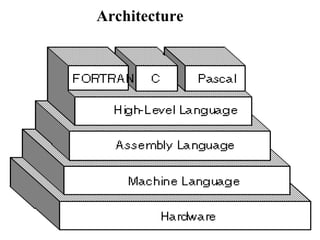
•   High Level Languages
•   Low Level Languages
•   Assembly Language
•   Machine Language
Architecture
High Level Language


The high-level languages are much closer to human
language.
A programming language such as C, FORTRAN or Pascal
 that enables to write programs which is understandable to
programmer (Human) and can perform any sort of task,
such languages are considered high-level because they are
closer to human languages.

High level language must use interpreter, compiler or
translator to convert human understandable program to
computer readable code (machine code).
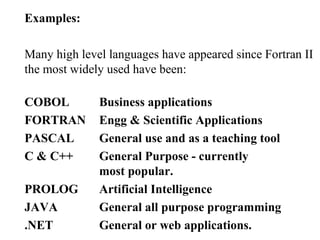
Examples:

Many high level languages have appeared since Fortran II
the most widely used have been:

COBOL         Business applications
FORTRAN       Engg & Scientific Applications
PASCAL        General use and as a teaching tool
C & C++       General Purpose - currently
              most popular.
PROLOG        Artificial Intelligence
JAVA          General all purpose programming
.NET          General or web applications.
Advantages of High level language over low level lang:
•   The main advantage of high-level languages over low-level
    languages is that they are easier to read, write and maintain.

•   High-level languages make complex programming simpler.

•   High level programming techniques are applicable everywhere even
    where computational resources are limited.

•   Error ratio is less in high level language and
    debugging (locate and correct errors in program code ) is easier.

•   Length of the program is also small compared with low level.

•   Many real time problems can be easily solved with high level
    language.
Low Level Language
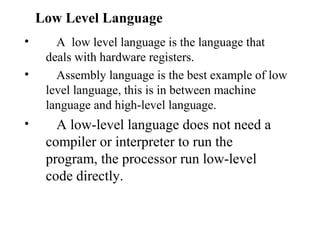
•      A low level language is the language that
     deals with hardware registers.
•      Assembly language is the best example of low
     level language, this is in between machine
     language and high-level language.
•      A low-level language does not need a
     compiler or interpreter to run the
     program, the processor run low-level
     code directly.
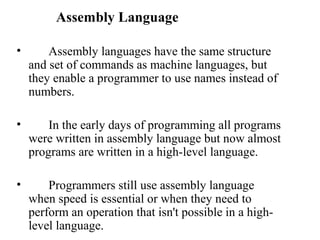
Assembly Language

•       Assembly languages have the same structure
    and set of commands as machine languages, but
    they enable a programmer to use names instead of
    numbers.

•       In the early days of programming all programs
    were written in assembly language but now almost
    programs are written in a high-level language.

•       Programmers still use assembly language
    when speed is essential or when they need to
    perform an operation that isn't possible in a high-
    level language.
Assembly Language
It uses mnemonic codes (short forms) for instructions
and allows the programmer to introduce names for blocks
of memory that hold data.
Assembly language is designed to be easily translated into
machine language. Like machine language, assembly
language requires detailed knowledge of a particular
internal computer architecture
mov edx, [esp+8]
cmp edx,
0 ja @f
mov eax, 0
ret
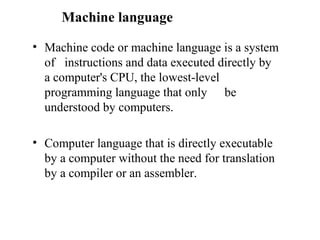
Machine language

• Machine code or machine language is a system
  of instructions and data executed directly by
  a computer's CPU, the lowest-level
  programming language that only be
  understood by computers.

• Computer language that is directly executable
  by a computer without the need for translation
  by a compiler or an assembler.
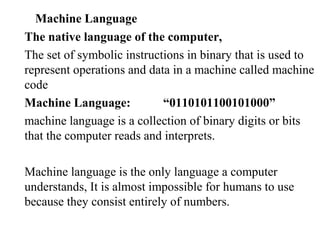
Machine Language
The native language of the computer,
The set of symbolic instructions in binary that is used to
represent operations and data in a machine called machine
code
Machine Language:           “0110101100101000”
machine language is a collection of binary digits or bits
that the computer reads and interprets.

Machine language is the only language a computer
understands, It is almost impossible for humans to use
because they consist entirely of numbers.
Program code converters
    There are four models of execution of program by
    processor in high-level languages:

•   INTERPRETER
•   COMPILER
•   ASSEMBLER
•   TRANSLATER
Interpreter
•      An interpreter is a program that executes
     programming code directly.

•    Interpreter can convert a source code , usually on a
    step-by-step, line-by-line and unit-by-unit basis
     into machine code.

•    Interpreted languages are read and then executed
     directly, with no compilation stage.
Compiler
Compiler is a program that compile source code into executable
instructions that a computer can understand, it compiles code and
produce in EXE format before it run.
 There are two stages of compiler

Intermediate Compilation
   Intermediate level compiles code in the form of Byte code
   and save for later execution without the need to re-read the
   source file.

Machine code Compilation
  Machine code compiles source code directly into machine
  code using Virtual machines that execute code directly into
  machine code
Assembler

Assembler normally converts assembly language’s
source code into machine language.

Assembly language is a family of low-level languages
for programming computers. It implements a symbolic
representation of code.

An assembler is a program that takes basic computer
instructions and converts them into a pattern of
bits ( 0 & 1) that the computer runs to produce result.
Translator

Translator is a computer program that translates one
programming language instruction(s) into another
programming language instruction(s) …

A computer source code is to be translated into a
low-level programming language where native code
compilers change it in machine language for execution.
Language Generations

Computer languages has the same history as the
computers itself history,

There are five generations of languages when
programming method and techniques could be
developed as far as development in hardware
occurred.
First Generation (1GL)

First-generation language was machine language or the level of
instructions and data that the processor is actually given to
work on binary numbers 0s and 1s.

First-generation language is the lowest level computer language.
Information is conveyed to the computer by the programmer as binary
instructions.

In the 1940s and 1950s, computers were programmed by scientists
sitting before control panels equipped with switches so that they could
input instructions as strings of zeros and ones.
Second Generation (2GL)

Second-generation language used assembly language, An
assembler converts the assembler language statements into
machine language.

By the late 1950s, this language had become popular.
Assembly language consists of letters of the alphabet.
This makes programming much easier than trying to
program a series of zeros and ones.

Second-generation language use increased when Grace
Hopper developed FLOW-MATIC, a language that made
programming easier.
Third Generation (3GL)

Third-generation language is a high-level programming language,
such as PL/I, COBOL, FORTRAN and C.

Compiler based FORTRAN and COBOL created because it improved
the record keeping and data management ability in many business
applications.

 In the early 1960s, BASIC language designed and used by
 nonprofessional programmers. BASIC remained popular during the
1970s and 1980s.

Programs written in third-generation languages require more memory
and run more slowly than those written in lower level languages.
Fourth Generation (4GL)

Fourth-generation language is designed to be closer to
natural language than a 3GL language.

Fourth-generation languages attempt to make
communicating with computers as much like the processes
of thinking and talking to other people as possible.

Fourth-generation languages typically consist of English-
like words and phrases, some of these languages include
graphic devices such as icons and onscreen push buttons for
use during programming and when running the application.

Many fourth-generation languages use C, C++, Java and
SQL that support stand-alone as well as web applications.
Fifth Generation (5GL)

Fifth-generation language is programming that uses
a visual or graphical development interface to create source
language that is usually compiled with a 3GL or 4GL
language compiler.

Microsoft, Borland, IBM, and other companies make 5GL
visual programming products for developing applications in
Java, J++, Visual Java, Visual Basic, ASP, ASP.NET,
VB.NET and C#.

Visual programming allows you to see object oriented
structures and drag icons to assemble program blocks.

Cmp104 lec 6 computer lang

  • 1.
  • 2.
    Computer languages • Acomputer language is an artificial language designed to work for different applications in different environments. • Programming languages can be used to create programs that control the behavior of a computer and serve any purpose. • Computer languages have some form of written specification of their Syntax (Rules) and Semantic (Words, phrase & sentences)
  • 3.
    Computer languages The termprogramming language usually refers to high-level languages such as BASIC, C, C++, COBOL, FORTRAN, Pascal, Java, Oracle, ASP.NET, VB.NET and C#. Each language has a unique set of keywords (words that it understands) and a special syntax for organizing program instructions.
  • 4.
    Computer Languages Human languages are known as natural languages. Unfortunately, computers can not understand natural languages, as a result we must communicate with computers using computer languages. These languages are; • High Level Languages • Low Level Languages • Assembly Language • Machine Language
  • 5.
  • 6.
    High Level Language Thehigh-level languages are much closer to human language. A programming language such as C, FORTRAN or Pascal that enables to write programs which is understandable to programmer (Human) and can perform any sort of task, such languages are considered high-level because they are closer to human languages. High level language must use interpreter, compiler or translator to convert human understandable program to computer readable code (machine code).
  • 7.
    Examples: Many high levellanguages have appeared since Fortran II the most widely used have been: COBOL Business applications FORTRAN Engg & Scientific Applications PASCAL General use and as a teaching tool C & C++ General Purpose - currently most popular. PROLOG Artificial Intelligence JAVA General all purpose programming .NET General or web applications.
  • 8.
    Advantages of Highlevel language over low level lang: • The main advantage of high-level languages over low-level languages is that they are easier to read, write and maintain. • High-level languages make complex programming simpler. • High level programming techniques are applicable everywhere even where computational resources are limited. • Error ratio is less in high level language and debugging (locate and correct errors in program code ) is easier. • Length of the program is also small compared with low level. • Many real time problems can be easily solved with high level language.
  • 9.
    Low Level Language • A low level language is the language that deals with hardware registers. • Assembly language is the best example of low level language, this is in between machine language and high-level language. • A low-level language does not need a compiler or interpreter to run the program, the processor run low-level code directly.
  • 10.
    Assembly Language • Assembly languages have the same structure and set of commands as machine languages, but they enable a programmer to use names instead of numbers. • In the early days of programming all programs were written in assembly language but now almost programs are written in a high-level language. • Programmers still use assembly language when speed is essential or when they need to perform an operation that isn't possible in a high- level language.
  • 11.
    Assembly Language It usesmnemonic codes (short forms) for instructions and allows the programmer to introduce names for blocks of memory that hold data. Assembly language is designed to be easily translated into machine language. Like machine language, assembly language requires detailed knowledge of a particular internal computer architecture mov edx, [esp+8] cmp edx, 0 ja @f mov eax, 0 ret
  • 12.
    Machine language • Machinecode or machine language is a system of instructions and data executed directly by a computer's CPU, the lowest-level programming language that only be understood by computers. • Computer language that is directly executable by a computer without the need for translation by a compiler or an assembler.
  • 13.
    Machine Language The nativelanguage of the computer, The set of symbolic instructions in binary that is used to represent operations and data in a machine called machine code Machine Language: “0110101100101000” machine language is a collection of binary digits or bits that the computer reads and interprets. Machine language is the only language a computer understands, It is almost impossible for humans to use because they consist entirely of numbers.
  • 14.
    Program code converters There are four models of execution of program by processor in high-level languages: • INTERPRETER • COMPILER • ASSEMBLER • TRANSLATER
  • 15.
    Interpreter • An interpreter is a program that executes programming code directly. • Interpreter can convert a source code , usually on a step-by-step, line-by-line and unit-by-unit basis into machine code. • Interpreted languages are read and then executed directly, with no compilation stage.
  • 16.
    Compiler Compiler is aprogram that compile source code into executable instructions that a computer can understand, it compiles code and produce in EXE format before it run. There are two stages of compiler Intermediate Compilation Intermediate level compiles code in the form of Byte code and save for later execution without the need to re-read the source file. Machine code Compilation Machine code compiles source code directly into machine code using Virtual machines that execute code directly into machine code
  • 17.
    Assembler Assembler normally convertsassembly language’s source code into machine language. Assembly language is a family of low-level languages for programming computers. It implements a symbolic representation of code. An assembler is a program that takes basic computer instructions and converts them into a pattern of bits ( 0 & 1) that the computer runs to produce result.
  • 18.
    Translator Translator is acomputer program that translates one programming language instruction(s) into another programming language instruction(s) … A computer source code is to be translated into a low-level programming language where native code compilers change it in machine language for execution.
  • 19.
    Language Generations Computer languageshas the same history as the computers itself history, There are five generations of languages when programming method and techniques could be developed as far as development in hardware occurred.
  • 20.
    First Generation (1GL) First-generationlanguage was machine language or the level of instructions and data that the processor is actually given to work on binary numbers 0s and 1s. First-generation language is the lowest level computer language. Information is conveyed to the computer by the programmer as binary instructions. In the 1940s and 1950s, computers were programmed by scientists sitting before control panels equipped with switches so that they could input instructions as strings of zeros and ones.
  • 21.
    Second Generation (2GL) Second-generationlanguage used assembly language, An assembler converts the assembler language statements into machine language. By the late 1950s, this language had become popular. Assembly language consists of letters of the alphabet. This makes programming much easier than trying to program a series of zeros and ones. Second-generation language use increased when Grace Hopper developed FLOW-MATIC, a language that made programming easier.
  • 22.
    Third Generation (3GL) Third-generationlanguage is a high-level programming language, such as PL/I, COBOL, FORTRAN and C. Compiler based FORTRAN and COBOL created because it improved the record keeping and data management ability in many business applications. In the early 1960s, BASIC language designed and used by nonprofessional programmers. BASIC remained popular during the 1970s and 1980s. Programs written in third-generation languages require more memory and run more slowly than those written in lower level languages.
  • 23.
    Fourth Generation (4GL) Fourth-generationlanguage is designed to be closer to natural language than a 3GL language. Fourth-generation languages attempt to make communicating with computers as much like the processes of thinking and talking to other people as possible. Fourth-generation languages typically consist of English- like words and phrases, some of these languages include graphic devices such as icons and onscreen push buttons for use during programming and when running the application. Many fourth-generation languages use C, C++, Java and SQL that support stand-alone as well as web applications.
  • 24.
    Fifth Generation (5GL) Fifth-generationlanguage is programming that uses a visual or graphical development interface to create source language that is usually compiled with a 3GL or 4GL language compiler. Microsoft, Borland, IBM, and other companies make 5GL visual programming products for developing applications in Java, J++, Visual Java, Visual Basic, ASP, ASP.NET, VB.NET and C#. Visual programming allows you to see object oriented structures and drag icons to assemble program blocks.