A T I Q A H M E D
1 1 - A B
Computer Language
Programming
 Computer programming (often shortened
toprogramming) is a process that leads from an
original formulation of a computing problem to
executable computer programs.
Programming Languages
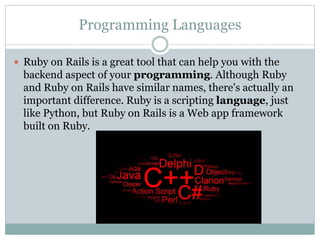
 Ruby on Rails is a great tool that can help you with the
backend aspect of your programming. Although Ruby
and Ruby on Rails have similar names, there's actually an
important difference. Ruby is a scripting language, just
like Python, but Ruby on Rails is a Web app framework
built on Ruby.
Computer Languages
 Computer programming language, any of various languages for
expressing a set of detailed instructions for a digital computer. Such
instructions can be executed directly when they are in the computer
manufacturer-specific numerical form known as machine language,
after a simple substitution process when expressed in a
corresponding assembly language, or after translation from some
“higher-level”language. Although there are over 2,000 computer
languages, relatively few are widely used.
Assembly Languages
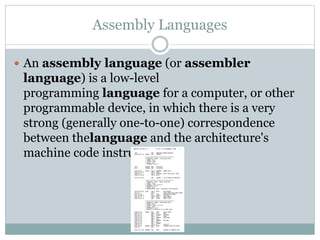
 An assembly language (or assembler
language) is a low-level
programming language for a computer, or other
programmable device, in which there is a very
strong (generally one-to-one) correspondence
between thelanguage and the architecture's
machine code instructions
Advantages Of Assembly languages
 1.The symbolic programming of Assembly Language is
easier to understand and saves a lot of time and effort of the
programmer.
 2.It is easier to correct errors and modify program
instructions.
 3.Assembly Language has the same efficiency of execution
as the machine level language. Because this is one-to-one
translator between assembly language program and its
corresponding machine language program.
Disadvantages of Assembly languages
 1.One of the major disadvantages is that assembly
language is machine dependent. A program written
for one computer might not run in other computers
with different hardware configuration.
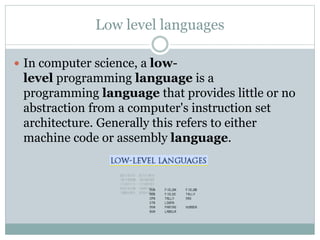
Low level languages
 In computer science, a low-
level programming language is a
programming language that provides little or no
abstraction from a computer's instruction set
architecture. Generally this refers to either
machine code or assembly language.

Computer languages

  • 1.
    A T IQ A H M E D 1 1 - A B Computer Language
  • 2.
    Programming  Computer programming(often shortened toprogramming) is a process that leads from an original formulation of a computing problem to executable computer programs.
  • 3.
    Programming Languages  Rubyon Rails is a great tool that can help you with the backend aspect of your programming. Although Ruby and Ruby on Rails have similar names, there's actually an important difference. Ruby is a scripting language, just like Python, but Ruby on Rails is a Web app framework built on Ruby.
  • 4.
    Computer Languages  Computerprogramming language, any of various languages for expressing a set of detailed instructions for a digital computer. Such instructions can be executed directly when they are in the computer manufacturer-specific numerical form known as machine language, after a simple substitution process when expressed in a corresponding assembly language, or after translation from some “higher-level”language. Although there are over 2,000 computer languages, relatively few are widely used.
  • 5.
    Assembly Languages  Anassembly language (or assembler language) is a low-level programming language for a computer, or other programmable device, in which there is a very strong (generally one-to-one) correspondence between thelanguage and the architecture's machine code instructions
  • 6.
    Advantages Of Assemblylanguages  1.The symbolic programming of Assembly Language is easier to understand and saves a lot of time and effort of the programmer.  2.It is easier to correct errors and modify program instructions.  3.Assembly Language has the same efficiency of execution as the machine level language. Because this is one-to-one translator between assembly language program and its corresponding machine language program.
  • 7.
    Disadvantages of Assemblylanguages  1.One of the major disadvantages is that assembly language is machine dependent. A program written for one computer might not run in other computers with different hardware configuration.
  • 8.
    Low level languages In computer science, a low- level programming language is a programming language that provides little or no abstraction from a computer's instruction set architecture. Generally this refers to either machine code or assembly language.