COMPUTER PROGRAMMING LANGUAGE
GENERATIONS
• The term generation summarizes major evolutionary advances
in programming languages.
• 0GL:-
i. Low level language is Machine understandable language
which is Binary / 0 or 1.
ii. Low-level programming languages are sometimes divided
into two categories: first generation and second generation.
Machine language is Example of 1GL. Assembly language is
Example of 2GL.
1GL
• First-generation languages were basic binary data instructions
for processors to execute.
• Code is made up of 0s and 1s.
2GL
• Second-generation languages are also low level language but
provide one abstraction level on top of the machine code.
• Second-generation languages use an assembler to convert
language statements into machine language.
• Second-generation languages are sometimes used in
kernels and hardware drives, but more commonly used for
video editing and video games.
3GL
• Third-generation languages use high-level language
statements that are converted by a compiler into specific
programming language statements.
• A third-generation language, such as C, C++ and Java, require
a considerable amount of programming skills and knowledge.
4GL
• Fourth-generation languages closely resemble human grammar
and language.
• These languages are often used for accessing databases.
• For example SQL(structured query language) is declarative
programming language, Used communicate with database.
• Perl , PHP, Python, Ruby, and SQL are examples of 4GL.
5GL
• Fifth-generation languages use a graphical interface to create
language statements that are compiled with a third- or fourth-
generation language compiler.
• Some of the biggest computer businesses, such as IBM and
Microsoft, make fifth-generation visual programming solutions for
creating new apps.
• Programming with a visual interface allows users to easily understand
and complete object-oriented programming tasks.
• 5GL, are programming languages contains visual tools to help
develop a program.
• Examples of fifth generation languages include Mercury, OPS5, and
Prolog.
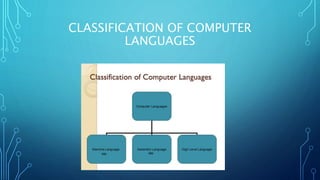
CLASSIFICATION OF COMPUTER
LANGUAGES

Computer programming language generations

  • 1.
    COMPUTER PROGRAMMING LANGUAGE GENERATIONS •The term generation summarizes major evolutionary advances in programming languages. • 0GL:- i. Low level language is Machine understandable language which is Binary / 0 or 1. ii. Low-level programming languages are sometimes divided into two categories: first generation and second generation. Machine language is Example of 1GL. Assembly language is Example of 2GL.
  • 2.
    1GL • First-generation languageswere basic binary data instructions for processors to execute. • Code is made up of 0s and 1s.
  • 3.
    2GL • Second-generation languagesare also low level language but provide one abstraction level on top of the machine code. • Second-generation languages use an assembler to convert language statements into machine language. • Second-generation languages are sometimes used in kernels and hardware drives, but more commonly used for video editing and video games.
  • 4.
    3GL • Third-generation languagesuse high-level language statements that are converted by a compiler into specific programming language statements. • A third-generation language, such as C, C++ and Java, require a considerable amount of programming skills and knowledge.
  • 5.
    4GL • Fourth-generation languagesclosely resemble human grammar and language. • These languages are often used for accessing databases. • For example SQL(structured query language) is declarative programming language, Used communicate with database. • Perl , PHP, Python, Ruby, and SQL are examples of 4GL.
  • 6.
    5GL • Fifth-generation languagesuse a graphical interface to create language statements that are compiled with a third- or fourth- generation language compiler. • Some of the biggest computer businesses, such as IBM and Microsoft, make fifth-generation visual programming solutions for creating new apps. • Programming with a visual interface allows users to easily understand and complete object-oriented programming tasks. • 5GL, are programming languages contains visual tools to help develop a program. • Examples of fifth generation languages include Mercury, OPS5, and Prolog.
  • 7.