


Theoretical Constructs
and Best Practice in
Assessment
Perspectives in Competency Assessment
Touchstone Institute, Toronto
5 February 2015
Cees van der Vleuten
Maastricht University
The Netherlands
www.maastrichtuniversity.nl/she
Overview
• From practice to research
• From research to theory
• From theory to practice
• Conclusions
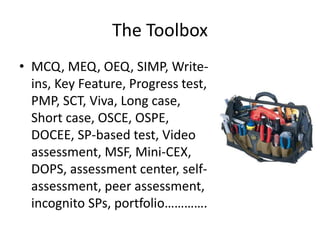
The Toolbox
• MCQ, MEQ, OEQ, SIMP, Write-
ins, Key Feature, Progress test,
PMP, SCT, Viva, Long case,
Short case, OSCE, OSPE,
DOCEE, SP-based test, Video
assessment, MSF, Mini-CEX,
DOPS, assessment center, self-
assessment, peer assessment,
incognito SPs, portfolio………….
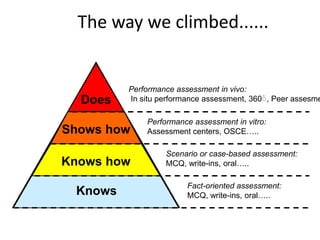
Knows
Shows how
Knows how
Does
Knows
Fact-oriented assessment:
MCQ, write-ins, oral…..
Knows how
Scenario or case-based assessment:
MCQ, write-ins, oral…..
Shows how
Performance assessment in vitro:
Assessment centers, OSCE…..
Does
Performance assessment in vivo:
In situ performance assessment, 360۫ , Peer assesme
The way we climbed......
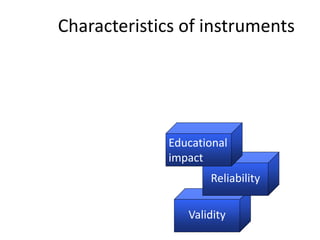
Validity
Characteristics of instruments
Reliability
Educational
impact
Acceptability
Cost
Validity
Reliability
Educational
impact
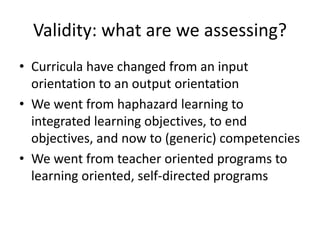
Validity: what are we assessing?
• Curricula have changed from an input
orientation to an output orientation
• We went from haphazard learning to
integrated learning objectives, to end
objectives, and now to (generic) competencies
• We went from teacher oriented programs to
learning oriented, self-directed programs
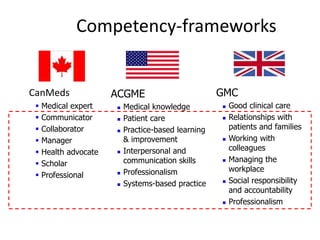
Competency-frameworks
CanMeds
 Medical expert
 Communicator
 Collaborator
 Manager
 Health advocate
 Scholar
 Professional
ACGME
 Medical knowledge
 Patient care
 Practice-based learning
& improvement
 Interpersonal and
communication skills
 Professionalism
 Systems-based practice
GMC
 Good clinical care
 Relationships with
patients and families
 Working with
colleagues
 Managing the
workplace
 Social responsibility
and accountability
 Professionalism
Knows
Shows how
Knows how
Does
Knows
Knows how
Shows how
Does
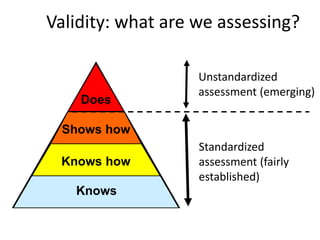
Validity: what are we assessing?
Standardized
assessment (fairly
established)
Unstandardized
assessment (emerging)
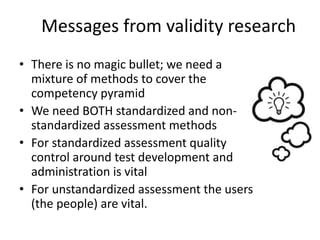
Messages from validity research
• There is no magic bullet; we need a
mixture of methods to cover the
competency pyramid
• We need BOTH standardized and non-
standardized assessment methods
• For standardized assessment quality
control around test development and
administration is vital
• For unstandardized assessment the users
(the people) are vital.
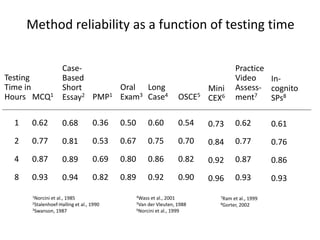
Method reliability as a function of testing time
Testing
Time in
Hours
1
2
4
8
MCQ1
0.62
0.77
0.87
0.93
Case-
Based
Short
Essay2
0.68
0.81
0.89
0.94
PMP1
0.36
0.53
0.69
0.82
Oral
Exam3
0.50
0.67
0.80
0.89
Long
Case4
0.60
0.75
0.86
0.92
OSCE5
0.54
0.70
0.82
0.90
Practice
Video
Assess-
ment7
0.62
0.77
0.87
0.93
1Norcini et al., 1985
2Stalenhoef-Halling et al., 1990
3Swanson, 1987
4Wass et al., 2001
5Van der Vleuten, 1988
6Norcini et al., 1999
In-
cognito
SPs8
0.61
0.76
0.86
0.93
Mini
CEX6
0.73
0.84
0.92
0.96
7Ram et al., 1999
8Gorter, 2002
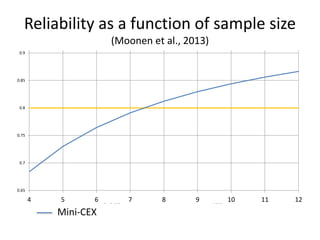
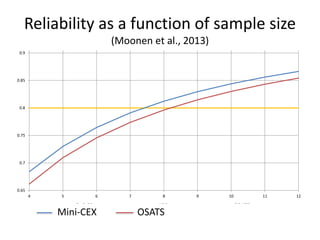
Reliability as a function of sample size
(Moonen et al., 2013)
0.65
0.7
0.75
0.8
0.85
0.9
4 5 6 7 8 9 10 11 12
G=0.80 KPB
Mini-CEX
0.65
0.7
0.75
0.8
0.85
0.9
4 5 6 7 8 9 10 11 12
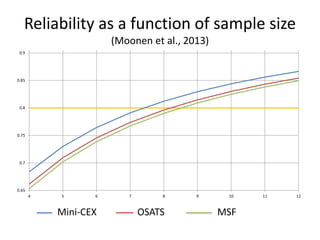
G=0.80 KPB OSATS
Mini-CEX OSATS
Reliability as a function of sample size
(Moonen et al., 2013)
0.65
0.7
0.75
0.8
0.85
0.9
4 5 6 7 8 9 10 11 12
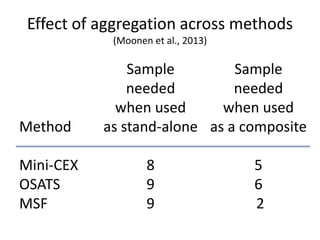
Mini-CEX OSATS MSF
Reliability as a function of sample size
(Moonen et al., 2013)
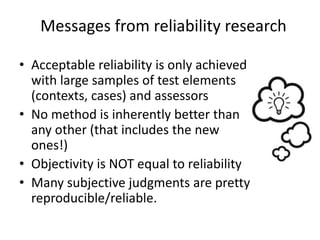
Effect of aggregation across methods
(Moonen et al., 2013)
Method
Mini-CEX
OSATS
MSF
Sample
needed
when used
as stand-alone
8
9
9
Sample
needed
when used
as a composite
5
6
2
Messages from reliability research
• Acceptable reliability is only achieved
with large samples of test elements
(contexts, cases) and assessors
• No method is inherently better than
any other (that includes the new
ones!)
• Objectivity is NOT equal to reliability
• Many subjective judgments are pretty
reproducible/reliable.
Educational impact: How does
assessment drive learning?
• Relationship is complex (cf. Cilliers, 2011, 2012)
• But impact is often very negative
– Poor learning styles
– Grade culture (grade hunting, competitiveness)
– Grade inflation (e.g. in the workplace)
• A lot of REDUCTIONISM!
– Little feedback (grade is poorest form of feedback one can get)
– Non-alignment with curricular goals
– Non-meaningful aggregation of assessment information
– Few longitudinal elements
– Tick-box exercises (OSCEs, logbooks, work-based assessment).
• All learners construct knowledge from an inner
scaffolding of their individual and social
experiences, emotions, will, aptitudes, beliefs,
values, self-awareness, purpose, and more . . .
if you are learning ….., what you understand is
determined by how you understand things,
who you are, and what you already know.
Peter Senge, Director of the Center for
Organizational Learning at MIT (as cited in van
Ryn et al., 2014)
Messages learning impact research
• No assessment without (meaningful)
feedback
• Narrative feedback has a lot more
impact on complex skills than scores
• Provision of feedback is not enough
(feedback is a dialogue)
• Longitudinal assessment is needed.
Overview
• From practice to research
• From research to theory
• From theory to practice
• Conclusions
Limitations of the single-method
approach
• No single method can do it all
• Each individual method has
(significant) limitations
• Each single method is a
considerable compromise on
reliability, validity, educational
impact
Implications
• Validity: a multitude of methods needed
• Reliability: a lot of (combined) information is
needed
• Learning impact: assessment should provide
(longitudinal) meaningful information for
learning
Programmatic assessment
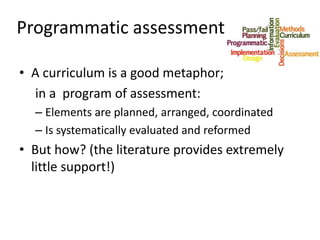
• A curriculum is a good metaphor;
in a program of assessment:
– Elements are planned, arranged, coordinated
– Is systematically evaluated and reformed
• But how? (the literature provides extremely
little support!)
Programmatic assessment
• Dijkstra et al 2012: 73 generic
guidelines
• To be done:
– Further validation
– A feasible (self-assessment) instrument
• ASPIRE assessment criteria
Building blocks for programmatic
assessment 1
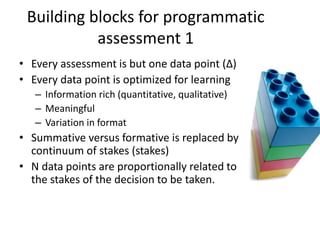
• Every assessment is but one data point (Δ)
• Every data point is optimized for learning
– Information rich (quantitative, qualitative)
– Meaningful
– Variation in format
• Summative versus formative is replaced by a
continuum of stakes (stakes)
• N data points are proportionally related to
the stakes of the decision to be taken.
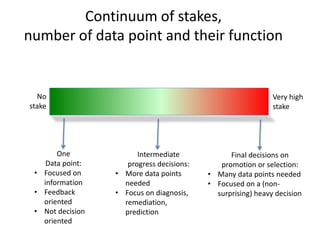
Continuum of stakes,
number of data point and their function
No
stake
Very high
stake
One
Data point:
• Focused on
information
• Feedback
oriented
• Not decision
oriented
Intermediate
progress decisions:
• More data points
needed
• Focus on diagnosis,
remediation,
prediction
Final decisions on
promotion or selection:
• Many data points needed
• Focused on a (non-
surprising) heavy decision
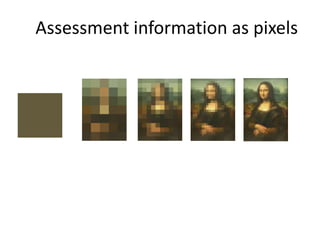
Assessment information as pixels
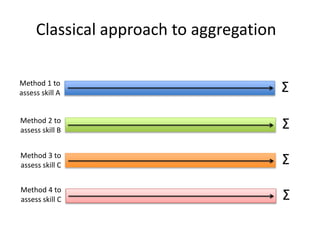
Classical approach to aggregation
Method 1 to
assess skill A Σ
Method 2 to
assess skill B Σ
Σ
Σ
Method 3 to
assess skill C
Method 4 to
assess skill C
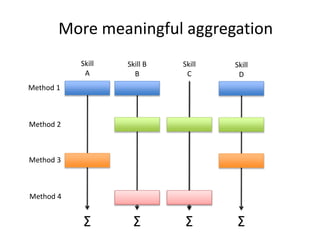
More meaningful aggregation
Method 1
Σ
Method 2
Σ
Method 3
Σ
Method 4
Σ
Skill
A
Skill B
B
Skill
C
Skill
D
Overview
• From practice to research
• From research to theory
• From theory to practice
• Conclusions
From theory back to practice
• Existing best practices:
– Vetirinary education Utrecht
– Cleveland Learner Clinic, Cleveland,
Ohio
– Dutch specialty training in General
Practice
– Graduate entry program Maastricht
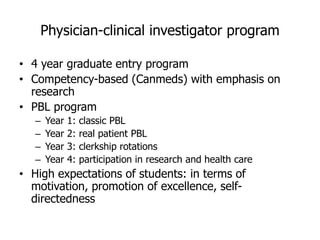
Physician-clinical investigator program
• 4 year graduate entry program
• Competency-based (Canmeds) with emphasis on
research
• PBL program
– Year 1: classic PBL
– Year 2: real patient PBL
– Year 3: clerkship rotations
– Year 4: participation in research and health care
• High expectations of students: in terms of
motivation, promotion of excellence, self-
directedness
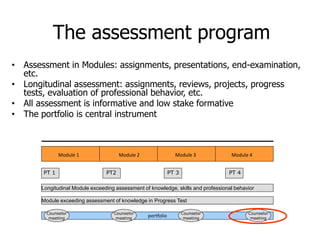
The assessment program
• Assessment in Modules: assignments, presentations, end-examination,
etc.
• Longitudinal assessment: assignments, reviews, projects, progress
tests, evaluation of professional behavior, etc.
• All assessment is informative and low stake formative
• The portfolio is central instrument
Module-overstijgende toetsing van professioneel gedrag
Module 2 Module 3 Module 4Module 1
PT 1 PT2 PT 3 PT 4
Longitudinal Module exceeding assessment of knowledge, skills and professional behavior
portfolioCounselor
meeting
Counselor
meeting
Counselor
meeting
Counselor
meeting
Module exceeding assessment of knowledge in Progress Test
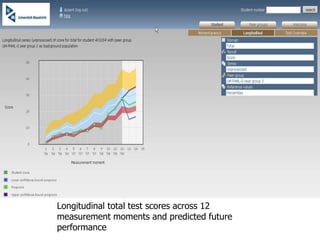
Longitudinal total test scores across 12
measurement moments and predicted future
performance
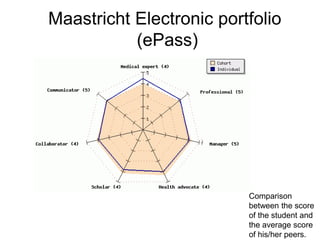
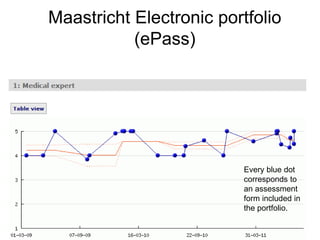
Maastricht Electronic portfolio
(ePass)
Comparison
between the score
of the student and
the average score
of his/her peers.
Every blue dot
corresponds to
an assessment
form included in
the portfolio.
Maastricht Electronic portfolio
(ePass)
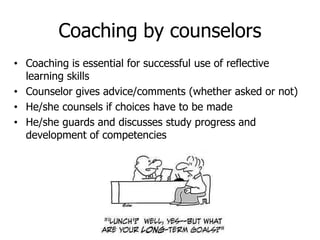
Coaching by counselors
• Coaching is essential for successful use of reflective
learning skills
• Counselor gives advice/comments (whether asked or not)
• He/she counsels if choices have to be made
• He/she guards and discusses study progress and
development of competencies
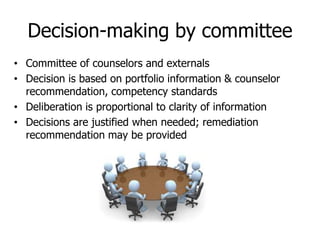
Decision-making by committee
• Committee of counselors and externals
• Decision is based on portfolio information & counselor
recommendation, competency standards
• Deliberation is proportional to clarity of information
• Decisions are justified when needed; remediation
recommendation may be provided
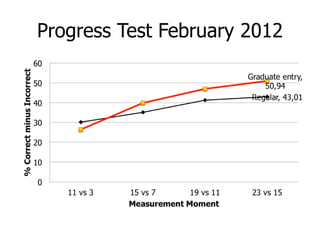
Progress Test February 2012
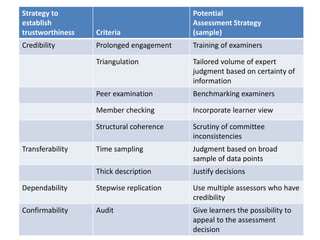
Strategy to
establish
trustworthiness Criteria
Potential
Assessment Strategy
(sample)
Credibility Prolonged engagement Training of examiners
Triangulation Tailored volume of expert
judgment based on certainty of
information
Peer examination Benchmarking examiners
Member checking Incorporate learner view
Structural coherence Scrutiny of committee
inconsistencies
Transferability Time sampling Judgment based on broad
sample of data points
Thick description Justify decisions
Dependability Stepwise replication Use multiple assessors who have
credibility
Confirmability Audit Give learners the possibility to
appeal to the assessment
decision
Overview
• From practice to research
• From research to theory
• From theory to practice
• Conclusions
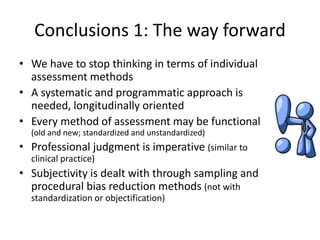
Conclusions 1: The way forward
• We have to stop thinking in terms of individual
assessment methods
• A systematic and programmatic approach is
needed, longitudinally oriented
• Every method of assessment may be functional
(old and new; standardized and unstandardized)
• Professional judgment is imperative (similar to
clinical practice)
• Subjectivity is dealt with through sampling and
procedural bias reduction methods (not with
standardization or objectification)
Conclusions 2: The way forward
• The programmatic approach to
assessment optimizes:
– The learning function (through
information richness)
– The pass/fail decision function
(through the combination of rich
information)
Please give an email if you wish to have this Powerpoint :
c.vandervleuten@maastrichtuniversity.nl

Theoretical Constructs and Best Practice in Assessment

  • 1.
    Theoretical Constructs and BestPractice in Assessment Perspectives in Competency Assessment Touchstone Institute, Toronto 5 February 2015 Cees van der Vleuten Maastricht University The Netherlands www.maastrichtuniversity.nl/she
  • 3.
    Overview • From practiceto research • From research to theory • From theory to practice • Conclusions
  • 4.
    The Toolbox • MCQ,MEQ, OEQ, SIMP, Write- ins, Key Feature, Progress test, PMP, SCT, Viva, Long case, Short case, OSCE, OSPE, DOCEE, SP-based test, Video assessment, MSF, Mini-CEX, DOPS, assessment center, self- assessment, peer assessment, incognito SPs, portfolio………….
  • 5.
    Knows Shows how Knows how Does Knows Fact-orientedassessment: MCQ, write-ins, oral….. Knows how Scenario or case-based assessment: MCQ, write-ins, oral….. Shows how Performance assessment in vitro: Assessment centers, OSCE….. Does Performance assessment in vivo: In situ performance assessment, 360۫ , Peer assesme The way we climbed......
  • 6.
  • 7.
    Validity: what arewe assessing? • Curricula have changed from an input orientation to an output orientation • We went from haphazard learning to integrated learning objectives, to end objectives, and now to (generic) competencies • We went from teacher oriented programs to learning oriented, self-directed programs
  • 8.
    Competency-frameworks CanMeds  Medical expert Communicator  Collaborator  Manager  Health advocate  Scholar  Professional ACGME  Medical knowledge  Patient care  Practice-based learning & improvement  Interpersonal and communication skills  Professionalism  Systems-based practice GMC  Good clinical care  Relationships with patients and families  Working with colleagues  Managing the workplace  Social responsibility and accountability  Professionalism
  • 9.
    Knows Shows how Knows how Does Knows Knowshow Shows how Does Validity: what are we assessing? Standardized assessment (fairly established) Unstandardized assessment (emerging)
  • 10.
    Messages from validityresearch • There is no magic bullet; we need a mixture of methods to cover the competency pyramid • We need BOTH standardized and non- standardized assessment methods • For standardized assessment quality control around test development and administration is vital • For unstandardized assessment the users (the people) are vital.
  • 11.
    Method reliability asa function of testing time Testing Time in Hours 1 2 4 8 MCQ1 0.62 0.77 0.87 0.93 Case- Based Short Essay2 0.68 0.81 0.89 0.94 PMP1 0.36 0.53 0.69 0.82 Oral Exam3 0.50 0.67 0.80 0.89 Long Case4 0.60 0.75 0.86 0.92 OSCE5 0.54 0.70 0.82 0.90 Practice Video Assess- ment7 0.62 0.77 0.87 0.93 1Norcini et al., 1985 2Stalenhoef-Halling et al., 1990 3Swanson, 1987 4Wass et al., 2001 5Van der Vleuten, 1988 6Norcini et al., 1999 In- cognito SPs8 0.61 0.76 0.86 0.93 Mini CEX6 0.73 0.84 0.92 0.96 7Ram et al., 1999 8Gorter, 2002
  • 12.
    Reliability as afunction of sample size (Moonen et al., 2013) 0.65 0.7 0.75 0.8 0.85 0.9 4 5 6 7 8 9 10 11 12 G=0.80 KPB Mini-CEX
  • 13.
    0.65 0.7 0.75 0.8 0.85 0.9 4 5 67 8 9 10 11 12 G=0.80 KPB OSATS Mini-CEX OSATS Reliability as a function of sample size (Moonen et al., 2013)
  • 14.
    0.65 0.7 0.75 0.8 0.85 0.9 4 5 67 8 9 10 11 12 Mini-CEX OSATS MSF Reliability as a function of sample size (Moonen et al., 2013)
  • 15.
    Effect of aggregationacross methods (Moonen et al., 2013) Method Mini-CEX OSATS MSF Sample needed when used as stand-alone 8 9 9 Sample needed when used as a composite 5 6 2
  • 16.
    Messages from reliabilityresearch • Acceptable reliability is only achieved with large samples of test elements (contexts, cases) and assessors • No method is inherently better than any other (that includes the new ones!) • Objectivity is NOT equal to reliability • Many subjective judgments are pretty reproducible/reliable.
  • 17.
    Educational impact: Howdoes assessment drive learning? • Relationship is complex (cf. Cilliers, 2011, 2012) • But impact is often very negative – Poor learning styles – Grade culture (grade hunting, competitiveness) – Grade inflation (e.g. in the workplace) • A lot of REDUCTIONISM! – Little feedback (grade is poorest form of feedback one can get) – Non-alignment with curricular goals – Non-meaningful aggregation of assessment information – Few longitudinal elements – Tick-box exercises (OSCEs, logbooks, work-based assessment).
  • 18.
    • All learnersconstruct knowledge from an inner scaffolding of their individual and social experiences, emotions, will, aptitudes, beliefs, values, self-awareness, purpose, and more . . . if you are learning ….., what you understand is determined by how you understand things, who you are, and what you already know. Peter Senge, Director of the Center for Organizational Learning at MIT (as cited in van Ryn et al., 2014)
  • 19.
    Messages learning impactresearch • No assessment without (meaningful) feedback • Narrative feedback has a lot more impact on complex skills than scores • Provision of feedback is not enough (feedback is a dialogue) • Longitudinal assessment is needed.
  • 20.
    Overview • From practiceto research • From research to theory • From theory to practice • Conclusions
  • 21.
    Limitations of thesingle-method approach • No single method can do it all • Each individual method has (significant) limitations • Each single method is a considerable compromise on reliability, validity, educational impact
  • 22.
    Implications • Validity: amultitude of methods needed • Reliability: a lot of (combined) information is needed • Learning impact: assessment should provide (longitudinal) meaningful information for learning Programmatic assessment
  • 23.
    Programmatic assessment • Acurriculum is a good metaphor; in a program of assessment: – Elements are planned, arranged, coordinated – Is systematically evaluated and reformed • But how? (the literature provides extremely little support!)
  • 24.
    Programmatic assessment • Dijkstraet al 2012: 73 generic guidelines • To be done: – Further validation – A feasible (self-assessment) instrument • ASPIRE assessment criteria
  • 25.
    Building blocks forprogrammatic assessment 1 • Every assessment is but one data point (Δ) • Every data point is optimized for learning – Information rich (quantitative, qualitative) – Meaningful – Variation in format • Summative versus formative is replaced by a continuum of stakes (stakes) • N data points are proportionally related to the stakes of the decision to be taken.
  • 26.
    Continuum of stakes, numberof data point and their function No stake Very high stake One Data point: • Focused on information • Feedback oriented • Not decision oriented Intermediate progress decisions: • More data points needed • Focus on diagnosis, remediation, prediction Final decisions on promotion or selection: • Many data points needed • Focused on a (non- surprising) heavy decision
  • 27.
  • 28.
    Classical approach toaggregation Method 1 to assess skill A Σ Method 2 to assess skill B Σ Σ Σ Method 3 to assess skill C Method 4 to assess skill C
  • 29.
    More meaningful aggregation Method1 Σ Method 2 Σ Method 3 Σ Method 4 Σ Skill A Skill B B Skill C Skill D
  • 32.
    Overview • From practiceto research • From research to theory • From theory to practice • Conclusions
  • 33.
    From theory backto practice • Existing best practices: – Vetirinary education Utrecht – Cleveland Learner Clinic, Cleveland, Ohio – Dutch specialty training in General Practice – Graduate entry program Maastricht
  • 34.
    Physician-clinical investigator program •4 year graduate entry program • Competency-based (Canmeds) with emphasis on research • PBL program – Year 1: classic PBL – Year 2: real patient PBL – Year 3: clerkship rotations – Year 4: participation in research and health care • High expectations of students: in terms of motivation, promotion of excellence, self- directedness
  • 35.
    The assessment program •Assessment in Modules: assignments, presentations, end-examination, etc. • Longitudinal assessment: assignments, reviews, projects, progress tests, evaluation of professional behavior, etc. • All assessment is informative and low stake formative • The portfolio is central instrument Module-overstijgende toetsing van professioneel gedrag Module 2 Module 3 Module 4Module 1 PT 1 PT2 PT 3 PT 4 Longitudinal Module exceeding assessment of knowledge, skills and professional behavior portfolioCounselor meeting Counselor meeting Counselor meeting Counselor meeting Module exceeding assessment of knowledge in Progress Test
  • 36.
    Longitudinal total testscores across 12 measurement moments and predicted future performance
  • 37.
    Maastricht Electronic portfolio (ePass) Comparison betweenthe score of the student and the average score of his/her peers.
  • 38.
    Every blue dot correspondsto an assessment form included in the portfolio. Maastricht Electronic portfolio (ePass)
  • 39.
    Coaching by counselors •Coaching is essential for successful use of reflective learning skills • Counselor gives advice/comments (whether asked or not) • He/she counsels if choices have to be made • He/she guards and discusses study progress and development of competencies
  • 40.
    Decision-making by committee •Committee of counselors and externals • Decision is based on portfolio information & counselor recommendation, competency standards • Deliberation is proportional to clarity of information • Decisions are justified when needed; remediation recommendation may be provided
  • 41.
  • 42.
    Strategy to establish trustworthiness Criteria Potential AssessmentStrategy (sample) Credibility Prolonged engagement Training of examiners Triangulation Tailored volume of expert judgment based on certainty of information Peer examination Benchmarking examiners Member checking Incorporate learner view Structural coherence Scrutiny of committee inconsistencies Transferability Time sampling Judgment based on broad sample of data points Thick description Justify decisions Dependability Stepwise replication Use multiple assessors who have credibility Confirmability Audit Give learners the possibility to appeal to the assessment decision
  • 43.
    Overview • From practiceto research • From research to theory • From theory to practice • Conclusions
  • 44.
    Conclusions 1: Theway forward • We have to stop thinking in terms of individual assessment methods • A systematic and programmatic approach is needed, longitudinally oriented • Every method of assessment may be functional (old and new; standardized and unstandardized) • Professional judgment is imperative (similar to clinical practice) • Subjectivity is dealt with through sampling and procedural bias reduction methods (not with standardization or objectification)
  • 45.
    Conclusions 2: Theway forward • The programmatic approach to assessment optimizes: – The learning function (through information richness) – The pass/fail decision function (through the combination of rich information)
  • 46.
    Please give anemail if you wish to have this Powerpoint : c.vandervleuten@maastrichtuniversity.nl