The Competency Assessment
Toolkit for Professional
Psychology
Psychology
Catherine L. Grus, Ph.D.,
Associate Executive Director for
Professional Education and Training
Education Directorate
American Psychological Association
THANK YOU
THANK YOU
Many thanks to
Many thanks to
• Nadya Fouad, University of Wisconsin
Nadya Fouad, University of Wisconsin
• Nadine Kaslow, Emory University
Nadine Kaslow, Emory University
• Benchmarks Workgroups
Benchmarks Workgroups
• Assessment “Toolkit” Workgroup
Assessment “Toolkit” Workgroup
Overview
Overview
• Considerations in the assessment of
Considerations in the assessment of
competence
competence
• Development of the Toolkit
Development of the Toolkit
• Putting the toolkit into practice
Putting the toolkit into practice
Competence …
Competence …
• “ …
“ … the habitual and judicious use of
the habitual and judicious use of
communication, knowledge, technical
skills, clinical reasoning, emotions,
values, and reflection in daily practice
for the benefit of the individual and
community being served.”
From Epstein and Hundert (2002)
Competence …
Competence …
• …
… is developmental depending on stage
is developmental depending on stage
of professional functioning
• …
… context dependent
context dependent
• …
… executed according to ethical
executed according to ethical
principles, guidelines, standards, and
values of the profession and
• …
… requires public verification
requires public verification
Competencies …
Competencies …
– Observable
Observable
– Measurable
Measurable
– Containable
Containable
– Practical
Practical
– Derived by experts
Derived by experts
– And flexible
And flexible
 are elements of competence that are ….
are elements of competence that are ….
Assessment of Competence -
Considerations
Considerations
• Use of both “formative” and
Use of both “formative” and
“summative” evaluation methods
• Authentic evaluations
Authentic evaluations
• Real world tasks, meaningful activities
Real world tasks, meaningful activities
• [High] Fidelity: Degree to which
[High] Fidelity: Degree to which
the assessment represents
actual performance
actual performance
• Employ a range of perspectives (multi-
Employ a range of perspectives (multi-
informant) and methods
• Challenge of evaluating attitudes and
Challenge of evaluating attitudes and
values
values
• Psychometric issues
Psychometric issues
• Feasibility/costs
Feasibility/costs
• Lifelong self-assessment
Lifelong self-assessment
What methods are commonly
used to assess students/
trainees?
trainees?
• In class examinations and course
In class examinations and course
“grades”
“grades”
• Faculty/supervisor completes rating
Faculty/supervisor completes rating
scale
scale
• Letters of recommendation
Letters of recommendation
• EPPP, state jurisprudence exams
EPPP, state jurisprudence exams
Developing Faculty/Supervisor
Competencies
Competencies
• Training in “difficult conversations”
Training in “difficult conversations”
– How to “critique constructively”
How to “critique constructively”
• Develop awareness of potential dual roles in
Develop awareness of potential dual roles in
evaluation and how that could influence
results
results
– Benefits of having other faculty evaluate students’
Benefits of having other faculty evaluate students’
performance
performance
– Explicit obligations to make evaluations accurate
Explicit obligations to make evaluations accurate
• Grade inflation
Grade inflation
• Letters of recommendation to “market” vs. evaluate
Letters of recommendation to “market” vs. evaluate
• Knowledge of a range of assessment tools,
Knowledge of a range of assessment tools,
access to resources “toolkits”
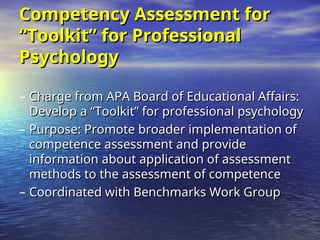
Competency Assessment for
“Toolkit” for Professional
Psychology
Psychology
– Charge from APA Board of Educational Affairs:
Charge from APA Board of Educational Affairs:
Develop a “Toolkit” for professional psychology
– Purpose: Promote broader implementation of
Purpose: Promote broader implementation of
competence assessment and provide
information about application of assessment
methods to the assessment of competence
– Coordinated with Benchmarks Work Group
Coordinated with Benchmarks Work Group
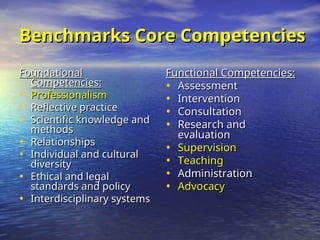
Benchmarks Core Competencies
Foundational
Foundational
Competencies:
Competencies:
• Professionalism
Professionalism
• Reflective practice
Reflective practice
• Scientific knowledge and
Scientific knowledge and
methods
methods
• Relationships
Relationships
• Individual and cultural
Individual and cultural
diversity
diversity
• Ethical and legal
Ethical and legal
standards and policy
• Interdisciplinary systems
Interdisciplinary systems
Functional Competencies:
• Assessment
Assessment
• Intervention
Intervention
• Consultation
Consultation
• Research and
Research and
evaluation
evaluation
• Supervision
Supervision
• Teaching
Teaching
• Administration
Administration
• Advocacy
Advocacy
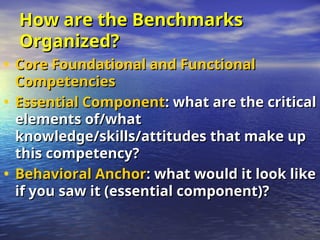
How are the Benchmarks
Organized?
Organized?
• Core Foundational and Functional
Core Foundational and Functional
Competencies
Competencies
• Essential Component
Essential Component: what are the critical
: what are the critical
elements of/what
elements of/what
knowledge/skills/attitudes that make up
this competency?
this competency?
• Behavioral Anchor
Behavioral Anchor: what would it look like
: what would it look like
if you saw it (essential component)?
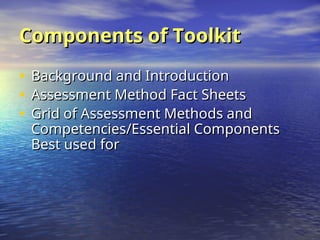
Components of Toolkit
• Background and Introduction
Background and Introduction
• Assessment Method Fact Sheets
Assessment Method Fact Sheets
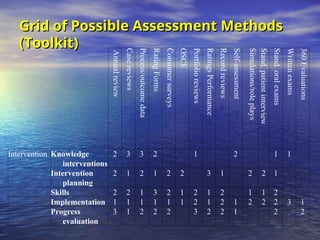
• Grid of Assessment Methods and
Grid of Assessment Methods and
Competencies/Essential Components
Best used for
Best used for
Fact Sheet: Portfolio Review
Description
A portfolio is a collection of products, gathered by the person being assessed …
Application
Competency Applies to1
Predominant
Use of2
Development
al Level3
Professionalism E F,S 2,3,4
Reflective Practice E F,S 1,2,3,4
Implementation
Deciding on form (e.g., web-based or hard copy)
Psychometric Properties
Reliability has not been well established due to the variable content included
in a portfolio
Strengths
Provides a low cost assessment strategy
Challenges
Requires intense commitment of time and labor intensive for the assessors
and the person being assessed
Future directions
Create and implement training modules for assessors and people being
assessed in the portfolio assessment strategy
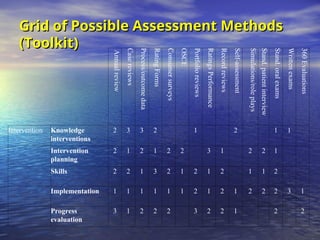
Annual
review
Case
reviews
Process/outcome
data
Rating
Forms
Consumer
surveys
OSCE
Portfolio
reviews
Ratings
Performance
Record
reviews
Self-assessment
Simulations/role
plays
Stand.
patient
interview
Stand.
oral
exams
Written
exams
360
Evaluations
Intervention Knowledge
interventions
2 3 3 2 1 2 1 1
Intervention
planning
2 1 2 1 2 2 3 1 2 2 1
Skills 2 2 1 3 2 1 2 1 2 1 1 2
Implementation 1 1 1 1 1 1 2 1 2 1 2 2 2 3 1
Progress
evaluation
3 1 2 2 2 3 2 2 1 2 2
Grid of Possible Assessment Methods
(Toolkit)
(Toolkit)
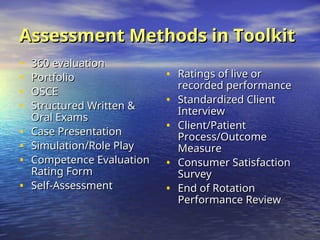
Assessment Methods in Toolkit
• 360 evaluation
360 evaluation
• Portfolio
Portfolio
• OSCE
OSCE
• Structured Written &
Structured Written &
Oral Exams
Oral Exams
• Case Presentation
Case Presentation
• Simulation/Role Play
Simulation/Role Play
• Competence Evaluation
Competence Evaluation
Rating Form
Rating Form
• Self-Assessment
Self-Assessment
• Ratings of live or
Ratings of live or
recorded performance
• Standardized Client
Standardized Client
Interview
Interview
• Client/Patient
Client/Patient
Process/Outcome
Process/Outcome
Measure
Measure
• Consumer Satisfaction
Consumer Satisfaction
Survey
Survey
• End of Rotation
End of Rotation
Performance Review
Performance Review
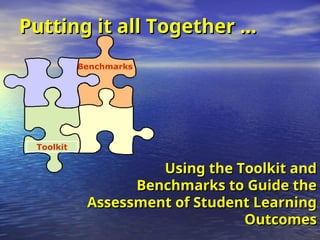
Putting it all Together …
Benchmarks
Toolkit
Using the Toolkit and
Benchmarks to Guide the
Assessment of Student Learning
Outcomes
Outcomes
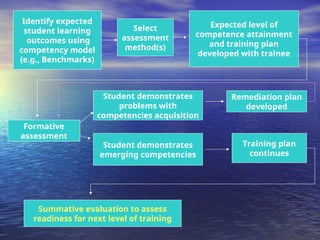
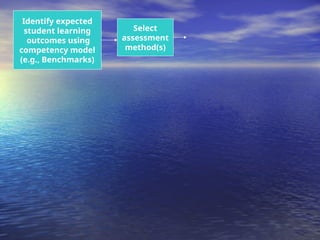
Identify expected
student learning
outcomes using
competency model
(e.g., Benchmarks)
Select
assessment
method(s)
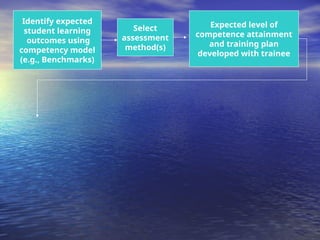
Expected level of
competence attainment
and training plan
developed with trainee
Formative
assessment
Student demonstrates
problems with
competencies acquisition
Student demonstrates
emerging competencies
Training plan
continues
Remediation plan
developed
Summative evaluation to assess
readiness for next level of training
Identify expected
student learning
outcomes using
competency model
(e.g., Benchmarks)
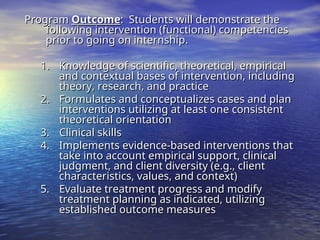
Program
Program Outcome
Outcome: Students will demonstrate the
: Students will demonstrate the
following intervention (functional) competencies
prior to going on internship.
1.
1. Knowledge of scientific, theoretical, empirical
Knowledge of scientific, theoretical, empirical
and contextual bases of intervention, including
theory, research, and practice
2.
2. Formulates and conceptualizes cases and plan
Formulates and conceptualizes cases and plan
interventions utilizing at least one consistent
theoretical orientation
3.
3. Clinical skills
Clinical skills
4.
4. Implements evidence-based interventions that
Implements evidence-based interventions that
take into account empirical support, clinical
judgment, and client diversity (e.g., client
characteristics, values, and context)
5.
5. Evaluate treatment progress and modify
Evaluate treatment progress and modify
treatment planning as indicated, utilizing
established outcome measures
Identify expected
student learning
outcomes using
competency model
(e.g., Benchmarks)
Select
assessment
method(s)
Annual
review
Case
reviews
Process/outcome
data
Rating
Forms
Consumer
surveys
OSCE
Portfolio
reviews
Ratings
Performance
Record
reviews
Self-assessment
Simulations/role
plays
Stand.
patient
interview
Stand.
oral
exams
Written
exams
360
Evaluations
Intervention Knowledge
interventions
2 3 3 2 1 2 1 1
Intervention
planning
2 1 2 1 2 2 3 1 2 2 1
Skills 2 2 1 3 2 1 2 1 2 1 1 2
Implementation 1 1 1 1 1 1 2 1 2 1 2 2 2 3 1
Progress
evaluation
3 1 2 2 2 3 2 2 1 2 2
Grid of Possible Assessment Methods
(Toolkit)
(Toolkit)
Identify expected
student learning
outcomes using
competency model
(e.g., Benchmarks)
Select
assessment
method(s)
Expected level of
competence attainment
and training plan
developed with trainee
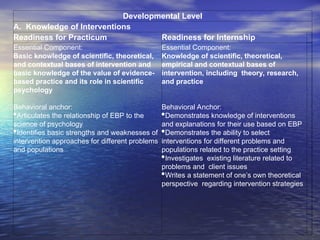
Developmental Level
A. Knowledge of Interventions
Readiness for Practicum Readiness for Internship
Essential Component:
Basic knowledge of scientific, theoretical,
and contextual bases of intervention and
basic knowledge of the value of evidence-
based practice and its role in scientific
psychology
Behavioral anchor:
Articulates the relationship of EBP to the
science of psychology
Identifies basic strengths and weaknesses of
intervention approaches for different problems
and populations
Essential Component:
Knowledge of scientific, theoretical,
empirical and contextual bases of
intervention, including theory, research,
and practice
Behavioral Anchor:
Demonstrates knowledge of interventions
and explanations for their use based on EBP
Demonstrates the ability to select
interventions for different problems and
populations related to the practice setting
Investigates existing literature related to
problems and client issues
Writes a statement of one’s own theoretical
perspective regarding intervention strategies
Identify expected
student learning
outcomes using
competency model
(e.g., Benchmarks)
Select
assessment
method(s)
Expected level of
competence attainment
and training plan
developed with trainee
Formative
assessment
Student demonstrates
problems with
competencies acquisition
Student demonstrates
emerging competencies
Training plan
continues
Remediation plan
developed
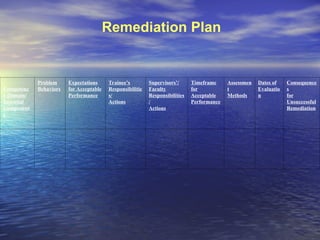
Remediation Plan
Competenc
y Domain/
Essential
Component
s
Problem
Behaviors
Expectations
for Acceptable
Performance
Trainee’s
Responsibilitie
s/
Actions
Supervisors’/
Faculty
Responsibilities
/
Actions
Timeframe
for
Acceptable
Performance
Assessmen
t
Methods
Dates of
Evaluatio
n
Consequence
s
for
Unsuccessful
Remediation
Identify expected
student learning
outcomes using
competency model
(e.g., Benchmarks)
Select
assessment
method(s)
Expected level of
competence attainment
and training plan
developed with trainee
Formative
assessment
Student demonstrates
problems with
competencies acquisition
Student demonstrates
emerging competencies
Training plan
continues
Remediation plan
developed
Summative evaluation to assess
readiness for next level of training
For more information:
http://www.apa.org/ed/graduate/competency.html
Coming soon:
Coming soon:
Kaslow, N. J., Grus, C. L., Campbell, L. C., Fouad, N. A.,
Hatcher, R. L., & Rodolfa, E. R. (in press) Competency
Assessment Toolkit for Professional Psychology.
Training and Education in Professional Psychology.
Toolkit on competency assessment tools and issues

  • 1.
    The Competency Assessment TheCompetency Assessment Toolkit for Professional Toolkit for Professional Psychology Psychology Catherine L. Grus, Ph.D., Catherine L. Grus, Ph.D., Associate Executive Director for Associate Executive Director for Professional Education and Training Professional Education and Training Education Directorate Education Directorate American Psychological Association American Psychological Association
  • 2.
    THANK YOU THANK YOU Manythanks to Many thanks to • Nadya Fouad, University of Wisconsin Nadya Fouad, University of Wisconsin • Nadine Kaslow, Emory University Nadine Kaslow, Emory University • Benchmarks Workgroups Benchmarks Workgroups • Assessment “Toolkit” Workgroup Assessment “Toolkit” Workgroup
  • 3.
    Overview Overview • Considerations inthe assessment of Considerations in the assessment of competence competence • Development of the Toolkit Development of the Toolkit • Putting the toolkit into practice Putting the toolkit into practice
  • 4.
    Competence … Competence … •“ … “ … the habitual and judicious use of the habitual and judicious use of communication, knowledge, technical communication, knowledge, technical skills, clinical reasoning, emotions, skills, clinical reasoning, emotions, values, and reflection in daily practice values, and reflection in daily practice for the benefit of the individual and for the benefit of the individual and community being served.” community being served.” From Epstein and Hundert (2002) From Epstein and Hundert (2002)
  • 5.
    Competence … Competence … •… … is developmental depending on stage is developmental depending on stage of professional functioning of professional functioning • … … context dependent context dependent • … … executed according to ethical executed according to ethical principles, guidelines, standards, and principles, guidelines, standards, and values of the profession and values of the profession and • … … requires public verification requires public verification
  • 6.
    Competencies … Competencies … –Observable Observable – Measurable Measurable – Containable Containable – Practical Practical – Derived by experts Derived by experts – And flexible And flexible  are elements of competence that are …. are elements of competence that are ….
  • 7.
    Assessment of Competence- Assessment of Competence - Considerations Considerations • Use of both “formative” and Use of both “formative” and “summative” evaluation methods “summative” evaluation methods • Authentic evaluations Authentic evaluations • Real world tasks, meaningful activities Real world tasks, meaningful activities • [High] Fidelity: Degree to which [High] Fidelity: Degree to which the assessment represents the assessment represents actual performance actual performance
  • 8.
    • Employ arange of perspectives (multi- Employ a range of perspectives (multi- informant) and methods informant) and methods • Challenge of evaluating attitudes and Challenge of evaluating attitudes and values values • Psychometric issues Psychometric issues • Feasibility/costs Feasibility/costs • Lifelong self-assessment Lifelong self-assessment
  • 9.
    What methods arecommonly What methods are commonly used to assess students/ used to assess students/ trainees? trainees? • In class examinations and course In class examinations and course “grades” “grades” • Faculty/supervisor completes rating Faculty/supervisor completes rating scale scale • Letters of recommendation Letters of recommendation • EPPP, state jurisprudence exams EPPP, state jurisprudence exams
  • 10.
    Developing Faculty/Supervisor Developing Faculty/Supervisor Competencies Competencies •Training in “difficult conversations” Training in “difficult conversations” – How to “critique constructively” How to “critique constructively” • Develop awareness of potential dual roles in Develop awareness of potential dual roles in evaluation and how that could influence evaluation and how that could influence results results – Benefits of having other faculty evaluate students’ Benefits of having other faculty evaluate students’ performance performance – Explicit obligations to make evaluations accurate Explicit obligations to make evaluations accurate • Grade inflation Grade inflation • Letters of recommendation to “market” vs. evaluate Letters of recommendation to “market” vs. evaluate • Knowledge of a range of assessment tools, Knowledge of a range of assessment tools, access to resources “toolkits” access to resources “toolkits”
  • 11.
    Competency Assessment for CompetencyAssessment for “Toolkit” for Professional “Toolkit” for Professional Psychology Psychology – Charge from APA Board of Educational Affairs: Charge from APA Board of Educational Affairs: Develop a “Toolkit” for professional psychology Develop a “Toolkit” for professional psychology – Purpose: Promote broader implementation of Purpose: Promote broader implementation of competence assessment and provide competence assessment and provide information about application of assessment information about application of assessment methods to the assessment of competence methods to the assessment of competence – Coordinated with Benchmarks Work Group Coordinated with Benchmarks Work Group
  • 12.
    Benchmarks Core Competencies BenchmarksCore Competencies Foundational Foundational Competencies: Competencies: • Professionalism Professionalism • Reflective practice Reflective practice • Scientific knowledge and Scientific knowledge and methods methods • Relationships Relationships • Individual and cultural Individual and cultural diversity diversity • Ethical and legal Ethical and legal standards and policy standards and policy • Interdisciplinary systems Interdisciplinary systems Functional Competencies: Functional Competencies: • Assessment Assessment • Intervention Intervention • Consultation Consultation • Research and Research and evaluation evaluation • Supervision Supervision • Teaching Teaching • Administration Administration • Advocacy Advocacy
  • 13.
    How are theBenchmarks How are the Benchmarks Organized? Organized? • Core Foundational and Functional Core Foundational and Functional Competencies Competencies • Essential Component Essential Component: what are the critical : what are the critical elements of/what elements of/what knowledge/skills/attitudes that make up knowledge/skills/attitudes that make up this competency? this competency? • Behavioral Anchor Behavioral Anchor: what would it look like : what would it look like if you saw it (essential component)? if you saw it (essential component)?
  • 14.
    Components of Toolkit Componentsof Toolkit • Background and Introduction Background and Introduction • Assessment Method Fact Sheets Assessment Method Fact Sheets • Grid of Assessment Methods and Grid of Assessment Methods and Competencies/Essential Components Competencies/Essential Components Best used for Best used for
  • 15.
    Fact Sheet: PortfolioReview Description A portfolio is a collection of products, gathered by the person being assessed … Application Competency Applies to1 Predominant Use of2 Development al Level3 Professionalism E F,S 2,3,4 Reflective Practice E F,S 1,2,3,4 Implementation Deciding on form (e.g., web-based or hard copy) Psychometric Properties Reliability has not been well established due to the variable content included in a portfolio Strengths Provides a low cost assessment strategy Challenges Requires intense commitment of time and labor intensive for the assessors and the person being assessed Future directions Create and implement training modules for assessors and people being assessed in the portfolio assessment strategy
  • 16.
    Annual review Case reviews Process/outcome data Rating Forms Consumer surveys OSCE Portfolio reviews Ratings Performance Record reviews Self-assessment Simulations/role plays Stand. patient interview Stand. oral exams Written exams 360 Evaluations Intervention Knowledge interventions 2 33 2 1 2 1 1 Intervention planning 2 1 2 1 2 2 3 1 2 2 1 Skills 2 2 1 3 2 1 2 1 2 1 1 2 Implementation 1 1 1 1 1 1 2 1 2 1 2 2 2 3 1 Progress evaluation 3 1 2 2 2 3 2 2 1 2 2 Grid of Possible Assessment Methods Grid of Possible Assessment Methods (Toolkit) (Toolkit)
  • 17.
    Assessment Methods inToolkit Assessment Methods in Toolkit • 360 evaluation 360 evaluation • Portfolio Portfolio • OSCE OSCE • Structured Written & Structured Written & Oral Exams Oral Exams • Case Presentation Case Presentation • Simulation/Role Play Simulation/Role Play • Competence Evaluation Competence Evaluation Rating Form Rating Form • Self-Assessment Self-Assessment • Ratings of live or Ratings of live or recorded performance recorded performance • Standardized Client Standardized Client Interview Interview • Client/Patient Client/Patient Process/Outcome Process/Outcome Measure Measure • Consumer Satisfaction Consumer Satisfaction Survey Survey • End of Rotation End of Rotation Performance Review Performance Review
  • 18.
    Putting it allTogether … Putting it all Together … Benchmarks Toolkit Using the Toolkit and Using the Toolkit and Benchmarks to Guide the Benchmarks to Guide the Assessment of Student Learning Assessment of Student Learning Outcomes Outcomes
  • 19.
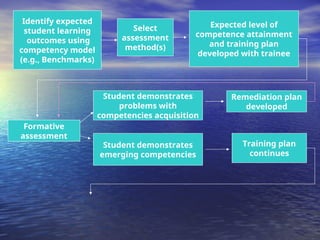
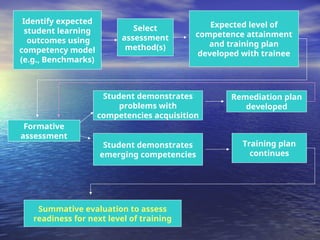
    Identify expected student learning outcomesusing competency model (e.g., Benchmarks) Select assessment method(s) Expected level of competence attainment and training plan developed with trainee Formative assessment Student demonstrates problems with competencies acquisition Student demonstrates emerging competencies Training plan continues Remediation plan developed Summative evaluation to assess readiness for next level of training
  • 20.
    Identify expected student learning outcomesusing competency model (e.g., Benchmarks)
  • 21.
    Program Program Outcome Outcome: Studentswill demonstrate the : Students will demonstrate the following intervention (functional) competencies following intervention (functional) competencies prior to going on internship. prior to going on internship. 1. 1. Knowledge of scientific, theoretical, empirical Knowledge of scientific, theoretical, empirical and contextual bases of intervention, including and contextual bases of intervention, including theory, research, and practice theory, research, and practice 2. 2. Formulates and conceptualizes cases and plan Formulates and conceptualizes cases and plan interventions utilizing at least one consistent interventions utilizing at least one consistent theoretical orientation theoretical orientation 3. 3. Clinical skills Clinical skills 4. 4. Implements evidence-based interventions that Implements evidence-based interventions that take into account empirical support, clinical take into account empirical support, clinical judgment, and client diversity (e.g., client judgment, and client diversity (e.g., client characteristics, values, and context) characteristics, values, and context) 5. 5. Evaluate treatment progress and modify Evaluate treatment progress and modify treatment planning as indicated, utilizing treatment planning as indicated, utilizing established outcome measures established outcome measures
  • 22.
    Identify expected student learning outcomesusing competency model (e.g., Benchmarks) Select assessment method(s)
  • 23.
    Annual review Case reviews Process/outcome data Rating Forms Consumer surveys OSCE Portfolio reviews Ratings Performance Record reviews Self-assessment Simulations/role plays Stand. patient interview Stand. oral exams Written exams 360 Evaluations Intervention Knowledge interventions 2 33 2 1 2 1 1 Intervention planning 2 1 2 1 2 2 3 1 2 2 1 Skills 2 2 1 3 2 1 2 1 2 1 1 2 Implementation 1 1 1 1 1 1 2 1 2 1 2 2 2 3 1 Progress evaluation 3 1 2 2 2 3 2 2 1 2 2 Grid of Possible Assessment Methods Grid of Possible Assessment Methods (Toolkit) (Toolkit)
  • 24.
    Identify expected student learning outcomesusing competency model (e.g., Benchmarks) Select assessment method(s) Expected level of competence attainment and training plan developed with trainee
  • 25.
    Developmental Level A. Knowledgeof Interventions Readiness for Practicum Readiness for Internship Essential Component: Basic knowledge of scientific, theoretical, and contextual bases of intervention and basic knowledge of the value of evidence- based practice and its role in scientific psychology Behavioral anchor: Articulates the relationship of EBP to the science of psychology Identifies basic strengths and weaknesses of intervention approaches for different problems and populations Essential Component: Knowledge of scientific, theoretical, empirical and contextual bases of intervention, including theory, research, and practice Behavioral Anchor: Demonstrates knowledge of interventions and explanations for their use based on EBP Demonstrates the ability to select interventions for different problems and populations related to the practice setting Investigates existing literature related to problems and client issues Writes a statement of one’s own theoretical perspective regarding intervention strategies
  • 26.
    Identify expected student learning outcomesusing competency model (e.g., Benchmarks) Select assessment method(s) Expected level of competence attainment and training plan developed with trainee Formative assessment Student demonstrates problems with competencies acquisition Student demonstrates emerging competencies Training plan continues Remediation plan developed
  • 27.
    Remediation Plan Competenc y Domain/ Essential Component s Problem Behaviors Expectations forAcceptable Performance Trainee’s Responsibilitie s/ Actions Supervisors’/ Faculty Responsibilities / Actions Timeframe for Acceptable Performance Assessmen t Methods Dates of Evaluatio n Consequence s for Unsuccessful Remediation
  • 28.
    Identify expected student learning outcomesusing competency model (e.g., Benchmarks) Select assessment method(s) Expected level of competence attainment and training plan developed with trainee Formative assessment Student demonstrates problems with competencies acquisition Student demonstrates emerging competencies Training plan continues Remediation plan developed Summative evaluation to assess readiness for next level of training
  • 29.
    For more information: Formore information: http://www.apa.org/ed/graduate/competency.html http://www.apa.org/ed/graduate/competency.html Coming soon: Coming soon: Kaslow, N. J., Grus, C. L., Campbell, L. C., Fouad, N. A., Kaslow, N. J., Grus, C. L., Campbell, L. C., Fouad, N. A., Hatcher, R. L., & Rodolfa, E. R. (in press) Competency Hatcher, R. L., & Rodolfa, E. R. (in press) Competency Assessment Toolkit for Professional Psychology. Assessment Toolkit for Professional Psychology. Training and Education in Professional Psychology. Training and Education in Professional Psychology.