


The Development of Multiple-
 Choice Questions using the
   Key-features Approach

  Claire Touchie, MD, FRCPC
        University of Ottawa
      Medical Council of Canada
Conflict of Interest
Medical Education: none


                          2
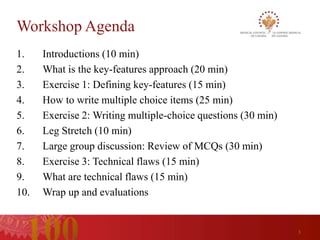
Workshop Agenda
1.    Introductions (10 min)
2.    What is the key-features approach (20 min)
3.    Exercise 1: Defining key-features (15 min)
4.    How to write multiple choice items (25 min)
5.    Exercise 2: Writing multiple-choice questions (30 min)
6.    Leg Stretch (10 min)
7.    Large group discussion: Review of MCQs (30 min)
8.    Exercise 3: Technical flaws (15 min)
9.    What are technical flaws (15 min)
10.   Wrap up and evaluations


                                                               3
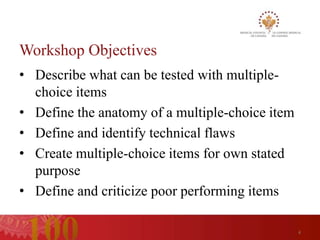
Workshop Objectives
• Describe what can be tested with multiple-
  choice items
• Define the anatomy of a multiple-choice item
• Define and identify technical flaws
• Create multiple-choice items for own stated
  purpose
• Define and criticize poor performing items

                                                 4
Why are we doing this?
 Which one of the following is true about pseudogout?

 1.   It occurs frequently in women.
 2.   Seldom associated with acute pain in a joint
 3.   May be associated with a finding of
      chondrocalcinosis.
 4.   It is hereditary in all cases
 5.   It responds well to treatment with allopurinol
Why are we doing this?
A 62 year-old woman with a history of confusion and constipation comes to
the office for a follow-up visit. Laboratory investigations reveal a serum
calcium of 2.9mmol/L, a creatinine of 146 µmol/L, and a hemoglobin of 108
g/L.
Which one of the following is the most likely diagnosis?

1.   Hyperparathyroidism
2.   Chronic renal failure
3.   Multiple myeloma*
4.   Vitamin D intoxication
5.   Renal cell carcinoma
Key Feature Problems
•Based on the concept of “Case Specificity”
  – The clinical performance on one problem is NOT a good
    predictor for performance on other problems
•Assessment is best served when focusing
exclusively on the unique challenges (key
features) in the resolution of each problem
  – Essential issues or specific difficulty
Key Feature Problems
•First discussed at Cambridge Conference – 1984
•Developed by Georges Bordage and Gordon Page for
the MCC
•First incorporated into the MCCQE Part I – 1992
•Known under different names
  – Q4, Clinical Reasoning Skills (CRS), Clinical Decision
    Making (CDM)
So what? Who cares?
•Studies show validity evidence and reliability in
testing settings
•Wenghofer et al. (Med Educ 2009)
  – Candidates in the bottom quartile had a 3-fold increase in
    the risk of an unacceptable quality-of-care assessment
    outcome (OR 3.41)
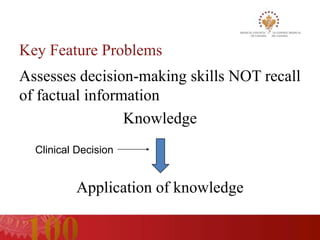
Key Feature Problems
Assesses decision-making skills NOT recall
of factual information
                 Knowledge
  Clinical Decision


          Application of knowledge
Application of Knowledge
•To elicit clinical clues
•To formulate diagnostic impressions
•To order investigative or f/u procedures
•To acquire data to monitor a course of action
OR evaluate the severity/probability of an
outcome
•To select a management course
Example of Knowledge question
•Which of the following are characteristic
of delirium?
Alternate type of question
Should assess the ability to:
  – Recognize delirium tremens in a specific patient
     • An example of a “clinical reasoning” issue
  – Prescribe appropriate therapeutic measures
     • An example of a “clinical decision” issue
Key Feature – Definition
•A critical or essential step in the resolution of a
problem
•A step in which examinees are most likely to
make errors in the resolution of a problem
•A difficult or challenging aspect in the
identification and management of the problem in
practice
Advantages of the Key Feature Approach
•More discriminating
•Shifts the emphasis from
  – The method of assessment to the object of
    assessment
  – Assessing all aspects of solving a problem to
    assessing only the essential element
Key Question of Key Features
“What are the critical, essential elements in
    the resolution of the problem?”
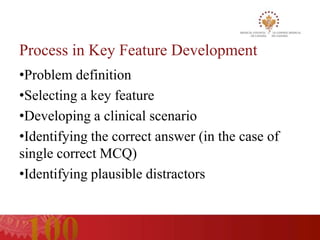
Process in Key Feature Development
•Problem definition
•Selecting a key feature
•Developing a clinical scenario
•Identifying the correct answer (in the case of
single correct MCQ)
•Identifying plausible distractors
How can this be applied?
Let us try…
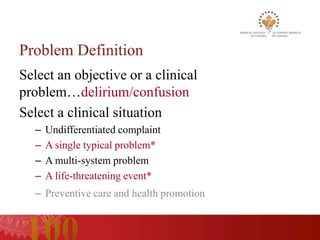
Problem Definition
Select an objective or a clinical
problem…delirium/confusion
Select a clinical situation
  –   Undifferentiated complaint
  –   A single typical problem*
  –   A multi-system problem
  –   A life-threatening event*
  – Preventive care and health promotion
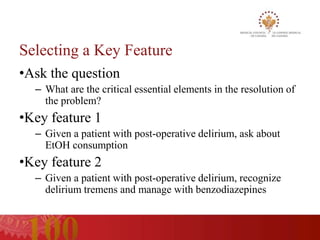
Selecting a Key Feature
•Ask the question
  – What are the critical essential elements in the resolution of
    the problem?
•Key feature 1
  – Given a patient with post-operative delirium, ask about
    EtOH consumption
•Key feature 2
  – Given a patient with post-operative delirium, recognize
    delirium tremens and manage with benzodiazepines
Exercise #1
Writing key features


                       21
How to write multiple-choice items
1. The What
2. The How


                                     22
The What
• What can I test with MCQs?
   •   Knowledge
   •   Clinical-decision making
• Clearly define the purpose of your exam
• Define what it is you want to test
   •   For the overall test
   •   For your specific question

                                        23
The What
Prior to writing your question, ask the
following questions
• What concept do I want to test?
• Where does the learner go wrong?
    •   Focus on areas of “challenge” for the learner


                                                        24
Example of the What
Purpose: To assess the clinical clerk’s
knowledge and decision making capability
at the end of an Internal Medicine six week
rotation
• Concept/Objective: Management of
    CHF
• Challenge to the learner: ???
                                          25
The How – Anatomy of a MC item
•   Stem
     •   Clinical vignette which describes the setting, the
         patient’s age and complaint along with pertinent
         historical facts, physical exam details, and/or
         laboratory findings
•   Lead-in question
     •   The task
•   Answer and alternatives
     •   The most correct answer and the plausible distractors

                                                                 26
The How – Anatomy of a MC item
Stem
•   A 58-year old man presents to the ED with
    sudden onset of left-sided chest pain
    associated with shortness of
    breath, palpitations and dizziness. His past
    history is relevant for a recent diagnosis of
    lung carcinoma. His examination is only
    remarkable for a heart rate of 112/minute.
                                                    27
The How-Anatomy of a MC item
Lead-in question
•   Which one of the following diagnostic test
    would be most useful to confirm the
    diagnosis?


                                                 28
The How – Anatomy of a MC item
Correct/Best answer and distractors
1. Chest radiograph
2. CT of the chest *
3. Sputum culture
4. Electrocardiogram
5. Echocardiogram

                                      29
What did you notice about this question?
Could you answer it without seeing the
alternatives?
Could you answer without being given the
diagnosis?


                                           30
The Stem
• Short description of a clinical scenario
    •       Common or clinically important
    •       Clear and contains relevant information to the
            clinical problem – avoid window-dressing
• Word the stem positively
    •       Avoid EXCEPT questions
    •       Use negative words with caution
        •     Eg: contraindication, what to avoid

                                                         31
The Stem
• Provide sufficient information to answer
  the item
   •   DO NOT create tricky items by omitting
       essential information
   •   DO NOT add extraneous information
   •   Stem should be a clinical vignette


                                                32
Lead-in Question
• Ensure the directions are very clear with
  a clear task
  • Can the stem be administered in a short answer
    (constructed-response) format?
  • “Cover answer test”
Lead-in Question
•   Different clinical tasks can be tested
•   Can be done with the same stem (cloning of
    question)
    •   History
    •   Diagnosis
    •   Investigations
    •   Management/Treatment/Drug therapy
    •   Counseling
Lead-in Question
Try asking questions that lead to clinical decision-
making?
Which one of the following
   –   … is the most likely diagnosis?
   –   … investigations would you now order?
   –   …is the next step in the work-up of this patient?
   –   … is the most important step in the initial management of
       this patient?
Distractors
•   Only one right choice with distractors
•   Number of distractors is a policy decision (3? vs. 4?)
•   Use plausible distractor choices
•   Keep distractors independent, they should not be overlapping
    •   E.g.: 1. 11-20; 2. 15-30

• Keep distractors homogeneous in content and grammatical
  structure
• Keep the length about equal
• Avoid specific determiners such as
  All, Never, Always, Completely and Absolutely
• Do not use All of the Above or None of the Above
Item testing clinical decision-making
A 62 year-old woman with a history of confusion and constipation comes to
the office for a follow-up visit. Laboratory investigations reveal a serum
calcium of 2.9mmol/L, a creatinine of 146 µmol/L, and a hemoglobin of 108
g/L.
Which one of the following is the most likely diagnosis?

1.   Hyperparathyroidism
2.   Chronic renal failure
3.   Multiple myeloma*
4.   Vitamin D intoxication
5.   Renal cell carcinoma
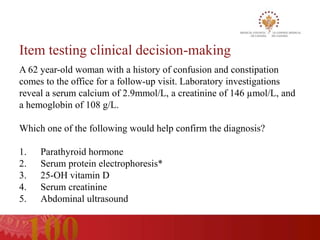
Item testing clinical decision-making
A 62 year-old woman with a history of confusion and constipation
comes to the office for a follow-up visit. Laboratory investigations
reveal a serum calcium of 2.9mmol/L, a creatinine of 146 µmol/L, and
a hemoglobin of 108 g/L.

Which one of the following would help confirm the diagnosis?

1.   Parathyroid hormone
2.   Serum protein electrophoresis*
3.   25-OH vitamin D
4.   Serum creatinine
5.   Abdominal ultrasound
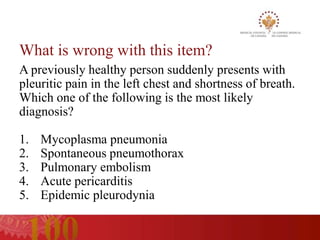
What is wrong with this item?
A previously healthy person suddenly presents with
pleuritic pain in the left chest and shortness of breath.
Which one of the following is the most likely
diagnosis?

1.   Mycoplasma pneumonia
2.   Spontaneous pneumothorax
3.   Pulmonary embolism
4.   Acute pericarditis
5.   Epidemic pleurodynia
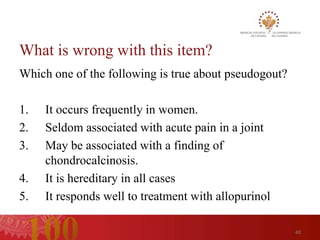
What is wrong with this item?
Which one of the following is true about pseudogout?

1.   It occurs frequently in women.
2.   Seldom associated with acute pain in a joint
3.   May be associated with a finding of
     chondrocalcinosis.
4.   It is hereditary in all cases
5.   It responds well to treatment with allopurinol

                                                       40
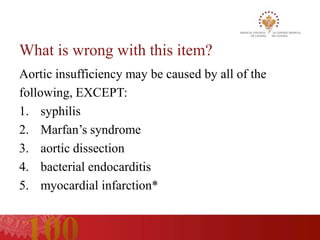
What is wrong with this item?
Aortic insufficiency may be caused by all of the
following, EXCEPT:
1. syphilis
2. Marfan’s syndrome
3. aortic dissection
4. bacterial endocarditis
5. myocardial infarction*
Exercise #2 – 30 minutes
       Writing MCQ items
•   Pair up with a partner
•   Using the MCQ item development
    worksheet, develop MCQ items that will be
    useful to you


                                                42
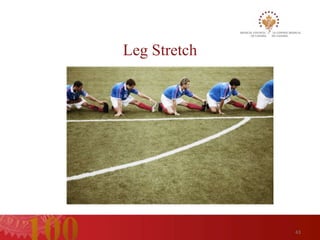
Leg Stretch


              43
Exercise #2 – Pre-test
A Test of General Rock and Roll
          Knowledge


                                  44
Technical Flaws
Violations of test item writing principles
• Flawed items are usually more difficult
• Fail more students


                                  Downing, 2002


                                                  45
Technical Flaws
•   Unfocused items
•   Negative stem or lead-in question
•   Heterogeneous options
•   Logical or grammatical cues
•   Long correct answer
•   Word repeats
•   Convergence strategy

                                        46
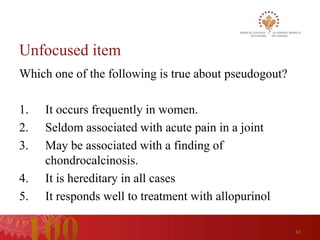
Unfocused item
Which one of the following is true about pseudogout?

1.   It occurs frequently in women.
2.   Seldom associated with acute pain in a joint
3.   May be associated with a finding of
     chondrocalcinosis.
4.   It is hereditary in all cases
5.   It responds well to treatment with allopurinol

                                                       47
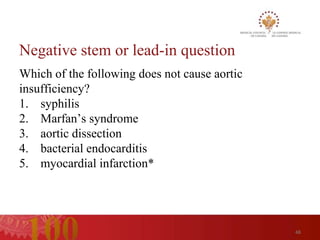
Negative stem or lead-in question
Which of the following does not cause aortic
insufficiency?
1. syphilis
2. Marfan’s syndrome
3. aortic dissection
4. bacterial endocarditis
5. myocardial infarction*


                                               48
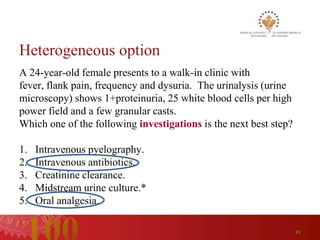
Heterogeneous option
A 24-year-old female presents to a walk-in clinic with
fever, flank pain, frequency and dysuria. The urinalysis (urine
microscopy) shows 1+proteinuria, 25 white blood cells per high
power field and a few granular casts.
Which one of the following investigations is the next best step?

1.   Intravenous pyelography.
2.   Intravenous antibiotics.
3.   Creatinine clearance.
4.   Midstream urine culture.*
5.   Oral analgesia.

                                                                   49
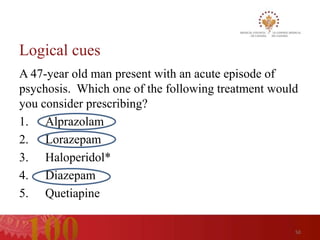
Logical cues
A 47-year old man present with an acute episode of
psychosis. Which one of the following treatment would
you consider prescribing?
1. Alprazolam
2. Lorazepam
3. Haloperidol*
4. Diazepam
5. Quetiapine

                                                    50
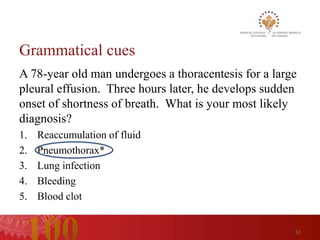
Grammatical cues
A 78-year old man undergoes a thoracentesis for a large
pleural effusion. Three hours later, he develops sudden
onset of shortness of breath. What is your most likely
diagnosis?
1.   Reaccumulation of fluid
2.   Pneumothorax*
3.   Lung infection
4.   Bleeding
5.   Blood clot


                                                      51
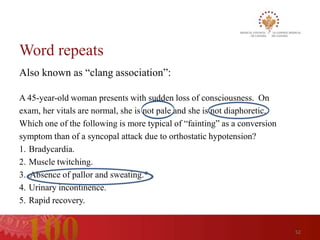
Word repeats
Also known as “clang association”:

A 45-year-old woman presents with sudden loss of consciousness. On
exam, her vitals are normal, she is not pale and she is not diaphoretic.
Which one of the following is more typical of “fainting” as a conversion
symptom than of a syncopal attack due to orthostatic hypotension?
1. Bradycardia.
2. Muscle twitching.
3. Absence of pallor and sweating.*
4. Urinary incontinence.
5. Rapid recovery.


                                                                           52
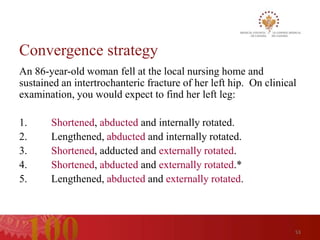
Convergence strategy
An 86-year-old woman fell at the local nursing home and
sustained an intertrochanteric fracture of her left hip. On clinical
examination, you would expect to find her left leg:

1.     Shortened, abducted and internally rotated.
2.     Lengthened, abducted and internally rotated.
3.     Shortened, adducted and externally rotated.
4.     Shortened, abducted and externally rotated.*
5.     Lengthened, abducted and externally rotated.


                                                                   53
Post-test
A Test of General Rock and Roll
          Knowledge


                                  54
Now review the items you have written
         using the checklist!


                                        55
In Summary
Prior to writing MCQ items:
   •   Determine the purpose of the test
   •   Determine WHAT you want to test
   •   Use key-features to help you develop your
       questions
Write questions avoiding technical flaws


                                                   56
References
•   Guidelines for the Development of Multiple-Choice
    Questions at http://www.mcc.ca/pdf/MCQ_Guidelines_e.pdf
•   Haladyna TM, Downing SM, Rodriguez MC. A Review of
    Multiple-Choice Item-Writing Guidelines for Classroom
    Assessment. Applied Measurement in Education
    2002;15:309-334


                                                          57
Thank you!
Questions? Comments?
  ctouchie@mcc.ca


                       58

McGill Workshop

  • 1.
    The Development ofMultiple- Choice Questions using the Key-features Approach Claire Touchie, MD, FRCPC University of Ottawa Medical Council of Canada
  • 2.
  • 3.
    Workshop Agenda 1. Introductions (10 min) 2. What is the key-features approach (20 min) 3. Exercise 1: Defining key-features (15 min) 4. How to write multiple choice items (25 min) 5. Exercise 2: Writing multiple-choice questions (30 min) 6. Leg Stretch (10 min) 7. Large group discussion: Review of MCQs (30 min) 8. Exercise 3: Technical flaws (15 min) 9. What are technical flaws (15 min) 10. Wrap up and evaluations 3
  • 4.
    Workshop Objectives • Describewhat can be tested with multiple- choice items • Define the anatomy of a multiple-choice item • Define and identify technical flaws • Create multiple-choice items for own stated purpose • Define and criticize poor performing items 4
  • 5.
    Why are wedoing this? Which one of the following is true about pseudogout? 1. It occurs frequently in women. 2. Seldom associated with acute pain in a joint 3. May be associated with a finding of chondrocalcinosis. 4. It is hereditary in all cases 5. It responds well to treatment with allopurinol
  • 6.
    Why are wedoing this? A 62 year-old woman with a history of confusion and constipation comes to the office for a follow-up visit. Laboratory investigations reveal a serum calcium of 2.9mmol/L, a creatinine of 146 µmol/L, and a hemoglobin of 108 g/L. Which one of the following is the most likely diagnosis? 1. Hyperparathyroidism 2. Chronic renal failure 3. Multiple myeloma* 4. Vitamin D intoxication 5. Renal cell carcinoma
  • 7.
    Key Feature Problems •Basedon the concept of “Case Specificity” – The clinical performance on one problem is NOT a good predictor for performance on other problems •Assessment is best served when focusing exclusively on the unique challenges (key features) in the resolution of each problem – Essential issues or specific difficulty
  • 8.
    Key Feature Problems •Firstdiscussed at Cambridge Conference – 1984 •Developed by Georges Bordage and Gordon Page for the MCC •First incorporated into the MCCQE Part I – 1992 •Known under different names – Q4, Clinical Reasoning Skills (CRS), Clinical Decision Making (CDM)
  • 9.
    So what? Whocares? •Studies show validity evidence and reliability in testing settings •Wenghofer et al. (Med Educ 2009) – Candidates in the bottom quartile had a 3-fold increase in the risk of an unacceptable quality-of-care assessment outcome (OR 3.41)
  • 10.
    Key Feature Problems Assessesdecision-making skills NOT recall of factual information Knowledge Clinical Decision Application of knowledge
  • 11.
    Application of Knowledge •Toelicit clinical clues •To formulate diagnostic impressions •To order investigative or f/u procedures •To acquire data to monitor a course of action OR evaluate the severity/probability of an outcome •To select a management course
  • 12.
    Example of Knowledgequestion •Which of the following are characteristic of delirium?
  • 13.
    Alternate type ofquestion Should assess the ability to: – Recognize delirium tremens in a specific patient • An example of a “clinical reasoning” issue – Prescribe appropriate therapeutic measures • An example of a “clinical decision” issue
  • 14.
    Key Feature –Definition •A critical or essential step in the resolution of a problem •A step in which examinees are most likely to make errors in the resolution of a problem •A difficult or challenging aspect in the identification and management of the problem in practice
  • 15.
    Advantages of theKey Feature Approach •More discriminating •Shifts the emphasis from – The method of assessment to the object of assessment – Assessing all aspects of solving a problem to assessing only the essential element
  • 16.
    Key Question ofKey Features “What are the critical, essential elements in the resolution of the problem?”
  • 17.
    Process in KeyFeature Development •Problem definition •Selecting a key feature •Developing a clinical scenario •Identifying the correct answer (in the case of single correct MCQ) •Identifying plausible distractors
  • 18.
    How can thisbe applied? Let us try…
  • 19.
    Problem Definition Select anobjective or a clinical problem…delirium/confusion Select a clinical situation – Undifferentiated complaint – A single typical problem* – A multi-system problem – A life-threatening event* – Preventive care and health promotion
  • 20.
    Selecting a KeyFeature •Ask the question – What are the critical essential elements in the resolution of the problem? •Key feature 1 – Given a patient with post-operative delirium, ask about EtOH consumption •Key feature 2 – Given a patient with post-operative delirium, recognize delirium tremens and manage with benzodiazepines
  • 21.
  • 22.
    How to writemultiple-choice items 1. The What 2. The How 22
  • 23.
    The What • Whatcan I test with MCQs? • Knowledge • Clinical-decision making • Clearly define the purpose of your exam • Define what it is you want to test • For the overall test • For your specific question 23
  • 24.
    The What Prior towriting your question, ask the following questions • What concept do I want to test? • Where does the learner go wrong? • Focus on areas of “challenge” for the learner 24
  • 25.
    Example of theWhat Purpose: To assess the clinical clerk’s knowledge and decision making capability at the end of an Internal Medicine six week rotation • Concept/Objective: Management of CHF • Challenge to the learner: ??? 25
  • 26.
    The How –Anatomy of a MC item • Stem • Clinical vignette which describes the setting, the patient’s age and complaint along with pertinent historical facts, physical exam details, and/or laboratory findings • Lead-in question • The task • Answer and alternatives • The most correct answer and the plausible distractors 26
  • 27.
    The How –Anatomy of a MC item Stem • A 58-year old man presents to the ED with sudden onset of left-sided chest pain associated with shortness of breath, palpitations and dizziness. His past history is relevant for a recent diagnosis of lung carcinoma. His examination is only remarkable for a heart rate of 112/minute. 27
  • 28.
    The How-Anatomy ofa MC item Lead-in question • Which one of the following diagnostic test would be most useful to confirm the diagnosis? 28
  • 29.
    The How –Anatomy of a MC item Correct/Best answer and distractors 1. Chest radiograph 2. CT of the chest * 3. Sputum culture 4. Electrocardiogram 5. Echocardiogram 29
  • 30.
    What did younotice about this question? Could you answer it without seeing the alternatives? Could you answer without being given the diagnosis? 30
  • 31.
    The Stem • Shortdescription of a clinical scenario • Common or clinically important • Clear and contains relevant information to the clinical problem – avoid window-dressing • Word the stem positively • Avoid EXCEPT questions • Use negative words with caution • Eg: contraindication, what to avoid 31
  • 32.
    The Stem • Providesufficient information to answer the item • DO NOT create tricky items by omitting essential information • DO NOT add extraneous information • Stem should be a clinical vignette 32
  • 33.
    Lead-in Question • Ensurethe directions are very clear with a clear task • Can the stem be administered in a short answer (constructed-response) format? • “Cover answer test”
  • 34.
    Lead-in Question • Different clinical tasks can be tested • Can be done with the same stem (cloning of question) • History • Diagnosis • Investigations • Management/Treatment/Drug therapy • Counseling
  • 35.
    Lead-in Question Try askingquestions that lead to clinical decision- making? Which one of the following – … is the most likely diagnosis? – … investigations would you now order? – …is the next step in the work-up of this patient? – … is the most important step in the initial management of this patient?
  • 36.
    Distractors • Only one right choice with distractors • Number of distractors is a policy decision (3? vs. 4?) • Use plausible distractor choices • Keep distractors independent, they should not be overlapping • E.g.: 1. 11-20; 2. 15-30 • Keep distractors homogeneous in content and grammatical structure • Keep the length about equal • Avoid specific determiners such as All, Never, Always, Completely and Absolutely • Do not use All of the Above or None of the Above
  • 37.
    Item testing clinicaldecision-making A 62 year-old woman with a history of confusion and constipation comes to the office for a follow-up visit. Laboratory investigations reveal a serum calcium of 2.9mmol/L, a creatinine of 146 µmol/L, and a hemoglobin of 108 g/L. Which one of the following is the most likely diagnosis? 1. Hyperparathyroidism 2. Chronic renal failure 3. Multiple myeloma* 4. Vitamin D intoxication 5. Renal cell carcinoma
  • 38.
    Item testing clinicaldecision-making A 62 year-old woman with a history of confusion and constipation comes to the office for a follow-up visit. Laboratory investigations reveal a serum calcium of 2.9mmol/L, a creatinine of 146 µmol/L, and a hemoglobin of 108 g/L. Which one of the following would help confirm the diagnosis? 1. Parathyroid hormone 2. Serum protein electrophoresis* 3. 25-OH vitamin D 4. Serum creatinine 5. Abdominal ultrasound
  • 39.
    What is wrongwith this item? A previously healthy person suddenly presents with pleuritic pain in the left chest and shortness of breath. Which one of the following is the most likely diagnosis? 1. Mycoplasma pneumonia 2. Spontaneous pneumothorax 3. Pulmonary embolism 4. Acute pericarditis 5. Epidemic pleurodynia
  • 40.
    What is wrongwith this item? Which one of the following is true about pseudogout? 1. It occurs frequently in women. 2. Seldom associated with acute pain in a joint 3. May be associated with a finding of chondrocalcinosis. 4. It is hereditary in all cases 5. It responds well to treatment with allopurinol 40
  • 41.
    What is wrongwith this item? Aortic insufficiency may be caused by all of the following, EXCEPT: 1. syphilis 2. Marfan’s syndrome 3. aortic dissection 4. bacterial endocarditis 5. myocardial infarction*
  • 42.
    Exercise #2 –30 minutes Writing MCQ items • Pair up with a partner • Using the MCQ item development worksheet, develop MCQ items that will be useful to you 42
  • 43.
  • 44.
    Exercise #2 –Pre-test A Test of General Rock and Roll Knowledge 44
  • 45.
    Technical Flaws Violations oftest item writing principles • Flawed items are usually more difficult • Fail more students Downing, 2002 45
  • 46.
    Technical Flaws • Unfocused items • Negative stem or lead-in question • Heterogeneous options • Logical or grammatical cues • Long correct answer • Word repeats • Convergence strategy 46
  • 47.
    Unfocused item Which oneof the following is true about pseudogout? 1. It occurs frequently in women. 2. Seldom associated with acute pain in a joint 3. May be associated with a finding of chondrocalcinosis. 4. It is hereditary in all cases 5. It responds well to treatment with allopurinol 47
  • 48.
    Negative stem orlead-in question Which of the following does not cause aortic insufficiency? 1. syphilis 2. Marfan’s syndrome 3. aortic dissection 4. bacterial endocarditis 5. myocardial infarction* 48
  • 49.
    Heterogeneous option A 24-year-oldfemale presents to a walk-in clinic with fever, flank pain, frequency and dysuria. The urinalysis (urine microscopy) shows 1+proteinuria, 25 white blood cells per high power field and a few granular casts. Which one of the following investigations is the next best step? 1. Intravenous pyelography. 2. Intravenous antibiotics. 3. Creatinine clearance. 4. Midstream urine culture.* 5. Oral analgesia. 49
  • 50.
    Logical cues A 47-yearold man present with an acute episode of psychosis. Which one of the following treatment would you consider prescribing? 1. Alprazolam 2. Lorazepam 3. Haloperidol* 4. Diazepam 5. Quetiapine 50
  • 51.
    Grammatical cues A 78-yearold man undergoes a thoracentesis for a large pleural effusion. Three hours later, he develops sudden onset of shortness of breath. What is your most likely diagnosis? 1. Reaccumulation of fluid 2. Pneumothorax* 3. Lung infection 4. Bleeding 5. Blood clot 51
  • 52.
    Word repeats Also knownas “clang association”: A 45-year-old woman presents with sudden loss of consciousness. On exam, her vitals are normal, she is not pale and she is not diaphoretic. Which one of the following is more typical of “fainting” as a conversion symptom than of a syncopal attack due to orthostatic hypotension? 1. Bradycardia. 2. Muscle twitching. 3. Absence of pallor and sweating.* 4. Urinary incontinence. 5. Rapid recovery. 52
  • 53.
    Convergence strategy An 86-year-oldwoman fell at the local nursing home and sustained an intertrochanteric fracture of her left hip. On clinical examination, you would expect to find her left leg: 1. Shortened, abducted and internally rotated. 2. Lengthened, abducted and internally rotated. 3. Shortened, adducted and externally rotated. 4. Shortened, abducted and externally rotated.* 5. Lengthened, abducted and externally rotated. 53
  • 54.
    Post-test A Test ofGeneral Rock and Roll Knowledge 54
  • 55.
    Now review theitems you have written using the checklist! 55
  • 56.
    In Summary Prior towriting MCQ items: • Determine the purpose of the test • Determine WHAT you want to test • Use key-features to help you develop your questions Write questions avoiding technical flaws 56
  • 57.
    References • Guidelines for the Development of Multiple-Choice Questions at http://www.mcc.ca/pdf/MCQ_Guidelines_e.pdf • Haladyna TM, Downing SM, Rodriguez MC. A Review of Multiple-Choice Item-Writing Guidelines for Classroom Assessment. Applied Measurement in Education 2002;15:309-334 57
  • 58.