ASSESSMENT TOOLS
Assessment is integral part of educational process and professional development. Assessment
tools should align with learning outcomes, competencies and teaching format.i
Three basic
competencies in medical education (knowledge, attitude and practice) are better assessed by
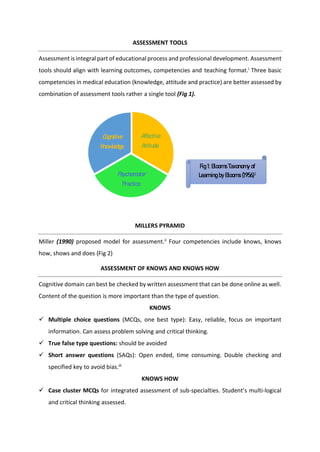
combination of assessment tools rather a single tool (Fig 1).
MILLERS PYRAMID
Miller (1990) proposed model for assessment.ii
Four competencies include knows, knows
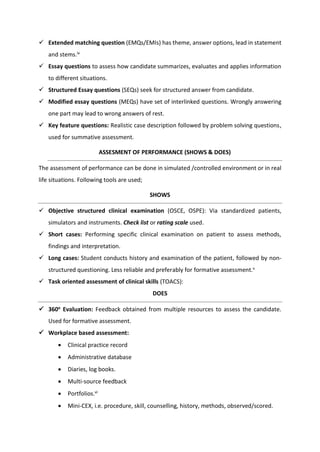
how, shows and does (Fig 2)
ASSESSMENT OF KNOWS AND KNOWS HOW
Cognitive domain can best be checked by written assessment that can be done online as well.
Content of the question is more important than the type of question.
KNOWS
✓ Multiple choice questions (MCQs, one best type): Easy, reliable, focus on important
information. Can assess problem solving and critical thinking.
✓ True false type questions: should be avoided
✓ Short answer questions (SAQs): Open ended, time consuming. Double checking and
specified key to avoid bias.iii
KNOWS HOW
✓ Case cluster MCQs for integrated assessment of sub-specialties. Student’s multi-logical
and critical thinking assessed.
Affective
Attitude
Psychomotor
Practice
Cognitive
Knowledge
Fig 1: Blooms Taxonomy of
Learning by Blooms (1956)1
✓ Extended matching question (EMQs/EMIs) has theme, answer options, lead in statement
and stems.iv
✓ Essay questions to assess how candidate summarizes, evaluates and applies information
to different situations.
✓ Structured Essay questions (SEQs) seek for structured answer from candidate.
✓ Modified essay questions (MEQs) have set of interlinked questions. Wrongly answering
one part may lead to wrong answers of rest.
✓ Key feature questions: Realistic case description followed by problem solving questions,
used for summative assessment.
ASSESMENT OF PERFORMANCE (SHOWS & DOES)
The assessment of performance can be done in simulated /controlled environment or in real
life situations. Following tools are used;
SHOWS
✓ Objective structured clinical examination (OSCE, OSPE): Via standardized patients,
simulators and instruments. Check list or rating scale used.
✓ Short cases: Performing specific clinical examination on patient to assess methods,
findings and interpretation.
✓ Long cases: Student conducts history and examination of the patient, followed by non-
structured questioning. Less reliable and preferably for formative assessment.v
✓ Task oriented assessment of clinical skills (TOACS):
DOES
✓ 360o
Evaluation: Feedback obtained from multiple resources to assess the candidate.
Used for formative assessment.
✓ Workplace based assessment:
• Clinical practice record
• Administrative database
• Diaries, log books.
• Multi-source feedback
• Portfolios.vi
• Mini-CEX, i.e. procedure, skill, counselling, history, methods, observed/scored.
• Directly observed procedural skills (DOPS)
• Chart simulated recall (case-based discussion)
ASSESSMENT OF ATTITUDE
Attitude is better assessed in summative than formative assessments. This domain should
be incorporated in above mentioned tools.
✓ 360o
evaluation and feedback (patients, colleagues, teachers, seniors and students).
✓ Counselling stations in Mini CEX, OSCE
✓ Admin record reviewal for punctuality
✓ Observation in group discussion, team work and conflict management.
✓ Communication skills during presentations, SGDs, history taking, counselling, etc.
✓ Observing politeness, privacy of patient, exposing patient, explaining procedure can
be assessed during short case, long case, mini CEX, feedback, and even in written
assessments.
Fig 2: THE DIAGRAMATIC REPRESENTATION OF MILLERS PYRAMID IN PARALLEL WITH
ASSESSMENT TOOLS
• Work place based assessment,
Mini-CEX, DOPS, direct
observation, video surveillance,
peer review. narratives, log books,
portfolios.
DOES
• OSCE, OSPE, short case,
long case, simulations,
standardized patients.
SHOWS
• EMQs, SEQs,case
presentations,
problem based
scenarios, key
feature questions.
KNOWS HOW
• MCQs, true
false type,
Short answer
questions, oral
exams/
KNOWS
b
e
h
a
v
i
o
r
c
o
g
n
i
t
i
o
n
References
i
Al-Wardy N. M. (2010). Assessment methods in undergraduate medical education. Sultan Qaboos
University medical journal.
ii
Miller GE, 1990. Acad Med.
iii
Different written assessment methods: what can be said about their strengths and
weaknesses? Schuwirth LW, van der Vleuten CP Med Educ. 2004 Sep; 38(9):974-9.
iv
Case SM, Swanson DB. Constructing written test questions for the basic and clinical
sciences. [Accessed July 2020].
v
The long case and its modifications: a literature review. Ponnamperuma GG, Karunathilake
IM, McAleer S, Davis MH. Med Educ. 2009 Oct; 43(10):936-41.
vi AMEE Medical Education Guide No. 24: Portfolios as a method of student assessment.
Friedman Ben David M, Davis MH, Harden RM, Howie PW, Ker J, Pippard MJ. Med Teach. 2001
Oct; 23(6):535-551.

Assessment Tools

  • 1.
    ASSESSMENT TOOLS Assessment isintegral part of educational process and professional development. Assessment tools should align with learning outcomes, competencies and teaching format.i Three basic competencies in medical education (knowledge, attitude and practice) are better assessed by combination of assessment tools rather a single tool (Fig 1). MILLERS PYRAMID Miller (1990) proposed model for assessment.ii Four competencies include knows, knows how, shows and does (Fig 2) ASSESSMENT OF KNOWS AND KNOWS HOW Cognitive domain can best be checked by written assessment that can be done online as well. Content of the question is more important than the type of question. KNOWS ✓ Multiple choice questions (MCQs, one best type): Easy, reliable, focus on important information. Can assess problem solving and critical thinking. ✓ True false type questions: should be avoided ✓ Short answer questions (SAQs): Open ended, time consuming. Double checking and specified key to avoid bias.iii KNOWS HOW ✓ Case cluster MCQs for integrated assessment of sub-specialties. Student’s multi-logical and critical thinking assessed. Affective Attitude Psychomotor Practice Cognitive Knowledge Fig 1: Blooms Taxonomy of Learning by Blooms (1956)1
  • 2.
    ✓ Extended matchingquestion (EMQs/EMIs) has theme, answer options, lead in statement and stems.iv ✓ Essay questions to assess how candidate summarizes, evaluates and applies information to different situations. ✓ Structured Essay questions (SEQs) seek for structured answer from candidate. ✓ Modified essay questions (MEQs) have set of interlinked questions. Wrongly answering one part may lead to wrong answers of rest. ✓ Key feature questions: Realistic case description followed by problem solving questions, used for summative assessment. ASSESMENT OF PERFORMANCE (SHOWS & DOES) The assessment of performance can be done in simulated /controlled environment or in real life situations. Following tools are used; SHOWS ✓ Objective structured clinical examination (OSCE, OSPE): Via standardized patients, simulators and instruments. Check list or rating scale used. ✓ Short cases: Performing specific clinical examination on patient to assess methods, findings and interpretation. ✓ Long cases: Student conducts history and examination of the patient, followed by non- structured questioning. Less reliable and preferably for formative assessment.v ✓ Task oriented assessment of clinical skills (TOACS): DOES ✓ 360o Evaluation: Feedback obtained from multiple resources to assess the candidate. Used for formative assessment. ✓ Workplace based assessment: • Clinical practice record • Administrative database • Diaries, log books. • Multi-source feedback • Portfolios.vi • Mini-CEX, i.e. procedure, skill, counselling, history, methods, observed/scored.
  • 3.
    • Directly observedprocedural skills (DOPS) • Chart simulated recall (case-based discussion) ASSESSMENT OF ATTITUDE Attitude is better assessed in summative than formative assessments. This domain should be incorporated in above mentioned tools. ✓ 360o evaluation and feedback (patients, colleagues, teachers, seniors and students). ✓ Counselling stations in Mini CEX, OSCE ✓ Admin record reviewal for punctuality ✓ Observation in group discussion, team work and conflict management. ✓ Communication skills during presentations, SGDs, history taking, counselling, etc. ✓ Observing politeness, privacy of patient, exposing patient, explaining procedure can be assessed during short case, long case, mini CEX, feedback, and even in written assessments. Fig 2: THE DIAGRAMATIC REPRESENTATION OF MILLERS PYRAMID IN PARALLEL WITH ASSESSMENT TOOLS • Work place based assessment, Mini-CEX, DOPS, direct observation, video surveillance, peer review. narratives, log books, portfolios. DOES • OSCE, OSPE, short case, long case, simulations, standardized patients. SHOWS • EMQs, SEQs,case presentations, problem based scenarios, key feature questions. KNOWS HOW • MCQs, true false type, Short answer questions, oral exams/ KNOWS b e h a v i o r c o g n i t i o n
  • 4.
    References i Al-Wardy N. M.(2010). Assessment methods in undergraduate medical education. Sultan Qaboos University medical journal. ii Miller GE, 1990. Acad Med. iii Different written assessment methods: what can be said about their strengths and weaknesses? Schuwirth LW, van der Vleuten CP Med Educ. 2004 Sep; 38(9):974-9. iv Case SM, Swanson DB. Constructing written test questions for the basic and clinical sciences. [Accessed July 2020]. v The long case and its modifications: a literature review. Ponnamperuma GG, Karunathilake IM, McAleer S, Davis MH. Med Educ. 2009 Oct; 43(10):936-41. vi AMEE Medical Education Guide No. 24: Portfolios as a method of student assessment. Friedman Ben David M, Davis MH, Harden RM, Howie PW, Ker J, Pippard MJ. Med Teach. 2001 Oct; 23(6):535-551.