ePortfolios and Integrative Department
   Grants as an Implementation Strategy
      Susan Kahn, Director of Institutional Effectiveness, Director of ePortfolio
Elaine Cooney, Professor and Chair, Electrical and Computer Engineering Technology
  Debra Runshe, Instructional Design Consultant, Center for Teaching and Learning
                 Indiana University - Purdue University Indianapolis
Integrative Department Grants

• Small grants to interested departments and
  schools
• First year designated for department-wide
  curricular and pedagogical preparation
• Intensive one-on-one guidance and support
• Projects geared to needs the academic unit wants
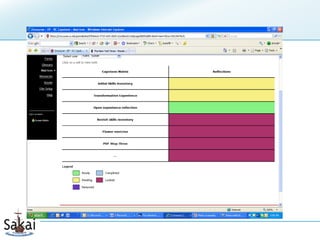
  to address (e.g., customized matrices/wizards
  geared to program outcomes)
• Faculty in these departments provide guidance
  for ongoing software development
The Context of IUPUI
• Urban research university
• 20+ schools
• Commuter campus
• 30,000 students
• Majority of students transfer at some
  point
• Many change majors
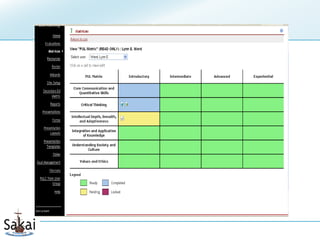
• Core Communication and Quantitative
  Skills
• Critical Thinking
• Integration and Application of Knowledge
• Intellectual Depth, Breadth, and
  Adaptiveness
• Understanding Society and Culture
• Values and Ethics
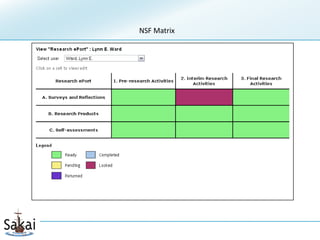
NSF Matrix
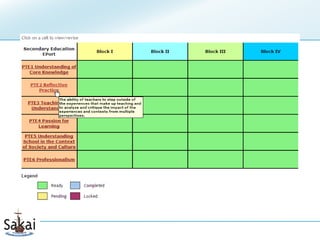
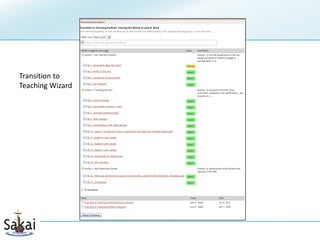
Transition to
Teaching Wizard
Who’s using ePortfolio at IUPUI?
 •   Center for Research and Learning
 •   Center for Service and Learning
 •   Computer and Information Science
 •   Computer, Information, and Leadership Technology
 •   School of Dentistry
 •   School of Engineering & Technology
 •   English (capstone)
 •   School of Library and Information Science
 •   School of Nursing
 •   Secondary Education
 •   Office of Student Life
 •   Tourism, Convention, and Event Management
 •   Transition to Teaching program
 •   Visual Communication
 •   IUPU-Columbus campus
ePortfolio for what?
• Focus on critical thinking (E & T)
• Focus on professional ethics (Dentistry)
• Focus on reflection and integration (English,
  Visual Communication)
• Leadership Development (Student Life)
• Reflection on service experiences
• Curriculum revision around outcomes
• Assessment of prior learning for credit
• Documentation of competencies for
  assessment and accreditation
Other Enablers
• Partnership with Center for Teaching and Learning:
  well-developed structure for supporting pedagogical
  and curricular innovation with technology
• Well-developed institutional and (some) program-level
  assessment programs
• OSP integrated into Sakai
• Growing awareness among faculty of ePortfolio
  movement in higher education
• Upcoming reaccreditation visit in 2012
Outcomes of Department-Focused
              Strategy
• Development and dissemination of a few
  good early examples
• Better understanding among developers of
  software needs leading to improvement of
  ePortfolio environment and tools
• Increased departmental collaboration
  around learning outcomes and curriculum
  development
On the brink of wider adoption?
Current planning to:
• Pilot ePortfolio in conjunction with
  Personal Development Plan in first-year
  seminars
• Grants to campus-wide units
• Grant to satellite campus
Critical Thinking Is . . .
• “Critical thinking” is the ability to analyze
  carefully and logically information and ideas from
  multiple perspectives. This skill is demonstrated
  in the ability to
  • analyze complex issues and make informed decisions;
  • synthesize information in order to arrive at reasoned
    conclusions;
  • evaluate the logic, validity, and relevance of data;
  • solve challenging problems; and
  • use knowledge and understanding in order to
    generate and explore new questions.
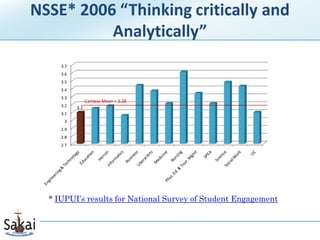
NSSE* 2006 “Thinking critically and
          Analytically”
     3.7
     3.6
     3.5
     3.4
     3.3
                 Campus Mean = 3.28
     3.2   3.1
     3.1
      3
     2.9
     2.8
     2.7


  * IUPUI’s results for National Survey of Student Engagement
Themes for Improving Critical Thinking


• Problem Based Learning

• Writing for Reflection
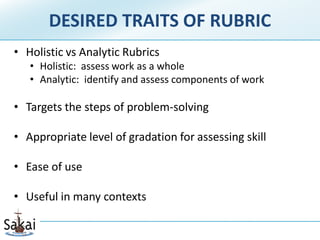
DESIRED TRAITS OF RUBRIC
• Holistic vs Analytic Rubrics
   • Holistic: assess work as a whole
   • Analytic: identify and assess components of work

• Targets the steps of problem-solving

• Appropriate level of gradation for assessing skill

• Ease of use

• Useful in many contexts
GOAL: TARGETING THE STEPS OF
        PROBLEM-SOLVING
• Analytic Rubric

• Problem-solving skills identified and
  assessed

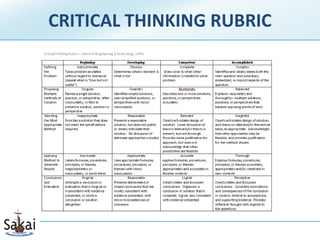
• Steps of problem-solving become rows in
  the rubric
GOAL: APPROPRIATE LEVEL OF
                GRADATION
• Using too many levels (fine gradation) may make
  it difficult to discern between individual levels (What
  is the difference between work that earns 88% and 89%?)


• An even number of levels helps avoid the
  tendency to pick the “average” (middle) ranking;
  provides additional feedback to students whose
  work is neither outstanding nor disgraceful

• Four levels of performance (Beginning,
  Developing, Competent, Accomplished) define
  columns of rubric
GOAL: EASE OF USE
• Hallmarks of work at each level of
  performance should be easy to identify

• Single-word descriptors in each matrix cell
  provide at-a-glance reminders of expected
  work at each level

• Longer descriptions in each cell provide
  additional detail
GOAL: USEFUL IN MANY CONTEXTS
• Generally applicable to any problem-solving
  assignment in which students describe and
  justify their solutions

• May be used for students at any level
  • Lower-level (freshman) students may be
    expected to achieve a lower average score than
    more advanced students
  • Rubric scores track development of critical
    thinking as students progress through curriculum
CRITICAL THINKING RUBRIC
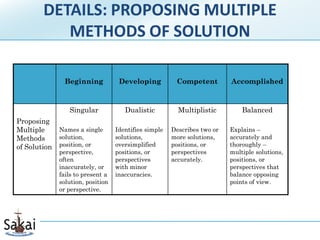
DETAILS: PROPOSING MULTIPLE
           METHODS OF SOLUTION

                Beginning           Developing          Competent         Accomplished


                 Singular             Dualistic          Multiplistic         Balanced
Proposing
Multiple      Names a single       Identifies simple   Describes two or   Explains –
Methods       solution,            solutions,          more solutions,    accurately and
of Solution   position, or         oversimplified      positions, or      thoroughly –
              perspective,         positions, or       perspectives       multiple solutions,
              often                perspectives        accurately.        positions, or
              inaccurately, or     with minor                             perspectives that
              fails to present a   inaccuracies.                          balance opposing
              solution, position                                          points of view.
              or perspective.
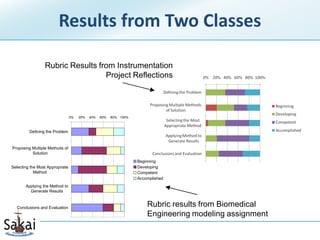
Results from Two Classes

                 Rubric Results from Instrumentation
                                  Project Reflections


                                 0%   20%   40%   60%   80% 100%


         Defining the Problem


Proposing Multiple Methods of
          Solution
                                                                   Beginning
Selecting the Most Appropriate                                     Developing
            Method                                                 Competent
                                                                   Accomplished
       Applying the Method to
         Generate Results


  Conclusions and Evaluation
                                                                       Rubric results from Biomedical
                                                                       Engineering modeling assignment
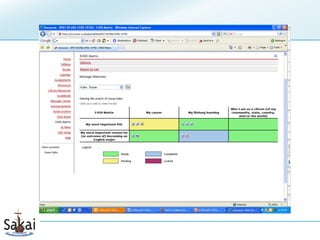
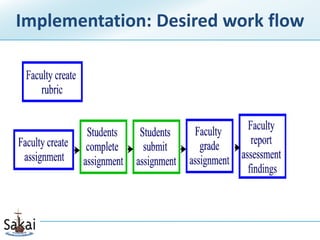
Implementation: Desired work flow
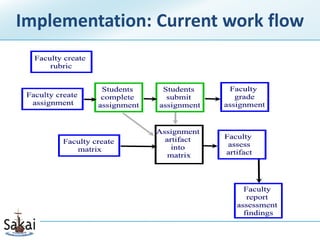
Implementation: Current work flow
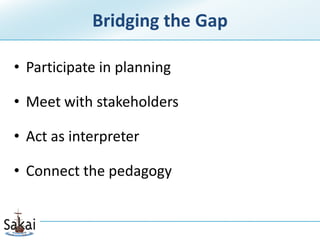
Bridging the Gap

• Participate in planning

• Meet with stakeholders

• Act as interpreter

• Connect the pedagogy
Questions

Integrated Department Grants As An Implementation Strategy

  • 1.
    ePortfolios and IntegrativeDepartment Grants as an Implementation Strategy Susan Kahn, Director of Institutional Effectiveness, Director of ePortfolio Elaine Cooney, Professor and Chair, Electrical and Computer Engineering Technology Debra Runshe, Instructional Design Consultant, Center for Teaching and Learning Indiana University - Purdue University Indianapolis
  • 2.
    Integrative Department Grants •Small grants to interested departments and schools • First year designated for department-wide curricular and pedagogical preparation • Intensive one-on-one guidance and support • Projects geared to needs the academic unit wants to address (e.g., customized matrices/wizards geared to program outcomes) • Faculty in these departments provide guidance for ongoing software development
  • 3.
    The Context ofIUPUI • Urban research university • 20+ schools • Commuter campus • 30,000 students • Majority of students transfer at some point • Many change majors
  • 4.
    • Core Communicationand Quantitative Skills • Critical Thinking • Integration and Application of Knowledge • Intellectual Depth, Breadth, and Adaptiveness • Understanding Society and Culture • Values and Ethics
  • 7.
  • 10.
  • 11.
    Who’s using ePortfolioat IUPUI? • Center for Research and Learning • Center for Service and Learning • Computer and Information Science • Computer, Information, and Leadership Technology • School of Dentistry • School of Engineering & Technology • English (capstone) • School of Library and Information Science • School of Nursing • Secondary Education • Office of Student Life • Tourism, Convention, and Event Management • Transition to Teaching program • Visual Communication • IUPU-Columbus campus
  • 12.
    ePortfolio for what? •Focus on critical thinking (E & T) • Focus on professional ethics (Dentistry) • Focus on reflection and integration (English, Visual Communication) • Leadership Development (Student Life) • Reflection on service experiences • Curriculum revision around outcomes • Assessment of prior learning for credit • Documentation of competencies for assessment and accreditation
  • 13.
    Other Enablers • Partnershipwith Center for Teaching and Learning: well-developed structure for supporting pedagogical and curricular innovation with technology • Well-developed institutional and (some) program-level assessment programs • OSP integrated into Sakai • Growing awareness among faculty of ePortfolio movement in higher education • Upcoming reaccreditation visit in 2012
  • 14.
    Outcomes of Department-Focused Strategy • Development and dissemination of a few good early examples • Better understanding among developers of software needs leading to improvement of ePortfolio environment and tools • Increased departmental collaboration around learning outcomes and curriculum development
  • 15.
    On the brinkof wider adoption? Current planning to: • Pilot ePortfolio in conjunction with Personal Development Plan in first-year seminars • Grants to campus-wide units • Grant to satellite campus
  • 16.
    Critical Thinking Is. . . • “Critical thinking” is the ability to analyze carefully and logically information and ideas from multiple perspectives. This skill is demonstrated in the ability to • analyze complex issues and make informed decisions; • synthesize information in order to arrive at reasoned conclusions; • evaluate the logic, validity, and relevance of data; • solve challenging problems; and • use knowledge and understanding in order to generate and explore new questions.
  • 17.
    NSSE* 2006 “Thinkingcritically and Analytically” 3.7 3.6 3.5 3.4 3.3 Campus Mean = 3.28 3.2 3.1 3.1 3 2.9 2.8 2.7 * IUPUI’s results for National Survey of Student Engagement
  • 18.
    Themes for ImprovingCritical Thinking • Problem Based Learning • Writing for Reflection
  • 19.
    DESIRED TRAITS OFRUBRIC • Holistic vs Analytic Rubrics • Holistic: assess work as a whole • Analytic: identify and assess components of work • Targets the steps of problem-solving • Appropriate level of gradation for assessing skill • Ease of use • Useful in many contexts
  • 20.
    GOAL: TARGETING THESTEPS OF PROBLEM-SOLVING • Analytic Rubric • Problem-solving skills identified and assessed • Steps of problem-solving become rows in the rubric
  • 21.
    GOAL: APPROPRIATE LEVELOF GRADATION • Using too many levels (fine gradation) may make it difficult to discern between individual levels (What is the difference between work that earns 88% and 89%?) • An even number of levels helps avoid the tendency to pick the “average” (middle) ranking; provides additional feedback to students whose work is neither outstanding nor disgraceful • Four levels of performance (Beginning, Developing, Competent, Accomplished) define columns of rubric
  • 22.
    GOAL: EASE OFUSE • Hallmarks of work at each level of performance should be easy to identify • Single-word descriptors in each matrix cell provide at-a-glance reminders of expected work at each level • Longer descriptions in each cell provide additional detail
  • 23.
    GOAL: USEFUL INMANY CONTEXTS • Generally applicable to any problem-solving assignment in which students describe and justify their solutions • May be used for students at any level • Lower-level (freshman) students may be expected to achieve a lower average score than more advanced students • Rubric scores track development of critical thinking as students progress through curriculum
  • 24.
  • 25.
    DETAILS: PROPOSING MULTIPLE METHODS OF SOLUTION Beginning Developing Competent Accomplished Singular Dualistic Multiplistic Balanced Proposing Multiple Names a single Identifies simple Describes two or Explains – Methods solution, solutions, more solutions, accurately and of Solution position, or oversimplified positions, or thoroughly – perspective, positions, or perspectives multiple solutions, often perspectives accurately. positions, or inaccurately, or with minor perspectives that fails to present a inaccuracies. balance opposing solution, position points of view. or perspective.
  • 26.
    Results from TwoClasses Rubric Results from Instrumentation Project Reflections 0% 20% 40% 60% 80% 100% Defining the Problem Proposing Multiple Methods of Solution Beginning Selecting the Most Appropriate Developing Method Competent Accomplished Applying the Method to Generate Results Conclusions and Evaluation Rubric results from Biomedical Engineering modeling assignment
  • 27.
  • 28.
  • 29.
    Bridging the Gap •Participate in planning • Meet with stakeholders • Act as interpreter • Connect the pedagogy
  • 30.