Dr. Gaurav Sawarkar
Asst. Professor
Dept. of Rachana Sharir
MGACH&RC
Qualitative & Quantitative Methods of
Evaluation
EVALUATION METHODS
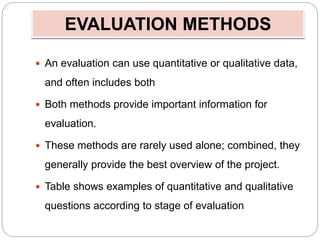
 An evaluation can use quantitative or qualitative data,
and often includes both
 Both methods provide important information for
evaluation.
 These methods are rarely used alone; combined, they
generally provide the best overview of the project.
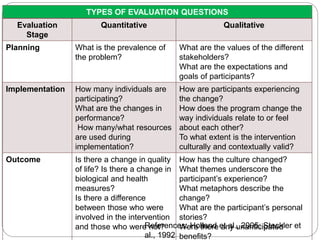
 Table shows examples of quantitative and qualitative
questions according to stage of evaluation
TYPES OF EVALUATION QUESTIONS
Evaluation
Stage
Quantitative Qualitative
Planning What is the prevalence of
the problem?
What are the values of the different
stakeholders?
What are the expectations and
goals of participants?
Implementation How many individuals are
participating?
What are the changes in
performance?
How many/what resources
are used during
implementation?
How are participants experiencing
the change?
How does the program change the
way individuals relate to or feel
about each other?
To what extent is the intervention
culturally and contextually valid?
Outcome Is there a change in quality
of life? Is there a change in
biological and health
measures?
Is there a difference
between those who were
involved in the intervention
and those who were not?
How has the culture changed?
What themes underscore the
participant’s experience?
What metaphors describe the
change?
What are the participant’s personal
stories?
Were there any unanticipated
benefits?
References: Holland et al., 2005; Steckler et
al., 1992
Quantitative Methods
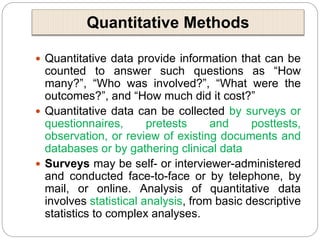
 Quantitative data provide information that can be
counted to answer such questions as “How
many?”, “Who was involved?”, “What were the
outcomes?”, and “How much did it cost?”
 Quantitative data can be collected by surveys or
questionnaires, pretests and posttests,
observation, or review of existing documents and
databases or by gathering clinical data
 Surveys may be self- or interviewer-administered
and conducted face-to-face or by telephone, by
mail, or online. Analysis of quantitative data
involves statistical analysis, from basic descriptive
statistics to complex analyses.
 Quantitative data measure the depth and breadth
of an implementation
(e.g., the number of people who participated, the
number of people who completed the program).
 Quantitative data collected before and after an
intervention can show its outcomes and impact.
 The strengths of quantitative data for evaluation
purposes include their generalize ability (if the
sample represents the population), the ease of
analysis, and their consistency and precision (if
collected reliably).
The limitations of using quantitative data for
evaluation can include
 Poor response rates from surveys,
 Difficulty obtaining documents,
 Difficulties in valid measurement,
 Do not provide an understanding of the program’s
context an
 May not be robust enough to explain complex
issues or interactions
(Holland et al., 2005; Garbarino et al.,
2009).
Qualitative Methods
 Qualitative data answer such questions as “What is the
value added?”, “Who was responsible?”, and “When did
something happen?’’
 Qualitative data are collected through direct or participant
observation, interviews, focus groups, and case studies
and from written documents, essays, scenarios, projects,
artefacts, personal experiences, introspection, visual texts,
portfolios, direct observation, role play or simulation
 Analyses of qualitative data include examining, comparing
and contrasting, and interpreting patterns.
 Analysis will likely include the identification of themes,
coding, clustering similar data, and reducing data to
meaningful and important points, such as in grounded
theory-building or other approaches to qualitative analysis
(Patton, 2002).
 Observations may help explain behaviors as well as social
context and meanings because the evaluator sees what is
actually happening.
 Observations can include watching a participant or program,
videotaping an intervention, or even recording people who
have been asked to “think aloud” while they work (Ericsson
 Interviews may be conducted with individuals alone
or with groups of people and are especially useful for
exploring complex issues.
 Interviews may be structured and conducted under
controlled conditions, or they may be conducted with
a loose set of questions asked in an open-ended
manner.
 It may be helpful to tape-record interviews, with
appropriate permissions, to facilitate the analysis of
themes or content.
 Some interviews have a specific focus, such as a
critical incident that an individual recalls and
describes in detail. Another type of interview
focuses on a person’s perceptions and
motivations.
 Focus groups are run by a facilitator who leads a
discussion among a group of people who have been
chosen because they have specific characteristics
(e.g. were clients of the program being evaluated).
 Focus group participants discuss their ideas and
insights in response to open-ended questions from
the facilitator.
 The strength of this method is that group discussion
can provide ideas and stimulate memories with
topics cascading as discussion occurs (Krueger et
 The strengths of qualitative data include providing
contextual data to explain complex issues and
complementing quantitative data by explaining the
“why” and “how” behind the “what” .
The limitations of qualitative data for evaluation may
include
Lack of generalize ability,
The time-consuming data collection
Costly nature of data collection,
The difficulty and complexity of data analysis and
interpretation
(Patton, 2002)
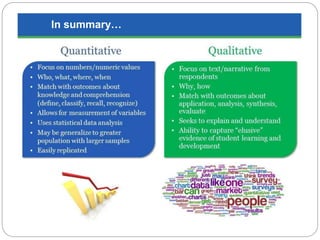
In summary…
Dr. G. Sawarkar qualitative & quantitative evaluation methode

Dr. G. Sawarkar qualitative & quantitative evaluation methode

  • 1.
    Dr. Gaurav Sawarkar Asst.Professor Dept. of Rachana Sharir MGACH&RC Qualitative & Quantitative Methods of Evaluation
  • 2.
    EVALUATION METHODS  Anevaluation can use quantitative or qualitative data, and often includes both  Both methods provide important information for evaluation.  These methods are rarely used alone; combined, they generally provide the best overview of the project.  Table shows examples of quantitative and qualitative questions according to stage of evaluation
  • 3.
    TYPES OF EVALUATIONQUESTIONS Evaluation Stage Quantitative Qualitative Planning What is the prevalence of the problem? What are the values of the different stakeholders? What are the expectations and goals of participants? Implementation How many individuals are participating? What are the changes in performance? How many/what resources are used during implementation? How are participants experiencing the change? How does the program change the way individuals relate to or feel about each other? To what extent is the intervention culturally and contextually valid? Outcome Is there a change in quality of life? Is there a change in biological and health measures? Is there a difference between those who were involved in the intervention and those who were not? How has the culture changed? What themes underscore the participant’s experience? What metaphors describe the change? What are the participant’s personal stories? Were there any unanticipated benefits? References: Holland et al., 2005; Steckler et al., 1992
  • 4.
    Quantitative Methods  Quantitativedata provide information that can be counted to answer such questions as “How many?”, “Who was involved?”, “What were the outcomes?”, and “How much did it cost?”  Quantitative data can be collected by surveys or questionnaires, pretests and posttests, observation, or review of existing documents and databases or by gathering clinical data  Surveys may be self- or interviewer-administered and conducted face-to-face or by telephone, by mail, or online. Analysis of quantitative data involves statistical analysis, from basic descriptive statistics to complex analyses.
  • 5.
     Quantitative datameasure the depth and breadth of an implementation (e.g., the number of people who participated, the number of people who completed the program).  Quantitative data collected before and after an intervention can show its outcomes and impact.  The strengths of quantitative data for evaluation purposes include their generalize ability (if the sample represents the population), the ease of analysis, and their consistency and precision (if collected reliably).
  • 6.
    The limitations ofusing quantitative data for evaluation can include  Poor response rates from surveys,  Difficulty obtaining documents,  Difficulties in valid measurement,  Do not provide an understanding of the program’s context an  May not be robust enough to explain complex issues or interactions (Holland et al., 2005; Garbarino et al., 2009).
  • 7.
    Qualitative Methods  Qualitativedata answer such questions as “What is the value added?”, “Who was responsible?”, and “When did something happen?’’  Qualitative data are collected through direct or participant observation, interviews, focus groups, and case studies and from written documents, essays, scenarios, projects, artefacts, personal experiences, introspection, visual texts, portfolios, direct observation, role play or simulation  Analyses of qualitative data include examining, comparing and contrasting, and interpreting patterns.
  • 8.
     Analysis willlikely include the identification of themes, coding, clustering similar data, and reducing data to meaningful and important points, such as in grounded theory-building or other approaches to qualitative analysis (Patton, 2002).  Observations may help explain behaviors as well as social context and meanings because the evaluator sees what is actually happening.  Observations can include watching a participant or program, videotaping an intervention, or even recording people who have been asked to “think aloud” while they work (Ericsson
  • 9.
     Interviews maybe conducted with individuals alone or with groups of people and are especially useful for exploring complex issues.  Interviews may be structured and conducted under controlled conditions, or they may be conducted with a loose set of questions asked in an open-ended manner.  It may be helpful to tape-record interviews, with appropriate permissions, to facilitate the analysis of themes or content.
  • 10.
     Some interviewshave a specific focus, such as a critical incident that an individual recalls and describes in detail. Another type of interview focuses on a person’s perceptions and motivations.
  • 11.
     Focus groupsare run by a facilitator who leads a discussion among a group of people who have been chosen because they have specific characteristics (e.g. were clients of the program being evaluated).  Focus group participants discuss their ideas and insights in response to open-ended questions from the facilitator.  The strength of this method is that group discussion can provide ideas and stimulate memories with topics cascading as discussion occurs (Krueger et
  • 12.
     The strengthsof qualitative data include providing contextual data to explain complex issues and complementing quantitative data by explaining the “why” and “how” behind the “what” . The limitations of qualitative data for evaluation may include Lack of generalize ability, The time-consuming data collection Costly nature of data collection, The difficulty and complexity of data analysis and interpretation (Patton, 2002)
  • 13.