Programmatic and Learning Assessments 
Lisa MacLeod – 27 August 2014
Assessments 
Overall, assessments are used either as a Programmatic 
Assessment or as a Learning Assessment. One of the most familiar 
learning assessments is the multiple choice assessment that reflects 
the typical pen and paper traditional classroom test (Popham, 2006). 
However, these tests are not very easy to construct to ensure validity 
due to unclear directions, ambiguous statements, unintended clues, 
complicated syntax and difficult vocabulary (Popham, 2006). Other 
learning assessments that are constructive in manner such as the 
essay and the reflective journal and tend to focus on the students-centered 
pedagogy that increases the student’s personal responsibility 
for their own learning.
Assessments 
Students practice critical thinking, problem solving and self-awareness 
that are all considered as survival skills in today’s global 
community (Wagner, 2010). In addition, the activities around such 
activities can also be incorporated into the assessment scheme to 
demonstrate the process of the student’s learning (Ballantyne and 
Packer, 1995). The only negative aspect of these assessments is the 
amount of allocated time that is required to complete the tasks and the 
amount of correcting is very time consuming for the teacher (Popham, 
2006).
Assessments 
Regarding the Programmatic Assessments, although there are 
many alternatives to assess programs, the most common non-preferred 
instrument is the standardized test. According to Leathwood ( 
2005), “Assessment is used to provide a rationale and legitimacy for 
the social structures and power relations of modern day societies, and 
for one’s place within these.” (Leathwood, 205, p.307). Unfortunately, 
this tends to be very common among educators. Due to the number of 
standardized assessments that are required today, educators need to 
take a step back and focus on the learning and the development of the 
whole student. A tool that addresses such are the Attitude Surveys: an 
instrument that determines the attitudes, interests and the values of 
students and to encourage the development of the individual through 
the instructed curriculum.
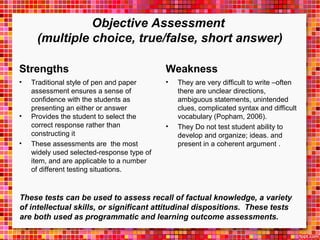
Objective Assessment 
(multiple choice, true/false, short answer) 
Strengths 
• Traditional style of pen and paper 
assessment ensures a sense of 
confidence with the students as 
presenting an either or answer 
• Provides the student to select the 
correct response rather than 
constructing it 
• These assessments are the most 
widely used selected-response type of 
item, and are applicable to a number 
of different testing situations. 
Weakness 
• They are very difficult to write –often 
there are unclear directions, 
ambiguous statements, unintended 
clues, complicated syntax and difficult 
vocabulary (Popham, 2006). 
• They Do not test student ability to 
develop and organize; ideas. and 
present in a coherent argument . 
These tests can be used to assess recall of factual knowledge, a variety 
of intellectual skills, or significant attitudinal dispositions. These tests 
are both used as programmatic and learning outcome assessments.
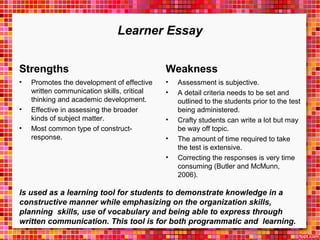
Learner Essay 
Strengths 
• Promotes the development of effective 
written communication skills, critical 
thinking and academic development. 
• Effective in assessing the broader 
kinds of subject matter. 
• Most common type of construct-response. 
Weakness 
• Assessment is subjective. 
• A detail criteria needs to be set and 
outlined to the students prior to the test 
being administered. 
• Crafty students can write a lot but may 
be way off topic. 
• The amount of time required to take 
the test is extensive. 
• Correcting the responses is very time 
consuming (Butler and McMunn, 
2006). 
Is used as a learning tool for students to demonstrate knowledge in a 
constructive manner while emphasizing on the organization skills, 
planning skills, use of vocabulary and being able to express through 
written communication. This tool is for both programmatic and learning.
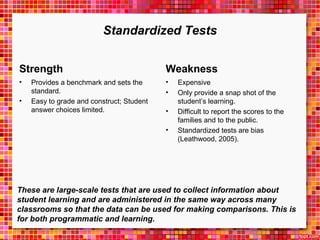
Standardized Tests 
Strength 
• Provides a benchmark and sets the 
standard. 
• Easy to grade and construct; Student 
answer choices limited. 
Weakness 
• Expensive 
• Only provide a snap shot of the 
student’s learning. 
• Difficult to report the scores to the 
families and to the public. 
• Standardized tests are bias 
(Leathwood, 2005). 
These are large-scale tests that are used to collect information about 
student learning and are administered in the same way across many 
classrooms so that the data can be used for making comparisons. This is 
for both programmatic and learning.
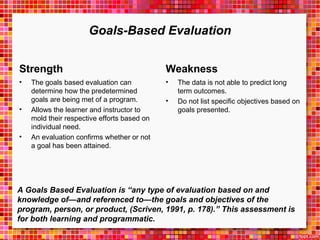
Goals-Based Evaluation 
Strength 
• The goals based evaluation can 
determine how the predetermined 
goals are being met of a program. 
• Allows the learner and instructor to 
mold their respective efforts based on 
individual need. 
• An evaluation confirms whether or not 
a goal has been attained. 
Weakness 
• The data is not able to predict long 
term outcomes. 
• Do not list specific objectives based on 
goals presented. 
A Goals Based Evaluation is “any type of evaluation based on and 
knowledge of—and referenced to—the goals and objectives of the 
program, person, or product, (Scriven, 1991, p. 178).” This assessment is 
for both learning and programmatic.
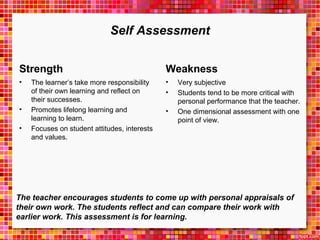
Self Assessment 
Strength 
• The learner’s take more responsibility 
of their own learning and reflect on 
their successes. 
• Promotes lifelong learning and 
learning to learn. 
• Focuses on student attitudes, interests 
and values. 
Weakness 
• Very subjective 
• Students tend to be more critical with 
personal performance that the teacher. 
• One dimensional assessment with one 
point of view. 
The teacher encourages students to come up with personal appraisals of 
their own work. The students reflect and can compare their work with 
earlier work. This assessment is for learning.
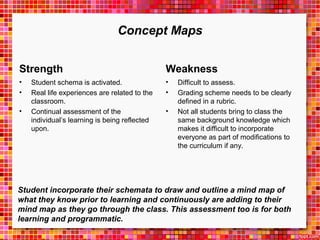
Concept Maps 
Strength 
• Student schema is activated. 
• Real life experiences are related to the 
classroom. 
• Continual assessment of the 
individual’s learning is being reflected 
upon. 
Weakness 
• Difficult to assess. 
• Grading scheme needs to be clearly 
defined in a rubric. 
• Not all students bring to class the 
same background knowledge which 
makes it difficult to incorporate 
everyone as part of modifications to 
the curriculum if any. 
Student incorporate their schemata to draw and outline a mind map of 
what they know prior to learning and continuously are adding to their 
mind map as they go through the class. This assessment too is for both 
learning and programmatic.
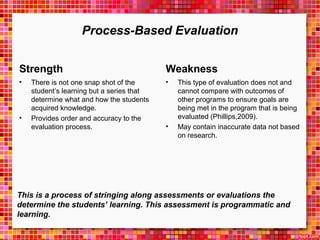
Process-Based Evaluation 
Strength 
• There is not one snap shot of the 
student’s learning but a series that 
determine what and how the students 
acquired knowledge. 
• Provides order and accuracy to the 
evaluation process. 
Weakness 
• This type of evaluation does not and 
cannot compare with outcomes of 
other programs to ensure goals are 
being met in the program that is being 
evaluated (Phillips,2009). 
• May contain inaccurate data not based 
on research. 
This is a process of stringing along assessments or evaluations the 
determine the students’ learning. This assessment is programmatic and 
learning.
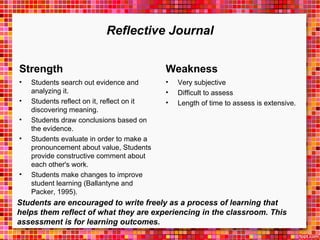
Reflective Journal 
Strength 
• Students search out evidence and 
analyzing it. 
• Students reflect on it, reflect on it 
discovering meaning. 
• Students draw conclusions based on 
the evidence. 
• Students evaluate in order to make a 
pronouncement about value, Students 
provide constructive comment about 
each other's work. 
• Students make changes to improve 
student learning (Ballantyne and 
Packer, 1995). 
Weakness 
• Very subjective 
• Difficult to assess 
• Length of time to assess is extensive. 
Students are encouraged to write freely as a process of learning that 
helps them reflect of what they are experiencing in the classroom. This 
assessment is for learning outcomes.
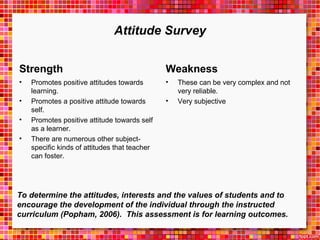
Attitude Survey 
Strength 
• Promotes positive attitudes towards 
learning. 
• Promotes a positive attitude towards 
self. 
• Promotes positive attitude towards self 
as a learner. 
• There are numerous other subject-specific 
kinds of attitudes that teacher 
can foster. 
Weakness 
• These can be very complex and not 
very reliable. 
• Very subjective 
To determine the attitudes, interests and the values of students and to 
encourage the development of the individual through the instructed 
curriculum (Popham, 2006). This assessment is for learning outcomes.
References 
Ballantyne, R & Packer, J; (1995). Making Connections: Using Student Journals as a 
Teaching/Learning Aid. HERDSA ACT. Retrieved 
from http://www.clt.uts.edu.au/Scholarship/Reflective.journal.htm 
Butler, S. M., & McMunn, N. D. (2006). A teacher’s guide to classroom assessment: 
Understanding and using assessment to improve student learning. San 
Francisco: Jossey-Bass. 
Leathwood, C. (2005). Assessment policy and practice in higher education: purpose, 
standards and equity. Assessment and Evaluation in Higher Education, 30(3), 
307-324. Retrieved March 10, 2011 from EBSCOhost database. 
Phillips, Fred (2009, November 6). Philosophies of Evaluation. SciTopics. Retrieved 
March 14, 2011, from 
http://www.scitopics.com/Philosophies_of_Evaluation.html 
Popham, W. J. (2006). Assessment for Educational Leaders. Boston: Pearson/Allyn and 
Bacon. 
Scriven, M. (1991). Evaluation Thesaurus (4th ed,). New York: Sage 
Wagner, T. (2010). The Global Achievement Gap: Why Even Our Best Schools Don't 
Teach the New Survival Skills Our Children Need and What We Can Do About 
It. Basic Books, New York.

Assessments for Programs and Learning

  • 1.
    Programmatic and LearningAssessments Lisa MacLeod – 27 August 2014
  • 2.
    Assessments Overall, assessmentsare used either as a Programmatic Assessment or as a Learning Assessment. One of the most familiar learning assessments is the multiple choice assessment that reflects the typical pen and paper traditional classroom test (Popham, 2006). However, these tests are not very easy to construct to ensure validity due to unclear directions, ambiguous statements, unintended clues, complicated syntax and difficult vocabulary (Popham, 2006). Other learning assessments that are constructive in manner such as the essay and the reflective journal and tend to focus on the students-centered pedagogy that increases the student’s personal responsibility for their own learning.
  • 3.
    Assessments Students practicecritical thinking, problem solving and self-awareness that are all considered as survival skills in today’s global community (Wagner, 2010). In addition, the activities around such activities can also be incorporated into the assessment scheme to demonstrate the process of the student’s learning (Ballantyne and Packer, 1995). The only negative aspect of these assessments is the amount of allocated time that is required to complete the tasks and the amount of correcting is very time consuming for the teacher (Popham, 2006).
  • 4.
    Assessments Regarding theProgrammatic Assessments, although there are many alternatives to assess programs, the most common non-preferred instrument is the standardized test. According to Leathwood ( 2005), “Assessment is used to provide a rationale and legitimacy for the social structures and power relations of modern day societies, and for one’s place within these.” (Leathwood, 205, p.307). Unfortunately, this tends to be very common among educators. Due to the number of standardized assessments that are required today, educators need to take a step back and focus on the learning and the development of the whole student. A tool that addresses such are the Attitude Surveys: an instrument that determines the attitudes, interests and the values of students and to encourage the development of the individual through the instructed curriculum.
  • 5.
    Objective Assessment (multiplechoice, true/false, short answer) Strengths • Traditional style of pen and paper assessment ensures a sense of confidence with the students as presenting an either or answer • Provides the student to select the correct response rather than constructing it • These assessments are the most widely used selected-response type of item, and are applicable to a number of different testing situations. Weakness • They are very difficult to write –often there are unclear directions, ambiguous statements, unintended clues, complicated syntax and difficult vocabulary (Popham, 2006). • They Do not test student ability to develop and organize; ideas. and present in a coherent argument . These tests can be used to assess recall of factual knowledge, a variety of intellectual skills, or significant attitudinal dispositions. These tests are both used as programmatic and learning outcome assessments.
  • 6.
    Learner Essay Strengths • Promotes the development of effective written communication skills, critical thinking and academic development. • Effective in assessing the broader kinds of subject matter. • Most common type of construct-response. Weakness • Assessment is subjective. • A detail criteria needs to be set and outlined to the students prior to the test being administered. • Crafty students can write a lot but may be way off topic. • The amount of time required to take the test is extensive. • Correcting the responses is very time consuming (Butler and McMunn, 2006). Is used as a learning tool for students to demonstrate knowledge in a constructive manner while emphasizing on the organization skills, planning skills, use of vocabulary and being able to express through written communication. This tool is for both programmatic and learning.
  • 7.
    Standardized Tests Strength • Provides a benchmark and sets the standard. • Easy to grade and construct; Student answer choices limited. Weakness • Expensive • Only provide a snap shot of the student’s learning. • Difficult to report the scores to the families and to the public. • Standardized tests are bias (Leathwood, 2005). These are large-scale tests that are used to collect information about student learning and are administered in the same way across many classrooms so that the data can be used for making comparisons. This is for both programmatic and learning.
  • 8.
    Goals-Based Evaluation Strength • The goals based evaluation can determine how the predetermined goals are being met of a program. • Allows the learner and instructor to mold their respective efforts based on individual need. • An evaluation confirms whether or not a goal has been attained. Weakness • The data is not able to predict long term outcomes. • Do not list specific objectives based on goals presented. A Goals Based Evaluation is “any type of evaluation based on and knowledge of—and referenced to—the goals and objectives of the program, person, or product, (Scriven, 1991, p. 178).” This assessment is for both learning and programmatic.
  • 9.
    Self Assessment Strength • The learner’s take more responsibility of their own learning and reflect on their successes. • Promotes lifelong learning and learning to learn. • Focuses on student attitudes, interests and values. Weakness • Very subjective • Students tend to be more critical with personal performance that the teacher. • One dimensional assessment with one point of view. The teacher encourages students to come up with personal appraisals of their own work. The students reflect and can compare their work with earlier work. This assessment is for learning.
  • 10.
    Concept Maps Strength • Student schema is activated. • Real life experiences are related to the classroom. • Continual assessment of the individual’s learning is being reflected upon. Weakness • Difficult to assess. • Grading scheme needs to be clearly defined in a rubric. • Not all students bring to class the same background knowledge which makes it difficult to incorporate everyone as part of modifications to the curriculum if any. Student incorporate their schemata to draw and outline a mind map of what they know prior to learning and continuously are adding to their mind map as they go through the class. This assessment too is for both learning and programmatic.
  • 11.
    Process-Based Evaluation Strength • There is not one snap shot of the student’s learning but a series that determine what and how the students acquired knowledge. • Provides order and accuracy to the evaluation process. Weakness • This type of evaluation does not and cannot compare with outcomes of other programs to ensure goals are being met in the program that is being evaluated (Phillips,2009). • May contain inaccurate data not based on research. This is a process of stringing along assessments or evaluations the determine the students’ learning. This assessment is programmatic and learning.
  • 12.
    Reflective Journal Strength • Students search out evidence and analyzing it. • Students reflect on it, reflect on it discovering meaning. • Students draw conclusions based on the evidence. • Students evaluate in order to make a pronouncement about value, Students provide constructive comment about each other's work. • Students make changes to improve student learning (Ballantyne and Packer, 1995). Weakness • Very subjective • Difficult to assess • Length of time to assess is extensive. Students are encouraged to write freely as a process of learning that helps them reflect of what they are experiencing in the classroom. This assessment is for learning outcomes.
  • 13.
    Attitude Survey Strength • Promotes positive attitudes towards learning. • Promotes a positive attitude towards self. • Promotes positive attitude towards self as a learner. • There are numerous other subject-specific kinds of attitudes that teacher can foster. Weakness • These can be very complex and not very reliable. • Very subjective To determine the attitudes, interests and the values of students and to encourage the development of the individual through the instructed curriculum (Popham, 2006). This assessment is for learning outcomes.
  • 14.
    References Ballantyne, R& Packer, J; (1995). Making Connections: Using Student Journals as a Teaching/Learning Aid. HERDSA ACT. Retrieved from http://www.clt.uts.edu.au/Scholarship/Reflective.journal.htm Butler, S. M., & McMunn, N. D. (2006). A teacher’s guide to classroom assessment: Understanding and using assessment to improve student learning. San Francisco: Jossey-Bass. Leathwood, C. (2005). Assessment policy and practice in higher education: purpose, standards and equity. Assessment and Evaluation in Higher Education, 30(3), 307-324. Retrieved March 10, 2011 from EBSCOhost database. Phillips, Fred (2009, November 6). Philosophies of Evaluation. SciTopics. Retrieved March 14, 2011, from http://www.scitopics.com/Philosophies_of_Evaluation.html Popham, W. J. (2006). Assessment for Educational Leaders. Boston: Pearson/Allyn and Bacon. Scriven, M. (1991). Evaluation Thesaurus (4th ed,). New York: Sage Wagner, T. (2010). The Global Achievement Gap: Why Even Our Best Schools Don't Teach the New Survival Skills Our Children Need and What We Can Do About It. Basic Books, New York.