2019 Perspectives Symposium
January 31, 2019
#TSINPerspectives2019
Erika Abner
University of Toronto
Teaching and Learning
Professionalism
Teaching and Learning Professionalism
Erika Abner LL.B LL.M PhD
Assistant Professor Department of Family and Community
Medicine
Faculty Lead, Ethics and Professionalism
University of Toronto Faculty of Medicine
Background
• Lawyer and PhD (Higher Education)
• Working in legal education since 1987
• Working in medical education since 2007
• Individualized instruction/remediation in
ethics and professionalism
– For medical residents, since 2007
– For undergraduate medical students, since 2014
– For practicing physicians, since 2014
“Rather than searching for a system to find the “bad
apples,” should we view the problem from an
alternative standpoint, where any professional, when
challenged by life events, has the potential of losing
his or her way and putting patients and colleagues at
unnecessary risk?”
[Murphy, 2015 at 19]
What this talk is about….
Review of my experience with individualized instruction and
coaching in professionalism and ethics through the
physician life-cycle:
“What happened?”
“Why did it happen?”
And to consider teaching and learning for both the “what”
and the “why.”
Professionalism Frameworks
1. Virtues-based
– Able to apply ethical reasoning, restrain self-interest, and
demonstrate compassion and respect as a humane person.
2. Competency
– A domain of competence (behaviours) to be mastered,
demonstrated and assessed.
3. Identity formation
– Socialization into thinking, acting, and feeling like a professional.
[Irby, 2016 at 1606]
4. Social control
– Medicine’s promise to police itself in the public interest.
– Individual ability and willingness to self-regulate in the public
interest. [Hafferty, 2009 at 62]
Teaching and Learning [Irby, 2016 at 1609]
Strategies Virtue-based Behavior-based Professional identity
Pedagogy Direct instruction, role
models, case studies,
reflective writing, guided
discussion, appreciative
inquiry, white coat
ceremonies
Direct instruction, role
models, case studies,
coaching, simulations,
reflection on action
Direct instruction, role
models, case studies,
reflective writing, guided
discussion, appreciative
inquiry
Cases since 2014
• Undergraduate = 25
• Post-graduate = 26
• Physicians = 35
NO cases of sexual abuse or assault.
MD students: University of Toronto Process
• Professionalism viewed as a competency.
• Professionalism assessment in every course.
• Assessment based on 5-point scale with multiple
domains.
• Students who score <3 on multiple occasions OR
involved in a critical incident may be referred to the
Faculty Lead, Ethics and Professionalism to
complete a Focused Professionalism Learning Plan.
What happened? MD students
• Reliability and responsibility
– Not attending classes or clinics
– Not completing assignments on time
• Truth-telling
• Confidentiality; social media
• Academic integrity
– Plagiarism
– Exam misconduct
• Communication/Collaboration
– Rude behaviours
– Not following administrative protocols
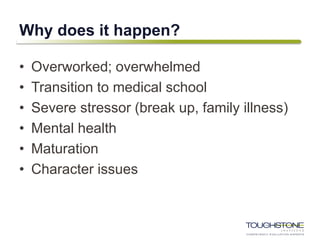
Why does it happen?
• Overworked; overwhelmed
• Transition to medical school
• Severe stressor (break up, family illness)
• Mental health
• Maturation
• Character issues
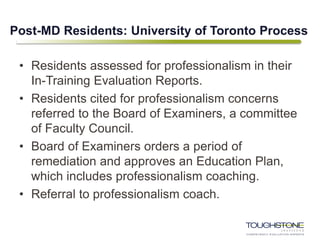
Post-MD Residents: University of Toronto Process
• Residents assessed for professionalism in their
In-Training Evaluation Reports.
• Residents cited for professionalism concerns
referred to the Board of Examiners, a committee
of Faculty Council.
• Board of Examiners orders a period of
remediation and approves an Education Plan,
which includes professionalism coaching.
• Referral to professionalism coach.
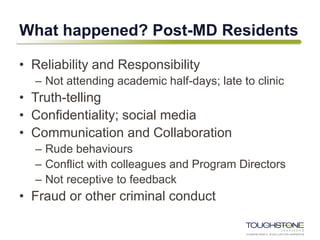
What happened? Post-MD Residents
• Reliability and Responsibility
– Not attending academic half-days; late to clinic
• Truth-telling
• Confidentiality; social media
• Communication and Collaboration
– Rude behaviours
– Conflict with colleagues and Program Directors
– Not receptive to feedback
• Fraud or other criminal conduct
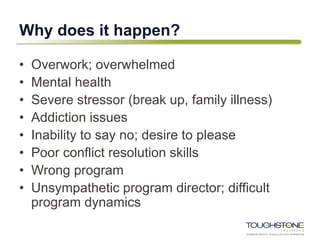
Why does it happen?
• Overwork; overwhelmed
• Mental health
• Severe stressor (break up, family illness)
• Addiction issues
• Inability to say no; desire to please
• Poor conflict resolution skills
• Wrong program
• Unsympathetic program director; difficult
program dynamics
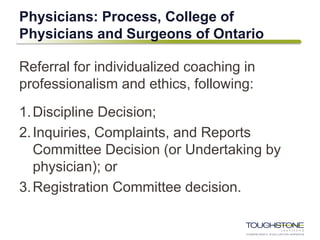
Physicians: Process, College of
Physicians and Surgeons of Ontario
Referral for individualized coaching in
professionalism and ethics, following:
1.Discipline Decision;
2.Inquiries, Complaints, and Reports
Committee Decision (or Undertaking by
physician); or
3.Registration Committee decision.
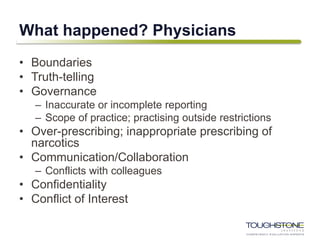
What happened? Physicians
• Boundaries
• Truth-telling
• Governance
– Inaccurate or incomplete reporting
– Scope of practice; practising outside restrictions
• Over-prescribing; inappropriate prescribing of
narcotics
• Communication/Collaboration
– Conflicts with colleagues
• Confidentiality
• Conflict of Interest
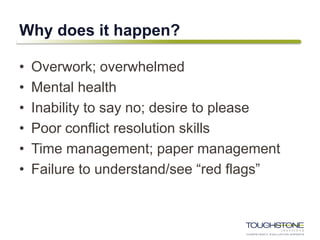
Why does it happen?
• Overwork; overwhelmed
• Mental health
• Inability to say no; desire to please
• Poor conflict resolution skills
• Time management; paper management
• Failure to understand/see “red flags”
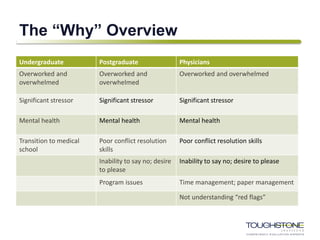
The “Why” Overview
Undergraduate Postgraduate Physicians
Overworked and
overwhelmed
Overworked and
overwhelmed
Overworked and overwhelmed
Significant stressor Significant stressor Significant stressor
Mental health Mental health Mental health
Transition to medical
school
Poor conflict resolution
skills
Poor conflict resolution skills
Inability to say no; desire
to please
Inability to say no; desire to please
Program issues Time management; paper management
Not understanding “red flags”
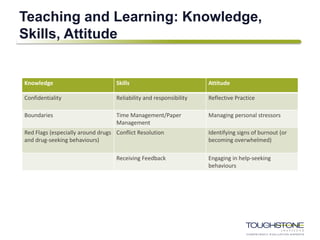
Teaching and Learning: Knowledge,
Skills, Attitude
Knowledge Skills Attitude
Confidentiality Reliability and responsibility Reflective Practice
Boundaries Time Management/Paper
Management
Managing personal stressors
Red Flags (especially around drugs
and drug-seeking behaviours)
Conflict Resolution Identifying signs of burnout (or
becoming overwhelmed)
Receiving Feedback Engaging in help-seeking
behaviours
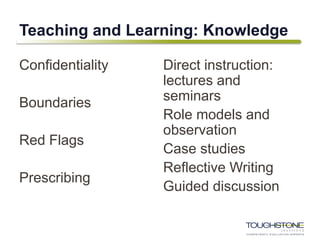
Teaching and Learning: Knowledge
Confidentiality
Boundaries
Red Flags
Prescribing
Direct instruction:
lectures and
seminars
Role models and
observation
Case studies
Reflective Writing
Guided discussion
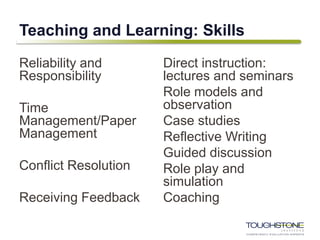
Teaching and Learning: Skills
Reliability and
Responsibility
Time
Management/Paper
Management
Conflict Resolution
Receiving Feedback
Direct instruction:
lectures and seminars
Role models and
observation
Case studies
Reflective Writing
Guided discussion
Role play and
simulation
Coaching
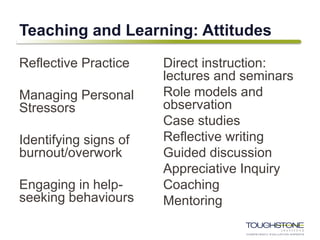
Teaching and Learning: Attitudes
Reflective Practice
Managing Personal
Stressors
Identifying signs of
burnout/overwork
Engaging in help-
seeking behaviours
Direct instruction:
lectures and seminars
Role models and
observation
Case studies
Reflective writing
Guided discussion
Appreciative Inquiry
Coaching
Mentoring
Teaching and Learning Attitudes:
Challenges
1. The challenge of the culture of medicine.
2. The challenge of identifying when we are
overwhelmed.
1. Do we know how we will react when faced with a
significant stressor?
2. Can we identify at an early stage when we might
be approaching burnout?
3. Will we listen if our friends, partners, colleagues
tell us we are “not ourselves”?
3. The challenge of a complex system.
Shifting to thinking about the system….
“Burnout is primarily a system-level problem
driven by excess job demands and
inadequate resources and support, not an
individual problem triggered by personal
limitations.” [Shanafelt et al at 1828]
System-level Responses
Canadian Medical Protective
Association
1. Medical Schools should develop a
culture of wellness.
2. Medical organizations should look
for ways to assist physicians.
3. Medical regulators should aim for
“compassionate regulation.”
4. Institutional and hospital leaders
should recognize the business
case.
5. Governments should invest in
physician wellness. [CMPA 2018]
Federation of State Medical Boards
[US]
1. State medical boards should
emphasize the importance of
physician health, self-care, and
treatment-seeking….
2. Professional medical societies have
a key role in encouraging physicians
to seek treatment….
3. Centers for Medicaid and Medicare
services should carefully analyze
any new requirements placed on
physicians to determine their
potential impact on physician
wellness.
4. Medical schools and residency
programs should continue to
improve the culture of medicine.
[FSMB Workgroup 2018 Report,
selected recommendations]
Conclusions
• Focus on teaching for the “why?”
• Recognize that more teaching may not be
the solution.
• Find the balance between individual
responsibility and system-level problems.
• Whenever possible, support wellness and
wellness programs.
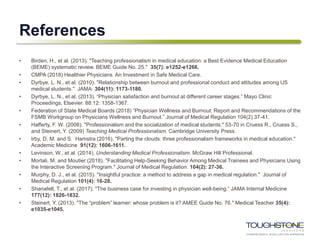
References
• Birden, H., et al. (2013). "Teaching professionalism in medical education: a Best Evidence Medical Education
(BEME) systematic review. BEME Guide No. 25." 35(7): e1252-e1266.
• CMPA (2018) Healthier Physicians. An Investment in Safe Medical Care.
• Dyrbye, L. N., et al. (2010). "Relationship between burnout and professional conduct and attitudes among US
medical students." JAMA: 304(11): 1173-1180.
• Dyrbye, L. N., et al. (2013). “Physician satisfaction and burnout at different career stages.” Mayo Clinic
Proceedings, Elsevier. 88:12: 1358-1367.
• Federation of State Medical Boards (2018) “Physician Wellness and Burnout: Report and Recommendations of the
FSMB Workgroup on Physicians Wellness and Burnout.” Journal of Medical Regulation 104(2) 37-41.
• Hafferty, F. W. (2008). "Professionalism and the socialization of medical students." 53-70 in Cruess R., Cruess S.,
and Steinert, Y. (2009) Teaching Medical Professionalism. Cambridge University Press.
• Irby, D. M. and S. Hamstra (2016). "Parting the clouds: three professionalism frameworks in medical education."
Academic Medicine 91(12): 1606-1611.
• Levinson, W., et al. (2014). Understanding Medical Professionalism. McGraw Hill Professional.
• Mortali, M. and Moutier (2018). "Facilitating Help-Seeking Behavior Among Medical Trainees and Physicians Using
the Interactive Screening Program." Journal of Medical Regulation: 104(2): 27-36.
• Murphy, D. J., et al. (2015). "Insightful practice: a method to address a gap in medical regulation." Journal of
Medical Regulation 101(4): 16-28.
• Shanafelt, T., et al. (2017). "The business case for investing in physician well-being.“ JAMA Internal Medicine
177(12): 1826-1832.
• Steinert, Y. (2013). "The “problem” learner: whose problem is it? AMEE Guide No. 76." Medical Teacher 35(4):
e1035-e1045.

Perspectives 2019: Erika Abner

  • 1.
    2019 Perspectives Symposium January31, 2019 #TSINPerspectives2019
  • 2.
    Erika Abner University ofToronto Teaching and Learning Professionalism
  • 3.
    Teaching and LearningProfessionalism Erika Abner LL.B LL.M PhD Assistant Professor Department of Family and Community Medicine Faculty Lead, Ethics and Professionalism University of Toronto Faculty of Medicine
  • 4.
    Background • Lawyer andPhD (Higher Education) • Working in legal education since 1987 • Working in medical education since 2007 • Individualized instruction/remediation in ethics and professionalism – For medical residents, since 2007 – For undergraduate medical students, since 2014 – For practicing physicians, since 2014
  • 5.
    “Rather than searchingfor a system to find the “bad apples,” should we view the problem from an alternative standpoint, where any professional, when challenged by life events, has the potential of losing his or her way and putting patients and colleagues at unnecessary risk?” [Murphy, 2015 at 19]
  • 6.
    What this talkis about…. Review of my experience with individualized instruction and coaching in professionalism and ethics through the physician life-cycle: “What happened?” “Why did it happen?” And to consider teaching and learning for both the “what” and the “why.”
  • 7.
    Professionalism Frameworks 1. Virtues-based –Able to apply ethical reasoning, restrain self-interest, and demonstrate compassion and respect as a humane person. 2. Competency – A domain of competence (behaviours) to be mastered, demonstrated and assessed. 3. Identity formation – Socialization into thinking, acting, and feeling like a professional. [Irby, 2016 at 1606] 4. Social control – Medicine’s promise to police itself in the public interest. – Individual ability and willingness to self-regulate in the public interest. [Hafferty, 2009 at 62]
  • 8.
    Teaching and Learning[Irby, 2016 at 1609] Strategies Virtue-based Behavior-based Professional identity Pedagogy Direct instruction, role models, case studies, reflective writing, guided discussion, appreciative inquiry, white coat ceremonies Direct instruction, role models, case studies, coaching, simulations, reflection on action Direct instruction, role models, case studies, reflective writing, guided discussion, appreciative inquiry
  • 9.
    Cases since 2014 •Undergraduate = 25 • Post-graduate = 26 • Physicians = 35 NO cases of sexual abuse or assault.
  • 10.
    MD students: Universityof Toronto Process • Professionalism viewed as a competency. • Professionalism assessment in every course. • Assessment based on 5-point scale with multiple domains. • Students who score <3 on multiple occasions OR involved in a critical incident may be referred to the Faculty Lead, Ethics and Professionalism to complete a Focused Professionalism Learning Plan.
  • 11.
    What happened? MDstudents • Reliability and responsibility – Not attending classes or clinics – Not completing assignments on time • Truth-telling • Confidentiality; social media • Academic integrity – Plagiarism – Exam misconduct • Communication/Collaboration – Rude behaviours – Not following administrative protocols
  • 12.
    Why does ithappen? • Overworked; overwhelmed • Transition to medical school • Severe stressor (break up, family illness) • Mental health • Maturation • Character issues
  • 13.
    Post-MD Residents: Universityof Toronto Process • Residents assessed for professionalism in their In-Training Evaluation Reports. • Residents cited for professionalism concerns referred to the Board of Examiners, a committee of Faculty Council. • Board of Examiners orders a period of remediation and approves an Education Plan, which includes professionalism coaching. • Referral to professionalism coach.
  • 14.
    What happened? Post-MDResidents • Reliability and Responsibility – Not attending academic half-days; late to clinic • Truth-telling • Confidentiality; social media • Communication and Collaboration – Rude behaviours – Conflict with colleagues and Program Directors – Not receptive to feedback • Fraud or other criminal conduct
  • 15.
    Why does ithappen? • Overwork; overwhelmed • Mental health • Severe stressor (break up, family illness) • Addiction issues • Inability to say no; desire to please • Poor conflict resolution skills • Wrong program • Unsympathetic program director; difficult program dynamics
  • 16.
    Physicians: Process, Collegeof Physicians and Surgeons of Ontario Referral for individualized coaching in professionalism and ethics, following: 1.Discipline Decision; 2.Inquiries, Complaints, and Reports Committee Decision (or Undertaking by physician); or 3.Registration Committee decision.
  • 17.
    What happened? Physicians •Boundaries • Truth-telling • Governance – Inaccurate or incomplete reporting – Scope of practice; practising outside restrictions • Over-prescribing; inappropriate prescribing of narcotics • Communication/Collaboration – Conflicts with colleagues • Confidentiality • Conflict of Interest
  • 18.
    Why does ithappen? • Overwork; overwhelmed • Mental health • Inability to say no; desire to please • Poor conflict resolution skills • Time management; paper management • Failure to understand/see “red flags”
  • 19.
    The “Why” Overview UndergraduatePostgraduate Physicians Overworked and overwhelmed Overworked and overwhelmed Overworked and overwhelmed Significant stressor Significant stressor Significant stressor Mental health Mental health Mental health Transition to medical school Poor conflict resolution skills Poor conflict resolution skills Inability to say no; desire to please Inability to say no; desire to please Program issues Time management; paper management Not understanding “red flags”
  • 20.
    Teaching and Learning:Knowledge, Skills, Attitude Knowledge Skills Attitude Confidentiality Reliability and responsibility Reflective Practice Boundaries Time Management/Paper Management Managing personal stressors Red Flags (especially around drugs and drug-seeking behaviours) Conflict Resolution Identifying signs of burnout (or becoming overwhelmed) Receiving Feedback Engaging in help-seeking behaviours
  • 21.
    Teaching and Learning:Knowledge Confidentiality Boundaries Red Flags Prescribing Direct instruction: lectures and seminars Role models and observation Case studies Reflective Writing Guided discussion
  • 22.
    Teaching and Learning:Skills Reliability and Responsibility Time Management/Paper Management Conflict Resolution Receiving Feedback Direct instruction: lectures and seminars Role models and observation Case studies Reflective Writing Guided discussion Role play and simulation Coaching
  • 23.
    Teaching and Learning:Attitudes Reflective Practice Managing Personal Stressors Identifying signs of burnout/overwork Engaging in help- seeking behaviours Direct instruction: lectures and seminars Role models and observation Case studies Reflective writing Guided discussion Appreciative Inquiry Coaching Mentoring
  • 24.
    Teaching and LearningAttitudes: Challenges 1. The challenge of the culture of medicine. 2. The challenge of identifying when we are overwhelmed. 1. Do we know how we will react when faced with a significant stressor? 2. Can we identify at an early stage when we might be approaching burnout? 3. Will we listen if our friends, partners, colleagues tell us we are “not ourselves”? 3. The challenge of a complex system.
  • 25.
    Shifting to thinkingabout the system…. “Burnout is primarily a system-level problem driven by excess job demands and inadequate resources and support, not an individual problem triggered by personal limitations.” [Shanafelt et al at 1828]
  • 26.
    System-level Responses Canadian MedicalProtective Association 1. Medical Schools should develop a culture of wellness. 2. Medical organizations should look for ways to assist physicians. 3. Medical regulators should aim for “compassionate regulation.” 4. Institutional and hospital leaders should recognize the business case. 5. Governments should invest in physician wellness. [CMPA 2018] Federation of State Medical Boards [US] 1. State medical boards should emphasize the importance of physician health, self-care, and treatment-seeking…. 2. Professional medical societies have a key role in encouraging physicians to seek treatment…. 3. Centers for Medicaid and Medicare services should carefully analyze any new requirements placed on physicians to determine their potential impact on physician wellness. 4. Medical schools and residency programs should continue to improve the culture of medicine. [FSMB Workgroup 2018 Report, selected recommendations]
  • 27.
    Conclusions • Focus onteaching for the “why?” • Recognize that more teaching may not be the solution. • Find the balance between individual responsibility and system-level problems. • Whenever possible, support wellness and wellness programs.
  • 28.
    References • Birden, H.,et al. (2013). "Teaching professionalism in medical education: a Best Evidence Medical Education (BEME) systematic review. BEME Guide No. 25." 35(7): e1252-e1266. • CMPA (2018) Healthier Physicians. An Investment in Safe Medical Care. • Dyrbye, L. N., et al. (2010). "Relationship between burnout and professional conduct and attitudes among US medical students." JAMA: 304(11): 1173-1180. • Dyrbye, L. N., et al. (2013). “Physician satisfaction and burnout at different career stages.” Mayo Clinic Proceedings, Elsevier. 88:12: 1358-1367. • Federation of State Medical Boards (2018) “Physician Wellness and Burnout: Report and Recommendations of the FSMB Workgroup on Physicians Wellness and Burnout.” Journal of Medical Regulation 104(2) 37-41. • Hafferty, F. W. (2008). "Professionalism and the socialization of medical students." 53-70 in Cruess R., Cruess S., and Steinert, Y. (2009) Teaching Medical Professionalism. Cambridge University Press. • Irby, D. M. and S. Hamstra (2016). "Parting the clouds: three professionalism frameworks in medical education." Academic Medicine 91(12): 1606-1611. • Levinson, W., et al. (2014). Understanding Medical Professionalism. McGraw Hill Professional. • Mortali, M. and Moutier (2018). "Facilitating Help-Seeking Behavior Among Medical Trainees and Physicians Using the Interactive Screening Program." Journal of Medical Regulation: 104(2): 27-36. • Murphy, D. J., et al. (2015). "Insightful practice: a method to address a gap in medical regulation." Journal of Medical Regulation 101(4): 16-28. • Shanafelt, T., et al. (2017). "The business case for investing in physician well-being.“ JAMA Internal Medicine 177(12): 1826-1832. • Steinert, Y. (2013). "The “problem” learner: whose problem is it? AMEE Guide No. 76." Medical Teacher 35(4): e1035-e1045.