Programme
 Program is the total Educational job being done in
particular setting. It is a prospectus or a statement
issues to promote understanding and interest in an
enterprise
Planning
 Is the study of past and present to forecast the future and
on the basis of that forecast we set our objectives to achieve
the goal.
 Program Planning
 Decision making process involving critical analysis of the
existing situation and the problems, evaluation of the
various alternatives to solve these problems and the
selection of the relevant ones, giving necessary priorities
based upon local needs and resources by the cooperative
efforts of the people both official and non-official with a
view to facilitate the individual and community growth and
development
Objectives of Programme Planning
 To ensure careful consideration of what is to be done
and why
 To furnish a guide against which to judge all new
proposals
 To establish objectives toward which progress can be
measured and evaluated
 To have a means of choosing the important (deep
rooted) from incidental (minor less important)
problems and the permanent from the temporary
changes.
To develop a common understanding about the means
ends between various functionaries and organizations
To ensure continuity during changes in personnel
To help develop leadership
To avoid waste of time and money and promote efficiency
To justify expenditure and to ensure flow of funds
To have available in written form a statement for public
use
Need
 Need implies a gap between what is, the existing
situation: and what ought to be the desirable situation.
 The nature and extent of the gap indicates significance
of the problem
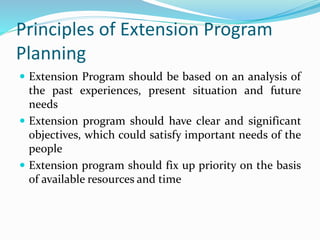
Principles of Extension Program
Planning
 Extension Program should be based on an analysis of
the past experiences, present situation and future
needs
 Extension program should have clear and significant
objectives, which could satisfy important needs of the
people
 Extension program should fix up priority on the basis
of available resources and time
 Extension program should clearly indicate the
availability and utilization of resources
 Extension program should have a general agreement at
various levels
 Extension program should involve people at the local
level
 Extension program should involve relevant institution
and organizations extension program should have
definite plan of work
 Extension program should provide for evaluation of
results and reconsideration of the program
 Extension program should provide for equitable
distribution of benefits amongst the members of the
community
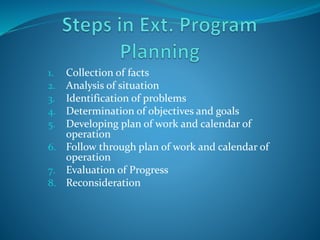
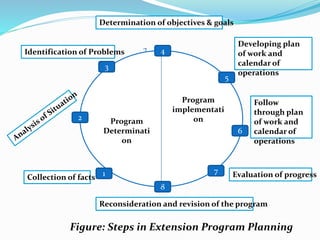
1. Collection of facts
2. Analysis of situation
3. Identification of problems
4. Determination of objectives and goals
5. Developing plan of work and calendar of
operation
6. Follow through plan of work and calendar of
operation
7. Evaluation of Progress
8. Reconsideration
2
6
3
1
8
4
5
7
Collection of facts
Identification of Problems
Determination of objectives & goals
Developing plan
of work and
calendar of
operations
Follow
through plan
of work and
calendar of
operations
Evaluation of progress
Reconsideration and revision of the program
Program
Determinati
on
Program
implementati
on
Figure: Steps in Extension Program Planning
Collection of facts
 There is a good deal of information that the agent will
need about the people in the area, their farming
systems, natural resources and the facilities available
for local development. The agent will need
information in order to have a good understanding of
the situation with which he is dealing, for example, on
social structure and local culture, farming systems,
education and literacy levels, size of farms, local
channels of communication, transport facilities, local
credit systems, marketing, health and nutrition levels,
and crops and livestock
These facts can be collected from a variety of
sources. Reports of soil classification and land-use
surveys, farm management studies, social surveys
and previous programmes can provide a lot of
useful background information. If the agent keeps
good records of the farms in his area, he will have
at his fingertips much of the information he
needs. He can also obtain a lot of his information
from farmers and local leaders. At public
meetings, in group discussions and in contact with
individual farmers, the agent should listen, ask
questions and gradually build up a fuller
understanding of the social, agricultural and
economic features of the area.
Analysis of situation
 Facts do not speak for themselves. It is necessary to ask
why things happen in the way they do. If farmers
report that yields have declined in recent years, the
agent must look for other information that would
suggest an explanation. Is it because of low rainfall,
declining soil fertility, or poor seed? The agent must
also separate fact from opinion and guesswork. He
may obtain conflicting information from two different
sources, and must judge which is the more reliable
Identification of Problems
 Throughout the situation analysis, the agent should avoid either, relying
totally on his own expertise when interpreting facts and identifying
problems, or leaving it entirely up to farmers to define local needs and
possibilities for change. It should be a joint effort, with agents and
farmers bringing their own experience and knowledge together to reach
a full understanding. If farmers are not fully involved in these activities,
the agent runs the risk of misinterpreting facts, wasting time in analysis
and, almost certainly, of failing to gain the full support of farmers for the
programme.
 A full situation analysis is not needed every year. The
basic facts about the area and the people will, in most
situations, not change very much from year to year.
However, the agent should review basic information
each year and decide which parts of it need to be
updated
Determination of objectives
 Objectives are expression of ends towards which our efforts are
directed. The objectives should be direct and stated in clear
terms.
 Objectives should be SMART
 S: Specific
 M: Measureable
 A: Achievable/attractive
 R: Realistic
 T: Time bound
 To make the objectives realistic and actionable, there is need to
state them in terms of specific goals
Developing plan of work
 Plan of work should be in written form and shall
indicate who shall do what job.
 I.e. what change agent system and the client system
shall do
 Which institution/department should be involved
 What will be the financial requirement and how shall
it be meet
 What arrangements shall be needed
 Plan should have all the essential details and no
important point should be left out.
Evaluation of Progress
 Evaluation is the process to check or judge the value
and worth of a programme.
 It should be a continuous process not only to measure
the end result but also to ensure that all the steps are
correctly followed.
Reconsideration and revision of the
program
 Reconsideration should be done not only with the
participants but also with the scientists, extension
managers, and local bodies like panchyats etc.
 It may help in making necessary corrections and
modifications in the program

Program Planning Priciples of programme planning.pptx

  • 2.
    Programme  Program isthe total Educational job being done in particular setting. It is a prospectus or a statement issues to promote understanding and interest in an enterprise
  • 3.
    Planning  Is thestudy of past and present to forecast the future and on the basis of that forecast we set our objectives to achieve the goal.  Program Planning  Decision making process involving critical analysis of the existing situation and the problems, evaluation of the various alternatives to solve these problems and the selection of the relevant ones, giving necessary priorities based upon local needs and resources by the cooperative efforts of the people both official and non-official with a view to facilitate the individual and community growth and development
  • 4.
    Objectives of ProgrammePlanning  To ensure careful consideration of what is to be done and why  To furnish a guide against which to judge all new proposals  To establish objectives toward which progress can be measured and evaluated  To have a means of choosing the important (deep rooted) from incidental (minor less important) problems and the permanent from the temporary changes.
  • 5.
    To develop acommon understanding about the means ends between various functionaries and organizations To ensure continuity during changes in personnel To help develop leadership To avoid waste of time and money and promote efficiency To justify expenditure and to ensure flow of funds To have available in written form a statement for public use
  • 6.
    Need  Need impliesa gap between what is, the existing situation: and what ought to be the desirable situation.  The nature and extent of the gap indicates significance of the problem
  • 7.
    Principles of ExtensionProgram Planning  Extension Program should be based on an analysis of the past experiences, present situation and future needs  Extension program should have clear and significant objectives, which could satisfy important needs of the people  Extension program should fix up priority on the basis of available resources and time
  • 8.
     Extension programshould clearly indicate the availability and utilization of resources  Extension program should have a general agreement at various levels  Extension program should involve people at the local level  Extension program should involve relevant institution and organizations extension program should have definite plan of work
  • 9.
     Extension programshould provide for evaluation of results and reconsideration of the program  Extension program should provide for equitable distribution of benefits amongst the members of the community
  • 10.
    1. Collection offacts 2. Analysis of situation 3. Identification of problems 4. Determination of objectives and goals 5. Developing plan of work and calendar of operation 6. Follow through plan of work and calendar of operation 7. Evaluation of Progress 8. Reconsideration
  • 11.
    2 6 3 1 8 4 5 7 Collection of facts Identificationof Problems Determination of objectives & goals Developing plan of work and calendar of operations Follow through plan of work and calendar of operations Evaluation of progress Reconsideration and revision of the program Program Determinati on Program implementati on Figure: Steps in Extension Program Planning
  • 12.
    Collection of facts There is a good deal of information that the agent will need about the people in the area, their farming systems, natural resources and the facilities available for local development. The agent will need information in order to have a good understanding of the situation with which he is dealing, for example, on social structure and local culture, farming systems, education and literacy levels, size of farms, local channels of communication, transport facilities, local credit systems, marketing, health and nutrition levels, and crops and livestock
  • 13.
    These facts canbe collected from a variety of sources. Reports of soil classification and land-use surveys, farm management studies, social surveys and previous programmes can provide a lot of useful background information. If the agent keeps good records of the farms in his area, he will have at his fingertips much of the information he needs. He can also obtain a lot of his information from farmers and local leaders. At public meetings, in group discussions and in contact with individual farmers, the agent should listen, ask questions and gradually build up a fuller understanding of the social, agricultural and economic features of the area.
  • 14.
    Analysis of situation Facts do not speak for themselves. It is necessary to ask why things happen in the way they do. If farmers report that yields have declined in recent years, the agent must look for other information that would suggest an explanation. Is it because of low rainfall, declining soil fertility, or poor seed? The agent must also separate fact from opinion and guesswork. He may obtain conflicting information from two different sources, and must judge which is the more reliable
  • 15.
    Identification of Problems Throughout the situation analysis, the agent should avoid either, relying totally on his own expertise when interpreting facts and identifying problems, or leaving it entirely up to farmers to define local needs and possibilities for change. It should be a joint effort, with agents and farmers bringing their own experience and knowledge together to reach a full understanding. If farmers are not fully involved in these activities, the agent runs the risk of misinterpreting facts, wasting time in analysis and, almost certainly, of failing to gain the full support of farmers for the programme.  A full situation analysis is not needed every year. The basic facts about the area and the people will, in most situations, not change very much from year to year. However, the agent should review basic information each year and decide which parts of it need to be updated
  • 16.
    Determination of objectives Objectives are expression of ends towards which our efforts are directed. The objectives should be direct and stated in clear terms.  Objectives should be SMART  S: Specific  M: Measureable  A: Achievable/attractive  R: Realistic  T: Time bound  To make the objectives realistic and actionable, there is need to state them in terms of specific goals
  • 17.
    Developing plan ofwork  Plan of work should be in written form and shall indicate who shall do what job.  I.e. what change agent system and the client system shall do  Which institution/department should be involved  What will be the financial requirement and how shall it be meet  What arrangements shall be needed  Plan should have all the essential details and no important point should be left out.
  • 18.
    Evaluation of Progress Evaluation is the process to check or judge the value and worth of a programme.  It should be a continuous process not only to measure the end result but also to ensure that all the steps are correctly followed.
  • 19.
    Reconsideration and revisionof the program  Reconsideration should be done not only with the participants but also with the scientists, extension managers, and local bodies like panchyats etc.  It may help in making necessary corrections and modifications in the program