Dr. Asif Mohammad
Senior Scientist
ICAR-National Dairy Research Institute
Kalynai-741235, West Bengal
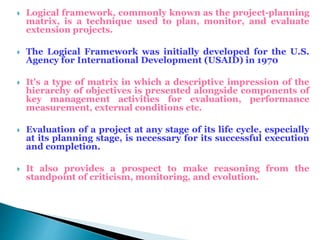
 Logical framework, commonly known as the project-planning
matrix, is a technique used to plan, monitor, and evaluate
extension projects.
 The Logical Framework was initially developed for the U.S.
Agency for International Development (USAID) in 1970
 It's a type of matrix in which a descriptive impression of the
hierarchy of objectives is presented alongside components of
key management activities for evaluation, performance
measurement, external conditions etc.
 Evaluation of a project at any stage of its life cycle, especially
at its planning stage, is necessary for its successful execution
and completion.
 It also provides a prospect to make reasoning from the
standpoint of criticism, monitoring, and evolution.
Basic elements of logical framework
 Hierarchy of objectives
 Goal, purpose, outputs, activities and inputs are included in the hierarchy of
objectives.
 The cause-and-effect relationship is the foundation of hierarchy.
 Disconnecting the cause from the impact while writing this column is very much
important and use of short, brief words with strong action verbs are required while
writing the hierarchy of objectives.
 The extension project's objective is defined in terms of purpose of the project as the
project's goals.
 The Projects' deliverables are referred to as outputs.
 The actions that must be taken in order to achieve outcomes are referred to as
activities.
 Inputs include personnel, money, services, equipment, information and databases,
as well as other soft and hard requirements for completing tasks.
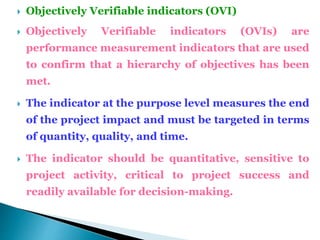
 Objectively Verifiable indicators (OVI)
 Objectively Verifiable indicators (OVIs) are
performance measurement indicators that are used
to confirm that a hierarchy of objectives has been
met.
 The indicator at the purpose level measures the end
of the project impact and must be targeted in terms
of quantity, quality, and time.
 The indicator should be quantitative, sensitive to
project activity, critical to project success and
readily available for decision-making.
 Means of Verification (MOV)
 Indicators can be evaluated for performance
measurement, but where do users access the
information?
 For this, researchers need some tools, such as
sources of data (MOV) that can be used to verify
the progress of objectives at various levels.
 Typically, project reports and baseline reports
are MOVs that can be used to track down the
information we require.
 Critical Assumptions & Risks
 Many extension project/ programme do not get success not only due
to external factors beyond the project's control but also due to
unreasonable structure of the project.
 National policies, environmental variables, access to resources,
political, social and religious issues etc. are some examples of these
conditions.
 Documentation of any external circumstances that are required to
achieve specific objectives is very important.
 In some circumstances, project managers become more creative and
smart by creating a contingency plan to achieve the objectives of the
projects.
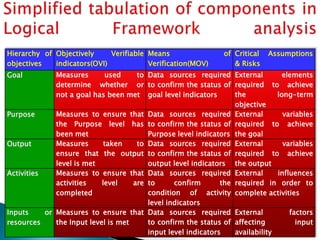
Hierarchy of
objectives
Objectively Verifiable
indicators(OVI)
Means of
Verification(MOV)
Critical Assumptions
& Risks
Goal Measures used to
determine whether or
not a goal has been met
Data sources required
to confirm the status of
goal level indicators
External elements
required to achieve
the long-term
objective
Purpose Measures to ensure that
the Purpose level has
been met
Data sources required
to confirm the status of
Purpose level indicators
External variables
required to achieve
the goal
Output Measures taken to
ensure that the output
level is met
Data sources required
to confirm the status of
output level indicators
External variables
required to achieve
the output
Activities Measures to ensure that
activities level are
completed
Data sources required
to confirm the
condition of activity
level indicators
External influences
required in order to
complete activities
Inputs or
resources
Measures to ensure that
the Input level is met
Data sources required
to confirm the status of
input level indicators
External factors
affecting input
availability
 Benefits of using Logical Framework
Analysis (LFA) in extension programme
planning
LFA reveals the project's major elements exposing the
project's logic to evaluate and monitor.
Ensure that the hierarchy of objectives is clear
Assist in monitoring on time to time basis
Clearly identifies the critical assumptions
Project managers are clear about the goals
Responsibility and accountability standards can be
established
The sustainability of the project can be understood
Logical Framework Analysis.pptx

Logical Framework Analysis.pptx

  • 1.
    Dr. Asif Mohammad SeniorScientist ICAR-National Dairy Research Institute Kalynai-741235, West Bengal
  • 2.
     Logical framework,commonly known as the project-planning matrix, is a technique used to plan, monitor, and evaluate extension projects.  The Logical Framework was initially developed for the U.S. Agency for International Development (USAID) in 1970  It's a type of matrix in which a descriptive impression of the hierarchy of objectives is presented alongside components of key management activities for evaluation, performance measurement, external conditions etc.  Evaluation of a project at any stage of its life cycle, especially at its planning stage, is necessary for its successful execution and completion.  It also provides a prospect to make reasoning from the standpoint of criticism, monitoring, and evolution.
  • 3.
    Basic elements oflogical framework
  • 4.
     Hierarchy ofobjectives  Goal, purpose, outputs, activities and inputs are included in the hierarchy of objectives.  The cause-and-effect relationship is the foundation of hierarchy.  Disconnecting the cause from the impact while writing this column is very much important and use of short, brief words with strong action verbs are required while writing the hierarchy of objectives.  The extension project's objective is defined in terms of purpose of the project as the project's goals.  The Projects' deliverables are referred to as outputs.  The actions that must be taken in order to achieve outcomes are referred to as activities.  Inputs include personnel, money, services, equipment, information and databases, as well as other soft and hard requirements for completing tasks.
  • 5.
     Objectively Verifiableindicators (OVI)  Objectively Verifiable indicators (OVIs) are performance measurement indicators that are used to confirm that a hierarchy of objectives has been met.  The indicator at the purpose level measures the end of the project impact and must be targeted in terms of quantity, quality, and time.  The indicator should be quantitative, sensitive to project activity, critical to project success and readily available for decision-making.
  • 6.
     Means ofVerification (MOV)  Indicators can be evaluated for performance measurement, but where do users access the information?  For this, researchers need some tools, such as sources of data (MOV) that can be used to verify the progress of objectives at various levels.  Typically, project reports and baseline reports are MOVs that can be used to track down the information we require.
  • 7.
     Critical Assumptions& Risks  Many extension project/ programme do not get success not only due to external factors beyond the project's control but also due to unreasonable structure of the project.  National policies, environmental variables, access to resources, political, social and religious issues etc. are some examples of these conditions.  Documentation of any external circumstances that are required to achieve specific objectives is very important.  In some circumstances, project managers become more creative and smart by creating a contingency plan to achieve the objectives of the projects.
  • 8.
    Hierarchy of objectives Objectively Verifiable indicators(OVI) Meansof Verification(MOV) Critical Assumptions & Risks Goal Measures used to determine whether or not a goal has been met Data sources required to confirm the status of goal level indicators External elements required to achieve the long-term objective Purpose Measures to ensure that the Purpose level has been met Data sources required to confirm the status of Purpose level indicators External variables required to achieve the goal Output Measures taken to ensure that the output level is met Data sources required to confirm the status of output level indicators External variables required to achieve the output Activities Measures to ensure that activities level are completed Data sources required to confirm the condition of activity level indicators External influences required in order to complete activities Inputs or resources Measures to ensure that the Input level is met Data sources required to confirm the status of input level indicators External factors affecting input availability
  • 9.
     Benefits ofusing Logical Framework Analysis (LFA) in extension programme planning LFA reveals the project's major elements exposing the project's logic to evaluate and monitor. Ensure that the hierarchy of objectives is clear Assist in monitoring on time to time basis Clearly identifies the critical assumptions Project managers are clear about the goals Responsibility and accountability standards can be established The sustainability of the project can be understood