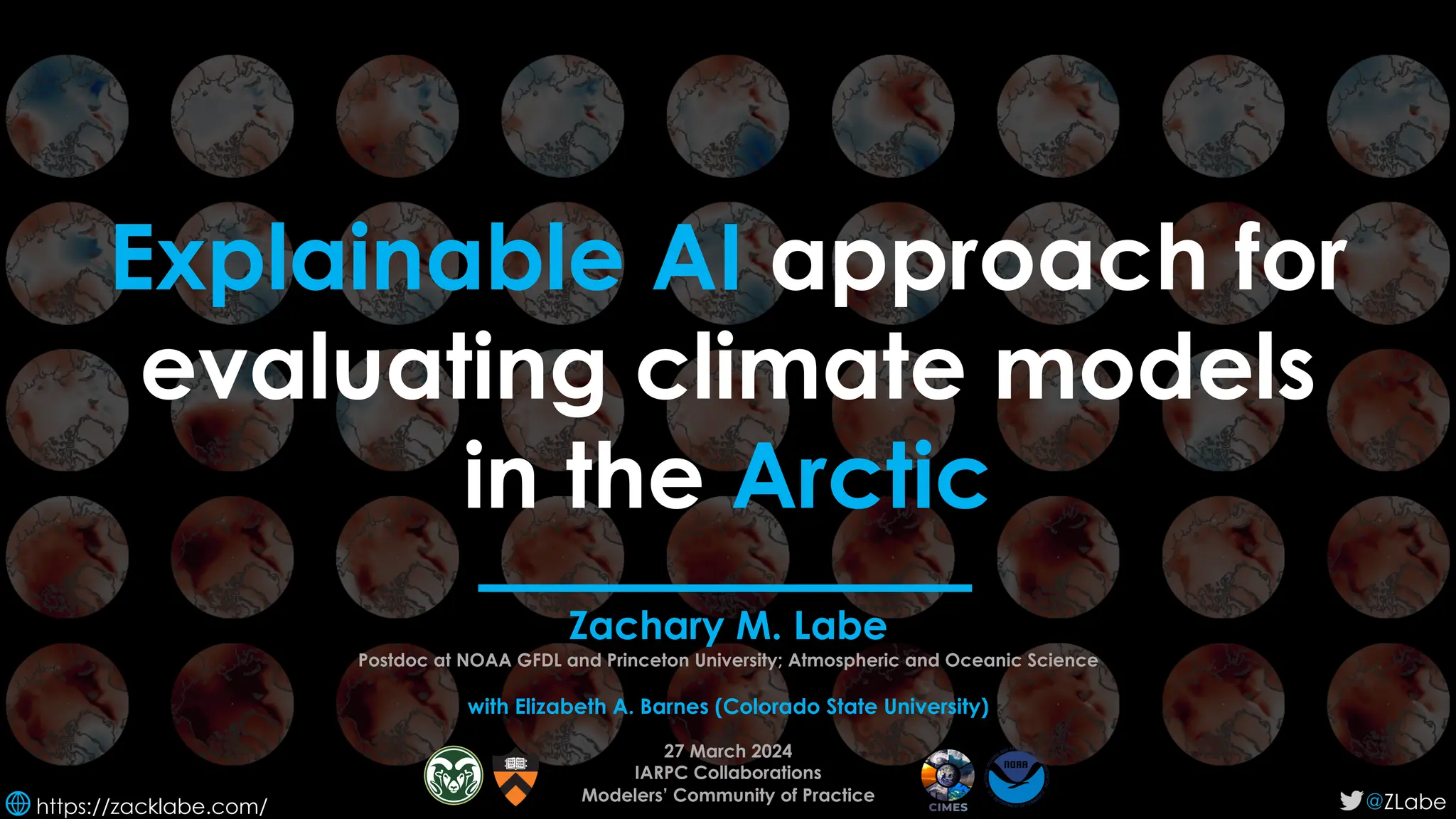
Explainable AI approach for
evaluating climate models
in the Arctic
Zachary M. Labe
Postdoc at NOAA GFDL and Princeton University; Atmospheric and Oceanic Science
with Elizabeth A. Barnes (Colorado State University)
27 March 2024
IARPC Collaborations
Modelers’ Community of Practice
https://zacklabe.com/ @ZLabe
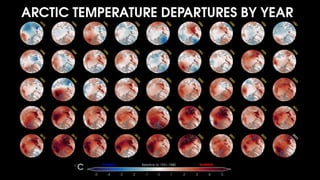
Relative to 1951-1980
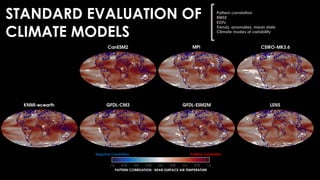
STANDARD EVALUATION OF
CLIMATE MODELS
Pattern correlation
RMSE
EOFs
Trends, anomalies, mean state
Climate modes of variability
Negative Correlation Positive Correlation
PATTERN CORRELATION – T2M
PATTERN CORRELATION : NEAR-SURFACE AIR TEMPERATURE
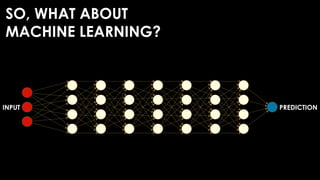
INPUT PREDICTION
SO, WHAT ABOUT
MACHINE LEARNING?
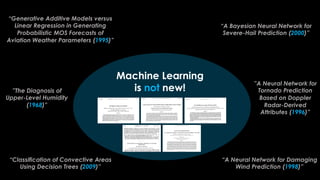
Machine Learning
is not new!
“A Bayesian Neural Network for
Severe-Hail Prediction (2000)”
“Classification of Convective Areas
Using Decision Trees (2009)”
“A Neural Network for Damaging
Wind Prediction (1998)”
“Generative Additive Models versus
Linear Regression in Generating
Probabilistic MOS Forecasts of
Aviation Weather Parameters (1995)”
”A Neural Network for
Tornado Prediction
Based on Doppler
Radar-Derived
Attributes (1996)”
”The Diagnosis of
Upper-Level Humidity
(1968)”
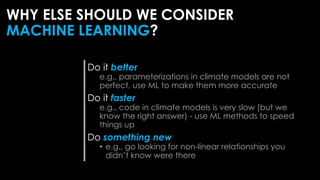
Do it better
e.g., parameterizations in climate models are not
perfect, use ML to make them more accurate
Do it faster
e.g., code in climate models is very slow (but we
know the right answer) - use ML methods to speed
things up
Do something new
• e.g., go looking for non-linear relationships you
didn’t know were there
WHY ELSE SHOULD WE CONSIDER
MACHINE LEARNING?
Do it better
e.g., parameterizations in climate models are not
perfect, use ML to make them more accurate
Do it faster
e.g., code in climate models is very slow (but we
know the right answer) - use ML methods to speed
things up
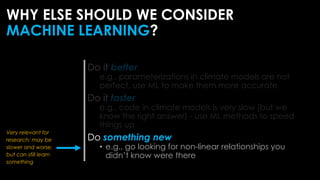
Do something new
• e.g., go looking for non-linear relationships you
didn’t know were there
WHY ELSE SHOULD WE CONSIDER
MACHINE LEARNING?
Very relevant for
research: may be
slower and worse,
but can still learn
something
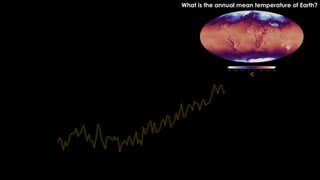
What is the annual mean temperature of Earth?
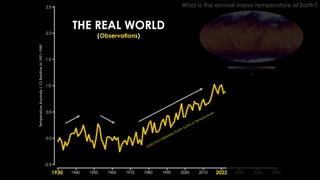
THE REAL WORLD
(Observations)
What is the annual mean temperature of Earth?
Data from
Berkeley Earth Surface Temperature
1930 2022
What is the annual mean temperature of Earth?
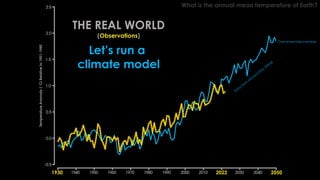
THE REAL WORLD
(Observations)
Let’s run a
climate model
One ensemble member
2022
1930 2050
Data
from
NO
AA/G
FDL SPEAR
What is the annual mean temperature of Earth?
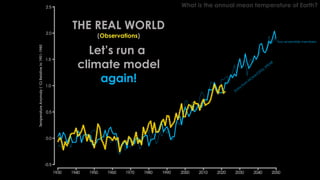
THE REAL WORLD
(Observations)
Let’s run a
climate model
again!
Two ensemble members
Data
from
NO
AA/G
FDL SPEAR
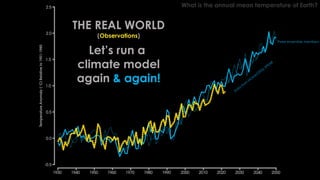
What is the annual mean temperature of Earth?
THE REAL WORLD
(Observations)
Let’s run a
climate model
again & again!
Three ensemble members
Data
from
NO
AA/G
FDL SPEAR
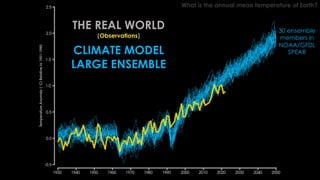
What is the annual mean temperature of Earth?
THE REAL WORLD
(Observations)
CLIMATE MODEL
LARGE ENSEMBLE
30 ensemble
members in
NOAA/GFDL
SPEAR
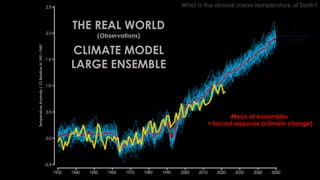
What is the annual mean temperature of Earth?
Mean of ensembles
= forced response (climate change)
THE REAL WORLD
(Observations)
CLIMATE MODEL
LARGE ENSEMBLE
30
ensemble members
In GFDL SPEAR
What is the annual mean temperature of Earth?
Mean of ensembles
= forced response (climate change)
THE REAL WORLD
(Observations)
CLIMATE MODEL
LARGE ENSEMBLE
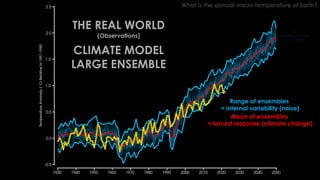
30
ensemble members
In GFDL SPEAR
Range of ensembles
= internal variability (noise)
Mean of ensembles
= forced response (climate change)
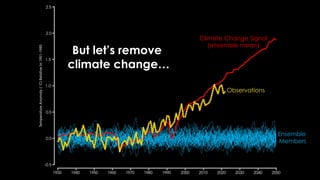
But let’s remove
climate change…
Climate Change Signal
(ensemble mean)
Observations
Ensemble
Members
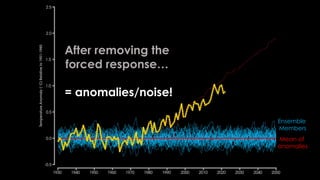
Ensemble
Members
Mean of
anomalies
After removing the
forced response…
= anomalies/noise!
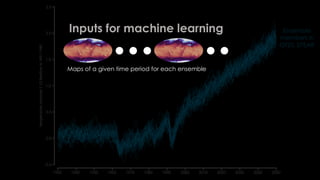
Ensemble
members in
GFDL SPEAR
Maps of a given time period for each ensemble
Inputs for machine learning
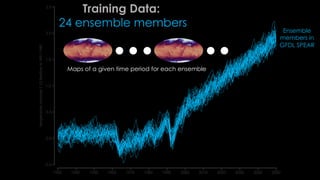
Ensemble
members in
GFDL SPEAR
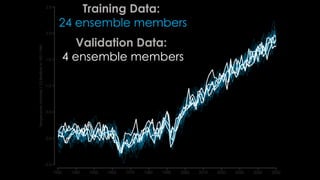
Training Data:
24 ensemble members
Maps of a given time period for each ensemble
Training Data:
24 ensemble members
Validation Data:
4 ensemble members
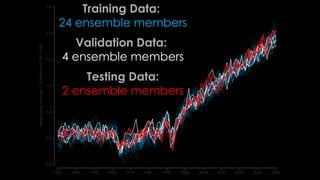
Training Data:
24 ensemble members
Validation Data:
4 ensemble members
Testing Data:
2 ensemble members
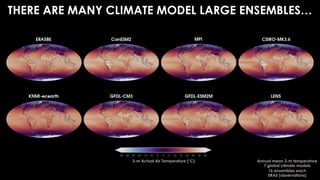
2-m Actual Air Temperature (°C)
THERE ARE MANY CLIMATE MODEL LARGE ENSEMBLES…
Annual mean 2-m temperature
7 global climate models
16 ensembles each
ERA5 (observations)
INPUT
[DATA]
PREDICTION
Machine
Learning
----ANN----
2 Hidden Layers
10 Nodes each
Ridge Regularization
Early Stopping
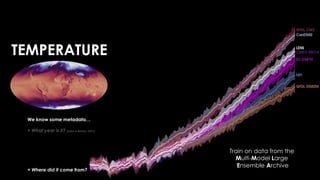
TEMPERATURE
We know some metadata…
+ What year is it? (Labe & Barnes, 2021)
+ Where did it come from?
TEMPERATURE
We know some metadata…
+ What year is it? (Labe & Barnes, 2021)
+ Where did it come from?
Train on data from the
Multi-Model Large
Ensemble Archive
TEMPERATURE
We know some metadata…
+ What year is it? (Labe & Barnes, 2021)
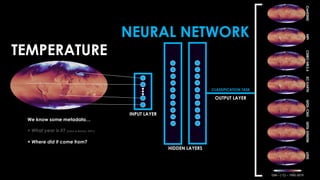
+ Where did it come from?
NEURAL NETWORK
CLASSIFICATION TASK
HIDDEN LAYERS
INPUT LAYER
INPUT LAYER
OUTPUT LAYER
HIDDEN LAYERS
CLIMATE MODEL
MAP
[DATA]
Machine
Learning
CLASSIFICATION
CLASSIFICATION
Machine
Learning
CLIMATE MODEL
MAP
[DATA]
CLASSIFICATION
Machine
Learning
CLIMATE MODEL
MAP
[DATA]
Explainable AI
Learn new
science!
WHY
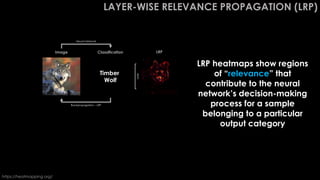
LAYER-WISE RELEVANCE PROPAGATION (LRP)
Volcano
Timber
Wolf
Image Classification LRP
LRP heatmaps show regions
of “relevance” that
contribute to the neural
network’s decision-making
process for a sample
belonging to a particular
output category
Neural Network
WHY
Backpropagation – LRP
https://heatmapping.org/
WHY
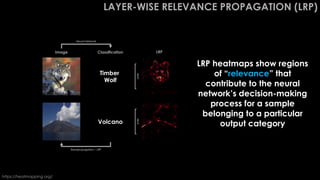
LAYER-WISE RELEVANCE PROPAGATION (LRP)
Volcano
Timber
Wolf
Image Classification LRP
LRP heatmaps show regions
of “relevance” that
contribute to the neural
network’s decision-making
process for a sample
belonging to a particular
output category
Neural Network
WHY
Backpropagation – LRP
https://heatmapping.org/
EXPLAINABLE AI (XAI)
THERE ARE MANY
METHODS
A bird!
XAI
[Adapted from Adebayo et al., 2020]
THERE ARE MANY
METHODS
EXPLAINABLE AI (XAI)
[Adapted from Adebayo et al., 2020]
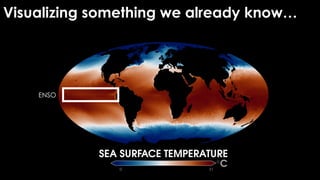
Visualizing something we already know…
ENSO
Neural
Network
[0] La Niña [1] El Niño
Input a map of sea surface temperatures
[Toms et al. 2020, JAMES]
Visualizing something we already know…
Input maps of sea surface
temperatures (SST) to
identify El Niño or La Niña
Use ‘LRP’ to see how the
neural network is making
its decision
[Toms et al. 2020, JAMES]
Layer-wise Relevance Propagation
Composite SST Observations
LRP [Relevance]
SST Anomaly [°C]
0.00 0.75
0.0 1.5
-1.5
Warmer
Colder
High
Low
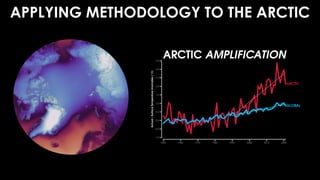
APPLYING METHODOLOGY TO THE ARCTIC
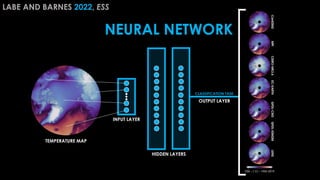
NEURAL NETWORK
CLASSIFICATION TASK
HIDDEN LAYERS
INPUT LAYER
OUTPUT LAYER
TEMPERATURE MAP
LABE AND BARNES 2022, ESS
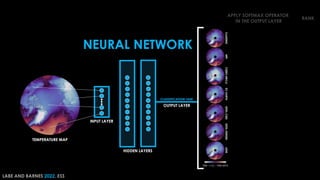
APPLY SOFTMAX OPERATOR
IN THE OUTPUT LAYER
RANK
LABE AND BARNES 2022, ESS
APPLY SOFTMAX OPERATOR
IN THE OUTPUT LAYER
[ 0.71 ]
[ 0.05 ]
[ 0.01 ]
[ 0.01 ]
[ 0.03 ]
[ 0.11 ]
[ 0.08 ]
RANK
LABE AND BARNES 2022, ESS
APPLY SOFTMAX OPERATOR
IN THE OUTPUT LAYER
[ 0.71 ]
[ 0.05 ]
[ 0.01 ]
[ 0.01 ]
[ 0.03 ]
[ 0.11 ]
[ 0.08 ]
RANK
[ 1 ]
[ 4 ]
[ 7 ]
[ 6 ]
[ 5 ]
[ 2 ]
[ 3 ]
LABE AND BARNES 2022, ESS
APPLY SOFTMAX OPERATOR
IN THE OUTPUT LAYER
[ 0.71 ]
[ 0.05 ]
[ 0.01 ]
[ 0.01 ]
[ 0.03 ]
[ 0.11 ]
[ 0.08 ]
RANK
[ 1 ]
[ 4 ]
[ 7 ]
[ 6 ]
[ 5 ]
[ 2 ]
[ 3 ]
Confidence/Probability
LABE AND BARNES 2022, ESS
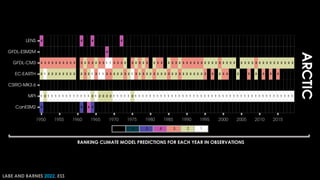
RANKING CLIMATE MODEL PREDICTIONS FOR EACH YEAR IN OBSERVATIONS
LABE AND BARNES 2022, ESS
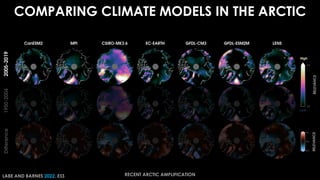
COMPARING CLIMATE MODELS IN THE ARCTIC
High
Low
RECENT ARCTIC AMPLIFICATION
LABE AND BARNES 2022, ESS
High
Low
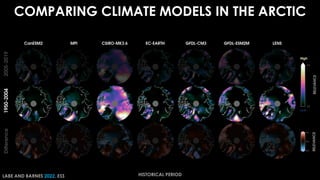
HISTORICAL PERIOD
COMPARING CLIMATE MODELS IN THE ARCTIC
LABE AND BARNES 2022, ESS
High
Low
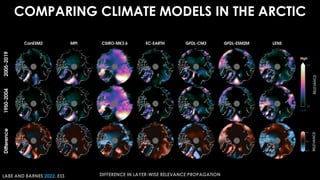
DIFFERENCE IN LAYER-WISE RELEVANCE PROPAGATION
COMPARING CLIMATE MODELS IN THE ARCTIC
LABE AND BARNES 2022, ESS
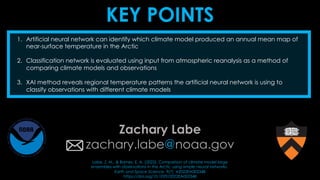
KEY POINTS
1. Artificial neural network can identify which climate model produced an annual mean map of
near-surface temperature in the Arctic
2. Classification network is evaluated using input from atmospheric reanalysis as a method of
comparing climate models and observations
3. XAI method reveals regional temperature patterns the artificial neural network is using to
classify observations with different climate models
Zachary Labe
zachary.labe@noaa.gov
Labe, Z. M., & Barnes, E. A. (2022). Comparison of climate model large
ensembles with observations in the Arctic using simple neural networks.
Earth and Space Science, 9(7), e2022EA002348
https://doi.org/10.1029/2022EA002348

Explainable AI approach for evaluating climate models in the Arctic

  • 1.
    Explainable AI approachfor evaluating climate models in the Arctic Zachary M. Labe Postdoc at NOAA GFDL and Princeton University; Atmospheric and Oceanic Science with Elizabeth A. Barnes (Colorado State University) 27 March 2024 IARPC Collaborations Modelers’ Community of Practice https://zacklabe.com/ @ZLabe
  • 2.
  • 4.
    STANDARD EVALUATION OF CLIMATEMODELS Pattern correlation RMSE EOFs Trends, anomalies, mean state Climate modes of variability Negative Correlation Positive Correlation PATTERN CORRELATION – T2M PATTERN CORRELATION : NEAR-SURFACE AIR TEMPERATURE
  • 5.
    INPUT PREDICTION SO, WHATABOUT MACHINE LEARNING?
  • 6.
    Machine Learning is notnew! “A Bayesian Neural Network for Severe-Hail Prediction (2000)” “Classification of Convective Areas Using Decision Trees (2009)” “A Neural Network for Damaging Wind Prediction (1998)” “Generative Additive Models versus Linear Regression in Generating Probabilistic MOS Forecasts of Aviation Weather Parameters (1995)” ”A Neural Network for Tornado Prediction Based on Doppler Radar-Derived Attributes (1996)” ”The Diagnosis of Upper-Level Humidity (1968)”
  • 7.
    Do it better e.g.,parameterizations in climate models are not perfect, use ML to make them more accurate Do it faster e.g., code in climate models is very slow (but we know the right answer) - use ML methods to speed things up Do something new • e.g., go looking for non-linear relationships you didn’t know were there WHY ELSE SHOULD WE CONSIDER MACHINE LEARNING?
  • 8.
    Do it better e.g.,parameterizations in climate models are not perfect, use ML to make them more accurate Do it faster e.g., code in climate models is very slow (but we know the right answer) - use ML methods to speed things up Do something new • e.g., go looking for non-linear relationships you didn’t know were there WHY ELSE SHOULD WE CONSIDER MACHINE LEARNING? Very relevant for research: may be slower and worse, but can still learn something
  • 9.
    What is theannual mean temperature of Earth?
  • 10.
    THE REAL WORLD (Observations) Whatis the annual mean temperature of Earth? Data from Berkeley Earth Surface Temperature 1930 2022
  • 11.
    What is theannual mean temperature of Earth? THE REAL WORLD (Observations) Let’s run a climate model One ensemble member 2022 1930 2050 Data from NO AA/G FDL SPEAR
  • 12.
    What is theannual mean temperature of Earth? THE REAL WORLD (Observations) Let’s run a climate model again! Two ensemble members Data from NO AA/G FDL SPEAR
  • 13.
    What is theannual mean temperature of Earth? THE REAL WORLD (Observations) Let’s run a climate model again & again! Three ensemble members Data from NO AA/G FDL SPEAR
  • 14.
    What is theannual mean temperature of Earth? THE REAL WORLD (Observations) CLIMATE MODEL LARGE ENSEMBLE 30 ensemble members in NOAA/GFDL SPEAR
  • 15.
    What is theannual mean temperature of Earth? Mean of ensembles = forced response (climate change) THE REAL WORLD (Observations) CLIMATE MODEL LARGE ENSEMBLE 30 ensemble members In GFDL SPEAR
  • 16.
    What is theannual mean temperature of Earth? Mean of ensembles = forced response (climate change) THE REAL WORLD (Observations) CLIMATE MODEL LARGE ENSEMBLE 30 ensemble members In GFDL SPEAR Range of ensembles = internal variability (noise) Mean of ensembles = forced response (climate change)
  • 17.
    But let’s remove climatechange… Climate Change Signal (ensemble mean) Observations Ensemble Members
  • 18.
    Ensemble Members Mean of anomalies After removingthe forced response… = anomalies/noise!
  • 19.
    Ensemble members in GFDL SPEAR Mapsof a given time period for each ensemble Inputs for machine learning
  • 20.
    Ensemble members in GFDL SPEAR TrainingData: 24 ensemble members Maps of a given time period for each ensemble
  • 21.
    Training Data: 24 ensemblemembers Validation Data: 4 ensemble members
  • 22.
    Training Data: 24 ensemblemembers Validation Data: 4 ensemble members Testing Data: 2 ensemble members
  • 23.
    2-m Actual AirTemperature (°C) THERE ARE MANY CLIMATE MODEL LARGE ENSEMBLES… Annual mean 2-m temperature 7 global climate models 16 ensembles each ERA5 (observations)
  • 24.
  • 25.
    ----ANN---- 2 Hidden Layers 10Nodes each Ridge Regularization Early Stopping TEMPERATURE We know some metadata… + What year is it? (Labe & Barnes, 2021) + Where did it come from?
  • 26.
    TEMPERATURE We know somemetadata… + What year is it? (Labe & Barnes, 2021) + Where did it come from? Train on data from the Multi-Model Large Ensemble Archive
  • 27.
    TEMPERATURE We know somemetadata… + What year is it? (Labe & Barnes, 2021) + Where did it come from? NEURAL NETWORK CLASSIFICATION TASK HIDDEN LAYERS INPUT LAYER INPUT LAYER OUTPUT LAYER HIDDEN LAYERS
  • 28.
  • 29.
  • 30.
  • 31.
    WHY LAYER-WISE RELEVANCE PROPAGATION(LRP) Volcano Timber Wolf Image Classification LRP LRP heatmaps show regions of “relevance” that contribute to the neural network’s decision-making process for a sample belonging to a particular output category Neural Network WHY Backpropagation – LRP https://heatmapping.org/
  • 32.
    WHY LAYER-WISE RELEVANCE PROPAGATION(LRP) Volcano Timber Wolf Image Classification LRP LRP heatmaps show regions of “relevance” that contribute to the neural network’s decision-making process for a sample belonging to a particular output category Neural Network WHY Backpropagation – LRP https://heatmapping.org/
  • 33.
    EXPLAINABLE AI (XAI) THEREARE MANY METHODS A bird! XAI [Adapted from Adebayo et al., 2020]
  • 34.
    THERE ARE MANY METHODS EXPLAINABLEAI (XAI) [Adapted from Adebayo et al., 2020]
  • 35.
    Visualizing something wealready know… ENSO
  • 36.
    Neural Network [0] La Niña[1] El Niño Input a map of sea surface temperatures [Toms et al. 2020, JAMES]
  • 37.
    Visualizing something wealready know… Input maps of sea surface temperatures (SST) to identify El Niño or La Niña Use ‘LRP’ to see how the neural network is making its decision [Toms et al. 2020, JAMES] Layer-wise Relevance Propagation Composite SST Observations LRP [Relevance] SST Anomaly [°C] 0.00 0.75 0.0 1.5 -1.5 Warmer Colder High Low
  • 38.
  • 39.
    NEURAL NETWORK CLASSIFICATION TASK HIDDENLAYERS INPUT LAYER OUTPUT LAYER TEMPERATURE MAP LABE AND BARNES 2022, ESS
  • 40.
    APPLY SOFTMAX OPERATOR INTHE OUTPUT LAYER RANK LABE AND BARNES 2022, ESS
  • 41.
    APPLY SOFTMAX OPERATOR INTHE OUTPUT LAYER [ 0.71 ] [ 0.05 ] [ 0.01 ] [ 0.01 ] [ 0.03 ] [ 0.11 ] [ 0.08 ] RANK LABE AND BARNES 2022, ESS
  • 42.
    APPLY SOFTMAX OPERATOR INTHE OUTPUT LAYER [ 0.71 ] [ 0.05 ] [ 0.01 ] [ 0.01 ] [ 0.03 ] [ 0.11 ] [ 0.08 ] RANK [ 1 ] [ 4 ] [ 7 ] [ 6 ] [ 5 ] [ 2 ] [ 3 ] LABE AND BARNES 2022, ESS
  • 43.
    APPLY SOFTMAX OPERATOR INTHE OUTPUT LAYER [ 0.71 ] [ 0.05 ] [ 0.01 ] [ 0.01 ] [ 0.03 ] [ 0.11 ] [ 0.08 ] RANK [ 1 ] [ 4 ] [ 7 ] [ 6 ] [ 5 ] [ 2 ] [ 3 ] Confidence/Probability LABE AND BARNES 2022, ESS
  • 44.
    RANKING CLIMATE MODELPREDICTIONS FOR EACH YEAR IN OBSERVATIONS LABE AND BARNES 2022, ESS
  • 45.
    COMPARING CLIMATE MODELSIN THE ARCTIC High Low RECENT ARCTIC AMPLIFICATION LABE AND BARNES 2022, ESS
  • 46.
    High Low HISTORICAL PERIOD COMPARING CLIMATEMODELS IN THE ARCTIC LABE AND BARNES 2022, ESS
  • 47.
    High Low DIFFERENCE IN LAYER-WISERELEVANCE PROPAGATION COMPARING CLIMATE MODELS IN THE ARCTIC LABE AND BARNES 2022, ESS
  • 48.
    KEY POINTS 1. Artificialneural network can identify which climate model produced an annual mean map of near-surface temperature in the Arctic 2. Classification network is evaluated using input from atmospheric reanalysis as a method of comparing climate models and observations 3. XAI method reveals regional temperature patterns the artificial neural network is using to classify observations with different climate models Zachary Labe zachary.labe@noaa.gov Labe, Z. M., & Barnes, E. A. (2022). Comparison of climate model large ensembles with observations in the Arctic using simple neural networks. Earth and Space Science, 9(7), e2022EA002348 https://doi.org/10.1029/2022EA002348