A new Lagrangian model of the sea ice and
related issues for data assimilation
Alberto Carrassi
C. Guider and C.K.R.T. Jones
M. Rabatel, P. Rampal,
L. Bertino and Ali Aydogdu
Outline
1. Why a different treatment of the sea-ice mechanics?
2. A novel solid/elastic Lagrangian sea-ice model
3. Issues related to the design of data assimilation methods
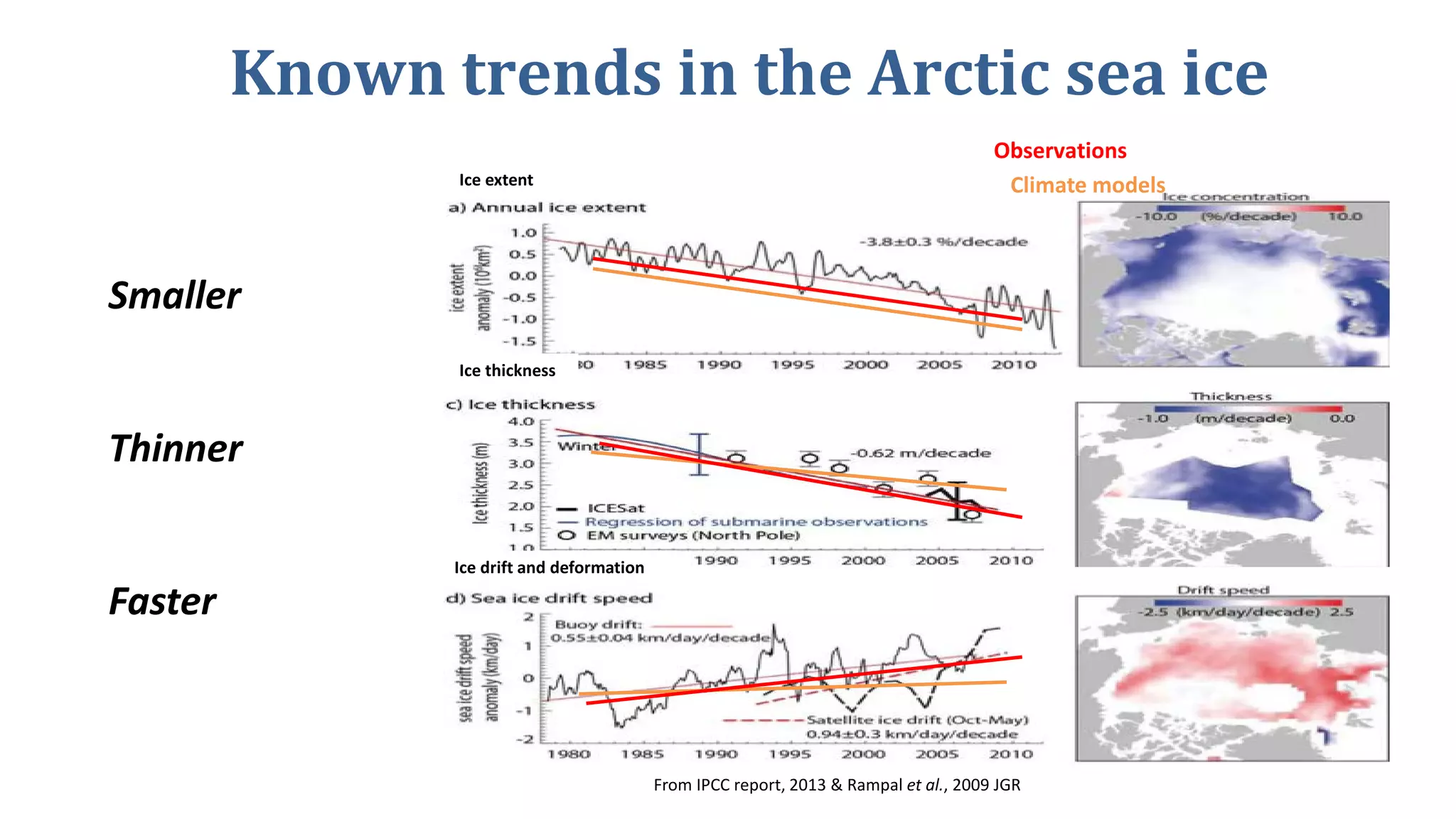
Known trends in the Arctic sea ice
From IPCC report, 2013 & Rampal et al., 2009 JGR
Ice extent
Ice thickness
Ice drift and deformation
Climate models
Observations
Smaller
Thinner
Faster
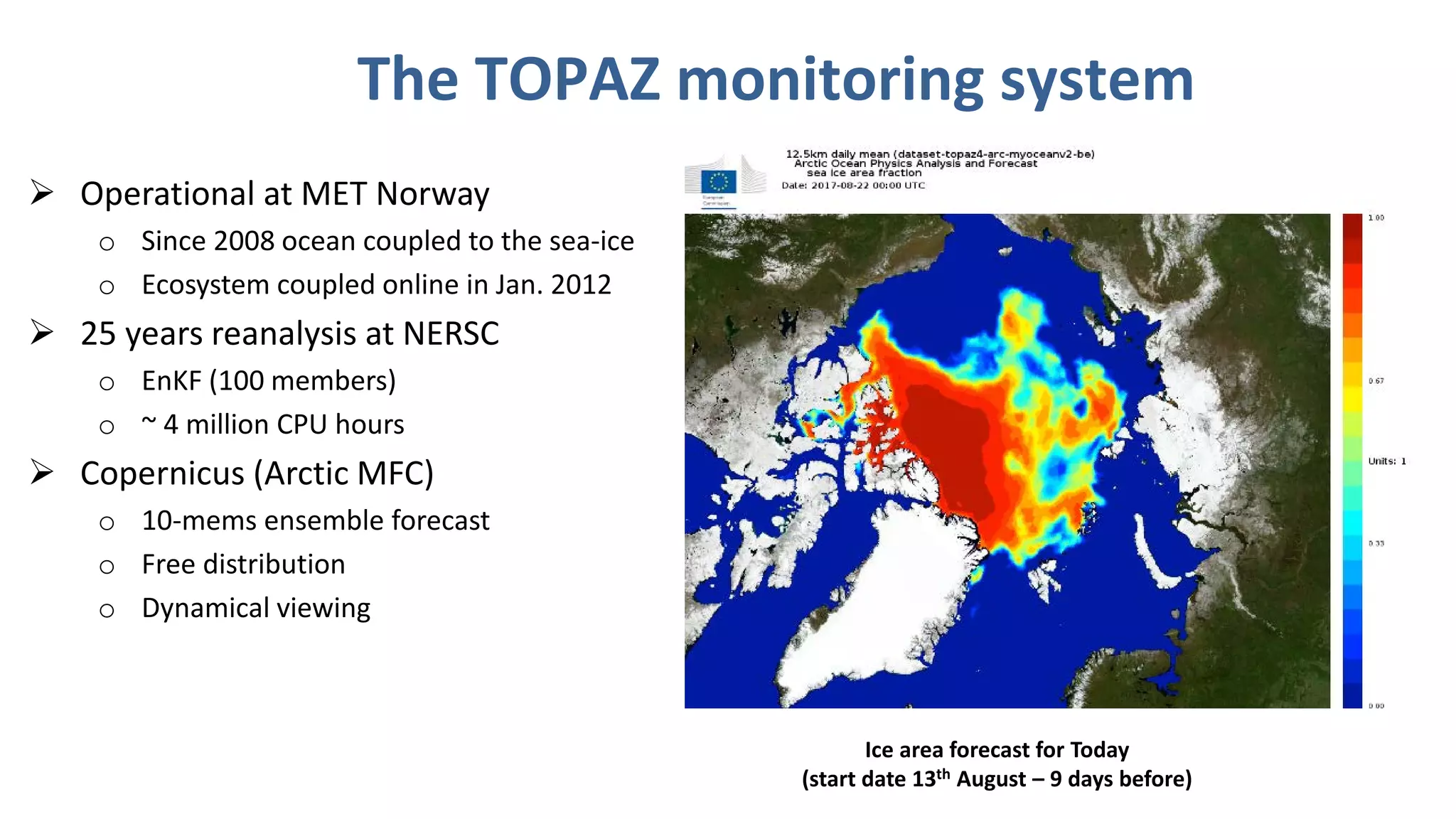
The TOPAZ monitoring system
 Operational at MET Norway
o Since 2008 ocean coupled to the sea-ice
o Ecosystem coupled online in Jan. 2012
 25 years reanalysis at NERSC
o EnKF (100 members)
o ~ 4 million CPU hours
 Copernicus (Arctic MFC)
o 10-mems ensemble forecast
o Free distribution
o Dynamical viewing
Ice area forecast for Today
(start date 13th August – 9 days before)
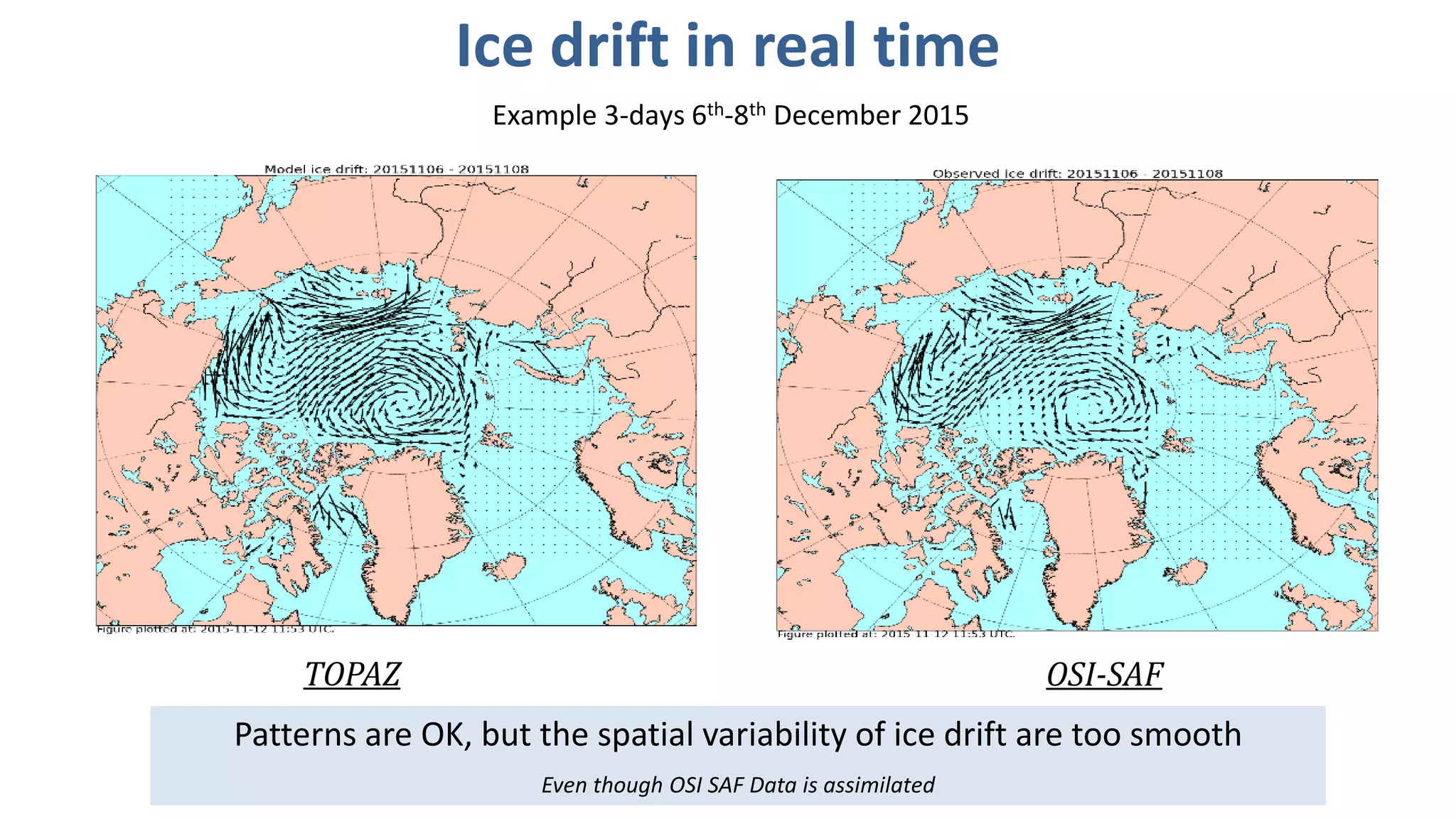
Ice drift in real time
TOPAZ OSI-SAF
Example 3-days 6th-8th December 2015
Patterns are OK, but the spatial variability of ice drift are too smooth
Even though OSI SAF Data is assimilated
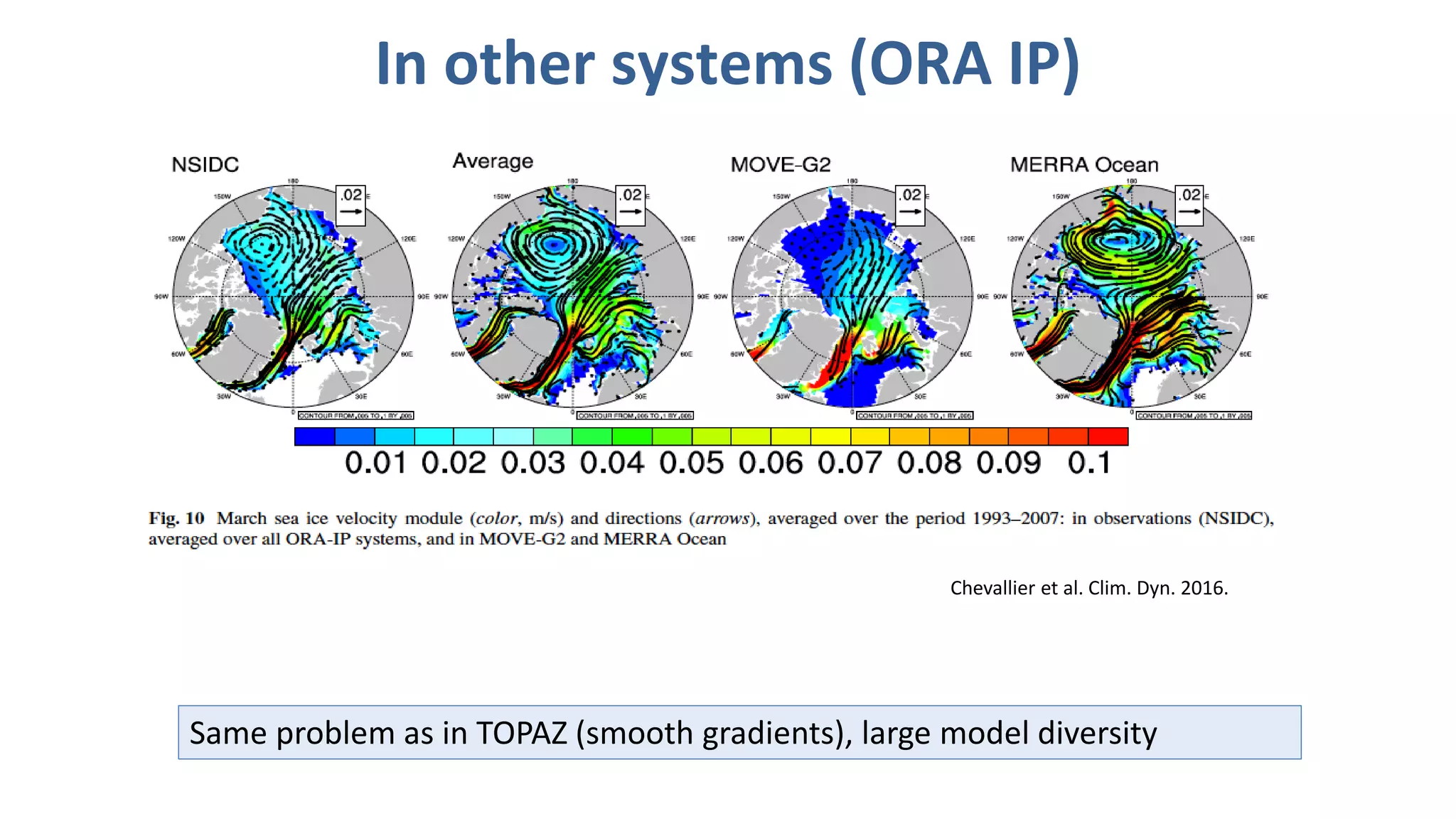
In other systems (ORA IP)
Same problem as in TOPAZ (smooth gradients), large model diversity
Chevallier et al. Clim. Dyn. 2016.
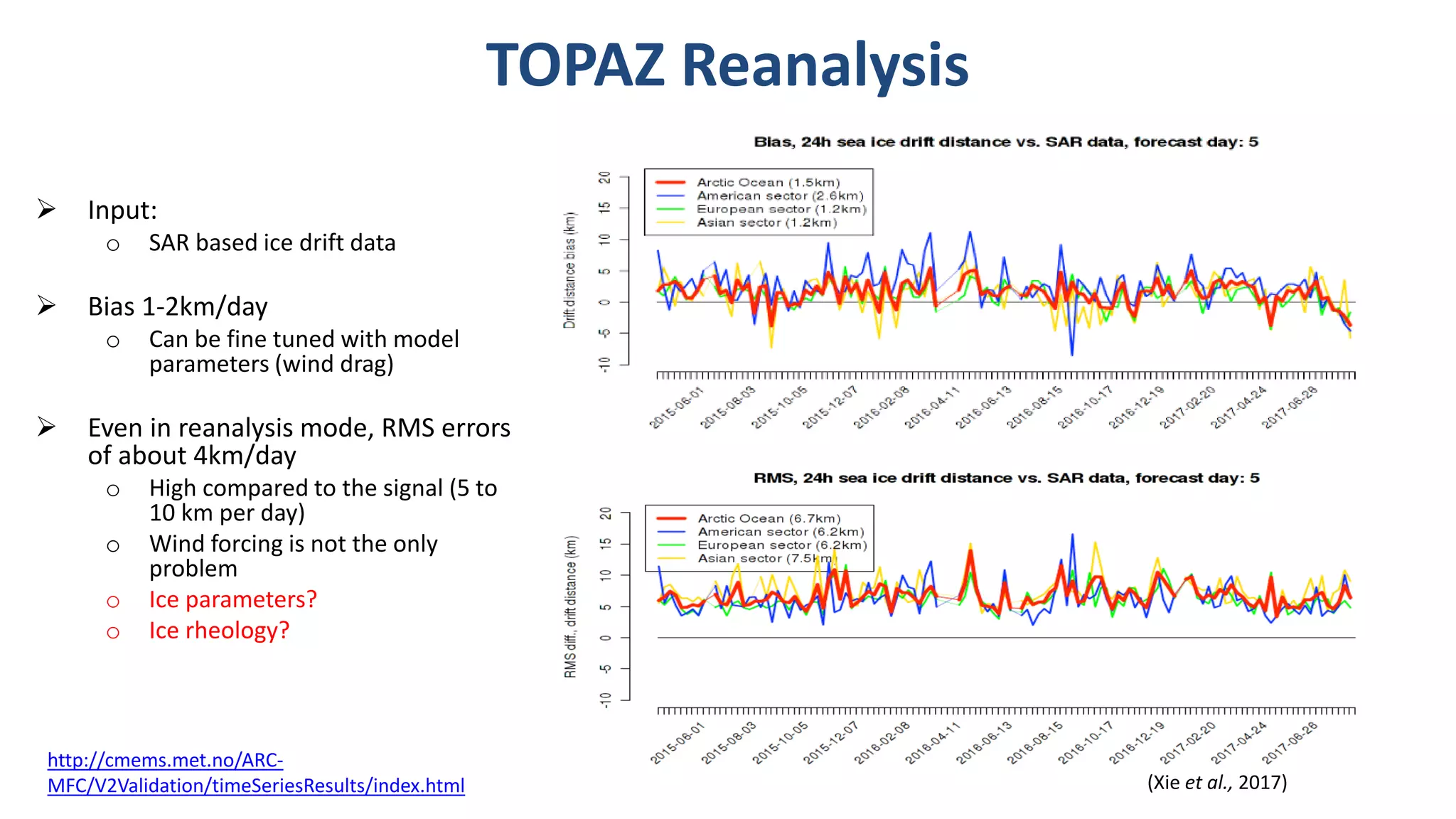
TOPAZ Reanalysis
 Input:
o SAR based ice drift data
 Bias 1-2km/day
o Can be fine tuned with model
parameters (wind drag)
 Even in reanalysis mode, RMS errors
of about 4km/day
o High compared to the signal (5 to
10 km per day)
o Wind forcing is not the only
problem
o Ice parameters?
o Ice rheology?
http://cmems.met.no/ARC-
MFC/V2Validation/timeSeriesResults/index.html (Xie et al., 2017)
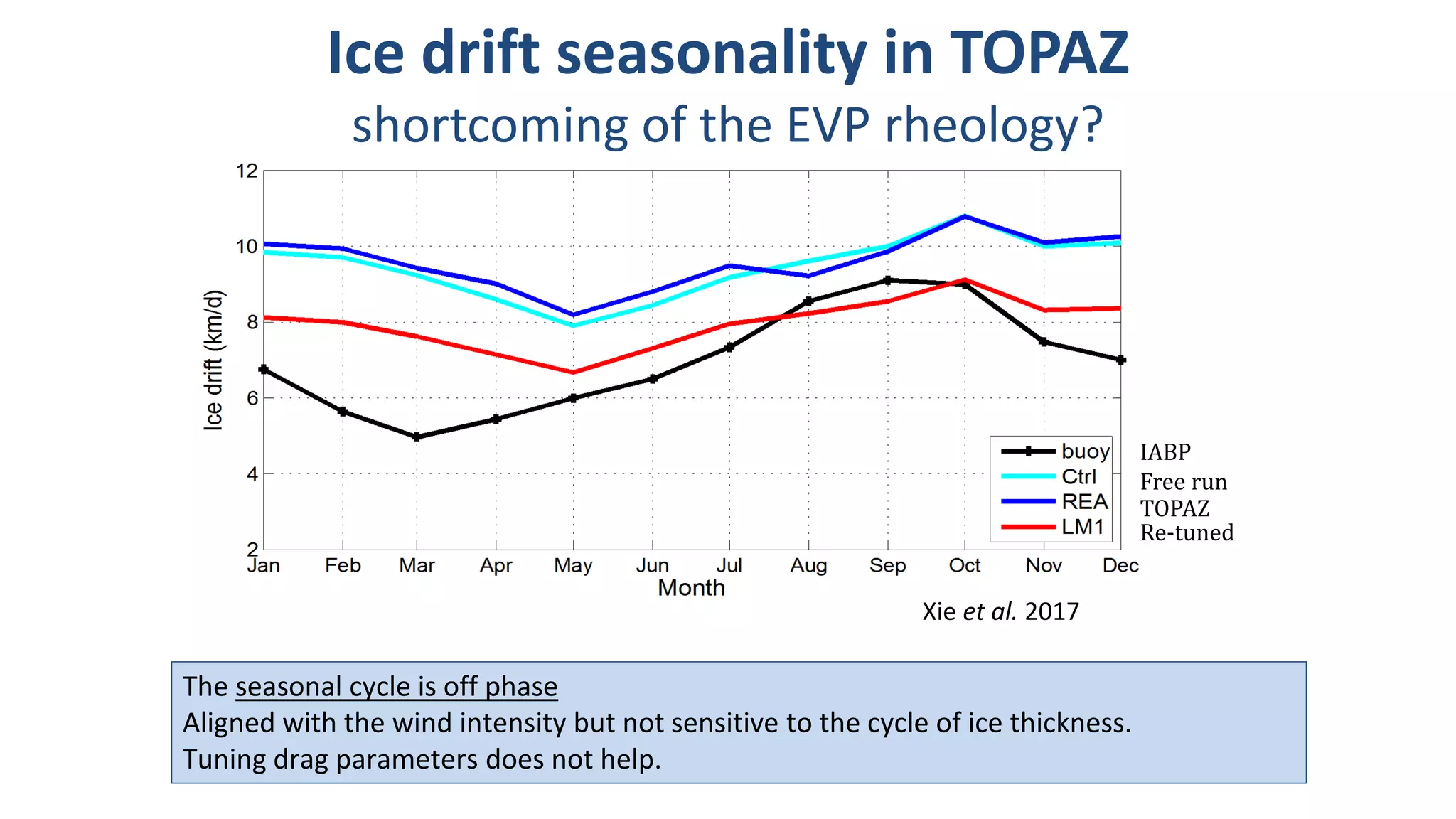
Ice drift seasonality in TOPAZ
shortcoming of the EVP rheology?
The seasonal cycle is off phase
Aligned with the wind intensity but not sensitive to the cycle of ice thickness.
Tuning drag parameters does not help.
IABP
Free run
TOPAZ
Re-tuned
Xie et al. 2017
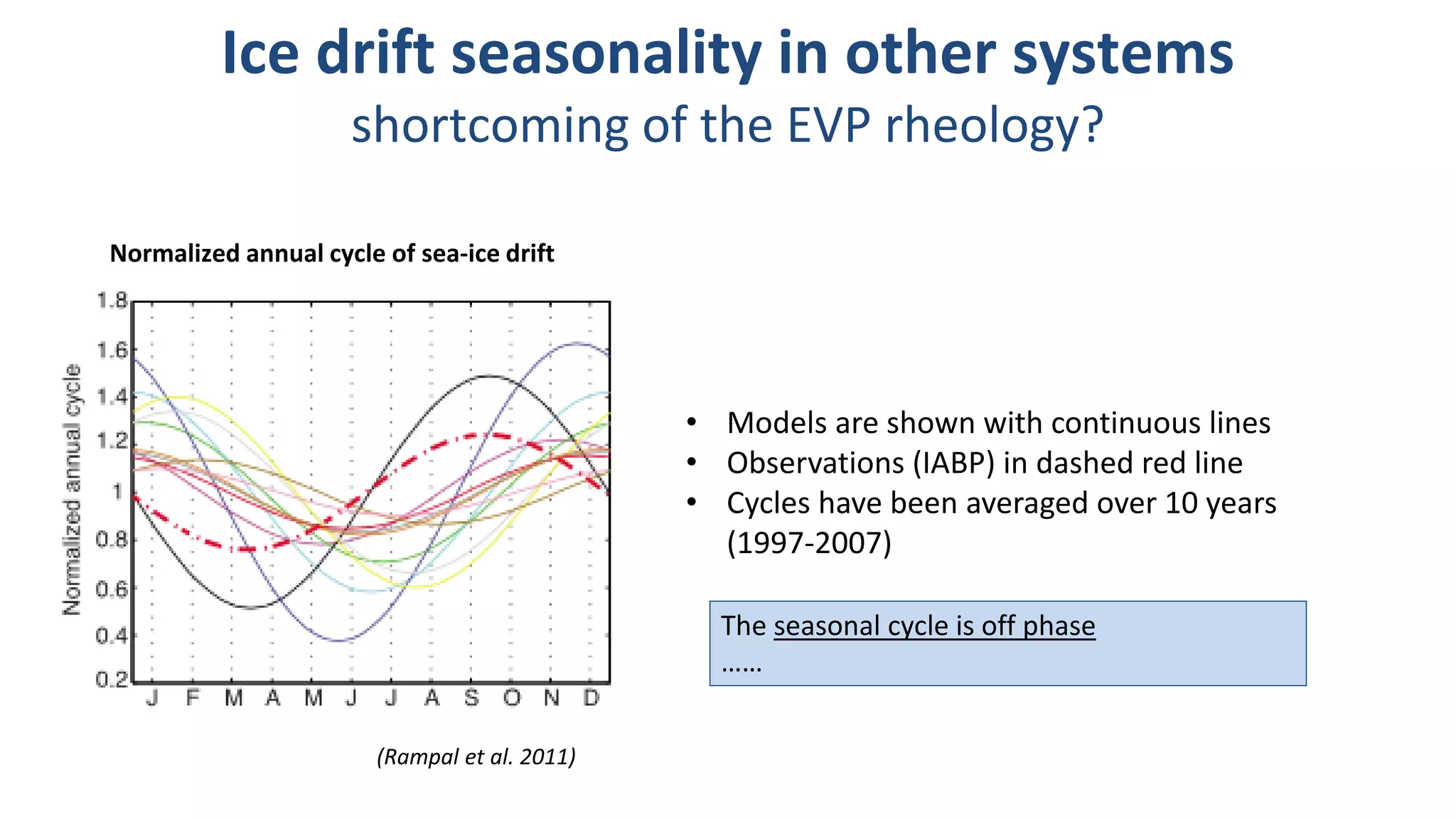
Ice drift seasonality in other systems
shortcoming of the EVP rheology?
(Rampal et al. 2011)
Normalized annual cycle of sea-ice drift
• Models are shown with continuous lines
• Observations (IABP) in dashed red line
• Cycles have been averaged over 10 years
(1997-2007)
The seasonal cycle is off phase
……
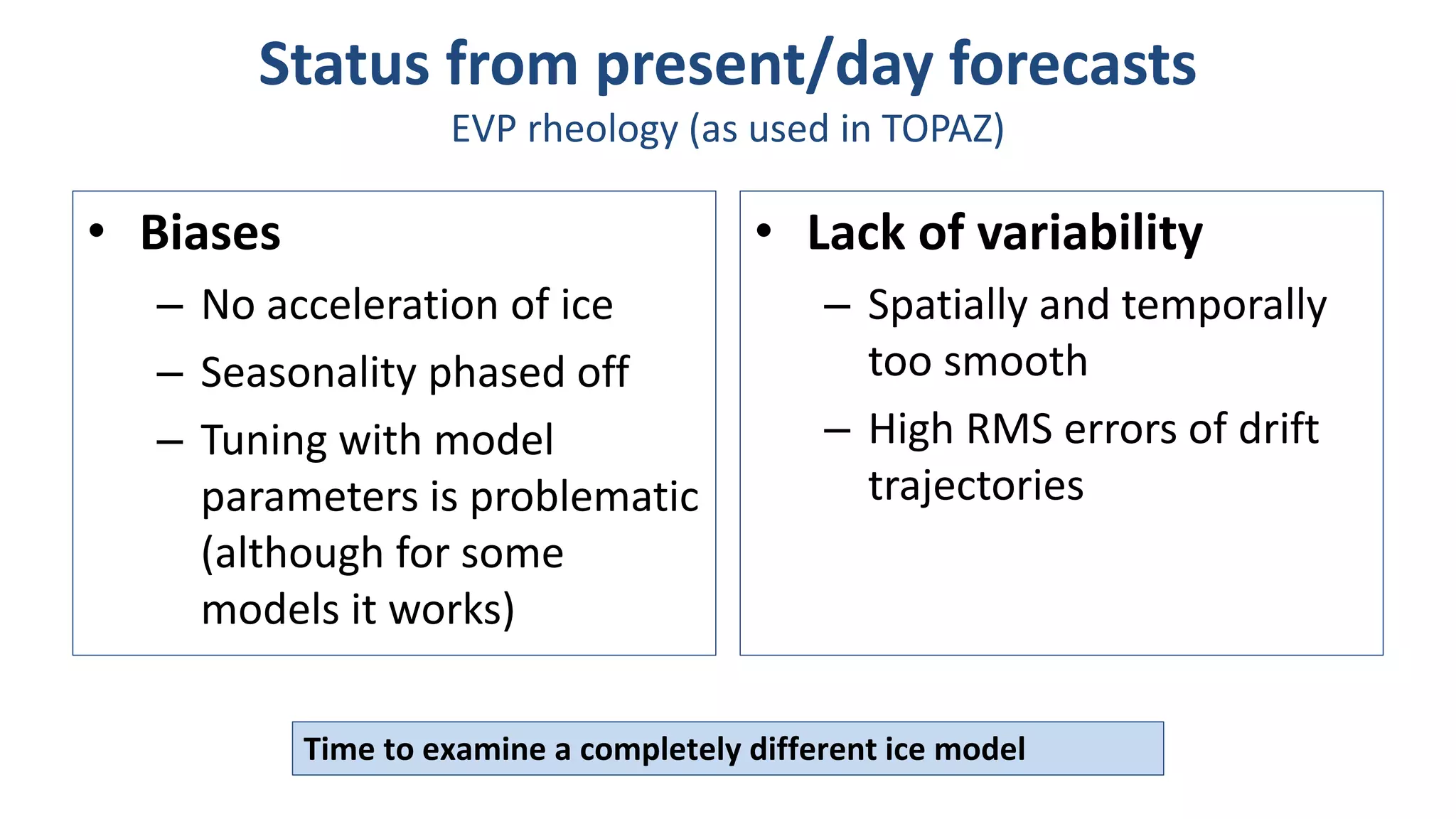
Status from present/day forecasts
EVP rheology (as used in TOPAZ)
• Biases
– No acceleration of ice
– Seasonality phased off
– Tuning with model
parameters is problematic
(although for some
models it works)
• Lack of variability
– Spatially and temporally
too smooth
– High RMS errors of drift
trajectories
Time to examine a completely different ice model
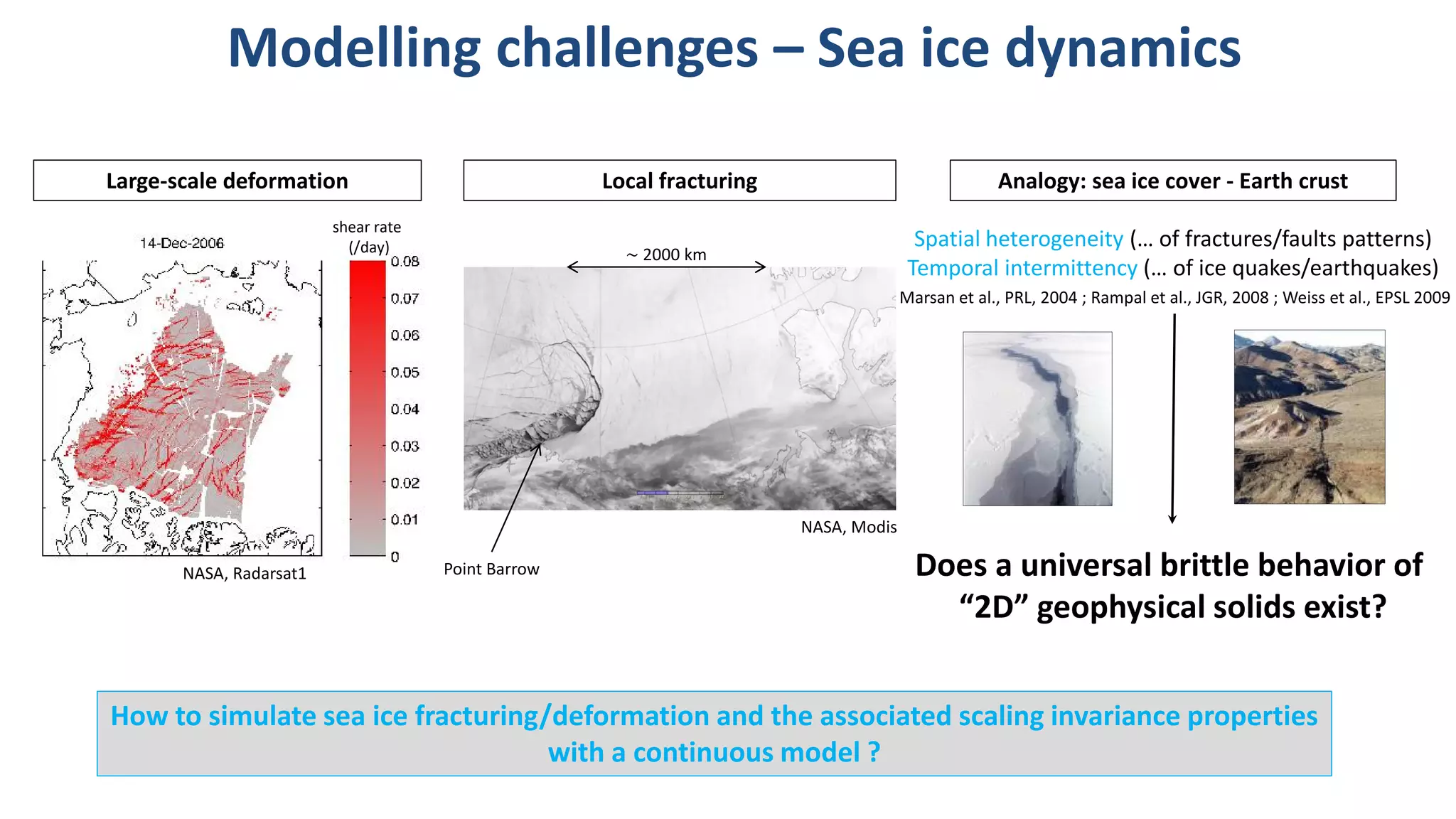
Modelling challenges – Sea ice dynamics
shear rate
(/day)
NASA, Modis
NASA, Radarsat1
How to simulate sea ice fracturing/deformation and the associated scaling invariance properties
with a continuous model ?
Spatial heterogeneity (… of fractures/faults patterns)
Temporal intermittency (… of ice quakes/earthquakes)
Does a universal brittle behavior of
“2D” geophysical solids exist?
Analogy: sea ice cover - Earth crustLarge-scale deformation Local fracturing
Marsan et al., PRL, 2004 ; Rampal et al., JGR, 2008 ; Weiss et al., EPSL 2009
Point Barrow
∼ 2000 km
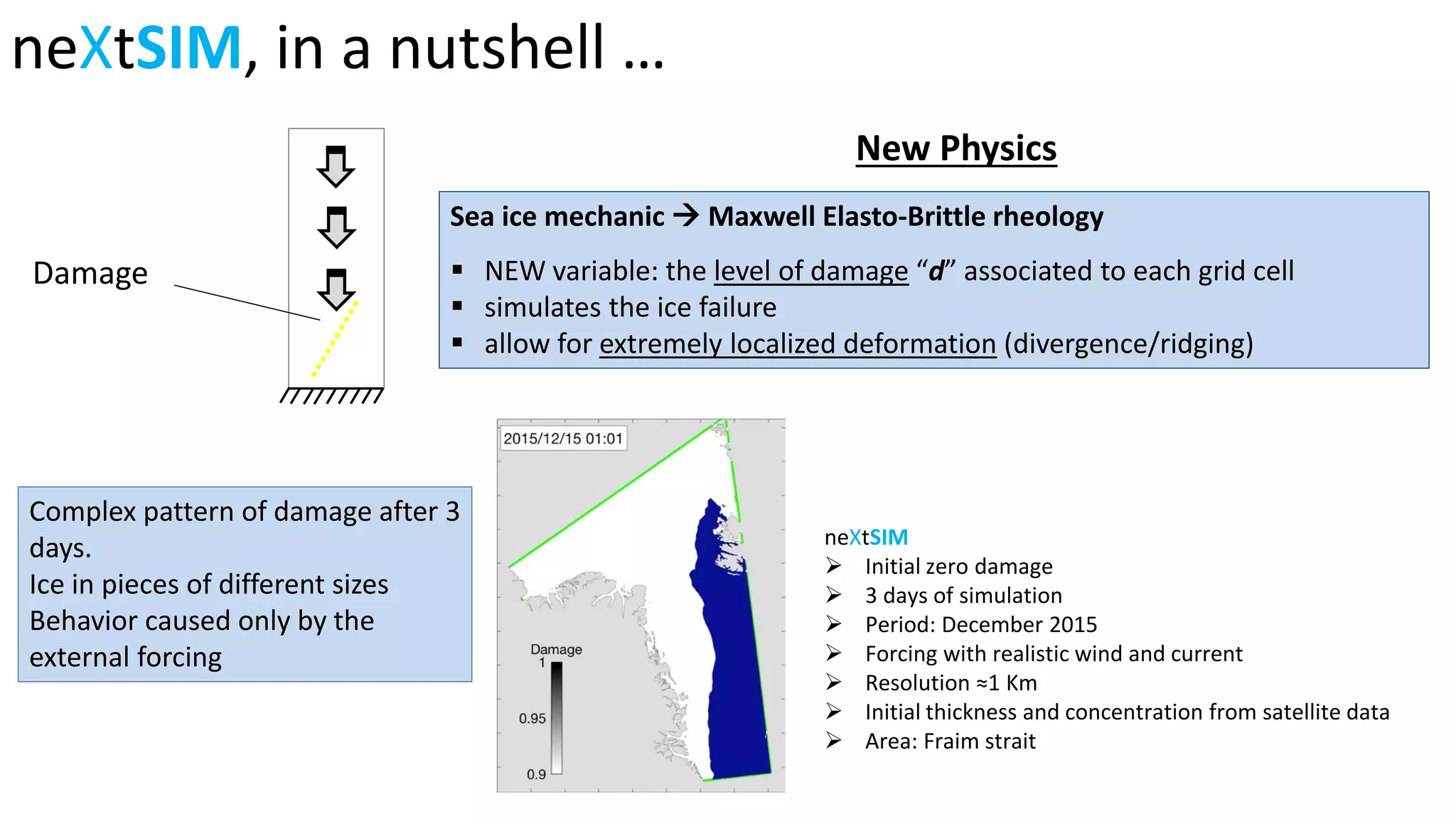
Sea ice mechanic  Maxwell Elasto-Brittle rheology
 NEW variable: the level of damage “d” associated to each grid cell
 simulates the ice failure
 allow for extremely localized deformation (divergence/ridging)
New Physics
neXtSIM, in a nutshell …
Damage
neXtSIM
Initial zero damage
3 days of simulation
Period: December 2015
Forcing with realistic wind and current
Resolution ≈1 Km
Initial thickness and concentration from satellite data
Area: Fraim strait
Complex pattern of damage after 3
days.
Ice in pieces of different sizes
Behavior caused only by the
external forcing
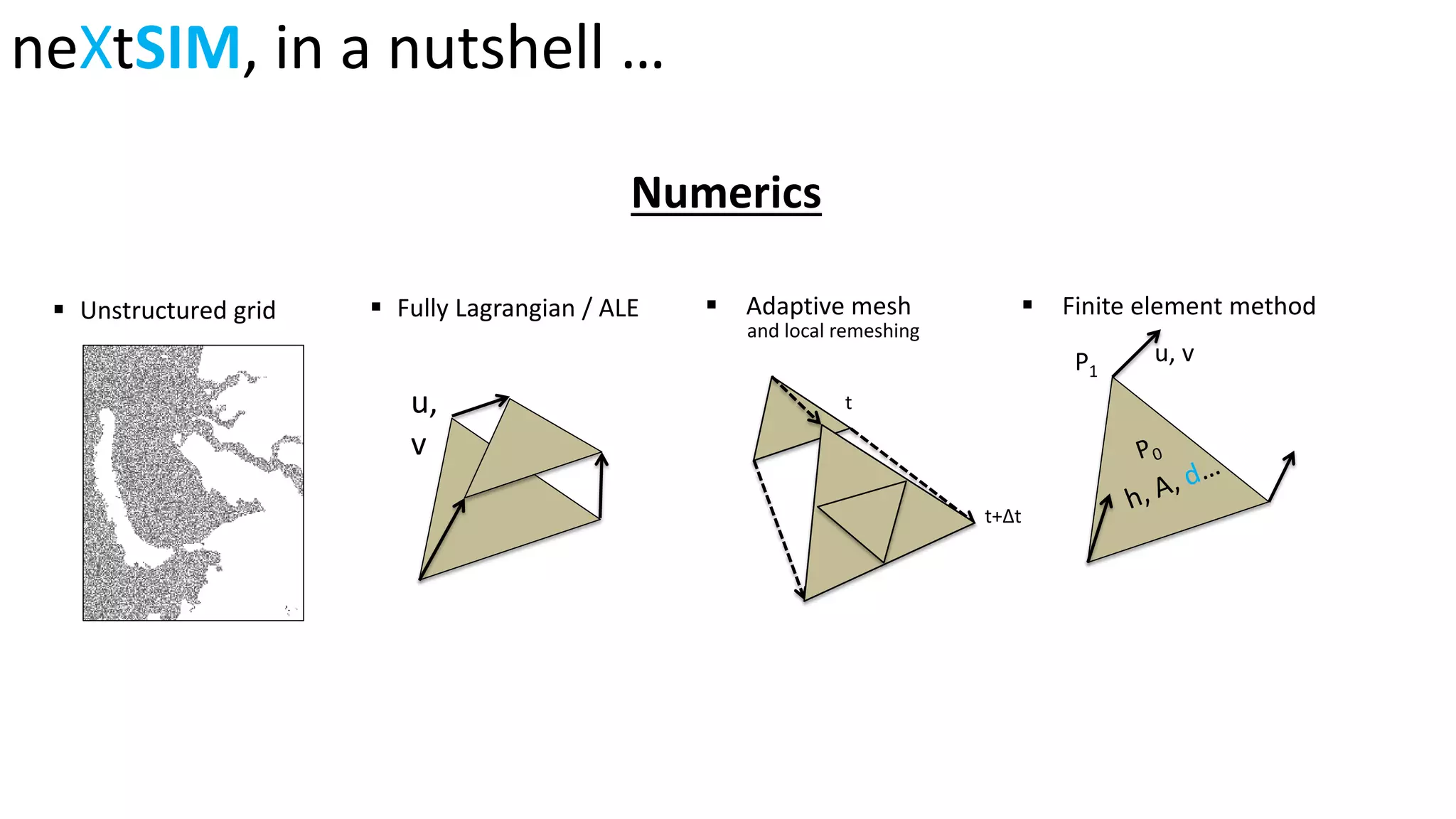
Numerics
 Finite element method
u, vP1
Unstructured grid  Adaptive mesh
and local remeshing
u,
v
 Fully Lagrangian / ALE
t
t+∆t
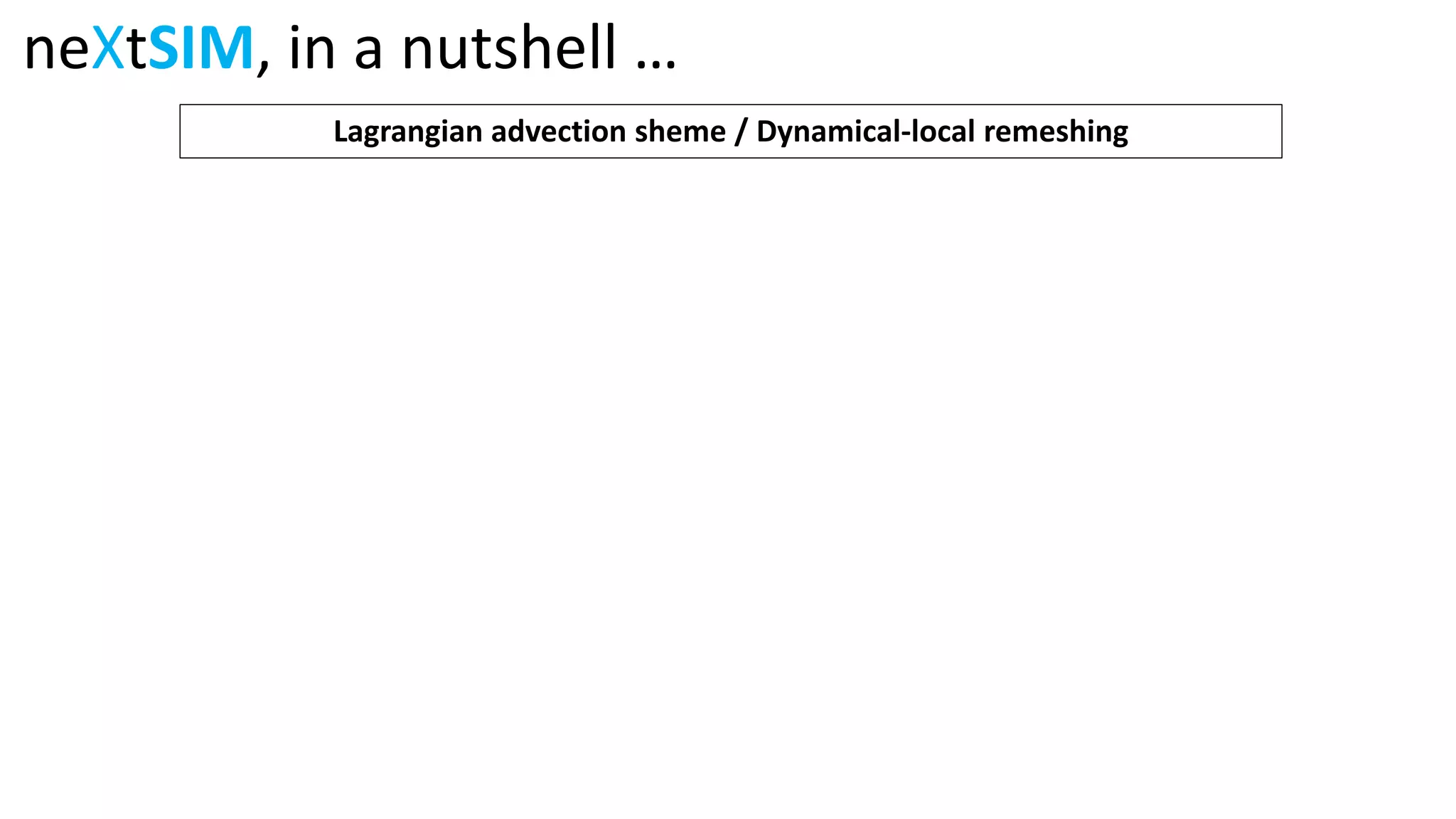
neXtSIM, in a nutshell …
Lagrangian advection sheme / Dynamical-local remeshing
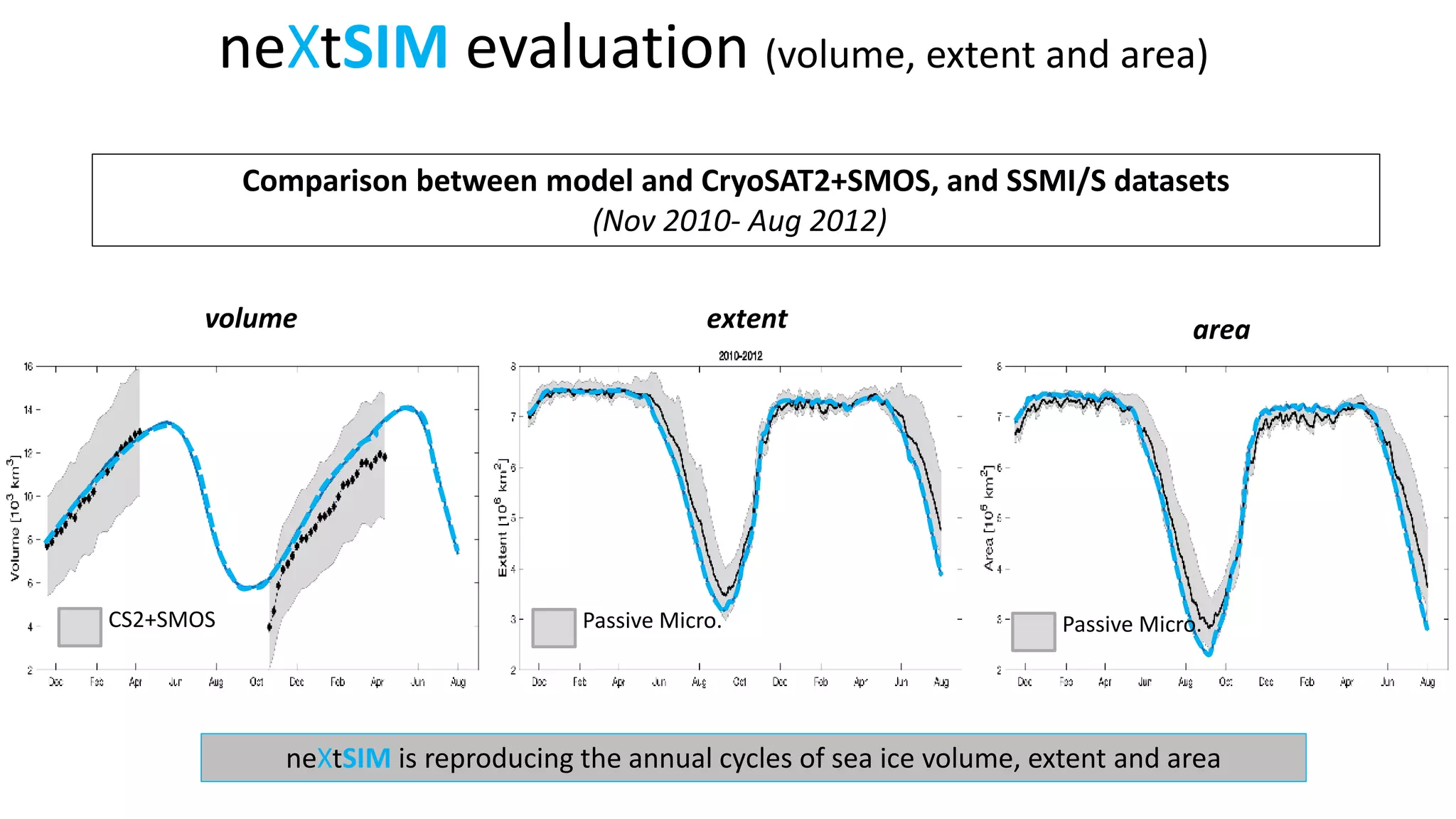
neXtSIM evaluation (volume, extent and area)
neXtSIM is reproducing the annual cycles of sea ice volume, extent and area
Comparison between model and CryoSAT2+SMOS, and SSMI/S datasets
(Nov 2010- Aug 2012)
volume extent area
CS2+SMOS Passive Micro. Passive Micro.
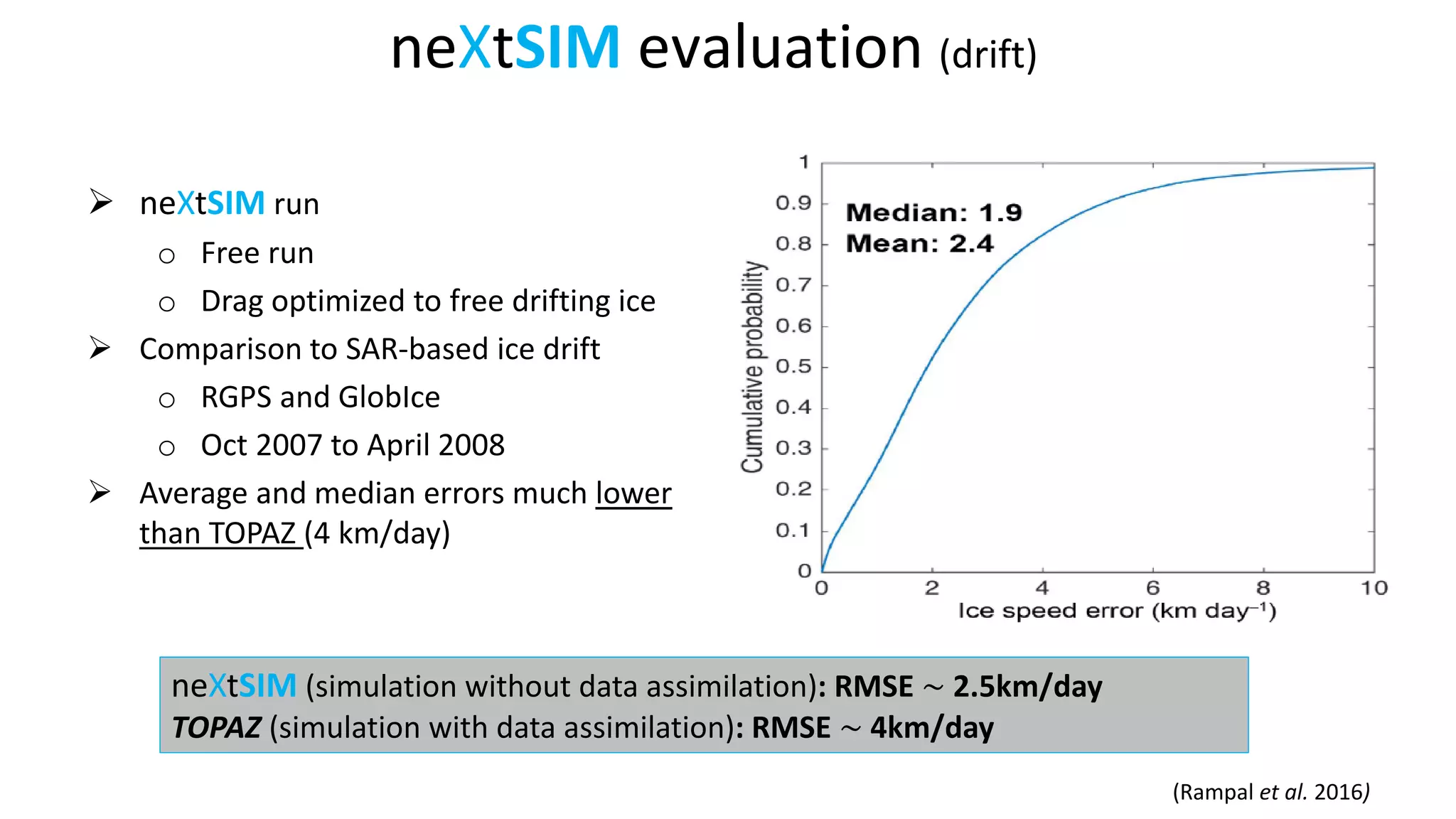
 neXtSIM run
o Free run
o Drag optimized to free drifting ice
 Comparison to SAR-based ice drift
o RGPS and GlobIce
o Oct 2007 to April 2008
 Average and median errors much lower
than TOPAZ (4 km/day)
(Rampal et al. 2016)
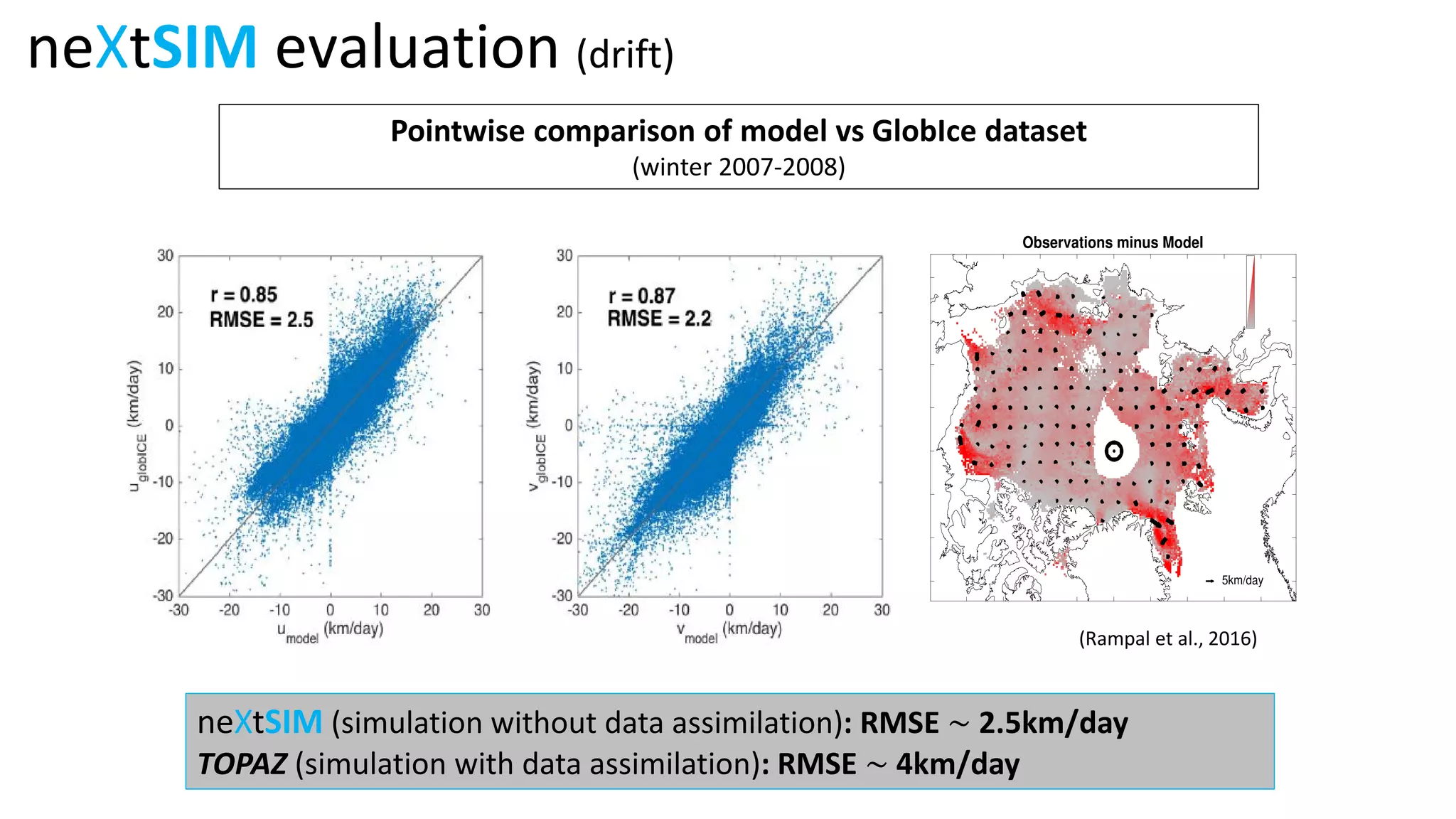
neXtSIM (simulation without data assimilation): RMSE ∼ 2.5km/day
TOPAZ (simulation with data assimilation): RMSE ∼ 4km/day
neXtSIM evaluation (drift)
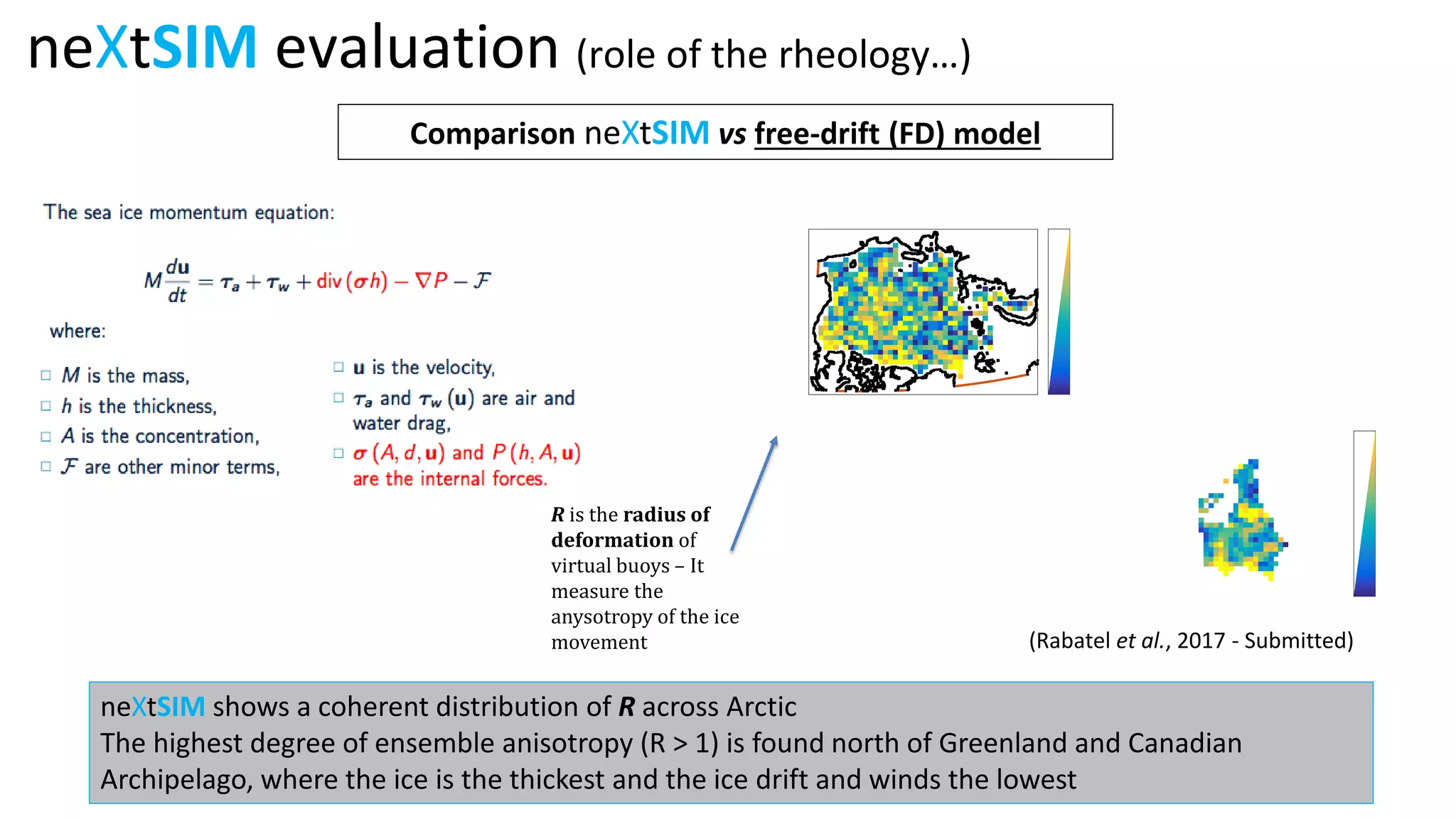
neXtSIM shows a coherent distribution of R across Arctic
The highest degree of ensemble anisotropy (R > 1) is found north of Greenland and Canadian
Archipelago, where the ice is the thickest and the ice drift and winds the lowest
neXtSIM evaluation (role of the rheology…)
Comparison neXtSIM vs free-drift (FD) model
(Rabatel et al., 2017 - Submitted)
R is the radius of
deformation of
virtual buoys – It
measure the
anysotropy of the ice
movement
neXtSIM evaluation (role of the rheology…)
Comparison neXtSIM vs free-drift model
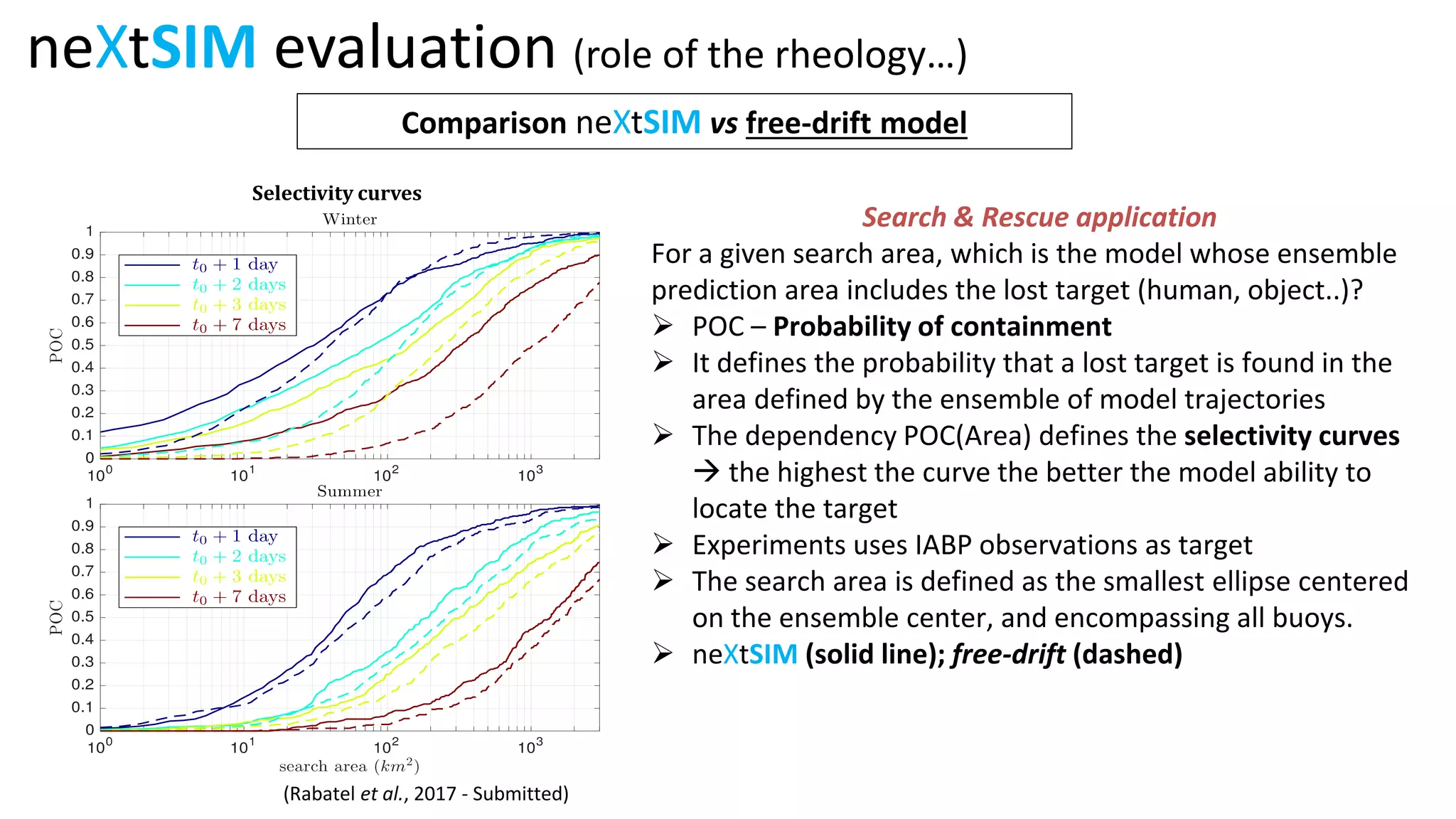
Search & Rescue application
For a given search area, which is the model whose ensemble
prediction area includes the lost target (human, object..)?
POC – Probability of containment
It defines the probability that a lost target is found in the
area defined by the ensemble of model trajectories
The dependency POC(Area) defines the selectivity curves
 the highest the curve the better the model ability to
locate the target
Experiments uses IABP observations as target
The search area is defined as the smallest ellipse centered
on the ensemble center, and encompassing all buoys.
ne XtSIM (solid line); free-drift (dashed)
Selectivity curves
(Rabatel et al., 2017 - Submitted)
Data assimilation with neXtSIM
Issues
 Mesh varies in time
 Remeshing procedure that does not
conserve the total number of elements
 Large computational model with physical
variables at both vertices and centers
 Variety of data types (satellite and in-situ)
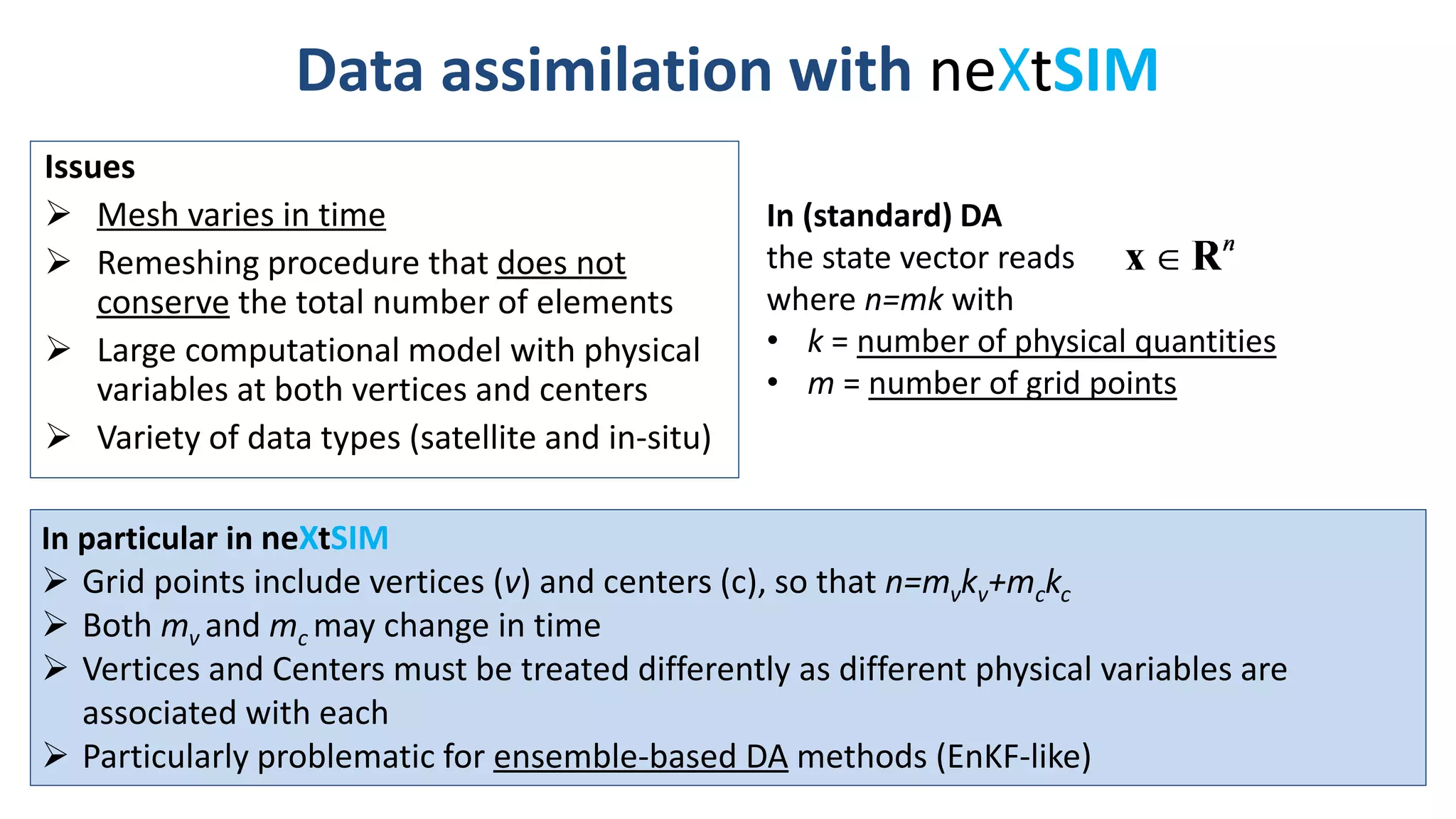
In (standard) DA
the state vector reads
where n=mk with
• k = number of physical quantities
• m = number of grid points
In particular in neXtSIM
 Grid points include vertices (v) and centers (c), so that n=mvkv+mckc
 Both mv and mc may change in time
 Vertices and Centers must be treated differently as different physical variables are
associated with each
 Particularly problematic for ensemble-based DA methods (EnKF-like)
Data assimilation with neXtSIM
Two “proposals”
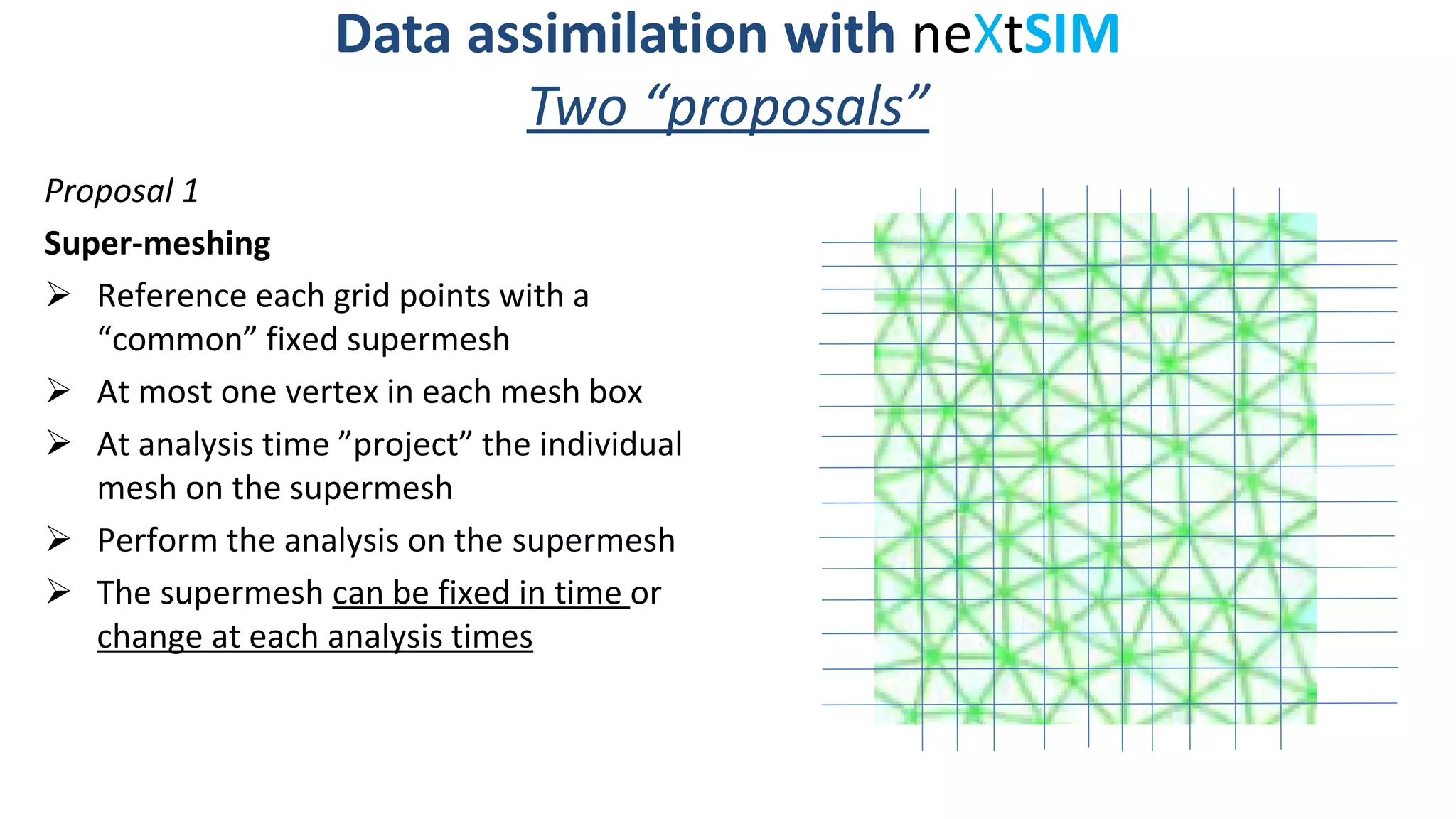
Proposal 1
Super-meshing
Reference each grid points with a
“common” fixed supermesh
At most one vertex in each mesh box
At analysis time ”project” the individual
mesh on the supermesh
Perform the analysis on the supermesh
The supermesh can be fixed in time or
change at each analysis times
Super-meshing
1D-case
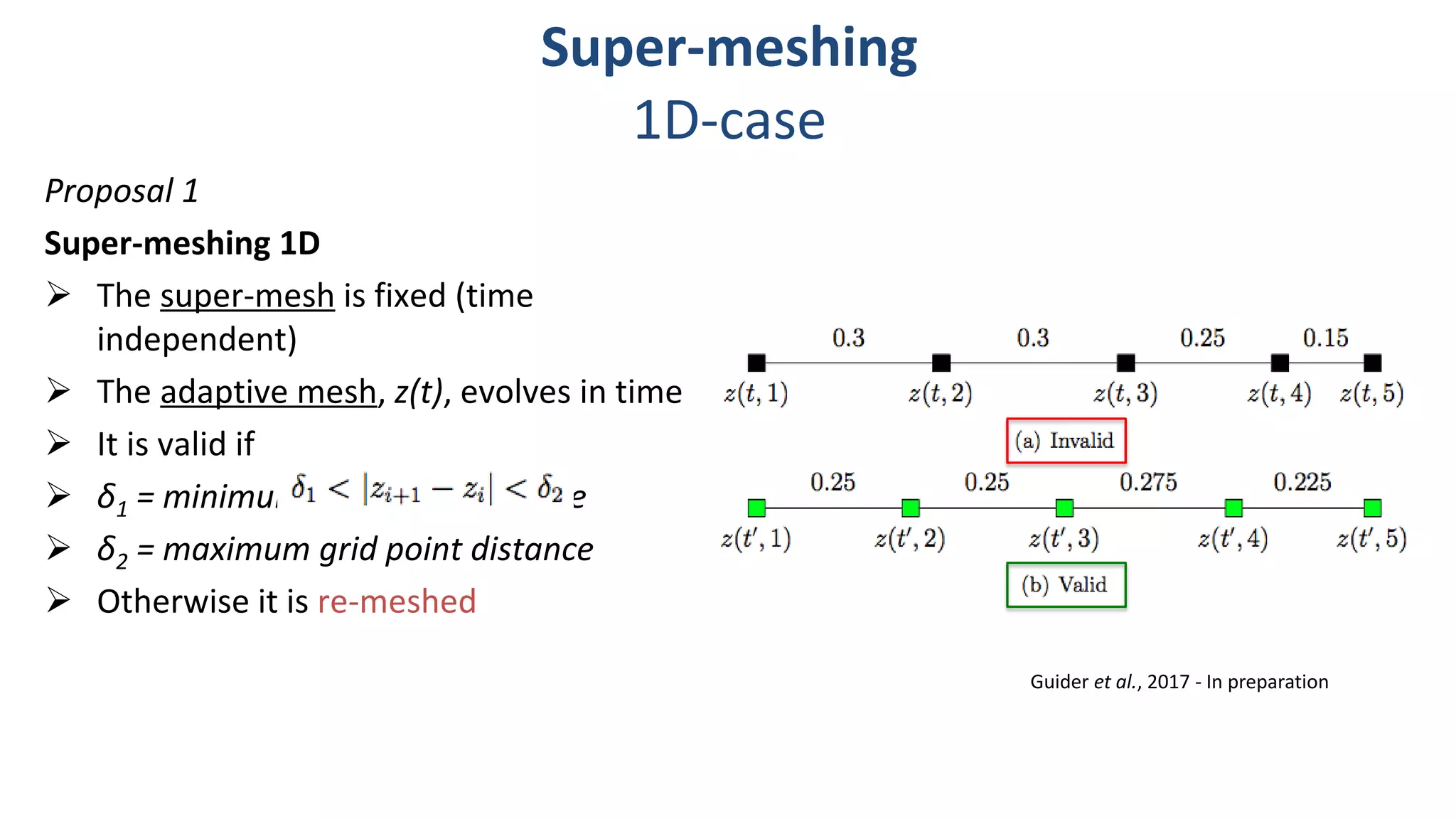
Proposal 1
Super-meshing 1D
The super-mesh is fixed (time
independent)
The adaptive mesh, z(t), evolves in time
It is valid if
 δ1 = minimum grid point distance
 δ2 = maximum grid point distance
Otherwise it is re-meshed
Guider et al., 2017 - In preparation
Super-meshing (1D-case)
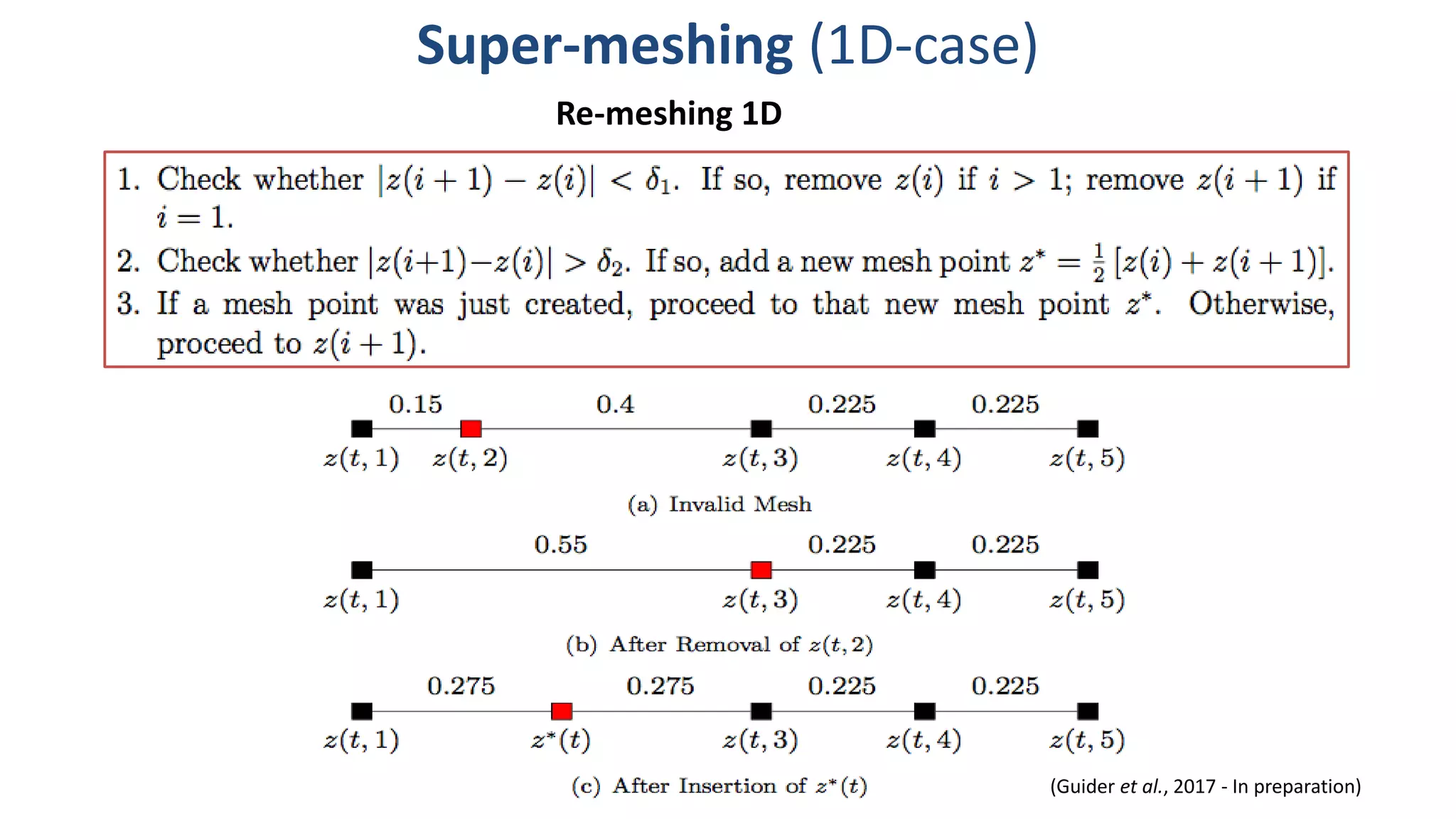
Re-meshing 1D
(Guider et al., 2017 - In preparation)
Super-meshing (1D-case)
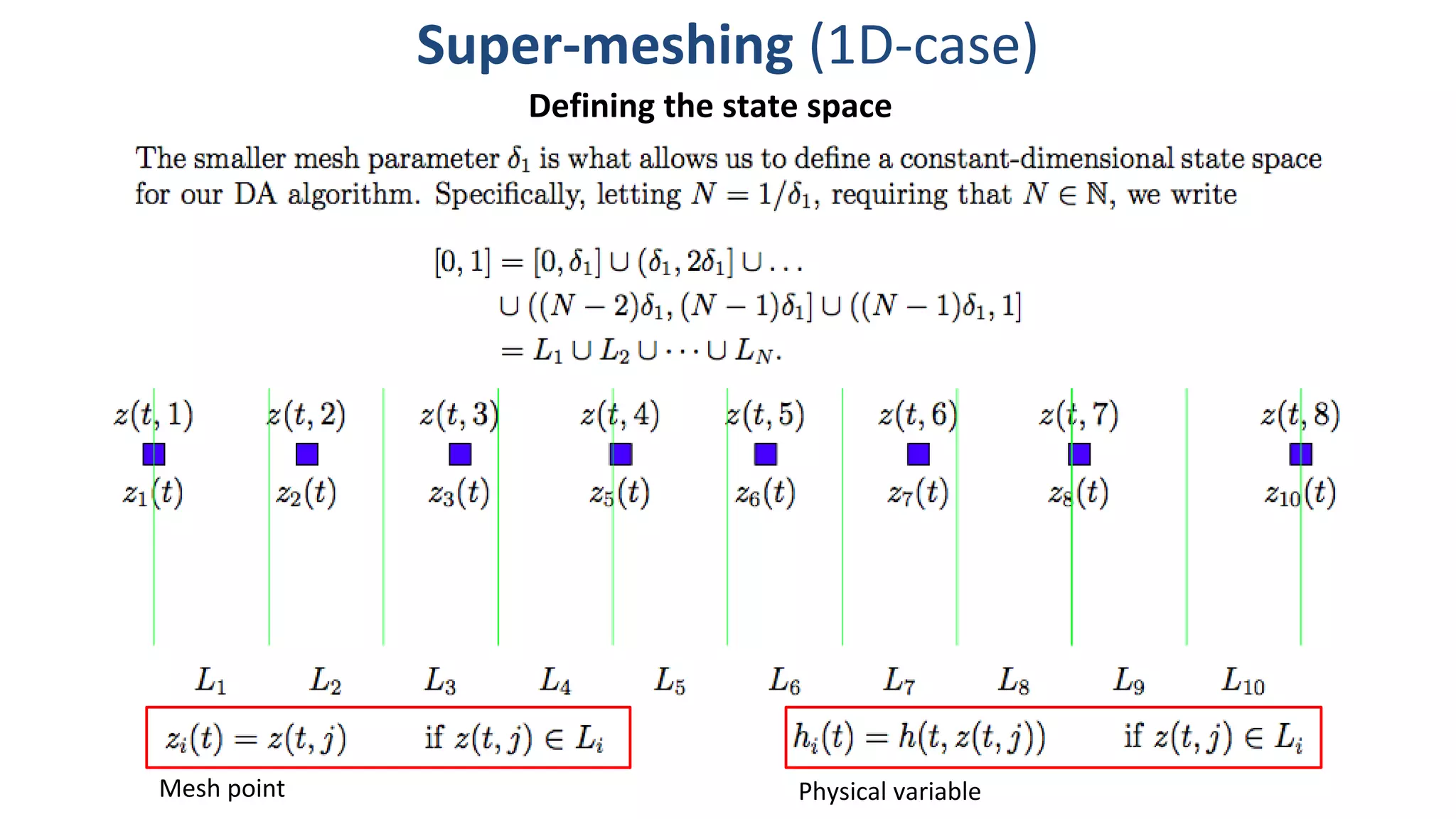
Defining the state space
Mesh point Physical variable
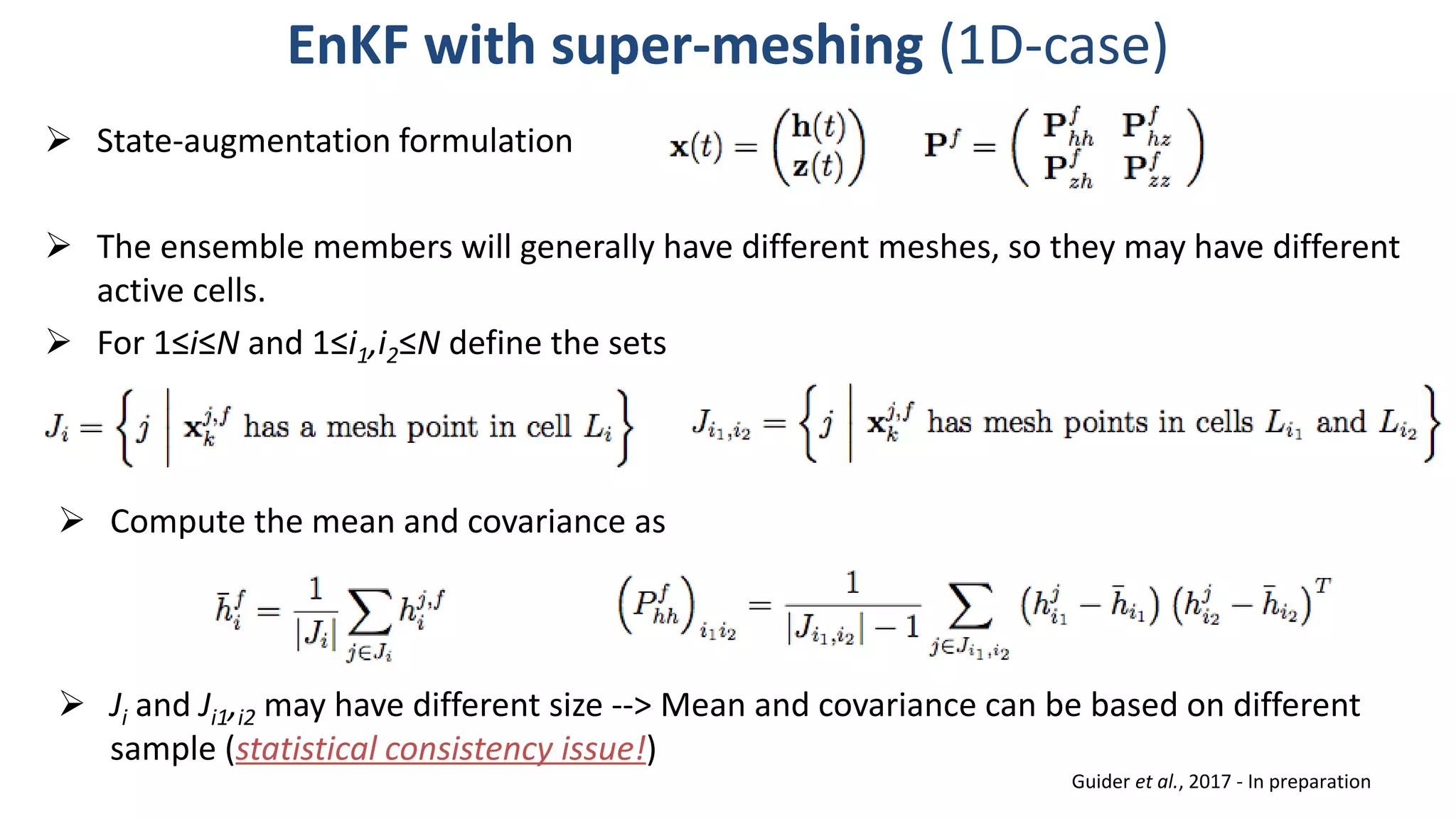
 The ensemble members will generally have different meshes, so they may have different
active cells.
 For 1≤i≤N and 1≤i1,i2≤N define the sets
EnKF with super-meshing (1D-case)
 State-augmentation formulation
 Compute the mean and covariance as
 Ji and Ji1,i2 may have different size --> Mean and covariance can be based on different
sample (statistical consistency issue!)
Guider et al., 2017 - In preparation
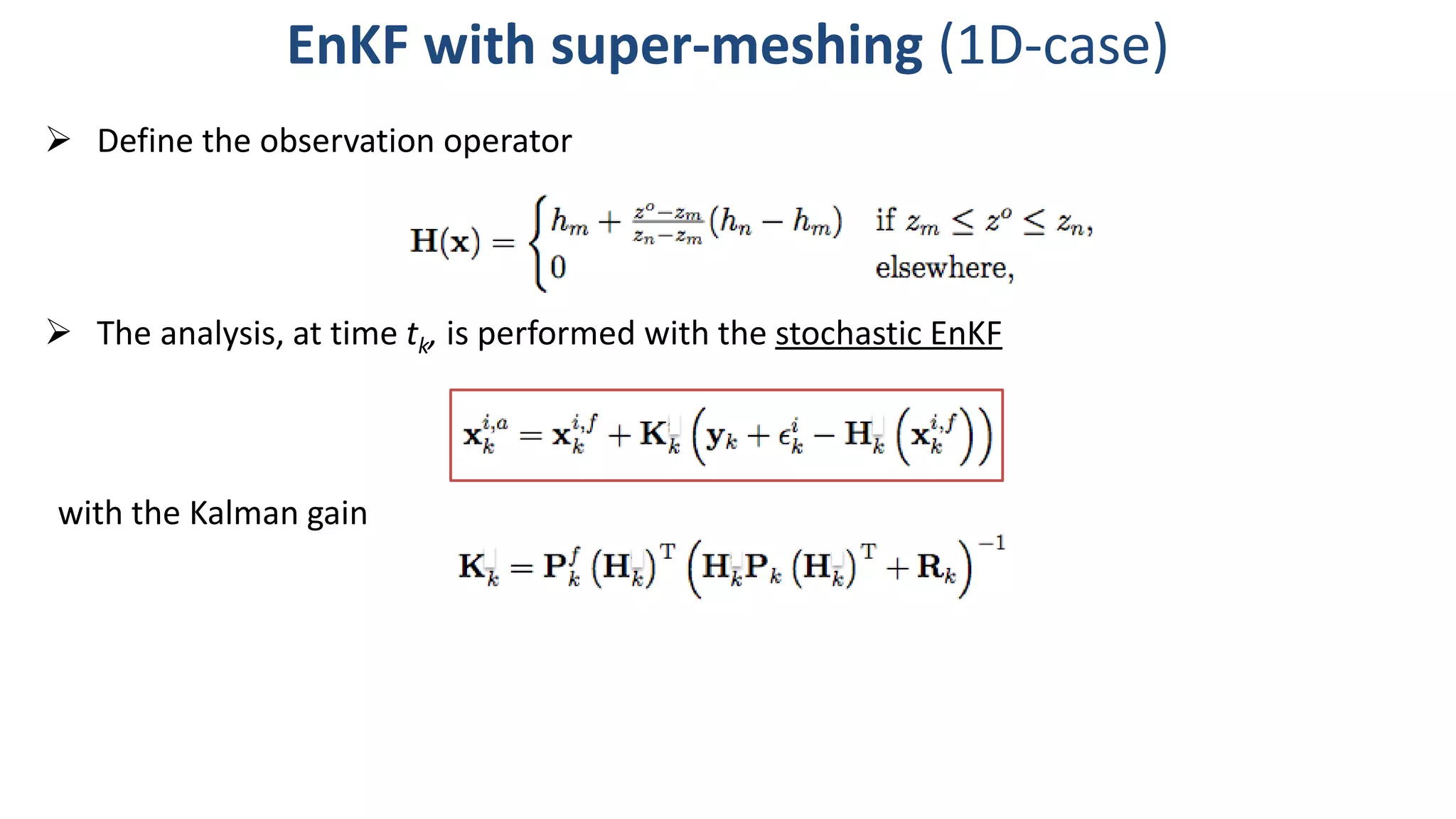
 The analysis, at time tk, is performed with the stochastic EnKF
EnKF with super-meshing (1D-case)
 Define the observation operator
with the Kalman gain
EnKF with super-meshing (1D-case)
Guider et al., 2017 (In preparation)
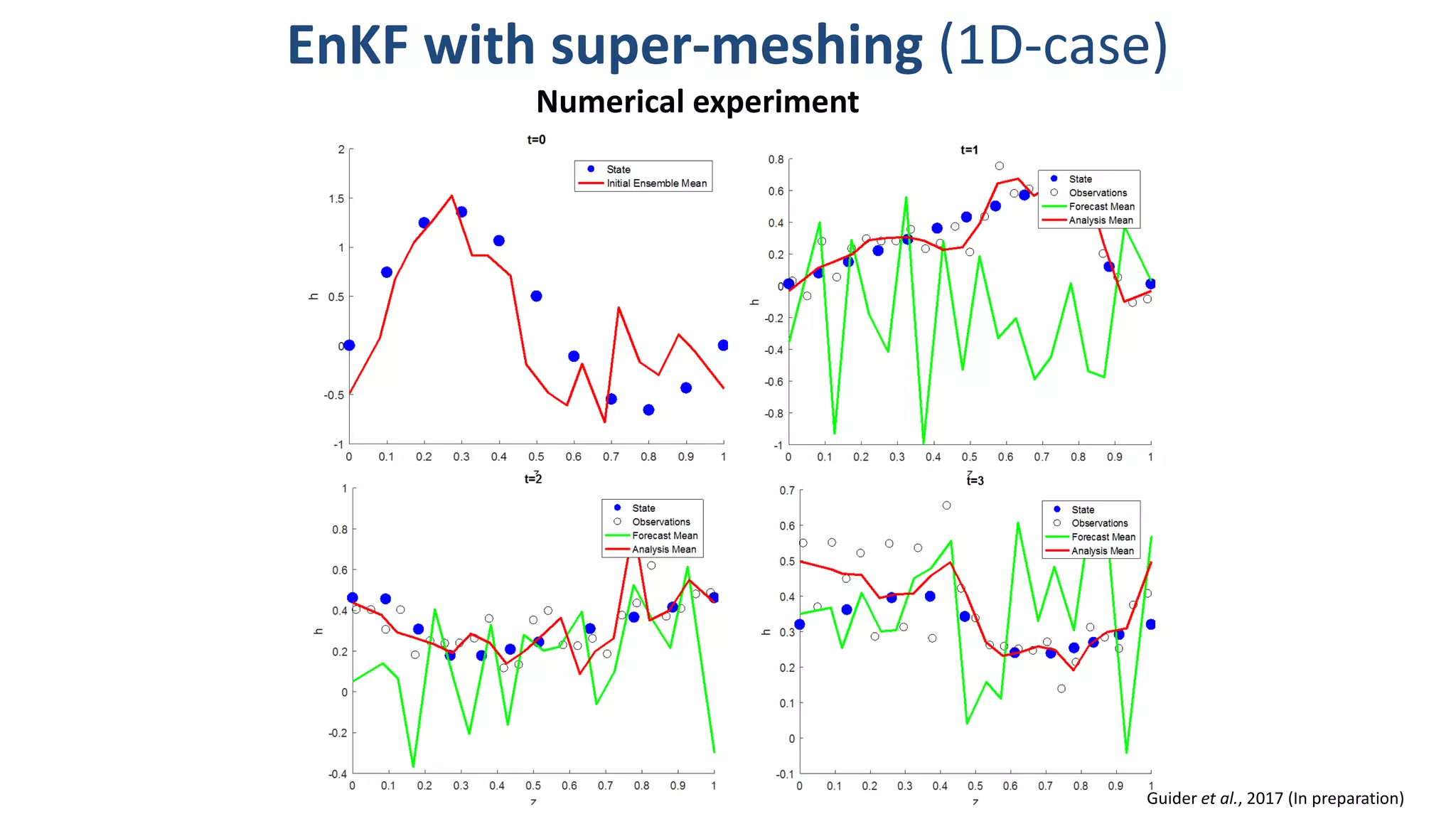
Numerical experiment
 The adaptive mesh, z(t), evolves as
The physical variable, h(t), evolves
following the Burgers’ equation
 The fixed super-mesh has N=50 cells and δ1/δ2 =
0.05/0.15
 EnKF with Ne=50 members
 25 observations evenly spaced over [0,1]
EnKF with super-meshing (1D-case)
Numerical experiment
Guider et al., 2017 (In preparation)
Super-meshing (2D-case)
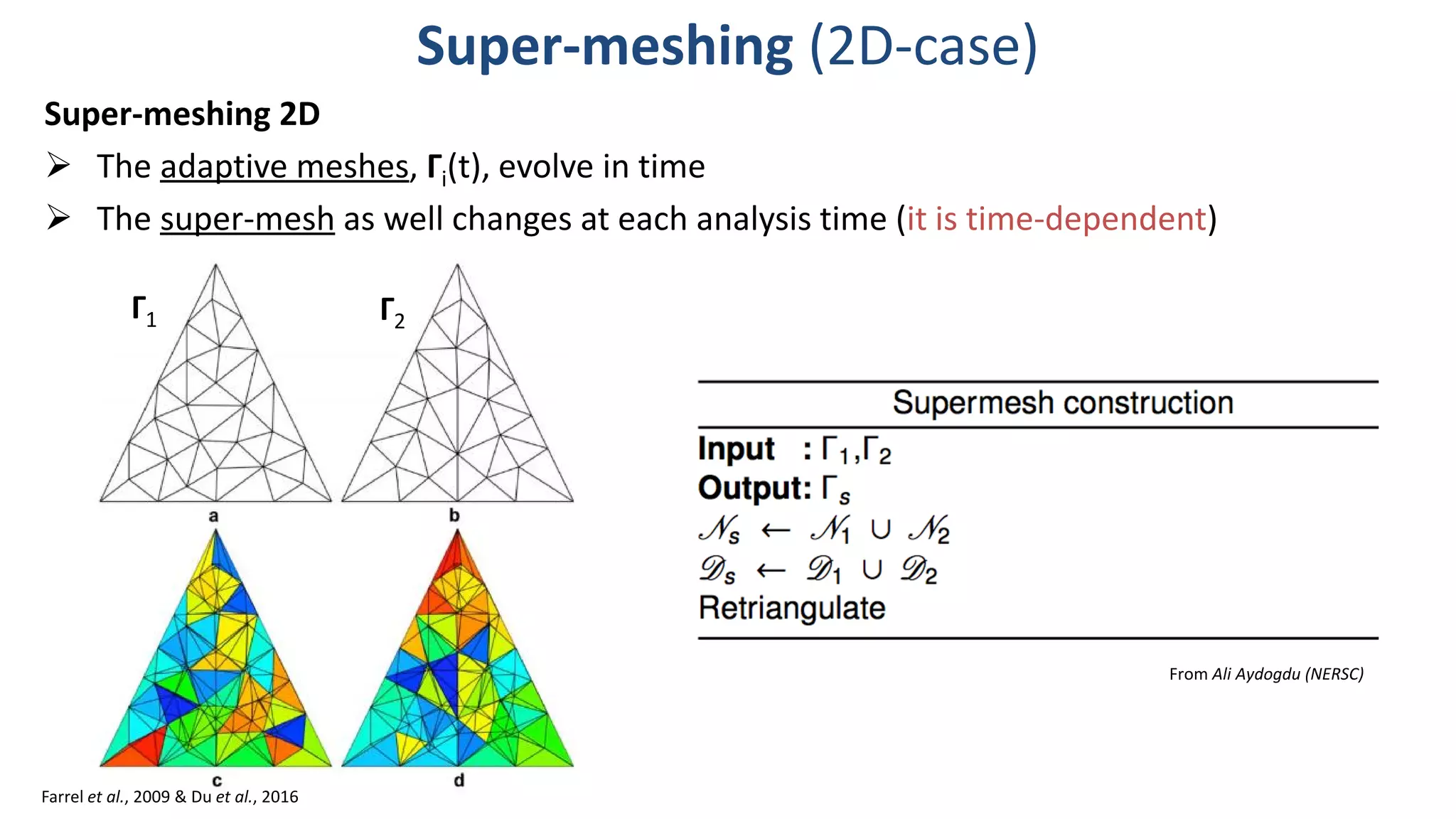
Super-meshing 2D
 The adaptive meshes, Γi(t), evolve in time
 The super-mesh as well changes at each analysis time (it is time-dependent)
Γ1 Γ2
Farrel et al., 2009 & Du et al., 2016
From Ali Aydogdu (NERSC)
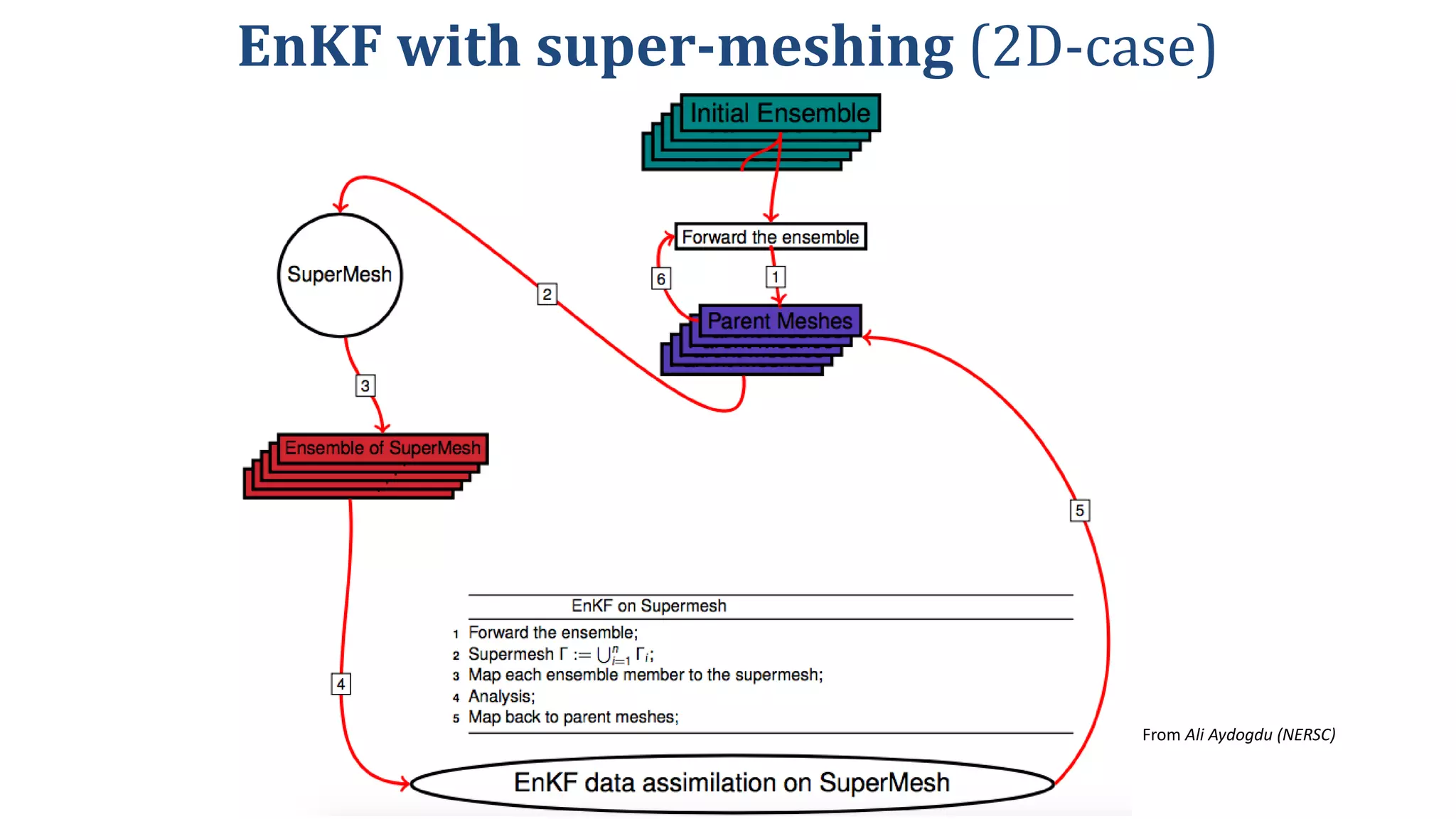
EnKF with super-meshing (2D-case)
From Ali Aydogdu (NERSC)
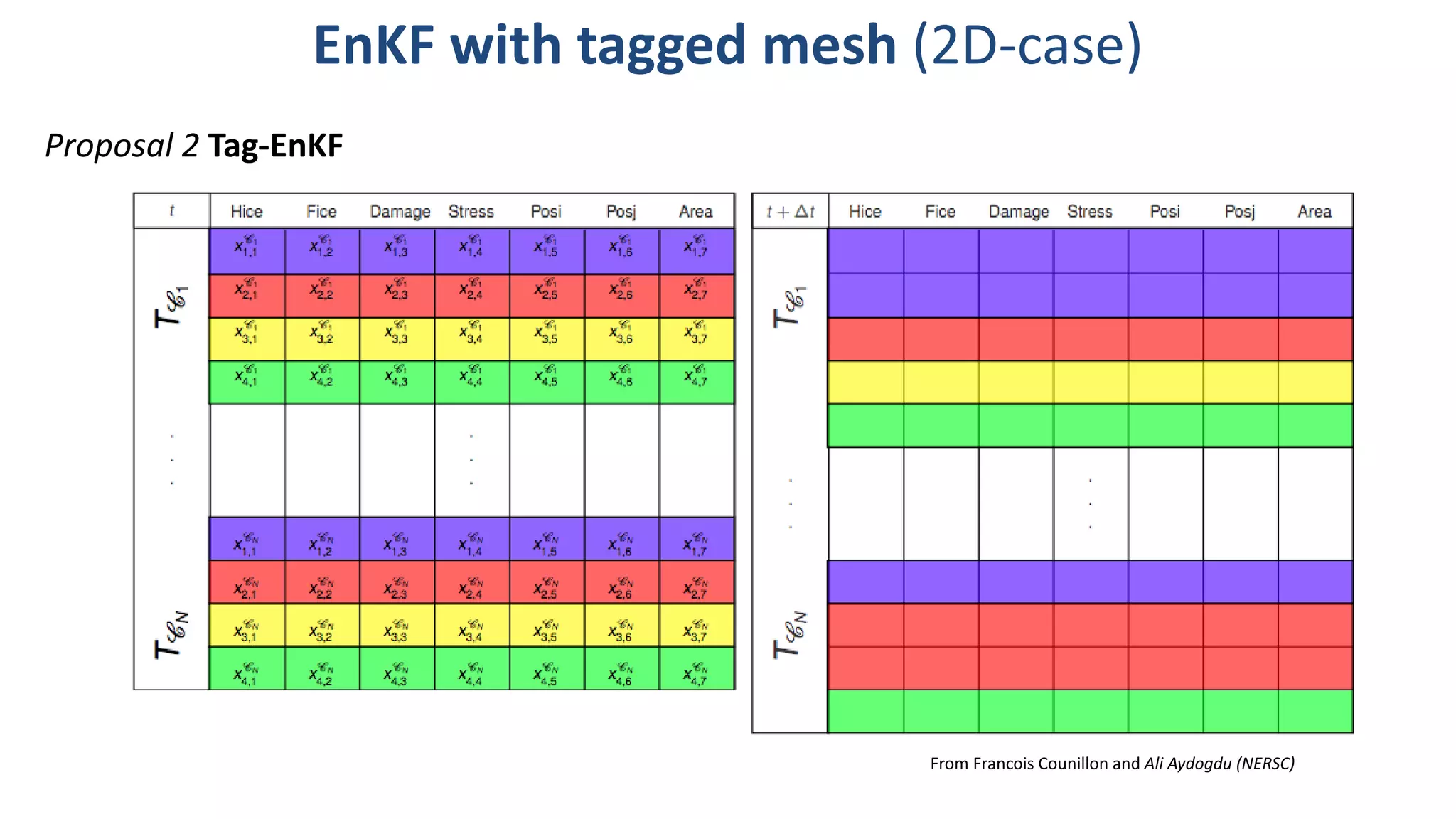
EnKF with tagged mesh (2D-case)
From Francois Counillon and Ali Aydogdu (NERSC)
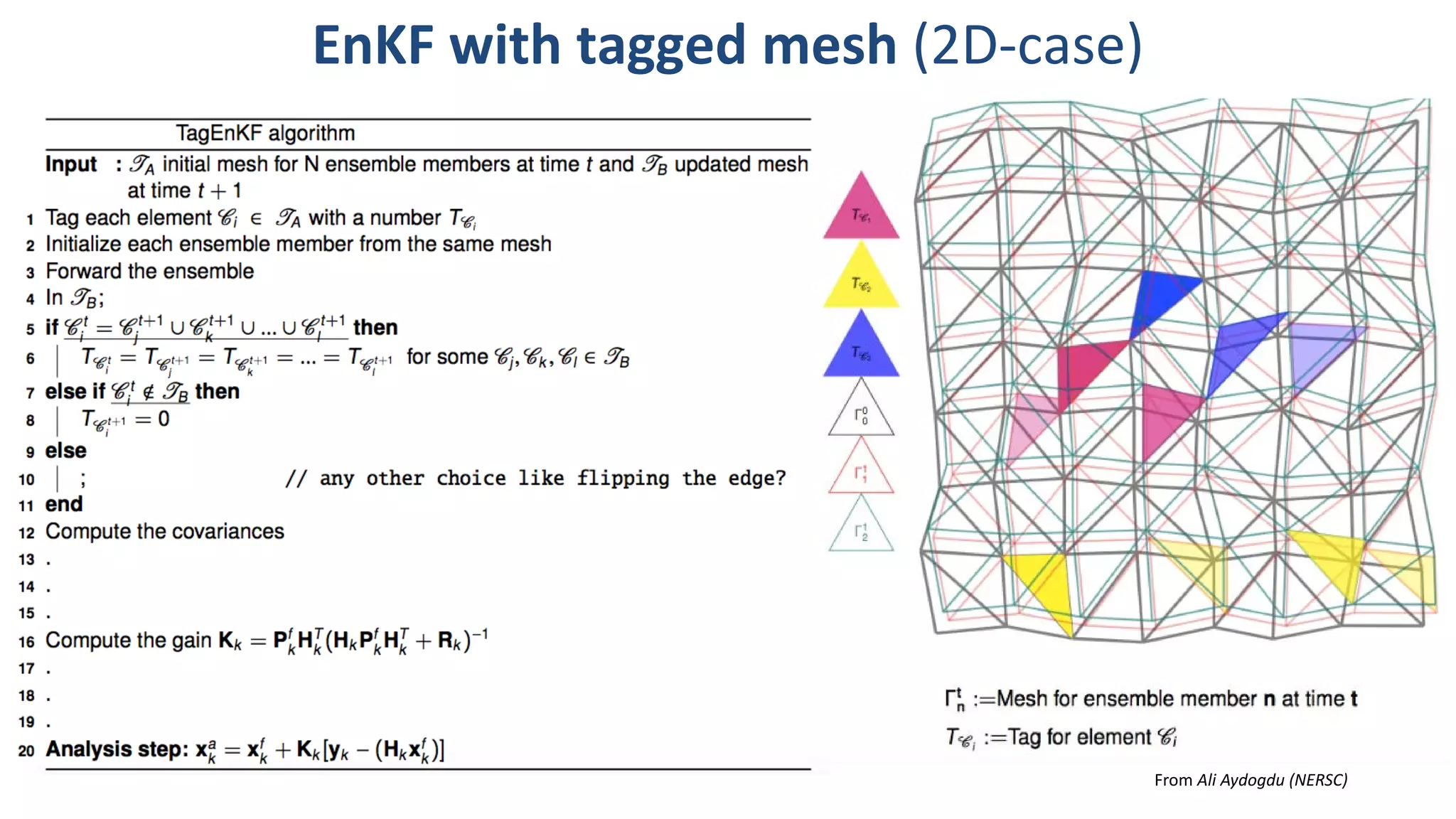
Proposal 2 Tag-EnKF
EnKF with tagged mesh (2D-case)
From Ali Aydogdu (NERSC)
Conclusion …
• Spatio-temporal varying mesh sets an issue for developing compatible
DA methods
• Ideally one may include the uncertainty in the mesh itself –>
Problematic given the usual huge size
• In-situ observations are Lagrangian by construction –> Their assimilation
in Lagragian model may thus be facilitated
• Satellite measurements of ice drift are expected to have the larger
impact
• Complexity of observation operator using EM radiation to infer physical
variables is a central issue.
Essential bibliography
Bouillon, S. and P. Rampal: Presentation of the dynamical core of neXtSIM, a new sea ice model, Ocean Modelling, 91, 23–37, 2015.
Bouillon, S. and P. Rampal: On producing sea ice deformation data sets from SAR-derived sea ice motion, The Cryosphere, 9, 663–673,
2015.
Guider, C., M. Rabatel, A. Carrassi and C.K.R.T. Jones: Data assimilation on a non-conservative adaptive mesh. Geophysical Research
Abstracts, vol. 19, EGU2017-706
Rabatel, M., P. Rampal, A. Carrassi, L. Bertino and C.K.R.T. Jones: Probabilistic forecast using a Lagrangian sea ice model - Application
for search and rescue operation. The Cryosphere, 2017 (submitted)
Rabatel, M., P. Rampal, A. Carrassi, L. Bertino and C.K.R.T. Jones: Sensitivity analysis of a Lagrangian sea ice model. Geophysical
Research Abstracts, vol. 19, EGU2017-688
Rampal , P., Weiss, J., Marsan, D., and Bourgoin, M.: Arctic sea ice velocity field: general circulation and turbulent-like fluctuations, J.
Geophys. Res., 114, 2009.
Rampal , P., Weiss, J., Dubois, C., and Campin, J. M.: IPCC climate models de not capture Arctic sea ice drift acceleration: Consequences
in terms of projected sea ice thinning and decline, J. Geophys. Res., 116, 2011.
Rampal , P., Bouillon, S., Bergh, J., and Ólason, E.: Arctic sea-ice diffusion from observed and simulated Lagrangian trajectories, The
Cryosphere, 10, 1513–1527, 2016.
Rampal , P., Bouillon, S., Ólason, E., and Morlighem, M.: neXtSIM: A new Lagrangian sea ice model, The Cryosphere, 10, 1055–1073,
2016.
Xie , J., Bertino, L., Counillon, F., Lisæter, K. A., and Sakov, P.: Quality assessment of the TOPAZ4 reanalysis in the Arctic over the period
1991-2013, Ocean Science, 13, 123, 2017.
Thank you !
neXtSIM (simulation without data assimilation): RMSE ∼ 2.5km/day
TOPAZ (simulation with data assimilation): RMSE ∼ 4km/day
neXtSIM evaluation (drift)
Pointwise comparison of model vs GlobIce dataset
(winter 2007-2008)
(Rampal et al., 2016)
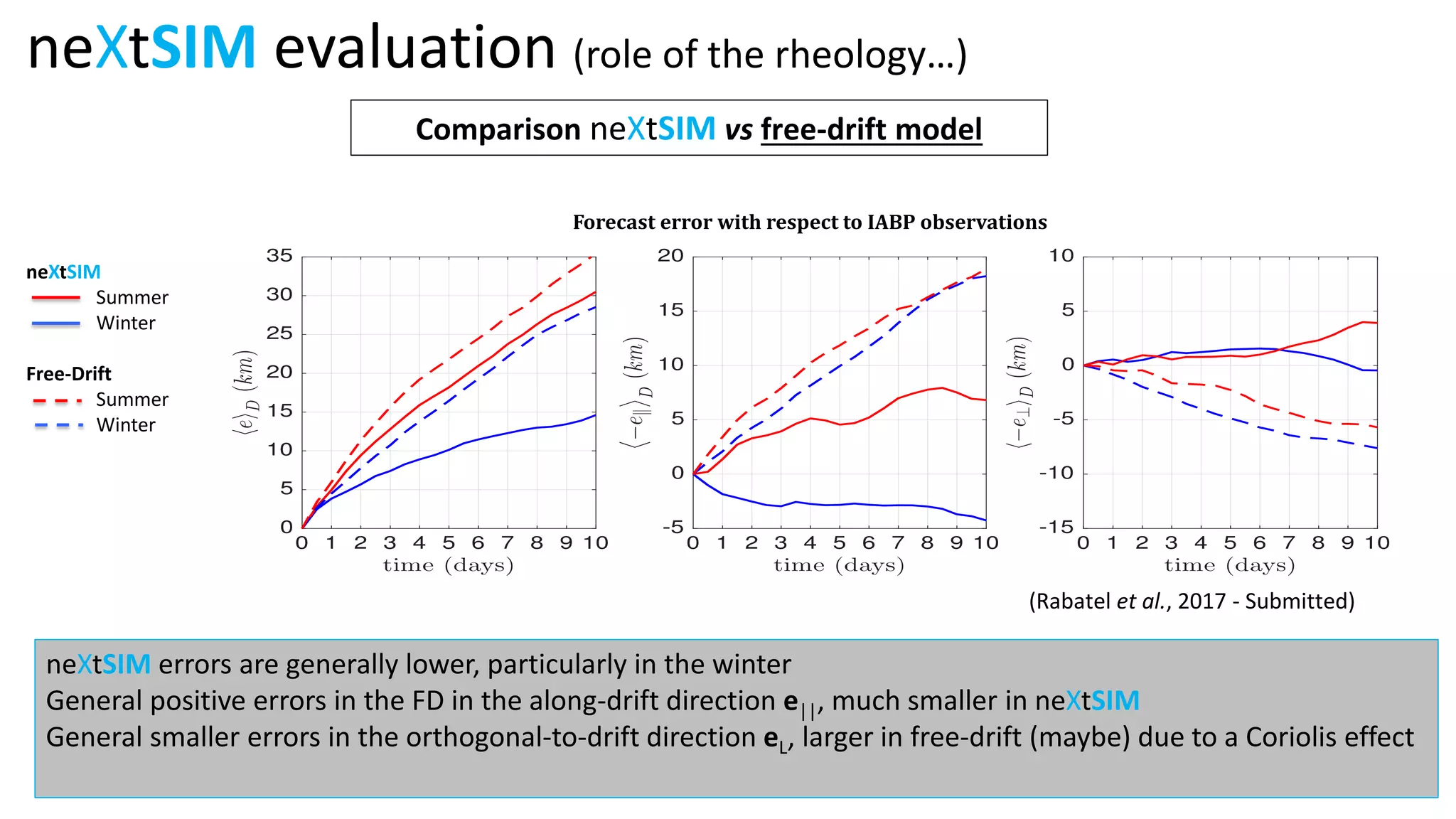
neXtSIM errors are generally lower, particularly in the winter
General positive errors in the FD in the along-drift direction e||, much smaller in neXtSIM
General smaller errors in the orthogonal-to-drift direction eL, larger in free-drift (maybe) due to a Coriolis effect
neXtSIM evaluation (role of the rheology…)
Comparison neXtSIM vs free-drift model
Forecast error with respect to IABP observations
neXtSIM
Summer
Winter
Free-Drift
Summer
Winter
(Rabatel et al., 2017 - Submitted)

Program on Mathematical and Statistical Methods for Climate and the Earth System Opening Workshop, Issues in Ensemble Prediction and Data Assimilation Using a Lagrangian Model of Sea-Ice - Alberto Carrassi, Aug 22, 2017

  • 1.
    A new Lagrangianmodel of the sea ice and related issues for data assimilation Alberto Carrassi C. Guider and C.K.R.T. Jones M. Rabatel, P. Rampal, L. Bertino and Ali Aydogdu
  • 2.
    Outline 1. Why adifferent treatment of the sea-ice mechanics? 2. A novel solid/elastic Lagrangian sea-ice model 3. Issues related to the design of data assimilation methods
  • 3.
    Known trends inthe Arctic sea ice From IPCC report, 2013 & Rampal et al., 2009 JGR Ice extent Ice thickness Ice drift and deformation Climate models Observations Smaller Thinner Faster
  • 4.
    The TOPAZ monitoringsystem  Operational at MET Norway o Since 2008 ocean coupled to the sea-ice o Ecosystem coupled online in Jan. 2012  25 years reanalysis at NERSC o EnKF (100 members) o ~ 4 million CPU hours  Copernicus (Arctic MFC) o 10-mems ensemble forecast o Free distribution o Dynamical viewing Ice area forecast for Today (start date 13th August – 9 days before)
  • 5.
    Ice drift inreal time TOPAZ OSI-SAF Example 3-days 6th-8th December 2015 Patterns are OK, but the spatial variability of ice drift are too smooth Even though OSI SAF Data is assimilated
  • 6.
    In other systems(ORA IP) Same problem as in TOPAZ (smooth gradients), large model diversity Chevallier et al. Clim. Dyn. 2016.
  • 7.
    TOPAZ Reanalysis  Input: oSAR based ice drift data  Bias 1-2km/day o Can be fine tuned with model parameters (wind drag)  Even in reanalysis mode, RMS errors of about 4km/day o High compared to the signal (5 to 10 km per day) o Wind forcing is not the only problem o Ice parameters? o Ice rheology? http://cmems.met.no/ARC- MFC/V2Validation/timeSeriesResults/index.html (Xie et al., 2017)
  • 8.
    Ice drift seasonalityin TOPAZ shortcoming of the EVP rheology? The seasonal cycle is off phase Aligned with the wind intensity but not sensitive to the cycle of ice thickness. Tuning drag parameters does not help. IABP Free run TOPAZ Re-tuned Xie et al. 2017
  • 9.
    Ice drift seasonalityin other systems shortcoming of the EVP rheology? (Rampal et al. 2011) Normalized annual cycle of sea-ice drift • Models are shown with continuous lines • Observations (IABP) in dashed red line • Cycles have been averaged over 10 years (1997-2007) The seasonal cycle is off phase ……
  • 10.
    Status from present/dayforecasts EVP rheology (as used in TOPAZ) • Biases – No acceleration of ice – Seasonality phased off – Tuning with model parameters is problematic (although for some models it works) • Lack of variability – Spatially and temporally too smooth – High RMS errors of drift trajectories Time to examine a completely different ice model
  • 11.
    Modelling challenges –Sea ice dynamics shear rate (/day) NASA, Modis NASA, Radarsat1 How to simulate sea ice fracturing/deformation and the associated scaling invariance properties with a continuous model ? Spatial heterogeneity (… of fractures/faults patterns) Temporal intermittency (… of ice quakes/earthquakes) Does a universal brittle behavior of “2D” geophysical solids exist? Analogy: sea ice cover - Earth crustLarge-scale deformation Local fracturing Marsan et al., PRL, 2004 ; Rampal et al., JGR, 2008 ; Weiss et al., EPSL 2009 Point Barrow ∼ 2000 km
  • 12.
    Sea ice mechanic Maxwell Elasto-Brittle rheology  NEW variable: the level of damage “d” associated to each grid cell  simulates the ice failure  allow for extremely localized deformation (divergence/ridging) New Physics neXtSIM, in a nutshell … Damage neXtSIM Initial zero damage 3 days of simulation Period: December 2015 Forcing with realistic wind and current Resolution ≈1 Km Initial thickness and concentration from satellite data Area: Fraim strait Complex pattern of damage after 3 days. Ice in pieces of different sizes Behavior caused only by the external forcing
  • 13.
    Numerics  Finite elementmethod u, vP1 Unstructured grid  Adaptive mesh and local remeshing u, v  Fully Lagrangian / ALE t t+∆t neXtSIM, in a nutshell …
  • 14.
    neXtSIM, in anutshell … Lagrangian advection sheme / Dynamical-local remeshing
  • 15.
    neXtSIM evaluation (volume,extent and area) neXtSIM is reproducing the annual cycles of sea ice volume, extent and area Comparison between model and CryoSAT2+SMOS, and SSMI/S datasets (Nov 2010- Aug 2012) volume extent area CS2+SMOS Passive Micro. Passive Micro.
  • 16.
     neXtSIM run oFree run o Drag optimized to free drifting ice  Comparison to SAR-based ice drift o RGPS and GlobIce o Oct 2007 to April 2008  Average and median errors much lower than TOPAZ (4 km/day) (Rampal et al. 2016) neXtSIM (simulation without data assimilation): RMSE ∼ 2.5km/day TOPAZ (simulation with data assimilation): RMSE ∼ 4km/day neXtSIM evaluation (drift)
  • 17.
    neXtSIM shows acoherent distribution of R across Arctic The highest degree of ensemble anisotropy (R > 1) is found north of Greenland and Canadian Archipelago, where the ice is the thickest and the ice drift and winds the lowest neXtSIM evaluation (role of the rheology…) Comparison neXtSIM vs free-drift (FD) model (Rabatel et al., 2017 - Submitted) R is the radius of deformation of virtual buoys – It measure the anysotropy of the ice movement
  • 18.
    neXtSIM evaluation (roleof the rheology…) Comparison neXtSIM vs free-drift model Search & Rescue application For a given search area, which is the model whose ensemble prediction area includes the lost target (human, object..)? POC – Probability of containment It defines the probability that a lost target is found in the area defined by the ensemble of model trajectories The dependency POC(Area) defines the selectivity curves  the highest the curve the better the model ability to locate the target Experiments uses IABP observations as target The search area is defined as the smallest ellipse centered on the ensemble center, and encompassing all buoys. ne XtSIM (solid line); free-drift (dashed) Selectivity curves (Rabatel et al., 2017 - Submitted)
  • 19.
    Data assimilation withneXtSIM Issues  Mesh varies in time  Remeshing procedure that does not conserve the total number of elements  Large computational model with physical variables at both vertices and centers  Variety of data types (satellite and in-situ) In (standard) DA the state vector reads where n=mk with • k = number of physical quantities • m = number of grid points In particular in neXtSIM  Grid points include vertices (v) and centers (c), so that n=mvkv+mckc  Both mv and mc may change in time  Vertices and Centers must be treated differently as different physical variables are associated with each  Particularly problematic for ensemble-based DA methods (EnKF-like)
  • 20.
    Data assimilation withneXtSIM Two “proposals” Proposal 1 Super-meshing Reference each grid points with a “common” fixed supermesh At most one vertex in each mesh box At analysis time ”project” the individual mesh on the supermesh Perform the analysis on the supermesh The supermesh can be fixed in time or change at each analysis times
  • 21.
    Super-meshing 1D-case Proposal 1 Super-meshing 1D Thesuper-mesh is fixed (time independent) The adaptive mesh, z(t), evolves in time It is valid if  δ1 = minimum grid point distance  δ2 = maximum grid point distance Otherwise it is re-meshed Guider et al., 2017 - In preparation
  • 22.
    Super-meshing (1D-case) Re-meshing 1D (Guideret al., 2017 - In preparation)
  • 23.
    Super-meshing (1D-case) Defining thestate space Mesh point Physical variable
  • 24.
     The ensemblemembers will generally have different meshes, so they may have different active cells.  For 1≤i≤N and 1≤i1,i2≤N define the sets EnKF with super-meshing (1D-case)  State-augmentation formulation  Compute the mean and covariance as  Ji and Ji1,i2 may have different size --> Mean and covariance can be based on different sample (statistical consistency issue!) Guider et al., 2017 - In preparation
  • 25.
     The analysis,at time tk, is performed with the stochastic EnKF EnKF with super-meshing (1D-case)  Define the observation operator with the Kalman gain
  • 26.
    EnKF with super-meshing(1D-case) Guider et al., 2017 (In preparation) Numerical experiment  The adaptive mesh, z(t), evolves as The physical variable, h(t), evolves following the Burgers’ equation  The fixed super-mesh has N=50 cells and δ1/δ2 = 0.05/0.15  EnKF with Ne=50 members  25 observations evenly spaced over [0,1]
  • 27.
    EnKF with super-meshing(1D-case) Numerical experiment Guider et al., 2017 (In preparation)
  • 28.
    Super-meshing (2D-case) Super-meshing 2D The adaptive meshes, Γi(t), evolve in time  The super-mesh as well changes at each analysis time (it is time-dependent) Γ1 Γ2 Farrel et al., 2009 & Du et al., 2016 From Ali Aydogdu (NERSC)
  • 29.
    EnKF with super-meshing(2D-case) From Ali Aydogdu (NERSC)
  • 30.
    EnKF with taggedmesh (2D-case) From Francois Counillon and Ali Aydogdu (NERSC) Proposal 2 Tag-EnKF
  • 31.
    EnKF with taggedmesh (2D-case) From Ali Aydogdu (NERSC)
  • 32.
    Conclusion … • Spatio-temporalvarying mesh sets an issue for developing compatible DA methods • Ideally one may include the uncertainty in the mesh itself –> Problematic given the usual huge size • In-situ observations are Lagrangian by construction –> Their assimilation in Lagragian model may thus be facilitated • Satellite measurements of ice drift are expected to have the larger impact • Complexity of observation operator using EM radiation to infer physical variables is a central issue.
  • 33.
    Essential bibliography Bouillon, S.and P. Rampal: Presentation of the dynamical core of neXtSIM, a new sea ice model, Ocean Modelling, 91, 23–37, 2015. Bouillon, S. and P. Rampal: On producing sea ice deformation data sets from SAR-derived sea ice motion, The Cryosphere, 9, 663–673, 2015. Guider, C., M. Rabatel, A. Carrassi and C.K.R.T. Jones: Data assimilation on a non-conservative adaptive mesh. Geophysical Research Abstracts, vol. 19, EGU2017-706 Rabatel, M., P. Rampal, A. Carrassi, L. Bertino and C.K.R.T. Jones: Probabilistic forecast using a Lagrangian sea ice model - Application for search and rescue operation. The Cryosphere, 2017 (submitted) Rabatel, M., P. Rampal, A. Carrassi, L. Bertino and C.K.R.T. Jones: Sensitivity analysis of a Lagrangian sea ice model. Geophysical Research Abstracts, vol. 19, EGU2017-688 Rampal , P., Weiss, J., Marsan, D., and Bourgoin, M.: Arctic sea ice velocity field: general circulation and turbulent-like fluctuations, J. Geophys. Res., 114, 2009. Rampal , P., Weiss, J., Dubois, C., and Campin, J. M.: IPCC climate models de not capture Arctic sea ice drift acceleration: Consequences in terms of projected sea ice thinning and decline, J. Geophys. Res., 116, 2011. Rampal , P., Bouillon, S., Bergh, J., and Ólason, E.: Arctic sea-ice diffusion from observed and simulated Lagrangian trajectories, The Cryosphere, 10, 1513–1527, 2016. Rampal , P., Bouillon, S., Ólason, E., and Morlighem, M.: neXtSIM: A new Lagrangian sea ice model, The Cryosphere, 10, 1055–1073, 2016. Xie , J., Bertino, L., Counillon, F., Lisæter, K. A., and Sakov, P.: Quality assessment of the TOPAZ4 reanalysis in the Arctic over the period 1991-2013, Ocean Science, 13, 123, 2017. Thank you !
  • 34.
    neXtSIM (simulation withoutdata assimilation): RMSE ∼ 2.5km/day TOPAZ (simulation with data assimilation): RMSE ∼ 4km/day neXtSIM evaluation (drift) Pointwise comparison of model vs GlobIce dataset (winter 2007-2008) (Rampal et al., 2016)
  • 35.
    neXtSIM errors aregenerally lower, particularly in the winter General positive errors in the FD in the along-drift direction e||, much smaller in neXtSIM General smaller errors in the orthogonal-to-drift direction eL, larger in free-drift (maybe) due to a Coriolis effect neXtSIM evaluation (role of the rheology…) Comparison neXtSIM vs free-drift model Forecast error with respect to IABP observations neXtSIM Summer Winter Free-Drift Summer Winter (Rabatel et al., 2017 - Submitted)