Causal Discovery in Neuro Imaging Data
Frederick Eberhardt
SAMSI Causal Inference Workshop, Dec 9-11, 2019
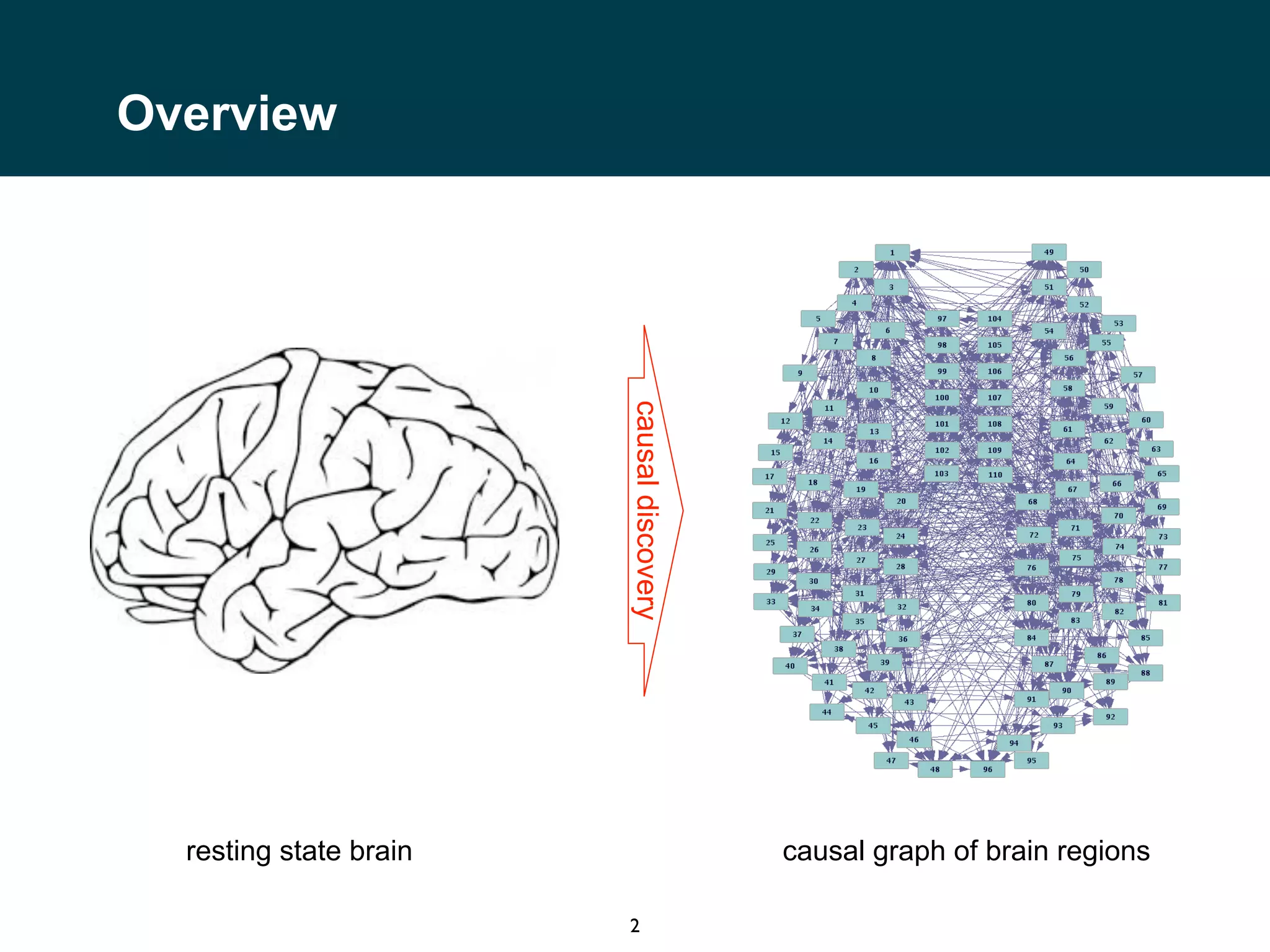
Overview
2
causaldiscovery
resting state brain causal graph of brain regions
3
Human Connectome Project
resting state fMRI data in the HCP
4
• The subjects are asked to lie with eyes open, with “relaxed” fixation
on a white cross (on a dark background), think of nothing in
particular, and not to fall asleep.
• Four ~15-minute rfMRI runs are acquired in two separate fMRI
sessions
• Acquisition parameters: 1200 volumes, TR = 720 ms, voxel size =
2mm isotropic, 72 slices
Anatomical Parcelation
anatomical parcelationvoxel level resting state fMRI
Parcel Activation over Time
time points
parcels
7
10-100ms interactions
~100billionneurons
What are we measuring?
7
10-100ms interactions
~100billionneurons
~90,000voxelsBOLDsignal 720ms measurement interval
What are we measuring?
7
10-100ms interactions
~100billionneurons
5-6s hemodynamic delay
~90,000voxelsBOLDsignal 720ms measurement interval
What are we measuring?
7
10-100ms interactions
~100billionneurons
5-6s hemodynamic delay
~90,000voxelsBOLDsignal 720ms measurement interval
}<latexit sha1_base64="DsDSimPTxv/Qm15+jZsruPb2YT4=">AAAB6XicdVDLSsNAFL3xWeur6tLNYBFclaQJNu6KblxWsQ9oQ5lMJ+3QySTMTIQS+gduXCji1j9y5984fQgqeuDC4Zx7ufeeMOVMadv+sFZW19Y3Ngtbxe2d3b390sFhSyWZJLRJEp7ITogV5UzQpmaa004qKY5DTtvh+Grmt++pVCwRd3qS0iDGQ8EiRrA20m1v2i+V7YrtedWqjwxxa37NNcTzzy9cFzkVe44yLNHol957g4RkMRWacKxU17FTHeRYakY4nRZ7maIpJmM8pF1DBY6pCvL5pVN0apQBihJpSmg0V79P5DhWahKHpjPGeqR+ezPxL6+b6cgPcibSTFNBFouijCOdoNnbaMAkJZpPDMFEMnMrIiMsMdEmnKIJ4etT9D9pVSuOXXFuvHL9chlHAY7hBM7AgRrU4Roa0AQCETzAEzxbY+vRerFeF60r1nLmCH7AevsEE0uNuA==</latexit><latexit sha1_base64="DsDSimPTxv/Qm15+jZsruPb2YT4=">AAAB6XicdVDLSsNAFL3xWeur6tLNYBFclaQJNu6KblxWsQ9oQ5lMJ+3QySTMTIQS+gduXCji1j9y5984fQgqeuDC4Zx7ufeeMOVMadv+sFZW19Y3Ngtbxe2d3b390sFhSyWZJLRJEp7ITogV5UzQpmaa004qKY5DTtvh+Grmt++pVCwRd3qS0iDGQ8EiRrA20m1v2i+V7YrtedWqjwxxa37NNcTzzy9cFzkVe44yLNHol957g4RkMRWacKxU17FTHeRYakY4nRZ7maIpJmM8pF1DBY6pCvL5pVN0apQBihJpSmg0V79P5DhWahKHpjPGeqR+ezPxL6+b6cgPcibSTFNBFouijCOdoNnbaMAkJZpPDMFEMnMrIiMsMdEmnKIJ4etT9D9pVSuOXXFuvHL9chlHAY7hBM7AgRrU4Roa0AQCETzAEzxbY+vRerFeF60r1nLmCH7AevsEE0uNuA==</latexit><latexit sha1_base64="DsDSimPTxv/Qm15+jZsruPb2YT4=">AAAB6XicdVDLSsNAFL3xWeur6tLNYBFclaQJNu6KblxWsQ9oQ5lMJ+3QySTMTIQS+gduXCji1j9y5984fQgqeuDC4Zx7ufeeMOVMadv+sFZW19Y3Ngtbxe2d3b390sFhSyWZJLRJEp7ITogV5UzQpmaa004qKY5DTtvh+Grmt++pVCwRd3qS0iDGQ8EiRrA20m1v2i+V7YrtedWqjwxxa37NNcTzzy9cFzkVe44yLNHol957g4RkMRWacKxU17FTHeRYakY4nRZ7maIpJmM8pF1DBY6pCvL5pVN0apQBihJpSmg0V79P5DhWahKHpjPGeqR+ezPxL6+b6cgPcibSTFNBFouijCOdoNnbaMAkJZpPDMFEMnMrIiMsMdEmnKIJ4etT9D9pVSuOXXFuvHL9chlHAY7hBM7AgRrU4Roa0AQCETzAEzxbY+vRerFeF60r1nLmCH7AevsEE0uNuA==</latexit><latexit sha1_base64="DsDSimPTxv/Qm15+jZsruPb2YT4=">AAAB6XicdVDLSsNAFL3xWeur6tLNYBFclaQJNu6KblxWsQ9oQ5lMJ+3QySTMTIQS+gduXCji1j9y5984fQgqeuDC4Zx7ufeeMOVMadv+sFZW19Y3Ngtbxe2d3b390sFhSyWZJLRJEp7ITogV5UzQpmaa004qKY5DTtvh+Grmt++pVCwRd3qS0iDGQ8EiRrA20m1v2i+V7YrtedWqjwxxa37NNcTzzy9cFzkVe44yLNHol957g4RkMRWacKxU17FTHeRYakY4nRZ7maIpJmM8pF1DBY6pCvL5pVN0apQBihJpSmg0V79P5DhWahKHpjPGeqR+ezPxL6+b6cgPcibSTFNBFouijCOdoNnbaMAkJZpPDMFEMnMrIiMsMdEmnKIJ4etT9D9pVSuOXXFuvHL9chlHAY7hBM7AgRrU4Roa0AQCETzAEzxbY+vRerFeF60r1nLmCH7AevsEE0uNuA==</latexit>
parcel 1
parcel 405
…
What are we measuring?
7
10-100ms interactions
~100billionneurons
5-6s hemodynamic delay
• indirect measurement of neural activity by
BOLD signal
• aggregation in space from voxel to parcel
• aggregation in time by an order of magnitude
~90,000voxelsBOLDsignal 720ms measurement interval
}<latexit sha1_base64="DsDSimPTxv/Qm15+jZsruPb2YT4=">AAAB6XicdVDLSsNAFL3xWeur6tLNYBFclaQJNu6KblxWsQ9oQ5lMJ+3QySTMTIQS+gduXCji1j9y5984fQgqeuDC4Zx7ufeeMOVMadv+sFZW19Y3Ngtbxe2d3b390sFhSyWZJLRJEp7ITogV5UzQpmaa004qKY5DTtvh+Grmt++pVCwRd3qS0iDGQ8EiRrA20m1v2i+V7YrtedWqjwxxa37NNcTzzy9cFzkVe44yLNHol957g4RkMRWacKxU17FTHeRYakY4nRZ7maIpJmM8pF1DBY6pCvL5pVN0apQBihJpSmg0V79P5DhWahKHpjPGeqR+ezPxL6+b6cgPcibSTFNBFouijCOdoNnbaMAkJZpPDMFEMnMrIiMsMdEmnKIJ4etT9D9pVSuOXXFuvHL9chlHAY7hBM7AgRrU4Roa0AQCETzAEzxbY+vRerFeF60r1nLmCH7AevsEE0uNuA==</latexit><latexit sha1_base64="DsDSimPTxv/Qm15+jZsruPb2YT4=">AAAB6XicdVDLSsNAFL3xWeur6tLNYBFclaQJNu6KblxWsQ9oQ5lMJ+3QySTMTIQS+gduXCji1j9y5984fQgqeuDC4Zx7ufeeMOVMadv+sFZW19Y3Ngtbxe2d3b390sFhSyWZJLRJEp7ITogV5UzQpmaa004qKY5DTtvh+Grmt++pVCwRd3qS0iDGQ8EiRrA20m1v2i+V7YrtedWqjwxxa37NNcTzzy9cFzkVe44yLNHol957g4RkMRWacKxU17FTHeRYakY4nRZ7maIpJmM8pF1DBY6pCvL5pVN0apQBihJpSmg0V79P5DhWahKHpjPGeqR+ezPxL6+b6cgPcibSTFNBFouijCOdoNnbaMAkJZpPDMFEMnMrIiMsMdEmnKIJ4etT9D9pVSuOXXFuvHL9chlHAY7hBM7AgRrU4Roa0AQCETzAEzxbY+vRerFeF60r1nLmCH7AevsEE0uNuA==</latexit><latexit sha1_base64="DsDSimPTxv/Qm15+jZsruPb2YT4=">AAAB6XicdVDLSsNAFL3xWeur6tLNYBFclaQJNu6KblxWsQ9oQ5lMJ+3QySTMTIQS+gduXCji1j9y5984fQgqeuDC4Zx7ufeeMOVMadv+sFZW19Y3Ngtbxe2d3b390sFhSyWZJLRJEp7ITogV5UzQpmaa004qKY5DTtvh+Grmt++pVCwRd3qS0iDGQ8EiRrA20m1v2i+V7YrtedWqjwxxa37NNcTzzy9cFzkVe44yLNHol957g4RkMRWacKxU17FTHeRYakY4nRZ7maIpJmM8pF1DBY6pCvL5pVN0apQBihJpSmg0V79P5DhWahKHpjPGeqR+ezPxL6+b6cgPcibSTFNBFouijCOdoNnbaMAkJZpPDMFEMnMrIiMsMdEmnKIJ4etT9D9pVSuOXXFuvHL9chlHAY7hBM7AgRrU4Roa0AQCETzAEzxbY+vRerFeF60r1nLmCH7AevsEE0uNuA==</latexit><latexit sha1_base64="DsDSimPTxv/Qm15+jZsruPb2YT4=">AAAB6XicdVDLSsNAFL3xWeur6tLNYBFclaQJNu6KblxWsQ9oQ5lMJ+3QySTMTIQS+gduXCji1j9y5984fQgqeuDC4Zx7ufeeMOVMadv+sFZW19Y3Ngtbxe2d3b390sFhSyWZJLRJEp7ITogV5UzQpmaa004qKY5DTtvh+Grmt++pVCwRd3qS0iDGQ8EiRrA20m1v2i+V7YrtedWqjwxxa37NNcTzzy9cFzkVe44yLNHol957g4RkMRWacKxU17FTHeRYakY4nRZ7maIpJmM8pF1DBY6pCvL5pVN0apQBihJpSmg0V79P5DhWahKHpjPGeqR+ezPxL6+b6cgPcibSTFNBFouijCOdoNnbaMAkJZpPDMFEMnMrIiMsMdEmnKIJ4etT9D9pVSuOXXFuvHL9chlHAY7hBM7AgRrU4Roa0AQCETzAEzxbY+vRerFeF60r1nLmCH7AevsEE0uNuA==</latexit>
parcel 1
parcel 405
…
What are we measuring?
Fast Greedy Equivalence Search (FGES)
8
Chickering (2002) JMLR

Ramsey (2017) IJDSA
• greedy local search for a DAG
• uses Bayesian Information Criterion (BIC) to determine which edge to
add/delete at any stage in the algorithm
• one free “sparsity” parameter that regulates fit vs. model complexity
• is consistent: given its assumptions it will identify the Markov
equivalence class of the true DAG in the large sample limit
Fast Greedy Equivalence Search (FGES)
8
• Assumptions
- acyclic causal structure
- no confounding
- linear Gaussian structural equation model
- iid data
Chickering (2002) JMLR

Ramsey (2017) IJDSA
• greedy local search for a DAG
• uses Bayesian Information Criterion (BIC) to determine which edge to
add/delete at any stage in the algorithm
• one free “sparsity” parameter that regulates fit vs. model complexity
• is consistent: given its assumptions it will identify the Markov
equivalence class of the true DAG in the large sample limit
Fast Greedy Equivalence Search (FGES)
8
• Assumptions
- acyclic causal structure
- no confounding
- linear Gaussian structural equation model
- iid data
Chickering (2002) JMLR

Ramsey (2017) IJDSA
• greedy local search for a DAG
• uses Bayesian Information Criterion (BIC) to determine which edge to
add/delete at any stage in the algorithm
• one free “sparsity” parameter that regulates fit vs. model complexity
• is consistent: given its assumptions it will identify the Markov
equivalence class of the true DAG in the large sample limit
• scales to >100,000 variables
- implementation in java in the Tetrad code
package
- our python implementation here: https://
github.com/eberharf/fges-py/
resting state fMRI
880
subjects
single
subject
correlations
resting state fMRI
880
subjects
single
subject
correlations
880
subjects
single
subject
left
hemisphere
right
hemisphere
causal connections
between
hemispheres
causal connections
880
subjects
single
subject
left
hemisphere
right
hemisphere
resting state fMRI
causal connections
880
subjects
single
subject
left
hemisphere
right
hemisphere
resting state fMRI
causal connections
880
subjects
single
subject
left
hemisphere
right
hemisphere
example structure for illustration
resting state fMRI
causal connections
between
hemispheres
880
subjects
single
subject
resting state fMRI
causal connections
between
hemispheres
880
subjects
single
subject
example structure for illustration
resting state fMRI
HUMAN

causal connections
MOUSE

causal connections
Cross-species Analysis
Fast Greedy Equivalence Search
• acyclic causal structure
• no unmeasured confounding
• very scalable
Causal Orientation
Fast Greedy Equivalence Search
• acyclic causal structure
• no unmeasured confounding
• very scalable
Answer Set Programming for Causality
• cyclic or acyclic causal structure
• unmeasured confounding permitted
• does not scale
Causal Orientation
56
59
81
82108
109
110
Fast Greedy Equivalence Search
• acyclic causal structure
• no unmeasured confounding
• very scalable
Answer Set Programming for Causality
• cyclic or acyclic causal structure
• unmeasured confounding permitted
• does not scale
Causal Orientation
true causal structure
Observation to Intervention
x y
z
true causal structure
Observation to Intervention
x y
z
equivalence class of causal
structures that we learned
x y
z
true causal structure
Observation to Intervention
x y
z
equivalence class of causal
structures that we learned
x y
z
intervened causal structure
x y
z
15
3.0 s
EPI scan EPI scan
Stimulation
period (30 s)
Electrical stimulation
Stimulus
isolator
Waveform
generation
computer
+ -
B
100 ms
a,b = 0.25 ms
c = 0.75 ms
a b c
d
e
R
(-2.4, -8.2,Subj.292)
L
electrical stimulation fMRI
16
simple contrast (GLM) causal discovery
Effect of stimulating the right amygdala
peak activation
depletion
-10 -5 0 5
-40-200204060
run 1, mean of 10 stimulus blocks stacked
timesteps before and after onset of stimulus
activation
-10 -5 0 5
-40-2002040
run 2, mean of 10 stimulus blocks stacked
timesteps before and after onset of stimulus
activation
-10 -5 0 5
-60-40-20020406080
run 3, mean of 10 stimulus blocks stacked
timesteps before and after onset of stimulus
activation
-10 -5 0 5
-60-40-2002040
run 4, mean of 10 stimulus blocks stacked
timesteps before and after onset of stimulus
activation
stimulation stimulation
18
parcel intervention On/Off on first 5 observation
alL_AngularGyrus x
R_InsularCortex x x
R_TemporalPole x x x
R_SuperiorTemporalGyrusPosterior x
R_MiddleTemporalGyrusAnterior x
R_MiddleTemporalGyrusTemporoOccipital x
R_InferiorTemporalGyrusAnterior x
R_InferiorTemporalGyrusTemporoOccipital x
R_FrontalOrbitalCortex x
R_ParahippocampalGyrusAnterior x
R_ParahippocampalGyrusPosterior x
R_TemporalFusiformCortexPosterior x
R_PlanumPolare x
LeftCaudate x
LeftAmygdala x
RightHippocampus x x x
After adjusting for hemodynamic delay and depletion…
18
parcel intervention On/Off on first 5 observation
alL_AngularGyrus x
R_InsularCortex x x
R_TemporalPole x x x
R_SuperiorTemporalGyrusPosterior x
R_MiddleTemporalGyrusAnterior x
R_MiddleTemporalGyrusTemporoOccipital x
R_InferiorTemporalGyrusAnterior x
R_InferiorTemporalGyrusTemporoOccipital x
R_FrontalOrbitalCortex x
R_ParahippocampalGyrusAnterior x
R_ParahippocampalGyrusPosterior x
R_TemporalFusiformCortexPosterior x
R_PlanumPolare x
LeftCaudate x
LeftAmygdala x
RightHippocampus x x x
—— one subject —— | population
After adjusting for hemodynamic delay and depletion…
Population Prior to Improve Learning for Single Subject
BIC(H) = − 2log(ℒ) + λ log(n)Bayesian Information Criterion
Population Prior to Improve Learning for Single Subject
BIC(H) = − 2log(ℒ) + λ log(n)Bayesian Information Criterion
Prior probability on the presence
of an edge
ϕij
Population Prior to Improve Learning for Single Subject
BIC(H) = − 2log(ℒ) + λ log(n)Bayesian Information Criterion
Prior probability on the presence
of an edge
ϕij
Effect of the prior probability
when adding an edge i—j
BIC(Hij) − BIC(H) − α log(
ϕij
1 − ϕij
)
Population Prior to Improve Learning for Single Subject
BIC(H) = − 2log(ℒ) + λ log(n)Bayesian Information Criterion
Prior probability on the presence
of an edge
ϕij
Effect of the prior probability
when adding an edge i—j
BIC(Hij) − BIC(H) − α log(
ϕij
1 − ϕij
)
sparsity
prior weight
Evaluation without ground truth
20
Evaluation without ground truth
20
• single-subject connectivity = high-confidence edges inferred on
MyConnectome data (84 scanning sessions of one individual)
- distinct from HCP data; different scanner
Evaluation without ground truth
20
• single-subject connectivity = high-confidence edges inferred on
MyConnectome data (84 scanning sessions of one individual)
- distinct from HCP data; different scanner
• human-generic edges = high-confidence edges learned from
Human Connectome population data
Evaluation without ground truth
20
• single-subject connectivity = high-confidence edges inferred on
MyConnectome data (84 scanning sessions of one individual)
- distinct from HCP data; different scanner
• human-generic edges = high-confidence edges learned from
Human Connectome population data
• subject-specific edges = high-confidence edges from single
subject that are not human-generic edges
Evaluation without ground truth
20
• single-subject connectivity = high-confidence edges inferred on
MyConnectome data (84 scanning sessions of one individual)
- distinct from HCP data; different scanner
• human-generic edges = high-confidence edges learned from
Human Connectome population data
• subject-specific edges = high-confidence edges from single
subject that are not human-generic edges
‣ single-subject connectivity = 60% human-generic, 40%
subject-specific
Evaluation without ground truth
20
• single-subject connectivity = high-confidence edges inferred on
MyConnectome data (84 scanning sessions of one individual)
- distinct from HCP data; different scanner
• human-generic edges = high-confidence edges learned from
Human Connectome population data
• subject-specific edges = high-confidence edges from single
subject that are not human-generic edges
‣ single-subject connectivity = 60% human-generic, 40%
subject-specific
• test data: two sessions (~1,000 timepoints) of single-subject
MyConnectome data
Evaluation without ground truth
20
• single-subject connectivity = high-confidence edges inferred on
MyConnectome data (84 scanning sessions of one individual)
- distinct from HCP data; different scanner
• human-generic edges = high-confidence edges learned from
Human Connectome population data
• subject-specific edges = high-confidence edges from single
subject that are not human-generic edges
‣ single-subject connectivity = 60% human-generic, 40%
subject-specific
• test data: two sessions (~1,000 timepoints) of single-subject
MyConnectome data
➡ How much does the prior help to learn the single-subject
connectivity from the test data?
Recall for human-generic and subject-specific Connectivity
human-generic edges,
recall for different
sparsities and prior weights
Recall for human-generic and subject-specific Connectivity
human-generic edges,
recall for different
sparsities and prior weights
subject-specific edges,
recall for different
sparsities and prior weights
video from Fetcho lab: http://pages.nbb.cornell.edu/neurobio/Fetcho/what-we-do-overview/; image from https://grants.nih.gov/sites/default/files/150312_zebrafish_slides.pdf
Zebrafish Larvae
video from Fetcho lab: http://pages.nbb.cornell.edu/neurobio/Fetcho/what-we-do-overview/; image from https://grants.nih.gov/sites/default/files/150312_zebrafish_slides.pdf
Zebrafish Larvae
GIF from video Ahrens M.B. et al. Nat. Methods 10, 413–420 (2013)
https://www.sfari.org/2018/09/11/sfari-workshop-discusses-zebrafish-as-experimental-systems-to-study-autism/#ref
Lightsheet Microscopy
GIF from video Ahrens M.B. et al. Nat. Methods 10, 413–420 (2013)
https://www.sfari.org/2018/09/11/sfari-workshop-discusses-zebrafish-as-experimental-systems-to-study-autism/#ref
Lightsheet Microscopy
Causal Discovery
Connections in the Brain of a Zebrafish Larva
~100,000 neurons
~250,000 direct
connections
Known Connections from Anatomical Studies
inferior olivecerebellum
inferior olivecerebellum inferior olivecerebellum
Recovered reliably across different larvae
fish 1 fish 2
image credit: Hildebrand et al, 2017; Janelia
The Aim: From Functional to Anatomical Connections
Anatomical Studies
Hypotheses
Causal Discovery
Open Questions
28
Open Questions
28
• What are appropriate coarse-grained parcelations of a brain?
Open Questions
28
• What are appropriate coarse-grained parcelations of a brain?
- How can we discover them?
Open Questions
28
• What are appropriate coarse-grained parcelations of a brain?
- How can we discover them?
• How do we handle time delays?
Open Questions
28
• What are appropriate coarse-grained parcelations of a brain?
- How can we discover them?
• How do we handle time delays?
- (sampling rate)
Open Questions
28
• What are appropriate coarse-grained parcelations of a brain?
- How can we discover them?
• How do we handle time delays?
- (sampling rate)
- slower vs. faster causal effects
Open Questions
28
• What are appropriate coarse-grained parcelations of a brain?
- How can we discover them?
• How do we handle time delays?
- (sampling rate)
- slower vs. faster causal effects
• How to model the interventions?
Open Questions
28
• What are appropriate coarse-grained parcelations of a brain?
- How can we discover them?
• How do we handle time delays?
- (sampling rate)
- slower vs. faster causal effects
• How to model the interventions?
- (soft vs. hard)
Open Questions
28
• What are appropriate coarse-grained parcelations of a brain?
- How can we discover them?
• How do we handle time delays?
- (sampling rate)
- slower vs. faster causal effects
• How to model the interventions?
- (soft vs. hard)
- time course of the intervention
Open Questions
28
• What are appropriate coarse-grained parcelations of a brain?
- How can we discover them?
• How do we handle time delays?
- (sampling rate)
- slower vs. faster causal effects
• How to model the interventions?
- (soft vs. hard)
- time course of the intervention
- electric stimulation vs. task fMRI vs. magnetic stimulation
Open Questions
28
• What are appropriate coarse-grained parcelations of a brain?
- How can we discover them?
• How do we handle time delays?
- (sampling rate)
- slower vs. faster causal effects
• How to model the interventions?
- (soft vs. hard)
- time course of the intervention
- electric stimulation vs. task fMRI vs. magnetic stimulation
• What is the relation between the observational network and
the stimulated network?
Open Questions
28
• What are appropriate coarse-grained parcelations of a brain?
- How can we discover them?
• How do we handle time delays?
- (sampling rate)
- slower vs. faster causal effects
• How to model the interventions?
- (soft vs. hard)
- time course of the intervention
- electric stimulation vs. task fMRI vs. magnetic stimulation
• What is the relation between the observational network and
the stimulated network?
• [scalability of methods with weaker assumptions: fast non-
parametric independence tests; non-Gaussian / non-linear
methods etc.]
Caltech:
• Ralph Adolphs
• Julien Dubois
• Lynn Paul
• Mike Tyszka
• Krzysztof
Chalupka
• Pietro Perona
• Yusuke Tomina
• Daniel Wagenaar


Undergraduates:
• RJ Antonello
• Lin Lin Lee
• Samuel Liebana
• John Moss
• Ethan Pronovost
• Amy Xiong
• Mark Xu
• Dan Xu
Funding:
• Chen Institute Director Award
• Caltech Carver Mead seed
grant
• AWS credit award
• NSF 1564330
• NSF 1845958
• NIH U01 NS103780-01
Janelia:
• Misha Ahrens
• Yu Mu
• Mikail Rubinov
• Greg Fleischman
UCLA / LA
Biomed:
• Paul Mathews
• Neil Harris
• Katrina Choe
• Joshua
Schoenfield
Collaborators
Thank you!

Causal Inference Opening Workshop - Causal Discovery in Neuroimaging Data - Frederick Eberhardt, December 11, 2019

  • 1.
    Causal Discovery inNeuro Imaging Data Frederick Eberhardt SAMSI Causal Inference Workshop, Dec 9-11, 2019
  • 2.
  • 3.
  • 4.
    resting state fMRIdata in the HCP 4 • The subjects are asked to lie with eyes open, with “relaxed” fixation on a white cross (on a dark background), think of nothing in particular, and not to fall asleep. • Four ~15-minute rfMRI runs are acquired in two separate fMRI sessions • Acquisition parameters: 1200 volumes, TR = 720 ms, voxel size = 2mm isotropic, 72 slices
  • 5.
  • 6.
    Parcel Activation overTime time points parcels
  • 7.
  • 8.
  • 9.
    7 10-100ms interactions ~100billionneurons 5-6s hemodynamicdelay ~90,000voxelsBOLDsignal 720ms measurement interval What are we measuring?
  • 10.
    7 10-100ms interactions ~100billionneurons 5-6s hemodynamicdelay ~90,000voxelsBOLDsignal 720ms measurement interval }<latexit sha1_base64="DsDSimPTxv/Qm15+jZsruPb2YT4=">AAAB6XicdVDLSsNAFL3xWeur6tLNYBFclaQJNu6KblxWsQ9oQ5lMJ+3QySTMTIQS+gduXCji1j9y5984fQgqeuDC4Zx7ufeeMOVMadv+sFZW19Y3Ngtbxe2d3b390sFhSyWZJLRJEp7ITogV5UzQpmaa004qKY5DTtvh+Grmt++pVCwRd3qS0iDGQ8EiRrA20m1v2i+V7YrtedWqjwxxa37NNcTzzy9cFzkVe44yLNHol957g4RkMRWacKxU17FTHeRYakY4nRZ7maIpJmM8pF1DBY6pCvL5pVN0apQBihJpSmg0V79P5DhWahKHpjPGeqR+ezPxL6+b6cgPcibSTFNBFouijCOdoNnbaMAkJZpPDMFEMnMrIiMsMdEmnKIJ4etT9D9pVSuOXXFuvHL9chlHAY7hBM7AgRrU4Roa0AQCETzAEzxbY+vRerFeF60r1nLmCH7AevsEE0uNuA==</latexit><latexit sha1_base64="DsDSimPTxv/Qm15+jZsruPb2YT4=">AAAB6XicdVDLSsNAFL3xWeur6tLNYBFclaQJNu6KblxWsQ9oQ5lMJ+3QySTMTIQS+gduXCji1j9y5984fQgqeuDC4Zx7ufeeMOVMadv+sFZW19Y3Ngtbxe2d3b390sFhSyWZJLRJEp7ITogV5UzQpmaa004qKY5DTtvh+Grmt++pVCwRd3qS0iDGQ8EiRrA20m1v2i+V7YrtedWqjwxxa37NNcTzzy9cFzkVe44yLNHol957g4RkMRWacKxU17FTHeRYakY4nRZ7maIpJmM8pF1DBY6pCvL5pVN0apQBihJpSmg0V79P5DhWahKHpjPGeqR+ezPxL6+b6cgPcibSTFNBFouijCOdoNnbaMAkJZpPDMFEMnMrIiMsMdEmnKIJ4etT9D9pVSuOXXFuvHL9chlHAY7hBM7AgRrU4Roa0AQCETzAEzxbY+vRerFeF60r1nLmCH7AevsEE0uNuA==</latexit><latexit sha1_base64="DsDSimPTxv/Qm15+jZsruPb2YT4=">AAAB6XicdVDLSsNAFL3xWeur6tLNYBFclaQJNu6KblxWsQ9oQ5lMJ+3QySTMTIQS+gduXCji1j9y5984fQgqeuDC4Zx7ufeeMOVMadv+sFZW19Y3Ngtbxe2d3b390sFhSyWZJLRJEp7ITogV5UzQpmaa004qKY5DTtvh+Grmt++pVCwRd3qS0iDGQ8EiRrA20m1v2i+V7YrtedWqjwxxa37NNcTzzy9cFzkVe44yLNHol957g4RkMRWacKxU17FTHeRYakY4nRZ7maIpJmM8pF1DBY6pCvL5pVN0apQBihJpSmg0V79P5DhWahKHpjPGeqR+ezPxL6+b6cgPcibSTFNBFouijCOdoNnbaMAkJZpPDMFEMnMrIiMsMdEmnKIJ4etT9D9pVSuOXXFuvHL9chlHAY7hBM7AgRrU4Roa0AQCETzAEzxbY+vRerFeF60r1nLmCH7AevsEE0uNuA==</latexit><latexit sha1_base64="DsDSimPTxv/Qm15+jZsruPb2YT4=">AAAB6XicdVDLSsNAFL3xWeur6tLNYBFclaQJNu6KblxWsQ9oQ5lMJ+3QySTMTIQS+gduXCji1j9y5984fQgqeuDC4Zx7ufeeMOVMadv+sFZW19Y3Ngtbxe2d3b390sFhSyWZJLRJEp7ITogV5UzQpmaa004qKY5DTtvh+Grmt++pVCwRd3qS0iDGQ8EiRrA20m1v2i+V7YrtedWqjwxxa37NNcTzzy9cFzkVe44yLNHol957g4RkMRWacKxU17FTHeRYakY4nRZ7maIpJmM8pF1DBY6pCvL5pVN0apQBihJpSmg0V79P5DhWahKHpjPGeqR+ezPxL6+b6cgPcibSTFNBFouijCOdoNnbaMAkJZpPDMFEMnMrIiMsMdEmnKIJ4etT9D9pVSuOXXFuvHL9chlHAY7hBM7AgRrU4Roa0AQCETzAEzxbY+vRerFeF60r1nLmCH7AevsEE0uNuA==</latexit> }<latexit sha1_base64="DsDSimPTxv/Qm15+jZsruPb2YT4=">AAAB6XicdVDLSsNAFL3xWeur6tLNYBFclaQJNu6KblxWsQ9oQ5lMJ+3QySTMTIQS+gduXCji1j9y5984fQgqeuDC4Zx7ufeeMOVMadv+sFZW19Y3Ngtbxe2d3b390sFhSyWZJLRJEp7ITogV5UzQpmaa004qKY5DTtvh+Grmt++pVCwRd3qS0iDGQ8EiRrA20m1v2i+V7YrtedWqjwxxa37NNcTzzy9cFzkVe44yLNHol957g4RkMRWacKxU17FTHeRYakY4nRZ7maIpJmM8pF1DBY6pCvL5pVN0apQBihJpSmg0V79P5DhWahKHpjPGeqR+ezPxL6+b6cgPcibSTFNBFouijCOdoNnbaMAkJZpPDMFEMnMrIiMsMdEmnKIJ4etT9D9pVSuOXXFuvHL9chlHAY7hBM7AgRrU4Roa0AQCETzAEzxbY+vRerFeF60r1nLmCH7AevsEE0uNuA==</latexit><latexit sha1_base64="DsDSimPTxv/Qm15+jZsruPb2YT4=">AAAB6XicdVDLSsNAFL3xWeur6tLNYBFclaQJNu6KblxWsQ9oQ5lMJ+3QySTMTIQS+gduXCji1j9y5984fQgqeuDC4Zx7ufeeMOVMadv+sFZW19Y3Ngtbxe2d3b390sFhSyWZJLRJEp7ITogV5UzQpmaa004qKY5DTtvh+Grmt++pVCwRd3qS0iDGQ8EiRrA20m1v2i+V7YrtedWqjwxxa37NNcTzzy9cFzkVe44yLNHol957g4RkMRWacKxU17FTHeRYakY4nRZ7maIpJmM8pF1DBY6pCvL5pVN0apQBihJpSmg0V79P5DhWahKHpjPGeqR+ezPxL6+b6cgPcibSTFNBFouijCOdoNnbaMAkJZpPDMFEMnMrIiMsMdEmnKIJ4etT9D9pVSuOXXFuvHL9chlHAY7hBM7AgRrU4Roa0AQCETzAEzxbY+vRerFeF60r1nLmCH7AevsEE0uNuA==</latexit><latexit sha1_base64="DsDSimPTxv/Qm15+jZsruPb2YT4=">AAAB6XicdVDLSsNAFL3xWeur6tLNYBFclaQJNu6KblxWsQ9oQ5lMJ+3QySTMTIQS+gduXCji1j9y5984fQgqeuDC4Zx7ufeeMOVMadv+sFZW19Y3Ngtbxe2d3b390sFhSyWZJLRJEp7ITogV5UzQpmaa004qKY5DTtvh+Grmt++pVCwRd3qS0iDGQ8EiRrA20m1v2i+V7YrtedWqjwxxa37NNcTzzy9cFzkVe44yLNHol957g4RkMRWacKxU17FTHeRYakY4nRZ7maIpJmM8pF1DBY6pCvL5pVN0apQBihJpSmg0V79P5DhWahKHpjPGeqR+ezPxL6+b6cgPcibSTFNBFouijCOdoNnbaMAkJZpPDMFEMnMrIiMsMdEmnKIJ4etT9D9pVSuOXXFuvHL9chlHAY7hBM7AgRrU4Roa0AQCETzAEzxbY+vRerFeF60r1nLmCH7AevsEE0uNuA==</latexit><latexit sha1_base64="DsDSimPTxv/Qm15+jZsruPb2YT4=">AAAB6XicdVDLSsNAFL3xWeur6tLNYBFclaQJNu6KblxWsQ9oQ5lMJ+3QySTMTIQS+gduXCji1j9y5984fQgqeuDC4Zx7ufeeMOVMadv+sFZW19Y3Ngtbxe2d3b390sFhSyWZJLRJEp7ITogV5UzQpmaa004qKY5DTtvh+Grmt++pVCwRd3qS0iDGQ8EiRrA20m1v2i+V7YrtedWqjwxxa37NNcTzzy9cFzkVe44yLNHol957g4RkMRWacKxU17FTHeRYakY4nRZ7maIpJmM8pF1DBY6pCvL5pVN0apQBihJpSmg0V79P5DhWahKHpjPGeqR+ezPxL6+b6cgPcibSTFNBFouijCOdoNnbaMAkJZpPDMFEMnMrIiMsMdEmnKIJ4etT9D9pVSuOXXFuvHL9chlHAY7hBM7AgRrU4Roa0AQCETzAEzxbY+vRerFeF60r1nLmCH7AevsEE0uNuA==</latexit> parcel 1 parcel 405 … What are we measuring?
  • 11.
    7 10-100ms interactions ~100billionneurons 5-6s hemodynamicdelay • indirect measurement of neural activity by BOLD signal • aggregation in space from voxel to parcel • aggregation in time by an order of magnitude ~90,000voxelsBOLDsignal 720ms measurement interval }<latexit sha1_base64="DsDSimPTxv/Qm15+jZsruPb2YT4=">AAAB6XicdVDLSsNAFL3xWeur6tLNYBFclaQJNu6KblxWsQ9oQ5lMJ+3QySTMTIQS+gduXCji1j9y5984fQgqeuDC4Zx7ufeeMOVMadv+sFZW19Y3Ngtbxe2d3b390sFhSyWZJLRJEp7ITogV5UzQpmaa004qKY5DTtvh+Grmt++pVCwRd3qS0iDGQ8EiRrA20m1v2i+V7YrtedWqjwxxa37NNcTzzy9cFzkVe44yLNHol957g4RkMRWacKxU17FTHeRYakY4nRZ7maIpJmM8pF1DBY6pCvL5pVN0apQBihJpSmg0V79P5DhWahKHpjPGeqR+ezPxL6+b6cgPcibSTFNBFouijCOdoNnbaMAkJZpPDMFEMnMrIiMsMdEmnKIJ4etT9D9pVSuOXXFuvHL9chlHAY7hBM7AgRrU4Roa0AQCETzAEzxbY+vRerFeF60r1nLmCH7AevsEE0uNuA==</latexit><latexit sha1_base64="DsDSimPTxv/Qm15+jZsruPb2YT4=">AAAB6XicdVDLSsNAFL3xWeur6tLNYBFclaQJNu6KblxWsQ9oQ5lMJ+3QySTMTIQS+gduXCji1j9y5984fQgqeuDC4Zx7ufeeMOVMadv+sFZW19Y3Ngtbxe2d3b390sFhSyWZJLRJEp7ITogV5UzQpmaa004qKY5DTtvh+Grmt++pVCwRd3qS0iDGQ8EiRrA20m1v2i+V7YrtedWqjwxxa37NNcTzzy9cFzkVe44yLNHol957g4RkMRWacKxU17FTHeRYakY4nRZ7maIpJmM8pF1DBY6pCvL5pVN0apQBihJpSmg0V79P5DhWahKHpjPGeqR+ezPxL6+b6cgPcibSTFNBFouijCOdoNnbaMAkJZpPDMFEMnMrIiMsMdEmnKIJ4etT9D9pVSuOXXFuvHL9chlHAY7hBM7AgRrU4Roa0AQCETzAEzxbY+vRerFeF60r1nLmCH7AevsEE0uNuA==</latexit><latexit sha1_base64="DsDSimPTxv/Qm15+jZsruPb2YT4=">AAAB6XicdVDLSsNAFL3xWeur6tLNYBFclaQJNu6KblxWsQ9oQ5lMJ+3QySTMTIQS+gduXCji1j9y5984fQgqeuDC4Zx7ufeeMOVMadv+sFZW19Y3Ngtbxe2d3b390sFhSyWZJLRJEp7ITogV5UzQpmaa004qKY5DTtvh+Grmt++pVCwRd3qS0iDGQ8EiRrA20m1v2i+V7YrtedWqjwxxa37NNcTzzy9cFzkVe44yLNHol957g4RkMRWacKxU17FTHeRYakY4nRZ7maIpJmM8pF1DBY6pCvL5pVN0apQBihJpSmg0V79P5DhWahKHpjPGeqR+ezPxL6+b6cgPcibSTFNBFouijCOdoNnbaMAkJZpPDMFEMnMrIiMsMdEmnKIJ4etT9D9pVSuOXXFuvHL9chlHAY7hBM7AgRrU4Roa0AQCETzAEzxbY+vRerFeF60r1nLmCH7AevsEE0uNuA==</latexit><latexit sha1_base64="DsDSimPTxv/Qm15+jZsruPb2YT4=">AAAB6XicdVDLSsNAFL3xWeur6tLNYBFclaQJNu6KblxWsQ9oQ5lMJ+3QySTMTIQS+gduXCji1j9y5984fQgqeuDC4Zx7ufeeMOVMadv+sFZW19Y3Ngtbxe2d3b390sFhSyWZJLRJEp7ITogV5UzQpmaa004qKY5DTtvh+Grmt++pVCwRd3qS0iDGQ8EiRrA20m1v2i+V7YrtedWqjwxxa37NNcTzzy9cFzkVe44yLNHol957g4RkMRWacKxU17FTHeRYakY4nRZ7maIpJmM8pF1DBY6pCvL5pVN0apQBihJpSmg0V79P5DhWahKHpjPGeqR+ezPxL6+b6cgPcibSTFNBFouijCOdoNnbaMAkJZpPDMFEMnMrIiMsMdEmnKIJ4etT9D9pVSuOXXFuvHL9chlHAY7hBM7AgRrU4Roa0AQCETzAEzxbY+vRerFeF60r1nLmCH7AevsEE0uNuA==</latexit> }<latexit sha1_base64="DsDSimPTxv/Qm15+jZsruPb2YT4=">AAAB6XicdVDLSsNAFL3xWeur6tLNYBFclaQJNu6KblxWsQ9oQ5lMJ+3QySTMTIQS+gduXCji1j9y5984fQgqeuDC4Zx7ufeeMOVMadv+sFZW19Y3Ngtbxe2d3b390sFhSyWZJLRJEp7ITogV5UzQpmaa004qKY5DTtvh+Grmt++pVCwRd3qS0iDGQ8EiRrA20m1v2i+V7YrtedWqjwxxa37NNcTzzy9cFzkVe44yLNHol957g4RkMRWacKxU17FTHeRYakY4nRZ7maIpJmM8pF1DBY6pCvL5pVN0apQBihJpSmg0V79P5DhWahKHpjPGeqR+ezPxL6+b6cgPcibSTFNBFouijCOdoNnbaMAkJZpPDMFEMnMrIiMsMdEmnKIJ4etT9D9pVSuOXXFuvHL9chlHAY7hBM7AgRrU4Roa0AQCETzAEzxbY+vRerFeF60r1nLmCH7AevsEE0uNuA==</latexit><latexit sha1_base64="DsDSimPTxv/Qm15+jZsruPb2YT4=">AAAB6XicdVDLSsNAFL3xWeur6tLNYBFclaQJNu6KblxWsQ9oQ5lMJ+3QySTMTIQS+gduXCji1j9y5984fQgqeuDC4Zx7ufeeMOVMadv+sFZW19Y3Ngtbxe2d3b390sFhSyWZJLRJEp7ITogV5UzQpmaa004qKY5DTtvh+Grmt++pVCwRd3qS0iDGQ8EiRrA20m1v2i+V7YrtedWqjwxxa37NNcTzzy9cFzkVe44yLNHol957g4RkMRWacKxU17FTHeRYakY4nRZ7maIpJmM8pF1DBY6pCvL5pVN0apQBihJpSmg0V79P5DhWahKHpjPGeqR+ezPxL6+b6cgPcibSTFNBFouijCOdoNnbaMAkJZpPDMFEMnMrIiMsMdEmnKIJ4etT9D9pVSuOXXFuvHL9chlHAY7hBM7AgRrU4Roa0AQCETzAEzxbY+vRerFeF60r1nLmCH7AevsEE0uNuA==</latexit><latexit sha1_base64="DsDSimPTxv/Qm15+jZsruPb2YT4=">AAAB6XicdVDLSsNAFL3xWeur6tLNYBFclaQJNu6KblxWsQ9oQ5lMJ+3QySTMTIQS+gduXCji1j9y5984fQgqeuDC4Zx7ufeeMOVMadv+sFZW19Y3Ngtbxe2d3b390sFhSyWZJLRJEp7ITogV5UzQpmaa004qKY5DTtvh+Grmt++pVCwRd3qS0iDGQ8EiRrA20m1v2i+V7YrtedWqjwxxa37NNcTzzy9cFzkVe44yLNHol957g4RkMRWacKxU17FTHeRYakY4nRZ7maIpJmM8pF1DBY6pCvL5pVN0apQBihJpSmg0V79P5DhWahKHpjPGeqR+ezPxL6+b6cgPcibSTFNBFouijCOdoNnbaMAkJZpPDMFEMnMrIiMsMdEmnKIJ4etT9D9pVSuOXXFuvHL9chlHAY7hBM7AgRrU4Roa0AQCETzAEzxbY+vRerFeF60r1nLmCH7AevsEE0uNuA==</latexit><latexit sha1_base64="DsDSimPTxv/Qm15+jZsruPb2YT4=">AAAB6XicdVDLSsNAFL3xWeur6tLNYBFclaQJNu6KblxWsQ9oQ5lMJ+3QySTMTIQS+gduXCji1j9y5984fQgqeuDC4Zx7ufeeMOVMadv+sFZW19Y3Ngtbxe2d3b390sFhSyWZJLRJEp7ITogV5UzQpmaa004qKY5DTtvh+Grmt++pVCwRd3qS0iDGQ8EiRrA20m1v2i+V7YrtedWqjwxxa37NNcTzzy9cFzkVe44yLNHol957g4RkMRWacKxU17FTHeRYakY4nRZ7maIpJmM8pF1DBY6pCvL5pVN0apQBihJpSmg0V79P5DhWahKHpjPGeqR+ezPxL6+b6cgPcibSTFNBFouijCOdoNnbaMAkJZpPDMFEMnMrIiMsMdEmnKIJ4etT9D9pVSuOXXFuvHL9chlHAY7hBM7AgRrU4Roa0AQCETzAEzxbY+vRerFeF60r1nLmCH7AevsEE0uNuA==</latexit> parcel 1 parcel 405 … What are we measuring?
  • 12.
    Fast Greedy EquivalenceSearch (FGES) 8 Chickering (2002) JMLR Ramsey (2017) IJDSA • greedy local search for a DAG • uses Bayesian Information Criterion (BIC) to determine which edge to add/delete at any stage in the algorithm • one free “sparsity” parameter that regulates fit vs. model complexity • is consistent: given its assumptions it will identify the Markov equivalence class of the true DAG in the large sample limit
  • 13.
    Fast Greedy EquivalenceSearch (FGES) 8 • Assumptions - acyclic causal structure - no confounding - linear Gaussian structural equation model - iid data Chickering (2002) JMLR Ramsey (2017) IJDSA • greedy local search for a DAG • uses Bayesian Information Criterion (BIC) to determine which edge to add/delete at any stage in the algorithm • one free “sparsity” parameter that regulates fit vs. model complexity • is consistent: given its assumptions it will identify the Markov equivalence class of the true DAG in the large sample limit
  • 14.
    Fast Greedy EquivalenceSearch (FGES) 8 • Assumptions - acyclic causal structure - no confounding - linear Gaussian structural equation model - iid data Chickering (2002) JMLR Ramsey (2017) IJDSA • greedy local search for a DAG • uses Bayesian Information Criterion (BIC) to determine which edge to add/delete at any stage in the algorithm • one free “sparsity” parameter that regulates fit vs. model complexity • is consistent: given its assumptions it will identify the Markov equivalence class of the true DAG in the large sample limit • scales to >100,000 variables - implementation in java in the Tetrad code package - our python implementation here: https:// github.com/eberharf/fges-py/
  • 15.
  • 16.
  • 17.
  • 18.
  • 19.
  • 20.
  • 21.
  • 22.
  • 23.
    Fast Greedy EquivalenceSearch • acyclic causal structure • no unmeasured confounding • very scalable Causal Orientation
  • 24.
    Fast Greedy EquivalenceSearch • acyclic causal structure • no unmeasured confounding • very scalable Answer Set Programming for Causality • cyclic or acyclic causal structure • unmeasured confounding permitted • does not scale Causal Orientation
  • 25.
    56 59 81 82108 109 110 Fast Greedy EquivalenceSearch • acyclic causal structure • no unmeasured confounding • very scalable Answer Set Programming for Causality • cyclic or acyclic causal structure • unmeasured confounding permitted • does not scale Causal Orientation
  • 26.
    true causal structure Observationto Intervention x y z
  • 27.
    true causal structure Observationto Intervention x y z equivalence class of causal structures that we learned x y z
  • 28.
    true causal structure Observationto Intervention x y z equivalence class of causal structures that we learned x y z intervened causal structure x y z
  • 29.
    15 3.0 s EPI scanEPI scan Stimulation period (30 s) Electrical stimulation Stimulus isolator Waveform generation computer + - B 100 ms a,b = 0.25 ms c = 0.75 ms a b c d e R (-2.4, -8.2,Subj.292) L electrical stimulation fMRI
  • 30.
    16 simple contrast (GLM)causal discovery Effect of stimulating the right amygdala
  • 31.
    peak activation depletion -10 -50 5 -40-200204060 run 1, mean of 10 stimulus blocks stacked timesteps before and after onset of stimulus activation -10 -5 0 5 -40-2002040 run 2, mean of 10 stimulus blocks stacked timesteps before and after onset of stimulus activation -10 -5 0 5 -60-40-20020406080 run 3, mean of 10 stimulus blocks stacked timesteps before and after onset of stimulus activation -10 -5 0 5 -60-40-2002040 run 4, mean of 10 stimulus blocks stacked timesteps before and after onset of stimulus activation stimulation stimulation stimulation stimulation
  • 32.
    18 parcel intervention On/Offon first 5 observation alL_AngularGyrus x R_InsularCortex x x R_TemporalPole x x x R_SuperiorTemporalGyrusPosterior x R_MiddleTemporalGyrusAnterior x R_MiddleTemporalGyrusTemporoOccipital x R_InferiorTemporalGyrusAnterior x R_InferiorTemporalGyrusTemporoOccipital x R_FrontalOrbitalCortex x R_ParahippocampalGyrusAnterior x R_ParahippocampalGyrusPosterior x R_TemporalFusiformCortexPosterior x R_PlanumPolare x LeftCaudate x LeftAmygdala x RightHippocampus x x x After adjusting for hemodynamic delay and depletion…
  • 33.
    18 parcel intervention On/Offon first 5 observation alL_AngularGyrus x R_InsularCortex x x R_TemporalPole x x x R_SuperiorTemporalGyrusPosterior x R_MiddleTemporalGyrusAnterior x R_MiddleTemporalGyrusTemporoOccipital x R_InferiorTemporalGyrusAnterior x R_InferiorTemporalGyrusTemporoOccipital x R_FrontalOrbitalCortex x R_ParahippocampalGyrusAnterior x R_ParahippocampalGyrusPosterior x R_TemporalFusiformCortexPosterior x R_PlanumPolare x LeftCaudate x LeftAmygdala x RightHippocampus x x x —— one subject —— | population After adjusting for hemodynamic delay and depletion…
  • 34.
    Population Prior toImprove Learning for Single Subject BIC(H) = − 2log(ℒ) + λ log(n)Bayesian Information Criterion
  • 35.
    Population Prior toImprove Learning for Single Subject BIC(H) = − 2log(ℒ) + λ log(n)Bayesian Information Criterion Prior probability on the presence of an edge ϕij
  • 36.
    Population Prior toImprove Learning for Single Subject BIC(H) = − 2log(ℒ) + λ log(n)Bayesian Information Criterion Prior probability on the presence of an edge ϕij Effect of the prior probability when adding an edge i—j BIC(Hij) − BIC(H) − α log( ϕij 1 − ϕij )
  • 37.
    Population Prior toImprove Learning for Single Subject BIC(H) = − 2log(ℒ) + λ log(n)Bayesian Information Criterion Prior probability on the presence of an edge ϕij Effect of the prior probability when adding an edge i—j BIC(Hij) − BIC(H) − α log( ϕij 1 − ϕij ) sparsity prior weight
  • 38.
  • 39.
    Evaluation without groundtruth 20 • single-subject connectivity = high-confidence edges inferred on MyConnectome data (84 scanning sessions of one individual) - distinct from HCP data; different scanner
  • 40.
    Evaluation without groundtruth 20 • single-subject connectivity = high-confidence edges inferred on MyConnectome data (84 scanning sessions of one individual) - distinct from HCP data; different scanner • human-generic edges = high-confidence edges learned from Human Connectome population data
  • 41.
    Evaluation without groundtruth 20 • single-subject connectivity = high-confidence edges inferred on MyConnectome data (84 scanning sessions of one individual) - distinct from HCP data; different scanner • human-generic edges = high-confidence edges learned from Human Connectome population data • subject-specific edges = high-confidence edges from single subject that are not human-generic edges
  • 42.
    Evaluation without groundtruth 20 • single-subject connectivity = high-confidence edges inferred on MyConnectome data (84 scanning sessions of one individual) - distinct from HCP data; different scanner • human-generic edges = high-confidence edges learned from Human Connectome population data • subject-specific edges = high-confidence edges from single subject that are not human-generic edges ‣ single-subject connectivity = 60% human-generic, 40% subject-specific
  • 43.
    Evaluation without groundtruth 20 • single-subject connectivity = high-confidence edges inferred on MyConnectome data (84 scanning sessions of one individual) - distinct from HCP data; different scanner • human-generic edges = high-confidence edges learned from Human Connectome population data • subject-specific edges = high-confidence edges from single subject that are not human-generic edges ‣ single-subject connectivity = 60% human-generic, 40% subject-specific • test data: two sessions (~1,000 timepoints) of single-subject MyConnectome data
  • 44.
    Evaluation without groundtruth 20 • single-subject connectivity = high-confidence edges inferred on MyConnectome data (84 scanning sessions of one individual) - distinct from HCP data; different scanner • human-generic edges = high-confidence edges learned from Human Connectome population data • subject-specific edges = high-confidence edges from single subject that are not human-generic edges ‣ single-subject connectivity = 60% human-generic, 40% subject-specific • test data: two sessions (~1,000 timepoints) of single-subject MyConnectome data ➡ How much does the prior help to learn the single-subject connectivity from the test data?
  • 45.
    Recall for human-genericand subject-specific Connectivity human-generic edges, recall for different sparsities and prior weights
  • 46.
    Recall for human-genericand subject-specific Connectivity human-generic edges, recall for different sparsities and prior weights subject-specific edges, recall for different sparsities and prior weights
  • 47.
    video from Fetcholab: http://pages.nbb.cornell.edu/neurobio/Fetcho/what-we-do-overview/; image from https://grants.nih.gov/sites/default/files/150312_zebrafish_slides.pdf Zebrafish Larvae
  • 48.
    video from Fetcholab: http://pages.nbb.cornell.edu/neurobio/Fetcho/what-we-do-overview/; image from https://grants.nih.gov/sites/default/files/150312_zebrafish_slides.pdf Zebrafish Larvae
  • 49.
    GIF from videoAhrens M.B. et al. Nat. Methods 10, 413–420 (2013) https://www.sfari.org/2018/09/11/sfari-workshop-discusses-zebrafish-as-experimental-systems-to-study-autism/#ref Lightsheet Microscopy
  • 50.
    GIF from videoAhrens M.B. et al. Nat. Methods 10, 413–420 (2013) https://www.sfari.org/2018/09/11/sfari-workshop-discusses-zebrafish-as-experimental-systems-to-study-autism/#ref Lightsheet Microscopy
  • 51.
    Causal Discovery Connections inthe Brain of a Zebrafish Larva ~100,000 neurons ~250,000 direct connections
  • 52.
    Known Connections fromAnatomical Studies inferior olivecerebellum
  • 53.
    inferior olivecerebellum inferiorolivecerebellum Recovered reliably across different larvae fish 1 fish 2
  • 54.
    image credit: Hildebrandet al, 2017; Janelia The Aim: From Functional to Anatomical Connections Anatomical Studies Hypotheses Causal Discovery
  • 55.
  • 56.
    Open Questions 28 • Whatare appropriate coarse-grained parcelations of a brain?
  • 57.
    Open Questions 28 • Whatare appropriate coarse-grained parcelations of a brain? - How can we discover them?
  • 58.
    Open Questions 28 • Whatare appropriate coarse-grained parcelations of a brain? - How can we discover them? • How do we handle time delays?
  • 59.
    Open Questions 28 • Whatare appropriate coarse-grained parcelations of a brain? - How can we discover them? • How do we handle time delays? - (sampling rate)
  • 60.
    Open Questions 28 • Whatare appropriate coarse-grained parcelations of a brain? - How can we discover them? • How do we handle time delays? - (sampling rate) - slower vs. faster causal effects
  • 61.
    Open Questions 28 • Whatare appropriate coarse-grained parcelations of a brain? - How can we discover them? • How do we handle time delays? - (sampling rate) - slower vs. faster causal effects • How to model the interventions?
  • 62.
    Open Questions 28 • Whatare appropriate coarse-grained parcelations of a brain? - How can we discover them? • How do we handle time delays? - (sampling rate) - slower vs. faster causal effects • How to model the interventions? - (soft vs. hard)
  • 63.
    Open Questions 28 • Whatare appropriate coarse-grained parcelations of a brain? - How can we discover them? • How do we handle time delays? - (sampling rate) - slower vs. faster causal effects • How to model the interventions? - (soft vs. hard) - time course of the intervention
  • 64.
    Open Questions 28 • Whatare appropriate coarse-grained parcelations of a brain? - How can we discover them? • How do we handle time delays? - (sampling rate) - slower vs. faster causal effects • How to model the interventions? - (soft vs. hard) - time course of the intervention - electric stimulation vs. task fMRI vs. magnetic stimulation
  • 65.
    Open Questions 28 • Whatare appropriate coarse-grained parcelations of a brain? - How can we discover them? • How do we handle time delays? - (sampling rate) - slower vs. faster causal effects • How to model the interventions? - (soft vs. hard) - time course of the intervention - electric stimulation vs. task fMRI vs. magnetic stimulation • What is the relation between the observational network and the stimulated network?
  • 66.
    Open Questions 28 • Whatare appropriate coarse-grained parcelations of a brain? - How can we discover them? • How do we handle time delays? - (sampling rate) - slower vs. faster causal effects • How to model the interventions? - (soft vs. hard) - time course of the intervention - electric stimulation vs. task fMRI vs. magnetic stimulation • What is the relation between the observational network and the stimulated network? • [scalability of methods with weaker assumptions: fast non- parametric independence tests; non-Gaussian / non-linear methods etc.]
  • 67.
    Caltech: • Ralph Adolphs •Julien Dubois • Lynn Paul • Mike Tyszka • Krzysztof Chalupka • Pietro Perona • Yusuke Tomina • Daniel Wagenaar 
 Undergraduates: • RJ Antonello • Lin Lin Lee • Samuel Liebana • John Moss • Ethan Pronovost • Amy Xiong • Mark Xu • Dan Xu Funding: • Chen Institute Director Award • Caltech Carver Mead seed grant • AWS credit award • NSF 1564330 • NSF 1845958 • NIH U01 NS103780-01 Janelia: • Misha Ahrens • Yu Mu • Mikail Rubinov • Greg Fleischman UCLA / LA Biomed: • Paul Mathews • Neil Harris • Katrina Choe • Joshua Schoenfield Collaborators Thank you!