arXiv:1504.03320v1[astro-ph.GA]13Apr2015
DRAFT VERSION APRIL 15, 2015
Preprint typeset using LATEX style emulateapj v. 12/16/11
SPECTROSCOPIC CONFIRMATION OF THE EXISTENCE OF LARGE, DIFFUSE GALAXIES IN THE COMA CLUSTER
PIETER G. VAN DOKKUM
1
, AARON J. ROMANOWSKY
2,3
, ROBERTO ABRAHAM
4
, JEAN P. BRODIE
3
, CHARLIE CONROY
5
, MARLA
GEHA
1
, ALLISON MERRITT
1
, ALEXA VILLAUME
3
, JIELAI ZHANG
4
Draft version April 15, 2015
ABSTRACT
We recently identified a population of low surface brightness objects in the field of the z = 0.023 Coma cluster,
using the Dragonfly Telephoto Array. Here we present Keck spectroscopy of one of the largest of these “ultra-
diffuse galaxies” (UDGs), confirming that it is a member of the cluster. The galaxy has prominent absorption
features, including the Ca II H+K lines and the G-band, and no detected emission lines. Its radial velocity of
cz = 6280±120km/s is within the 1σ velocity dispersion of the Coma cluster. The galaxy has an effective radius
of 4.3 ± 0.3kpc and a Sersic index of 0.89 ± 0.06, as measured from Keck imaging. We find no indications
of tidal tails or other distortions, at least out to a radius of ∼ 2re. We show that UDGs are located in a
previously sparsely populated region of the size – magnitude plane of quiescent stellar systems, as they are ∼ 6
magnitudes fainter than normal early-type galaxies of the same size. It appears that the luminosity distribution
of large quiescent galaxies is not continuous, although this could largely be due to selection effects. Dynamical
measurements are needed to determine whether the dark matter halos of UDGs are similar to those of galaxies
with the same luminosity or to those of galaxies with the same size.
Keywords: galaxies: clusters: individual (Coma) — galaxies: evolution — galaxies: structure
1. INTRODUCTION
In the Spring of 2014 we obtained wide-field (3◦
× 3◦
)
observations of the Coma cluster with the Dragonfly Tele-
photo Array (Abraham & van Dokkum 2014). These images
have low spatial resolution (≈ 6′′
), but reach surface bright-
ness limits of µ(g) ∼ 29.3 mag arcsec−2
. We found a popu-
lation of spatially-extended, low surface brightness objects
in these images (van Dokkum et al. 2015). After combin-
ing the data with higher resolution imaging from the Sloan
Digital Sky Survey (SDSS) and the Canada France Hawaii
Telescope (CFHT), we identified 47 objects with effective
radii in the range re = 3′′
−10′′
and central surface brightness
µ(g,0) = 24 −26mag arcsec−2
.
Based on the spatial distribution of the objects, and the
smooth appearance of one of them in a deep Hubble Space
Telescope Advanced Camera for Surveys image, we con-
cluded that they are probably galaxies in the Coma cluster.
The Coma cluster has a radial velocity of cz = 7090 km s−1
(Geller, Diaferio, & Kurtz 1999), and for a Hubble con-
stant of 70 km s−1
Mpc−1
this implies a distance of ≈ 100 Mpc
(DA = 98 Mpc and DL = 103 Mpc). This distance places the
galaxies in an interesting region of parameter space: with ef-
fective radii of reff = 1.5 kpc – 4.6 kpc their sizes are similar
to those of ∼ L∗ galaxies, even though their luminosities, col-
ors, axis ratios, and Sersic (1968) indices are similar to those
of dwarf spheroidal galaxies. In van Dokkum et al. (2015)
[vD15] we used the term “ultra-diffuse galaxies”, or UDGs, to
distinguish these large, relatively round, diffuse objects from
the general classes of dwarf galaxies and low surface bright-
1 Department of Astronomy, Yale University, New Haven, CT 06511,
USA
2 Department of Physics and Astronomy, San José State University, San
Jose, CA 95192, USA
3 University of California Observatories, 1156 High Street, Santa Cruz,
CA 95064, USA
4 Department of Astronomy & Astrophysics, University of Toronto, 50
St. George St., Toronto, ON M5S 3H4 Canada
5 Harvard-Smithsonian Center for Astrophysics, 60 Garden St., Cam-
bridge, MA, USA
ness galaxies.
Although it is plausible that most or all of the 47 galaxies
are indeed Coma cluster members, this can only be confirmed
with secure distance measurements. This is particularly im-
portant for the largest galaxies: it may be that only the galax-
ies with the smallest apparent sizes are at ∼ 100 Mpc, and that
the largest ones are considerably closer (see, e.g., Merritt, van
Dokkum, & Abraham 2014). Here we present spectroscopy
and imaging with the 10 m W.M. Keck Observatory of the
largest galaxy in the vD15 sample, DF44. The goal of the
spectroscopy is to test whether the galaxy is, in fact, in the
Coma cluster. The imaging provides improved measurements
of its morphology and structural parameters.
2. OBSERVATIONS AND REDUCTION
Galaxy DF44 (α = 13h
00m
58.0s
; δ = 26◦
58′
35′′
) was cho-
sen because it is the largest (and second-brightest) galaxy in
the sample of vD15. It has a major-axis effective radius of
9.′′
8 and an integrated apparent magnitude of mg = 19.4, as
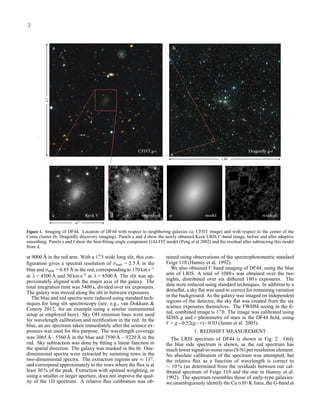
measured from CFHT images (see Fig. 1a).6
The effective
radius was derived by fitting a 2D Sersic profile. The Sersic
index was fixed to n = 1 (exponential) in this fit, as the S/N
in the CFHT images is not sufficiently high to measure n re-
liably (see vD15). In Sect. 4 we update these measurements
using deeper imaging from Keck. As shown in Fig. 1a, DF44
does not have bright neighbors. It is at a projected distance of
1.◦
04 from the center of the cluster, corresponding to 1.8 Mpc
or ∼ 0.6 × R200 (Kubo et al. 2007).
The galaxy was observed 2014 December 18 and 19, using
the Low Resolution Imaging Spectrometer (LRIS; Oke et al.
1995) on the Keck I telescope. Conditions were mostly clear.
The 600 lines mm−1
grism blazed at 4000 Å was used in the
blue arm, and the gold-coated 1200 lines mm−1
grating blazed
6 DF44 is also featured in Fig. 1 of vD15. A careful reader may note that
the location of DF44 within the Coma field appears to be different in that
paper. The apparent location of DF44 in vD15 is, indeed, incorrect; the red
square in the Dragonfly image belongs to another one of the four highlighted
galaxies.
2
Figure 1. Imaging of DF44. Location of DF44 with respect to neighboring galaxies (a; CFHT image) and with respect to the center of the
Coma cluster (b; Dragonfly discovery imaging). Panels c and d show the newly obtained Keck LRIS V-band image, before and after adaptive
smoothing. Panels e and f show the best-fitting single component GALFIT model (Peng et al 2002) and the residual after subtracting this model
from d.
at 9000 Å in the red arm. With a 1.′′
5 wide long slit, this con-
figuration gives a spectral resolution of σinstr = 2.5 Å in the
blue and σinstr = 0.85 Å in the red, corresponding to 170 km s−1
at λ = 4500 Å and 30 km s−1
at λ = 8500 Å. The slit was ap-
proximately aligned with the major axis of the galaxy. The
total integration time was 5400 s, divided over six exposures.
The galaxy was moved along the slit in between exposures.
The blue and red spectra were reduced using standard tech-
niques for long slit spectroscopy (see, e.g., van Dokkum &
Conroy 2012, for an example using a similar instrumental
setup as employed here). Sky OH emission lines were used
for wavelength calibration and rectification in the red. In the
blue, an arc spectrum taken immediately after the science ex-
posures was used for this purpose. The wavelength coverage
was 3065 Å– 5560 Å in the blue and 7590 Å – 9220 Å in the
red. Sky subtraction was done by fitting a linear function in
the spatial direction. The galaxy was masked in the fit. One-
dimensional spectra were extracted by summing rows in the
two-dimensional spectra. The extraction regions are ≈ 11′′
,
and correspond approximately to the rows where the flux is at
least 30 % of the peak. Extraction with optimal weighting, or
using a smaller or larger aperture, does not improve the qual-
ity of the 1D spectrum. A relative flux calibration was ob-
tained using observations of the spectrophotometric standard
Feige 110 (Hamuy et al. 1992).
We also obtained V band imaging of DF44, using the blue
arm of LRIS. A total of 1080 s was obtained over the two
nights, distributed over six dithered 180 s exposures. The
data were reduced using standard techniques. In addition to a
domeflat, a sky flat was used to correct for remaining variation
in the background. As the galaxy was imaged on independent
regions of the detector, the sky flat was created from the six
science exposures themselves. The FWHM seeing in the fi-
nal, combined image is 1.′′
0. The image was calibrated using
SDSS g and r photometry of stars in the DF44 field, using
V = g −0.52(g −r)−0.03 (Jester et al. 2005).
3. REDSHIFT MEASUREMENT
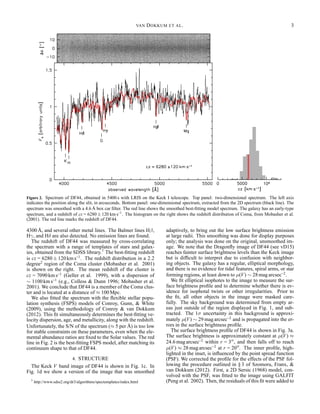
The LRIS spectrum of DF44 is shown in Fig. 2. Only
the blue side spectrum is shown, as the red spectrum has
much lower signal-to-noise ratio (S/N) per resolution element.
No absolute calibration of the spectrum was attempted, but
the relative flux as a function of wavelength is correct to
∼ 10 % (as determined from the residuals between our cal-
ibrated spectrum of Feige 110 and the one in Hamuy et al.
1992). The spectrum resembles those of early-type galaxies:
we unambiguously identify the Ca II H+K lines, the G-band at
VAN DOKKUM ET AL. 3
Figure 2. Spectrum of DF44, obtained in 5400 s with LRIS on the Keck I telescope. Top panel: two-dimensional spectrum. The left axis
indicates the position along the slit, in arcseconds. Bottom panel: one-dimensional spectrum, extracted from the 2D spectrum (black line). The
spectrum was smoothed with a 4.6 Å box car filter. The red line shows the smoothed best-fitting model spectrum. The galaxy has an early-type
spectrum, and a redshift of cz = 6280± 120 km s−1
. The histogram on the right shows the redshift distribution of Coma, from Mobasher et al.
(2001). The red line marks the redshift of DF44.
4300 Å, and several other metal lines. The Balmer lines Hβ,
Hγ, and Hδ are also detected. No emission lines are found.
The redshift of DF44 was measured by cross-correlating
the spectrum with a range of templates of stars and galax-
ies, obtained from the SDSS library.7
The best-fitting redshift
is cz = 6280 ± 120 km s−1
. The redshift distribution in a 2.2
degree2
region of the Coma cluster (Mobasher et al. 2001)
is shown on the right. The mean redshift of the cluster is
cz = 7090 km s−1
(Geller et al. 1999), with a dispersion of
∼ 1100 km s−1
(e.g., Colless & Dunn 1996; Mobasher et al.
2001). We conclude that DF44 is a member of the Coma clus-
ter and is located at a distance of ≈ 100 Mpc.
We also fitted the spectrum with the flexible stellar popu-
lation synthesis (FSPS) models of Conroy, Gunn, & White
(2009), using the methodology of Conroy & van Dokkum
(2012). This fit simultaneously determines the best-fitting ve-
locity dispersion, age, and metallicity, along with the redshift.
Unfortunately, the S/N of the spectrum (≈ 5 per Å) is too low
for stable constraints on these parameters, even when the ele-
mental abundance ratios are fixed to the Solar values. The red
line in Fig. 2 is the best-fitting FSPS model, after matching its
continuum shape to that of DF44.
4. STRUCTURE
The Keck V band image of DF44 is shown in Fig. 1c. In
Fig. 1d we show a version of the image that was smoothed
7 http://www.sdss2.org/dr3/algorithms/spectemplates/index.html
adaptively, to bring out the low surface brightness emission
at large radii. This smoothing was done for display purposes
only; the analysis was done on the original, unsmoothed im-
age. We note that the Dragonfly image of DF44 (see vD15)
reaches fainter surface brightness levels than the Keck image
but is difficult to interpret due to confusion with neighbor-
ing objects. The galaxy has a regular, elliptical morphology,
and there is no evidence for tidal features, spiral arms, or star
forming regions, at least down to µ(V) ∼ 28 mag arcsec−2
.
We fit elliptical isophotes to the image to measure the sur-
face brightness profile and to determine whether there is ev-
idence for isophotal twists or other irregularities. Prior to
the fit, all other objects in the image were masked care-
fully. The sky background was determined from empty ar-
eas just outside of the region displayed in Fig. 1, and sub-
tracted. The 1σ uncertainty in this background is approxi-
mately µ(V) ∼ 29 mag arcsec−2
and is propagated into the er-
rors in the surface brightness profile.
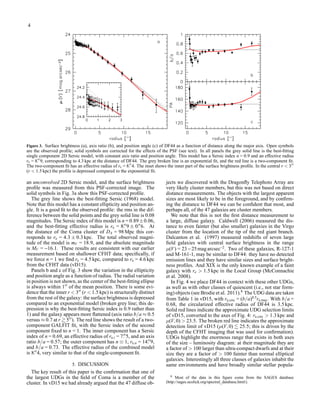
The surface brightness profile of DF44 is shown in Fig. 3a.
The surface brightness is approximately constant at µ(V) ≈
24.6 mag arcsec−2
within r = 3′′
, and then falls off to reach
µ(V) ≈ 28 mag arcsec−2
at r = 20′′
. The inner profile, high-
lighted in the inset, is influenced by the point spread function
(PSF). We corrected the profile for the effects of the PSF fol-
lowing the procedure outlined in § 3 of Szomoru, Franx, &
van Dokkum (2012). First, a 2D Sersic (1968) model, con-
volved with the PSF, was fitted to the image using GALFIT
(Peng et al. 2002). Then, the residuals of this fit were added to
4
Figure 3. Surface brightness (a), axis ratio (b), and position angle (c) of DF44 as a function of distance along the major axis. Open symbols
are the observed profile; solid symbols are corrected for the effects of the PSF (see text). In all panels the grey solid line is the best-fitting
single component 2D Sersic model, with constant axis ratio and position angle. This model has a Sersic index n = 0.9 and an effective radius
re = 8.′′
9, corresponding to 4.3 kpc at the distance of DF44. The grey broken line is an exponential fit, and the red line is a two-component fit.
The two-component fit has an effective radius of re = 8.′′
4. The inset shows the inner part of the surface brightness profile. In the central r < 3′′
(r < 1.5 kpc) the profile is depressed compared to the exponential fit.
an unconvolved 2D Sersic model, and the surface brightness
profile was measured from this PSF-corrected image. The
solid symbols in Fig. 3a show this PSF-corrected profile.
The grey line shows the best-fitting Sersic (1968) model.
Note that this model has a constant ellipticity and position an-
gle. It is a good fit to the observed profile: the rms in the dif-
ference between the solid points and the grey solid line is 0.08
magnitudes. The Sersic index of this model is n = 0.89±0.06,
and the best-fitting effective radius is re = 8.′′
9 ± 0.′′
6. At
the distance of the Coma cluster of DA = 98 Mpc this cor-
responds to re = 4.3 ± 0.3 kpc. The total observed magni-
tude of the model is mV = 18.9, and the absolute magnitude
is MV = −16.1. These results are consistent with our earlier
measurement based on shallower CFHT data; specifically, if
we force n = 1 we find re = 4.5 kpc, compared to re = 4.6 kpc
from the CFHT data (vD15).
Panels b and c of Fig. 3 show the variation in the ellipticity
and position angle as a function of radius. The radial variation
in position is not shown, as the center of the best-fitting ellipse
is always within 1′′
of the mean position. There is some evi-
dence that the inner r < 3′′
(r < 1.5 kpc) is structurally distinct
from the rest of the galaxy: the surface brightness is depressed
compared to an exponential model (broken grey line; this de-
pression is why the best-fitting Sersic index is 0.9 rather than
1) and the galaxy appears more flattened (axis ratio b/a ≈ 0.5
versus ≈ 0.7 at r 5′′
). The red line shows the result of a two-
component GALFIT fit, with the Sersic index of the second
component fixed to n = 1. The inner component has a Sersic
index of n = 0.69, an effective radius of re,i = 7.′′
5, and an axis
ratio b/a = 0.57; the outer component has n ≡ 1, re,o = 14.′′
9,
and b/a = 0.73. The effective radius of the combined model
is 8.′′
4, very similar to that of the single-component fit.
5. DISCUSSION
The key result of this paper is the confirmation that one of
the largest UDGs in the field of Coma is a member of the
cluster. In vD15 we had already argued that the 47 diffuse ob-
jects we discovered with the Dragonfly Telephoto Array are
very likely cluster members, but this was not based on direct
distance measurements. The objects with the largest apparent
sizes are most likely to be in the foreground, and by confirm-
ing the distance to DF44 we can be confident that most, and
perhaps all, of the 47 galaxies are cluster members.
We note that this is not the first distance measurement to
a large, diffuse galaxy. Caldwell (2006) measured the dis-
tance to even fainter (but also smaller) galaxies in the Virgo
cluster from the location of the tip of the red giant branch.
Dalcanton et al. (1997) measured redshifts of seven large
field galaxies with central surface brightness in the range
µ(V) = 23 − 25mag arcsec−2
. Two of these galaxies, R-127-1
and M-161-1, may be similar to DF44: they have no detected
emission lines and they have similar sizes and surface bright-
ness profiles. And XIX is the only known example of a faint
galaxy with re > 1.5 kpc in the Local Group (McConnachie
et al. 2008).
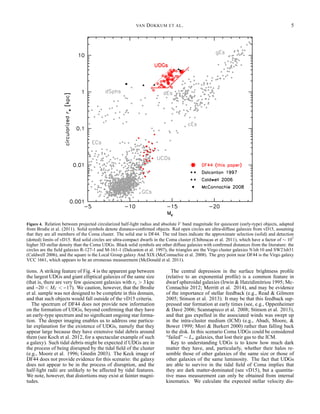
In Fig. 4 we place DF44 in context with these other UDGs,
as well as with other classes of quiescent (i.e., not star form-
ing) objects (see Brodie et al. 2011).8
The UDG data are taken
from Table 1 in vD15, with re,circ = (b/a)0.5
re,maj. With b/a =
0.68, the circularized effective radius of DF44 is 3.5 kpc.
Solid red lines indicate the approximate UDG selection limits
of vD15, converted to the axes of Fig. 4: re,circ > 1.3 kpc and
µ(V,0) > 23.5. The broken red line indicates the approximate
detection limit of vD15 (µ(V,0) 25.5; this is driven by the
depth of the CFHT imaging that was used for confirmation).
UDGs highlight the enormous range that exists in both axes
of the size – luminosity diagram: at their magnitude they are
a factor of > 100 larger than ultra-compact dwarfs and at their
size they are a factor of > 100 fainter than normal elliptical
galaxies. Interestingly all three classes of galaxies inhabit the
same environments and have broadly similar stellar popula-
8 Most of the data in this figure come from the SAGES database
(http://sages.ucolick.org/spectral_database.html).
VAN DOKKUM ET AL. 5
Figure 4. Relation between projected circularized half-light radius and absolute V band magnitude for quiescent (early-type) objects, adapted
from Brodie et al. (2011). Solid symbols denote distance-confirmed objects. Red open circles are ultra-diffuse galaxies from vD15, assuming
that they are all members of the Coma cluster. The solid star is DF44. The red lines indicate the approximate selection (solid) and detection
(dotted) limits of vD15. Red solid circles are ultra-compact dwarfs in the Coma cluster (Chiboucas et al. 2011), which have a factor of ∼ 107
higher 3D stellar density than the Coma UDGs. Black solid symbols are other diffuse galaxies with confirmed distances from the literature: the
circles are the field galaxies R-127-1 and M-161-1 (Dalcanton et al. 1997), the triangles are the Virgo cluster galaxies N lsb 10 and SW2lsb31
(Caldwell 2006), and the square is the Local Group galaxy And XIX (McConnachie et al. 2008). The grey point near DF44 is the Virgo galaxy
VCC 1661, which appears to be an erroneous measurement (McDonald et al. 2011).
tions. A striking feature of Fig. 4 is the apparent gap between
the largest UDGs and giant elliptical galaxies of the same size
(that is, there are very few quiescent galaxies with re > 3 kpc
and −20 < MV < −17). We caution, however, that the Brodie
et al. sample was not designed to be complete in this domain,
and that such objects would fall outside of the vD15 criteria.
The spectrum of DF44 does not provide new information
on the formation of UDGs, beyond confirming that they have
an early-type spectrum and no significant ongoing star forma-
tion. The deeper imaging enables us to address one particu-
lar explanation for the existence of UDGs, namely that they
appear large because they have extensive tidal debris around
them (see Koch et al. 2012, for a spectacular example of such
a galaxy). Such tidal debris might be expected if UDGs are in
the process of being disrupted by the tidal field of the cluster
(e.g., Moore et al. 1996; Gnedin 2003). The Keck image of
DF44 does not provide evidence for this scenario: the galaxy
does not appear to be in the process of disruption, and the
half-light radii are unlikely to be affected by tidal features.
We note, however, that distortions may exist at fainter magni-
tudes.
The central depression in the surface brightness profile
(relative to an exponential profile) is a common feature in
dwarf spheroidal galaxies (Irwin & Hatzidimitriou 1995; Mc-
Connachie 2012; Merritt et al. 2014), and may be evidence
of the importance of stellar feedback (e.g., Read & Gilmore
2005; Stinson et al. 2013). It may be that this feedback sup-
pressed star formation at early times (see, e.g., Oppenheimer
& Davé 2006; Scannapieco et al. 2008; Stinson et al. 2013),
and that gas expelled in the associated winds was swept up
in the intra-cluster medium (ICM) (e.g., Abadi, Moore, &
Bower 1999; Mori & Burkert 2000) rather than falling back
to the disk. In this scenario Coma UDGs could be considered
“failed” ∼ L∗ galaxies, that lost their gas to the ICM.
Key to understanding UDGs is to know how much dark
matter they have, and, particularly, whether their halos re-
semble those of other galaxies of the same size or those of
other galaxies of the same luminosity. The fact that UDGs
are able to survive in the tidal field of Coma implies that
they are dark matter-dominated (see vD15), but a quantita-
tive mass measurement can only be obtained from internal
kinematics. We calculate the expected stellar velocity dis-
6
persion as a function of radius using simple spherical mass
models with stars and Navarro, Frenk, & White (1997) dark
matter halos, and a correlation between dark matter density
and scale radius as in Spitler et al. (2012). If the dark matter
halos of UDGs are similar to those of dwarf galaxies (with as-
sumed Mvir = 6×10¹⁰
M⊙) their luminosity-weighted velocity
dispersions are expected to be ∼ 35 km s−1
within the stellar
effective radius. By contrast, if their halos are similar to those
of L∗ galaxies (with assumed Mvir = 1.8×10¹²
M⊙), their dis-
persions are ∼ 60 km s−1
.9
In this paper we have shown what
can be achieved in 1.5 hrs with a traditional long-slit spectro-
graph on a large telescope. Using long exposure times with
low surface brightness-optimized integral field units (such as
the planned Keck Cosmic Web Imager; Martin et al. 2010),
it should be possible to measure dynamical masses, ages, and
metallicities of these enigmatic objects.
We thank Nicola Pastorello for an independent check of
the redshift measurement. Support from NSF grants AST-
1312376, AST-1109878, and AST-1211995 is gratefully ac-
knowledged. We also acknowledge the support of the Dun-
lap Institute, funded through an endowment established by the
David Dunlap family and the University of Toronto.
REFERENCES
Abadi, M. G., Moore, B., & Bower, R. G. 1999, MNRAS, 308, 947
Abraham, R. G. & van Dokkum, P. G. 2014, PASP, 126, 55
Brodie, J. P., Romanowsky, A. J., Strader, J., & Forbes, D. A. 2011, AJ, 142,
199
Caldwell, N. 2006, ApJ, 651, 822
Chiboucas, K., Tully, R. B., Marzke, R. O., Phillipps, S., Price, J., Peng,
E. W., Trentham, N., Carter, D., et al. 2011, ApJ, 737, 86
Colless, M. & Dunn, A. M. 1996, ApJ, 458, 435
Conroy, C., Gunn, J. E., & White, M. 2009, ApJ, 699, 486
Conroy, C. & van Dokkum, P. 2012, ApJ, 747, 69
Dalcanton, J. J., Spergel, D. N., Gunn, J. E., Schmidt, M., & Schneider, D. P.
1997, AJ, 114, 635
Geller, M. J., Diaferio, A., & Kurtz, M. J. 1999, ApJ, 517, L23
Gnedin, O. Y. 2003, ApJ, 589, 752
Hamuy, M., Walker, A. R., Suntzeff, N. B., Gigoux, P., Heathcote, S. R., &
Phillips, M. M. 1992, PASP, 104, 533
Irwin, M. & Hatzidimitriou, D. 1995, MNRAS, 277, 1354
Jester, S., Schneider, D. P., Richards, G. T., Green, R. F., Schmidt, M., Hall,
P. B., Strauss, M. A., Vanden Berk, D. E., et al. 2005, AJ, 130, 873
Koch, A., Burkert, A., Rich, R. M., Collins, M. L. M., Black, C. S., Hilker,
M., & Benson, A. J. 2012, ApJ, 755, L13
Kubo, J. M., Stebbins, A., Annis, J., Dell’Antonio, I. P., Lin, H., Khiabanian,
H., & Frieman, J. A. 2007, ApJ, 671, 1466
Martin, C., Moore, A., Morrissey, P., Matuszewski, M., Rahman, S., Adkins,
S., & Epps, H. 2010, in Society of Photo-Optical Instrumentation
Engineers (SPIE) Conference Series, Vol. 7735, Society of Photo-Optical
Instrumentation Engineers (SPIE) Conference Series, 0
McConnachie, A. W. 2012, AJ, 144, 4
McConnachie, A. W., Huxor, A., Martin, N. F., Irwin, M. J., Chapman, S. C.,
Fahlman, G., Ferguson, A. M. N., Ibata, R. A., et al. 2008, ApJ, 688, 1009
McDonald, M., Courteau, S., Tully, R. B., & Roediger, J. 2011, MNRAS,
414, 2055
Merritt, A., van Dokkum, P., & Abraham, R. 2014, ApJ, 787, L37
Mobasher, B., Bridges, T. J., Carter, D., Poggianti, B. M., Komiyama, Y.,
Kashikawa, N., Doi, M., Iye, M., et al. 2001, ApJS, 137, 279
Moore, B., Katz, N., Lake, G., Dressler, A., & Oemler, A. 1996, Nature, 379,
613
Mori, M. & Burkert, A. 2000, ApJ, 538, 559
Navarro, J. F., Frenk, C. S., & White, S. D. M. 1997, ApJ, 490, 493
Oke, J. B., Cohen, J. G., Carr, M., Cromer, J., Dingizian, A., Harris, F. H.,
Labrecque, S., Lucinio, R., et al. 1995, PASP, 107, 375
Oppenheimer, B. D. & Davé, R. 2006, MNRAS, 373, 1265
Peng, C. Y., Ho, L. C., Impey, C. D., & Rix, H.-W. 2002, AJ, 124, 266
Read, J. I. & Gilmore, G. 2005, MNRAS, 356, 107
Scannapieco, C., Tissera, P. B., White, S. D. M., & Springel, V. 2008,
MNRAS, 389, 1137
Sersic, J. L. 1968, Atlas de galaxias australes (Cordoba, Argentina:
Observatorio Astronomico, 1968)
Spitler, L. R., Romanowsky, A. J., Diemand, J., Strader, J., Forbes, D. A.,
Moore, B., & Brodie, J. P. 2012, MNRAS, 423, 2177
Stinson, G. S., Brook, C., Macciò, A. V., Wadsley, J., Quinn, T. R., &
Couchman, H. M. P. 2013, MNRAS, 428, 129
Szomoru, D., Franx, M., & van Dokkum, P. G. 2012, ApJ, 749, 121
van Dokkum, P. G., Abraham, R., Merritt, A., Zhang, J., Geha, M., & Conroy,
C. 2015, ApJ, 798, L45
van Dokkum, P. G. & Conroy, C. 2012, ApJ, 760, 70
9 In either scenario the stellar mass does not contribute to the mea- sured dispersion; the stars-only expectation for the velocity dispersion is
∼ 7 km s−1, for Mstars/LV = 1.3.

Spectroscopic confirmation of_the_existence_of_large_diffuse_galaxies_in_the_coma_cluster

  • 1.
    arXiv:1504.03320v1[astro-ph.GA]13Apr2015 DRAFT VERSION APRIL15, 2015 Preprint typeset using LATEX style emulateapj v. 12/16/11 SPECTROSCOPIC CONFIRMATION OF THE EXISTENCE OF LARGE, DIFFUSE GALAXIES IN THE COMA CLUSTER PIETER G. VAN DOKKUM 1 , AARON J. ROMANOWSKY 2,3 , ROBERTO ABRAHAM 4 , JEAN P. BRODIE 3 , CHARLIE CONROY 5 , MARLA GEHA 1 , ALLISON MERRITT 1 , ALEXA VILLAUME 3 , JIELAI ZHANG 4 Draft version April 15, 2015 ABSTRACT We recently identified a population of low surface brightness objects in the field of the z = 0.023 Coma cluster, using the Dragonfly Telephoto Array. Here we present Keck spectroscopy of one of the largest of these “ultra- diffuse galaxies” (UDGs), confirming that it is a member of the cluster. The galaxy has prominent absorption features, including the Ca II H+K lines and the G-band, and no detected emission lines. Its radial velocity of cz = 6280±120km/s is within the 1σ velocity dispersion of the Coma cluster. The galaxy has an effective radius of 4.3 ± 0.3kpc and a Sersic index of 0.89 ± 0.06, as measured from Keck imaging. We find no indications of tidal tails or other distortions, at least out to a radius of ∼ 2re. We show that UDGs are located in a previously sparsely populated region of the size – magnitude plane of quiescent stellar systems, as they are ∼ 6 magnitudes fainter than normal early-type galaxies of the same size. It appears that the luminosity distribution of large quiescent galaxies is not continuous, although this could largely be due to selection effects. Dynamical measurements are needed to determine whether the dark matter halos of UDGs are similar to those of galaxies with the same luminosity or to those of galaxies with the same size. Keywords: galaxies: clusters: individual (Coma) — galaxies: evolution — galaxies: structure 1. INTRODUCTION In the Spring of 2014 we obtained wide-field (3◦ × 3◦ ) observations of the Coma cluster with the Dragonfly Tele- photo Array (Abraham & van Dokkum 2014). These images have low spatial resolution (≈ 6′′ ), but reach surface bright- ness limits of µ(g) ∼ 29.3 mag arcsec−2 . We found a popu- lation of spatially-extended, low surface brightness objects in these images (van Dokkum et al. 2015). After combin- ing the data with higher resolution imaging from the Sloan Digital Sky Survey (SDSS) and the Canada France Hawaii Telescope (CFHT), we identified 47 objects with effective radii in the range re = 3′′ −10′′ and central surface brightness µ(g,0) = 24 −26mag arcsec−2 . Based on the spatial distribution of the objects, and the smooth appearance of one of them in a deep Hubble Space Telescope Advanced Camera for Surveys image, we con- cluded that they are probably galaxies in the Coma cluster. The Coma cluster has a radial velocity of cz = 7090 km s−1 (Geller, Diaferio, & Kurtz 1999), and for a Hubble con- stant of 70 km s−1 Mpc−1 this implies a distance of ≈ 100 Mpc (DA = 98 Mpc and DL = 103 Mpc). This distance places the galaxies in an interesting region of parameter space: with ef- fective radii of reff = 1.5 kpc – 4.6 kpc their sizes are similar to those of ∼ L∗ galaxies, even though their luminosities, col- ors, axis ratios, and Sersic (1968) indices are similar to those of dwarf spheroidal galaxies. In van Dokkum et al. (2015) [vD15] we used the term “ultra-diffuse galaxies”, or UDGs, to distinguish these large, relatively round, diffuse objects from the general classes of dwarf galaxies and low surface bright- 1 Department of Astronomy, Yale University, New Haven, CT 06511, USA 2 Department of Physics and Astronomy, San José State University, San Jose, CA 95192, USA 3 University of California Observatories, 1156 High Street, Santa Cruz, CA 95064, USA 4 Department of Astronomy & Astrophysics, University of Toronto, 50 St. George St., Toronto, ON M5S 3H4 Canada 5 Harvard-Smithsonian Center for Astrophysics, 60 Garden St., Cam- bridge, MA, USA ness galaxies. Although it is plausible that most or all of the 47 galaxies are indeed Coma cluster members, this can only be confirmed with secure distance measurements. This is particularly im- portant for the largest galaxies: it may be that only the galax- ies with the smallest apparent sizes are at ∼ 100 Mpc, and that the largest ones are considerably closer (see, e.g., Merritt, van Dokkum, & Abraham 2014). Here we present spectroscopy and imaging with the 10 m W.M. Keck Observatory of the largest galaxy in the vD15 sample, DF44. The goal of the spectroscopy is to test whether the galaxy is, in fact, in the Coma cluster. The imaging provides improved measurements of its morphology and structural parameters. 2. OBSERVATIONS AND REDUCTION Galaxy DF44 (α = 13h 00m 58.0s ; δ = 26◦ 58′ 35′′ ) was cho- sen because it is the largest (and second-brightest) galaxy in the sample of vD15. It has a major-axis effective radius of 9.′′ 8 and an integrated apparent magnitude of mg = 19.4, as measured from CFHT images (see Fig. 1a).6 The effective radius was derived by fitting a 2D Sersic profile. The Sersic index was fixed to n = 1 (exponential) in this fit, as the S/N in the CFHT images is not sufficiently high to measure n re- liably (see vD15). In Sect. 4 we update these measurements using deeper imaging from Keck. As shown in Fig. 1a, DF44 does not have bright neighbors. It is at a projected distance of 1.◦ 04 from the center of the cluster, corresponding to 1.8 Mpc or ∼ 0.6 × R200 (Kubo et al. 2007). The galaxy was observed 2014 December 18 and 19, using the Low Resolution Imaging Spectrometer (LRIS; Oke et al. 1995) on the Keck I telescope. Conditions were mostly clear. The 600 lines mm−1 grism blazed at 4000 Å was used in the blue arm, and the gold-coated 1200 lines mm−1 grating blazed 6 DF44 is also featured in Fig. 1 of vD15. A careful reader may note that the location of DF44 within the Coma field appears to be different in that paper. The apparent location of DF44 in vD15 is, indeed, incorrect; the red square in the Dragonfly image belongs to another one of the four highlighted galaxies.
  • 2.
    2 Figure 1. Imagingof DF44. Location of DF44 with respect to neighboring galaxies (a; CFHT image) and with respect to the center of the Coma cluster (b; Dragonfly discovery imaging). Panels c and d show the newly obtained Keck LRIS V-band image, before and after adaptive smoothing. Panels e and f show the best-fitting single component GALFIT model (Peng et al 2002) and the residual after subtracting this model from d. at 9000 Å in the red arm. With a 1.′′ 5 wide long slit, this con- figuration gives a spectral resolution of σinstr = 2.5 Å in the blue and σinstr = 0.85 Å in the red, corresponding to 170 km s−1 at λ = 4500 Å and 30 km s−1 at λ = 8500 Å. The slit was ap- proximately aligned with the major axis of the galaxy. The total integration time was 5400 s, divided over six exposures. The galaxy was moved along the slit in between exposures. The blue and red spectra were reduced using standard tech- niques for long slit spectroscopy (see, e.g., van Dokkum & Conroy 2012, for an example using a similar instrumental setup as employed here). Sky OH emission lines were used for wavelength calibration and rectification in the red. In the blue, an arc spectrum taken immediately after the science ex- posures was used for this purpose. The wavelength coverage was 3065 Å– 5560 Å in the blue and 7590 Å – 9220 Å in the red. Sky subtraction was done by fitting a linear function in the spatial direction. The galaxy was masked in the fit. One- dimensional spectra were extracted by summing rows in the two-dimensional spectra. The extraction regions are ≈ 11′′ , and correspond approximately to the rows where the flux is at least 30 % of the peak. Extraction with optimal weighting, or using a smaller or larger aperture, does not improve the qual- ity of the 1D spectrum. A relative flux calibration was ob- tained using observations of the spectrophotometric standard Feige 110 (Hamuy et al. 1992). We also obtained V band imaging of DF44, using the blue arm of LRIS. A total of 1080 s was obtained over the two nights, distributed over six dithered 180 s exposures. The data were reduced using standard techniques. In addition to a domeflat, a sky flat was used to correct for remaining variation in the background. As the galaxy was imaged on independent regions of the detector, the sky flat was created from the six science exposures themselves. The FWHM seeing in the fi- nal, combined image is 1.′′ 0. The image was calibrated using SDSS g and r photometry of stars in the DF44 field, using V = g −0.52(g −r)−0.03 (Jester et al. 2005). 3. REDSHIFT MEASUREMENT The LRIS spectrum of DF44 is shown in Fig. 2. Only the blue side spectrum is shown, as the red spectrum has much lower signal-to-noise ratio (S/N) per resolution element. No absolute calibration of the spectrum was attempted, but the relative flux as a function of wavelength is correct to ∼ 10 % (as determined from the residuals between our cal- ibrated spectrum of Feige 110 and the one in Hamuy et al. 1992). The spectrum resembles those of early-type galaxies: we unambiguously identify the Ca II H+K lines, the G-band at
  • 3.
    VAN DOKKUM ETAL. 3 Figure 2. Spectrum of DF44, obtained in 5400 s with LRIS on the Keck I telescope. Top panel: two-dimensional spectrum. The left axis indicates the position along the slit, in arcseconds. Bottom panel: one-dimensional spectrum, extracted from the 2D spectrum (black line). The spectrum was smoothed with a 4.6 Å box car filter. The red line shows the smoothed best-fitting model spectrum. The galaxy has an early-type spectrum, and a redshift of cz = 6280± 120 km s−1 . The histogram on the right shows the redshift distribution of Coma, from Mobasher et al. (2001). The red line marks the redshift of DF44. 4300 Å, and several other metal lines. The Balmer lines Hβ, Hγ, and Hδ are also detected. No emission lines are found. The redshift of DF44 was measured by cross-correlating the spectrum with a range of templates of stars and galax- ies, obtained from the SDSS library.7 The best-fitting redshift is cz = 6280 ± 120 km s−1 . The redshift distribution in a 2.2 degree2 region of the Coma cluster (Mobasher et al. 2001) is shown on the right. The mean redshift of the cluster is cz = 7090 km s−1 (Geller et al. 1999), with a dispersion of ∼ 1100 km s−1 (e.g., Colless & Dunn 1996; Mobasher et al. 2001). We conclude that DF44 is a member of the Coma clus- ter and is located at a distance of ≈ 100 Mpc. We also fitted the spectrum with the flexible stellar popu- lation synthesis (FSPS) models of Conroy, Gunn, & White (2009), using the methodology of Conroy & van Dokkum (2012). This fit simultaneously determines the best-fitting ve- locity dispersion, age, and metallicity, along with the redshift. Unfortunately, the S/N of the spectrum (≈ 5 per Å) is too low for stable constraints on these parameters, even when the ele- mental abundance ratios are fixed to the Solar values. The red line in Fig. 2 is the best-fitting FSPS model, after matching its continuum shape to that of DF44. 4. STRUCTURE The Keck V band image of DF44 is shown in Fig. 1c. In Fig. 1d we show a version of the image that was smoothed 7 http://www.sdss2.org/dr3/algorithms/spectemplates/index.html adaptively, to bring out the low surface brightness emission at large radii. This smoothing was done for display purposes only; the analysis was done on the original, unsmoothed im- age. We note that the Dragonfly image of DF44 (see vD15) reaches fainter surface brightness levels than the Keck image but is difficult to interpret due to confusion with neighbor- ing objects. The galaxy has a regular, elliptical morphology, and there is no evidence for tidal features, spiral arms, or star forming regions, at least down to µ(V) ∼ 28 mag arcsec−2 . We fit elliptical isophotes to the image to measure the sur- face brightness profile and to determine whether there is ev- idence for isophotal twists or other irregularities. Prior to the fit, all other objects in the image were masked care- fully. The sky background was determined from empty ar- eas just outside of the region displayed in Fig. 1, and sub- tracted. The 1σ uncertainty in this background is approxi- mately µ(V) ∼ 29 mag arcsec−2 and is propagated into the er- rors in the surface brightness profile. The surface brightness profile of DF44 is shown in Fig. 3a. The surface brightness is approximately constant at µ(V) ≈ 24.6 mag arcsec−2 within r = 3′′ , and then falls off to reach µ(V) ≈ 28 mag arcsec−2 at r = 20′′ . The inner profile, high- lighted in the inset, is influenced by the point spread function (PSF). We corrected the profile for the effects of the PSF fol- lowing the procedure outlined in § 3 of Szomoru, Franx, & van Dokkum (2012). First, a 2D Sersic (1968) model, con- volved with the PSF, was fitted to the image using GALFIT (Peng et al. 2002). Then, the residuals of this fit were added to
  • 4.
    4 Figure 3. Surfacebrightness (a), axis ratio (b), and position angle (c) of DF44 as a function of distance along the major axis. Open symbols are the observed profile; solid symbols are corrected for the effects of the PSF (see text). In all panels the grey solid line is the best-fitting single component 2D Sersic model, with constant axis ratio and position angle. This model has a Sersic index n = 0.9 and an effective radius re = 8.′′ 9, corresponding to 4.3 kpc at the distance of DF44. The grey broken line is an exponential fit, and the red line is a two-component fit. The two-component fit has an effective radius of re = 8.′′ 4. The inset shows the inner part of the surface brightness profile. In the central r < 3′′ (r < 1.5 kpc) the profile is depressed compared to the exponential fit. an unconvolved 2D Sersic model, and the surface brightness profile was measured from this PSF-corrected image. The solid symbols in Fig. 3a show this PSF-corrected profile. The grey line shows the best-fitting Sersic (1968) model. Note that this model has a constant ellipticity and position an- gle. It is a good fit to the observed profile: the rms in the dif- ference between the solid points and the grey solid line is 0.08 magnitudes. The Sersic index of this model is n = 0.89±0.06, and the best-fitting effective radius is re = 8.′′ 9 ± 0.′′ 6. At the distance of the Coma cluster of DA = 98 Mpc this cor- responds to re = 4.3 ± 0.3 kpc. The total observed magni- tude of the model is mV = 18.9, and the absolute magnitude is MV = −16.1. These results are consistent with our earlier measurement based on shallower CFHT data; specifically, if we force n = 1 we find re = 4.5 kpc, compared to re = 4.6 kpc from the CFHT data (vD15). Panels b and c of Fig. 3 show the variation in the ellipticity and position angle as a function of radius. The radial variation in position is not shown, as the center of the best-fitting ellipse is always within 1′′ of the mean position. There is some evi- dence that the inner r < 3′′ (r < 1.5 kpc) is structurally distinct from the rest of the galaxy: the surface brightness is depressed compared to an exponential model (broken grey line; this de- pression is why the best-fitting Sersic index is 0.9 rather than 1) and the galaxy appears more flattened (axis ratio b/a ≈ 0.5 versus ≈ 0.7 at r 5′′ ). The red line shows the result of a two- component GALFIT fit, with the Sersic index of the second component fixed to n = 1. The inner component has a Sersic index of n = 0.69, an effective radius of re,i = 7.′′ 5, and an axis ratio b/a = 0.57; the outer component has n ≡ 1, re,o = 14.′′ 9, and b/a = 0.73. The effective radius of the combined model is 8.′′ 4, very similar to that of the single-component fit. 5. DISCUSSION The key result of this paper is the confirmation that one of the largest UDGs in the field of Coma is a member of the cluster. In vD15 we had already argued that the 47 diffuse ob- jects we discovered with the Dragonfly Telephoto Array are very likely cluster members, but this was not based on direct distance measurements. The objects with the largest apparent sizes are most likely to be in the foreground, and by confirm- ing the distance to DF44 we can be confident that most, and perhaps all, of the 47 galaxies are cluster members. We note that this is not the first distance measurement to a large, diffuse galaxy. Caldwell (2006) measured the dis- tance to even fainter (but also smaller) galaxies in the Virgo cluster from the location of the tip of the red giant branch. Dalcanton et al. (1997) measured redshifts of seven large field galaxies with central surface brightness in the range µ(V) = 23 − 25mag arcsec−2 . Two of these galaxies, R-127-1 and M-161-1, may be similar to DF44: they have no detected emission lines and they have similar sizes and surface bright- ness profiles. And XIX is the only known example of a faint galaxy with re > 1.5 kpc in the Local Group (McConnachie et al. 2008). In Fig. 4 we place DF44 in context with these other UDGs, as well as with other classes of quiescent (i.e., not star form- ing) objects (see Brodie et al. 2011).8 The UDG data are taken from Table 1 in vD15, with re,circ = (b/a)0.5 re,maj. With b/a = 0.68, the circularized effective radius of DF44 is 3.5 kpc. Solid red lines indicate the approximate UDG selection limits of vD15, converted to the axes of Fig. 4: re,circ > 1.3 kpc and µ(V,0) > 23.5. The broken red line indicates the approximate detection limit of vD15 (µ(V,0) 25.5; this is driven by the depth of the CFHT imaging that was used for confirmation). UDGs highlight the enormous range that exists in both axes of the size – luminosity diagram: at their magnitude they are a factor of > 100 larger than ultra-compact dwarfs and at their size they are a factor of > 100 fainter than normal elliptical galaxies. Interestingly all three classes of galaxies inhabit the same environments and have broadly similar stellar popula- 8 Most of the data in this figure come from the SAGES database (http://sages.ucolick.org/spectral_database.html).
  • 5.
    VAN DOKKUM ETAL. 5 Figure 4. Relation between projected circularized half-light radius and absolute V band magnitude for quiescent (early-type) objects, adapted from Brodie et al. (2011). Solid symbols denote distance-confirmed objects. Red open circles are ultra-diffuse galaxies from vD15, assuming that they are all members of the Coma cluster. The solid star is DF44. The red lines indicate the approximate selection (solid) and detection (dotted) limits of vD15. Red solid circles are ultra-compact dwarfs in the Coma cluster (Chiboucas et al. 2011), which have a factor of ∼ 107 higher 3D stellar density than the Coma UDGs. Black solid symbols are other diffuse galaxies with confirmed distances from the literature: the circles are the field galaxies R-127-1 and M-161-1 (Dalcanton et al. 1997), the triangles are the Virgo cluster galaxies N lsb 10 and SW2lsb31 (Caldwell 2006), and the square is the Local Group galaxy And XIX (McConnachie et al. 2008). The grey point near DF44 is the Virgo galaxy VCC 1661, which appears to be an erroneous measurement (McDonald et al. 2011). tions. A striking feature of Fig. 4 is the apparent gap between the largest UDGs and giant elliptical galaxies of the same size (that is, there are very few quiescent galaxies with re > 3 kpc and −20 < MV < −17). We caution, however, that the Brodie et al. sample was not designed to be complete in this domain, and that such objects would fall outside of the vD15 criteria. The spectrum of DF44 does not provide new information on the formation of UDGs, beyond confirming that they have an early-type spectrum and no significant ongoing star forma- tion. The deeper imaging enables us to address one particu- lar explanation for the existence of UDGs, namely that they appear large because they have extensive tidal debris around them (see Koch et al. 2012, for a spectacular example of such a galaxy). Such tidal debris might be expected if UDGs are in the process of being disrupted by the tidal field of the cluster (e.g., Moore et al. 1996; Gnedin 2003). The Keck image of DF44 does not provide evidence for this scenario: the galaxy does not appear to be in the process of disruption, and the half-light radii are unlikely to be affected by tidal features. We note, however, that distortions may exist at fainter magni- tudes. The central depression in the surface brightness profile (relative to an exponential profile) is a common feature in dwarf spheroidal galaxies (Irwin & Hatzidimitriou 1995; Mc- Connachie 2012; Merritt et al. 2014), and may be evidence of the importance of stellar feedback (e.g., Read & Gilmore 2005; Stinson et al. 2013). It may be that this feedback sup- pressed star formation at early times (see, e.g., Oppenheimer & Davé 2006; Scannapieco et al. 2008; Stinson et al. 2013), and that gas expelled in the associated winds was swept up in the intra-cluster medium (ICM) (e.g., Abadi, Moore, & Bower 1999; Mori & Burkert 2000) rather than falling back to the disk. In this scenario Coma UDGs could be considered “failed” ∼ L∗ galaxies, that lost their gas to the ICM. Key to understanding UDGs is to know how much dark matter they have, and, particularly, whether their halos re- semble those of other galaxies of the same size or those of other galaxies of the same luminosity. The fact that UDGs are able to survive in the tidal field of Coma implies that they are dark matter-dominated (see vD15), but a quantita- tive mass measurement can only be obtained from internal kinematics. We calculate the expected stellar velocity dis-
  • 6.
    6 persion as afunction of radius using simple spherical mass models with stars and Navarro, Frenk, & White (1997) dark matter halos, and a correlation between dark matter density and scale radius as in Spitler et al. (2012). If the dark matter halos of UDGs are similar to those of dwarf galaxies (with as- sumed Mvir = 6×10¹⁰ M⊙) their luminosity-weighted velocity dispersions are expected to be ∼ 35 km s−1 within the stellar effective radius. By contrast, if their halos are similar to those of L∗ galaxies (with assumed Mvir = 1.8×10¹² M⊙), their dis- persions are ∼ 60 km s−1 .9 In this paper we have shown what can be achieved in 1.5 hrs with a traditional long-slit spectro- graph on a large telescope. Using long exposure times with low surface brightness-optimized integral field units (such as the planned Keck Cosmic Web Imager; Martin et al. 2010), it should be possible to measure dynamical masses, ages, and metallicities of these enigmatic objects. We thank Nicola Pastorello for an independent check of the redshift measurement. Support from NSF grants AST- 1312376, AST-1109878, and AST-1211995 is gratefully ac- knowledged. We also acknowledge the support of the Dun- lap Institute, funded through an endowment established by the David Dunlap family and the University of Toronto. REFERENCES Abadi, M. G., Moore, B., & Bower, R. G. 1999, MNRAS, 308, 947 Abraham, R. G. & van Dokkum, P. G. 2014, PASP, 126, 55 Brodie, J. P., Romanowsky, A. J., Strader, J., & Forbes, D. A. 2011, AJ, 142, 199 Caldwell, N. 2006, ApJ, 651, 822 Chiboucas, K., Tully, R. B., Marzke, R. O., Phillipps, S., Price, J., Peng, E. W., Trentham, N., Carter, D., et al. 2011, ApJ, 737, 86 Colless, M. & Dunn, A. M. 1996, ApJ, 458, 435 Conroy, C., Gunn, J. E., & White, M. 2009, ApJ, 699, 486 Conroy, C. & van Dokkum, P. 2012, ApJ, 747, 69 Dalcanton, J. J., Spergel, D. N., Gunn, J. E., Schmidt, M., & Schneider, D. P. 1997, AJ, 114, 635 Geller, M. J., Diaferio, A., & Kurtz, M. J. 1999, ApJ, 517, L23 Gnedin, O. Y. 2003, ApJ, 589, 752 Hamuy, M., Walker, A. R., Suntzeff, N. B., Gigoux, P., Heathcote, S. R., & Phillips, M. M. 1992, PASP, 104, 533 Irwin, M. & Hatzidimitriou, D. 1995, MNRAS, 277, 1354 Jester, S., Schneider, D. P., Richards, G. T., Green, R. F., Schmidt, M., Hall, P. B., Strauss, M. A., Vanden Berk, D. E., et al. 2005, AJ, 130, 873 Koch, A., Burkert, A., Rich, R. M., Collins, M. L. M., Black, C. S., Hilker, M., & Benson, A. J. 2012, ApJ, 755, L13 Kubo, J. M., Stebbins, A., Annis, J., Dell’Antonio, I. P., Lin, H., Khiabanian, H., & Frieman, J. A. 2007, ApJ, 671, 1466 Martin, C., Moore, A., Morrissey, P., Matuszewski, M., Rahman, S., Adkins, S., & Epps, H. 2010, in Society of Photo-Optical Instrumentation Engineers (SPIE) Conference Series, Vol. 7735, Society of Photo-Optical Instrumentation Engineers (SPIE) Conference Series, 0 McConnachie, A. W. 2012, AJ, 144, 4 McConnachie, A. W., Huxor, A., Martin, N. F., Irwin, M. J., Chapman, S. C., Fahlman, G., Ferguson, A. M. N., Ibata, R. A., et al. 2008, ApJ, 688, 1009 McDonald, M., Courteau, S., Tully, R. B., & Roediger, J. 2011, MNRAS, 414, 2055 Merritt, A., van Dokkum, P., & Abraham, R. 2014, ApJ, 787, L37 Mobasher, B., Bridges, T. J., Carter, D., Poggianti, B. M., Komiyama, Y., Kashikawa, N., Doi, M., Iye, M., et al. 2001, ApJS, 137, 279 Moore, B., Katz, N., Lake, G., Dressler, A., & Oemler, A. 1996, Nature, 379, 613 Mori, M. & Burkert, A. 2000, ApJ, 538, 559 Navarro, J. F., Frenk, C. S., & White, S. D. M. 1997, ApJ, 490, 493 Oke, J. B., Cohen, J. G., Carr, M., Cromer, J., Dingizian, A., Harris, F. H., Labrecque, S., Lucinio, R., et al. 1995, PASP, 107, 375 Oppenheimer, B. D. & Davé, R. 2006, MNRAS, 373, 1265 Peng, C. Y., Ho, L. C., Impey, C. D., & Rix, H.-W. 2002, AJ, 124, 266 Read, J. I. & Gilmore, G. 2005, MNRAS, 356, 107 Scannapieco, C., Tissera, P. B., White, S. D. M., & Springel, V. 2008, MNRAS, 389, 1137 Sersic, J. L. 1968, Atlas de galaxias australes (Cordoba, Argentina: Observatorio Astronomico, 1968) Spitler, L. R., Romanowsky, A. J., Diemand, J., Strader, J., Forbes, D. A., Moore, B., & Brodie, J. P. 2012, MNRAS, 423, 2177 Stinson, G. S., Brook, C., Macciò, A. V., Wadsley, J., Quinn, T. R., & Couchman, H. M. P. 2013, MNRAS, 428, 129 Szomoru, D., Franx, M., & van Dokkum, P. G. 2012, ApJ, 749, 121 van Dokkum, P. G., Abraham, R., Merritt, A., Zhang, J., Geha, M., & Conroy, C. 2015, ApJ, 798, L45 van Dokkum, P. G. & Conroy, C. 2012, ApJ, 760, 70 9 In either scenario the stellar mass does not contribute to the mea- sured dispersion; the stars-only expectation for the velocity dispersion is ∼ 7 km s−1, for Mstars/LV = 1.3.