Using worldwide available TerraSAR-X data to calibrate the geo-location accuracy of optical sensors R. Perko , H. Raggam, KH. Gutjahr, M. Schardt IGARSS – Vancouver - July 2011
Motivation We all need ortho-rectified images Solution Manual tie-pointing w.r.t. some reference data or measure GCPs to update sensor model Problems Reference data (e.g. ortho-photo) Tie-point measurement But what‘s about their geo-location accuracy? Often unknown – displacements up to 40m TerraSAR-X imagery Automatic optical to SAR matching technique
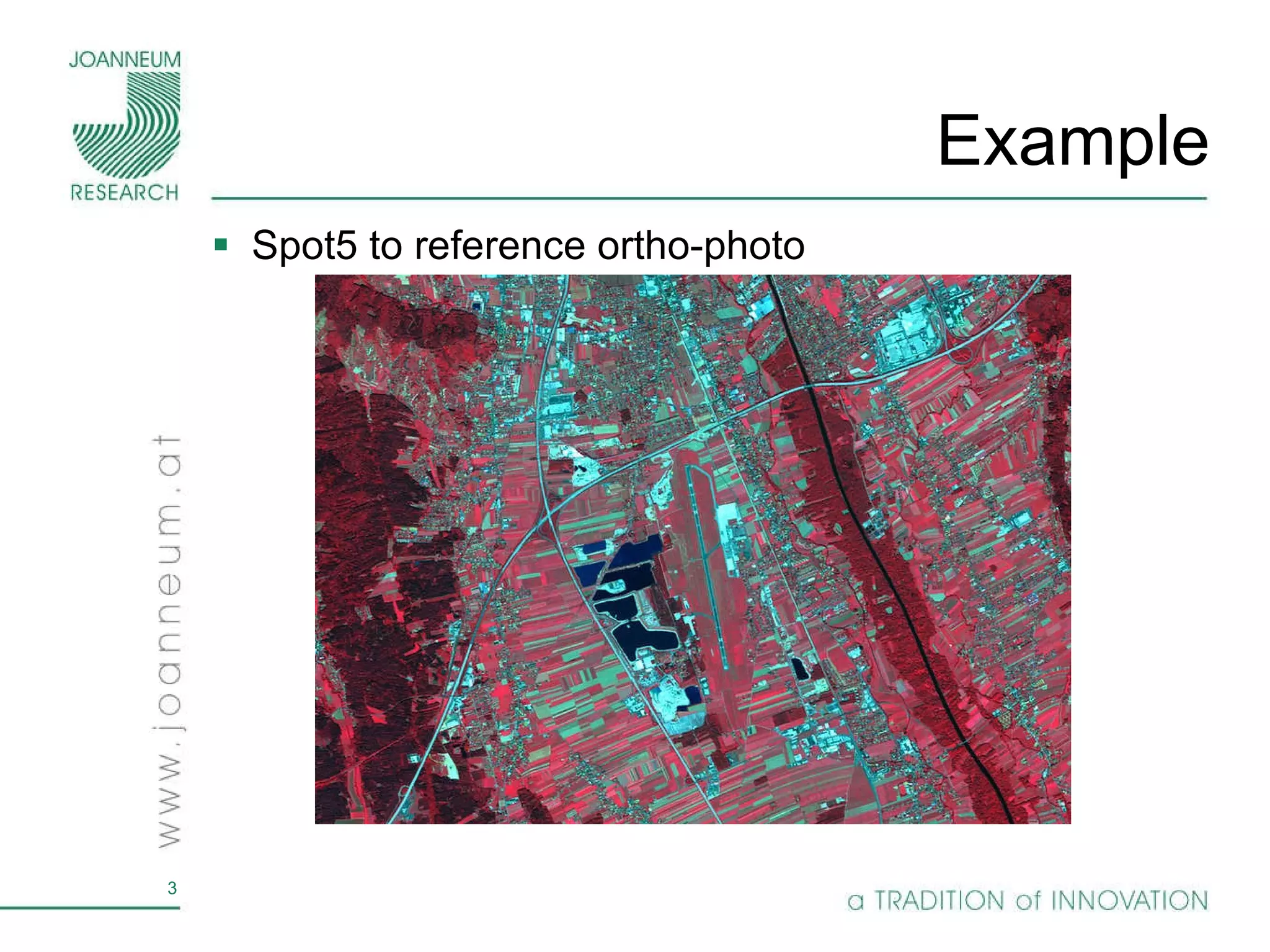
Example Spot5 to reference ortho-photo
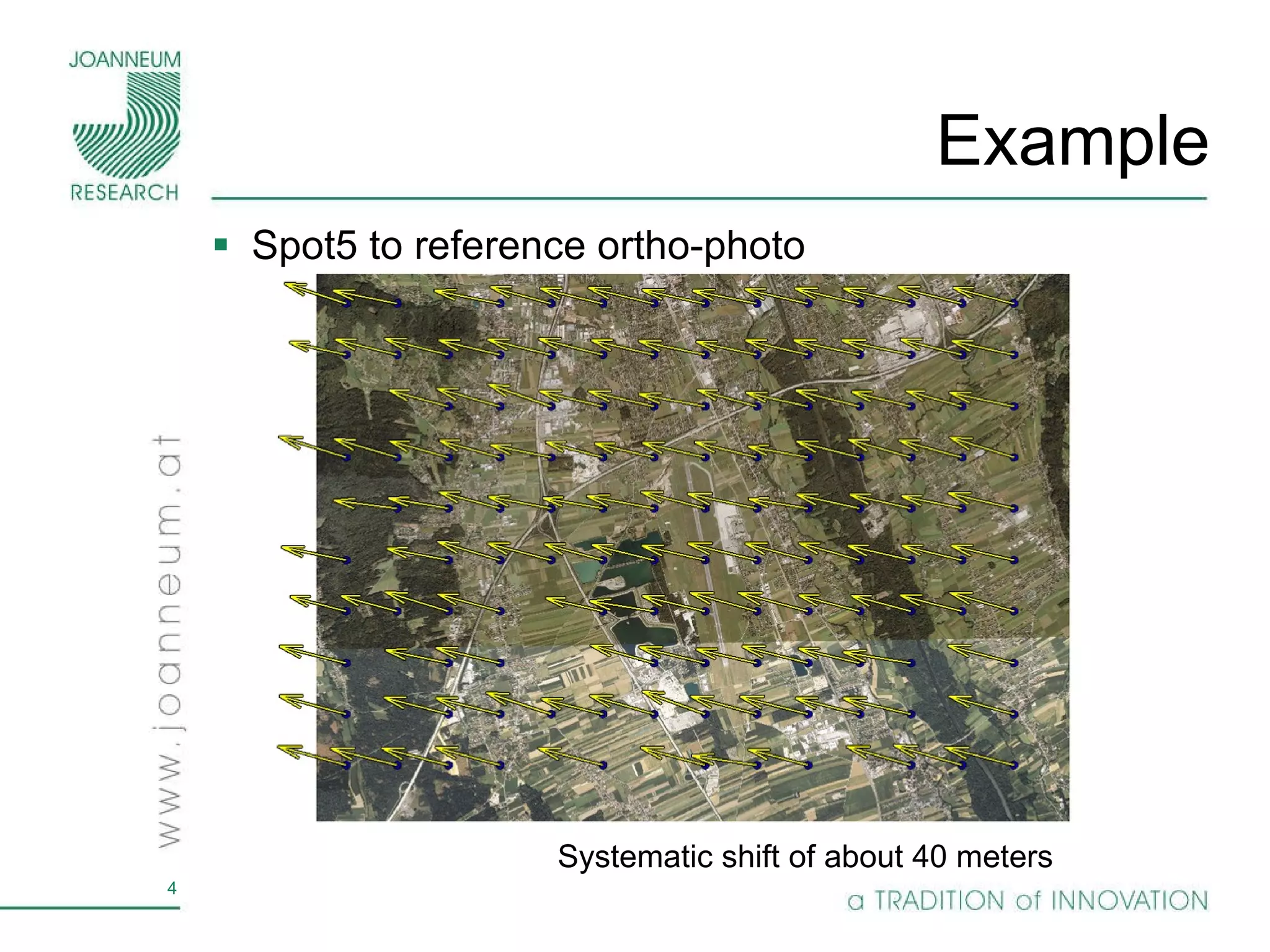
Example Spot5 to reference ortho-photo Systematic shift of about 40 meters
TerraSAR-X as Reference Data TanDEM-X mission launched in June 2010 Collect interferometric SAR data in StripMap mode Goal: Generate a worldwide DSM, 12m GSD and 2m relative vertical accuracy (beyond SRTM or ASTER) Absolute geo-location accuracy of StripMap data is better than 3m [Bresnahan, 2009; Raggam et al., 2010] [Krieger et al., 2005] Bi-static mode TerraSAR-X data is being collected worldwide the amplitude information serves as our reference database with an accuracy better than 3m
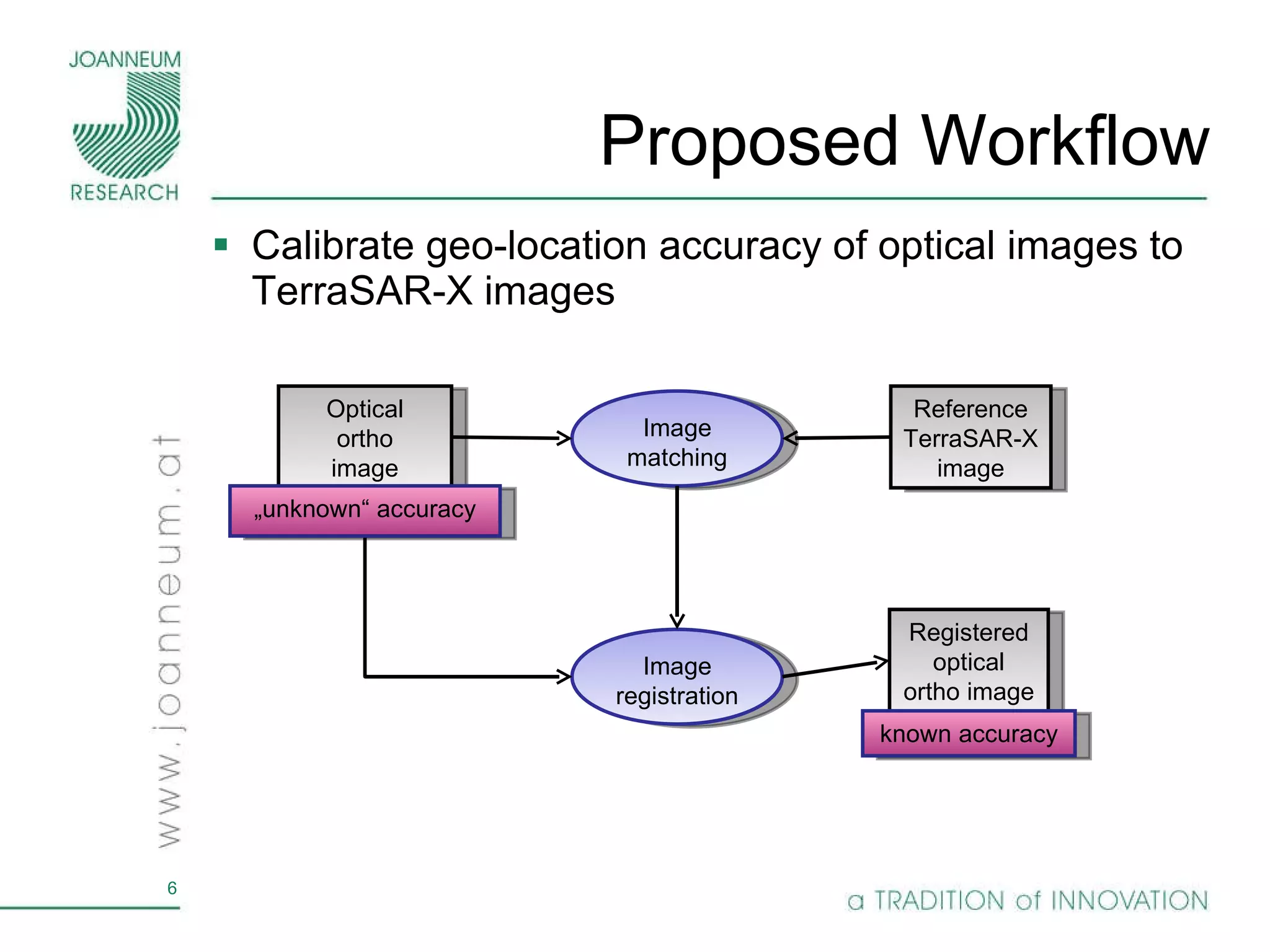
Proposed Workflow Calibrate geo-location accuracy of optical images to TerraSAR-X images Optical ortho image Reference TerraSAR-X image Registered optical ortho image Image matching Image registration „ unknown“ accuracy known accuracy
SAR to Optical Matching TerraSAR-X – amplitude, 5m GSD [2200x1600 pixels]
SAR to Optical Matching RapidEye, band 1-3, 5m GSD [2200x1600 pixels]
SAR to Optical Matching TerraSAR-X – amplitude, 5m GSD [300x200 pixels]
SAR to Optical Matching RapidEye, band 1-3, 5m GSD [300x200 pixels]
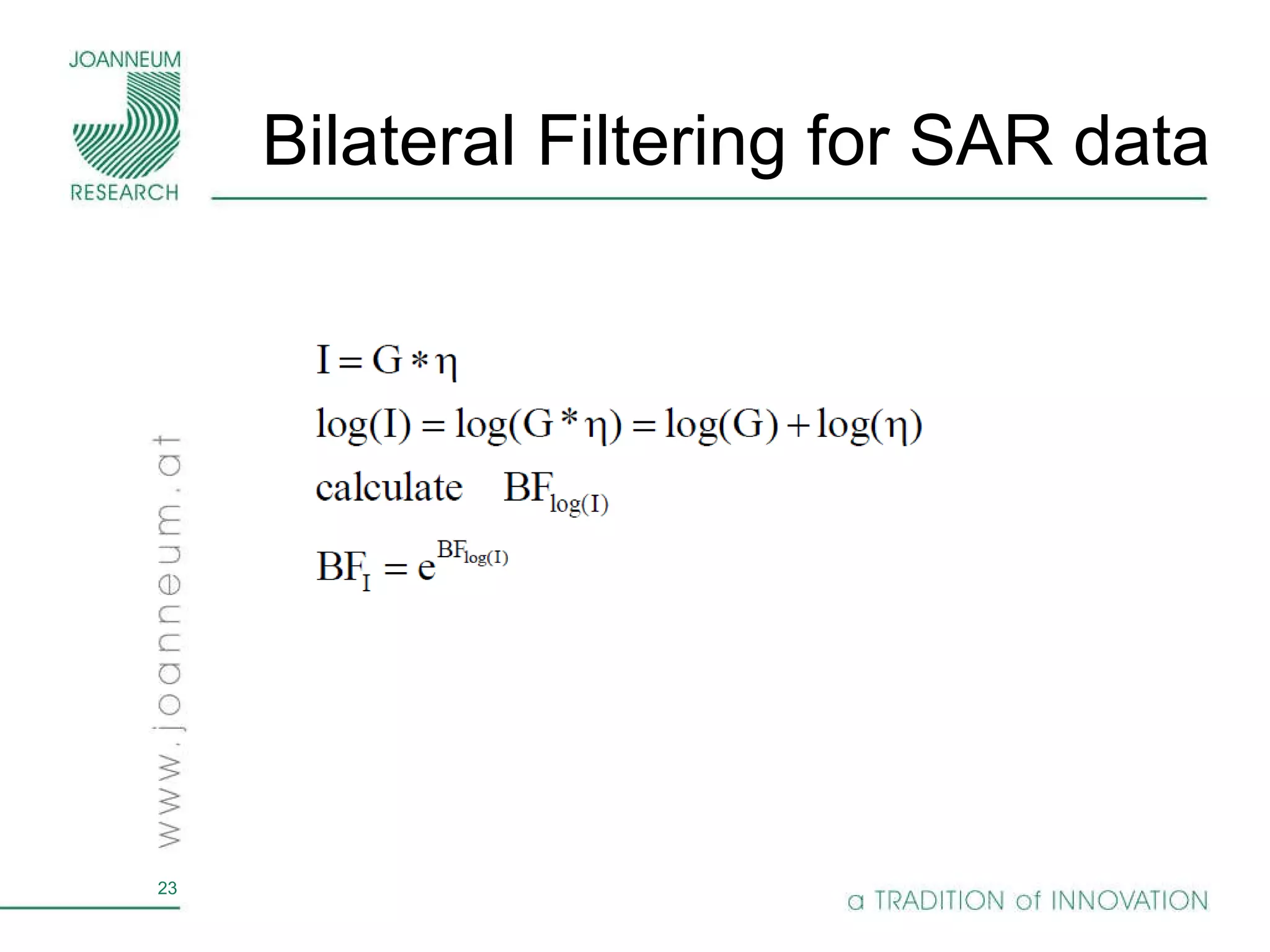
Algorithm: Pre-processing Purpose Noise reduction Remove details which are not visible in SAR data Bilateral filtering Edge preserving smoothing Does not change geometric properties Applicable for additive noise Adapted for multiplicative noise (SAR) [Tomasi and Manduchi, 1998]
Algorithm: Pre-processing Remove noise, speckle and unwanted details  original filtered TerraSAR-X Ortho photo [150x150 pixels @ 5m GSD]
Algorithm: Image Matching Areal mutual-information maximization „ similar“ concept as normalized cross-correlation (NCC) However, also works with non-linear dependencies Produces correct matches also in cases where NCC fails 151x151 reference window Additional subpixel interpolation technique [Pluim et al., 2003]
SAR specific Aspects Side looking geometry introduces geometric shifts in range direction when DTMs are used in the ortho-rectification process Fuse ASC and DSC imagery SAR ascending SAR descending Ortho photo [80x64 pixels @ 5m GSD]
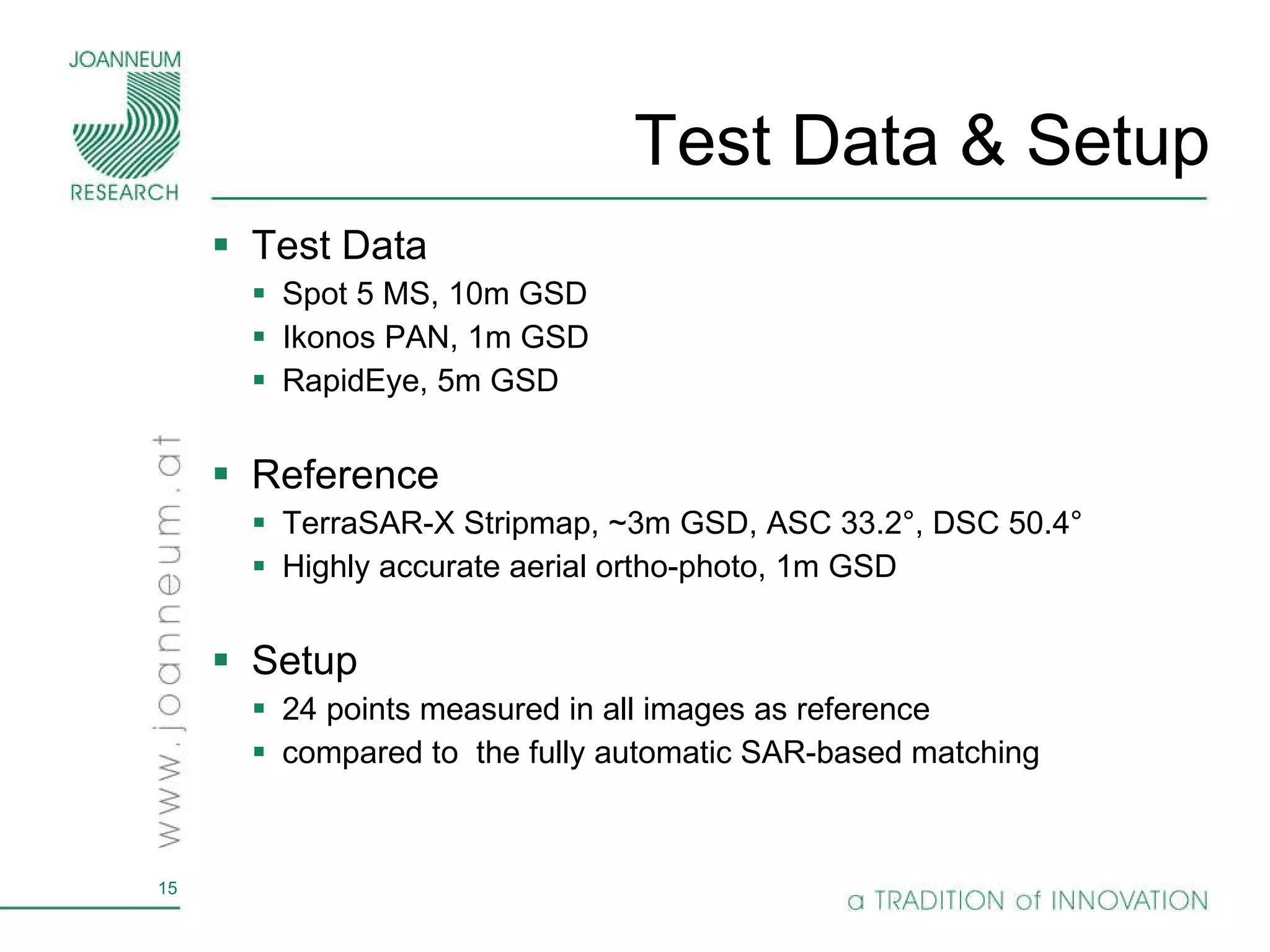
Test Data & Setup Test Data Spot 5 MS, 10m GSD Ikonos PAN, 1m GSD RapidEye, 5m GSD Reference TerraSAR-X Stripmap, ~3m GSD, ASC 33.2°, DSC 50.4° Highly accurate aerial ortho-photo, 1m GSD Setup 24 points measured in all images as reference compared to  the fully automatic SAR-based matching
Results: Visual Interpretation Spot 5 Ikonos PAN RapidEye Ortho photo TerraSAR-X initial matching [75x75 pixels @ 5m GSD]
Results: Numerical Analysis Registering TerraSAR-X to ortho-photo Ascending and descending fusion [m]
Results: Numerical Analysis Optical to SAR calibration Initial displacements of 20 to 40m drop below 5m in sub-pixel range (5m GSD data) in the geo-local accuracy range of TerraSAR-X Stripmap data [m]
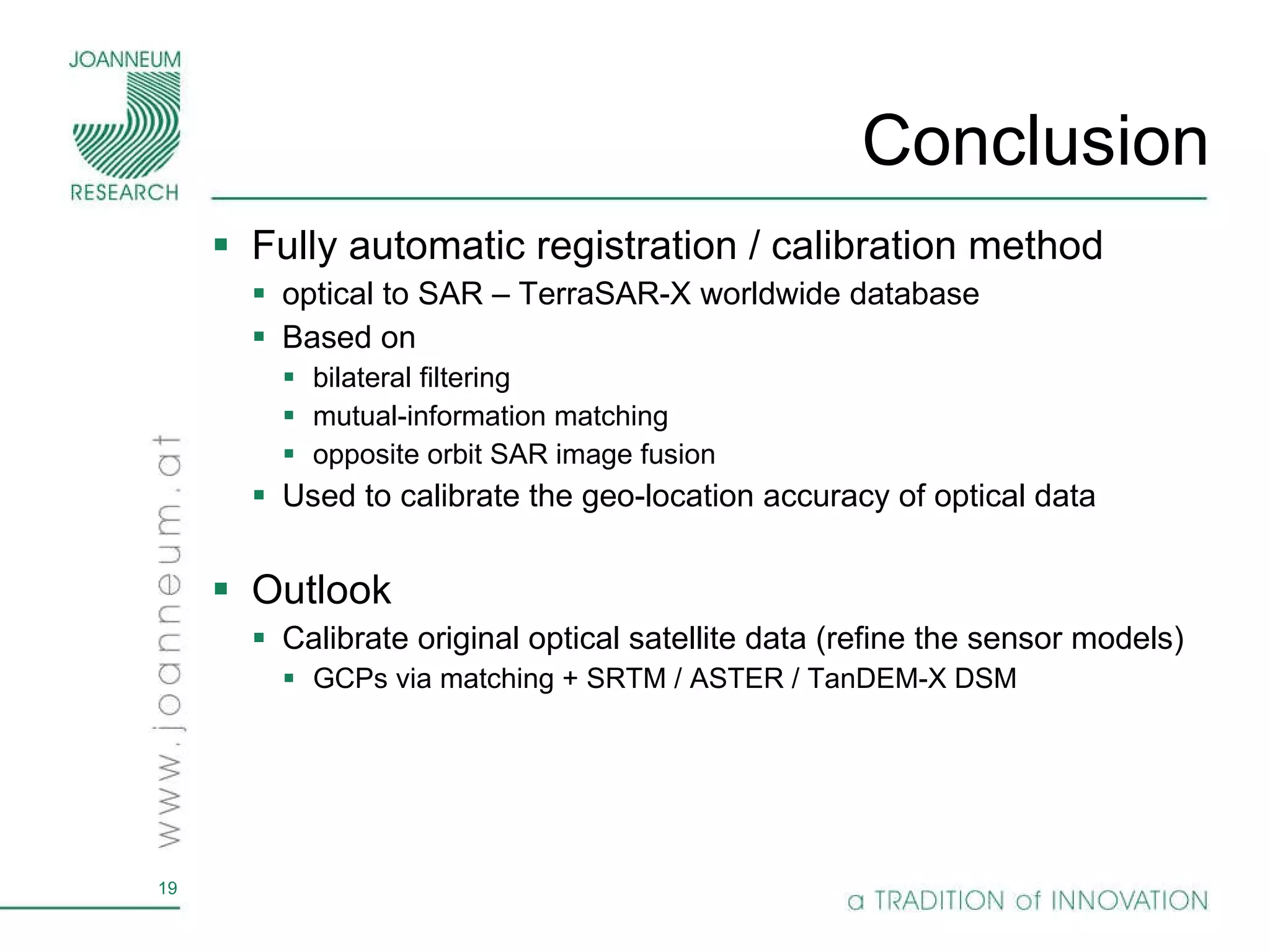
Conclusion Fully automatic registration / calibration method optical to SAR – TerraSAR-X worldwide database Based on bilateral filtering mutual-information matching opposite orbit SAR image fusion Used to calibrate the geo-location accuracy of optical data Outlook Calibrate original optical satellite data (refine the sensor models) GCPs via matching + SRTM / ASTER / TanDEM-X DSM
Using worldwide available TerraSAR-X data to calibrate the geo-location accuracy of optical sensors R. Perko, H. Raggam, KH. Gutjahr, M. Schardt IGARSS – Vancouver - July 2011
Contact DIGITAL  - Institute for Information and Communication Technologies JOANNEUM RESEARCH Forschungsgesellschaft mbH Steyrergasse 17, A-8010 Graz, AUSTRIA E-mail:  roland.perko@joanneum.at Web:  http://www.joanneum.at/digital Roland Perko, PhD
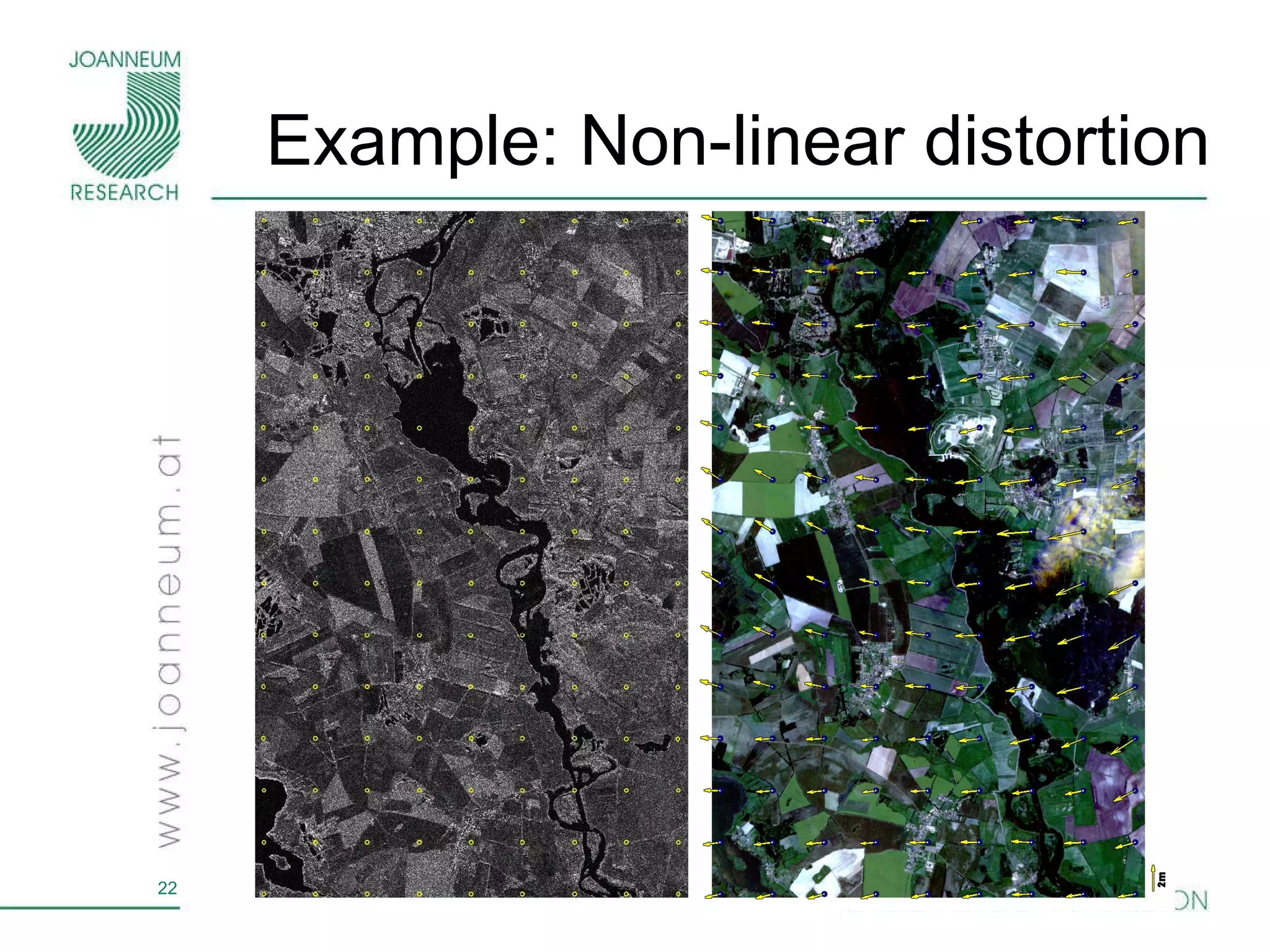
Example: Non-linear distortion
Bilateral Filtering for SAR data
Need automatic matching
Outlook
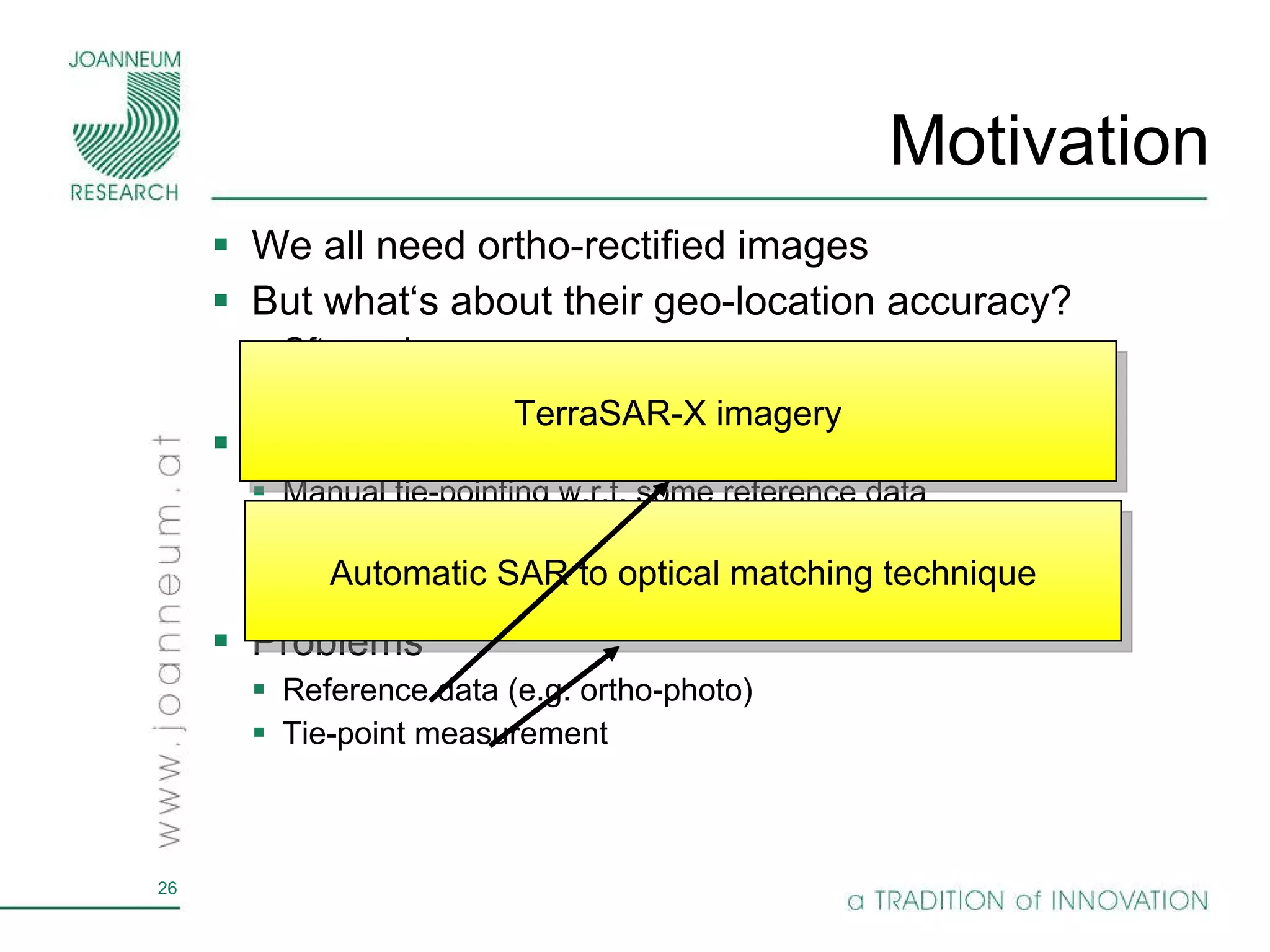
Motivation We all need ortho-rectified images But what‘s about their geo-location accuracy? Often unknown Solution Manual tie-pointing w.r.t. some reference data Problems Reference data (e.g. ortho-photo) Tie-point measurement TerraSAR-X imagery Automatic SAR to optical matching technique
Algorithm: Pre-processing Bilateral Filtering - remove noise, speckle and unwanted  details original filtered TerraSAR-X Ortho photo [150x150 pixels @ 5m GSD]

perko_2011_IGARSS_presentation_v2.ppt

  • 1.
    Using worldwide availableTerraSAR-X data to calibrate the geo-location accuracy of optical sensors R. Perko , H. Raggam, KH. Gutjahr, M. Schardt IGARSS – Vancouver - July 2011
  • 2.
    Motivation We allneed ortho-rectified images Solution Manual tie-pointing w.r.t. some reference data or measure GCPs to update sensor model Problems Reference data (e.g. ortho-photo) Tie-point measurement But what‘s about their geo-location accuracy? Often unknown – displacements up to 40m TerraSAR-X imagery Automatic optical to SAR matching technique
  • 3.
    Example Spot5 toreference ortho-photo
  • 4.
    Example Spot5 toreference ortho-photo Systematic shift of about 40 meters
  • 5.
    TerraSAR-X as ReferenceData TanDEM-X mission launched in June 2010 Collect interferometric SAR data in StripMap mode Goal: Generate a worldwide DSM, 12m GSD and 2m relative vertical accuracy (beyond SRTM or ASTER) Absolute geo-location accuracy of StripMap data is better than 3m [Bresnahan, 2009; Raggam et al., 2010] [Krieger et al., 2005] Bi-static mode TerraSAR-X data is being collected worldwide the amplitude information serves as our reference database with an accuracy better than 3m
  • 6.
    Proposed Workflow Calibrategeo-location accuracy of optical images to TerraSAR-X images Optical ortho image Reference TerraSAR-X image Registered optical ortho image Image matching Image registration „ unknown“ accuracy known accuracy
  • 7.
    SAR to OpticalMatching TerraSAR-X – amplitude, 5m GSD [2200x1600 pixels]
  • 8.
    SAR to OpticalMatching RapidEye, band 1-3, 5m GSD [2200x1600 pixels]
  • 9.
    SAR to OpticalMatching TerraSAR-X – amplitude, 5m GSD [300x200 pixels]
  • 10.
    SAR to OpticalMatching RapidEye, band 1-3, 5m GSD [300x200 pixels]
  • 11.
    Algorithm: Pre-processing PurposeNoise reduction Remove details which are not visible in SAR data Bilateral filtering Edge preserving smoothing Does not change geometric properties Applicable for additive noise Adapted for multiplicative noise (SAR) [Tomasi and Manduchi, 1998]
  • 12.
    Algorithm: Pre-processing Removenoise, speckle and unwanted details original filtered TerraSAR-X Ortho photo [150x150 pixels @ 5m GSD]
  • 13.
    Algorithm: Image MatchingAreal mutual-information maximization „ similar“ concept as normalized cross-correlation (NCC) However, also works with non-linear dependencies Produces correct matches also in cases where NCC fails 151x151 reference window Additional subpixel interpolation technique [Pluim et al., 2003]
  • 14.
    SAR specific AspectsSide looking geometry introduces geometric shifts in range direction when DTMs are used in the ortho-rectification process Fuse ASC and DSC imagery SAR ascending SAR descending Ortho photo [80x64 pixels @ 5m GSD]
  • 15.
    Test Data &Setup Test Data Spot 5 MS, 10m GSD Ikonos PAN, 1m GSD RapidEye, 5m GSD Reference TerraSAR-X Stripmap, ~3m GSD, ASC 33.2°, DSC 50.4° Highly accurate aerial ortho-photo, 1m GSD Setup 24 points measured in all images as reference compared to the fully automatic SAR-based matching
  • 16.
    Results: Visual InterpretationSpot 5 Ikonos PAN RapidEye Ortho photo TerraSAR-X initial matching [75x75 pixels @ 5m GSD]
  • 17.
    Results: Numerical AnalysisRegistering TerraSAR-X to ortho-photo Ascending and descending fusion [m]
  • 18.
    Results: Numerical AnalysisOptical to SAR calibration Initial displacements of 20 to 40m drop below 5m in sub-pixel range (5m GSD data) in the geo-local accuracy range of TerraSAR-X Stripmap data [m]
  • 19.
    Conclusion Fully automaticregistration / calibration method optical to SAR – TerraSAR-X worldwide database Based on bilateral filtering mutual-information matching opposite orbit SAR image fusion Used to calibrate the geo-location accuracy of optical data Outlook Calibrate original optical satellite data (refine the sensor models) GCPs via matching + SRTM / ASTER / TanDEM-X DSM
  • 20.
    Using worldwide availableTerraSAR-X data to calibrate the geo-location accuracy of optical sensors R. Perko, H. Raggam, KH. Gutjahr, M. Schardt IGARSS – Vancouver - July 2011
  • 21.
    Contact DIGITAL - Institute for Information and Communication Technologies JOANNEUM RESEARCH Forschungsgesellschaft mbH Steyrergasse 17, A-8010 Graz, AUSTRIA E-mail: roland.perko@joanneum.at Web: http://www.joanneum.at/digital Roland Perko, PhD
  • 22.
  • 23.
  • 24.
  • 25.
  • 26.
    Motivation We allneed ortho-rectified images But what‘s about their geo-location accuracy? Often unknown Solution Manual tie-pointing w.r.t. some reference data Problems Reference data (e.g. ortho-photo) Tie-point measurement TerraSAR-X imagery Automatic SAR to optical matching technique
  • 27.
    Algorithm: Pre-processing BilateralFiltering - remove noise, speckle and unwanted details original filtered TerraSAR-X Ortho photo [150x150 pixels @ 5m GSD]