A bracketing relationship between
difference-in-differences and
lagged-dependent-variable adjustment
Peng Ding
UC Berkeley, Statistics
December 10, 2019 at SAMSI
With Fan Li at Duke Statistics, published in Political Analysis
1 / 20
Classic Card and Krueger (1994)
▶ Minimum wage increased in New Jersey in 1992, not in Pennsylvania
▶ Observed employment in fast food restaurants before and after
▶ Figure from Angrist and Pischke (2008) book:
2 / 20
The basic two-period two-group panel design
▶ Units: i = 1, . . . , n
▶ Two periods—“before” and “after”: T = t, t + 1
▶ Two groups—control and treatment: Gi = 0, 1
▶ Treatment is only assigned to group Gi = 1 in the “after” period
▶ DiT : the observed treatment status at time T
▶ Dit ≡ 0 (all control in the “before” period)
▶ Di,t+1 = 1 for the units in group Gi = 1 =⇒ Gi = Di,t+1
▶ Outcome YiT : i = 1, . . . , n and T = t, t + 1
3 / 20
Potential outcomes and causal effects
▶ Potential outcomes {YiT (1), YiT (0)}
▶ Observed outcomes: YiT = YiT (DiT )
before T = t after T = t + 1
control group G = 0 Yit = Yit(0) Yi,t+1 = Yi,t+1(0)
treatment group G = 1 Yit = Yit(0) Yi,t+1 = Yi,t+1(1)
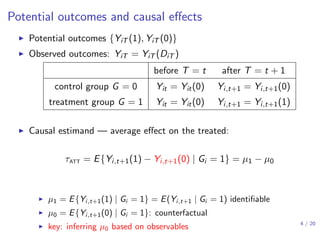
▶ Causal estimand — average effect on the treated:
τATT = E{Yi,t+1(1) − Yi,t+1(0) | Gi = 1} = µ1 − µ0
▶ µ1 = E{Yi,t+1(1) | Gi = 1} = E(Yi,t+1 | Gi = 1) identifiable
▶ µ0 = E{Yi,t+1(0) | Gi = 1}: counterfactual
▶ key: inferring µ0 based on observables 4 / 20
Difference-in-differences (DID)
Assumption (Parallel trends conditioning on covariates Xi )
E{Yi,t+1(0) − Yi,t(0) | Xi , Gi = 1} = E{Yi,t+1(0) − Yi,t(0) | Xi , Gi = 0}
▶ Nonparametric identification of µ0 = E{Yi,t+1(0) | Gi = 1}
µ0,DID = E [E{Yit (0) | Xi , Gi = 1} + E{Yi,t+1(0) − Yit (0) | Xi , Gi = 0} | Gi = 1]
= E(Yit | Gi = 1) + E{E(Yi,t+1 − Yit | Xi , Gi = 0) | Gi = 1}
▶ Without covariates — difference-in-difference
▶ nonparametric identification:
µ0 = E(Yit | Gi = 1) + E(Yi,t+1 | Gi = 0) − E(Yit | Gi = 0)
▶ moment estimator: ˆτDID = ( ¯Y1,t+1 − ¯Y1,t) − ( ¯Y0,t+1 − ¯Y0,t)
5 / 20
The scale dependent issue of DID
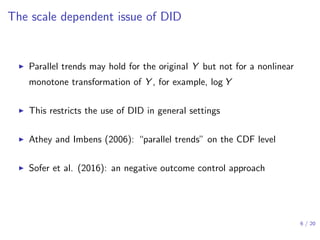
▶ Parallel trends may hold for the original Y but not for a nonlinear
monotone transformation of Y , for example, log Y
▶ This restricts the use of DID in general settings
▶ Athey and Imbens (2006): “parallel trends” on the CDF level
▶ Sofer et al. (2016): an negative outcome control approach
6 / 20
Lagged-dependent-variable adjustment (LDV)
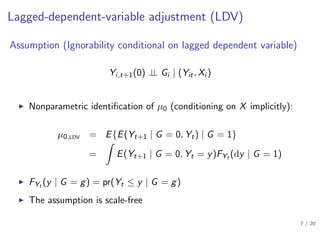
Assumption (Ignorability conditional on lagged dependent variable)
Yi,t+1(0) ⊥⊥ Gi | (Yit, Xi )
▶ Nonparametric identification of µ0 (conditioning on X implicitly):
µ0,LDV = E{E(Yt+1 | G = 0, Yt) | G = 1}
=
∫
E(Yt+1 | G = 0, Yt = y)FYt (dy | G = 1)
▶ FYt (y | G = g) = pr(Yt ≤ y | G = g)
▶ The assumption is scale-free
7 / 20
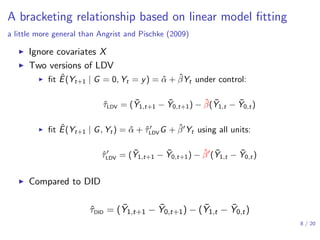
A bracketing relationship based on linear model fitting
a little more general than Angrist and Pischke (2009)
▶ Ignore covariates X
▶ Two versions of LDV
▶ fit ˆE(Yt+1 | G = 0, Yt = y) = ˆα + ˆβYt under control:
ˆτLDV = ( ¯Y1,t+1 − ¯Y0,t+1) − ˆβ( ¯Y1,t − ¯Y0,t)
▶ fit ˆE(Yt+1 | G, Yt) = ˆα + ˆτ′
LDVG + ˆβ′
Yt using all units:
ˆτ′
LDV = ( ¯Y1,t+1 − ¯Y0,t+1) − ˆβ′
( ¯Y1,t − ¯Y0,t)
▶ Compared to DID
ˆτDID = ( ¯Y1,t+1 − ¯Y0,t+1) − ( ¯Y1,t − ¯Y0,t)
8 / 20
Interpreting the bracketing relationship under linear models
▶ Consider the case with ˆβ or ˆβ′ smaller than 1
▶ The sign of ˆτDID − ˆτLDV or ˆτDID − ˆτ′
LDV depends on the sign of ¯Y1,t − ¯Y0,t
▶ Treatment group has smaller Yt on average =⇒ ˆτDID > ˆτLDV
▶ Treatment group has larger Yt on average =⇒ ˆτDID < ˆτLDV
▶ How much ˆβ or ˆβ′ deviates from 1
=⇒ how different the DID and LDV estimates are
▶ They are identical if ˆβ = 1 or ˆβ′ = 1
9 / 20
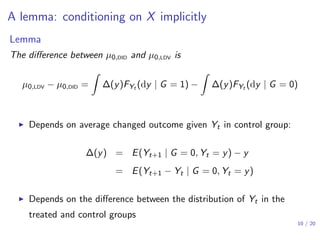
A lemma: conditioning on X implicitly
Lemma
The difference between µ0,DID and µ0,LDV is
µ0,LDV − µ0,DID =
∫
∆(y)FYt (dy | G = 1) −
∫
∆(y)FYt (dy | G = 0)
▶ Depends on average changed outcome given Yt in control group:
∆(y) = E(Yt+1 | G = 0, Yt = y) − y
= E(Yt+1 − Yt | G = 0, Yt = y)
▶ Depends on the difference between the distribution of Yt in the
treated and control groups
10 / 20
Two testable conditions
Condition (Stationarity)
∂E(Yt+1 | G = 0, Yt = y)/∂y < 1 for all y.
▶ Linear model: in the control group, the coefficient of the outcome
Yt+1 on Yt is smaller than 1 (Angrist and Pischke 2009)
▶ The time series of the outcomes would not evolve to infinity
Condition (Stochastic Monotonicity)
(1) FYt (y | G = 1) ≥ FYt (y | G = 0) for all y;
(2) FYt (y | G = 1) ≤ FYt (y | G = 0) for all y.
▶ (1) implies that the treated group has smaller lagged outcome
▶ (2) implies the opposite relationship
11 / 20
A theorem
Theorem
If Stationarity and Stochastic Monotonicity(1) hold, then
µ0,DID ≤ µ0,LDV, τDID ≥ τLDV.
If Stationarity and Stochastic Monotonicity(2) hold, then
µ0,DID ≥ µ0,LDV, τDID ≤ τLDV.
▶ It does not require the parallel trends or the ignorability
▶ Simply a result on the relative magnitude between τDID and τLDV
▶ Extends Angrist and Pischke (2009) to the nonparametric setting
12 / 20
Interpretations of the theorem
▶ Under Stationarity and Stochastic Monotonicity(1),
τDID ≥ τLDV
▶ Both of them can be biased for the true causal effect τATT
▶ τDID ≥ τLDV ≥ τATT =⇒ τDID over-estimates τATT more than τLDV
▶ τATT ≥ τDID ≥ τLDV =⇒ τLDV under-estimates τATT more than τDID
▶ τDID ≥ τATT ≥ τLDV =⇒ τDID and τLDV are the upper and lower bounds
▶ In the last case, [τLDV, τDID] bracket the true causal effect
▶ Analogous results under Stationarity and Stochastic Monotonicity(2)
13 / 20
Example 1: Card and Krueger (1994) study
▶ Effect of a minimum wage increase on employment
▶ Employment information in New Jersey and Pennsylvania before and
after a minimum wage increase in New Jersey in 1992
▶ Outcome = # employees at each fast food restaurant
▶ Estimates:
ˆτDID = 2.446, ˆτLDV = 0.302, ˆτ′
LDV = 0.865
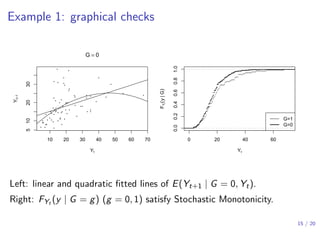
▶ Coefficients of the lag outcome ˆβ = 0.288 < 1 and ˆβ′ = 0.475 < 1
▶ The same conclusion under a quadratic model
14 / 20
Example 1: graphical checks
10 20 30 40 50 60 70
5102030
G = 0
Yt
Yt+1
0 20 40 60
0.00.20.40.60.81.0
Yt
FYt
(y|G)
G=1
G=0
Left: linear and quadratic fitted lines of E(Yt+1 | G = 0, Yt).
Right: FYt (y | G = g) (g = 0, 1) satisfy Stochastic Monotonicity.
15 / 20
Example 2: Bechtel and Hainmueller (2011) study
▶ Electoral returns to beneficial policy
▶ We focus on the short-term electoral returns by analyzing the causal
effect of a disaster relief aid due to the 2002 Elbe flooding in Germany
▶ Before period = 1998; After period = 2002
▶ The units of analysis are electoral districts
▶ Treatment = the indicator whether a district is affected by the flood
▶ Outcome = the vote share that the Social Democratic Party attains
▶ Estimates:
ˆτDID = 7.144, ˆτLDV = 7.160, ˆτ′
LDV = 7.121
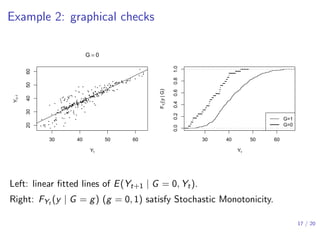
▶ Coefficients of the lag outcome ˆβ = 1.002 > 1 and ˆβ′ = 0.997 < 1
▶ These estimates are almost identical 16 / 20
Example 2: graphical checks
30 40 50 60
2030405060
G = 0
Yt
Yt+1
30 40 50 60
0.00.20.40.60.81.0
Yt
FYt
(y|G)
G=1
G=0
Left: linear fitted lines of E(Yt+1 | G = 0, Yt).
Right: FYt (y | G = g) (g = 0, 1) satisfy Stochastic Monotonicity.
17 / 20
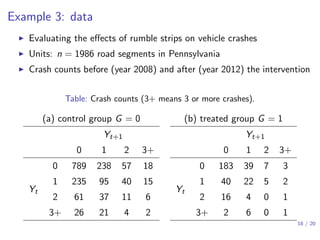
Example 3: data
▶ Evaluating the effects of rumble strips on vehicle crashes
▶ Units: n = 1986 road segments in Pennsylvania
▶ Crash counts before (year 2008) and after (year 2012) the intervention
Table: Crash counts (3+ means 3 or more crashes).
(a) control group G = 0 (b) treated group G = 1
Yt+1
0 1 2 3+
Yt
0 789 238 57 18
1 235 95 40 15
2 61 37 11 6
3+ 26 21 4 2
Yt+1
0 1 2 3+
Yt
0 183 39 7 3
1 40 22 5 2
2 16 4 0 1
3+ 2 6 0 1
18 / 20
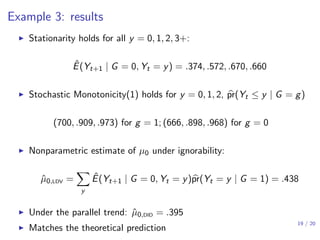
Example 3: results
▶ Stationarity holds for all y = 0, 1, 2, 3+:
ˆE(Yt+1 | G = 0, Yt = y) = .374, .572, .670, .660
▶ Stochastic Monotonicity(1) holds for y = 0, 1, 2, pr(Yt ≤ y | G = g)
(700, .909, .973) for g = 1; (666, .898, .968) for g = 0
▶ Nonparametric estimate of µ0 under ignorability:
ˆµ0,LDV =
∑
y
ˆE(Yt+1 | G = 0, Yt = y)pr(Yt = y | G = 1) = .438
▶ Under the parallel trend: ˆµ0,DID = .395
▶ Matches the theoretical prediction
19 / 20
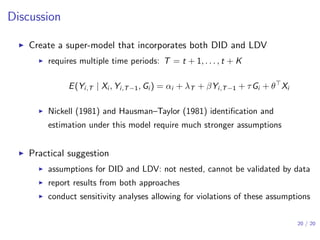
Discussion
▶ Create a super-model that incorporates both DID and LDV
▶ requires multiple time periods: T = t + 1, . . . , t + K
E(Yi,T | Xi , Yi,T−1, Gi ) = αi + λT + βYi,T−1 + τGi + θ⊤
Xi
▶ Nickell (1981) and Hausman–Taylor (1981) identification and
estimation under this model require much stronger assumptions
▶ Practical suggestion
▶ assumptions for DID and LDV: not nested, cannot be validated by data
▶ report results from both approaches
▶ conduct sensitivity analyses allowing for violations of these assumptions
20 / 20

Causal Inference Opening Workshop - A Bracketing Relationship between Difference-in-Differences and Lagged-Dependent-Variable Adjustment - Peng Ding, December 11, 2019

  • 1.
    A bracketing relationshipbetween difference-in-differences and lagged-dependent-variable adjustment Peng Ding UC Berkeley, Statistics December 10, 2019 at SAMSI With Fan Li at Duke Statistics, published in Political Analysis 1 / 20
  • 2.
    Classic Card andKrueger (1994) ▶ Minimum wage increased in New Jersey in 1992, not in Pennsylvania ▶ Observed employment in fast food restaurants before and after ▶ Figure from Angrist and Pischke (2008) book: 2 / 20
  • 3.
    The basic two-periodtwo-group panel design ▶ Units: i = 1, . . . , n ▶ Two periods—“before” and “after”: T = t, t + 1 ▶ Two groups—control and treatment: Gi = 0, 1 ▶ Treatment is only assigned to group Gi = 1 in the “after” period ▶ DiT : the observed treatment status at time T ▶ Dit ≡ 0 (all control in the “before” period) ▶ Di,t+1 = 1 for the units in group Gi = 1 =⇒ Gi = Di,t+1 ▶ Outcome YiT : i = 1, . . . , n and T = t, t + 1 3 / 20
  • 4.
    Potential outcomes andcausal effects ▶ Potential outcomes {YiT (1), YiT (0)} ▶ Observed outcomes: YiT = YiT (DiT ) before T = t after T = t + 1 control group G = 0 Yit = Yit(0) Yi,t+1 = Yi,t+1(0) treatment group G = 1 Yit = Yit(0) Yi,t+1 = Yi,t+1(1) ▶ Causal estimand — average effect on the treated: τATT = E{Yi,t+1(1) − Yi,t+1(0) | Gi = 1} = µ1 − µ0 ▶ µ1 = E{Yi,t+1(1) | Gi = 1} = E(Yi,t+1 | Gi = 1) identifiable ▶ µ0 = E{Yi,t+1(0) | Gi = 1}: counterfactual ▶ key: inferring µ0 based on observables 4 / 20
  • 5.
    Difference-in-differences (DID) Assumption (Paralleltrends conditioning on covariates Xi ) E{Yi,t+1(0) − Yi,t(0) | Xi , Gi = 1} = E{Yi,t+1(0) − Yi,t(0) | Xi , Gi = 0} ▶ Nonparametric identification of µ0 = E{Yi,t+1(0) | Gi = 1} µ0,DID = E [E{Yit (0) | Xi , Gi = 1} + E{Yi,t+1(0) − Yit (0) | Xi , Gi = 0} | Gi = 1] = E(Yit | Gi = 1) + E{E(Yi,t+1 − Yit | Xi , Gi = 0) | Gi = 1} ▶ Without covariates — difference-in-difference ▶ nonparametric identification: µ0 = E(Yit | Gi = 1) + E(Yi,t+1 | Gi = 0) − E(Yit | Gi = 0) ▶ moment estimator: ˆτDID = ( ¯Y1,t+1 − ¯Y1,t) − ( ¯Y0,t+1 − ¯Y0,t) 5 / 20
  • 6.
    The scale dependentissue of DID ▶ Parallel trends may hold for the original Y but not for a nonlinear monotone transformation of Y , for example, log Y ▶ This restricts the use of DID in general settings ▶ Athey and Imbens (2006): “parallel trends” on the CDF level ▶ Sofer et al. (2016): an negative outcome control approach 6 / 20
  • 7.
    Lagged-dependent-variable adjustment (LDV) Assumption(Ignorability conditional on lagged dependent variable) Yi,t+1(0) ⊥⊥ Gi | (Yit, Xi ) ▶ Nonparametric identification of µ0 (conditioning on X implicitly): µ0,LDV = E{E(Yt+1 | G = 0, Yt) | G = 1} = ∫ E(Yt+1 | G = 0, Yt = y)FYt (dy | G = 1) ▶ FYt (y | G = g) = pr(Yt ≤ y | G = g) ▶ The assumption is scale-free 7 / 20
  • 8.
    A bracketing relationshipbased on linear model fitting a little more general than Angrist and Pischke (2009) ▶ Ignore covariates X ▶ Two versions of LDV ▶ fit ˆE(Yt+1 | G = 0, Yt = y) = ˆα + ˆβYt under control: ˆτLDV = ( ¯Y1,t+1 − ¯Y0,t+1) − ˆβ( ¯Y1,t − ¯Y0,t) ▶ fit ˆE(Yt+1 | G, Yt) = ˆα + ˆτ′ LDVG + ˆβ′ Yt using all units: ˆτ′ LDV = ( ¯Y1,t+1 − ¯Y0,t+1) − ˆβ′ ( ¯Y1,t − ¯Y0,t) ▶ Compared to DID ˆτDID = ( ¯Y1,t+1 − ¯Y0,t+1) − ( ¯Y1,t − ¯Y0,t) 8 / 20
  • 9.
    Interpreting the bracketingrelationship under linear models ▶ Consider the case with ˆβ or ˆβ′ smaller than 1 ▶ The sign of ˆτDID − ˆτLDV or ˆτDID − ˆτ′ LDV depends on the sign of ¯Y1,t − ¯Y0,t ▶ Treatment group has smaller Yt on average =⇒ ˆτDID > ˆτLDV ▶ Treatment group has larger Yt on average =⇒ ˆτDID < ˆτLDV ▶ How much ˆβ or ˆβ′ deviates from 1 =⇒ how different the DID and LDV estimates are ▶ They are identical if ˆβ = 1 or ˆβ′ = 1 9 / 20
  • 10.
    A lemma: conditioningon X implicitly Lemma The difference between µ0,DID and µ0,LDV is µ0,LDV − µ0,DID = ∫ ∆(y)FYt (dy | G = 1) − ∫ ∆(y)FYt (dy | G = 0) ▶ Depends on average changed outcome given Yt in control group: ∆(y) = E(Yt+1 | G = 0, Yt = y) − y = E(Yt+1 − Yt | G = 0, Yt = y) ▶ Depends on the difference between the distribution of Yt in the treated and control groups 10 / 20
  • 11.
    Two testable conditions Condition(Stationarity) ∂E(Yt+1 | G = 0, Yt = y)/∂y < 1 for all y. ▶ Linear model: in the control group, the coefficient of the outcome Yt+1 on Yt is smaller than 1 (Angrist and Pischke 2009) ▶ The time series of the outcomes would not evolve to infinity Condition (Stochastic Monotonicity) (1) FYt (y | G = 1) ≥ FYt (y | G = 0) for all y; (2) FYt (y | G = 1) ≤ FYt (y | G = 0) for all y. ▶ (1) implies that the treated group has smaller lagged outcome ▶ (2) implies the opposite relationship 11 / 20
  • 12.
    A theorem Theorem If Stationarityand Stochastic Monotonicity(1) hold, then µ0,DID ≤ µ0,LDV, τDID ≥ τLDV. If Stationarity and Stochastic Monotonicity(2) hold, then µ0,DID ≥ µ0,LDV, τDID ≤ τLDV. ▶ It does not require the parallel trends or the ignorability ▶ Simply a result on the relative magnitude between τDID and τLDV ▶ Extends Angrist and Pischke (2009) to the nonparametric setting 12 / 20
  • 13.
    Interpretations of thetheorem ▶ Under Stationarity and Stochastic Monotonicity(1), τDID ≥ τLDV ▶ Both of them can be biased for the true causal effect τATT ▶ τDID ≥ τLDV ≥ τATT =⇒ τDID over-estimates τATT more than τLDV ▶ τATT ≥ τDID ≥ τLDV =⇒ τLDV under-estimates τATT more than τDID ▶ τDID ≥ τATT ≥ τLDV =⇒ τDID and τLDV are the upper and lower bounds ▶ In the last case, [τLDV, τDID] bracket the true causal effect ▶ Analogous results under Stationarity and Stochastic Monotonicity(2) 13 / 20
  • 14.
    Example 1: Cardand Krueger (1994) study ▶ Effect of a minimum wage increase on employment ▶ Employment information in New Jersey and Pennsylvania before and after a minimum wage increase in New Jersey in 1992 ▶ Outcome = # employees at each fast food restaurant ▶ Estimates: ˆτDID = 2.446, ˆτLDV = 0.302, ˆτ′ LDV = 0.865 ▶ Coefficients of the lag outcome ˆβ = 0.288 < 1 and ˆβ′ = 0.475 < 1 ▶ The same conclusion under a quadratic model 14 / 20
  • 15.
    Example 1: graphicalchecks 10 20 30 40 50 60 70 5102030 G = 0 Yt Yt+1 0 20 40 60 0.00.20.40.60.81.0 Yt FYt (y|G) G=1 G=0 Left: linear and quadratic fitted lines of E(Yt+1 | G = 0, Yt). Right: FYt (y | G = g) (g = 0, 1) satisfy Stochastic Monotonicity. 15 / 20
  • 16.
    Example 2: Bechteland Hainmueller (2011) study ▶ Electoral returns to beneficial policy ▶ We focus on the short-term electoral returns by analyzing the causal effect of a disaster relief aid due to the 2002 Elbe flooding in Germany ▶ Before period = 1998; After period = 2002 ▶ The units of analysis are electoral districts ▶ Treatment = the indicator whether a district is affected by the flood ▶ Outcome = the vote share that the Social Democratic Party attains ▶ Estimates: ˆτDID = 7.144, ˆτLDV = 7.160, ˆτ′ LDV = 7.121 ▶ Coefficients of the lag outcome ˆβ = 1.002 > 1 and ˆβ′ = 0.997 < 1 ▶ These estimates are almost identical 16 / 20
  • 17.
    Example 2: graphicalchecks 30 40 50 60 2030405060 G = 0 Yt Yt+1 30 40 50 60 0.00.20.40.60.81.0 Yt FYt (y|G) G=1 G=0 Left: linear fitted lines of E(Yt+1 | G = 0, Yt). Right: FYt (y | G = g) (g = 0, 1) satisfy Stochastic Monotonicity. 17 / 20
  • 18.
    Example 3: data ▶Evaluating the effects of rumble strips on vehicle crashes ▶ Units: n = 1986 road segments in Pennsylvania ▶ Crash counts before (year 2008) and after (year 2012) the intervention Table: Crash counts (3+ means 3 or more crashes). (a) control group G = 0 (b) treated group G = 1 Yt+1 0 1 2 3+ Yt 0 789 238 57 18 1 235 95 40 15 2 61 37 11 6 3+ 26 21 4 2 Yt+1 0 1 2 3+ Yt 0 183 39 7 3 1 40 22 5 2 2 16 4 0 1 3+ 2 6 0 1 18 / 20
  • 19.
    Example 3: results ▶Stationarity holds for all y = 0, 1, 2, 3+: ˆE(Yt+1 | G = 0, Yt = y) = .374, .572, .670, .660 ▶ Stochastic Monotonicity(1) holds for y = 0, 1, 2, pr(Yt ≤ y | G = g) (700, .909, .973) for g = 1; (666, .898, .968) for g = 0 ▶ Nonparametric estimate of µ0 under ignorability: ˆµ0,LDV = ∑ y ˆE(Yt+1 | G = 0, Yt = y)pr(Yt = y | G = 1) = .438 ▶ Under the parallel trend: ˆµ0,DID = .395 ▶ Matches the theoretical prediction 19 / 20
  • 20.
    Discussion ▶ Create asuper-model that incorporates both DID and LDV ▶ requires multiple time periods: T = t + 1, . . . , t + K E(Yi,T | Xi , Yi,T−1, Gi ) = αi + λT + βYi,T−1 + τGi + θ⊤ Xi ▶ Nickell (1981) and Hausman–Taylor (1981) identification and estimation under this model require much stronger assumptions ▶ Practical suggestion ▶ assumptions for DID and LDV: not nested, cannot be validated by data ▶ report results from both approaches ▶ conduct sensitivity analyses allowing for violations of these assumptions 20 / 20