Introduction Sample of galaxies Data Analysis Asymmetry Star formation rate Relationship between A and SFR Conclusions
The asymmetry and star formation rate for dwarf
spiral galaxies
M.Sc. Ignacio Vega Acevedo
Dr. Ana Mar´ıa Hidalgo G´amez
Departamento de F´ısica, ESFM-IPN
August 10, 2013
I. Vega, A.M. Hidalgo Departamento de F´ısica, ESFM-IPN
Asymmetry and SFR for dS
Introduction Sample of galaxies Data Analysis Asymmetry Star formation rate Relationship between A and SFR Conclusions
1 Introduction
CAS system
2 Sample of galaxies
3 Data Analysis
4 Asymmetry
5 Star formation rate
6 Relationship between A and SFR
7 Conclusions
I. Vega, A.M. Hidalgo Departamento de F´ısica, ESFM-IPN
Asymmetry and SFR for dS
Introduction Sample of galaxies Data Analysis Asymmetry Star formation rate Relationship between A and SFR Conclusions
Introduction
dS galaxy
The dwarf spiral galaxies,dS are the galaxies with an optical
radius 5 Kpc, a magnitude MB − 18 (Hidalgo-G´amez, 2004).
I. Vega, A.M. Hidalgo Departamento de F´ısica, ESFM-IPN
Asymmetry and SFR for dS
Introduction Sample of galaxies Data Analysis Asymmetry Star formation rate Relationship between A and SFR Conclusions
CAS system
CAS system
The CAS system is defined by the morphological parameters
Concentration, C, asymmetry, A and clumpiness, S (Conselice et
al., 2000).
I. Vega, A.M. Hidalgo Departamento de F´ısica, ESFM-IPN
Asymmetry and SFR for dS
Introduction Sample of galaxies Data Analysis Asymmetry Star formation rate Relationship between A and SFR Conclusions
CAS system
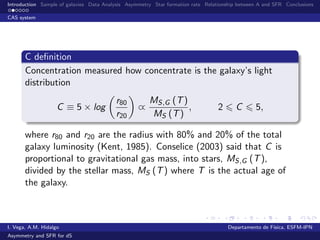
C definition
Concentration measured how concentrate is the galaxy’s light
distribution
C ≡ 5 × log
r80
r20
∝
MS,G (T)
MS (T)
, 2 C 5,
where r80 and r20 are the radius with 80% and 20% of the total
galaxy luminosity (Kent, 1985). Conselice (2003) said that C is
proportional to gravitational gas mass, into stars, MS,G (T),
divided by the stellar mass, MS (T) where T is the actual age of
the galaxy.
I. Vega, A.M. Hidalgo Departamento de F´ısica, ESFM-IPN
Asymmetry and SFR for dS
Introduction Sample of galaxies Data Analysis Asymmetry Star formation rate Relationship between A and SFR Conclusions
CAS system
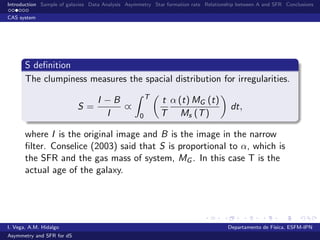
S definition
The clumpiness measures the spacial distribution for irregularities.
S =
I − B
I
∝
T
0
t
T
α (t) MG (t)
Ms (T)
dt,
where I is the original image and B is the image in the narrow
filter. Conselice (2003) said that S is proportional to α, which is
the SFR and the gas mass of system, MG . In this case T is the
actual age of the galaxy.
I. Vega, A.M. Hidalgo Departamento de F´ısica, ESFM-IPN
Asymmetry and SFR for dS
Introduction Sample of galaxies Data Analysis Asymmetry Star formation rate Relationship between A and SFR Conclusions
CAS system
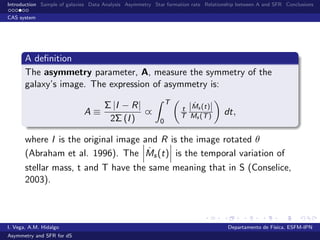
A definition
The asymmetry parameter, A, measure the symmetry of the
galaxy’s image. The expression of asymmetry is:
A ≡
Σ |I − R|
2Σ (I)
∝
T
0
t
T
| ˙Ms (t)|
Ms (T) dt,
where I is the original image and R is the image rotated θ
(Abraham et al. 1996). The ˙Ms(t) is the temporal variation of
stellar mass, t and T have the same meaning that in S (Conselice,
2003).
I. Vega, A.M. Hidalgo Departamento de F´ısica, ESFM-IPN
Asymmetry and SFR for dS
Introduction Sample of galaxies Data Analysis Asymmetry Star formation rate Relationship between A and SFR Conclusions
CAS system
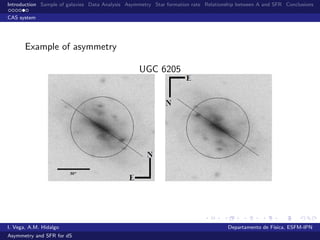
Example of asymmetry
UGC 6205
I. Vega, A.M. Hidalgo Departamento de F´ısica, ESFM-IPN
Asymmetry and SFR for dS
Introduction Sample of galaxies Data Analysis Asymmetry Star formation rate Relationship between A and SFR Conclusions
CAS system
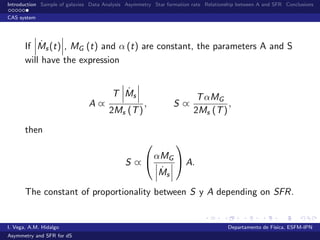
If ˙Ms(t) , MG (t) and α (t) are constant, the parameters A and S
will have the expression
A ∝
T ˙Ms
2Ms (T)
, S ∝
TαMG
2Ms (T)
,
then
S ∝

αMG
˙Ms

 A.
The constant of proportionality between S y A depending on SFR.
I. Vega, A.M. Hidalgo Departamento de F´ısica, ESFM-IPN
Asymmetry and SFR for dS
Introduction Sample of galaxies Data Analysis Asymmetry Star formation rate Relationship between A and SFR Conclusions
Our sample of galaxies dS
This sample of galaxies follows the definition of dwarf spiral galaxy
given by Hidalgo-G´amez (2004).
Galaxy
i
[degree]
r25
[kpc]
D
[Mpc]
MB
Av
[mag]
UGC891 63 3.13 9.4 ± 1 -15.32 0.076
UGC3775 27 4.68 20.8 ± 7.7 -15.08 0.305
UGC5242 50 4.86 24.76 ± ... -16.60 0.417
UGC5296 29 3.02 20.28 ± ... -15.08 0.031
UGC6205 41 4.99 18.87 ± ... -16.53 0.043
UGC6304 39 4.72 23.51 ± ... -15.40 0.029
UGC9570 14 ... 29.4 ± ... -15.89 0.029
UGC11820 24 4.96 17.1 ± 2.4 -14.70 0.332
UGC12212 56 3.3 14.7 ± 2.8 -15.11 0.170
Taken from: RC3; Hidalgo-G´amez, 2004; Fitzpatrick, 1999
I. Vega, A.M. Hidalgo Departamento de F´ısica, ESFM-IPN
Asymmetry and SFR for dS
Introduction Sample of galaxies Data Analysis Asymmetry Star formation rate Relationship between A and SFR Conclusions
These galaxies were observed in the filters R, V, Hα and
continuum. The observations were done with the telescope of
1.5m in Observatorio Astron´omico Nacional in San Pedro M´artir
by Dr. Ana Mar´ıa Hidalgo G´amez.
I. Vega, A.M. Hidalgo Departamento de F´ısica, ESFM-IPN
Asymmetry and SFR for dS
Introduction Sample of galaxies Data Analysis Asymmetry Star formation rate Relationship between A and SFR Conclusions
Data Analysis
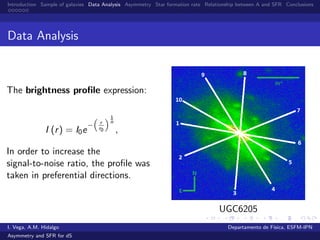
The brightness profile expression:
I (r) = I0e
− r
r0
1
n
,
In order to increase the
signal-to-noise ratio, the profile was
taken in preferential directions.
UGC6205
I. Vega, A.M. Hidalgo Departamento de F´ısica, ESFM-IPN
Asymmetry and SFR for dS
Introduction Sample of galaxies Data Analysis Asymmetry Star formation rate Relationship between A and SFR Conclusions
Galaxy
V filter R filter
n r0 [arcsec] rP [arcsec] n r0 [arcsec] rP [arcsec]
UGC 891 0.6 ± 0.4 13.0 ± 2.2 27.3 ± 4.6 0.7 ± 0.3 14.4 ± 2.3 30.2 ± 4.8
UGC 3775 0.5 ± 0.3 10.7 ± 2.5 22.5 ± 5.3 0.6 ± 0.3 11.0 ± 2.0 23.1 ± 4.2
UGC 11820 0.7 ± 0.3 10.6 ± 1.4 22.3 ± 2.9 0.9 ± 0.2 11.6 ± 1.4 24.4 ± 2.9
UGC 5296 2.0 ± 0.2 19.5 ± 2.5 41.0 ± 5.3 1.9 ± 0.2 22.3 ± 2.5 46.8 ± 5.3
UGC 6205 1.6 ± 0.3 20.9 ± 2.3 43.9 ± 4.8 1.7 ± 0.2 22.5 ± 2.6 47.3 ± 5.5
UGC 6304 1.5 ± 0.7 27.1 ± 2.4 56.9 ± 5.0 1.4 ± 0.6 1.4 ± 1.1 2.9 ± 2.3
UGC 9570 1.7 ± 0.2 26.0 ± 2.2 54.6 ± 4.6 1.7 ± 0.4 28.5 ± 2.2 59.9 ± 4.6
UGC 12212 1.5 ± 0.2 15.4 ± 2.1 32.3 ± 4.4 1.3 ± 0.1 16.3 ± 2.3 34.2 ± 4.8
UGC 5242 2.1 ± 0.4 14.8 ± 2.1 31.1 ± 4.4 2.1 ± 0.8 15.8 ± 1.9 33.2 ± 4.0
I. Vega, A.M. Hidalgo Departamento de F´ısica, ESFM-IPN
Asymmetry and SFR for dS
Introduction Sample of galaxies Data Analysis Asymmetry Star formation rate Relationship between A and SFR Conclusions
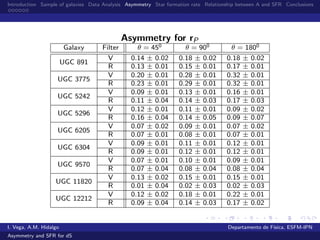
Asymmetry for rP
Galaxy Filter θ = 450 θ = 900 θ = 1800
UGC 891
V 0.14 ± 0.02 0.18 ± 0.02 0.18 ± 0.02
R 0.13 ± 0.01 0.15 ± 0.01 0.17 ± 0.01
UGC 3775
V 0.20 ± 0.01 0.28 ± 0.01 0.32 ± 0.01
R 0.23 ± 0.01 0.29 ± 0.01 0.32 ± 0.01
UGC 5242
V 0.09 ± 0.01 0.13 ± 0.01 0.16 ± 0.01
R 0.11 ± 0.04 0.14 ± 0.03 0.17 ± 0.03
UGC 5296
V 0.12 ± 0.01 0.11 ± 0.01 0.09 ± 0.02
R 0.16 ± 0.04 0.14 ± 0.05 0.09 ± 0.07
UGC 6205
V 0.07 ± 0.02 0.09 ± 0.01 0.07 ± 0.02
R 0.07 ± 0.01 0.08 ± 0.01 0.07 ± 0.01
UGC 6304
V 0.09 ± 0.01 0.11 ± 0.01 0.12 ± 0.01
R 0.09 ± 0.01 0.12 ± 0.01 0.12 ± 0.01
UGC 9570
V 0.07 ± 0.01 0.10 ± 0.01 0.09 ± 0.01
R 0.07 ± 0.04 0.08 ± 0.04 0.08 ± 0.04
UGC 11820
V 0.13 ± 0.02 0.15 ± 0.01 0.15 ± 0.01
R 0.01 ± 0.04 0.02 ± 0.03 0.02 ± 0.03
UGC 12212
V 0.12 ± 0.02 0.18 ± 0.01 0.22 ± 0.01
R 0.09 ± 0.04 0.14 ± 0.03 0.17 ± 0.02
I. Vega, A.M. Hidalgo Departamento de F´ısica, ESFM-IPN
Asymmetry and SFR for dS
Introduction Sample of galaxies Data Analysis Asymmetry Star formation rate Relationship between A and SFR Conclusions
Star formation rate
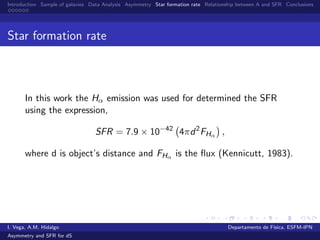
In this work the Hα emission was used for determined the SFR
using the expression,
SFR = 7.9 × 10−42
4πd2
FHα ,
where d is object’s distance and FHα is the flux (Kennicutt, 1983).
I. Vega, A.M. Hidalgo Departamento de F´ısica, ESFM-IPN
Asymmetry and SFR for dS
Introduction Sample of galaxies Data Analysis Asymmetry Star formation rate Relationship between A and SFR Conclusions
Galaxy
Flux SFR
[erg*cm−2]*10−13 [M yr−1]*10−2
UGC 891 21.9 ± 0.4 1.9 ± 0.3
UGC 3775 14.7 ± 0.2 6.0 ± 0.3
UGC 5242 5.9 ± 0.1 3.4 ± 0.2
UGC 5296 6.3 ± 0.3 2.6 ± 0.3
UGC 6205 9.3 ± 0.1 3.2 ± 0.3
UGC 6304 10.8 ± 0.4 6.0 ± 0.2
UGC 9570 2.6 ± 0.1 2.1 ± 0.2
UGC 11820 2.5 ± 0.5 6.8 ± 0.3
UGC 12212 34.0 ± 0.1 5.2 ± 0.4
These values of SFR are of the same order as those obtained for
dwarf irregular galaxies (Zhang et al. 2011) and similar for
late-type (Hunter et al. 1998).
I. Vega, A.M. Hidalgo Departamento de F´ısica, ESFM-IPN
Asymmetry and SFR for dS
Introduction Sample of galaxies Data Analysis Asymmetry Star formation rate Relationship between A and SFR Conclusions
0,0 0,1 0,2 0,3 0,4 0,5
1
2
3
4
5
6
7
UGC 9570
UGC 891
UGC 6304
UGC 6205
UGC 5296
UGC 5242
UGC 3775
UGC 12212
SFR(Mo*yr^-1)x10^-2
A
UGC 11820
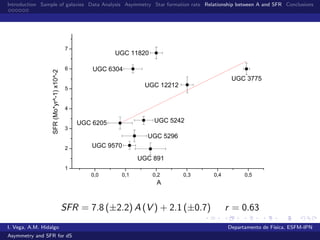
SFR = 7.8 (±2.2) A (V ) + 2.1 (±0.7) r = 0.63
I. Vega, A.M. Hidalgo Departamento de F´ısica, ESFM-IPN
Asymmetry and SFR for dS
Introduction Sample of galaxies Data Analysis Asymmetry Star formation rate Relationship between A and SFR Conclusions
Conclusions
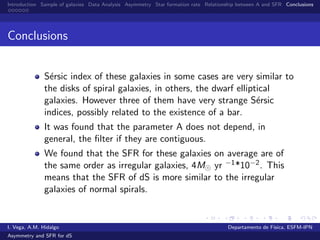
S´ersic index of these galaxies in some cases are very similar to
the disks of spiral galaxies, in others, the dwarf elliptical
galaxies. However three of them have very strange S´ersic
indices, possibly related to the existence of a bar.
It was found that the parameter A does not depend, in
general, the filter if they are contiguous.
We found that the SFR for these galaxies on average are of
the same order as irregular galaxies, 4M yr −1*10−2. This
means that the SFR of dS is more similar to the irregular
galaxies of normal spirals.
I. Vega, A.M. Hidalgo Departamento de F´ısica, ESFM-IPN
Asymmetry and SFR for dS
Introduction Sample of galaxies Data Analysis Asymmetry Star formation rate Relationship between A and SFR Conclusions
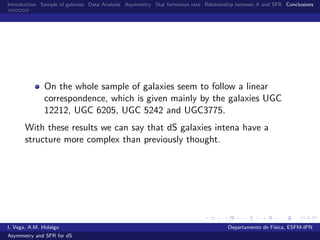
On the whole sample of galaxies seem to follow a linear
correspondence, which is given mainly by the galaxies UGC
12212, UGC 6205, UGC 5242 and UGC3775.
With these results we can say that dS galaxies intena have a
structure more complex than previously thought.
I. Vega, A.M. Hidalgo Departamento de F´ısica, ESFM-IPN
Asymmetry and SFR for dS
Introduction Sample of galaxies Data Analysis Asymmetry Star formation rate Relationship between A and SFR Conclusions
Thanks for your attention.
I. Vega, A.M. Hidalgo Departamento de F´ısica, ESFM-IPN
Asymmetry and SFR for dS
Introduction Sample of galaxies Data Analysis Asymmetry Star formation rate Relationship between A and SFR Conclusions
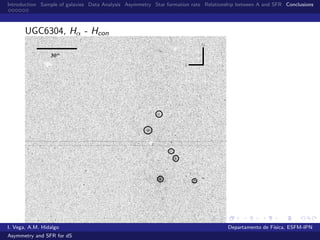
UGC6304, Hα - Hcon
I. Vega, A.M. Hidalgo Departamento de F´ısica, ESFM-IPN
Asymmetry and SFR for dS
Introduction Sample of galaxies Data Analysis Asymmetry Star formation rate Relationship between A and SFR Conclusions
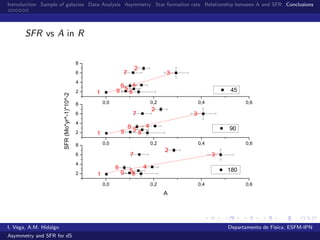
SFR vs A in R
1
2
3
4
5
6
7
89
1
2
3
4
5
6
7
89
1
2
3
4
5
6
7
89
0,0 0,2 0,4 0,6
2
4
6
8
SFR(Mo*yr^-1)*10^-2
45
0,0 0,2 0,4 0,6
2
4
6
8
90
0,0 0,2 0,4 0,6
2
4
6
8
A
180
I. Vega, A.M. Hidalgo Departamento de F´ısica, ESFM-IPN
Asymmetry and SFR for dS
Introduction Sample of galaxies Data Analysis Asymmetry Star formation rate Relationship between A and SFR Conclusions
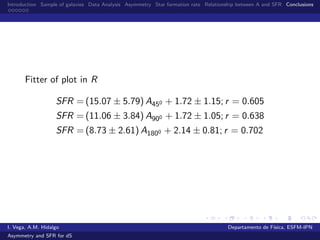
Fitter of plot in R
SFR = (15.07 ± 5.79) A450 + 1.72 ± 1.15; r = 0.605
SFR = (11.06 ± 3.84) A900 + 1.72 ± 1.05; r = 0.638
SFR = (8.73 ± 2.61) A1800 + 2.14 ± 0.81; r = 0.702
I. Vega, A.M. Hidalgo Departamento de F´ısica, ESFM-IPN
Asymmetry and SFR for dS
Introduction Sample of galaxies Data Analysis Asymmetry Star formation rate Relationship between A and SFR Conclusions
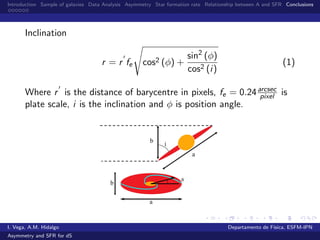
Inclination
r = r fe cos2 (φ) +
sin2
(φ)
cos2 (i)
(1)
Where r is the distance of barycentre in pixels, fe = 0.24arcsec
pixel is
plate scale, i is the inclination and φ is position angle.
I. Vega, A.M. Hidalgo Departamento de F´ısica, ESFM-IPN
Asymmetry and SFR for dS
Introduction Sample of galaxies Data Analysis Asymmetry Star formation rate Relationship between A and SFR Conclusions
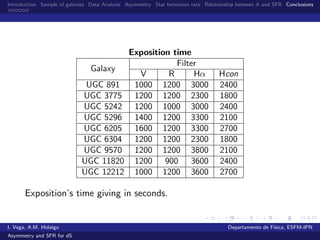
Exposition time
Galaxy
Filter
V R Hα Hcon
UGC 891 1000 1200 3000 2400
UGC 3775 1200 1200 2300 1800
UGC 5242 1200 1000 3000 2400
UGC 5296 1400 1200 3300 2100
UGC 6205 1600 1200 3300 2700
UGC 6304 1200 1200 2300 1800
UGC 9570 1200 1200 3800 2100
UGC 11820 1200 900 3600 2400
UGC 12212 1000 1200 3600 2700
Exposition’s time giving in seconds.
I. Vega, A.M. Hidalgo Departamento de F´ısica, ESFM-IPN
Asymmetry and SFR for dS
Introduction Sample of galaxies Data Analysis Asymmetry Star formation rate Relationship between A and SFR Conclusions
Barycentre [pixel]
Galaxy(1) Filter(2) Bx(3) By(4) Separation(5) [arcsec]
UGC891
V 414 357
0.96
R 417 360
UGC3775
V 249 647
0.96
R 245 644
UGC5242
V 501 463
1.68
R 505 458
UGC5296
V 432 53
0.72
R 433 529
UGC6205
V 479 381
0.72
R 479 378
UGC6304
V 601 376
0.72
R 601 366
UGC9570
V 737 754
0.48
R 739 755
UGC11820
V 668 451
0.96
R 665 465
UGC12212
V 540 473
1.2
R 540 479
I. Vega, A.M. Hidalgo Departamento de F´ısica, ESFM-IPN
Asymmetry and SFR for dS

IVega_Acevedo

  • 1.
    Introduction Sample ofgalaxies Data Analysis Asymmetry Star formation rate Relationship between A and SFR Conclusions The asymmetry and star formation rate for dwarf spiral galaxies M.Sc. Ignacio Vega Acevedo Dr. Ana Mar´ıa Hidalgo G´amez Departamento de F´ısica, ESFM-IPN August 10, 2013 I. Vega, A.M. Hidalgo Departamento de F´ısica, ESFM-IPN Asymmetry and SFR for dS
  • 2.
    Introduction Sample ofgalaxies Data Analysis Asymmetry Star formation rate Relationship between A and SFR Conclusions 1 Introduction CAS system 2 Sample of galaxies 3 Data Analysis 4 Asymmetry 5 Star formation rate 6 Relationship between A and SFR 7 Conclusions I. Vega, A.M. Hidalgo Departamento de F´ısica, ESFM-IPN Asymmetry and SFR for dS
  • 3.
    Introduction Sample ofgalaxies Data Analysis Asymmetry Star formation rate Relationship between A and SFR Conclusions Introduction dS galaxy The dwarf spiral galaxies,dS are the galaxies with an optical radius 5 Kpc, a magnitude MB − 18 (Hidalgo-G´amez, 2004). I. Vega, A.M. Hidalgo Departamento de F´ısica, ESFM-IPN Asymmetry and SFR for dS
  • 4.
    Introduction Sample ofgalaxies Data Analysis Asymmetry Star formation rate Relationship between A and SFR Conclusions CAS system CAS system The CAS system is defined by the morphological parameters Concentration, C, asymmetry, A and clumpiness, S (Conselice et al., 2000). I. Vega, A.M. Hidalgo Departamento de F´ısica, ESFM-IPN Asymmetry and SFR for dS
  • 5.
    Introduction Sample ofgalaxies Data Analysis Asymmetry Star formation rate Relationship between A and SFR Conclusions CAS system C definition Concentration measured how concentrate is the galaxy’s light distribution C ≡ 5 × log r80 r20 ∝ MS,G (T) MS (T) , 2 C 5, where r80 and r20 are the radius with 80% and 20% of the total galaxy luminosity (Kent, 1985). Conselice (2003) said that C is proportional to gravitational gas mass, into stars, MS,G (T), divided by the stellar mass, MS (T) where T is the actual age of the galaxy. I. Vega, A.M. Hidalgo Departamento de F´ısica, ESFM-IPN Asymmetry and SFR for dS
  • 6.
    Introduction Sample ofgalaxies Data Analysis Asymmetry Star formation rate Relationship between A and SFR Conclusions CAS system S definition The clumpiness measures the spacial distribution for irregularities. S = I − B I ∝ T 0 t T α (t) MG (t) Ms (T) dt, where I is the original image and B is the image in the narrow filter. Conselice (2003) said that S is proportional to α, which is the SFR and the gas mass of system, MG . In this case T is the actual age of the galaxy. I. Vega, A.M. Hidalgo Departamento de F´ısica, ESFM-IPN Asymmetry and SFR for dS
  • 7.
    Introduction Sample ofgalaxies Data Analysis Asymmetry Star formation rate Relationship between A and SFR Conclusions CAS system A definition The asymmetry parameter, A, measure the symmetry of the galaxy’s image. The expression of asymmetry is: A ≡ Σ |I − R| 2Σ (I) ∝ T 0 t T | ˙Ms (t)| Ms (T) dt, where I is the original image and R is the image rotated θ (Abraham et al. 1996). The ˙Ms(t) is the temporal variation of stellar mass, t and T have the same meaning that in S (Conselice, 2003). I. Vega, A.M. Hidalgo Departamento de F´ısica, ESFM-IPN Asymmetry and SFR for dS
  • 8.
    Introduction Sample ofgalaxies Data Analysis Asymmetry Star formation rate Relationship between A and SFR Conclusions CAS system Example of asymmetry UGC 6205 I. Vega, A.M. Hidalgo Departamento de F´ısica, ESFM-IPN Asymmetry and SFR for dS
  • 9.
    Introduction Sample ofgalaxies Data Analysis Asymmetry Star formation rate Relationship between A and SFR Conclusions CAS system If ˙Ms(t) , MG (t) and α (t) are constant, the parameters A and S will have the expression A ∝ T ˙Ms 2Ms (T) , S ∝ TαMG 2Ms (T) , then S ∝  αMG ˙Ms   A. The constant of proportionality between S y A depending on SFR. I. Vega, A.M. Hidalgo Departamento de F´ısica, ESFM-IPN Asymmetry and SFR for dS
  • 10.
    Introduction Sample ofgalaxies Data Analysis Asymmetry Star formation rate Relationship between A and SFR Conclusions Our sample of galaxies dS This sample of galaxies follows the definition of dwarf spiral galaxy given by Hidalgo-G´amez (2004). Galaxy i [degree] r25 [kpc] D [Mpc] MB Av [mag] UGC891 63 3.13 9.4 ± 1 -15.32 0.076 UGC3775 27 4.68 20.8 ± 7.7 -15.08 0.305 UGC5242 50 4.86 24.76 ± ... -16.60 0.417 UGC5296 29 3.02 20.28 ± ... -15.08 0.031 UGC6205 41 4.99 18.87 ± ... -16.53 0.043 UGC6304 39 4.72 23.51 ± ... -15.40 0.029 UGC9570 14 ... 29.4 ± ... -15.89 0.029 UGC11820 24 4.96 17.1 ± 2.4 -14.70 0.332 UGC12212 56 3.3 14.7 ± 2.8 -15.11 0.170 Taken from: RC3; Hidalgo-G´amez, 2004; Fitzpatrick, 1999 I. Vega, A.M. Hidalgo Departamento de F´ısica, ESFM-IPN Asymmetry and SFR for dS
  • 11.
    Introduction Sample ofgalaxies Data Analysis Asymmetry Star formation rate Relationship between A and SFR Conclusions These galaxies were observed in the filters R, V, Hα and continuum. The observations were done with the telescope of 1.5m in Observatorio Astron´omico Nacional in San Pedro M´artir by Dr. Ana Mar´ıa Hidalgo G´amez. I. Vega, A.M. Hidalgo Departamento de F´ısica, ESFM-IPN Asymmetry and SFR for dS
  • 12.
    Introduction Sample ofgalaxies Data Analysis Asymmetry Star formation rate Relationship between A and SFR Conclusions Data Analysis The brightness profile expression: I (r) = I0e − r r0 1 n , In order to increase the signal-to-noise ratio, the profile was taken in preferential directions. UGC6205 I. Vega, A.M. Hidalgo Departamento de F´ısica, ESFM-IPN Asymmetry and SFR for dS
  • 13.
    Introduction Sample ofgalaxies Data Analysis Asymmetry Star formation rate Relationship between A and SFR Conclusions Galaxy V filter R filter n r0 [arcsec] rP [arcsec] n r0 [arcsec] rP [arcsec] UGC 891 0.6 ± 0.4 13.0 ± 2.2 27.3 ± 4.6 0.7 ± 0.3 14.4 ± 2.3 30.2 ± 4.8 UGC 3775 0.5 ± 0.3 10.7 ± 2.5 22.5 ± 5.3 0.6 ± 0.3 11.0 ± 2.0 23.1 ± 4.2 UGC 11820 0.7 ± 0.3 10.6 ± 1.4 22.3 ± 2.9 0.9 ± 0.2 11.6 ± 1.4 24.4 ± 2.9 UGC 5296 2.0 ± 0.2 19.5 ± 2.5 41.0 ± 5.3 1.9 ± 0.2 22.3 ± 2.5 46.8 ± 5.3 UGC 6205 1.6 ± 0.3 20.9 ± 2.3 43.9 ± 4.8 1.7 ± 0.2 22.5 ± 2.6 47.3 ± 5.5 UGC 6304 1.5 ± 0.7 27.1 ± 2.4 56.9 ± 5.0 1.4 ± 0.6 1.4 ± 1.1 2.9 ± 2.3 UGC 9570 1.7 ± 0.2 26.0 ± 2.2 54.6 ± 4.6 1.7 ± 0.4 28.5 ± 2.2 59.9 ± 4.6 UGC 12212 1.5 ± 0.2 15.4 ± 2.1 32.3 ± 4.4 1.3 ± 0.1 16.3 ± 2.3 34.2 ± 4.8 UGC 5242 2.1 ± 0.4 14.8 ± 2.1 31.1 ± 4.4 2.1 ± 0.8 15.8 ± 1.9 33.2 ± 4.0 I. Vega, A.M. Hidalgo Departamento de F´ısica, ESFM-IPN Asymmetry and SFR for dS
  • 14.
    Introduction Sample ofgalaxies Data Analysis Asymmetry Star formation rate Relationship between A and SFR Conclusions Asymmetry for rP Galaxy Filter θ = 450 θ = 900 θ = 1800 UGC 891 V 0.14 ± 0.02 0.18 ± 0.02 0.18 ± 0.02 R 0.13 ± 0.01 0.15 ± 0.01 0.17 ± 0.01 UGC 3775 V 0.20 ± 0.01 0.28 ± 0.01 0.32 ± 0.01 R 0.23 ± 0.01 0.29 ± 0.01 0.32 ± 0.01 UGC 5242 V 0.09 ± 0.01 0.13 ± 0.01 0.16 ± 0.01 R 0.11 ± 0.04 0.14 ± 0.03 0.17 ± 0.03 UGC 5296 V 0.12 ± 0.01 0.11 ± 0.01 0.09 ± 0.02 R 0.16 ± 0.04 0.14 ± 0.05 0.09 ± 0.07 UGC 6205 V 0.07 ± 0.02 0.09 ± 0.01 0.07 ± 0.02 R 0.07 ± 0.01 0.08 ± 0.01 0.07 ± 0.01 UGC 6304 V 0.09 ± 0.01 0.11 ± 0.01 0.12 ± 0.01 R 0.09 ± 0.01 0.12 ± 0.01 0.12 ± 0.01 UGC 9570 V 0.07 ± 0.01 0.10 ± 0.01 0.09 ± 0.01 R 0.07 ± 0.04 0.08 ± 0.04 0.08 ± 0.04 UGC 11820 V 0.13 ± 0.02 0.15 ± 0.01 0.15 ± 0.01 R 0.01 ± 0.04 0.02 ± 0.03 0.02 ± 0.03 UGC 12212 V 0.12 ± 0.02 0.18 ± 0.01 0.22 ± 0.01 R 0.09 ± 0.04 0.14 ± 0.03 0.17 ± 0.02 I. Vega, A.M. Hidalgo Departamento de F´ısica, ESFM-IPN Asymmetry and SFR for dS
  • 15.
    Introduction Sample ofgalaxies Data Analysis Asymmetry Star formation rate Relationship between A and SFR Conclusions Star formation rate In this work the Hα emission was used for determined the SFR using the expression, SFR = 7.9 × 10−42 4πd2 FHα , where d is object’s distance and FHα is the flux (Kennicutt, 1983). I. Vega, A.M. Hidalgo Departamento de F´ısica, ESFM-IPN Asymmetry and SFR for dS
  • 16.
    Introduction Sample ofgalaxies Data Analysis Asymmetry Star formation rate Relationship between A and SFR Conclusions Galaxy Flux SFR [erg*cm−2]*10−13 [M yr−1]*10−2 UGC 891 21.9 ± 0.4 1.9 ± 0.3 UGC 3775 14.7 ± 0.2 6.0 ± 0.3 UGC 5242 5.9 ± 0.1 3.4 ± 0.2 UGC 5296 6.3 ± 0.3 2.6 ± 0.3 UGC 6205 9.3 ± 0.1 3.2 ± 0.3 UGC 6304 10.8 ± 0.4 6.0 ± 0.2 UGC 9570 2.6 ± 0.1 2.1 ± 0.2 UGC 11820 2.5 ± 0.5 6.8 ± 0.3 UGC 12212 34.0 ± 0.1 5.2 ± 0.4 These values of SFR are of the same order as those obtained for dwarf irregular galaxies (Zhang et al. 2011) and similar for late-type (Hunter et al. 1998). I. Vega, A.M. Hidalgo Departamento de F´ısica, ESFM-IPN Asymmetry and SFR for dS
  • 17.
    Introduction Sample ofgalaxies Data Analysis Asymmetry Star formation rate Relationship between A and SFR Conclusions 0,0 0,1 0,2 0,3 0,4 0,5 1 2 3 4 5 6 7 UGC 9570 UGC 891 UGC 6304 UGC 6205 UGC 5296 UGC 5242 UGC 3775 UGC 12212 SFR(Mo*yr^-1)x10^-2 A UGC 11820 SFR = 7.8 (±2.2) A (V ) + 2.1 (±0.7) r = 0.63 I. Vega, A.M. Hidalgo Departamento de F´ısica, ESFM-IPN Asymmetry and SFR for dS
  • 18.
    Introduction Sample ofgalaxies Data Analysis Asymmetry Star formation rate Relationship between A and SFR Conclusions Conclusions S´ersic index of these galaxies in some cases are very similar to the disks of spiral galaxies, in others, the dwarf elliptical galaxies. However three of them have very strange S´ersic indices, possibly related to the existence of a bar. It was found that the parameter A does not depend, in general, the filter if they are contiguous. We found that the SFR for these galaxies on average are of the same order as irregular galaxies, 4M yr −1*10−2. This means that the SFR of dS is more similar to the irregular galaxies of normal spirals. I. Vega, A.M. Hidalgo Departamento de F´ısica, ESFM-IPN Asymmetry and SFR for dS
  • 19.
    Introduction Sample ofgalaxies Data Analysis Asymmetry Star formation rate Relationship between A and SFR Conclusions On the whole sample of galaxies seem to follow a linear correspondence, which is given mainly by the galaxies UGC 12212, UGC 6205, UGC 5242 and UGC3775. With these results we can say that dS galaxies intena have a structure more complex than previously thought. I. Vega, A.M. Hidalgo Departamento de F´ısica, ESFM-IPN Asymmetry and SFR for dS
  • 20.
    Introduction Sample ofgalaxies Data Analysis Asymmetry Star formation rate Relationship between A and SFR Conclusions Thanks for your attention. I. Vega, A.M. Hidalgo Departamento de F´ısica, ESFM-IPN Asymmetry and SFR for dS
  • 21.
    Introduction Sample ofgalaxies Data Analysis Asymmetry Star formation rate Relationship between A and SFR Conclusions UGC6304, Hα - Hcon I. Vega, A.M. Hidalgo Departamento de F´ısica, ESFM-IPN Asymmetry and SFR for dS
  • 22.
    Introduction Sample ofgalaxies Data Analysis Asymmetry Star formation rate Relationship between A and SFR Conclusions SFR vs A in R 1 2 3 4 5 6 7 89 1 2 3 4 5 6 7 89 1 2 3 4 5 6 7 89 0,0 0,2 0,4 0,6 2 4 6 8 SFR(Mo*yr^-1)*10^-2 45 0,0 0,2 0,4 0,6 2 4 6 8 90 0,0 0,2 0,4 0,6 2 4 6 8 A 180 I. Vega, A.M. Hidalgo Departamento de F´ısica, ESFM-IPN Asymmetry and SFR for dS
  • 23.
    Introduction Sample ofgalaxies Data Analysis Asymmetry Star formation rate Relationship between A and SFR Conclusions Fitter of plot in R SFR = (15.07 ± 5.79) A450 + 1.72 ± 1.15; r = 0.605 SFR = (11.06 ± 3.84) A900 + 1.72 ± 1.05; r = 0.638 SFR = (8.73 ± 2.61) A1800 + 2.14 ± 0.81; r = 0.702 I. Vega, A.M. Hidalgo Departamento de F´ısica, ESFM-IPN Asymmetry and SFR for dS
  • 24.
    Introduction Sample ofgalaxies Data Analysis Asymmetry Star formation rate Relationship between A and SFR Conclusions Inclination r = r fe cos2 (φ) + sin2 (φ) cos2 (i) (1) Where r is the distance of barycentre in pixels, fe = 0.24arcsec pixel is plate scale, i is the inclination and φ is position angle. I. Vega, A.M. Hidalgo Departamento de F´ısica, ESFM-IPN Asymmetry and SFR for dS
  • 25.
    Introduction Sample ofgalaxies Data Analysis Asymmetry Star formation rate Relationship between A and SFR Conclusions Exposition time Galaxy Filter V R Hα Hcon UGC 891 1000 1200 3000 2400 UGC 3775 1200 1200 2300 1800 UGC 5242 1200 1000 3000 2400 UGC 5296 1400 1200 3300 2100 UGC 6205 1600 1200 3300 2700 UGC 6304 1200 1200 2300 1800 UGC 9570 1200 1200 3800 2100 UGC 11820 1200 900 3600 2400 UGC 12212 1000 1200 3600 2700 Exposition’s time giving in seconds. I. Vega, A.M. Hidalgo Departamento de F´ısica, ESFM-IPN Asymmetry and SFR for dS
  • 26.
    Introduction Sample ofgalaxies Data Analysis Asymmetry Star formation rate Relationship between A and SFR Conclusions Barycentre [pixel] Galaxy(1) Filter(2) Bx(3) By(4) Separation(5) [arcsec] UGC891 V 414 357 0.96 R 417 360 UGC3775 V 249 647 0.96 R 245 644 UGC5242 V 501 463 1.68 R 505 458 UGC5296 V 432 53 0.72 R 433 529 UGC6205 V 479 381 0.72 R 479 378 UGC6304 V 601 376 0.72 R 601 366 UGC9570 V 737 754 0.48 R 739 755 UGC11820 V 668 451 0.96 R 665 465 UGC12212 V 540 473 1.2 R 540 479 I. Vega, A.M. Hidalgo Departamento de F´ısica, ESFM-IPN Asymmetry and SFR for dS