DEENDAYALUPADHYAYAGORAKHPURUNIVERSITY
GORAKHPUR
•Department of zoology and Environmental
science
•ADVANCES ON BIOLOGICAL AND ENVIRONMENTAL
SCIENCE FOR HUMAN WELFARE
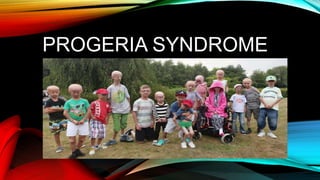
PROGERIA SYNDROME
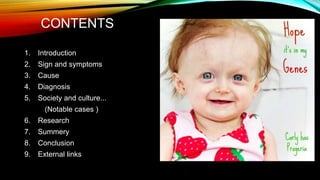
CONTENTS
1. Introduction
2. Sign and symptoms
3. Cause
4. Diagnosis
5. Society and culture...
(Notable cases )
6. Research
7. Summery
8. Conclusion
9. External links
INTRODUCTION
• Progeria is a Greek word :- pro : before or premature
. geras : old age
• Progeria was first described in 1886 by Jonathan Hutchinson .
• It was also described independently in 1897 by Hasting gilford .
• Later named as Hutchinson gilford progeria syndrome.
• Progeria is an extremely rare autosomal dominant genetic disorder in which symptoms
resembling aspects of aging are manifested at a very early age
• It is a genetic condition that occurs as a new mutation and is rarely inherited as
carriers do not live to reproduce
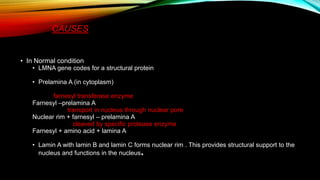
CAUSES
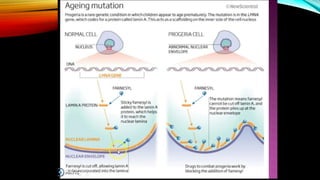
• In Normal condition
• LMNA gene codes for a structural protein
• Prelamina A (in cytoplasm)
farnesyl transferase enzyme
Farnesyl –prelamina A
transport in nucleus through nuclear pore
Nuclear rim + farnesyl – prelamina A
cleaved by specific protease enzyme
Farnesyl + amino acid + lamina A
• Lamin A with lamin B and lamin C forms nuclear rim . This provides structural support to the
nucleus and functions in the nucleus.
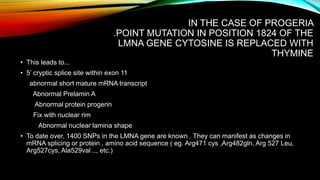
IN THE CASE OF PROGERIA
.POINT MUTATION IN POSITION 1824 OF THE
LMNA GENE CYTOSINE IS REPLACED WITH
THYMINE
• This leads to...
• 5’ cryptic splice site within exon 11
abnormal short mature mRNA transcript
Abnormal Prelamin A
Abnormal protein progerin
Fix with nuclear rim
Abnormal nuclear lamina shape
• To date over, 1400 SNPs in the LMNA gene are known . They can manifest as changes in
mRNA splicing or protein , amino acid sequence ( eg. Arg471 cys ,Arg482gln, Arg 527 Leu,
Arg527cys, Ala529val .., etc.)
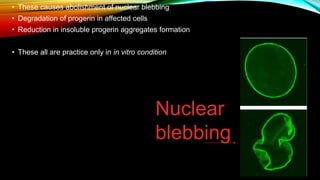
• These causes abolishment of nuclear blebbing
• Degradation of progerin in affected cells
• Reduction in insoluble progerin aggregates formation
• These all are practice only in in vitro condition
Nuclear
blebbing
DIAGNOSIS AND TREATMENT
• Diagnosis : According to sign and symptoms skin changes , abnormal growth , loss of hair
• A genetic test for LMNA mutations.
• Treatment : generally no treatment is a available.
• 1. Treatment provides only for reducing complications
• Coronary artery bypass surgery
• Low dose aspirin
• 2. Growth hormone treatment
• 3. In mice and cell tissue culture
. Anticancer Medicine are used
[ anti sense morpholino oligonucleotide specifically directed against the mutated exon -11 and exon -12
junction in the mutated pre mRNA were used .
• farnesyl transferase inhibitor FTI s are used
• . 1 lonabfarnib
• 2. Rapamycin ( having property of autophagy)
EPIDEMIOLOGY
1 IN 4 MILLION BIRTH
100 KNOWN CASES IN THE WORLD
140 CASES IN THE MEDICAL HISTORY
SOCIETY AND CULTURE
NOTABLE CASES
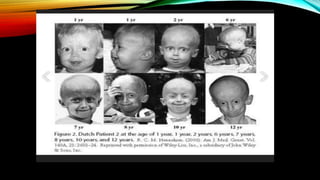
1. IN 1987, TWELVE YEAR OLD MICKEY HAYS APPEARED IN THE
DOCUMENTARY ‘I AM NOT A FREAK”. HAYS DIED IN 1992 ,AGE 20
2.SOUTH AFRICAN HIP HOP ARTIST LEAN BOTHA WAS ONE OF THE OLDEST
KNOWN PROGERIA SUFFERES SURVIVING TO THE AGE OF 26 BEFORE HIS
DEATH IN JUNE 2011
3. “LIFE ACCORDING TO SAM ` WAS A 2013 DOCUMENTARY ON SAM BERN’S
.HE DIED AT THE AGE OF 17 (JANUARY 10,2014).
4. A 2009 BOLLYWOOD MOVIE ‘PAA ` WAS MADE ABOUT THE CONDITION.
RESEARCH ON PROGERIA
• Several discoveries have been made that have led to greater understanding and
perhaps eventual treatment for this disease.
• A 2003 report in Nature said that progeria may be a de novo dominant trait .
• It develops during cell division in a newly conceived zygote or in the gametes of one
of the parents .
• It is caused by mutations in the LMNA (Lamin A protein) gene on Chromosome 1. ;
the mutated form f lamin A is commonly known as progerin .
• One of the authors , and Leslie Gordon ,was a physician who did not
known anything about progeria until her own son .Sam , was
diagnosed at 22 months
LAMIN A
• Lamin A is a major component of a protein Scaffold on the inner edge of the nucleus
called he nuclear lamina that helps organize nuclear processes such as RNA AND
DNA synthesis.
• Prelamin A conta a CAAX BOX at the C terminus of the protein (where C is a
cystein and A is any aliphatic amino acids)
• This ensures that the cysteine is farnesylated and allows prelamin A to bind
membranes, specially the nuclear membrane
• After prelamin A has been localised to the cell nuclear membrane, the C-terminus
amino acids, including the farnesylated cysteine, are cleaved off by q specific
protease.
• The resulting proteins , now lamin A is no longer membrane –bound and carries out
functions inside the nucleus.
• In HGPS, the recognition site that the enzyme requires for cleavage of prelamin A to
lamin A is mutated .Lamin A cannot be produced , and prelamin A builds up on the
nucleus membrane causing a characteristic nuclear blebbing.
• This results in the symptoms of progeria , although the relationship between the
misshape nucleus and the symptoms
• A study that compared HGPS patient cells with the skin cells from young and elderly
normal human subjects found similar defects in the HGPS and elderly cells,
including down regulation of certain nuclear proteins increased DNA damage , and
demethylation of histone , leading to reduced heterochromatin .
SUMMARY
• Scientists are interested in progeria partly because it might it reveal clues about the
normal process of aging.
• Since the support that the nuclear lamina normally provides is necessary for the
organizing of chromatin during mitosis, weaking of nuclear lamina limits the ability of
the cell division
CONCLUSION
• Did u ever think:
• Your children look
• More older than
• You
• Where the children
• Not grown up to the
• Adult but goes towards
• Old age
• So,once think about its
• Treatment. A field of research
• Waiting for us ,full of curiosity
• Of aging process.
Desire is
the starting
point of all
achieveme
nt,not a
hope,not a
wish ,but a
keen
pulsating
desire
which
transcend
everything.
THANK
YOU…
…Waiting
for Research
On my Topic.

Progeria syndrome

  • 1.
    DEENDAYALUPADHYAYAGORAKHPURUNIVERSITY GORAKHPUR •Department of zoologyand Environmental science •ADVANCES ON BIOLOGICAL AND ENVIRONMENTAL SCIENCE FOR HUMAN WELFARE
  • 2.
  • 3.
    CONTENTS 1. Introduction 2. Signand symptoms 3. Cause 4. Diagnosis 5. Society and culture... (Notable cases ) 6. Research 7. Summery 8. Conclusion 9. External links
  • 4.
    INTRODUCTION • Progeria isa Greek word :- pro : before or premature . geras : old age • Progeria was first described in 1886 by Jonathan Hutchinson . • It was also described independently in 1897 by Hasting gilford . • Later named as Hutchinson gilford progeria syndrome. • Progeria is an extremely rare autosomal dominant genetic disorder in which symptoms resembling aspects of aging are manifested at a very early age • It is a genetic condition that occurs as a new mutation and is rarely inherited as carriers do not live to reproduce
  • 6.
    CAUSES • In Normalcondition • LMNA gene codes for a structural protein • Prelamina A (in cytoplasm) farnesyl transferase enzyme Farnesyl –prelamina A transport in nucleus through nuclear pore Nuclear rim + farnesyl – prelamina A cleaved by specific protease enzyme Farnesyl + amino acid + lamina A • Lamin A with lamin B and lamin C forms nuclear rim . This provides structural support to the nucleus and functions in the nucleus.
  • 8.
    IN THE CASEOF PROGERIA .POINT MUTATION IN POSITION 1824 OF THE LMNA GENE CYTOSINE IS REPLACED WITH THYMINE • This leads to... • 5’ cryptic splice site within exon 11 abnormal short mature mRNA transcript Abnormal Prelamin A Abnormal protein progerin Fix with nuclear rim Abnormal nuclear lamina shape • To date over, 1400 SNPs in the LMNA gene are known . They can manifest as changes in mRNA splicing or protein , amino acid sequence ( eg. Arg471 cys ,Arg482gln, Arg 527 Leu, Arg527cys, Ala529val .., etc.)
  • 9.
    • These causesabolishment of nuclear blebbing • Degradation of progerin in affected cells • Reduction in insoluble progerin aggregates formation • These all are practice only in in vitro condition Nuclear blebbing
  • 10.
    DIAGNOSIS AND TREATMENT •Diagnosis : According to sign and symptoms skin changes , abnormal growth , loss of hair • A genetic test for LMNA mutations. • Treatment : generally no treatment is a available. • 1. Treatment provides only for reducing complications • Coronary artery bypass surgery • Low dose aspirin • 2. Growth hormone treatment • 3. In mice and cell tissue culture . Anticancer Medicine are used [ anti sense morpholino oligonucleotide specifically directed against the mutated exon -11 and exon -12 junction in the mutated pre mRNA were used . • farnesyl transferase inhibitor FTI s are used • . 1 lonabfarnib • 2. Rapamycin ( having property of autophagy)
  • 11.
    EPIDEMIOLOGY 1 IN 4MILLION BIRTH 100 KNOWN CASES IN THE WORLD 140 CASES IN THE MEDICAL HISTORY SOCIETY AND CULTURE NOTABLE CASES 1. IN 1987, TWELVE YEAR OLD MICKEY HAYS APPEARED IN THE DOCUMENTARY ‘I AM NOT A FREAK”. HAYS DIED IN 1992 ,AGE 20 2.SOUTH AFRICAN HIP HOP ARTIST LEAN BOTHA WAS ONE OF THE OLDEST KNOWN PROGERIA SUFFERES SURVIVING TO THE AGE OF 26 BEFORE HIS DEATH IN JUNE 2011 3. “LIFE ACCORDING TO SAM ` WAS A 2013 DOCUMENTARY ON SAM BERN’S .HE DIED AT THE AGE OF 17 (JANUARY 10,2014). 4. A 2009 BOLLYWOOD MOVIE ‘PAA ` WAS MADE ABOUT THE CONDITION.
  • 12.
    RESEARCH ON PROGERIA •Several discoveries have been made that have led to greater understanding and perhaps eventual treatment for this disease. • A 2003 report in Nature said that progeria may be a de novo dominant trait . • It develops during cell division in a newly conceived zygote or in the gametes of one of the parents . • It is caused by mutations in the LMNA (Lamin A protein) gene on Chromosome 1. ; the mutated form f lamin A is commonly known as progerin . • One of the authors , and Leslie Gordon ,was a physician who did not known anything about progeria until her own son .Sam , was diagnosed at 22 months
  • 13.
    LAMIN A • LaminA is a major component of a protein Scaffold on the inner edge of the nucleus called he nuclear lamina that helps organize nuclear processes such as RNA AND DNA synthesis. • Prelamin A conta a CAAX BOX at the C terminus of the protein (where C is a cystein and A is any aliphatic amino acids) • This ensures that the cysteine is farnesylated and allows prelamin A to bind membranes, specially the nuclear membrane • After prelamin A has been localised to the cell nuclear membrane, the C-terminus amino acids, including the farnesylated cysteine, are cleaved off by q specific protease. • The resulting proteins , now lamin A is no longer membrane –bound and carries out functions inside the nucleus.
  • 14.
    • In HGPS,the recognition site that the enzyme requires for cleavage of prelamin A to lamin A is mutated .Lamin A cannot be produced , and prelamin A builds up on the nucleus membrane causing a characteristic nuclear blebbing. • This results in the symptoms of progeria , although the relationship between the misshape nucleus and the symptoms • A study that compared HGPS patient cells with the skin cells from young and elderly normal human subjects found similar defects in the HGPS and elderly cells, including down regulation of certain nuclear proteins increased DNA damage , and demethylation of histone , leading to reduced heterochromatin .
  • 15.
    SUMMARY • Scientists areinterested in progeria partly because it might it reveal clues about the normal process of aging. • Since the support that the nuclear lamina normally provides is necessary for the organizing of chromatin during mitosis, weaking of nuclear lamina limits the ability of the cell division
  • 17.
    CONCLUSION • Did uever think: • Your children look • More older than • You • Where the children • Not grown up to the • Adult but goes towards • Old age • So,once think about its • Treatment. A field of research • Waiting for us ,full of curiosity • Of aging process. Desire is the starting point of all achieveme nt,not a hope,not a wish ,but a keen pulsating desire which transcend everything.
  • 19.