Hutchinson–
Gilford
progeria
syndrome
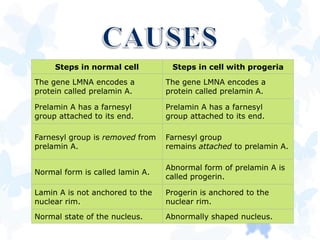
Steps in normal cell Steps in cell with progeria
The gene LMNA encodes a
protein called prelamin A.
The gene LMNA encodes a
protein called prelamin A.
Prelamin A has a farnesyl
group attached to its end.
Prelamin A has a farnesyl
group attached to its end.
Farnesyl group is removed from
prelamin A.
Farnesyl group
remains attached to prelamin A.
Normal form is called lamin A.
Abnormal form of prelamin A is
called progerin.
Lamin A is not anchored to the
nuclear rim.
Progerin is anchored to the
nuclear rim.
Normal state of the nucleus. Abnormally shaped nucleus.
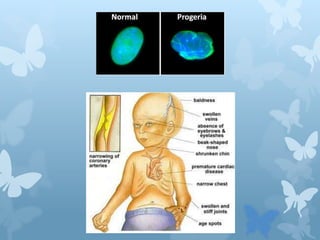
• Limited growth, full-body alopecia
• Scleroderma
• wrinkled skin, atherosclerosis, kidney failure,
loss of eyesight, and cardiovascular problems
• narrow face and a beak nose
• small, fragile bodies, like those of elderly
people
• a small face with a shallow recessed jaw, and a
pinched nose
http://www.progeriaresearch.org/index.html
http://en.wikipedia.org/wiki/Progeria
http://www.adaliarose.com
http://www.medpagetoday.com/celeb
ritydiagnosis/42315
Sources
Progeria Syndrome

Progeria Syndrome

Editor's Notes

  • #4 extremely rare genetic disorder (occur in 1 in 4 million newborns worldwide) At a very early age, children show aging symptoms genetic condition that occurs as a new mutation, and is rarely inherited, as patients usually do not live to reproduce
  • #5 Mutation of LMNA gene in nucleus
  • #6 Prominent scalp veins are noticeable
  • #8 6 years old, from Texas.
  • #9 Lonafarnib, a type of farnesyltransferase inhibitor (FTI) 
  • #10 Sam Berns – HBO Documentary ‘Life According to Sam’