Mohnish Rachuru
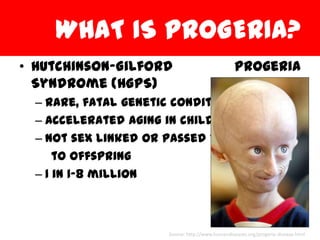
WHAT IS PROGERIA?
• Hutchinson-Gilford                             Progeria
  Syndrome (HGPS)
  – Rare, fatal genetic condition
  – Accelerated aging in children
  – Not sex linked or passed from parent
      to offspring
  – 1 in 1-8 million


                     Source: http://www.humandiseases.org/progeria-disease.html
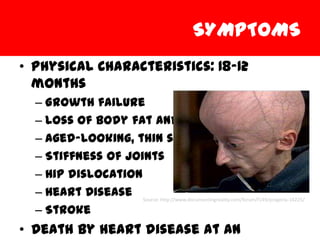
SYMPTOMS
• Physical Characteristics: 18-12
  months
  – Growth failure
  – Loss of body fat and hair
  – Aged-looking, thin skin
  – Stiffness of joints
  – Hip dislocation
  – Heart Disease Source: http://www.documentingreality.com/forum/f149/progeria-16225/
  – Stroke
• Death by heart disease at an
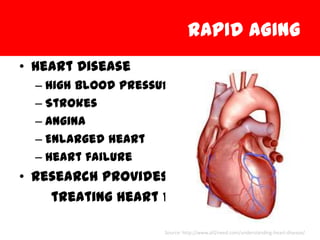
RAPID AGING
• Heart Disease
  – High blood pressure
  – Strokes
  – Angina
  – Enlarged heart
  – Heart failure
• Research provides keys in
    treating heart disease

                     Source: http://www.all2need.com/understanding-heart-disease/
causes
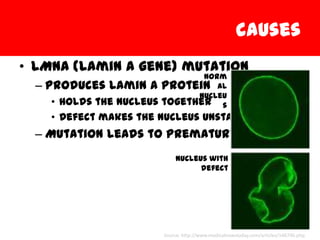
• LMNA (Lamin A gene) mutation
                              Norm
  – Produces Lamin A   protein al
                             Nucleu
    • Holds the nucleustogether s
    • Defect makes the nucleus unstable
  – Mutation leads to premature aging
                           Nucleus with
                                 defect


                       Source: http://www.medicalnewstoday.com/articles/146746.php
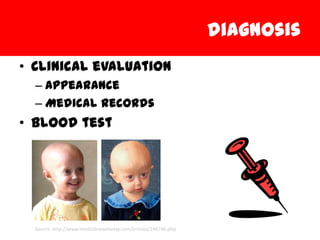
diagnosis
• Clinical evaluation
  – Appearance
  – Medical Records
• Blood test


  Source: http://www.medicalnewstoday.com/articles/146746.php
IS THERE A CURE?
• No cure
• Finding a cure
  – Cell and tissue bank
  – Medical & Research Database
    • Medical recommendations
    • Nutritional recommendations
  – “The Progeria Handbook”
    • Daily care recommendations
    • Basic health facts
    • Extensive treatment guidelines
Treatment
• No specific treatment
  – Low-dose aspirin
  – Other medications
  – Physical and occupational therapy
  – Extraction of primary teeth
• Investigational treatment
  – Farnesyltransferase inhibitors (FTIs)
    • Drugs that may correct cell defects
FOR MORE INFORMATION, GO TO THE
 PROGERIA RESEARCH FOUNDATION
            WEBSITE


 PROGERIARESEARCH.OR
          G
WORKS CITED
1. “Progeria.” Mayo Clinic. N.p., n.d. Web.
   21 Feb. 2012.
   <http://www.mayoclinic.com/health/
   progeria/DS00936/DSECTION=treatme
   nts-and-drugs>.
2. Progeria Research Foundation. N.p.,
   n.d. Web. 21 Feb. 2012.
   <http://www.progeriaresearch.org/p
   rogeria_101.html>.
3. “What Is Progeria?” Medical News
   Today. N.p., n.d. Web. 21 Feb. 2012.

Biology project progeria

  • 1.
  • 2.
    WHAT IS PROGERIA? •Hutchinson-Gilford Progeria Syndrome (HGPS) – Rare, fatal genetic condition – Accelerated aging in children – Not sex linked or passed from parent to offspring – 1 in 1-8 million Source: http://www.humandiseases.org/progeria-disease.html
  • 3.
    SYMPTOMS • Physical Characteristics:18-12 months – Growth failure – Loss of body fat and hair – Aged-looking, thin skin – Stiffness of joints – Hip dislocation – Heart Disease Source: http://www.documentingreality.com/forum/f149/progeria-16225/ – Stroke • Death by heart disease at an
  • 4.
    RAPID AGING • HeartDisease – High blood pressure – Strokes – Angina – Enlarged heart – Heart failure • Research provides keys in treating heart disease Source: http://www.all2need.com/understanding-heart-disease/
  • 5.
    causes • LMNA (LaminA gene) mutation Norm – Produces Lamin A protein al Nucleu • Holds the nucleustogether s • Defect makes the nucleus unstable – Mutation leads to premature aging Nucleus with defect Source: http://www.medicalnewstoday.com/articles/146746.php
  • 6.
    diagnosis • Clinical evaluation – Appearance – Medical Records • Blood test Source: http://www.medicalnewstoday.com/articles/146746.php
  • 7.
    IS THERE ACURE? • No cure • Finding a cure – Cell and tissue bank – Medical & Research Database • Medical recommendations • Nutritional recommendations – “The Progeria Handbook” • Daily care recommendations • Basic health facts • Extensive treatment guidelines
  • 8.
    Treatment • No specifictreatment – Low-dose aspirin – Other medications – Physical and occupational therapy – Extraction of primary teeth • Investigational treatment – Farnesyltransferase inhibitors (FTIs) • Drugs that may correct cell defects
  • 9.
    FOR MORE INFORMATION,GO TO THE PROGERIA RESEARCH FOUNDATION WEBSITE PROGERIARESEARCH.OR G
  • 10.
    WORKS CITED 1. “Progeria.”Mayo Clinic. N.p., n.d. Web. 21 Feb. 2012. <http://www.mayoclinic.com/health/ progeria/DS00936/DSECTION=treatme nts-and-drugs>. 2. Progeria Research Foundation. N.p., n.d. Web. 21 Feb. 2012. <http://www.progeriaresearch.org/p rogeria_101.html>. 3. “What Is Progeria?” Medical News Today. N.p., n.d. Web. 21 Feb. 2012.

Editor's Notes

  • #9 Permanent teeth come in before baby teeth fall outFTIs were originally developed for treating cancer