A disease of rapid aging Stéphanie Boilard, Liam Crapper, Stephen Mosca, Anna Neustaeter
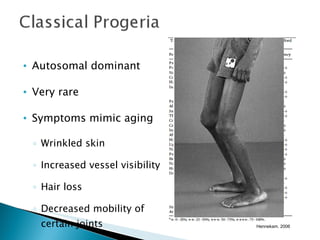
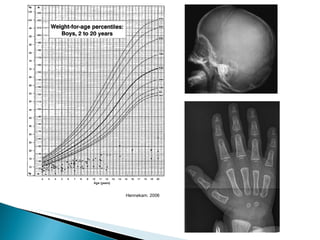
Autosomal dominant Very rare Symptoms mimic aging Wrinkled skin Increased vessel visibility Hair loss Decreased mobility of certain joints Hennekam. 2006
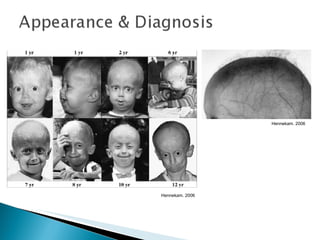
Hennekam. 2006 Hennekam. 2006
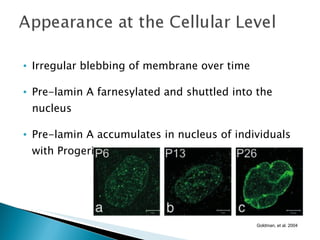
Irregular blebbing of membrane over time Pre-lamin A farnesylated and shuttled into the nucleus Pre-lamin A accumulates in nucleus of individuals with Progeria Goldman, et al. 2004
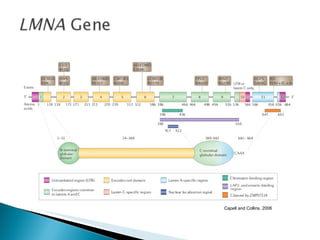
Pre-lamin A from the  LMNA  gene on chromosome 1q21 LMNA  is alternatively spliced into Lamin A and Lamin C These are type A lamins located at the inner nuclear envelope (NE) and dissociate from the membrane during mitosis Lamins are intermediate filaments that help support the NE
Capell and Collins. 2006
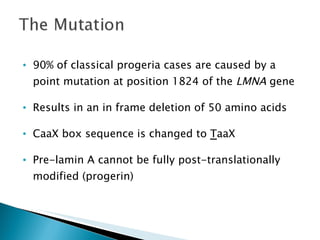
90% of classical progeria cases are caused by a point mutation at position 1824 of the  LMNA  gene Results in an in frame deletion of 50 amino acids CaaX box sequence is changed to  T aaX Pre-lamin A cannot be fully post-translationally modified (progerin)
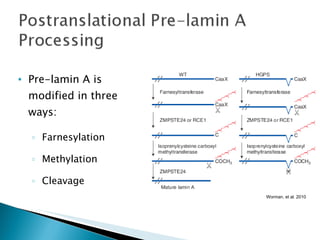
Pre-lamin A is modified in three ways: Farnesylation Methylation Cleavage Worman, et al .  2010
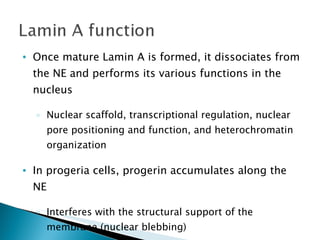
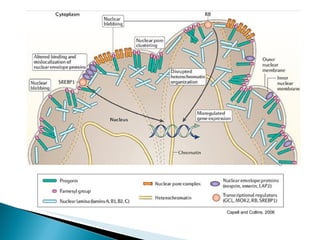
Once mature Lamin A is formed, it dissociates from the NE and performs its various functions in the nucleus Nuclear scaffold, transcriptional regulation, nuclear pore positioning and function, and heterochromatin organization In progeria cells, progerin accumulates along the NE Interferes with the structural support of the membrane (nuclear blebbing) Lamin A's other functions become deregulated
Capell and Collins. 2006
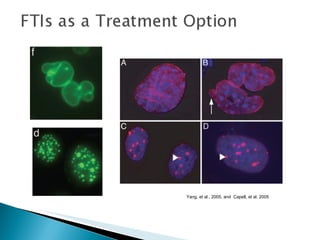
Yang, et al., 2005, and  Capell, et al. 2005
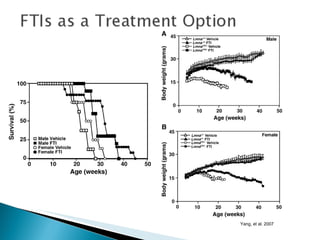
Yang, et al. 2007
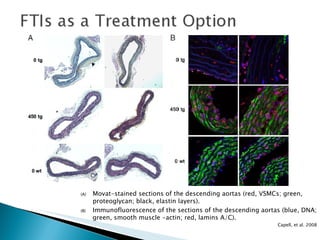
Movat-stained sections of the descending aortas (red, VSMCs; green, proteoglycan; black, elastin layers).  Immunofluorescence of the sections of the descending aortas (blue, DNA; green, smooth muscle -actin; red, lamins A/C). Capell, et al. 2008
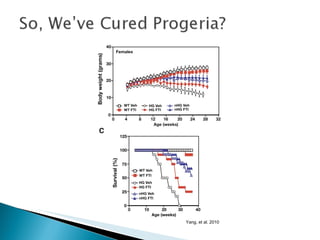
Yang, et al. 2010
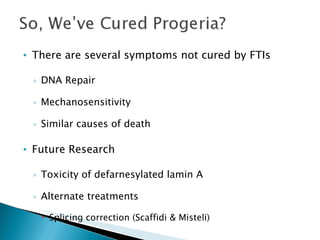
There are several symptoms not cured by FTIs DNA Repair Mechanosensitivity Similar causes of death Future Research Toxicity of defarnesylated lamin A  Alternate treatments Splicing correction (Scaffidi & Misteli)
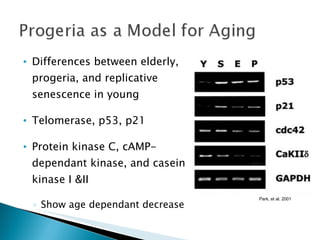
Differences between elderly, progeria, and replicative senescence in young Telomerase, p53, p21 Protein kinase C, cAMP-dependant kinase, and casein kinase I &II  Show age dependant decrease  Park, et al. 2001
BMR Telomere Length Hyaluronic acid secretion Antiangiogenesis, biomarker for aging Fibroblasts, LMNA Alterations to lamins Mouse model (introduction of splicing defect in intron 9) – terminal phenotype similar
Progerin expressed and accumulates  in vivo  during normal aging and progeria Progressive DNA damage “ Gerontogenetics” proposal  Further Implications Genetics of progeria may assist in research for the elderly
Allsopp, R. C., et al.  1992. Telomere length predicts replicative capacity of human fibroblasts.  Proc. Natl. Acad. Sci.   89 :10114- 10118.  Brown, T.W.,  1992. Progeria: a human-disease model for accelerated aging.  Am. J. Clin. Nutr.   55 :1222S-1224S. Capell B. C., et al.  2005. Inhibiting farnesylation of progerin prevents the characteristic nuclear blebbing of hutchinson-gilford progeria syndrome.  Proc. Natl. Acad. Sci. U.S.A.  102 :12879-12884.   Capell, B.C. and F.S. Collins.  2006. Human laminopathies: nuclei gone genetically awry.  Nature .  7 :940-952. Capell B. C., et al.  2008. A farnesyltransferase inhibitor prevents both the onset and late progression of cardiovascular disease in a progeria mouse model . Proc. Natl. Acad. Sci. U.S.A.  105 :15902-15907.  Downward J.  2003. Targeting RAS signalling pathways in cancer therapy.  Nature Reviews Cancer  3 :11–22.    Goldman, R., et al.  2004. Accumulation of mutant lamin A causes progressive changes in nuclear architcture in Hutchinson-Gilford progeria syndrome.  PNAS.  101 :8963-8968. Hennekam, R.  2006. Hutchinson-Gilford Progeria Syndrome: Review of the Phenotype.  Am. J. Hum. Genet.  140 :2603-2624. Johnson, B. F., Sinclair, D. A., Guarente, L.  1999. Molecular biology of aging.  Cell .  96 : 291-302.  Mallampalli, M. P., et al.  2005. Inhibiting farnesylation reverses the nuclear morphology defect in HeLa cell model for Hutchinson-Gilford progeria syndrome.  Proc. Natl. Acad. Sci .  102 : 14416-14421. Merideth, M., et al.  2008. Phenotype and Course of Hutchinson-Gilford Progeria Syndrome.  New Engl. J. Med.   358 :592-604. Mounkes, L. C., Stewart, C. L.  2004. Aging and nuclear organization: lamins and progeria.  Curr. Opin. Cell Biol.   16 : 322-327.
Park, W., et al.  2001. Gene profile of replicative senescence is different from progeria or elderly donor.  Biochem. Biophys. Res. Commun.   282 : 934-939. Reuter C. W. M., M. A. Morgan, and L. Bergmann . 2000. Targeting the Ras signaling pathway: a rational, mechanism-based treatment for hematologic malignancies?  Blood  96 :1655-1669.  Scaffidi, P. and T., Misteli . 2005. Reversal of the cellular phenotype in the premature aging disease Hutchinson-Gilford progeria syndrome.  Nat. Med.   11 : 440–445   Smallwood D., and S. Shackleton . 2010. Lamin A-linked progerias: is farnesylation the be all and end all?  Biochem. Soc. Trans.  38 :281. Worman, H.J., C. Oestlund, Y. Wang.  2010. Diseases of the Nuclear Envelope.  Cold Spring Harb .  Perspect .  Biol .  2010;2:a000760 Yang S. H., et al.  2005. Blocking protein farnesyltransferase improves nuclear blebbing in mouse fibroblasts with a targeted Hutchinson–Gilford progeria syndrome mutation.  Proc. Natl. Acad. Sci. U.S.A.  102 :10291-10296.   Yang S. H., et al.  2010. Assessing the efficacy of protein farnesyltransferase inhibitors in mouse models of progeria.  J. Lipid Res.  51 :400-405.  Yang S. H., X. Qiao, L. G. Fong, and S. G. Young . 2007. Treatment with a farnesyltransferase inhibitor improves survival in mice with a Hutchinson-Gilford progeria syndrome mutation.  Biochim. Biophys. Acta,   Mol. Cell Biol. Lipids  1781 :36-39.  
Hennekam. 2006