Topic:
Retinoblastoma
Assignment No. 01
Subject: Molecular Genetics
Submitted by: Ahmed Madni
Registration No. : SP14-BTY-011
Submitted to: Dr. Sidra Rehman
Submitted date: 22th-Mar-2016
Page | 1
Retinoblastoma
List of contents Page No.
 Introduction…………………………………………….
 Pathogenesis……………………………………………
 Inheritance risk………………………………………...
 Conclusion………………………………………………
 References………………………………………………
Page | 2
Retinoblastoma
Introduction
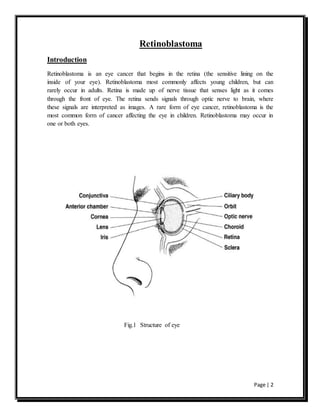
Retinoblastoma is an eye cancer that begins in the retina (the sensitive lining on the
inside of your eye). Retinoblastoma most commonly affects young children, but can
rarely occur in adults. Retina is made up of nerve tissue that senses light as it comes
through the front of eye. The retina sends signals through optic nerve to brain, where
these signals are interpreted as images. A rare form of eye cancer, retinoblastoma is the
most common form of cancer affecting the eye in children. Retinoblastoma may occur in
one or both eyes.
Fig.1 Structure of eye
Page | 3
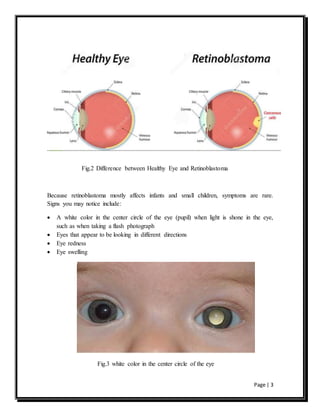
Fig.2 Difference between Healthy Eye and Retinoblastoma
Because retinoblastoma mostly affects infants and small children, symptoms are rare.
Signs you may notice include:
 A white color in the center circle of the eye (pupil) when light is shone in the eye,
such as when taking a flash photograph
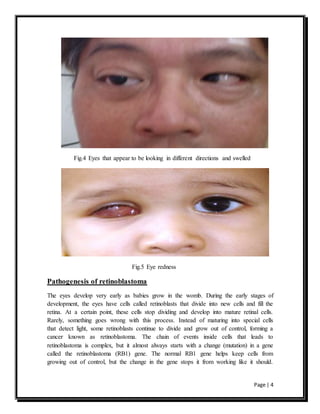
 Eyes that appear to be looking in different directions
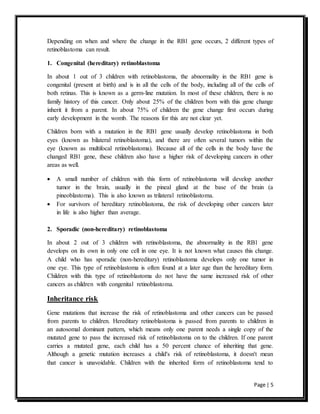
 Eye redness
 Eye swelling
Fig.3 white color in the center circle of the eye
Page | 4
Fig.4 Eyes that appear to be looking in different directions and swelled
Fig.5 Eye redness
Pathogenesis of retinoblastoma
The eyes develop very early as babies grow in the womb. During the early stages of
development, the eyes have cells called retinoblasts that divide into new cells and fill the
retina. At a certain point, these cells stop dividing and develop into mature retinal cells.
Rarely, something goes wrong with this process. Instead of maturing into special cells
that detect light, some retinoblasts continue to divide and grow out of control, forming a
cancer known as retinoblastoma. The chain of events inside cells that leads to
retinoblastoma is complex, but it almost always starts with a change (mutation) in a gene
called the retinoblastoma (RB1) gene. The normal RB1 gene helps keep cells from
growing out of control, but the change in the gene stops it from working like it should.
Page | 5
Depending on when and where the change in the RB1 gene occurs, 2 different types of
retinoblastoma can result.
1. Congenital (hereditary) retinoblastoma
In about 1 out of 3 children with retinoblastoma, the abnormality in the RB1 gene is
congenital (present at birth) and is in all the cells of the body, including all of the cells of
both retinas. This is known as a germ-line mutation. In most of these children, there is no
family history of this cancer. Only about 25% of the children born with this gene change
inherit it from a parent. In about 75% of children the gene change first occurs during
early development in the womb. The reasons for this are not clear yet.
Children born with a mutation in the RB1 gene usually develop retinoblastoma in both
eyes (known as bilateral retinoblastoma), and there are often several tumors within the
eye (known as multifocal retinoblastoma). Because all of the cells in the body have the
changed RB1 gene, these children also have a higher risk of developing cancers in other
areas as well.
 A small number of children with this form of retinoblastoma will develop another
tumor in the brain, usually in the pineal gland at the base of the brain (a
pineoblastoma). This is also known as trilateral retinoblastoma.
 For survivors of hereditary retinoblastoma, the risk of developing other cancers later
in life is also higher than average.
2. Sporadic (non-hereditary) retinoblastoma
In about 2 out of 3 children with retinoblastoma, the abnormality in the RB1 gene
develops on its own in only one cell in one eye. It is not known what causes this change.
A child who has sporadic (non-hereditary) retinoblastoma develops only one tumor in
one eye. This type of retinoblastoma is often found at a later age than the hereditary form.
Children with this type of retinoblastoma do not have the same increased risk of other
cancers as children with congenital retinoblastoma.
Inheritance risk
Gene mutations that increase the risk of retinoblastoma and other cancers can be passed
from parents to children. Hereditary retinoblastoma is passed from parents to children in
an autosomal dominant pattern, which means only one parent needs a single copy of the
mutated gene to pass the increased risk of retinoblastoma on to the children. If one parent
carries a mutated gene, each child has a 50 percent chance of inheriting that gene.
Although a genetic mutation increases a child's risk of retinoblastoma, it doesn't mean
that cancer is unavoidable. Children with the inherited form of retinoblastoma tend to
Page | 6
develop the disease at an earlier age. Hereditary retinoblastoma also tends to occur in
both eyes, as opposed to just one eye.
Conclusion
Retinoblastoma is caused by mutations (changes) in certain genes. Over the past few
decades, scientists have learned how certain changes in a person’s DNA can cause cells
of the retina to become cancerous. The DNA in each of our cells makes up our genes,
which are the instructions for how our cells function. We usually look like our parents
because they are the source of our DNA. But DNA affects much more than how we look.
Some genes control when our cells grow, divide into new cells, and die at the right time.
Certain genes that help cells grow, divide, or stay alive are called oncogenes. Others that
slow down cell division or cause cells to die at the right time are called tumor suppressor
genes. Cancers can be caused by DNA changes that turn on oncogenes or turn off tumor
suppressor genes. The most important gene in retinoblastoma is the RB1 tumor
suppressor gene. This gene makes a protein (pRb) that helps stop cells from growing too
quickly. Each cell normally has 2 RB1 genes. As long as a retinal cell has at least one
RB1 gene that works as it should, it will not form a retinoblastoma. But when both of the
RB1 genes are mutated or missing, a cell can grow unchecked. This can lead to further
gene changes, which in turn may cause cells to become cancerous.
References
 Mayo Clinic Staff, “Overview of Retinoblastoma”.
http://www.mayoclinic.org/diseases/retinoblastoma/home/ovc-20156213
 Dimaras H, Kimani K, Dimba EA. Retinoblastoma. Lancet. 2012;379:1436–1446.
 Rushlow DE, Mol BM, Kennett JY, et al. Characterisation of retinoblastomas
without RB1 mutations: Genomic, gene expression, and clinical studies. Lancet
Oncol. 2013;14:327–334.

Retinoblastoma

  • 1.
    Topic: Retinoblastoma Assignment No. 01 Subject:Molecular Genetics Submitted by: Ahmed Madni Registration No. : SP14-BTY-011 Submitted to: Dr. Sidra Rehman Submitted date: 22th-Mar-2016
  • 2.
    Page | 1 Retinoblastoma Listof contents Page No.  Introduction…………………………………………….  Pathogenesis……………………………………………  Inheritance risk………………………………………...  Conclusion………………………………………………  References………………………………………………
  • 3.
    Page | 2 Retinoblastoma Introduction Retinoblastomais an eye cancer that begins in the retina (the sensitive lining on the inside of your eye). Retinoblastoma most commonly affects young children, but can rarely occur in adults. Retina is made up of nerve tissue that senses light as it comes through the front of eye. The retina sends signals through optic nerve to brain, where these signals are interpreted as images. A rare form of eye cancer, retinoblastoma is the most common form of cancer affecting the eye in children. Retinoblastoma may occur in one or both eyes. Fig.1 Structure of eye
  • 4.
    Page | 3 Fig.2Difference between Healthy Eye and Retinoblastoma Because retinoblastoma mostly affects infants and small children, symptoms are rare. Signs you may notice include:  A white color in the center circle of the eye (pupil) when light is shone in the eye, such as when taking a flash photograph  Eyes that appear to be looking in different directions  Eye redness  Eye swelling Fig.3 white color in the center circle of the eye
  • 5.
    Page | 4 Fig.4Eyes that appear to be looking in different directions and swelled Fig.5 Eye redness Pathogenesis of retinoblastoma The eyes develop very early as babies grow in the womb. During the early stages of development, the eyes have cells called retinoblasts that divide into new cells and fill the retina. At a certain point, these cells stop dividing and develop into mature retinal cells. Rarely, something goes wrong with this process. Instead of maturing into special cells that detect light, some retinoblasts continue to divide and grow out of control, forming a cancer known as retinoblastoma. The chain of events inside cells that leads to retinoblastoma is complex, but it almost always starts with a change (mutation) in a gene called the retinoblastoma (RB1) gene. The normal RB1 gene helps keep cells from growing out of control, but the change in the gene stops it from working like it should.
  • 6.
    Page | 5 Dependingon when and where the change in the RB1 gene occurs, 2 different types of retinoblastoma can result. 1. Congenital (hereditary) retinoblastoma In about 1 out of 3 children with retinoblastoma, the abnormality in the RB1 gene is congenital (present at birth) and is in all the cells of the body, including all of the cells of both retinas. This is known as a germ-line mutation. In most of these children, there is no family history of this cancer. Only about 25% of the children born with this gene change inherit it from a parent. In about 75% of children the gene change first occurs during early development in the womb. The reasons for this are not clear yet. Children born with a mutation in the RB1 gene usually develop retinoblastoma in both eyes (known as bilateral retinoblastoma), and there are often several tumors within the eye (known as multifocal retinoblastoma). Because all of the cells in the body have the changed RB1 gene, these children also have a higher risk of developing cancers in other areas as well.  A small number of children with this form of retinoblastoma will develop another tumor in the brain, usually in the pineal gland at the base of the brain (a pineoblastoma). This is also known as trilateral retinoblastoma.  For survivors of hereditary retinoblastoma, the risk of developing other cancers later in life is also higher than average. 2. Sporadic (non-hereditary) retinoblastoma In about 2 out of 3 children with retinoblastoma, the abnormality in the RB1 gene develops on its own in only one cell in one eye. It is not known what causes this change. A child who has sporadic (non-hereditary) retinoblastoma develops only one tumor in one eye. This type of retinoblastoma is often found at a later age than the hereditary form. Children with this type of retinoblastoma do not have the same increased risk of other cancers as children with congenital retinoblastoma. Inheritance risk Gene mutations that increase the risk of retinoblastoma and other cancers can be passed from parents to children. Hereditary retinoblastoma is passed from parents to children in an autosomal dominant pattern, which means only one parent needs a single copy of the mutated gene to pass the increased risk of retinoblastoma on to the children. If one parent carries a mutated gene, each child has a 50 percent chance of inheriting that gene. Although a genetic mutation increases a child's risk of retinoblastoma, it doesn't mean that cancer is unavoidable. Children with the inherited form of retinoblastoma tend to
  • 7.
    Page | 6 developthe disease at an earlier age. Hereditary retinoblastoma also tends to occur in both eyes, as opposed to just one eye. Conclusion Retinoblastoma is caused by mutations (changes) in certain genes. Over the past few decades, scientists have learned how certain changes in a person’s DNA can cause cells of the retina to become cancerous. The DNA in each of our cells makes up our genes, which are the instructions for how our cells function. We usually look like our parents because they are the source of our DNA. But DNA affects much more than how we look. Some genes control when our cells grow, divide into new cells, and die at the right time. Certain genes that help cells grow, divide, or stay alive are called oncogenes. Others that slow down cell division or cause cells to die at the right time are called tumor suppressor genes. Cancers can be caused by DNA changes that turn on oncogenes or turn off tumor suppressor genes. The most important gene in retinoblastoma is the RB1 tumor suppressor gene. This gene makes a protein (pRb) that helps stop cells from growing too quickly. Each cell normally has 2 RB1 genes. As long as a retinal cell has at least one RB1 gene that works as it should, it will not form a retinoblastoma. But when both of the RB1 genes are mutated or missing, a cell can grow unchecked. This can lead to further gene changes, which in turn may cause cells to become cancerous. References  Mayo Clinic Staff, “Overview of Retinoblastoma”. http://www.mayoclinic.org/diseases/retinoblastoma/home/ovc-20156213  Dimaras H, Kimani K, Dimba EA. Retinoblastoma. Lancet. 2012;379:1436–1446.  Rushlow DE, Mol BM, Kennett JY, et al. Characterisation of retinoblastomas without RB1 mutations: Genomic, gene expression, and clinical studies. Lancet Oncol. 2013;14:327–334.